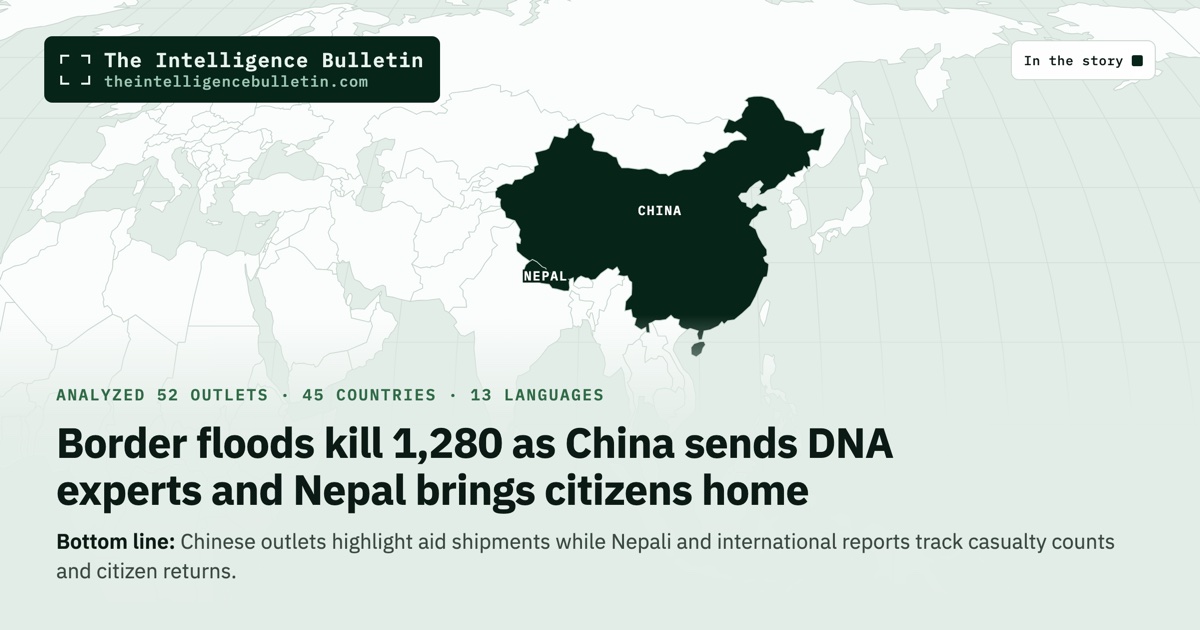
Border floods kill 1,280 as China sends DNA experts and Nepal brings citizens home

Map of the countries in the story: Border floods kill 1,280 as China sends DNA experts and Nepal brings citizens home
An ice-rock avalanche near Mount Langtang Lirung triggered flash floods and mudslides on August 26 that devastated villages, roads and hydropower sites along the Nepal-Tibet border in Rasuwa and Nuwakot districts. Nepal authorities report 1,252 bodies recovered and thousands missing; China reports 21 deaths and 541 missing in Gyirong county. Rescue operations entered a second week with helicopters, zip lines and DNA identification teams deployed. China dispatched emergency supplies and additional DNA experts; Nepal coordinated returns of stranded citizens at border points while raising climate compensation claims.

One Story. Many Angles.

🇹🇷
Turkey
Anadolu Agency
Original reporting
Nepal-China flash floods death toll rises to 1,280, over 5,620 missing as search, rescue enter 2nd week
Read →
🇨🇳
China
Xinhua
FRENCH
Original reporting
China sends new relief supplies and additional DNA experts to Nepal – Xinhua
“La Chine envoie de nouvelles fournitures de secours et des experts d’ADN supplémentaires au Népal – Xinhua”
Read →
🇳🇵
Nepal
Ekantipur
NEPALI
Original reporting
147 Nepalis stranded in China after floods return from Tatopani border crossing
“बाढीपछि चीनतर्फ फसेका १ सय ४७ नेपाली तातोपानी नाकाबाट फर्कँदै”
Read →
🇶🇦
Qatar
Al Jazeera
Original reporting
Rescue efforts continue as Nepal-China flood death toll surpasses 1,270
Read →
🇮🇳
India
Rediff
Carries PTI reporting
Nepal floods death toll rises to 1,252; thousands still missing
Read →
5 sources · each independently reported
Analyzed 52 outlets across 45 countries and 13 languages · 17 translated · read 5 in full
In Brief

Chinese outlets highlight aid shipments while Nepali and international reports track casualty counts and citizen returns.

Reporting across borders converges on the scale of the disaster but diverges sharply on what matters most to each audience. Chinese state media centers exclusively on Beijing’s shipments of tents, blankets, morgue freezers and extra DNA experts as evidence of neighborly cooperation, quoting officials on shared monitoring and Nepal’s gratitude. Nepali domestic coverage instead tracks the human logistics of 147 citizens returning via the Tatopani crossing and the ongoing search for hundreds more still unaccounted for in Sindhupalchok. International outlets such as Al Jazeera and Anadolu Agency foreground the raw casualty updates, the mechanics of tunnel rescues and the forensic identification backlog, while also noting Nepal’s formal request for climate compensation from major emitters. Rediff, drawing on Indian wire reporting, adds the regional angle of missing Nepalis in Tibet and fresh flood risks from upstream rains. The consistent thread is bilateral aid and rescue activity, yet the choice of emphasis reveals whose priorities each outlet serves: aid delivery for Beijing, citizen repatriation for Kathmandu, and body counts plus displacement for global readers. No outlet contradicts the core death and missing figures, but the framing makes clear that the same event registers as a diplomatic success story in one capital and an unfolding humanitarian emergency in another.

Perspective Analysis

An ice-rock avalanche near Mount Langtang Lirung on August 26 sent a cascade of rock, mud and water down the Bhotekoshi River valley, sweeping away villages, roads, bridges and hydropower facilities on both sides of the Nepal-Tibet border. In Nepal the districts of Rasuwa and Nuwakot bore the heaviest damage. In China the county of Gyirong in the Tibet Autonomous Region recorded the main impact. Nepal’s National Disaster Risk Reduction and Management Authority reported 1,252 bodies recovered by early September. Chinese authorities recorded 21 deaths in Gyirong county. The combined death toll reached 1,280, with more than 5,000 people still missing across the two countries.

Rescue teams worked through a second week. In Rasuwa, Nepalese army engineers used bulldozers to clear mud from the entrances of hydropower tunnels where workers remained trapped. Officers expressed hope that some survivors might still be found inside large power-house chambers not fully flooded. Families gathered daily outside facilities in Kathmandu, posting photographs of the missing and waiting for news. Forensic teams at DNA testing sites examined bodies in advanced decomposition, relying on tattoos, jewelry and other markers where possible. The United Nations Development Programme estimated 2.2 million tonnes of debris left by the floods and mudflows. Nepal’s government said roughly 20,000 houses would need rebuilding, including 7,500 destroyed, and began identifying safer relocation sites because rebuilding in the same locations would repeat the exposure to risk. More than 3,400 displaced people were living in 27 sites, mostly schools, in Nuwakot and Rasuwa.

China sent a third shipment of emergency supplies that included tents, blankets, morgue freezers, medical protective suits and satellite communication equipment. A second group of DNA identification experts traveled on the same flight. Chinese officials stated that meteorological and water-resources authorities had maintained close cooperation with Nepal, sharing monitoring data and responding jointly. They quoted Nepalese expressions of gratitude for the support and described the exchanges as reflecting the friendship between the two neighbors. China said it would continue aid according to Nepal’s needs.

On the Nepalese side of the border, district officials in Sindhupalchok prepared for the return of 147 citizens who had been stranded in the Kerung area of China. Chinese authorities supplied passport details and arranged road transport to the Tatopani crossing point. The border post remained open for travelers even though commercial trade stayed suspended. At the same time, 239 people from Sindhupalchok remained unaccounted for, and searches continued. Nepal’s Foreign Ministry reported that around 3,000 citizens who had been in Tibet for pilgrimage or business had already returned through Hilsa and Tatopani, with roughly 1,500 still at the Kerung point awaiting evacuation. Indian wire reporting added that approximately 100 Nepalese nationals were missing inside Tibet itself.

Nepal’s Prime Minister Balendra Shah told parliament that the disaster raised serious questions about growing risks in the Himalayan region linked to climate change. Foreign Minister Shisir Khanal said the government had filed a formal climate compensation claim letter with international partners, citing the historical responsibility of major greenhouse-gas emitters. Continuous rainfall upstream on the Bhotekoshi raised new flood warnings for Rasuwa, Nuwakot and downstream areas.

The same core numbers appear in reporting from Turkey, Qatar and India. Anadolu Agency, Al Jazeera and Rediff each cite Nepal’s disaster authority for the 1,252 figure in Nepal and Chinese statements for the 21 deaths in Gyirong, producing a consistent total near 1,280 and a missing count above 5,000. No independent chain disputes these aggregates. The accounts diverge instead on emphasis. Chinese state media presents the event as an occasion for demonstrated bilateral cooperation, listing the contents of aid shipments and quoting officials on shared monitoring and Nepalese appreciation. It contains no casualty updates and no mention of stranded citizens or climate claims. Nepali local reporting centers on the logistics of bringing citizens home across the Tatopani crossing and the continuing search for the unaccounted in specific districts. It does not detail Chinese aid shipments or the international climate request. International outlets track the mechanics of rescue, the forensic backlog, displacement numbers and the climate compensation filing. Indian coverage adds the regional dimension of Nepalese missing inside Tibet and fresh flood risks from upstream rains.

A reader limited to Chinese sources would see an orderly aid relationship and shared technical cooperation. A reader limited to Nepali domestic coverage would see returning citizens and local searches but miss the scale of Chinese material support and the formal climate claim. A reader limited to international or Indian reporting would receive the casualty totals, rescue details and displacement figures but would not encounter the precise contents of the latest Chinese shipment or the exact count of citizens scheduled to cross at Tatopani. The consistent thread across all accounts remains the delivery of aid and the conduct of rescue operations, yet the framing shows each outlet serving the priorities of its primary audience: diplomatic success for Beijing, citizen repatriation for Kathmandu, and body counts plus displacement for global readers.

What to Watch

The corroborated death and missing figures rest on multiple independent reporting chains that cite the same named authorities on each side of the border. The single-source claims about the exact contents of the Chinese shipment, the precise number returning at Tatopani, and the filing of the climate claim each trace to one outlet’s direct sourcing and carry that limitation. No outlet contradicts the core tolls, and no outlet supplies primary evidence that would allow a reader to reconcile the slight differences in missing-person counts reported by different Nepali agencies. The event registers as a diplomatic success story in one capital and an unfolding humanitarian emergency in another because those are the elements each press chose to place in the foreground.
Share this story

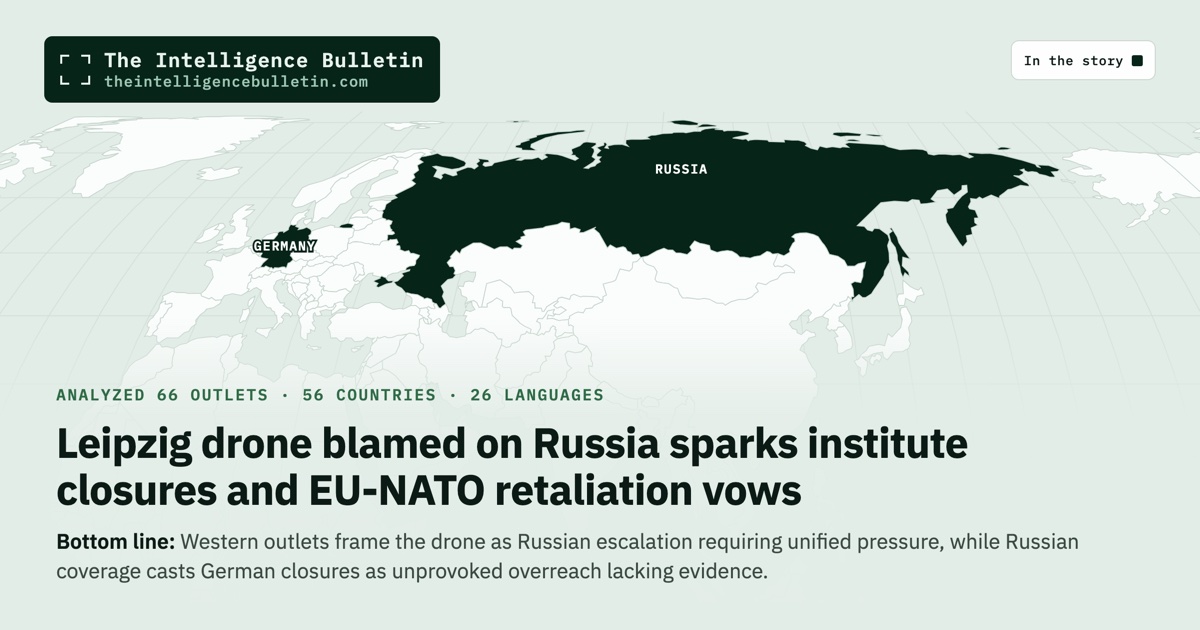
Leipzig drone blamed on Russia sparks institute closures and EU-NATO retaliation vows

Map of the countries in the story: Leipzig drone blamed on Russia sparks institute closures and EU-NATO retaliation vows
Germany attributed an August 4 explosive drone found near a Ukrainian cargo plane at Leipzig airport to Russia and responded by closing the Russian consulate in Bonn and Russian House in Berlin. Russia denied involvement, called the accusations baseless, and announced it would close Goethe-Institut centers in Moscow, St. Petersburg and Yekaterinburg. EU and NATO leaders described the incident as a new Russian escalation and vowed intensified sanctions and support for Ukraine.

One Story. Many Angles.

🇩🇪
Germany
Merkur
GERMAN
Original reporting
Expert warns: NATO unprepared after explosive drone in Leipzig
“Experte warnt: NATO nach Sprengstoff-Drohne in Leipzig unvorbereitet”
Read →
🇷🇺
Russia
RIA Novosti
RUSSIAN
Original reporting
German politician assessed Germany’s decision to close Russian consulate
“Немецкий политик оценил решение Германии закрыть консульство России”
Read →
🇶🇦
Qatar
Al Jazeera
Carries AFP and Reuters reporting
Russia to close Goethe-Institut centres as Germany tensions escalate
Read →
🇺🇦
Ukraine
Kyiv Post
Carries AFP reporting
Kremlin to Close German Culture Centers in Russia, Says Lavrov
Read →
🇦🇹
Austria
ORF
GERMAN
Original reporting
Von der Leyen: Leipzig incident new escalation by Russia
“Von der Leyen: Leipzig-Vorfall neue Eskalation Russlands”
Read →
5 sources · each independently reported
Analyzed 66 outlets across 56 countries and 26 languages · 40 translated · read 5 in full
In Brief

Western outlets frame the drone as Russian escalation requiring unified pressure, while Russian coverage casts German closures as unprovoked overreach lacking evidence.

The reporting across these outlets reveals a clear pattern of tit-for-tat retaliation framed through national lenses rather than a shared factual record. German and Austrian coverage centers the Leipzig incident as evidence of Russian hybrid aggression on NATO soil, with von der Leyen and Rutte using it to rally bloc unity and push for stronger defenses, while experts highlight alliance vulnerabilities. Russian state media instead spotlights a German opposition politician decrying Berlin’s closures as inexplicable and quotes Putin tying the accusations to German domestic politics, downplaying any Russian role. Ukrainian reporting explicitly connects the drone plot to Russia’s war effort and Ukraine logistics, treating the cultural closures as direct spillover. Al Jazeera presents the institute closures as mutual retaliation in a hybrid standoff without assigning primary blame. What stands out is the absence of any outlet bridging these accounts: Western sources treat Russian denials as expected deflection while Russian sources treat German evidence claims as unproven provocation, leaving readers in different countries with incompatible versions of who started the latest round and what it means for the wider conflict.

Perspective Analysis

Germany attributed an explosive-laden drone discovered on August 4 at Leipzig/Halle airport to Russia, describing it as part of a pattern of hybrid operations. The device, a first-person-view quadcopter carrying a Semtex-like plastic explosive, was found in a secure cargo area near a Ukrainian Antonov An-124 transport plane loaded with munitions from France. German authorities reported that a Boeing cargo flight the next day struck a second unidentified object, possibly another drone, though that item was never recovered. Interior Minister Alexander Dobrindt cited police investigations, intelligence assessments, and the established pattern of similar incidents to assign responsibility to Moscow.

Russia rejected the accusation outright. President Vladimir Putin described the claims as fabricated evidence tied to Germany’s difficult domestic political situation. Russian officials, including the ambassador in Berlin, stated that no concrete proof—witness statements, material evidence, or expert analysis—had been provided, and they labeled the incident a hastily assembled provocation. Foreign Minister Sergey Lavrov responded by announcing that Russia would close the Goethe-Institut centers in Moscow, St. Petersburg, and Yekaterinburg, declaring that Germany had deliberately ended its own cultural presence in Russia by shuttering the Russian House in Berlin. Deputy Foreign Minister Alexander Grushko said further retaliatory steps would follow the closure of the Russian consulate in Bonn.

Germany’s measures went beyond the consulate and cultural center. Officials tightened entry rules for Russian citizens, expelled several diplomats, and signaled new sanctions targeting Russia’s military-industrial base and shadow fleet. Berlin summoned the Russian ambassador and framed the actions as necessary to deter further hybrid activity on European soil. The Leipzig airport serves as a major logistics point for military aid to Ukraine, a detail that Ukrainian reporting highlighted as direct context for the attempted sabotage.

European Union and NATO leaders treated the incident as a significant escalation. Commission President Ursula von der Leyen, speaking alongside NATO Secretary General Mark Rutte, called it a new stage of Russian activity on European territory and warned that intimidation would not succeed. EU foreign policy chief Kaja Kallas described the episode as bearing the hallmarks of state-sponsored terrorism and said member states would not allow an act of such gravity to go unpunished. Foreign ministers agreed to advance a sanctions package covering 1,600 individuals and entities linked to Russia’s military industry, with adoption expected by October. Rutte and von der Leyen stressed that infrastructure once considered routine must now be treated as frontline targets requiring enhanced protection.

Coverage of these events diverged sharply in emphasis. German reporting, including expert commentary carried by Merkur, stressed NATO’s lack of agreed thresholds for collective response and the depletion of key capabilities after years of supporting Ukraine and other conflicts. Analysts quoted there argued that Russia finds such sub-threshold operations attractive precisely because they erode alliance cohesion without triggering Article 5. Austrian public broadcaster ORF foregrounded the joint von der Leyen–Rutte statement and the expressions of solidarity from other EU capitals, presenting the episode as a test of European unity. Ukrainian outlets connected the drone directly to Russia’s ongoing war effort, noting the airport’s role in supplying Kyiv and treating the cultural-center closures as predictable retaliation against Western support for Ukraine.

Russian state media instead foregrounded criticism from German politician Sevim Dagdelen of the Bundestag, who called the consulate and Russian House closures inexplicable. Reports quoted Putin linking the accusations to Berlin’s internal politics and presented Moscow’s institute closures as a measured, reciprocal step. International coverage from Al Jazeera described the sequence as mutual retaliation in a hybrid standoff, quoting Lavrov’s warning that Germany must have understood the consequences of its decision and noting EU sanctions discussions without assigning primary fault.

These framings leave readers with incompatible accounts of motive and sequence. A German or Austrian reader encounters an unprovoked Russian probe against NATO territory that demands stronger collective defenses. A Russian reader sees German overreach driven by domestic weakness and lacking evidentiary foundation. Ukrainian coverage positions the episode as an extension of the battlefield into European logistics hubs. The single point of convergence across all five outlets is the factual sequence itself: Germany’s attribution, Russia’s denial and announced closures, and the EU-NATO pledge of additional sanctions. No independent reporting chain in the set bridges the attribution dispute; each side’s interpretation rests on its own national sources and strategic interests.

The corroborated elements—Germany’s public attribution citing its interior ministry and police, Russia’s explicit announcement of the Goethe-Institut closures, the EU and NATO leaders’ on-record commitments to intensified pressure, and Russia’s consistent denial—form the only uncontested spine. Western sources converge on treating the drone as Russian state action and the closures as warranted response, a position supported by four of the five outlets examined. Russian coverage consistently presents the opposite causal direction, yet that account appears in only one national chain within the set. Russia has a clear interest in portraying Western moves as the escalatory driver to justify its own hybrid activity and to weaken alliance resolve. Western governments have an interest in rallying domestic and allied support for continued Ukraine aid by framing hybrid incidents as part of a broader pattern requiring stronger deterrence.

What to Watch

Absent new public evidence from either side, the next phase will likely feature the sanctions package already in preparation and possible further reciprocal closures or restrictions. The episode tests whether European states can establish credible thresholds for response to sub-threshold attacks before such operations erode political cohesion or force a direct confrontation neither side has signaled it wants.


Share this story

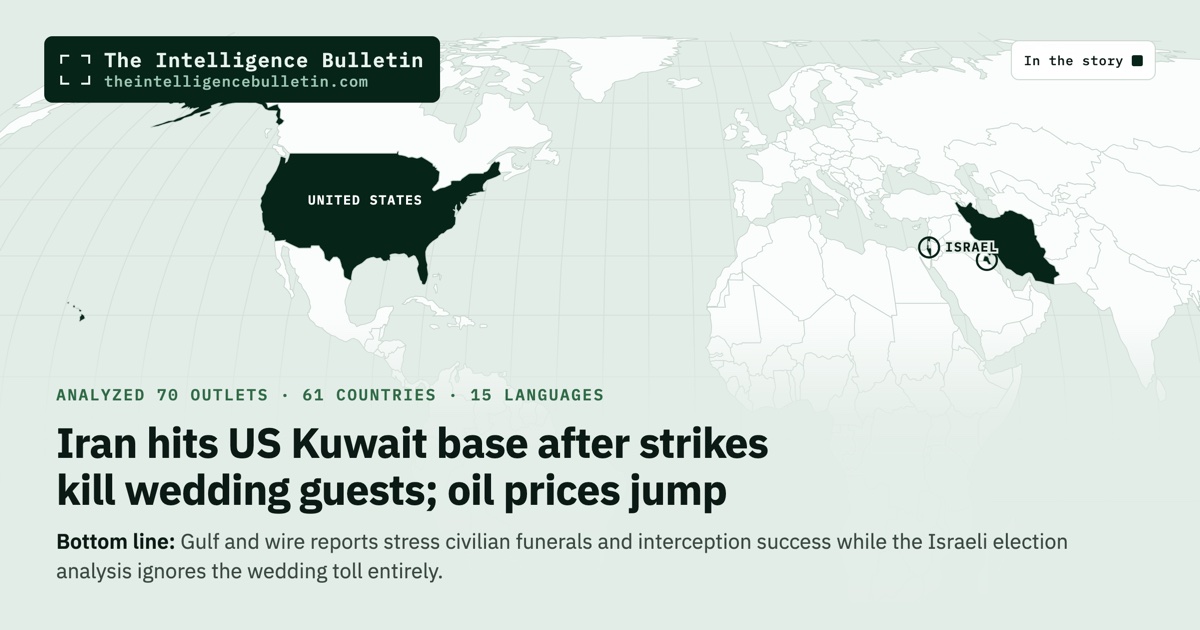
Iran hits US Kuwait base after strikes kill wedding guests; oil prices jump

Map of the countries in the story: Iran hits US Kuwait base after strikes kill wedding guests; oil prices jump
Iran launched missiles and drones at a US military base in Kuwait on September 3, 2026, in retaliation for US airstrikes on Iranian coastal targets two days earlier that hit a wedding in Kuhestak, killing four or five civilians. Kuwait reported its air defenses intercepted the incoming projectiles. The US said its strikes targeted military sites linked to shipping threats in the Strait of Hormuz; oil prices rose sharply. Coverage from Saudi, Canadian, German and Israeli outlets agrees on the basic retaliation chain while differing on emphasis of civilian casualties and regional implications.

One Story. Many Angles.

🇮🇷
Iran
National Council of Resistance of Iran
Carries Reuters reporting
Iran News in Brief – September 3, 2026
Read →
🇸🇦
Saudi Arabia
Arab News
Carries Reuters reporting
Arab News | Iran buries victims of reported US wedding attack, fires on Kuwait
Read →
🇮🇱
Israel
The Jerusalem Post
Original reporting
How will Gadi Eisenkot differ from Benjamin Netanyahu on Iran, West Bank violence?
Read →
🇩🇪
Germany
Deutschlandfunk
GERMAN
Original reporting
Situation in the Gulf – Iran attacks US bases in Kuwait and the Emirates
“Lage am Golf – Iran greift US-Stützpunkte in Kuwait und den Emiraten an”
Read →
🇨🇦
Canada
CP24
Carries Associated Press reporting
Iran war news: Tehran strikes Kuwait and Israeli elections
Read →
5 sources · 4 independent accounts — some share the same news agency’s report
Analyzed 70 outlets across 61 countries and 15 languages · 31 translated · read 10 in full
In Brief

Gulf and wire reports stress civilian funerals and interception success while the Israeli election analysis ignores the wedding toll entirely.

The reporting converges on the core sequence—Iran struck back at a US facility in Kuwait after Washington hit Iranian sites including a wedding venue—but the outlets diverge most revealingly on how much weight to give civilian deaths versus military targets. Arab News and the AP wire both detail mourners burying victims in Kuhestak and quote Iranian claims of five dead, while noting US denials of targeting civilians; this civilian focus is almost absent from the Israeli election piece, which instead folds the Kuwait flare-up into arguments over Netanyahu’s Iran strategy. The German public broadcaster alone flags simultaneous strikes on bases in the Emirates and links the spike directly to European fuel prices, an angle no other source in the set develops. The exile opposition site frames everything inside a regime-resistance narrative but supplies no independent details on the Kuwait attack itself. These choices reveal that the story’s factual core travels intact across borders while each national lens decides whether the human cost or the strategic ripple matters more. No outlet contradicts the basic retaliation timeline, yet the selective omission of the wedding toll in the Israeli domestic analysis shows how quickly a shared event becomes domestic ammunition.

Perspective Analysis

On September 3, 2026, Iran launched missiles and drones at a United States military base in Kuwait. Kuwait’s air defenses intercepted the incoming projectiles, according to statements from its Defence Ministry. The action followed US airstrikes two days earlier on Iranian coastal targets along the Strait of Hormuz, including one that struck a home in the southern village of Kuhestak during a wedding celebration. Iranian state media and local accounts reported four initial deaths from that strike, with a fifth victim, a 22-year-old woman, dying later in hospital. Mourners in Kuhestak carried flag-draped caskets through the streets, with families, soldiers and residents throwing petals as doleful music played. Iranian officials described the victims as civilians, including a four-year-old child.

The United States said its Tuesday strikes targeted military sites, including rocket launchers and maritime assets, after Iran had threatened to mine the Strait of Hormuz. Washington added that it never targets civilians. Iranian reports placed the total death toll from the latest US assault at 18, including the wedding victims. In response, Iran carried out further attacks early on Thursday, stating it was targeting another US base in Kuwait. Some Iranian statements also claimed strikes on US facilities in the Emirates, though this detail appeared in only one account among the sources examined.

Kuwait had already faced Iranian attacks the previous night, alongside Jordan and Bahrain. Air defenses in those countries likewise reported intercepts. The pattern marked the largest escalation in the Gulf theater in more than a month. Ship traffic through the Strait of Hormuz remained well below pre-war levels, with operators rerouting or reducing transits amid the risk. Oil prices responded immediately, with Brent crude futures climbing above $96 a barrel for the fourth straight day.

The sequence of retaliation rests on three independent reporting chains that converge on the same timeline. Arab News, drawing on Reuters, and CP24, carrying Associated Press copy, both recorded the Kuwait launch, the interception, the Kuhestak funeral details and the US denial of civilian targeting. Deutschlandfunk added that Iranian statements described attacks on bases in both Kuwait and the Emirates, while noting the resulting rise in European fuel prices. No source in the set disputes the basic order of events or the interception claim.

The accounts diverge sharply on what receives emphasis once the sequence is established. Arab News and the AP wire both foreground the civilian funerals in Kuhestak, quoting local men who said the pain came from striking a wedding rather than a military site. They describe mourners carrying caskets past soldiers at attention and note the five confirmed deaths. The Jerusalem Post article on Israeli elections makes no reference to the wedding casualties or the funerals. Instead it folds the Kuwait strikes into a discussion of how challenger Gadi Eisenkot would differ from Prime Minister Benjamin Netanyahu on containing Iran, proposing a US “kill zone” around remaining enriched-uranium sites and wider covert operations against ballistic missiles. The piece treats the escalation as further evidence in an ongoing domestic debate over Netanyahu’s handling of the nuclear file and regional threats.

Deutschlandfunk alone connects the Gulf actions directly to European consumers by reporting that the price of E10 gasoline in Germany reached a new high. It frames the theater as widening to include the Emirates and notes Trump’s earlier threats of further action. The National Council of Resistance of Iran outlet places the strikes inside a narrative of regime resistance but supplies no independent reporting on the Kuwait or Kuhestak incidents themselves.

A reader limited to the Jerusalem Post would therefore encounter the Kuwait events only as background for Israeli electoral choices, without learning that US strikes had killed civilians at a wedding or that Kuwait had intercepted the response. A reader limited to Arab News or the AP summary would receive the fullest account of the human cost and the immediate military exchange but would miss the German observation that the same day’s fuel-price spike reached ordinary European drivers. The exile opposition source adds no new factual layer on the Gulf strikes at all.

The three corroborated claims—Iran’s retaliatory launch at the Kuwait base, the US strike on the Kuhestak wedding with four or five civilian deaths, and Kuwait’s successful interception—rest on separate reporting chains that align without contradiction. The single-source claim of additional strikes on Emirates bases carries only the attribution of Iranian statements reported by one outlet. No independent chain confirms or disputes it within the set.

The wire and Gulf accounts supply the most complete picture of the immediate event because they track both the military exchange and the civilian toll from the same set of primary statements. The Israeli domestic analysis narrows the lens to strategic options for one country’s leadership, which is a legitimate editorial choice but leaves the human dimension of the Kuhestak strike outside the frame. The German report widens the lens to economic effects felt beyond the region, an angle absent from the others. These differences do not alter the shared timeline; they show how each outlet selects which consequences of that timeline matter most to its audience.

What to Watch

The corroborated sequence across Reuters, AP and the German public broadcaster provides the strongest warrant for the basic facts of the day. Primary statements from Kuwait’s Defence Ministry and Iranian state media anchor the interception and launch claims, while the funeral details rest on local reporting from Kuhestak carried by multiple outlets. The interest of any single national lens is to render the event legible to its own readers, whether as electoral ammunition, regional security concern or energy-market signal. What follows next will depend on whether further US or Iranian actions stay limited to the bases already struck or expand into sustained pressure on shipping lanes. The price movement above $96 already registers the market’s assessment that the risk has increased.


Share this story

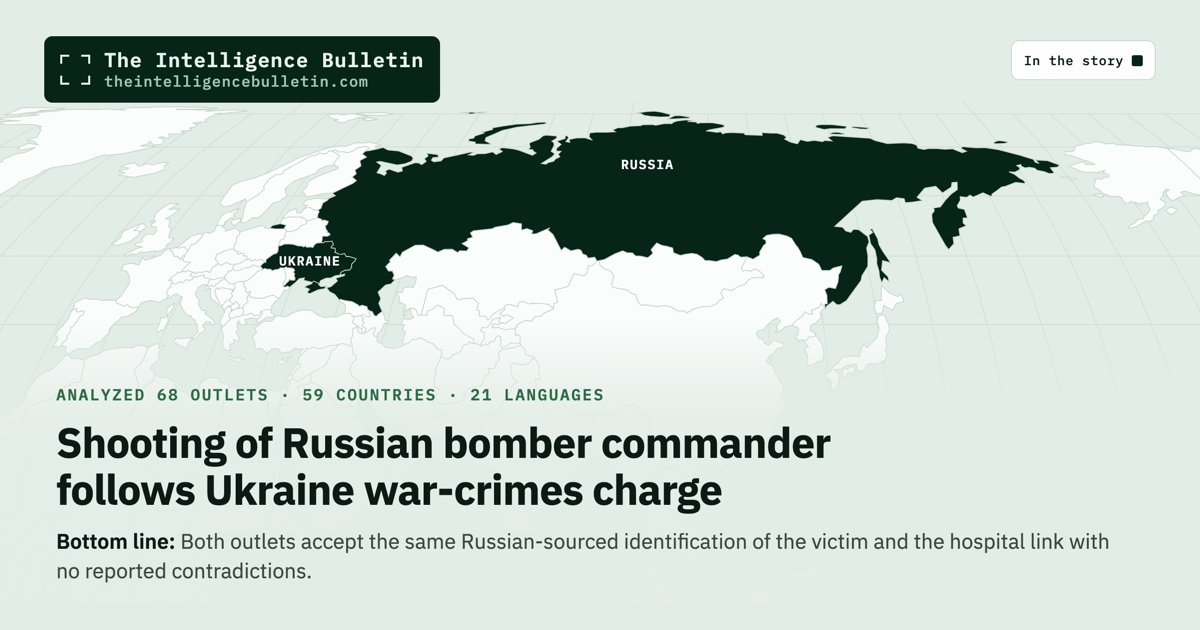
Shooting of Russian bomber commander follows Ukraine war-crimes charge

Map of the countries in the story: Shooting of Russian bomber commander follows Ukraine war-crimes charge
Major General Nikolai Varpakhovich, commander of Russia’s 22nd Heavy Bomber Aviation Division, was shot multiple times on September 3, 2026, near Engels in the Saratov region. The Russian Investigative Committee opened an attempted murder probe; he survived and was flown to Moscow for treatment. Ukraine had charged him with war crimes three days earlier over a July 2024 Kh-101 missile strike on Kyiv’s Okhmatdyt children’s hospital that killed three and injured dozens. Both outlets link the general to Tu-95 and Tu-160 strikes on Ukraine.

One Story. Many Angles.

🇺🇸
United States
KTVZ
Carries CNN reporting
Russian general accused of masterminding the attack against Kyiv’s children’s hospital injured in assassination attempt
Read →
🇺🇦
Ukraine
Dialog.ua
RUSSIAN
Original reporting
Near Saratov, a killer shot Russian General Varpakhovich, commander of Tu-95 strikes on Ukraine
“Под Саратовом киллер расстрелял российского генерала Варпаховича, командующего ударами Ту-95 по Украине”
Read →
2 sources · each independently reported
Analyzed 68 outlets across 59 countries and 21 languages · 24 translated · read 2 in full
In Brief

Both outlets accept the same Russian-sourced identification of the victim and the hospital link with no reported contradictions.

The two available accounts converge on the same sequence drawn from Russian official statements and Telegram reporting: a named Russian general survived a targeted shooting in his home region hours after Ukraine formally accused him of directing the 2024 Okhmatdyt hospital strike. The CNN-syndicated piece and the Ukrainian outlet both treat the identification of Varpakhovich and the details of the attack as established through those Russian channels, without independent verification of the shooter’s identity or motive. What stands out is how little the coverage diverges once the basic facts are stated; the Ukrainian report adds context from Kyiv’s recent charges and prior Dialog.ua stories on the same figure, while the US wire emphasizes the pattern of high-profile Russian military deaths without attributing responsibility. The absence of any Russian domestic outlet in the selected set means the story reaches readers only through an American wire and a Ukrainian lens, both of which accept the Russian Investigative Committee’s confirmation that the victim was a serving officer. This produces a narrow but consistent narrative centered on command vulnerability rather than disputed claims about who carried out the shooting.

Perspective Analysis

The shooting of Major General Nikolai Varpakhovich reached readers on September 3, 2026, through two outlets that worked from the same Russian Investigative Committee statement and Telegram-channel reporting. Both pieces identify the target as the commander of the 22nd Heavy Bomber Aviation Division, the unit that operates Tu-95MS, Tu-160 and Tu-22M3 aircraft for long-range strikes on Ukraine. Both record that the general was shot multiple times near a private residence in the Saratov region settlement of Probuzhdenie, that he survived, and that he was flown to Moscow for treatment. The committee described the victim only as a military serviceman; the name and rank surfaced through Telegram channels that both outlets cited.

The shared origin produces a narrow factual spine. The Russian statement confirms an attempted murder investigation opened the same day. Telegram reporting supplies the details of two pistol shots to the head and torso area at roughly 7 a.m. local time, the general’s critical condition at the scene, and the absence of an immediate arrest. Both outlets place the attack in Engels district, home base for Russia’s strategic bomber fleet. Neither claims independent confirmation of the shooter’s identity or motive.

KTVZ published the story under the headline “Russian general accused of masterminding the attack against Kyiv’s children’s hospital injured in assassination attempt.” The lead sentence foregrounds Ukraine’s accusation that Varpakhovich ordered the July 2024 Kh-101 strike on the Okhmatdyt children’s hospital, which killed three people including one child and damaged intensive-care, oncology and surgical wards. The piece then notes the Russian committee’s investigation and the Telegram identification of the victim. It devotes a separate section to prior high-profile killings of Russian officers, naming Igor Kirillov in December 2024, Yaroslav Moskalik and Fanil Sarvarov in 2025, and Armen Sarkisyan in February 2025. The framing therefore presents the Saratov shooting as the latest instance in an established pattern rather than an isolated incident.

Dialog.ua ran the story under the Russian-language headline “Под Саратовом киллер расстрелял российского генерала Варпаховича, командующего ударами Ту-95 по Украине.” Its opening paragraph states the time, exact location and the two shots to the head and abdomen, then immediately ties the target to the operational command of Tu-95 strikes. The article cites the Telegram channel “Dossier Shpiona” by name and adds that Varpakhovich was flown to Moscow in critical condition. It references the outlet’s own earlier reporting that Ukraine’s Security Service and Prosecutor General had formally charged the general with war crimes three days before the shooting. A later paragraph notes the strategic importance of Saratov-region air bases and the recent sensitivity around rear-area security after drone strikes on airfields and refineries.

The two pieces therefore diverge in emphasis rather than in disputed facts. KTVZ leads with the hospital accusation and widens the lens to a multi-year series of targeted killings inside Russia. Dialog.ua leads with the operational role in long-range aviation and anchors the event in Ukraine’s recent legal action against the same officer. KTVZ draws its additional context from the list of earlier deaths; Dialog.ua draws its additional context from its own prior coverage of the SBU charges and from Telegram’s granular description of the morning attack. Neither outlet attributes responsibility for the shooting to any party.

What to Watch

The absence of a Russian domestic outlet from the selected set means the story appears to readers only through an American wire service and a Ukrainian newsroom. Both treat the Russian committee’s confirmation that the victim was a serving officer as sufficient grounding for the identification supplied by Telegram. The resulting narrative centers on the vulnerability of senior Russian aviation commanders rather than on competing claims about who ordered or carried out the attack. Because the underlying reporting chain is single, the observable differences lie in headline choice, placement of the hospital accusation, and the local context each masthead chose to add from the same originating material.


Share this story

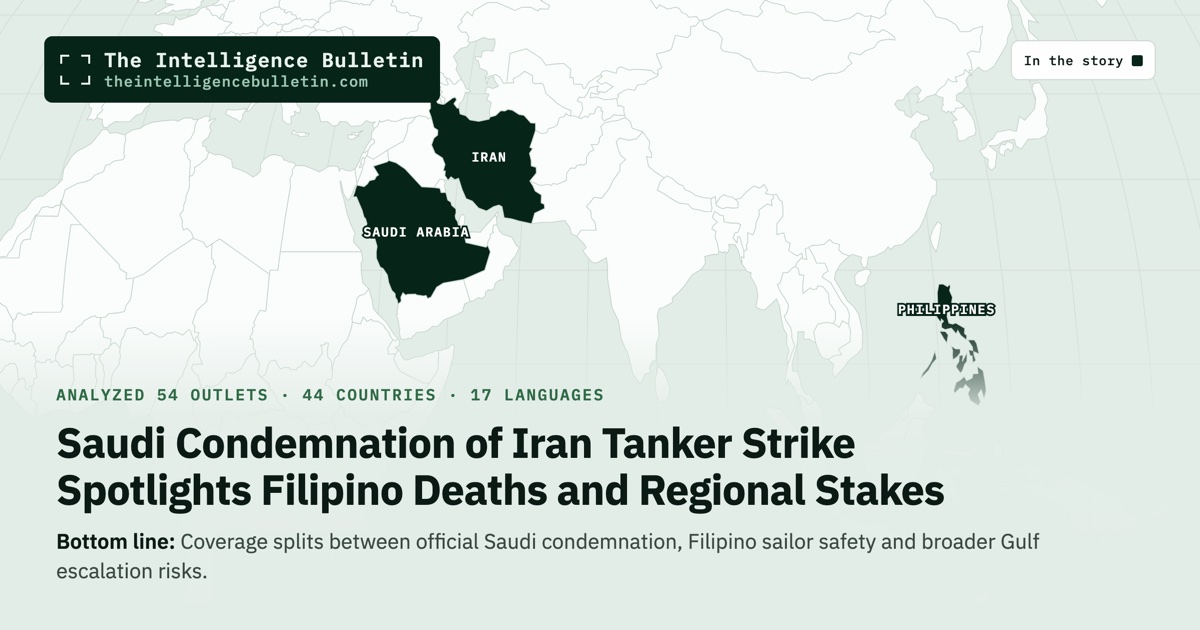
Saudi Condemnation of Iran Tanker Strike Spotlights Filipino Deaths and Regional Stakes

Map of the countries in the story: Saudi Condemnation of Iran Tanker Strike Spotlights Filipino Deaths and Regional Stakes
Saudi Arabia’s foreign ministry condemned an Iranian attack on the Bahri-owned tanker Sidr in the Strait of Hormuz, which killed two Filipino crew members on August 31. The vessel was carrying Saudi crude when struck. Saudi Arabia called for an end to escalation and respect for maritime safety and international law. Kuwait, Qatar and Jordan issued similar condemnations.

One Story. Many Angles.

🇸🇦
Saudi Arabia
Arab News
Original reporting
Arab News | Saudi Arabia condemns deadly Iran attack on oil tanker in Strait of Hormuz
Read →
🇶🇦
Qatar
Al Jazeera
Carries AFP and Reuters reporting
Saudi Arabia condemns deadly Iranian attack on tanker in Strait of Hormuz
Read →
🇵🇭
Philippines
Rappler
Carries Reuters reporting
Saudi Arabia says Iran attacked vessel in Hormuz, killing 2 Filipino sailors
Read →
🇬🇧
United Kingdom
Middle East Eye
Original reporting
Saudi Arabia accuses Iran of attacking Saudi tanker in Strait of Hormuz
Read →
🇦🇫
Afghanistan
Khaama Press
Original reporting
Saudi Arabia Says Iran Attacked Saudi Oil Tanker in Strait of Hormuz
Read →
5 sources · each independently reported
Analyzed 54 outlets across 44 countries and 17 languages · 31 translated · read 8 in full
In Brief

Coverage splits between official Saudi condemnation, Filipino sailor safety and broader Gulf escalation risks.

The five reports converge on the core facts of Saudi condemnation and Filipino deaths yet diverge in what they foreground, revealing how national stakes shape coverage of the same incident. Rappler centers the Philippine government’s response, detailing assistance for families, repatriation efforts and the explicit right of Filipino seafarers to refuse high-risk voyages through the strait, an angle absent elsewhere. Arab News leads with the Saudi foreign ministry statement, extending condemnation to alleged Iranian attacks on Jordan, Bahrain and Kuwait while stressing sovereignty and energy security. Al Jazeera places the event inside the ongoing US-Israel-Iran war, noting neighbors’ shared language on violations of navigation freedom and Iran’s threats to the waterway. Khaama Press frames it as a new escalation threatening global shipping routes and energy flows, reflecting an Afghan vantage on regional instability. Middle East Eye offers the briefest update, recording the accusation and fatalities without additional context. These choices show that outlets with direct national connections to victims or actors supply granular local reactions, while others embed the event in the wider conflict narrative; the absence of Iranian-sourced accounts in the set leaves the Saudi framing unchallenged within this coverage.

Perspective Analysis

The Strait of Hormuz saw another direct strike on commercial traffic on August 31 when the Saudi-owned tanker Sidr came under attack while carrying crude from the kingdom’s east coast. The vessel, operated by national shipping company Bahri, was transiting the narrow waterway when the incident occurred at 23:40 local time. Two Filipino crew members died in the attack. Saudi Arabia’s foreign ministry issued a statement the next day condemning what it described as Iran’s targeting of the tanker and calling for an immediate halt to escalation, respect for the safety of international navigation, and protection of global energy supplies.

Saudi officials framed the strike as a violation of state sovereignty and the principles of good neighborliness. Their statement urged all parties to return to negotiations and peaceful solutions under international law. The same ministry extended its condemnation to reported Iranian actions against Jordan, Bahrain and Kuwait in the same period, expressing solidarity with those governments in defending their security. Bahri confirmed the security incident on its vessel and said it remained in contact with the ship while coordinating with authorities and maritime stakeholders.

Neighboring governments aligned with the Saudi position on the navigation issue. Kuwait’s foreign ministry called the attack a heinous violation of international law. Qatar described it as a flagrant breach of the freedom of maritime navigation and rejected any use of the strait as a bargaining chip. Jordan’s foreign ministry expressed absolute solidarity with Saudi Arabia. These statements appeared alongside the Saudi announcement in coverage from the region.

The incident fits a pattern of tanker strikes that has intensified since the start of the US-Israel conflict with Iran on February 28. Earlier attacks had already hit other Bahri vessels, including the Wedyan supertanker in July near Oman’s coast and the Masa and Amzan in the Red Sea. Shipping data show that roughly one-fifth of global oil and liquefied natural gas trade once passed through the strait before traffic began to drop sharply under the threat of mines, projectiles and Iranian restrictions. Two other supertankers loaded at Juaymah the previous week were also reported hit in separate overnight strikes.

The Philippines government responded through its Department of Migrant Workers. Officials coordinated with the vessel’s principal, the licensed manning agency and relevant authorities to arrange repatriation of the two deceased sailors and to deliver medical, welfare and compensation support to their families under employment contracts and international maritime rules. The department reiterated that Filipino seafarers hold the right to refuse deployment on high-risk voyages and reminded shipowners to conduct risk assessments and implement security measures before any passage through conflict zones. An investigation into whether proper safeguards were followed on the Sidr is under way.

Accounts of the event converge on the Saudi condemnation and the deaths of the two Filipino sailors. Five separate outlets carried the foreign ministry statement and the Bahri confirmation without material variation in those core details. They also recorded the parallel condemnations from Kuwait, Qatar and Jordan. The convergence holds across Saudi, Qatari, Philippine, British and Afghan reporting despite the outlets’ different locations and editorial priorities.

The reporting diverges in emphasis according to national connections. Arab News opened with the full Saudi foreign ministry text and noted the extension of condemnation to three other Gulf states. Al Jazeera placed the strike inside the broader US-Israel-Iran war that began in February and highlighted the shared language from Kuwait and Qatar on navigation rights. Rappler devoted space to the Philippine department’s assistance program and the explicit policy allowing seafarers to decline risky routes. Khaama Press stressed the threat to global energy shipping routes and the wider security crisis in the Gulf. Middle East Eye limited itself to a short live-blog note recording the Saudi accusation and the fatalities.

These differences track the outlets’ direct stakes. The Saudi paper drew on its government’s primary statement and national carrier details. The Philippine outlet followed the affected citizens and their government’s welfare response. The Qatari outlet embedded the event in its ongoing conflict coverage. The Afghan outlet connected it to regional stability concerns. The British outlet supplied a minimal factual update inside a larger live blog.

No Iranian-sourced material appears in the set. Iranian Revolutionary Guard statements claiming mines or other causes for fires on tankers are referenced only indirectly through the Saudi accusation and the pattern of prior incidents. The selected coverage therefore presents the Saudi framing without a parallel Iranian account to test it against.

The corroborated elements rest on multiple independent chains: the foreign ministry statement carried by Arab News, Al Jazeera and Rappler; the condemnations from three neighboring states recorded in Arab News and Al Jazeera; and the deaths confirmed by Bahri and reported across all five outlets. The single-source detail on Philippine government assistance comes solely from Rappler’s account of the Department of Migrant Workers statement.

What to Watch

The Saudi and Philippine accounts carry the strongest primary documents in this set. The foreign ministry text supplies the official condemnation and policy call. The Department of Migrant Workers statement supplies the concrete response to the victims’ families. Both rest on named government sources rather than secondary interpretation. The other outlets add useful context on the conflict backdrop and shipping risks, yet they rely on the same core statements. The absence of Iranian reporting in the selected sources leaves the Saudi version of events standing without direct rebuttal inside this coverage. That gap means readers of these outlets receive a one-sided picture of responsibility even while the factual spine of the condemnation and the deaths remains consistent across the reporting chains.


Share this story

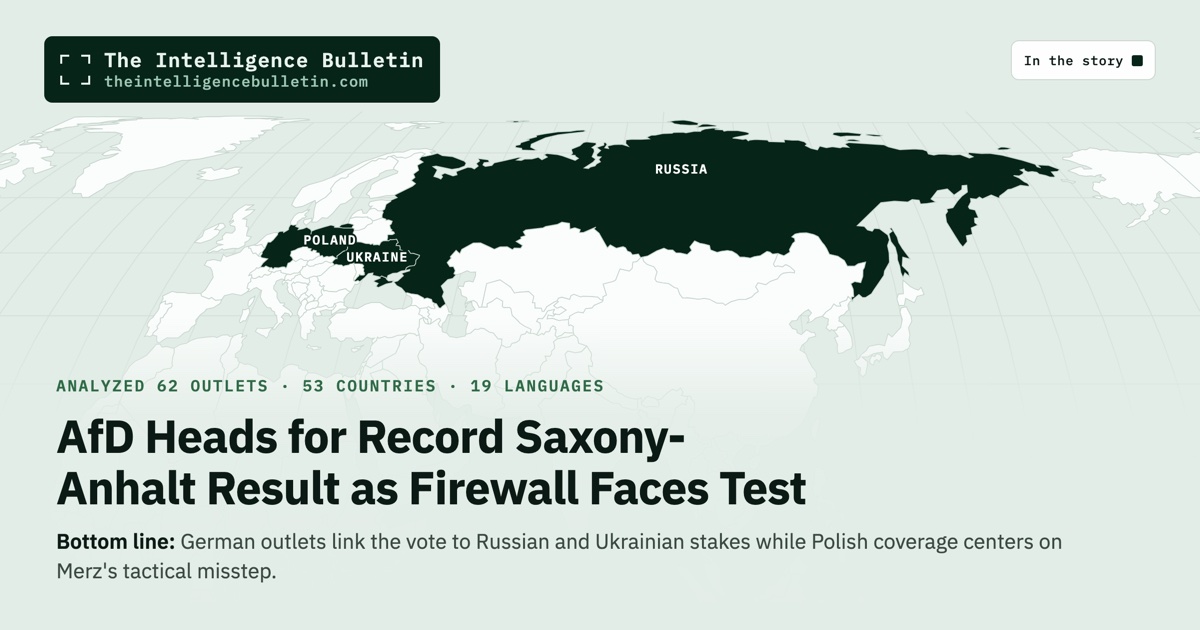
AfD Heads for Record Saxony-Anhalt Result as Firewall Faces Test

Map of the countries in the story: AfD Heads for Record Saxony-Anhalt Result as Firewall Faces Test
Voters in Saxony-Anhalt go to the polls on 6 September 2026 to elect a new state parliament. AfD leads polls at 40-43 percent with Ulrich Siegmund as its candidate for minister president. CDU trails at 22-23 percent under Sven Schulze. AfD’s pro-Russia stance and plans for remigration, education changes and reduced Ukraine support draw attention from Moscow and Kyiv while other parties maintain a firewall against coalitions.

One Story. Many Angles.

🇩🇪
Germany
Stuttgarter Zeitung
GERMAN
Original reporting
Saxony-Anhalt state election: These are the top candidates from AfD, CDU, Left & Co.
“Landtagswahl Sachsen-Anhalt: Das sind die Spitzenkandidaten von AfD, CDU, Linke & Co.”
Read →
🇩🇪
Germany
Mitteldeutsche Zeitung
GERMAN
Carries dpa reporting
State election: AfD victory in Saxony-Anhalt? Moscow hopes – Kiev fears
“Landtagswahl: AfD-Sieg in Sachsen-Anhalt? Moskau hofft – Kiew bangt”
Read →
🇵🇱
Poland
Onet Wiadomości
POLISH
Carries Blick.ch reporting
The far right is heading towards its biggest victory yet. Friedrich Merz fell straight into the AfD trap
“Skrajna prawica zmierza ku swojemu największemu jak dotąd zwycięstwu. Friedrich Merz wpadł prosto w pułapkę AfD”
Read →
🇨🇿
Czech Republic
Reflex
CZECH
Commentary
Pro-Russian laboratory in the heart of Germany: AfD promises return of Russian and undermining of NATO plans
“Proruská laboratoř v srdci Německa: AfD slibuje návrat ruštiny i podkopání plánů NATO”
Read →
🇹🇷
Turkey
Bianet
TURKISH
Original reporting
Germany: Saxony-Anhalt at the ballot box on Sunday; is AfD’s victory inevitable?
“Almanya: Saksonya-Anhalt pazar günü sandık başında; AfD’nin zaferi kaçınılmaz mı?”
Read →
5 sources · 4 independent accounts — some share the same news agency’s report
Analyzed 62 outlets across 53 countries and 19 languages · 35 translated · read 5 in full
In Brief

German outlets link the vote to Russian and Ukrainian stakes while Polish coverage centers on Merz’s tactical misstep.

Reporting across the selected outlets shows the AfD’s projected lead in Saxony-Anhalt is treated less as a domestic polling curiosity and more as a test of Germany’s post-2021 firewall strategy. German regional coverage explicitly ties an AfD win to Russian hopes of weakening Berlin’s Ukraine policy while Ukrainian observers fear reduced support. Polish analysis frames the surge as the unintended result of CDU leader Friedrich Merz’s repeated warnings that have instead boosted AfD visibility. Czech commentary details AfD’s explicit platform promises on restoring Russian-language instruction, limiting NATO-related planning at state level, and shifting school curricula toward patriotism and away from gender studies or anti-racism projects. Turkish reporting stresses structural East German economic grievances and historical Soviet-era memory as drivers that make the result feel nearly inevitable absent a broader social response. The consistent thread is that firewall declarations by CDU, SPD, Greens and Left Party are reported as holding for now, yet the same pieces note that AfD’s polling strength already exceeds what those parties can comfortably contain through arithmetic alone.

Perspective Analysis

Voters in the eastern German state of Saxony-Anhalt will choose a new state parliament on 6 September 2026. Roughly 1.7 million eligible residents are called to the ballot boxes. Current surveys place the Alternative for Germany, or AfD, at 40 to 43 percent, well ahead of the Christian Democratic Union at 22 to 23 percent. The AfD candidate for minister president is Ulrich Siegmund, a 35-year-old former co-chair of the state parliamentary group who rose to prominence through social-media videos during the pandemic. The CDU candidate is Sven Schulze, who took over as minister president in January after Reiner Haseloff stepped down.

Siegmund campaigns on pointed criticism of federal policy under Chancellor Friedrich Merz. He attacks what he describes as failures in migration, energy and security. His party platform calls for an end to sanctions on Russia and a halt to weapons deliveries to Ukraine. It also proposes mass deportations, including of Ukrainians granted protection status, and the use of Leipzig-Halle airport infrastructure for removal flights. The program further demands the restoration of Russian-language instruction in schools at current levels and the revival of student exchanges with Russia. In education more broadly, the AfD wants to replace compulsory school attendance with a duty to educate, opening the door to expanded homeschooling with periodic testing at schools. It seeks to remove gender studies and post-colonial theory from universities, ban rainbow flags in classrooms, end sex education for younger pupils, and require pupils to sing the national anthem at school events while flying the German flag.

The CDU, under Schulze, rules out any coalition with the AfD and remains vague about a tolerated minority government involving the Left Party. The current governing alliance of CDU, Social Democrats and Free Democrats looks unlikely to survive on current numbers. The Left Party candidate Eva von Angern stresses social justice and reclaims the term “Heimat” from AfD usage. The Social Democrat Armin Willingmann positions his party as a bulwark with the slogan “We are the dike.” The Greens candidate Susan Sziborra-Seidlitz warns that only a Green presence guarantees a future-oriented government. The Free Democrat Lydia Hüskens fights to keep her party above the five-percent threshold. The Sahra Wagenknecht Alliance fields a dual ticket of Thomas Schulze and Claudia Wittig and aims to unseat the CDU without aligning with the AfD.

Russian observers view a strong AfD result as a potential breach in Germany’s refusal to cooperate with the party at any level. A Moscow-based expert told the German press agency that Russia seeks an outcome that serves German national interests rather than Ukrainian ones and that could pressure Merz. Ukrainian commentary registers concern that reduced German political leadership on Ukraine support would follow. The same reporting notes that sanctions announced after an explosive drone incident at Leipzig-Halle airport may instead boost AfD support in the state.

Polish coverage frames the AfD surge as the direct result of Merz’s repeated public warnings against the party. Those warnings, the analysis argues, have amplified AfD visibility and turned the firewall strategy into an unintended campaign asset for the far-right. Czech analysis examines the AfD program in detail and highlights its implications for state-level education policy, remigration enforcement and the handling of NATO-related security planning. Turkish reporting places the polling numbers in the context of persistent East-West economic disparities, noting that household wealth in the east remains roughly one-quarter of western levels, youth out-migration continues, and historical Soviet-era memory in the region aligns with AfD calls to restore economic ties with Russia.

The five outlets converge on the basic polling picture and on the refusal of the CDU, Social Democrats, Greens and Left Party to enter coalitions with the AfD. They also agree that an absolute AfD majority remains possible only if smaller parties fall below the threshold. Beyond those points the accounts diverge in emphasis. The Stuttgarter Zeitung presents the contest through candidate biographies and standard campaign mechanics. The Mitteldeutsche Zeitung foregrounds the Moscow-Kyiv dimension with on-record comments from a Russian academic. The Polish piece centers Merz’s tactical position. The Czech commentary supplies the longest catalog of specific AfD policy pledges. The Turkish article draws on local interviews and economic data to explain voter sentiment.

A reader limited to the candidate-focused German account would miss the explicit platform commitments on Russian exchanges and remigration flights that appear in the Czech text. A reader limited to the Polish account would miss the structural economic grievances cited in the Turkish reporting. A reader limited to the regional German piece that links the vote to Ukraine policy would miss the detailed education and security proposals that make those foreign-policy stakes concrete at state level.

What to Watch

The firewall declarations remain on record across multiple German parties, yet the polling margin already exceeds what those parties can offset through seat arithmetic alone if smaller competitors drop out. The AfD program items on education and remigration fall within state competencies, while foreign and security policy remain federal. The reporting that places the economic and historical drivers alongside the platform details shows why the arithmetic test on 6 September will also test whether declarations of exclusion can contain a party whose support now reaches beyond protest voters into broader segments of the electorate.


Share this story