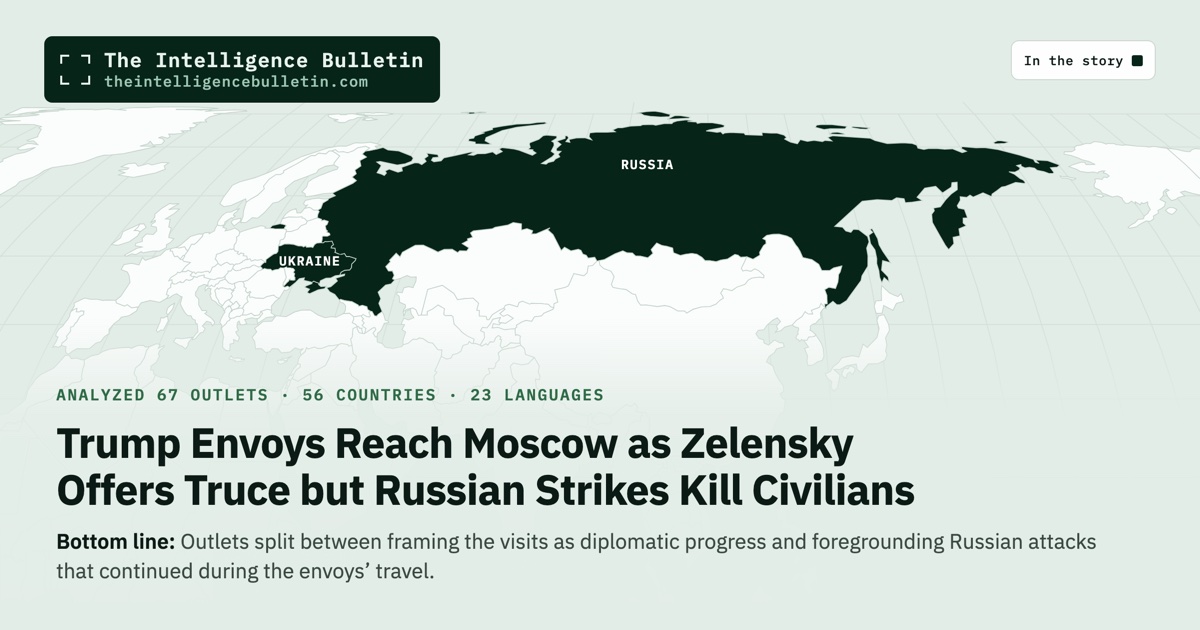
Trump Envoys Reach Moscow as Zelensky Offers Truce but Russian Strikes Kill Civilians

Map of the countries in the story: Trump Envoys Reach Moscow as Zelensky Offers Truce but Russian Strikes Kill Civilians
US special envoys Steve Witkoff and Jared Kushner arrived in Moscow on Saturday and are scheduled for Kyiv on Sunday carrying President Trump’s proposal to end the Russia-Ukraine war. Ukrainian President Volodymyr Zelensky confirmed the meetings, offered a temporary halt to airstrikes for safe passage, and said Ukraine would ensure Russian airspace access. Russia continued strikes, killing at least four in Kamianske and hitting the Kyiv region. The visits mark the first such trip to both capitals under the current US administration.

One Story. Many Angles.

🇺🇦
Ukraine
Kyiv Post
Original reporting
Zelensky Confirms US Envoys Will Visit Kyiv on Sunday, After Visiting Moscow
Read →
🇷🇺
Russia
The Moscow Times
Original reporting
U.S. Special Envoys to Visit Russia and Ukraine This Weekend
Read →
🇬🇧
United Kingdom
The Independent
Original reporting
Ukraine-Russia war latest: Moscow violates Zelensky’s air truce as Trump envoys head abroad for peace talks
Read →
🇶🇦
Qatar
Al Jazeera
Original reporting
At least 5 killed in Russian attacks on Ukraine as US envoys visit Moscow
Read →
4 sources · each independently reported
Analyzed 67 outlets across 56 countries and 23 languages · 33 translated · read 4 in full
In Brief

Outlets split between framing the visits as diplomatic progress and foregrounding Russian attacks that continued during the envoys’ travel.

The reporting converges on the basic itinerary and Zelensky’s truce offer yet diverges sharply in what it foregrounds. Kyiv Post centers Zelensky’s direct confirmation and Ukraine’s practical preparations, treating the envoys’ Moscow stop as background to the Kyiv meeting. The Moscow Times, writing from exile, relays Russian official caution and notes Moscow’s hope for proposals while recording the Kremlin’s insistence that any deal must be bilateral first. The Independent and Al Jazeera both lead with Russian strikes that occurred despite the proposed calm, the former in a live blog framing violations as the immediate story and the latter with casualty counts timed to the Moscow arrival. Across the set, the same factual sequence—Trump’s announcement, Zelensky’s offer, continued Russian attacks—receives different weight: one outlet sees diplomatic scheduling, another sees battlefield reality that undercuts the schedule. No source claims a breakthrough is imminent; all record the gap between the envoys’ travel and the absence of reciprocal restraint on the ground.

Perspective Analysis

US special envoys Steve Witkoff and Jared Kushner landed in Moscow on Saturday carrying a proposal from President Donald Trump to end the Russia-Ukraine war. They are scheduled to continue to Kyiv on Sunday for meetings with President Volodymyr Zelensky. The trip marks the first time the pair has visited both capitals under the current US administration.

Zelensky confirmed the Kyiv portion of the itinerary in a statement released Friday evening. He said Ukraine had received the schedule directly from the US presidential office and would ensure the envoys could travel safely, including by keeping Russian airspace open for their flight. In the same statement Zelensky proposed a temporary halt to airstrikes on both sides for as long as the talks required. He framed the offer as a reciprocal measure that would allow the American delegation to move without risk.

Russian authorities have not confirmed or denied the Moscow meetings in advance. Kremlin spokesman Dmitry Peskov told journalists that details would be released once the contacts occurred. President Vladimir Putin has previously described Witkoff and Kushner as officials the Kremlin enjoys working with and said they remain welcome in Moscow. The visit follows earlier US-mediated contacts, including a CIA director’s trip to the Russian capital in August.

Despite Zelensky’s truce proposal, Russian strikes continued into the weekend. Ukrainian regional authorities reported that an attack on an industrial site in Kamianske in the Dnipropetrovsk region killed at least four people and injured five others. Additional drone strikes damaged a residential building in Boryspil near Kyiv, injuring two women, and hit other sites across the region. Zelensky described the airport-area strikes as a direct reaction to the planned US flights and said Ukraine would adjust its operations accordingly.

The envoys’ itinerary has been under discussion for months. Zelensky had foreshadowed the dates in late July after his own meetings with Trump at the White House. The pair last visited Russia in January for extended talks with Putin. Ukrainian lawmakers had raised concerns that Russia might use force to signal opposition to the visits, citing a reported drone incident at a Kyiv airport earlier in the week.

The four outlets that covered the developments in detail place different weight on the same sequence of events. Kyiv Post centers Zelensky’s direct confirmation and Ukraine’s logistical preparations for the Kyiv leg, presenting the Moscow stop largely as background. The Moscow Times, publishing from exile, records Russian official caution and notes that Moscow continues to insist any agreement must be reached bilaterally between Russia and Ukraine before external parties play a larger role. It also relays a source saying Russian officials prefer the envoys avoid Kyiv altogether.

The Independent and Al Jazeera both open with the Russian strikes that followed the truce offer. The Independent’s live coverage frames the continued attacks as the immediate test of Zelensky’s proposal. Al Jazeera leads with the casualty count from Kamianske and places the strikes in the context of the envoys’ arrival in Moscow. Neither outlet reports any Russian reciprocal pause.

No account claims the weekend meetings are expected to produce an immediate breakthrough. All record the distance that remains between the two sides on core territorial and security questions. The same factual thread—Trump’s announcement of a proposal, Zelensky’s air-truce offer, and the absence of a matching Russian restraint—appears across the set, yet the emphasis shifts according to the outlet’s primary vantage.

The accounts that connect the diplomatic schedule directly to the continuing strikes give the clearest picture of what the visits actually test. The corroborated reports of at least four deaths in Kamianske and additional injuries near Kyiv show that the proposed period of calm did not hold on the ground. Ukrainian statements treat those strikes as deliberate signals to the American visitors. Russian officials have not addressed the specific incidents in the coverage examined here, but the Moscow Times records their consistent position that talks must remain bilateral first.

What to Watch

This pattern suggests the envoys will arrive in Kyiv carrying whatever they heard in Moscow while the battlefield continues to generate its own facts. The gap between the scheduled meetings and the lack of reciprocal restraint on strikes is the measurable limit on what the current round of diplomacy can achieve in the short term.
Share this story

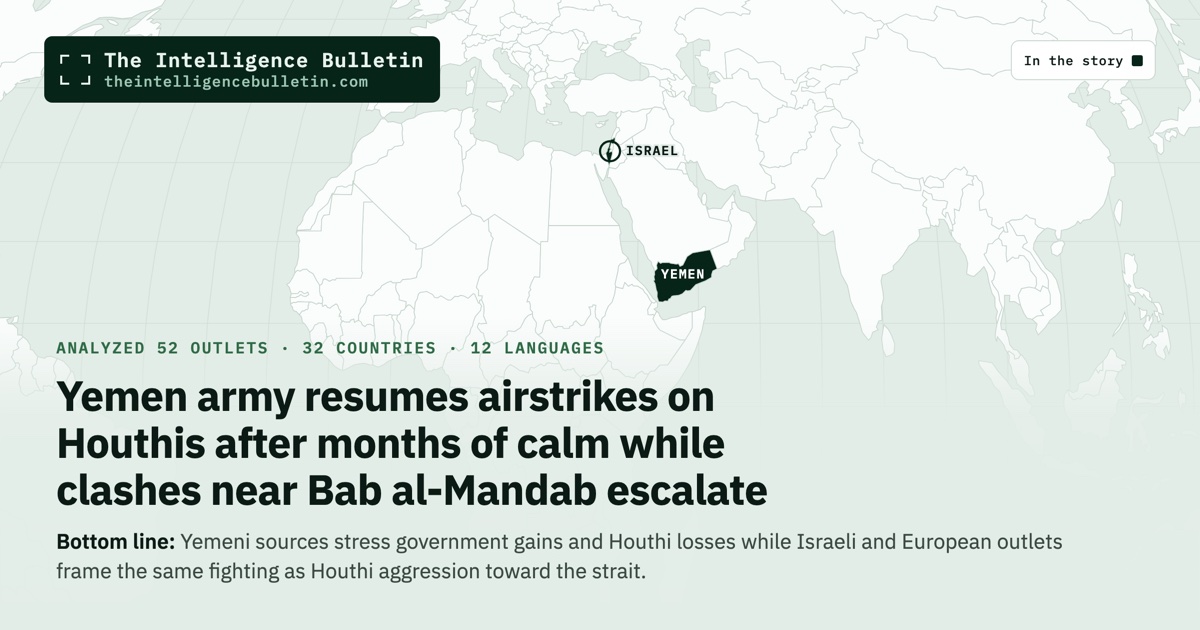
Yemen army resumes airstrikes on Houthis after months of calm while clashes near Bab al-Mandab escalate

Map of the countries in the story: Yemen army resumes airstrikes on Houthis after months of calm while clashes near Bab al-Mandab escalate
Yemen’s internationally recognized government forces conducted more than 15 airstrikes on Houthi positions, gatherings and vehicles in western Taiz and Hodeidah provinces on September 4-5 2026. The strikes, the first by Yemeni aircraft since July, supported ground troops repelling a Houthi offensive that began early Thursday. Houthis sought to advance toward Mocha port and the Bab al-Mandab Strait; both sides reported casualties with government-aligned sources citing dozens of Houthi dead or wounded.

One Story. Many Angles.

🇾🇩
Yemen
Khabar Agency
Original reporting
Houthi Casualties Surge Following Intense Fighting on Yemen’s West Coast
Read →
🇮🇱
Israel
The Jerusalem Post
Carries New York Times reporting
Houthis escalate fighting in Yemen, aiming for Mocha Port, Bab al-Mandab Strait
Read →
🇬🇧
United Kingdom
Middle East Eye
Carries Al Jazeera reporting
Yemen’s army claims air strikes against Houthis in Taiz
Read →
🇹🇷
Turkey
Star
TURKISH
Anadolu Agency wire copy
Yemeni army warplanes bomb Houthi positions for the first time since July
“Yemen ordusuna ait savaş uçakları temmuzdan bu yana ilk kez Husilerin mevzilerini bombaladı”
Read →
🇦🇹
Austria
Krone
GERMAN
Relayed reporting
New escalation – Houthis brutally attack Yemen’s army: 120 dead
“Neue Eskalation – Houthis greifen Jemens Armee brutal an: 120 Tote”
Read →
5 sources · each independently reported
Analyzed 52 outlets across 32 countries and 12 languages · 30 translated · read 5 in full
In Brief

Yemeni sources stress government gains and Houthi losses while Israeli and European outlets frame the same fighting as Houthi aggression toward the strait.

Yemeni reporting from Khabar Agency frames the clashes as a government success that inflicted heavy losses on Houthis, including field commanders and minors, with hospitals in Hodeidah and Sanaa overwhelmed and bodies left on the battlefield. Israeli coverage in the Jerusalem Post, citing New York Times reporting, presents the same fighting as a Houthi escalation aimed at seizing Mocha to control the Bab al-Mandab Strait and international shipping. Middle East Eye and Turkish Star both highlight the airstrikes themselves as the central development, noting their resumption after months of relative calm and grounding the claim in an official Yemeni military statement. Austrian Krone leads instead with Houthi attacks on the army and a total of 120 dead, producing a casualty-focused European account. The pattern shows that only outlets with direct access to Yemeni military statements or local hospitals emphasize government initiative and Houthi losses; others either relay the Houthi offensive narrative or isolate the airstrike novelty without resolving who initiated the latest round. No source supplies independent verification of casualty totals or territorial control, leaving the battlefield outcome dependent on which side’s military communique each outlet chooses to foreground.

Perspective Analysis

Yemen’s internationally recognized government forces launched more than 15 airstrikes against Houthi positions, gatherings and vehicles along the western coastal fronts in Taiz and Hodeidah provinces on September 4 and 5. The strikes marked the first use of Yemeni warplanes against Houthi targets since July and provided direct air support to ground troops holding the line near the Hays front in western Taiz. Fighting had intensified early on Thursday when Houthi forces opened a major offensive in the area, prompting the government to send additional reinforcements.

The same government statement described the airstrikes as targeting Houthi concentrations and military equipment while ground units repelled attempts to breach established contact lines. Turkish reporting carried by Star and UK reporting in Middle East Eye both drew directly from this official Yemeni military communique, noting the resumption of fixed-wing strikes after months of relative quiet along the Red Sea coast. Khabar Agency, a Yemeni outlet with access to local military sources, added that the strikes formed part of a broader effort in which government forces documented numerous Houthi remains left on the battlefield through video footage.

Houthi forces had sought to advance toward the port city of Mocha, less than 50 miles from the Bab al-Mandab Strait. The Jerusalem Post relayed reporting from the New York Times that cited two Yemeni security officials describing the offensive as an attempt to cut supply routes to Mocha and gain greater leverage over shipping through the narrow waterway. Mocha itself had come under Houthi missile fire earlier in August, when more than 25 projectiles struck the port and forced a temporary suspension of operations. Those earlier attacks were presented by the Houthis at the time as pre-emptive measures against an alleged Saudi-backed buildup.

Casualty accounts diverged sharply. Khabar Agency reported that hospitals in Hodeidah and Sanaa received dozens of Houthi fighters, including field commanders and minors, many arriving in critical condition or with remains charred beyond recognition. Facilities in Zabid, Bayt al-Faqih and central Hodeidah exceeded capacity, morgues filled to the point that commercial refrigeration containers were pressed into service, and appeals went out for blood donations. Government-aligned sources described these figures as only a partial count, with additional bodies still scattered across the front lines. Krone, an Austrian outlet, reported a total of 120 dead from Houthi attacks on army positions without specifying which side suffered the losses.

The clashes sit inside a longer pattern that began after the 2022 UN-brokered ceasefire. Relative calm along the west coast gave way in July to renewed exchanges of fire. The Houthis have controlled Sanaa and parts of the north since 2014, while the internationally recognized government and its allied forces hold most of the south, east and west. The current fighting occurs in territory that directly affects access to one of the world’s busiest maritime chokepoints.

A reader limited to Khabar Agency would conclude that government forces had seized the initiative and inflicted disproportionate losses on the Houthis, with the airstrikes serving as effective support for that advance. A reader limited to the Jerusalem Post would instead see the same days as the latest stage of a deliberate Houthi push to dominate the Bab al-Mandab Strait and threaten international shipping lanes. A reader limited to Middle East Eye or Star would register the airstrikes themselves as the notable development, the first concrete sign of renewed Yemeni air capability after months of restraint. A reader limited to Krone would take away only the raw death toll and the image of Houthi forces on the attack.

The airstrike claim rests on a single official Yemeni military statement carried independently by three outlets with different geographic bases. The assertion that the Houthis aimed specifically at Mocha and the strait rests on two unnamed security officials quoted in the New York Times and relayed without additional sourcing. The casualty numbers cannot be reconciled: one account supplies local hospital details and battlefield video, the other supplies an aggregate figure of 120 without attribution to any counting authority. No source in the set provides an independent count or on-the-ground verification from a third party.

The corroborated military action—the resumption of airstrikes after July—offers the clearest warrant for treating the government statement as the most reliable thread. That statement was issued by the party conducting the operations and was carried verbatim or in close paraphrase by outlets that do not share a common editorial line. The Houthi offensive narrative, while plausible given the port’s location and prior missile activity, lacks the same cross-chain support in this reporting window. Casualty claims remain unresolvable from the available accounts and should be treated as partisan tallies until additional reporting chains appear.

What to Watch

The immediate stakes center on whether the fighting expands along the coast or draws in additional external actors already active in Red Sea security. Government forces have demonstrated renewed air support capacity; Houthi forces have shown willingness to press ground offensives near a critical strait. The next several days of contact-line reports from either side will indicate whether the current round settles into another period of attrition or escalates further.


Share this story

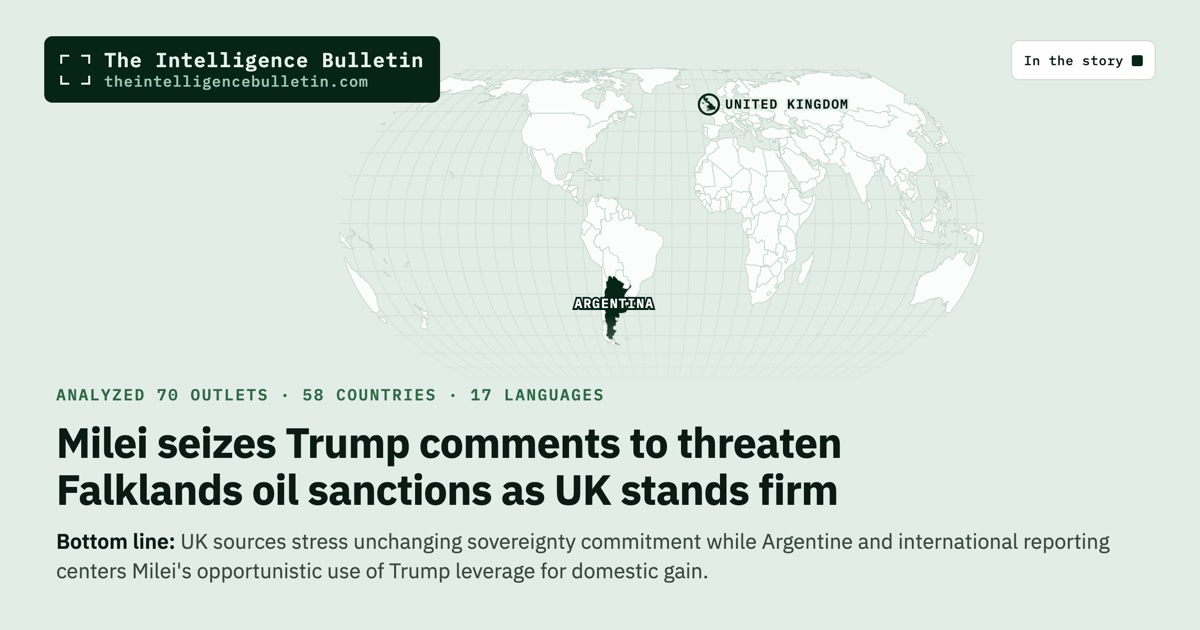
Milei seizes Trump comments to threaten Falklands oil sanctions as UK stands firm

Map of the countries in the story: Milei seizes Trump comments to threaten Falklands oil sanctions as UK stands firm
Argentine President Javier Milei delivered a national address announcing sanctions against companies in the Sea Lion oil project near the Falkland Islands and new naval funding, citing US President Donald Trump’s suggestion that Washington might review its stance on the islands’ sovereignty. The UK responded by declaring its commitment to the islands absolute and unshakeable. The moves revive the long-standing dispute, last fought in 1982, amid tensions over Britain’s refusal to back US action against Iran.

One Story. Many Angles.

🇬🇧
United Kingdom
The Guardian
Original reporting
Trump’s ‘retribution’ could now include Falklands as favor to Milei – and revenge on the UK
Read →
🇦🇷
Argentina
Ámbito
SPANISH
Original reporting
Javier Milei takes advantage of Donald Trump’s pressure on the United Kingdom and seeks to capitalize on the Malvinas cause
“Javier Milei aprovecha la presión de Donald Trump sobre Reino Unido y busca capitalizar la causa Malvinas”
Read →
🇶🇦
Qatar
Al Jazeera
Original reporting
‘Winds of change’: How Milei is stirring Falklands claim amid Trump-UK spat
Read →
🇭🇰
Hong Kong
South China Morning Post
Carries Associated Press reporting
Milei escalates Argentina’s Falklands dispute with UK as Trump hints at US policy shift
Read →
🇿🇦
South Africa
Daily Maverick
Carries Reuters reporting
Argentina’s Milei vows Falklands oil sanctions in sovereignty push
Read →
5 sources · each independently reported
Analyzed 70 outlets across 58 countries and 17 languages · 37 translated · read 5 in full
In Brief

UK sources stress unchanging sovereignty commitment while Argentine and international reporting centers Milei’s opportunistic use of Trump leverage for domestic gain.

Reporting across outlets shows Milei’s speech as opportunistic timing rather than a fundamental policy shift, leveraging Trump’s personal grievance with Britain to advance Argentina’s sovereignty claim without altering his core alignment with Washington. The Guardian frames the episode as Trump using the Falklands as leverage for retribution against the UK over Iran, exposing British vulnerability in the special relationship. Argentine coverage in Ámbito details Milei’s strategic pivot to sanctions on the Sea Lion project and rejection of islander self-determination, presenting it as capitalizing on external pressure while maintaining domestic nationalist consensus. Al Jazeera and SCMP emphasize analysts’ view that Trump’s remarks originated as Pentagon leverage over UK defense spending, not a deliberate sovereignty reversal, yet provide Milei symbolic room to maneuver ahead of 2027 elections. Daily Maverick, relaying Reuters, highlights the economic focus on oil sanctions and London’s dismissal of the rhetoric as Argentine domestic politics. The consistent UK response across sources—that islanders determine their future—contrasts with Milei’s explicit invalidation of any referendum, revealing the core irreconcilable positions that external comments have not altered.

Perspective Analysis

Milei delivered a nationally televised address on 4 September 2026 in which he announced new sanctions targeting companies involved in the Sea Lion offshore oil project and additional funding for a naval base in Tierra del Fuego. The project lies roughly 220 kilometres north of the Falkland Islands, known in Argentina as the Malvinas. Rockhopper Exploration of the United Kingdom holds a 35 percent stake and Israel’s Navitas Petroleum holds 65 percent. Drilling is scheduled to begin in coming months with first production targeted for 2028. Milei described any further advance on the islands as a violation of Argentine national security and said Argentina would not stand idly by.

He tied the measures directly to comments by US President Donald Trump. Trump told GB News that Britain had not supported the United States in its conflict with Iran and said he was reviewing every position, including the longstanding US stance on the islands. In a separate BBC interview Trump said the same. Milei presented the remarks as evidence that Washington now viewed Argentina as a reliable partner aligned with Western values and therefore open to reconsidering its position. He called the Malvinas a national cause that rises above partisan differences.

The United Kingdom responded within hours. Defence Secretary Wes Streeting stated that the commitment to the Falklands was absolute and unshakeable. A spokesperson for Prime Minister Andy Burnham said the islanders had the right to determine their own future and that the UK’s commitment remained unwavering. Both statements repeated the British position that the roughly 2,000 residents had chosen to remain a British overseas territory in a 2013 referendum.

The islands have been administered by Britain since 1833. Argentina maintains it inherited sovereignty from Spain in the nineteenth century. The two countries fought a 74-day war in 1982 after Argentine forces seized the territory. British forces retook the islands at a cost of 255 British and 649 Argentine lives. An uneasy peace followed, with Argentina never renouncing its claim.

Milei’s earlier public statements had been more measured. He had praised Margaret Thatcher, the British prime minister during the 1982 conflict, and had spoken of solutions that took account of the islanders’ wishes. In the September address he rejected self-determination for the islanders on the grounds that they constitute an implanted population and declared any referendum invalid. He also linked the renewed push to Argentina’s broader review of its southern maritime strategy, including concepts of deterrence and control of the South Atlantic.

Four of the five outlets that covered the speech reported the sanctions announcement and the naval-base funding in nearly identical terms. The Guardian placed the episode inside Trump’s pattern of personal grievances, noting his irritation that Britain had declined to send ships during the Iran conflict and framing the Falklands comments as potential leverage for higher UK defence spending. Ámbito described the speech as an upgrade in intensity that allowed Milei to harden the claim while preserving his alignment with Washington. Al Jazeera and the South China Morning Post both carried analyst assessments that the Pentagon had floated the idea of reviewing US support as bargaining pressure over NATO contributions rather than as a considered shift on sovereignty itself. The Daily Maverick, carrying Reuters copy, focused on the immediate market reaction: Rockhopper shares fell 8 percent on the day of the speech.

The accounts converge on the same sequence of public statements and on the unchanged British reply. They diverge on emphasis. The Guardian foregrounds the risk to the special relationship and to the new British government. Ámbito stresses the domestic political opening for Milei and the cross-party consensus that the sovereignty claim enjoys inside Argentina. Al Jazeera and the South China Morning Post treat the episode as a limited window created by personal alignment rather than a durable change in US policy. The Daily Maverick treats the sanctions and the stock reaction as the central development.

A reader who saw only the Guardian would conclude that Britain faces a genuine diplomatic squeeze from its closest ally. A reader who saw only Ámbito would conclude that Milei has successfully converted an external opening into a strengthened domestic position on a long-standing national issue. A reader who saw only the Al Jazeera or South China Morning Post pieces would conclude that the episode is largely symbolic and unlikely to alter the legal or military facts on the ground. The Daily Maverick piece would leave the impression that the story is chiefly about investment risk in the South Atlantic.

The evidence across the reporting chains points to the narrower reading. Every outlet that quoted the British response recorded the same language of unshakeable commitment and islander self-determination. No outlet reported any indication that the United States had altered its formal position or that Washington intended to do so. The sanctions themselves target companies and their suppliers; they cannot physically halt drilling already under contract. Rockhopper’s share-price reaction shows that investors registered the political signal, yet the project’s resource estimate of 1.7 billion barrels remains unchanged in the coverage.

What to Watch

The most probable near-term outcome is therefore continued diplomatic friction without material alteration of control or investment plans. Milei gains a visible nationalist credential that may help him with domestic audiences ahead of the 2027 election cycle. Britain faces no immediate requirement to negotiate because its legal and military position rests on the islanders’ expressed preference and on its own administration since 1833. The United States retains the option to treat the episode as one more item of personal leverage rather than a policy commitment. The South Atlantic dispute therefore remains what it has been since 1982: a frozen conflict whose temperature can be raised by external actors but whose underlying claims have not moved.


Share this story

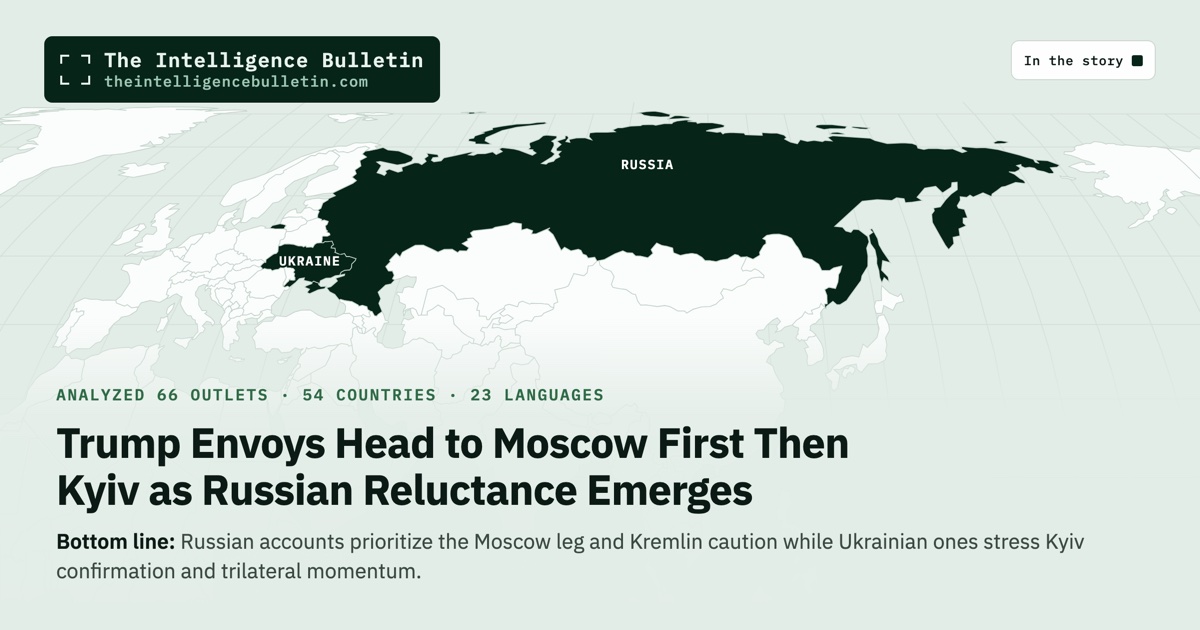
Trump Envoys Head to Moscow First Then Kyiv as Russian Reluctance Emerges

Map of the countries in the story: Trump Envoys Head to Moscow First Then Kyiv as Russian Reluctance Emerges
US President Donald Trump’s envoys Steve Witkoff and Jared Kushner plan to visit Moscow on September 5 and Kyiv on September 6 to advance trilateral talks on ending the Russia-Ukraine war. Ukrainian President Volodymyr Zelensky confirmed meetings in both capitals. Russian state agency TASS reported the sequence citing a source; the Kremlin declined advance confirmation. Ukrainian reports note ongoing Russian drone strikes on Kyiv and unconfirmed claims of damage to planes at a Kyiv airport, raising questions about the Kyiv leg.

One Story. Many Angles.

🇺🇦
Ukraine
Kyiv Post
Original reporting
Trump Envoys Witkoff, Kushner to Visit Moscow En Route to Kyiv to Promote Trilateral Talks
Read →
🇷🇺
Russia
Pravda
Carries TASS reporting
Steve Witkoff and Jared Kushner May Visit Moscow and Kyiv on September 5–6
Read →
🇺🇸
United States
CNN
Original reporting
Trump envoys Witkoff and Kushner plan to visit Moscow and Kyiv, in their first trip to Ukraine
Read →
🇵🇱
Poland
Rzeczpospolita
POLISH
Carries Kyiv Independent reporting
Steve Witkoff and Jared Kushner are to fly to Moscow and Kyiv. But it is not yet certain
“Steve Witkoff i Jared Kushner mają przylecieć do Moskwy i Kijowa. Ale nie jest to jeszcze pewne”
Read →
🇬🇧
United Kingdom
Middle East Eye
Carries TASS reporting
Witkoff and Kushner to visit Russia and Ukraine at weekend, says Tass
Read →
5 sources · 4 independent accounts — some share the same news agency’s report
Analyzed 66 outlets across 54 countries and 23 languages · 30 translated · read 5 in full
In Brief

Russian accounts prioritize the Moscow leg and Kremlin caution while Ukrainian ones stress Kyiv confirmation and trilateral momentum.

The reporting converges on the envoys’ planned itinerary and purpose but splits sharply on emphasis and caveats. Russian and TASS-relayed accounts lead with Moscow as the primary stop and note Kremlin reticence on dates, while Ukrainian outlets tie the trip explicitly to restarting talks with Kyiv as endpoint and highlight Zelensky’s confirmation of both meetings. Polish coverage, drawing on Kyiv Independent sources, stresses Russian reluctance and possible last-minute changes due to security concerns in Kyiv, where strikes continue. CNN frames it as a US diplomatic push and the envoys’ first Ukraine trip. The pattern shows actor-country outlets anchoring the story in their capital’s role, with the Polish angle surfacing the clearest friction: Moscow’s reported pressure to alter plans. This cross-border consistency on the dates and sequence, paired with the neighbor caution on delivery, points to a negotiation step that remains tentative despite the announcements.

Perspective Analysis

US President Donald Trump’s special envoys Steve Witkoff and Jared Kushner are scheduled to arrive in Moscow on September 5 and then travel to Kyiv on September 6. The sequence comes from a source cited by Russia’s state news agency TASS, which updated its reporting to state that the two men will visit Moscow first before proceeding to the Ukrainian capital. Ukrainian President Volodymyr Zelensky confirmed on September 3 that his negotiating team had maintained near-constant contact with the US side and that meetings would occur in both cities in the coming days. A US official told CNN that the visits were planned, marking the first time either envoy would travel to Ukraine.

The envoys have maintained contacts with Russian officials since earlier in the year. In late July Trump said the pair would visit Ukraine soon, though that trip did not occur. Russian presidential spokesman Dmitry Peskov told reporters that the Kremlin would not announce dates in advance but would inform the public once the contacts take place. Zelensky described his most recent conversation with the envoys on August 31 as detailed and constructive, adding that the trip would be useful for working out decisions toward peace. Both men have also been involved in Trump’s parallel efforts on Gaza and the conflict involving Iran.

Russian attacks on Kyiv have continued for eight consecutive days through early September. A drone struck the central headquarters of Ukraine’s Security Service on September 4. Ukrainian reports also described strikes on a Coca-Cola production facility and on two Soviet-era Yak-40 planes parked at Zhulyany Airport, an unused airfield southwest of the city center. Verkhovna Rada deputy Oleksiy Honcharenko linked the airport incident to the planned envoy visit, suggesting the Americans had considered flying from Moscow to Kyiv but would now likely arrive by train instead. No independent confirmation of the plane damage has appeared in the published accounts.

Zelensky warned earlier in the week that Ukrainian drones would make Russian airspace effectively closed to foreign flights, yet he stated that Ukraine would ensure safe passage if diplomats traveled to Moscow. Ukrainian forces have conducted their own long-range strikes on Russian oil facilities and warehouses during the same period. The envoys’ visit is expected to focus on restarting trilateral talks among Ukraine, Russia and the United States.

Russian outlets carrying the TASS dispatch present Moscow as the first stop and note that the Kremlin has declined to pre-announce any schedule. Ukrainian coverage, including Kyiv Post reporting, places the Kyiv meeting on equal footing with the Moscow stop and ties the trip directly to Zelensky’s confirmation of both venues. CNN reporting adds an American official’s confirmation of the planning and notes that the Kyiv leg would be the envoys’ first visit to the country. The Polish daily Rzeczpospolita, citing the Kyiv Independent, reports that Russian officials have expressed security concerns about a Kyiv stop and that Witkoff has grown wary, prompting discussion of alternative plans. Middle East Eye’s live-blog entry relays the same TASS source claiming that Moscow prefers the envoys avoid Kyiv.

The date sequence itself appears in multiple independent chains: TASS reporting, Zelensky’s public statement, and the US official cited by CNN. The claim that the Kyiv visit would be the envoys’ first trip to Ukraine rests on the same US and Ukrainian accounts. The assertion that Russia is actively seeking to alter or block the Kyiv leg rests on a single reporting chain running through the Kyiv Independent and echoed in one TASS-sourced remark carried by Middle East Eye.

A reader limited to Russian-language outlets would see the Moscow stop emphasized and the Kremlin’s preference for advance silence on dates. A reader limited to Ukrainian outlets would see equal weight given to both capitals and local context on recent strikes. The Polish account supplies the clearest indication that the Kyiv portion remains subject to last-minute pressure. The shared element across all published pieces is the reported itinerary of September 5 in Moscow followed by September 6 in Kyiv, with no outlet contradicting that order.

What to Watch

The corroborated sequence of dates and the confirmation from both Zelensky and a US official provide the strongest ground for treating the visit as scheduled rather than speculative. The single-source reports of Russian reluctance carry less weight because they trace to one investigative thread rather than overlapping independent chains. Actor-country coverage predictably foregrounds the role of its own capital, while the neighbor perspective from Poland surfaces the friction that the direct participants have not placed on the record. The next concrete signal will be whether the Kyiv leg occurs on the stated date or whether security or diplomatic adjustments alter the plan before the weekend.


Share this story

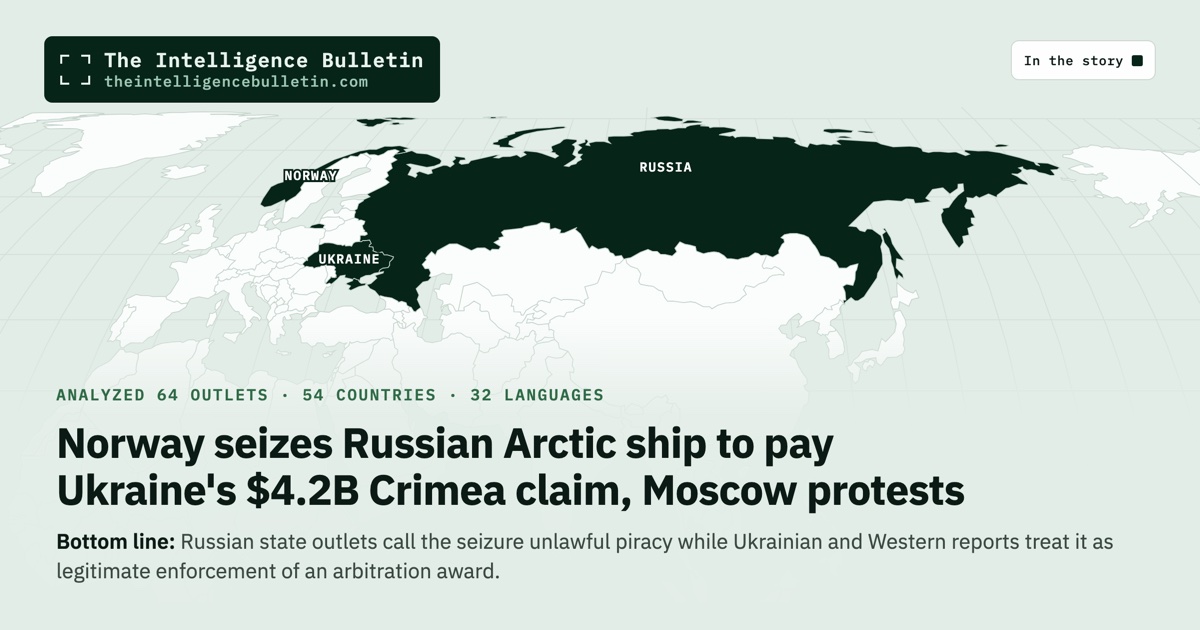
Norway seizes Russian Arctic ship to pay Ukraine’s $4.2B Crimea claim, Moscow protests

Map of the countries in the story: Norway seizes Russian Arctic ship to pay Ukraine's $4.2B Crimea claim, Moscow protests
Norwegian authorities seized the Russian research vessel Professor Molchanov in Barentsburg on Svalbard under a court order sought by Ukraine’s Naftogaz. The move enforces a 2023 Hague tribunal ruling requiring Russia to pay roughly $4.2 billion plus interest for assets expropriated after the 2014 annexation of Crimea. Russia summoned Norway’s ambassador to protest the action as unlawful and announced plans to seek the ship’s release through legal channels.

One Story. Many Angles.

🇳🇴
Norway
The Local
Carries AFP reporting
Norway seizes Russian ship to compensate Ukraine firm
Read →
🇳🇱
Netherlands
The Moscow Times
Carries Reuters reporting
Norway Seizes Russian Ship to Enforce $4.2Bln Claim by Ukraine’s Naftogaz
Read →
🇷🇺
Russia
RT
RUSSIAN
Original reporting
Russia expressed protest to Norway in connection with the arrest of the ship ‘Professor Molchanov’
“Россия выразила Норвегии протест в связи с арестом судна «Профессор Молчанов»”
Read →
🇺🇦
Ukraine
Kyiv Post
Carries AFP reporting
Norway Seizes Russian Ship Over $4.2B Naftogaz Claim
Read →
🇶🇦
Qatar
Al Jazeera
Carries AFP reporting
Norway seizes Russian ship in Arctic over Crimea compensation claim
Read →
5 sources · 3 independent accounts — some share the same news agency’s report
Analyzed 64 outlets across 54 countries and 32 languages · 48 translated · read 5 in full
In Brief

Russian state outlets call the seizure unlawful piracy while Ukrainian and Western reports treat it as legitimate enforcement of an arbitration award.

Norwegian, Ukrainian and most Western reporting presents the seizure as straightforward enforcement of an international arbitral award, while Russian state coverage centers Moscow’s formal protest and labels the detention piracy or lawlessness. The Moscow Times, publishing from exile, sticks to factual detail on the standoff and Russian diplomatic response without adopting the piracy framing used domestically. Al Jazeera alone adds explicit Russian quotes calling the move piracy and situates the incident inside wider Arctic tensions tied to Crimea. AFP copy underpins the Norwegian, Ukrainian and some Western accounts, producing near-identical factual cores on the vessel, location and Naftogaz statement, yet the same facts support sharply different conclusions depending on the outlet’s national vantage. Russian reporting omits Naftogaz’s claim of pursuing assets globally and instead highlights embassy contact with the crew, underscoring sovereignty concerns absent from the compensation-focused pieces. The split reveals that agreement on the seizure itself does not extend to whether an arbitration award overrides territorial or diplomatic protections for a vessel in a Russian-settled Arctic settlement.

Perspective Analysis

Norway seized the Russian research vessel Professor Molchanov in the port of Barentsburg on Norway’s Svalbard archipelago on 2 September 2026. A Norwegian district court had approved the arrest the day before at the request of Ukraine’s state energy company Naftogaz, which sought to enforce a 2023 arbitration award from The Hague ordering Russia to pay approximately $4.2 billion plus interest and costs for assets expropriated after the 2014 annexation of Crimea. The ship, a Russian-owned cruise vessel used for commercial expeditions, had arrived the previous day carrying Russian scientists and docked without incident in the Russian-operated mining settlement. Norwegian authorities took control of the vessel under the court order and stated they would supervise it and ensure it remained in port.

Naftogaz acting chief executive Sergii Fedorenko described the seizure as another step toward restoring justice and said the company would continue pursuing Russian assets worldwide until the full award was paid. The Svalbard governor’s office confirmed the ship would be held in the archipelago and that it would care for the crew and passengers on board. Vessel-tracking data showed the Professor Molchanov anchored at Barentsburg. The Moscow Times, drawing on reporting from the U.S. law firm Covington representing Naftogaz, added that the seizure followed a 24-hour standoff with the Norwegian Coast Guard. Russian officials, including the ambassador to Norway, Nikolai Korchunov, responded by insisting on the vessel’s immediate release and the safety of those aboard, stating that Moscow would pursue the matter through legal channels.

Russia’s Foreign Ministry summoned Norway’s ambassador to Moscow, Heidi Olufsen, on 3 September and delivered a formal protest against the arrest of the vessel in the port of the Russian settlement on Spitsbergen. The ministry described the Norwegian action as unlawful. Russian state reporting highlighted ongoing contact between the Russian embassy in Oslo, the consulate in Barentsburg, and the crew and passengers. One account noted that expedition participants had gone ashore before the seizure became public and that no one had been arrested. Russian ministers quoted in some coverage called the detention an example of Western legal nihilism and lawlessness.

The $4.2 billion figure originates from the 2023 Hague tribunal ruling that found Russia liable for the expropriation of Naftogaz property in Crimea. Naftogaz has pursued the claim since 2016 and has stated it is coordinating enforcement actions in multiple jurisdictions, including the United States, France, the United Kingdom and Finland. Svalbard itself operates under a 1920 treaty that grants Norway sovereignty while allowing citizens of signatory states, including Russia, to settle and conduct economic activity without visas. Barentsburg remains one of the few permanently inhabited Russian communities on the archipelago.

The core facts of the seizure, the court order, the location, the vessel’s identity, the amount of the award, and the Russian diplomatic protest appear across independent reporting chains. The Local, Kyiv Post and Al Jazeera all carried versions of the Naftogaz statement and the Svalbard police confirmation. The Moscow Times added details on the coast-guard standoff drawn from Covington. RT reported the ministry protest and embassy contacts directly from official Russian releases. These accounts converge on the sequence of events without contradiction.

Where the accounts diverge is in the framing of the same events. Norwegian and Ukrainian coverage presents the detention as lawful enforcement of an international ruling, foregrounding the Naftogaz statement and the court order. Russian state coverage centers the protest and the location inside a Russian settlement, describing the action as unlawful without referencing the arbitration award or Naftogaz’s global pursuit of assets. The exiled Moscow Times reports the standoff and the ambassador’s response in detail but does not adopt the piracy language used by Russian officials in other outlets. Al Jazeera alone incorporates explicit Russian ministry quotes labeling the seizure piracy while also situating the incident within Arctic and Crimea-related tensions. No single national press carried both the full Naftogaz enforcement narrative and the Russian sovereignty protest in equal measure.

A reader limited to Norwegian or Ukrainian outlets would encounter the seizure as a routine step in asset recovery with no mention of Russian diplomatic steps or the settlement’s status. A reader limited to Russian state reporting would encounter a protest against an unlawful arrest but would not see the arbitration award or Naftogaz’s statements about continued global enforcement. The exiled Moscow Times provides a narrower factual bridge but still omits the piracy characterization carried elsewhere. Al Jazeera supplies the missing Russian language on piracy while adding regional context not foregrounded in the actor-country pieces.

What to Watch

The corroborated elements—the seizure itself, the $4.2 billion award tied to the 2014 Crimea expropriations, and the Russian protest—rest on multiple independent chains and form the factual spine. The description of the action as piracy or lawlessness appears only through one chain that cites TASS and Russian ministers. Ukraine has a direct financial interest in portraying the seizure as legitimate recovery of war-related losses. Russia has a direct interest in portraying it as an infringement on sovereignty and diplomatic protections for a vessel in one of its Arctic settlements. The next development will likely be Russian legal challenges in Norwegian courts or further asset pursuits by Naftogaz in other jurisdictions, testing whether arbitration awards can be enforced against state property in third countries without triggering broader diplomatic escalation.


Share this story

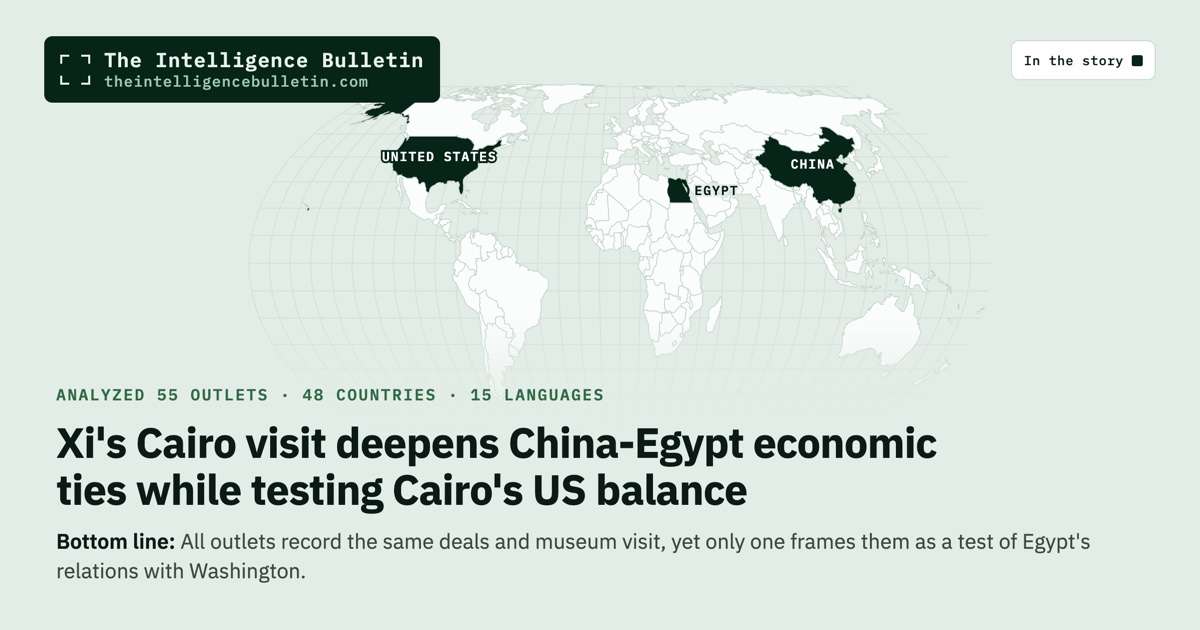
Xi’s Cairo visit deepens China-Egypt economic ties while testing Cairo’s US balance

Map of the countries in the story: Xi's Cairo visit deepens China-Egypt economic ties while testing Cairo's US balance
Chinese President Xi Jinping arrived in Cairo for a three-day state visit on 1 September 2026, his first to Egypt in a decade. He met President Abdel Fattah el-Sisi, toured the Grand Egyptian Museum and signed agreements expanding the Suez Canal Economic Zone, aligning Belt and Road with Egypt Vision 2030, and boosting trade, investment and technology cooperation. The visit followed an SCO summit in Kyrgyzstan and came amid a US-Iran war that has disrupted Red Sea shipping. Egyptian exports to China have risen sharply this year but remain far smaller than imports, leaving a persistent trade gap that both sides now target.

One Story. Many Angles.

🇨🇳
China
People’s Daily
Carries Xinhua reporting
Xi’s milestone visit highlights strategic, leading and exemplary nature of China-Egypt ties, says Chinese FM
Read →
🇪🇬
Egypt
Cairo Scene
Original reporting
How Egypt and China’s Relationship Has Changed in a Decade
Read →
🇬🇧
United Kingdom
Middle East Eye
Original reporting
Xi’s Egypt visit tests Cairo’s balancing act
Read →
🇭🇰
Hong Kong
South China Morning Post
Original reporting
China’s Xi seeks trade routes in Egypt, Central Asia to bypass tariffs and Western rules
Read →
🇮🇱
Israel
The Jerusalem Post
Carries Xinhua reporting
China’s Xi, Egypt’s Sisi meet in Cairo after SCO summit in Kyrgyzstan
Read →
5 sources · 4 independent accounts — some share the same news agency’s report
Analyzed 55 outlets across 48 countries and 15 languages · 23 translated · read 5 in full
In Brief

All outlets record the same deals and museum visit, yet only one frames them as a test of Egypt’s relations with Washington.

The reporting converges on concrete economic outcomes from the visit yet splits on what those outcomes mean for Egypt’s wider alignments. Chinese state media and Egyptian domestic accounts treat the partnership as a straightforward success built on mutual infrastructure projects and rising exports, with no mention of external constraints. Middle East Eye alone flags the unaddressed Huawei AI-chip bid and Egypt’s simultaneous US military aid as the real test of balance, while SCMP reads the same deals as deliberate steps to reroute trade around Western tariffs and rules. The Jerusalem Post places the meeting after the SCO gathering but adds no independent security analysis, simply relaying Chinese statements. What stands out is the absence of contradiction on facts: every outlet records the same museum visit, zone expansion and One China reaffirmation. The divergence lies in emphasis—economic win for the two capitals, geopolitical tightrope only for the UK-based outlet that tracks US reactions. That pattern shows how the event’s meaning is supplied by each outlet’s location rather than by conflicting claims about what happened on the ground.

Perspective Analysis

Chinese President Xi Jinping arrived in Cairo on the evening of 1 September 2026 for a three-day state visit, his first to Egypt since 2016. Egyptian President Abdel Fattah el-Sisi greeted him at the airport with an honor guard and folk dancers. The two leaders held talks the next day at Ittihadiya Palace, then toured the Grand Egyptian Museum together. Security measures closed major roads around the presidential movements in a city of more than 20 million.

The visit marked the 70th anniversary of diplomatic relations. It followed an SCO summit in Bishkek, Kyrgyzstan, where Xi had met other regional leaders. A joint statement issued after the Cairo talks committed both sides to a third phase of the Suez Canal Economic Zone, already home to roughly 200 companies and $4 billion in investment. The statement also aligned China’s Belt and Road Initiative with Egypt’s Vision 2030 development plan and called for expanded cooperation in renewable energy, data centres, semiconductors, space applications, critical minerals, agriculture and car manufacturing. Egypt reaffirmed the One China principle, describing Taiwan as an integral part of the People’s Republic of China, and voiced support for China’s 2027 BRICS presidency. China acknowledged the Nile River’s vital importance to Egypt.

Trade figures supplied by Egyptian sources show the scale of the existing relationship. Bilateral trade stood at $11.6 billion in 2014 when the comprehensive strategic partnership was declared. It reached $20.78 billion by the end of 2025, with Egyptian imports from China at approximately $19.9 billion against exports of roughly $819 million. In the first half of 2026 Egyptian exports to China jumped 199.8 percent year-on-year to $840.8 million while imports rose 14.3 percent to $10.4 billion. Leading Egyptian exports included fuels, vegetables, cotton and phosphates; imports were dominated by machinery, vehicles, iron and steel. Recent measures include 100 percent tariff exemptions on qualifying Egyptian goods entering China and 17 new export contracts worth $168 million signed in August.

Chinese investment has moved beyond finished-goods imports into local production. The China-Egypt TEDA Suez zone in Ain Sokhna has drawn about 200 enterprises and $3.8 billion in investment, generating more than 10,000 local jobs. A $150 million photovoltaic factory opened there in early 2026 with capacity for 2 gigawatts of solar cells. Tourism recovered to hundreds of thousands of Chinese visitors annually, supported by new direct flights. Chinese-language education expanded to 36 university majors and 41 public middle schools. In the other direction, a Shanghai Museum exhibition of Egyptian artifacts drew 2.77 million visitors before closing in 2025, and three Chinese archaeological teams now work at sites including Karnak Temple.

The same agreements appear in every account of the visit, yet the framing differs sharply by outlet. People’s Daily, relaying the Chinese foreign minister’s briefing, presented the trip as demonstrating the strategic, leading and exemplary character of the relationship and a journey to expand cooperation. Cairo Scene, drawing on local trade statistics and embassy data, described a decade of concrete changes inside Egypt, including the persistent import-export gap and recent Egyptian efforts to close it through preferential access and new contracts. South China Morning Post read the same economic moves as steps to build alternative manufacturing and currency-swap networks that reduce exposure to Western tariffs and rules, noting the renewal of a bilateral currency-swap agreement and greater use of the yuan and Egyptian pound. The Jerusalem Post placed the Cairo stop after the SCO gathering and quoted Chinese state-media language on friendship and win-win cooperation between ancient civilizations, adding no separate analysis of its own.

Middle East Eye alone connected the visit to a reported Huawei bid to supply more than 2,000 AI chips for an Egyptian data centre. That tender went unmentioned in official documents from the talks, though the two sides did discuss AI and digital transformation. The same outlet noted Egypt’s continued receipt of roughly $1.4 billion in annual US military aid and the Huawei offer’s position in a broader US-China technology contest. No other source in the set raised the chip bid or US reactions.

The economic outcomes rest on overlapping reporting from four outlets that cite the joint statement and project figures. The interpretation of those outcomes as a test of Egypt’s relations with Washington rests on a single account that tracks US commercial interests. Egyptian coverage emphasises local gains and agency without reference to external constraints. Chinese state media emphasises strategic partnership without reference to trade imbalances or third-party reactions. The Hong Kong outlet supplies the only explicit link to tariff circumvention. The Israeli outlet adds nothing beyond the Chinese framing already available in Beijing.

What to Watch

The corroborated record shows measurable expansion of an existing economic relationship through zone enlargement, new investment projects and rising though still lopsided trade. The single-source suggestion that these steps create friction with Washington rests on the presence of the Huawei tender and Egypt’s parallel US security ties, both documented outside the visit coverage itself. Egypt has a clear interest in presenting the partnership as frictionless while it negotiates financing and market access. China has an interest in framing the relationship as exemplary amid wider regional diplomacy. The next measurable test will be whether the new export contracts and zone expansion produce further narrowing of the trade gap in the second half of 2026 and whether the announced third phase of the Suez zone attracts additional manufacturing capacity. Those outcomes will determine whether the visit’s economic substance outlasts its diplomatic choreography.


Share this story