NBC Crew Beaten by Masked Settlers While Interviewing Displaced Palestinian Woman

Map of the countries in the story: NBC Crew Beaten by Masked Settlers While Interviewing Displaced Palestinian Woman
On August 29, 2026, in Jalud near Nablus, masked Israeli settlers attacked an NBC News crew interviewing 51-year-old Palestinian Aida Ahmed Abdullah, who said settlers had forced her family from their home. The attackers beat the reporter, producer, cameraman and Abdullah with sticks and stones; one carried a gun but did not fire it. Abdullah and three NBC staff were injured and required medical treatment. Multiple independent reports confirm the sequence and injuries while differing on context and implications.

One Story. Many Angles.

🇮🇱
Israel
Haaretz
Original reporting
Masked Israeli Settlers Attack NBC News Crew in West Bank
Read →
🇮🇱
Israel
The Jerusalem Post
Original reporting
Extremist settlers attack NBC journalists interviewing Palestinian in West Bank
Read →
🇺🇸
United States
Democracy Now
Carries NBC News reporting
Masked Israeli Settlers Attack NBC News Team Reporting in the Occupied West Bank
Read →
🇬🇧
United Kingdom
Middle East Eye
Original reporting
US issues gentle condemnation of Israeli settler attack on NBC news crew
Read →
🇬🇷
Greece
Lifo
GREEK
Carries NBC News reporting
Israeli settlers attacked a Palestinian woman and NBC crew in the West Bank
“Ισραηλινοί έποικοι επιτέθηκαν σε Παλαιστίνια και συνεργείο του NBC στη Δυτική Όχθη”
Read →
5 sources · 4 independent accounts — some share the same news agency’s report
In Brief

Outlets agree on the attack details but split on whether to frame it as fringe extremism or systemic occupation violence.

All five outlets describe the same core incident drawn from NBC footage and statements: masked settlers in a car ambushed the interview in a Palestinian area, assaulted four people and damaged equipment. Israeli papers Haaretz and Jerusalem Post both treat the attackers as a fringe group and note domestic calls for prosecutions and journalist protection. Democracy Now and Middle East Eye place the event inside a pattern of settler violence against Palestinians and reporters under occupation, while Middle East Eye alone flags the US statement’s measured tone. Greek outlet Lifo adds Netanyahu’s condemnation of the violence as criminal acts by a small group and cites UN figures on recent West Bank deaths. The convergence on facts from NBC-sourced material across four countries shows the attack itself is not contested; the split lies in whether outlets present it as an isolated breach of law or part of wider occupation dynamics that endanger accountability. The absence of Palestinian-territory voices leaves the Palestinian woman’s account and local context filtered entirely through foreign and Israeli reporting chains.

Perspective Analysis

On the afternoon of August 29, 2026, an NBC News crew was interviewing 51-year-old Aida Ahmed Abdullah and members of her family in the West Bank village of Jalud, near Nablus. Abdullah told the reporters that Israeli settlers had driven her family from their home. As the group moved down a hill toward the house, a gray car bearing Israeli license plates approached in reverse. Masked men inside leaned from the windows. The car stopped, and at least four masked figures emerged carrying sticks. They struck Abdullah and the three NBC staff members, threw stones, and damaged camera equipment and one of the vehicles. One attacker held a gun but did not fire it. Reporter Matt Bradley later said the men “jumped out, beat us, then jumped back in the car.” He received two blows to the arm. Producer Lawahez Jabari and cameraman Khaldoon Eid were also injured. Abdullah fell to the ground and was taken by the Palestinian Red Crescent to a hospital, where her injuries were described as non-life-threatening. The NBC team received treatment at a nearby clinic.

Every account of the assault that appeared in the five outlets traces directly to footage and statements released by NBC News. Haaretz reported that Bradley and his colleagues were interviewing a Palestinian woman when the masked settlers attacked. The Jerusalem Post carried the same sequence, naming Abdullah and quoting Bradley and Eid on the unexpected nature of the assault inside a Palestinian residential area. Democracy Now described the crew interviewing Abdullah about her displacement before the masked men struck. Middle East Eye summarized the same incident in its account of the American response. Lifo recounted the car reversing up the hill, the masked men leaping out with sticks and stones, and the injuries to Abdullah and the three journalists, again citing NBC material.

Israeli security forces arrived after the attack. According to Lifo, they found dozens of masked men inside a Palestinian house in the nearby village of Kousra, separated the groups, and seized vehicles believed to have been used by the attackers. Netanyahu issued a statement condemning the violence in both Jalud and Kousra as “criminal acts” committed by a small group of troublemakers and called for the perpetrators to be located and brought to justice. The Israel Press Council, cited by the Jerusalem Post, demanded that security forces guarantee the safety of journalists in the West Bank and prosecute those responsible, describing any harm to journalists as a violation of the public’s right to know.

The five outlets converge on the sequence of events and the identities of the injured. They diverge on the frame placed around those events. Haaretz and the Jerusalem Post present the attackers as a limited set of masked extremists whose actions required a domestic law-enforcement response. Both papers note the Israel Press Council’s call for prosecutions and protection of media teams. Democracy Now situates the assault inside the occupied West Bank and links it to risks faced by foreign reporters documenting settler activity. Middle East Eye alone records the United States State Department’s statement condemning criminal violence in the West Bank and calling for investigations, arrests, and convictions while adding that the Trump administration was monitoring the situation and maintaining regular dialogue with partners on stability. Lifo alone supplies the Netanyahu condemnation and the United Nations figure that Israeli forces or settlers had killed 76 Palestinians in the West Bank between January 1 and July 24, 2026, while three Israelis were killed in the same period.

No outlet in the set carried reporting from Palestinian Territory. The account of Abdullah’s displacement and the immediate aftermath of her injuries therefore reaches readers only through the chain of NBC footage and statements relayed by Israeli, American, British, and Greek outlets. The same chain supplies the only on-record descriptions of the attackers’ car, weapons, and conduct.

The shared factual spine across four countries rests on one originating source. Where the outlets differ is in the context they attach to that spine. Israeli papers emphasize the legal breach and the institutional Israeli response. The American and British pieces foreground the occupation setting and the implications for international accountability. The Greek piece adds the Israeli prime minister’s statement and casualty statistics that place the single incident inside a wider count. These choices do not contradict one another on what occurred; they select different surrounding facts that each outlet’s readers are presumed to need.

What to Watch

The corroborated record shows that four people were beaten during a routine interview in a Palestinian village, that one carried a firearm but did not discharge it, and that the victims required medical care. That record is available to any reader who consults the NBC material directly or any of the five relays. The additional layer supplied by the coverage is the demonstration that the same set of facts can be presented either as an isolated criminal act requiring arrests or as one data point inside a documented pattern of violence that endangers both local residents and foreign observers. The absence of any independent Palestinian-territory reporting means the reader cannot yet weigh a local institutional account against the relayed one. What the five outlets together establish is that the attack itself crossed no national line of disagreement; the interpretive line that remains is whether the event is treated as an exception that Israeli authorities can contain or as evidence of dynamics that continue to constrain reporting from the ground.
Share this story

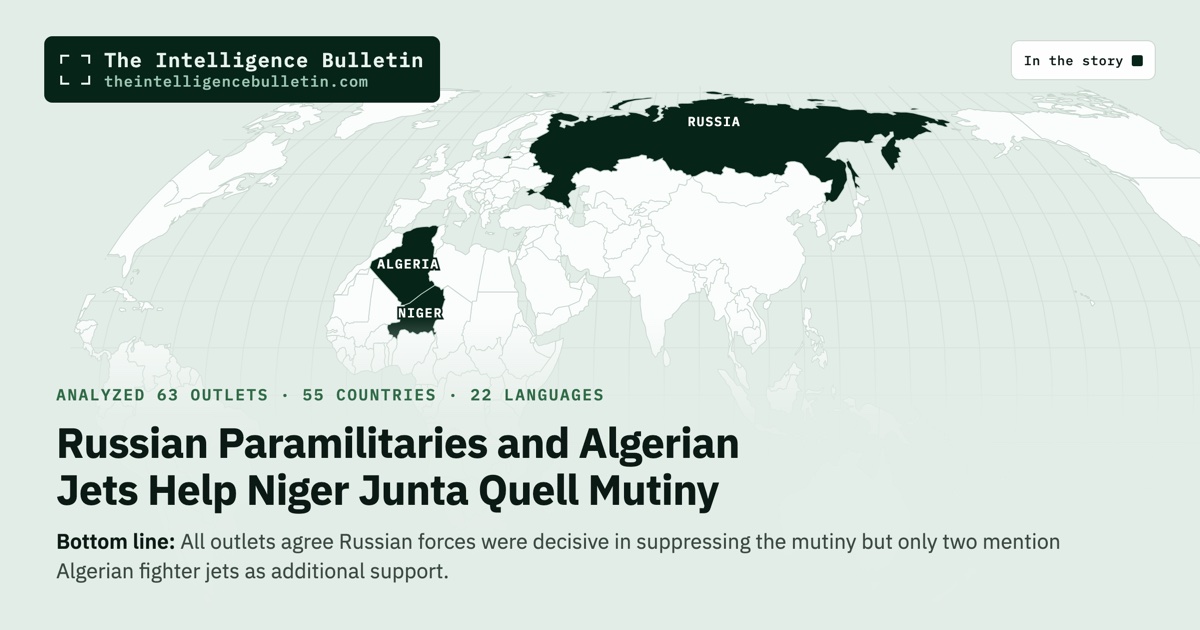
Russian Paramilitaries and Algerian Jets Help Niger Junta Quell Mutiny

Map of the countries in the story: Russian Paramilitaries and Algerian Jets Help Niger Junta Quell Mutiny
On the night of August 28-29 2026, mutinous Nigerien soldiers attacked sites in Niamey including Air Base 101 at the airport. Loyalist forces requested and received ground and air support from Russia’s Africa Corps, which helped retake the base and end the uprising within hours. The event exposed the junta’s reliance on Russian paramilitaries after severing ties with France, with Algeria also sending fighter jets in support. No assistance came from the Alliance of Sahel States partners.

One Story. Many Angles.

🇰🇪
Kenya
Standard Media
Carries AFP reporting
Thwarted Niger mutiny exposes junta’s Russia dependence
Read →
🇧🇯
Benin
La Nouvelle Tribune
FRENCH
Carries AP reporting
Mutiny in Niger: Russia confirms its decisive aid to the Tiani power
“Mutinerie au Niger : la Russie confirme son aide décisive au pouvoir Tiani”
Read →
🇫🇷
France
Boursorama
FRENCH
Carries AFP reporting
Sahel: Niger represses a mutiny thanks to the Africa Corps, a symbol of the putschists’ dependence on Russia
“Sahel : le Niger réprime une mutinerie grâce à l’Africa Corps, un symbole de la dépendance des putschistes à la Russie – 01/09/2026 à 09:59”
Read →
🇿🇦
South Africa
DefenceWeb
Carries Reuters reporting
Niger’s junta survives mutiny with Russian support
Read →
🇮🇹
Italy
Linkiesta
ITALIAN
Commentary
Russian paramilitaries and Algerian fighters saved the Niger junta
“I paramilitari russi e i caccia algerini hanno salvato la giunta del Niger”
Read →
5 sources · 3 independent accounts — some share the same news agency’s report
In Brief

All outlets agree Russian forces were decisive in suppressing the mutiny but only two mention Algerian fighter jets as additional support.

The most striking pattern across these accounts is how uniformly the mutiny suppression is read as proof of swapped dependencies rather than a victory for the junta’s sovereignty rhetoric. Kenyan and South African outlets foreground the tactical Russian intervention as the central fact that undercuts the regime’s anti-foreign-power narrative, while the Benin French-language piece treats Moscow’s own confirmation of decisive aid as the story’s anchor. The French financial outlet sharpens this into a symbol of putschist reliance on the Africa Corps, and the Italian report adds the detail of Algerian Su-30 jets arriving afterward, widening the lens to regional actors without altering the core assessment of Moscow’s role. All five pieces draw from the same cluster of wire reporting on the ambassador’s statements, analyst commentary from Aldebaran and Control Risks, and the Timbuktu Institute note, yet each selects a different emphasis that collectively shows the absence of any counter-narrative in the selected coverage. The lack of an outlet from Russia itself means Russian official lines appear only through foreign relays, and the consistent mention that AES allies offered no help underscores the junta’s isolation even within its own bloc. What the reporting together reveals is that the event did not resolve underlying military grievances or jihadist threats but simply illustrated how quickly the regime turned to its new external guarantor when internal control was at stake.

Perspective Analysis

On the night of August 28 into August 29 2026, gunfire and explosions erupted at several sites in Niger’s capital Niamey, including the presidential palace and Air Base 101 inside the Diori Hamani International Airport complex. Mutinous soldiers, drawn from units based in the capital and from towns such as Ouallam, Tera and Dosso that have seen heavy fighting against Islamist insurgents, seized positions and took hostages among their own colleagues. The attackers focused their efforts on the air base, one of the country’s most strategic military sites.

Loyalist forces responded with several hours of combat. By the following day the base had been retaken, dozens of mutineers killed or captured, and the immediate threat contained. State television later showed some of those detained. No official casualty figures were released by the Nigerien authorities, and the number of soldiers who took part remains unclear; Reuters noted that state media claimed hundreds but could not independently verify the figure.

The decisive external factor in restoring control was the intervention of Russia’s Africa Corps. The Russian ambassador in Niamey, Viktor Voropaev, stated publicly that the Nigerien authorities had requested assistance and that the Africa Corps had supplied ground and air support to help loyalist troops neutralise the mutineers. All five outlets in the set carried this account, drawing on statements from Voropaev and from the Russian Foreign Ministry, which added that calm had been restored and that Moscow would continue supporting Nigerien authorities against “extremists.” Estimates of the Africa Corps contingent inside Niger range from 200 to 300 personnel, with its headquarters at the same air base that became the focus of the fighting.

Two outlets reported an additional layer of external involvement. Algeria dispatched four Su-30MKA fighter jets and an Il-78 tanker aircraft after the mutiny had been quelled. The Algerian Defence Ministry described the mission as one requested by the Nigerien authorities to support the army against destabilisation. No reports indicated that the Algerian aircraft conducted strikes or engaged directly in the ground operation.

Niger’s state television accused France of orchestrating the mutiny, a recurring claim by the junta since the 2023 coup that removed President Mohamed Bazoum. The Russian Foreign Ministry echoed the charge, describing the mutineers as “extremists seemingly incited by European former colonial powers.” France has repeatedly rejected such accusations. The Alliance of Sahel States, the confederation formed by Niger, Mali and Burkina Faso, issued a joint statement supporting the loyalist forces and condemning the “betrayal” by the mutineers, but provided no military assistance during the crisis.

The episode occurred against the background of Niger’s post-coup security arrangements. After breaking military ties with France, its former colonial power and long-standing partner, the junta under General Abdourahmane Tchiani turned to Russia. The Africa Corps, operating under the Russian Defence Ministry and replacing the Wagner Group’s African footprint, is formally present to assist against jihadist groups linked to al-Qaeda and the Islamic State. Analysts quoted across the coverage noted that the mutiny instead illustrated the group’s role as a praetorian force protecting the regime itself. Charlie Werb of Aldebaran Threat Consultants told AFP that the Africa Corps supplied “ground and air support” that proved decisive at the air base. Lou Osborn of All Eyes on Wagner described the Russian promise as primarily one of regime protection. Beverly Ochieng of Control Risks said the Africa Corps fulfilled an obligation to ensure the government prevailed against any threat, not only jihadists.

The Timbuktu Institute, a Dakar-based think tank, observed that the junta had built much of its legitimacy on restoring security sovereignty, yet the need for outside help to contain an internal crisis raised questions about how far strategic autonomy can extend when it produces growing dependence on Moscow. The institute also noted deep divisions and grievances inside the security apparatus, where soldiers face constant exposure to jihadist attacks with limited equipment and supplies. The mutiny did not end those underlying pressures; analysts pointed out that Russian-trained local forces have still struggled to reverse jihadist gains, most recently the loss of Kidal in northern Mali in April.

The five outlets converged on the central sequence of events and on the assessment that the suppression demonstrated swapped dependencies rather than restored sovereignty. Standard Media led with the exposure of the junta’s reliance on Russia after its anti-foreign-power rhetoric. La Nouvelle Tribune anchored its account in Russia’s own confirmation of decisive aid. Boursorama framed the episode as symbolic of putschist dependence on the Africa Corps. DefenceWeb stressed the tactical Russian support that enabled survival amid internal military tensions. Linkiesta added the Algerian jet deployment as part of a broader regional dynamic.

Where the accounts differed in emphasis, the differences were narrow and additive rather than contradictory. Only DefenceWeb and Linkiesta mentioned the Algerian aircraft; the other three did not. All five relayed the same wire-service reporting on Voropaev’s statements and the analyst commentary. None carried an independent Russian or Nigerien-sourced counter-narrative that challenged the dependence framing. The absence of any outlet from Russia itself in the set meant that Russian official lines appeared only through foreign relays. The consistent reporting that AES allies offered no help during the crisis appeared in multiple pieces and underscored the junta’s isolation even within its own bloc.

The corroborated spine of the coverage—that Russian paramilitaries supplied the ground and air support that allowed loyalist forces to retake the air base—rests on the ambassador’s on-record statement and is carried by every outlet through the same wire agencies. That convergence supplies the strongest warrant for treating the dependence finding as the central takeaway. The Algerian jet detail, carried by only two outlets, remains narrower and does not alter the assessment of Moscow’s role on the ground. Nigerien accusations against France and the Russian echo of those claims appear in three outlets but remain one-sided assertions without independent corroboration in the set.

What to Watch

The reporting therefore shows a regime that moved quickly to its new external guarantor when internal control was threatened, while the jihadist insurgency and military grievances that predated the mutiny continue. Moscow gains visible leverage inside the Sahel juntas precisely because the alternative security partnership the juntas rejected has not been replaced by any viable regional substitute. The event is unlikely to resolve those structural weaknesses; it simply made the existing dependence visible in a single night of fighting.


Share this story

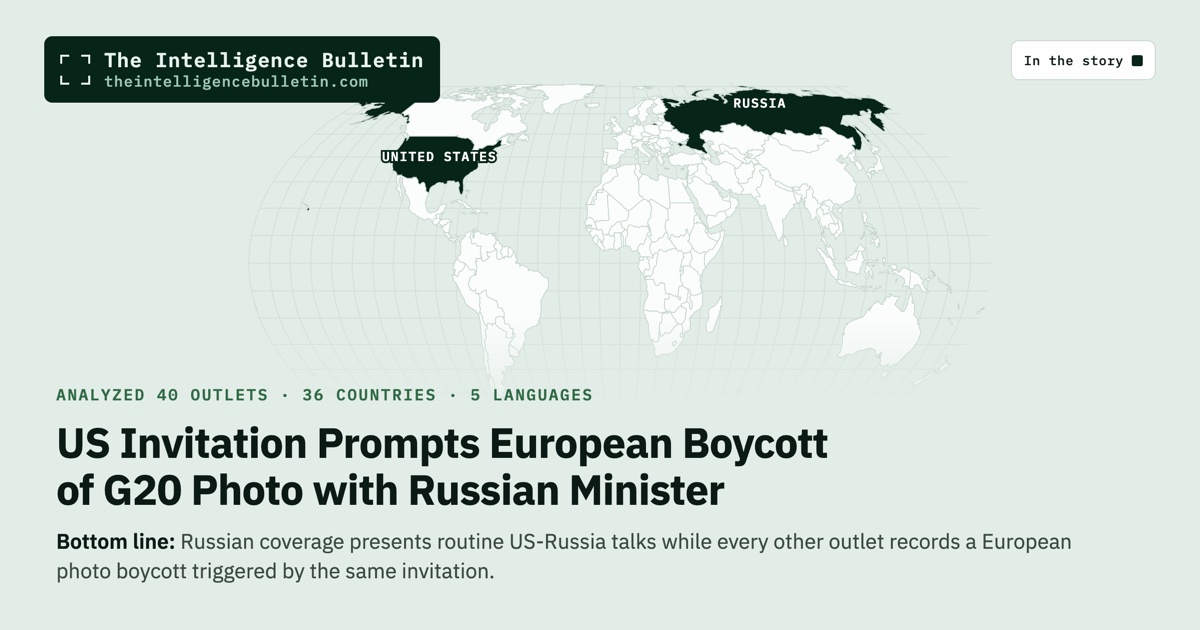
US Invitation Prompts European Boycott of G20 Photo with Russian Minister

Map of the countries in the story: US Invitation Prompts European Boycott of G20 Photo with Russian Minister
US Treasury Secretary Scott Bessent hosted G20 finance ministers in Asheville and held bilateral talks with Russian Finance Minister Anton Siluanov, the first in-person G20 attendance by a Russian official since 2022. German Finance Minister Lars Klingbeil confronted Siluanov directly and rallied European colleagues, including Poland’s Andrzej Domanski and ECB President Christine Lagarde, to refuse the traditional group photo if the Russian minister joined. The photo was taken without Siluanov. Russian reporting framed the US-Russia meeting as routine high-level financial cooperation while European accounts stressed ongoing war and sanctions.

One Story. Many Angles.

🇩🇪
Germany
Bild
GERMAN
Original reporting
SPD’s Lars Klingbeil urges Russian minister off photo at G20 summit
“SPDS: Lars Klingbeil drängt russischen Minister von Foto bei G20-Gipfel”
Read →
🇷🇺
Russia
Pravda
Original reporting
Russia and US Hold High-Level Financial Talks at G20 Summit in Asheville
Read →
🇶🇦
Qatar
Al Jazeera
Original reporting
US brings back Russia’s Siluanov to G20 finance talks, angering Europe
Read →
🇺🇸
United States
HNGN
Carries Reuters and AFP reporting
Europeans Boycott G20 Photo With Russia Over Ukraine War
Read →
🇺🇦
Ukraine
Kyiv Post
Carries AFP reporting
Europe Boycotts G20 Photo Over Russian Minister’s Return
Read →
5 sources · each independently reported
In Brief

Russian coverage presents routine US-Russia talks while every other outlet records a European photo boycott triggered by the same invitation.

The reporting converges on one concrete sequence: the US invitation produced a visible European protest that succeeded in excluding Siluanov from the group photograph, while bilateral US-Russia talks still occurred. Bild and Kyiv Post both record Klingbeil delivering a direct message to Siluanov and securing European alignment beforehand; Al Jazeera and HNGN add that the invitation itself was the trigger, reversing the 2022 walkout precedent. Pravda alone omits the boycott and presents the Bessent-Siluanov encounter as substantive dialogue on financial cooperation and Trump’s peace plan. The contrast reveals a deliberate US choice to reopen channels without European consent, met by European refusal to normalize the optics. Klingbeil’s public criticism of receiving Siluanov ‘as a normal guest’ appears in German, Ukrainian, Qatari and US accounts, while Russian coverage treats the same event as unremarkable diplomacy. This split shows the invitation exposed a transatlantic divergence over whether engagement can proceed without symbolic concessions on Ukraine.

Perspective Analysis

The US invitation brought Russian Finance Minister Anton Siluanov to the G20 finance ministers and central bank governors meeting in Asheville, North Carolina, on August 31, 2026, marking his first in-person appearance at such a gathering since Russia’s full-scale invasion of Ukraine in 2022. US Treasury Secretary Scott Bessent hosted the session and met Siluanov one-on-one on the sidelines. The Russian Finance Ministry described the discussion as covering financial cooperation within the G20 framework. US officials said the exchange also addressed President Donald Trump’s 28-point peace plan for Ukraine, and a source familiar with the talks reported that Bessent made clear no economic relief would be provided until the war ended.

European ministers reacted sharply to the invitation. German Finance Minister Lars Klingbeil told reporters that receiving Siluanov as a normal guest sent a troubling signal while Russia continued its attacks on Ukraine. He said he had wanted greater clarity from the American side that the Russian minister should not be treated routinely. Klingbeil confronted Siluanov directly during a plenary session, telling him that the Russian government must end the war and that Europe stood clearly with Ukraine. Polish Finance Minister Andrzej Domanski echoed the distrust, stating that Russia lies constantly and that any conversation required extreme caution. European Central Bank President Christine Lagarde participated in prior European discussions on how to handle the Russian presence.

The traditional G20 group photograph became the clearest point of friction. Klingbeil said he had made clear in advance among European colleagues that he would not stand for a joint photo with the Russian minister. European officials conveyed to the hosts that they would boycott the photograph if Siluanov were included. The image was ultimately taken without him. Klingbeil later noted that while maintaining a channel for direct messages had value, the return of the Russian minister after four prior meetings without participation signaled an attempt at normalization that Europe felt compelled to push back against.

This sequence reversed the pattern from April 2022, when Siluanov participated virtually in a Washington-hosted G20 meeting and officials from the United States, Britain, Canada, and the European Central Bank walked out in protest. At Asheville, the protest took the form of exclusion from the photograph rather than departure from the room. Klingbeil also raised separate concerns about press access, noting that some journalists, including from the New York Times and Bloomberg, had been denied credentials.

Russian reporting presented the same days differently. It described the Siluanov-Bessent meeting as high-level talks on bilateral financial cooperation and G20 issues, without reference to European objections or the photograph. Russian accounts noted that Deputy Finance Minister Ivan Chebeskov had represented Moscow at earlier deputy-level sessions and highlighted Putin’s recent remarks on moving toward an end to the military operation.

Four of the five accounts record the same core sequence: the invitation occurred, the bilateral meeting took place, Klingbeil criticized the optics and confronted Siluanov, and European pressure kept the Russian minister out of the group photo. The same outlets quote Klingbeil using nearly identical language about the troubling signal and the desire for clarity from Washington. They also note that Europe is preparing a further sanctions package and hopes for coordinated US action. The single account that omits the boycott and the confrontation is the Russian domestic report, which instead emphasizes the substance of the US-Russia exchange and frames participation as unremarkable.

The divergence is not over whether Siluanov attended or met Bessent—those facts appear across independent reporting chains—but over whether the European reaction constituted a meaningful diplomatic event. The accounts that include the boycott treat the photo exclusion as evidence of sustained European resistance to any appearance of normalization while the war continues. The account that excludes it treats the encounter as evidence that direct financial and peace-related channels remain open under the new US administration. Both readings rest on the same documented actions: the invitation was extended, the meeting happened, and the photograph did not include the Russian minister.

The European-led accounts carry the stronger warrant on the friction itself because the details of Klingbeil’s statements, the advance coordination among European ministers, and the outcome of the photograph appear in German on-site reporting, Ukrainian coverage of the affected party, a regional observer outlet, and a US summary drawing on multiple official statements. These four chains converge on the same sequence and the same quoted language. The Russian account, by contrast, draws from its own ministry statements and US reporting of the bilateral meeting but does not address the European protest that four other sources document in detail.

What to Watch

The split points to a practical difference in priorities. The United States under Trump is testing whether direct engagement can advance a negotiated end to the fighting, even if that requires receiving Russian officials in routine diplomatic settings. European governments, having borne the costs of sustained sanctions, are unwilling to grant symbolic legitimacy without concrete movement on the battlefield or on sanctions relief. The Asheville episode shows both positions operating at once: the bilateral channel functioned, and the European protest succeeded in shaping one visible element of the meeting. Future gatherings will test whether the US approach produces tangible progress on a ceasefire or whether the European insistence on visible distinctions erodes the room for those talks.


Share this story

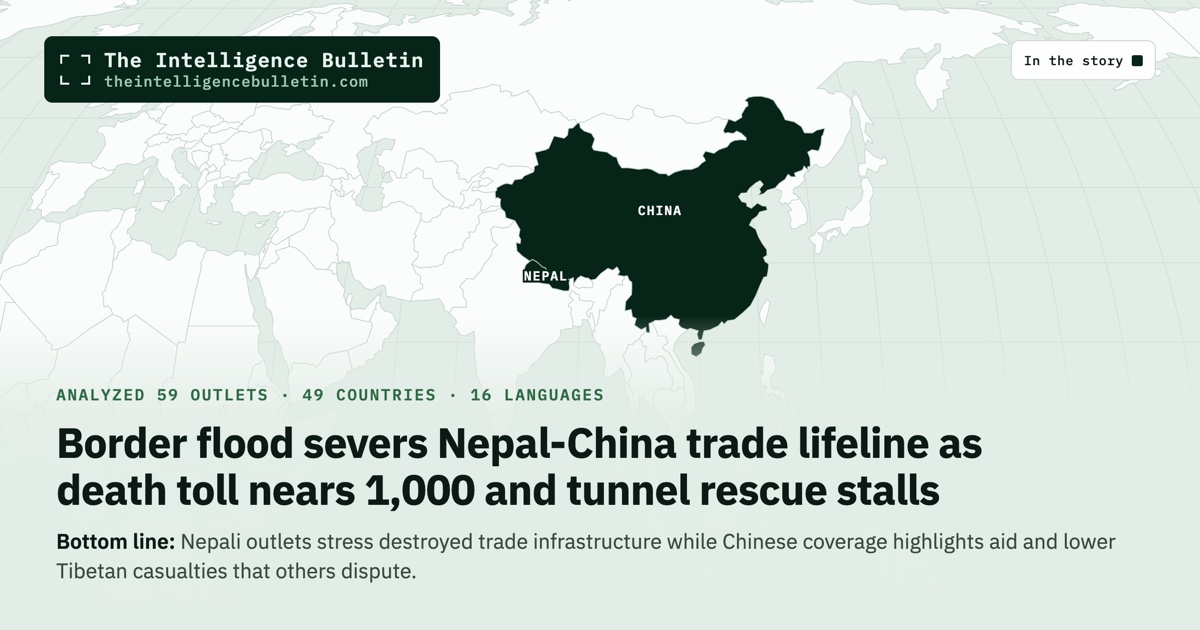
Border flood severs Nepal-China trade lifeline as death toll nears 1,000 and tunnel rescue stalls

Map of the countries in the story: Border flood severs Nepal-China trade lifeline as death toll nears 1,000 and tunnel rescue stalls
A glacier collapse on August 26 sent floods and debris through Nepal-Tibet border valleys, destroying the Gyirong/Rasuwagadhi crossing and burying hydropower tunnels. Nepal counts 919 confirmed dead and 4,247 missing while China reports 16 dead and 546 missing on its side. Rescue teams from both countries search debris and pump air into a silent tunnel at Trishuli 3A with no response. The disaster severed Nepal’s main land trade route with China, halting imports and stranding pilgrims and workers.

One Story. Many Angles.

🇳🇵
Nepal
Ekantipur
NEPALI
Original reporting
Rasuwagadhi border: Nepal-China trade’s ‘lifeline’ itself in crisis
“रसुवागढी नाका : नेपाल–चीन व्यापारको ‘लाइफलाइन’ नै संकटमा”
Read →
🇨🇳
China
China.org.cn
SPANISH
Original reporting
China provides emergency humanitarian assistance to Nepal after mudslide disaster
“China proporciona asistencia humanitaria de emergencia a Nepal tras desastre por alud de lodo”
Read →
🇺🇸
United States
HNGN
Original reporting
Nepal Flood Toll Hits 919 Dead, 4,793 Missing as Tunnel Rescue Finds No Response
Read →
🇭🇰
Hong Kong
South China Morning Post
Original reporting
Rescue work intensifies as death toll in China-Nepal disaster approaches 1,000
Read →
🇨🇳
China
Phayul
Original reporting
China censors Kyirong flood footage, grossly under-reports death toll
Read →
5 sources · each independently reported
In Brief

Nepali outlets stress destroyed trade infrastructure while Chinese coverage highlights aid and lower Tibetan casualties that others dispute.

The reporting reveals a sharp split between casualty counts and priorities rather than a unified regional crisis narrative. Nepali coverage centers on the destroyed Rasuwagadhi trade corridor and its immediate economic fallout for Kathmandu supplies, treating the border crossing as the story’s core loss. Chinese state outlets emphasize rapid aid shipments and joint rescue gestures while listing far lower figures on the Tibetan side. Western and regional English-language accounts track the rising Nepali toll and stalled tunnel operation in detail, including foreign nationals among the missing. The Tibetan exile outlet directly challenges the Chinese numbers by documenting removed footage from Kyirong and restricted access. These framings cannot be reconciled on the scale of deaths and missing persons across the border; independent chains show Nepal’s higher confirmed figures alongside China’s insistence on its own lower tally and censorship allegations that no other outlet corroborates on the record. The divergence shows how national interests shape what each press treats as the measurable human cost versus the visible diplomatic response.

Perspective Analysis

A glacier in Nepal’s Langtang-Lirung range collapsed before dawn on August 26 and sent a wall of water, ice, rock and mud through mountain valleys on both sides of the Nepal-Tibet border. The surge reached Gyirong Port within six to seven minutes on the Chinese side. It destroyed the primary land crossing between the two countries, which handles roughly a third of bilateral trade, along with at least 35 bridges and about 40 kilometers of road. The Trishuli River rose as much as nine meters in thirty minutes and carried debris and bodies nearly 240 kilometers downstream into India.

Nepal reports 919 confirmed dead and 4,247 missing as of the latest counts. China reports 16 dead and 546 missing on its side of the border. The combined missing total stands at 4,793. The disaster struck at the height of the Kailash Mansarovar pilgrimage season, catching traders, pilgrims and hydropower workers along the exposed river system. At least 897 workers tied to hydropower projects in the zone remain unaccounted for.

Rescue teams located the crown of the Trishuli 3A hydropower tunnel after three days of drilling and excavation. They installed a pipe to pump air inside but received no response from within. Indian and Chinese tunnel specialists joined Nepali army engineers at the site. A barrier lake formed by the initial landslide overflowed on Sunday, briefly halting operations on the Chinese side before teams resumed. A second smaller lake upstream remains under monitoring.

The Rasuwagadhi crossing, upgraded to international status in 2017 and positioned as Nepal’s main overland trade route with China after the 2015 earthquake damaged the Tatopani alternative, was swept away. Containers carrying roughly one thousand electric vehicles and spare parts vanished in the flood. Nepal’s main supply line for Chinese goods, including vehicles, industrial inputs and festival merchandise bound for Kathmandu markets, is now severed. Alternative routes through Tatopani and Korala face higher costs, weaker infrastructure and greater geographic risk, offering no immediate substitute.

China dispatched two Y-20 transport planes carrying emergency supplies and four rescue experts to Tribhuvan International Airport in Kathmandu on August 30. The Chinese Agency for International Development Cooperation activated a special package that includes financial aid and humanitarian materials. Chinese teams simultaneously conducted operations on their own territory and shared satellite imagery, hydrological data and other information with Nepali counterparts. Officials described the two countries as a community linked by mountains and rivers that would face the catastrophe together.

Coverage of the same event diverges sharply on what counts as the central loss. Ekantipur treats the destruction of the Rasuwagadhi trade corridor as the defining damage, detailing lost shipments of BYD electric vehicles, severed supply chains for Kathmandu consumers and the strategic setback to a route China had promoted under the Belt and Road Initiative for broader South Asian connectivity. No other outlet in the set foregrounds these commercial consequences with comparable specificity.

Chinese state reporting centers on the aid package and joint gestures. It lists the lower casualty figures on the Tibetan side without reconciling them against the higher Nepali totals reported elsewhere. The South China Morning Post notes rescue coordination across the border and tracks the combined death toll approaching one thousand while citing both Nepali and Chinese data. HNGN aggregates the Nepali toll of 919 dead and the full missing count of 4,793, adding details on foreign nationals among the missing and the lack of response from the buried tunnel.

Phayul reports that footage of the surge through Kyirong Port circulated briefly on Chinese platforms before being removed and that official Chinese casualty figures on the Tibetan side are substantially lower than independent accounts suggest. No other outlet in the set records the removal of specific videos or levels the same direct accusation of underreporting.

The casualty split cannot be reconciled from the published accounts. Nepal’s higher confirmed dead and missing figures appear in HNGN, the South China Morning Post and earlier Nepali reporting, while China’s lower tally on its side stands alone in the Chinese state material and is challenged only by the Tibetan exile outlet. The trade-route destruction is documented in detail only by the Nepali daily. The aid dispatch and data-sharing appear only in the Chinese state piece. The tunnel silence and foreign missing numbers are carried in the American outlet. These are not variations in emphasis but distinct factual baselines that a reader limited to one source would accept as the complete picture.

The higher Nepali casualty count rests on the most independent reporting chains. HNGN and the South China Morning Post both cite Nepali government authorities for the 919 dead and thousands missing, and earlier Ekantipur reporting already recorded hundreds of deaths and thousands missing before the final update. China’s lower figures on the Tibetan side receive no corroboration from any other outlet and are directly disputed by Phayul on the basis of removed footage and restricted access. The trade destruction carries concrete detail—lost containers, specific vehicle counts, the route’s post-earthquake role—that appears nowhere else and aligns with the physical destruction corroborated across multiple accounts. The Chinese aid operation is presented only by the state outlet itself and therefore stands as a single-source claim.

What to Watch

China has an institutional interest in presenting its response as rapid and cooperative while limiting visibility into losses on the Tibetan side of a sensitive border region. Nepal has an immediate economic stake in highlighting the severed trade artery that supplies its capital and powers a growing electric-vehicle market. The tunnel rescue remains the highest operational priority for Nepali authorities, with air already inside the structure and multinational specialists on site. Continued monsoon rains through September raise the risk of secondary flooding along already saturated riverbanks. Trade recovery will depend on whichever alternative crossing can be made operational first, at higher cost and lower capacity than the lost Rasuwagadhi route. The gap between the two casualty counts will persist in public records unless one side revises its figures with supporting evidence.


Share this story

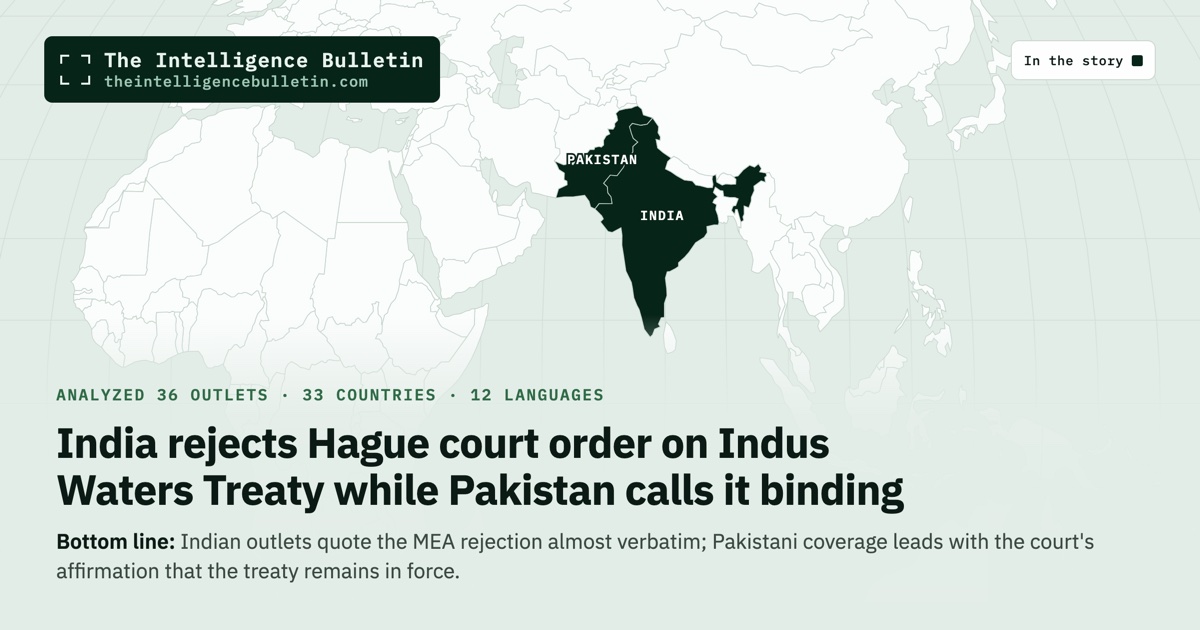
India rejects Hague court order on Indus Waters Treaty while Pakistan calls it binding

Map of the countries in the story: India rejects Hague court order on Indus Waters Treaty while Pakistan calls it binding
India placed the 1960 Indus Waters Treaty in abeyance after a 2025 terror attack in Pahalgam. Pakistan referred the matter to the Permanent Court of Arbitration in The Hague. The court ruled the treaty remains fully in force and India must observe its obligations, including limits on the Ratle hydroelectric project. India rejected the ruling, calling the court illegally constituted with no jurisdiction over its sovereign decisions.

One Story. Many Angles.

🇮🇳
India
Siasat
Carries Press Trust reporting
India rejects The Hague court’s ruling on Indus Waters Treaty
Read →
🇵🇰
Pakistan
Daily Pakistan
Original reporting
Blow to India as Hague Court keeps Indus Waters Treaty fully alive
Read →
🇭🇰
Hong Kong
South China Morning Post
Carries Reuters reporting
India rejects ruling on water-sharing treaty with Pakistan by international court
Read →
🇹🇷
Turkey
Anadolu Agency
Permanent Court of Arbitration wire copy
India remains bound by and must observe Indus Waters Treaty with Pakistan: Hague-based court
Read →
4 sources · each independently reported
In Brief

Indian outlets quote the MEA rejection almost verbatim; Pakistani coverage leads with the court’s affirmation that the treaty remains in force.

Indian reporting across multiple outlets uniformly centers the Ministry of External Affairs statement that rejects the court’s legitimacy outright, repeating the phrase ‘illegally constituted’ and insisting the abeyance decision stands unchanged. Pakistani coverage instead highlights the court’s unanimous finding that the treaty stays fully operational and frames the outcome as a direct setback for New Delhi’s hydropower plans. International outlets such as Reuters via SCMP and Anadolu Agency report both positions without emphasis, noting the court’s interim restrictions on construction and India’s non-participation in proceedings. The divergence stems from sourcing: Indian pieces derive from the official MEA release while the Pakistani account incorporates the tribunal’s own media statement on treaty status and project limits. This pattern shows how actor outlets treat the same legal event as either a sovereignty victory or an enforceable obligation, with no independent verification of the court’s composition or the 2025 suspension trigger appearing in any dispatch.

Perspective Analysis

India placed the 1960 Indus Waters Treaty in abeyance in April 2025 after the Pahalgam attack that killed 26 civilians at a tourist site in Jammu and Kashmir. Indian authorities identified two of the three assailants as Pakistani. The treaty, signed in 1960 with World Bank mediation, divides the waters of the Indus river system and has endured three wars and repeated crises between the two countries. Pakistan responded by taking the suspension to the Permanent Court of Arbitration in The Hague in March 2026.

On 31 August 2026 the court issued two linked decisions. It ruled unanimously that none of the grounds India had advanced justified suspension or termination. The treaty therefore remained fully in force, and India must continue to meet its obligations on the design and operation of hydroelectric projects on the western rivers. The court also issued interim measures restricting certain construction activities at the Ratle hydroelectric plant on the Chenab until 90 days after a Neutral Expert issues a final technical determination expected around July 2027. India must supply information on its construction schedule.

India’s Ministry of External Affairs responded the same day. It described the court as “illegally constituted” by the World Bank in breach of the treaty’s terms and stated that the body had no jurisdiction over New Delhi’s sovereign decisions. The MEA repeated that India had never recognised the court’s existence in law, had never appeared before it, and would treat its pronouncements as having no effect on ongoing projects. The decision to keep the treaty in abeyance therefore remained in force until Pakistan credibly and irrevocably ended support for cross-border terrorism.

Indian outlets that carried the Ministry statement, including Siasat, reproduced the language of rejection in full and placed it at the top of their accounts. They noted that India had already accelerated work on several hydropower projects in Jammu and Kashmir that Pakistan had previously opposed under the treaty. Pakistani reporting, by contrast, opened with the court’s conclusion that the treaty stayed fully operational and described the outcome as a setback for India’s plans at Ratle and similar sites. It recorded the interim restrictions on concreting work and the requirement to provide project schedules.

The court examined India’s public statements and conduct outside the proceedings, including government communications to Pakistan and the neutral expert. It considered but rejected the argument that Pakistan’s alleged sponsorship of terrorism constituted a material breach allowing suspension. The treaty, the court noted, addresses only the rights and obligations concerning the use of the waters and contains no provision for unilateral suspension or termination; any change requires mutual agreement.

International coverage, including the Reuters dispatch carried by the South China Morning Post and the shorter Anadolu Agency account, recorded both the Indian rejection and the court’s orders without emphasis on either. These pieces noted that the treaty supplies water to 80 per cent of Pakistani farms and that India had begun steps to increase reservoir capacity at disputed projects.

The accounts converge on the sequence of events and on the content of the two official statements. Every source that addressed the court’s ruling reported its finding that the treaty remains in force. Every source that addressed the Indian response reported the Ministry’s assertion that the court lacks jurisdiction and that abeyance continues. No outlet supplied independent evidence on the court’s composition or on the factual basis of the 2025 suspension.

Where the accounts diverge is in selection and framing. Indian reporting foregrounds the Ministry’s characterisation of the court and the continued validity of the abeyance decision. Pakistani reporting foregrounds the court’s conclusions on treaty status and the concrete limits placed on the Ratle project. The international wires present both elements in roughly equal measure. A reader limited to Indian sources would encounter the court’s specific interim construction order only in passing or not at all. A reader limited to the Pakistani account would encounter the Ministry’s detailed jurisdictional objection only after the court’s position had already been established as the lead fact.

The underlying disagreement is therefore not over what each side said on 31 August but over which statement carries legal weight. India treats the treaty suspension as a sovereign response to terrorism that cannot be reviewed by a body it regards as improperly constituted. Pakistan treats the treaty as an enduring international obligation whose terms the court is competent to interpret and enforce. The court itself applied the principle that agreements must be honoured and found that the word “abeyance” has no established meaning in the treaty or in general international law that would permit unilateral action.

The pattern of sourcing explains the divergence. Indian pieces largely reproduced the Ministry statement. The Pakistani piece incorporated the court’s own media release on both the status award and the interim order. The Reuters and Anadolu accounts balanced the two primary documents. No reporting chain supplied external verification of either the court’s legitimacy or the scale of any Pakistani involvement in the 2025 attack.

What to Watch

The most durable element across the record is the court’s explicit order on the Ratle project. That restriction is described in concrete terms—limits on concreting above prescribed levels and a reporting obligation—while the broader status ruling rests on the legal interpretation of the treaty’s silence on unilateral suspension. India’s rejection does not alter the fact that the tribunal has asserted continuing authority over the project’s construction schedule. Pakistan’s emphasis on the ruling does not alter the fact that India has stated it will proceed with the projects regardless. The next measurable development will therefore be whether India alters the physical work at Ratle or at other western-river sites before the Neutral Expert’s July 2027 deadline, and whether Pakistan returns to the court for enforcement measures.


Share this story

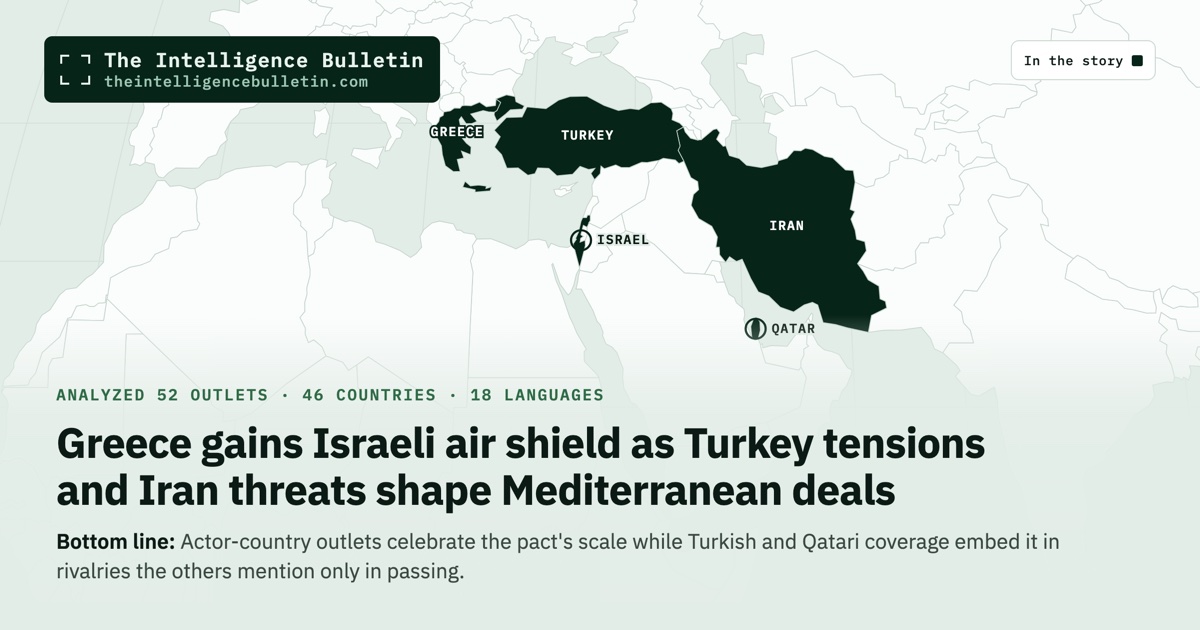
Greece gains Israeli air shield as Turkey tensions and Iran threats shape Mediterranean deals

Map of the countries in the story: Greece gains Israeli air shield as Turkey tensions and Iran threats shape Mediterranean deals
Israel and Greece signed a €3 billion defense agreement in Tel Aviv on August 31 for Greece’s Achilles Shield multilayered air defense system. The deal includes Israeli systems such as David’s Sling, Spyder and Barak MX, plus radars and an AI command network, with a separate €26 million Drone Dome contract. Greece will integrate existing capabilities and involve local industry worth over €700 million. The pact advances Greece’s military modernization amid tensions with Turkey and concerns over Iran.

One Story. Many Angles.

🇮🇱
Israel
Ynet
Carries Reuters reporting
Israel, Greece sign €3 billion deal to build multilayered defense based on Israeli ar
Read →
🇬🇷
Greece
in.gr
Original reporting
Greece and Israel Sign Deal for New Air Defense Shield
Read →
🇹🇷
Turkey
Hürriyet Daily News
Original reporting
Israel signs 3-billion-euro arms export deal with Greece
Read →
🇶🇦
Qatar
Al Jazeera
Commentary
Why has Greece signed a $3.5bn missile deal with Israel?
Read →
🇭🇰
Hong Kong
South China Morning Post
Carries Associated Press reporting
Israel and Greece sign US$3.5 billion defence deal, largest ever between the 2
Read →
5 sources · 4 independent accounts — some share the same news agency’s report
In Brief

Actor-country outlets celebrate the pact’s scale while Turkish and Qatari coverage embed it in rivalries the others mention only in passing.

The reporting across actor and neighbor outlets converges on the deal’s scale and Israeli technological core while diverging sharply on motive and context. Israeli coverage frames it as a record export strengthening bilateral ties through proven systems. Greek accounts stress domestic modernization, technology transfer and strategic autonomy under a three-year negotiation. Turkish reporting notes the export without alarm but places it against Aegean disputes and NATO spending. Qatari analysis questions Greece’s timing, tying the purchase to Iranian threats and Turkish drone capabilities while noting domestic Greek opposition to closer Israel ties. Hong Kong reporting treats it primarily as a global arms-trade milestone driven by battle-tested Israeli weapons amid record exports. The consistent absence of Turkish official reaction in the set and the uniform emphasis on Greece receiving source-code access point to a pact designed for operational independence rather than off-the-shelf purchase. This cross-border pattern shows the agreement functions simultaneously as Israeli industrial success, Greek deterrence upgrade and regional signaling whose meaning shifts by the reader’s location.

Perspective Analysis

Israel and Greece signed a €3 billion defense agreement on August 31 in Tel Aviv. The contract covers Greece’s Achilles Shield multilayered air defense network, built around Israeli platforms and scheduled for full operational deployment within 35 months. Israeli Defense Ministry statements list the core components as David’s Sling for medium- to long-range ballistic and cruise missiles, Spyder for low-altitude aircraft and drones, Barak MX for a wider spectrum of threats, multi-mission radars, and an artificial-intelligence-enabled command-and-control system that fuses data from multiple sensors. A separate €26 million deal supplies Rafael’s Drone Dome systems for unmanned aerial threats.

Greek procurement officials, including Major General Ioannis Bouras, signed alongside Israeli counterparts from SIBAT and MAFAT. The agreement integrates systems Greece already operates, including Patriot batteries, into a single network that can assign the cheapest suitable interceptor to each incoming threat. Israel Aerospace Industries, Rafael, and ELTA Systems will supply the equipment, with roughly 12 Greek companies participating in work valued at more than €700 million, or about 25 percent of the total project. Negotiators secured Greek access to the source code, allowing future maintenance and upgrades without continuous Israeli involvement.

Greek Defense Minister Nikos Dendias described the project as a decisive step in the structural modernization of the armed forces and the creation of an uninterrupted protective shield over national territory. Israeli Defense Minister Israel Katz said the two countries share strategic interests and face common regional challenges from actors seeking to expand influence. The signing followed nearly three years of negotiations and launches the implementation phase of a program Greece has positioned as its largest-ever defense reform.

Israeli reporting presents the contract as the largest defense export in the history of Israel-Greece relations and one of the largest in Israel’s history. Greek accounts emphasize the industrial return and technology transfer that accompany the purchase. Turkish coverage records the export value and notes Greece’s decision to spend at least 3 percent of GDP on defense while facing long-standing maritime disputes in the Aegean and eastern Mediterranean. Qatari analysis connects the timing to Greek concerns over Iranian strikes on U.S. allies and Turkish drone capabilities, citing expert views that the first elements of the shield are likely to appear in the Aegean. Hong Kong reporting places the transaction inside Israel’s record defense exports, which exceeded $19 billion last year.

All five outlets agree on the monetary value, the signing date and location, the named Israeli systems, the supplementary drone contract, and the involvement of local Greek industry. They also agree that Greece will receive source-code access. No outlet disputes the participation of the listed Israeli manufacturers or the 35-month deployment timeline.

The accounts diverge on emphasis and surrounding context. Israeli and Greek pieces foreground national achievement and bilateral deepening. Turkish reporting embeds the deal inside existing Aegean tensions without quoting an official Turkish reaction. Qatari coverage adds Greek public-opinion data showing 76 percent of respondents do not believe Israeli Prime Minister Benjamin Netanyahu will do the right thing, and it quotes domestic critics who describe the relationship as turning Greece into an Israeli satellite. The Hong Kong account stresses the global arms-market implications and the appeal of battle-tested equipment.

These differences shape what a reader encounters depending on the single outlet consulted. A reader limited to Israeli or Greek sources receives the industrial and modernization details but little on Greek domestic opposition or explicit Iranian threat linkages. A reader limited to the Turkish outlet sees the export framed against regional rivalry but without the Greek ministerial language on autonomy. A reader of the Qatari analysis encounters the public-opinion figures and expert commentary on timing that do not appear in the actor-country reports. The Hong Kong piece supplies the export-volume statistic that places the deal inside broader Israeli sales trends.

The convergence across independent reporting chains on the core transaction supplies the strongest warrant for treating the €3 billion figure, the listed systems, the local-industry share, and the source-code provision as settled. The consistent placement of these facts alongside references to Turkey tensions or Iran concerns, even when worded differently, indicates that the deal functions as regional signaling whose precise meaning shifts with the reader’s vantage. No outlet supplies an on-record Turkish government reaction, leaving that dimension visible only through contextual framing rather than direct quotation.

What to Watch

The reporting therefore supports reading the agreement as simultaneously an Israeli export success, a Greek modernization milestone, and a Mediterranean security adjustment whose longer-term consequences will depend on how Athens deploys the new network and how Ankara responds to its presence in the Aegean.


Share this story