Classified Warnings Show US Iran Campaign Straining Forces for Other Missions

Map of the countries in the story: Classified Warnings Show US Iran Campaign Straining Forces for Other Missions
US military service chiefs and combatant commanders warned Defense Secretary Pete Hegseth in a classified August 14 document that sustaining large-scale operations against Iran is unsustainable and would weaken forces needed for other global missions and homeland defense. The warnings, reported by The Washington Post, appeared in the Secretary of Defense Orders Book and included non-concurrences from Pacific, European and Southern Command leaders while troops might remain in the Middle East into 2027. Pentagon spokesman Sean Parnell called the reporting inaccurate and illegal. The conflict has lasted six to seven months.

One Story. Many Angles.

🇺🇸
United States
The New Republic
Carries The Washington Post reporting
Pentagon Erupts Over Report on Classified Warnings Against Iran War
Read →
🇮🇱
Israel
The Jerusalem Post
Carries The Washington Post reporting
US armed forces chiefs tell Pete Hegseth Iran war US armed erodes forces’ readiness
Read →
🇬🇧
United Kingdom
The Independent
Carries The Washington Post reporting
Military leaders are warning Hegseth that escalating Iran war could harm their ability to protect the US: report
Read →
🇦🇺
Australia
The Australian Financial Review
Carries The Washington Post reporting
‘Too much for too long’: US generals warn Hegseth on Iran war
Read →
🇵🇰
Pakistan
The Express Tribune
Carries The Washington Post reporting
Military leaders warn Hegseth on Iran war
Read →
5 sources · all sharing one news agency’s report
In Brief

Every outlet relays the identical Washington Post account of classified warnings and the same Pentagon denial.

The uniform reliance on a single Washington Post account across five outlets reveals a story whose core facts travel intact because they rest on one classified internal document rather than competing national narratives. American coverage in The New Republic stresses the Pentagon’s furious leak response and legal pushback from spokesman Sean Parnell, framing the episode as bureaucratic damage control. Israeli reporting in The Jerusalem Post highlights operational strain on forces needed to counter broader threats, a direct concern for a frontline ally. British and Australian accounts emphasize homeland protection and Indo-Pacific readiness respectively, showing how the same warnings register differently depending on each nation’s geographic exposure. Pakistani coverage keeps the focus on escalation risks to regional stability. No outlet contradicts the others on the existence of the warnings or the official denial; the pattern demonstrates how a single authoritative leak shapes a global consensus on military overstretch without requiring independent verification in each capital. The absence of Iranian voices leaves the principal actor’s perspective outside the record entirely.

Perspective Analysis

US military service chiefs and the commanders of US European, Pacific and Southern Commands recorded their objections inside the classified August 14 edition of the Secretary of Defense Orders Book, a twice-monthly document that lists worldwide availability of warships, aircraft, personnel and weapons systems. The entries stated that extending large-scale operations against Iran would leave forces stretched beyond sustainable levels and would degrade the ability to meet other commitments, including homeland defense. Some commanders wrote “non-concur” on proposed force extensions that would keep certain units in the Middle East into 2027, while noting they would still carry out the orders. One unnamed source described the overall assessment as “too much for too long.” The Washington Post obtained and published the details on August 30.

Every subsequent account that reached readers on August 30 and 31 originated in that single Washington Post dispatch. The New Republic used the leak itself as the lead, describing Pentagon officials as “fuming” and “scrambling to contain” the release. It quoted Defense Department spokesman Sean Parnell calling publication of the assessments “a crime” and “a betrayal of the force,” then added Parnell’s further claim that the story reflected “Trump Derangement Syndrome” and “Pete Derangement Syndrome.” The piece also noted an active-duty Army lieutenant colonel’s social-media attack on the newspaper. Operational numbers from the original document appeared only after the bureaucratic reaction had been established.

The Jerusalem Post headline and opening paragraph foregrounded the direct warning to Defense Secretary Pete Hegseth that the war “erodes forces’ readiness.” It listed the service chiefs and the three combatant commanders by name, then quoted the phrase “too much for too long” attributed to people familiar with the matter. The article added that some troops would remain through September while others stayed until 2027, and it recorded the “non-concur” responses without further elaboration on domestic US reaction.

The Independent placed the homeland-defense consequence in its headline and first sentence: military leaders warned that escalation “could harm their ability to protect the US.” It supplied the specific detail that roughly one-quarter of the destroyer fleet was currently ready to deploy and that Pacific, European and Southern Command leaders had all responded “non-concur.” It also noted that commanders in Latin America and Europe had said diversion of ships and aircraft had already “degraded their ability to fulfill homeland-defense obligations.” The piece included Parnell’s statement that decisions rest on presidential priorities and Joint Chiefs advice, but it did not dwell on the spokesman’s accusations of illegality.

The Australian Financial Review opened with the phrase “too much for too long” in its headline and lead, then immediately connected the warnings to implications for Indo-Pacific commitments. Its single paragraph summarized the same set of commanders and the same classified document, leaving the reader with the resource-strain angle most relevant to an Asia-Pacific audience.

The Express Tribune produced the shortest treatment, a one-paragraph relay that stated the warnings concerned the ability to confront threats “elsewhere, including in the US homeland.” It added no new operational detail and closed with unrelated regional reaction from Iranian and Hezbollah officials that had no bearing on the US military assessment.

Because all five pieces rest on the identical Washington Post reporting chain, differences appear only in selection and emphasis. The New Republic devoted the largest share of its text to the Pentagon’s public rebuttal and to social-media attacks on the newspaper. The Jerusalem Post and the Independent each extracted the geographic scope of the commanders’ objections and the specific readiness figures. The Australian Financial Review compressed everything into a resource-and-Pacific frame. The Express Tribune kept the account brief and placed it alongside other Middle East items. None of the outlets added independent sourcing or new documents.

The classified nature of the Orders Book means the primary evidence remains internal to the Defense Department; the only on-record response available is Parnell’s denial that the assessments are accurate. Readers therefore encounter the same set of claims filtered through each outlet’s sense of what its audience needs to understand about American force posture. An American reader sees institutional conflict inside the Pentagon; an Israeli reader sees strain on forces that could affect regional deterrence; a British or Australian reader sees effects on alliance tasks farther afield; a Pakistani reader sees the risk of wider instability. The single originating report supplies the common factual spine, while the mastheads supply the differing lenses.

What to Watch

The most useful accounts for a reader tracking great-power competition are those that retained the specific commands and readiness metrics rather than shifting primary attention to the leak reaction. Those details make concrete the scale of the overstretch the commanders described. The absence of any reporting from Iranian outlets leaves the perspective of the country whose territory and forces are under direct pressure outside the published record entirely.
Share this story

Gaza families protest missing persons as rights groups accuse Israel of concealment

Map of the countries in the story: Gaza families protest missing persons as rights groups accuse Israel of concealment
Dozens of Palestinians protested in Gaza City on August 30 outside Red Cross offices on the International Day of the Disappeared, demanding information on more than 11,200 missing persons since October 2023. Rights groups accused Israeli authorities of concealing detainees’ fates, locations and conditions, amounting to enforced disappearances. The protest coincided with criticism of Israeli National Security Minister Itamar Ben-Gvir’s prison visit and video of female detainees. Palestinian organizations called for independent mechanisms to locate the missing and investigate deaths in custody.

One Story. Many Angles.

🇨🇳
China
Xinhua
Carries Xinhua reporting
Palestinians protest in Gaza to seek information on fate of missing persons-Xinhua
Read →
🇺🇸
United States
Middle East Online
Carries Commission of Detainees and Ex-Detainees Affairs, Palestinian Prisoner Society and Addameer reporting
Rights groups accuse Israel of concealing fate of Gaza detainees
Read →
🇳🇿
New Zealand
Scoop
Commentary
Missing. Without A Trace: Gaza’s Disappeared And The World’s Silence
Read →
3 sources · 2 independent accounts — some share the same news agency’s report
In Brief

All three sources treat Palestinian rights groups’ statements as the authoritative account while differing on whether the story centers local protest, legal accusations, or international inaction.

The three reports converge on the same core events and figures while choosing distinct entry points that together reveal the story’s international framing. Xinhua leads with the physical protest in Gaza City and local voices calling for a national database and forensic support. Middle East Online centers the joint statement from three Palestinian rights groups detailing enforced disappearance, at least 53 known deaths from Gaza in custody, and blocked access for lawyers and the Red Cross. Scoop, publishing a New Zealand forum release, widens the lens to global silence on the twentieth anniversary of the enforced disappearances convention and distinguishes enforced disappearance from deaths under rubble. All three reference the same protest outside Red Cross headquarters, the 11,200 figure, and Ben-Gvir’s filmed prison remarks that conditions have changed. The absence of any Palestinian-territory outlet means the selected coverage rests entirely on statements from Palestinian NGOs and one Chinese agency dispatch, with no independent verification of numbers or conditions offered by the outlets themselves. This pattern shows the event reaching English-language audiences primarily through advocacy statements and agency reporting rather than on-the-ground journalism from multiple nations.

Perspective Analysis

Dozens of Palestinians gathered in Gaza City on August 30 outside the International Committee of the Red Cross headquarters to mark the International Day of the Disappeared. They held photographs and banners reading “The Missing: Stories Awaiting the Truth.” The demonstration was organized by the Palestinian NGO Network, whose director Mohammed Saleh told the crowd that the missing were “not merely a matter of statistics” but families seeking names, dreams and justice. Saleh said the network had recorded more than 11,200 missing persons since the October 2023 outbreak of fighting, with the true total believed higher. He called for an independent search mechanism, a unified national database and expanded forensic capacity to identify remains.

The same day brought renewed attention to conditions inside Israeli prisons. Israeli National Security Minister Itamar Ben-Gvir visited the women’s section of Damon Prison, filmed female Palestinian detainees and posted the footage online. In the video an unidentified prisoner described going three days without showers, lacking medical treatment and wearing unclean clothes. Ben-Gvir replied through a translator that “the good conditions that used to exist in the prisons are over.” The Palestinian Prisoners’ Club condemned the visit as systematic targeting of detainees for political propaganda. The Islamic Jihad Movement and Hamas separately warned that the Israeli government bore responsibility for the prisoners’ safety and urged international action against alleged violations.

All three English-language accounts that reached international readers on August 30 and 31 rested on statements from Palestinian rights organizations and one Xinhua dispatch filed from Gaza. Xinhua’s report opened with the protest itself, the Red Cross location, the NGO Network organizer and Saleh’s direct quotes before turning, in a separate paragraph, to Ben-Gvir’s prison visit and the responses from the Prisoners’ Club and the two militant groups. Middle East Online placed the rights groups’ joint statement first, listing the Commission of Detainees and Ex-Detainees Affairs, the Palestinian Prisoner Society and Addameer as the sources for claims of withheld names, locations, health data and blocked access for lawyers and the Red Cross. It added the figure of at least 53 known deaths among Gaza detainees in custody since October 2023 and placed Ben-Gvir’s video in a later section on prison policy. Scoop published a press release from the Palestine Forum of New Zealand that drew on the same Palestinian Center for Missing and Forcibly Disappeared Persons and Ministry of Justice counts, distinguished the 2,500 to 3,000 cases of enforced disappearance from the separate estimate of 4,000 to 5,000 people believed lost under rubble, and framed the anniversary of the 2006 International Convention for the Protection of All Persons from Enforced Disappearances as the central context.

Xinhua’s headline and lead sentence foregrounded the physical protest and the demand for information on the missing. The dispatch added no further local context beyond the quotes and the Red Cross location. Middle East Online’s headline led with the rights groups’ accusation of concealment and devoted the body to cataloguing the groups’ specific allegations of enforced disappearance, deaths in custody and withheld bodies. It supplied the additional detail that roughly 9,500 Palestinians are currently held in Israeli prisons, including 94 women and more than 350 children, according to the same organizations. Scoop’s headline and opening paragraphs emphasized global silence and the twentieth anniversary of the convention, then distinguished enforced disappearance from deaths under rubble before closing with a call for disclosure of every missing person’s fate and unimpeded Red Cross access.

The single originating chain of Palestinian organizational statements and the Xinhua dispatch explains why the three pieces share the protest location, the 11,200 figure and the Ben-Gvir video yet diverge sharply in emphasis. Xinhua treated the demonstration as the primary event and the prison video as a related development. Middle East Online treated the groups’ legal accusations as the primary event and the protest as background. Scoop treated neither the protest nor the specific video as central and instead located the entire matter inside the international human-rights calendar and the distinction between different categories of missing. No account supplied independent verification of the counts or conditions; each reproduced the numbers and descriptions supplied by the Palestinian organizations that issued the statements.

What to Watch

The pattern of coverage therefore shows how the same material travels once it leaves Palestinian advocacy channels. One agency dispatch from the protest site supplied the on-the-ground details that Xinhua carried intact. The rights groups’ joint statement supplied the legal framing and death tally that Middle East Online carried intact. The New Zealand forum release supplied the convention-anniversary framing and the rubble distinction that Scoop carried intact. Readers of any single piece therefore encounter a different hierarchy of importance and a different set of surrounding facts even though the underlying assertions originate in the same Palestinian sources.


Share this story

Xi’s arrival in Bishkek highlights bilateral ‘golden period’ amid SCO’s 25-year strategic tests

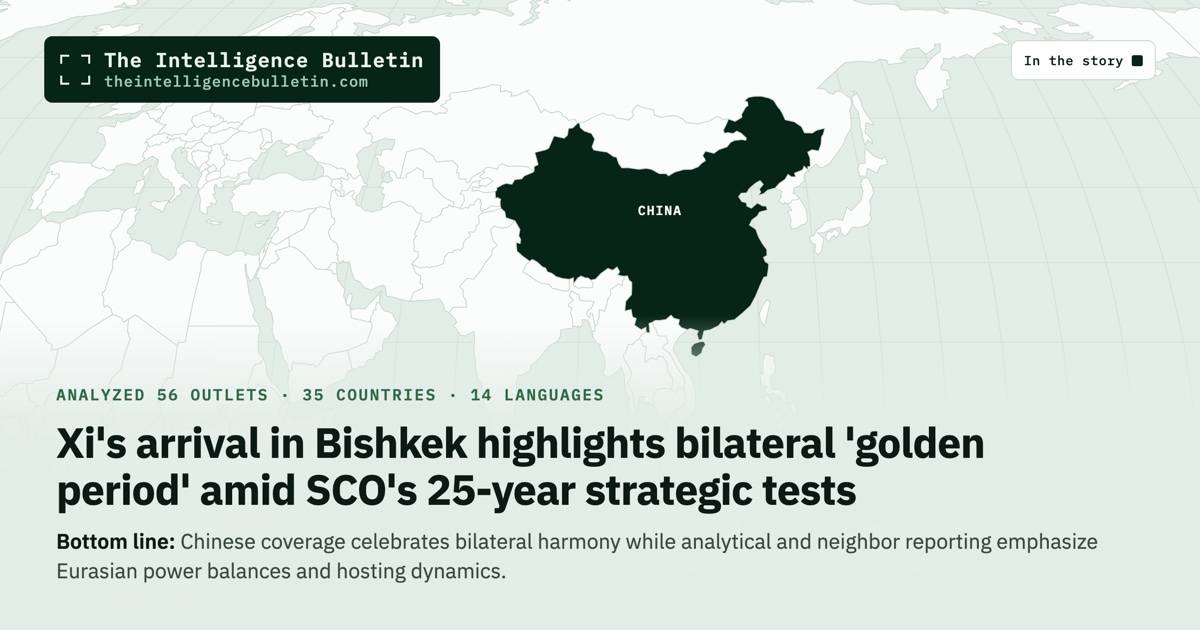
Map of the countries in the story: Xi's arrival in Bishkek highlights bilateral 'golden period' amid SCO's 25-year strategic tests
Chinese President Xi Jinping arrived in Bishkek on August 30 for a state visit to Kyrgyzstan and the Shanghai Cooperation Organization summit. Kyrgyz President Sadyr Japarov and his wife welcomed Xi and Peng Liyuan at Manas airport with a ceremonial reception including flags, honor guards, and traditional gifts. Xi delivered a written statement describing China-Kyrgyzstan ties as entering a ‘golden period’ of rapid development and looked ahead to SCO discussions. The summit marks the organization’s 25th anniversary amid regional security and connectivity priorities.

One Story. Many Angles.

🇰🇬
Kyrgyzstan
AKIpress
Original reporting
President Xi Jinping arrives in Kyrgyzstan on state visit
Read →
🇨🇳
China
Beijing Review
Carries Xinhua reporting
Xi kicks off state visit to Kyrgyzstan, hailing “golden period” of cooperation– Beijing Review
Read →
🇷🇺
Russia
RIA Novosti
RUSSIAN
Original reporting
Xi Jinping arrived in Kyrgyzstan
“Си Цзиньпин прибыл в Киргизию”
Read →
🇭🇰
Hong Kong
South China Morning Post
Commentary
Xi is in Bishkek for SCO summit. How does bloc fit China’s Eurasian strategy 25 years on?
Read →
🇰🇿
Kazakhstan
The Astana Times
Original reporting
Kyrgyzstan in Hot Seat: Japarov Hosts 25-Year SCO Milestone
Read →
5 sources · 4 independent accounts — some share the same news agency’s report
In Brief

Chinese coverage celebrates bilateral harmony while analytical and neighbor reporting emphasize Eurasian power balances and hosting dynamics.

Chinese state outlets uniformly present the arrival through Xi’s written speech and a signed article, stressing millennia-old friendship, infrastructure projects like the China-Kyrgyzstan-Uzbekistan railway, and mutual praise from Kyrgyz academics for high-level guidance. Kyrgyz domestic reporting anchors the same events in local leadership reactions and development alignment. Russian coverage stays narrowly logistical, detailing the airport protocol without broader commentary. In contrast, Hong Kong-based analysis situates the visit inside China’s 25-year Eurasian balancing act, citing trade volumes, Afghanistan risks, and hedging by Central Asian states between Moscow and Beijing. Kazakh neighbor reporting highlights Kyrgyzstan’s hosting prestige and the SCO’s multipolar rhetoric while noting Japarov’s domestic priorities and upcoming UN Security Council seat. The pattern shows originating Chinese material dominating celebratory bilateral language, while adjacent outlets supply the strategic and regional context absent from actor-country accounts. Convergence on the welcome ceremony and Xi’s phrasing coexists with divergence on whether the story is about friendship milestones or power projection in a shifting order.

Perspective Analysis

Chinese President Xi Jinping stepped off his plane at Manas International Airport in Bishkek on August 30 as Kyrgyz President Sadyr Japarov and his wife Aigul Japarova waited on the tarmac to greet him and First Lady Peng Liyuan. Flags of both countries flew, a red carpet stretched across the apron, an honor guard stood ready, and a military band played while young women in traditional Kyrgyz dress offered boorsok pastries and honey. Children performed a musical piece in Kyrgyz and Chinese. The ceremony marked the start of Xi’s state visit to Kyrgyzstan and his attendance at the Shanghai Cooperation Organization summit scheduled for the following days.

Xi delivered a written statement on arrival that described the relationship as having entered a “golden period” of rapid development. He noted the Tianshan Mountains as witnesses to millennia of exchanges, recalled 34 years of diplomatic ties that had reached the level of a comprehensive strategic partnership for a new era, and listed recent gains in trade volume and people-to-people contacts. He singled out the China-Kyrgyzstan-Uzbekistan railway as one project already delivering results that benefit both populations. Xi said he would hold in-depth talks with Japarov on bilateral cooperation and regional issues and expressed hope that the Bishkek SCO summit would allow members to review the organization’s 25-year record and chart its next steps.

Beijing Review carried the full text of that statement along with a separate signed article Xi had published days earlier in the Kyrgyz outlets Slovo Kyrgyzstana and Kabar National News Agency. The article framed the two countries as good neighbors sharing weal and woe and called for alignment between Kyrgyzstan’s National Development Program to 2030 and China’s 15th Five-Year Plan. It also previewed Xi’s third visit to the country and his intention to advance a China-Kyrgyzstan community with a shared future. Kyrgyz commentators quoted in the same coverage echoed the language of strategic guidance and mutual benefit. Sheradil Baktygulov of the Kyrgyz Institute of World Politics described high-level exchanges as providing clear direction. Former foreign minister Alikbek Jekshenkulov called the mutual understanding between the peoples “precious” and a foundation that could be passed to future generations. Economists Iskender Sharsheev and Tolonbek Abdyrov pointed to potential in digital economy, green energy, and infrastructure modernization.

The same Beijing Review dispatch reported that Japarov had told Xi upon greeting, “You are family. When you come to Kyrgyzstan, you are coming home.” That personal note appeared alongside the official protocol details also recorded by RIA Novosti, which listed the flags, carpet, guard of honor, and national ensembles without adding commentary on the substance of the talks ahead.

South China Morning Post placed the same arrival inside a longer assessment of the SCO’s role in Chinese diplomacy twenty-five years after its founding. The piece noted that China-Central Asia goods trade reached a record $106 billion the previous year, making Beijing the largest trading partner of the five Central Asian states combined for the first time. It quoted analysts on the organization’s focus on regional security, connectivity projects including the railway now under construction, and the need to manage risks from Afghanistan. The report also observed that Central Asian states continue to hedge between Russian security ties and Chinese economic engagement, citing the local saying that the region “wears Moscow’s armour, but its heart beats in Urumqi.”

The Astana Times framed the gathering around Kyrgyzstan’s role as host of the 25th-anniversary summit. It listed the expected attendance of the ten heads of state, including leaders from Belarus, India, Iran, Kazakhstan, Pakistan, Russia, Tajikistan, and Uzbekistan, and described the motto chosen by Japarov: “25 Years of the SCO: Together Towards Sustainable Peace, Development, and Prosperity.” The paper highlighted Kyrgyzstan’s interest in steering parts of the agenda toward ecological issues and mountain ecosystems while advancing its own domestic goals of raising living standards and securing a non-permanent seat on the UN Security Council in 2027.

These accounts converge on the basic sequence of the arrival and on the phrasing Xi used to characterize the bilateral relationship. They diverge in emphasis once the ceremony ends. Chinese state reporting centers on the language of friendship, concrete projects, and statements from Kyrgyz experts that reinforce the official narrative. Russian state reporting stays within the bounds of the airport protocol. The Hong Kong and Kazakh pieces add trade statistics, security concerns, and the hedging behavior of smaller states that do not appear in the Chinese or Russian dispatches. No source contradicts the others on any measurable fact of the arrival itself.

A reader who saw only the Chinese material would leave with a clear picture of the bilateral projects and rhetorical warmth but without the surrounding discussion of how Central Asian governments balance competing external partners or why the railway route matters for bypassing maritime chokepoints. A reader who saw only the South China Morning Post piece would understand the strategic stakes yet miss the specific language Xi chose and the Kyrgyz officials who endorsed it on record. The Astana Times account supplies the host-country vantage on prestige and agenda-setting that neither the Chinese nor the Russian coverage foregrounds.

What to Watch

The event itself is a scheduled high-level visit whose substance is captured most fully by the combination of the official Chinese text and the independent analytical framing. The Chinese accounts accurately reproduce the statements and projects the two governments wish to highlight; the additional reporting from Hong Kong and Kazakhstan correctly situates those statements inside a region where economic dependence on one power coexists with security arrangements anchored in another. The next concrete test will be the summit declaration itself, which is expected to address connectivity corridors, energy security, and the organization’s internal reforms. Those outcomes will show whether the “golden period” language translates into new agreements or remains the standard framing for a visit whose main result is the maintenance of existing channels.


Share this story

Istanbul hosts first formal meeting under Turkey-Saudi-Pakistan Mecca defence pact

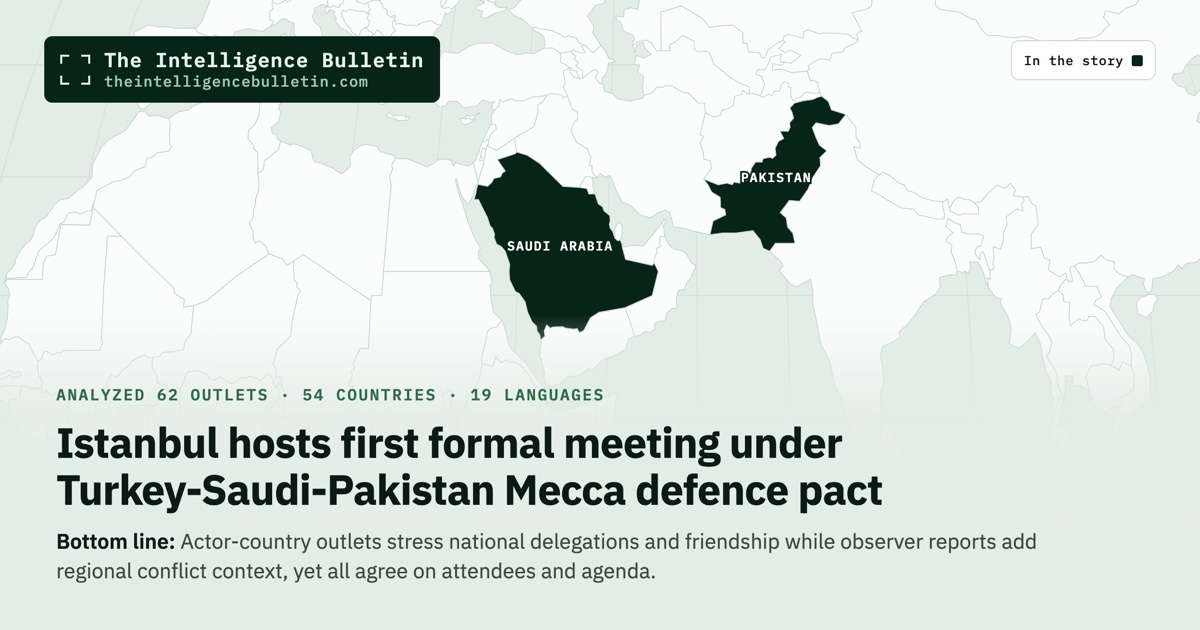
Map of the countries in the story: Istanbul hosts first formal meeting under Turkey-Saudi-Pakistan Mecca defence pact
Foreign and defence ministers plus military chiefs from Turkey, Saudi Arabia and Pakistan meet in Istanbul on 31 August for the inaugural session of the Strategic Political and Defence Committee created by the Makkah Joint Defence Agreement signed on 7 August. The pact establishes collective defence obligations and aims to deepen military cooperation, interoperability and defence industry ties. Pakistani officials highlight historic ties and regional stability; Turkish sources stress the venue and coordination mechanisms; outside reports note shared concerns over regional conflicts including Iran.

One Story. Many Angles.

🇵🇰
Pakistan
The Express Tribune
Original reporting
Pakistan, Saudi Arabia, Turkiye to hold first defence pact meeting in Istanbul on Monday
Read →
🇹🇷
Turkey
Hürriyet Daily News
Original reporting
Istanbul to host 1st Mecca Pact meeting
Read →
🇮🇱
Israel
The Jerusalem Post
Carries Turkish foreign ministry source reporting
Turkey, Saudi Arabia, Pakistan to hold first defense pact meeting, source says
Read →
🇶🇦
Qatar
Al Jazeera
Carries Reuters reporting
Top officials from Turkiye, Saudi Arabia, Pakistan to meet in Istanbul
Read →
🇲🇾
Malaysia
Free Malaysia Today
Carries Reuters reporting
Turkey, Saudi Arabia, Pakistan to hold first defence pact meeting
Read →
5 sources · 4 independent accounts — some share the same news agency’s report
In Brief

Actor-country outlets stress national delegations and friendship while observer reports add regional conflict context, yet all agree on attendees and agenda.

The reporting shows near-uniform agreement on the meeting’s participants, timing and core agenda across Pakistani, Turkish and international outlets, yet the framing reveals distinct national priorities that the pact itself does not erase. Pakistani coverage from The Express Tribune centres Islamabad’s delegation of Deputy Prime Minister Ishaq Dar, Defence Minister Khawaja Asif and Field Marshal Asim Munir, framing participation as affirmation of longstanding bilateral bonds and a contribution to Muslim-world stability. Turkish reporting in Hürriyet Daily News presents the event as a diplomatic achievement hosted in Istanbul, listing Turkey’s own ministers and chief of staff while detailing expected outcomes such as a secretariat roadmap and joint production plans. Jerusalem Post and Free Malaysia Today, both drawing on Turkish foreign ministry sources, add context about concerns over the Iran conflict and the pact’s openness to expansion, including Egypt, without the actor-state emphasis on prestige or friendship. Al Jazeera situates the gathering inside broader Middle East realignments, noting the collective-defence clause and potential for further Sunni coordination. No outlet contradicts the basic facts of who attends or what the pact requires; the divergence lies in what each chooses to foreground—the venue, the delegation, or the strategic backdrop—producing a composite picture of an alliance whose members still speak first from their own capitals.

Perspective Analysis

The first formal session of the Strategic Political and Defence Committee established under the Makkah Joint Defence Agreement opened in Istanbul on 31 August. Foreign and defence ministers together with the chiefs of staff from Turkey, Saudi Arabia and Pakistan gathered for the inaugural meeting, according to statements from the Turkish foreign ministry and Pakistan’s Ministry of Foreign Affairs. The three countries had signed the pact on 7 August in Mecca, where Turkish President Recep Tayyip Erdogan, Saudi Crown Prince Mohammed bin Salman and Pakistani Prime Minister Shehbaz Sharif formalised the accord at Al-Safa Palace.

The agreement creates a collective defence obligation under which an armed attack against any signatory is treated as an attack against all three. Its stated purpose is to strengthen joint deterrence, promote regional security and expand cooperation in military capabilities. Turkish diplomatic sources listed the expected Turkish participants as Foreign Minister Hakan Fidan, Defence Minister Yaşar Güler and Chief of General Staff Selçuk Bayraktaroğlu. Saudi Arabia was expected to send Foreign Minister Faisal bin Farhan, Defence Minister Khalid bin Salman and Chief of General Staff Fayyadh bin Hamed Al-Ruwaili. Pakistan’s delegation included Deputy Prime Minister and Foreign Minister Ishaq Dar, Defence Minister Khawaja Muhammad Asif and Chief of Defence Forces Field Marshal Asim Munir.

The committee’s opening session was scheduled to address international security issues, efforts to improve interoperability among the armed forces, deeper cooperation in the defence industry including joint production and research, and stronger joint counterterrorism work. Turkish sources indicated the meeting would also establish a framework for a secretariat and other coordination mechanisms while drawing up a roadmap for implementing the pact. Pakistan’s Foreign Ministry statement noted that Dar had arrived in Istanbul after concluding a visit to the United Kingdom and that Munir had reached Turkey earlier on an official visit. Upon arrival, Dar visited the shrine of Hazrat Abu Ayyub Al-Ansari and offered prayers for Pakistan’s security and for unity across the Muslim world.

The pact emerged amid descriptions of growing instability across the signatories’ regions. Turkish and international reporting linked the agreement to concerns over the ongoing US and Israeli military campaign against Iran, which began six months earlier and has contributed to a global energy crisis through Iranian missile activity targeting Gulf oil facilities. The three countries are described in several accounts as Sunni Muslim states with longstanding ties to the United States, though the pact itself is presented as open to further members and not intended to replace existing alliances.

Coverage of the meeting converged on the core facts of timing, location and participants. All five outlets that reported the story carried the same roster of ministers and military chiefs and the same description of the pact’s collective defence clause. Turkish diplomatic sources supplied the agenda details on interoperability, defence industry cooperation and the secretariat framework to Hürriyet Daily News, The Jerusalem Post and Al Jazeera. Pakistan’s official statements supplied the names of its delegation and the emphasis on historic friendship to The Express Tribune.

The accounts diverged in emphasis rather than in disputed facts. The Express Tribune, drawing directly from Pakistan’s Foreign Ministry and Inter-Services Public Relations releases, led with the composition of Islamabad’s delegation and closed its account by quoting the ministry’s statement that participation reflected “historic bonds of friendship” and a desire for “lasting regional peace and stability.” It also noted Dar’s visit to the shrine and Munir’s separate arrival. Hürriyet Daily News opened by declaring that Istanbul would host the first Mecca Pact meeting and foregrounded Turkey’s expected representatives before listing the Saudi and Pakistani participants. It described the session as a step toward deepening military cooperation and coordinating on regional security, then detailed the anticipated outcomes around a secretariat and joint production.

The Jerusalem Post and Free Malaysia Today both attributed their core details to a Turkish foreign ministry source and carried identical language on the agenda items and the pact’s collective defence provision. Both added context on shared concerns about Israel and Iran that was absent from the Pakistani and Turkish actor accounts. Al Jazeera combined Turkish official statements with wire reporting to place the gathering inside wider Middle East realignments, noting the pact’s similarity to NATO’s Article 5 and mentioning potential expansion to Egypt and interest from Bangladesh. None of the five articles contradicted the others on who would attend or what the pact requires.

The composite picture that emerges is therefore tighter on operational details than any single national account supplies on its own. The Turkish and Pakistani outlets each add concrete information on their own governments’ participants and immediate logistics that outside observers do not repeat. The observer accounts add the surrounding conflict context and the language of possible enlargement that the actor states do not foreground. Because the core claims about attendance, date and the pact’s text appear in every independent reporting chain, those elements stand as the settled record. The differences in framing reflect the vantage of each capital rather than competing versions of events.

What to Watch

The fullest account is therefore the one that keeps the delegation lists from Hürriyet and The Express Tribune alongside the regional conflict backdrop supplied by the Jerusalem Post, Al Jazeera and Free Malaysia Today. This combined record shows three governments moving from a signed declaration to an operational committee within three weeks while still describing the same step through the priorities of their own foreign ministries. The next meetings will test whether the secretariat and joint production plans materialise or remain aspirational language.


Share this story

US Hits Iranian Island Launchers; Tehran Promises Punishment for Aggression

Map of the countries in the story: US Hits Iranian Island Launchers; Tehran Promises Punishment for Aggression
US forces struck Iranian rocket launchers on Larak Island in the Strait of Hormuz on August 30, 2026, the first direct attack in over a month. Iranian Revolutionary Guard Corps statements reported several soldiers and civilians killed or wounded and pledged retaliation against the aggressor. US officials described the targets as preparing to mine the strait, while Iran rejected the account as pretext. The strikes occur amid an ongoing US-Iran confrontation over Hormuz access and sanctions.

One Story. Many Angles.

🇮🇷
Iran
Press TV
Original reporting
IRGC: US terrorist attack on Larak Island will be answered, aggressor to be punished
Read →
🇺🇸
United States
Antiwar.com
Carries US officials and IRGC statements via media reporting
US Bombs Iran’s Larak Island; IRGC Vows Response – News From Antiwar.com
Read →
🇶🇦
Qatar
Al Jazeera
Original reporting
US strikes Iran’s Larak Island in first attack in weeks
Read →
🇹🇷
Turkey
Anadolu Agency
Carries IRGC statements reporting
Iran’s Revolutionary Guards say US attack on Larak Island killed and injured several; vows response
Read →
🇩🇪
Germany
Deutsche Welle
Carries AFP reporting
Iran war: US military strikes Iran’s Larak Island — reports
Read →
5 sources · each independently reported
In Brief

Western sources stress defensive necessity against mining; Iranian accounts call it unprovoked terrorism on sovereign soil.

Reporting across the set converges on the strike occurring and the IRGC’s immediate vow of response but parts sharply on motive and legitimacy. US-linked accounts frame the action as a targeted response to imminent mining threats in a vital shipping lane, with a Navy captain’s statement to AFP and anonymous officials supplying the operational detail. Iranian state media, by contrast, labels the same event a deliberate terrorist strike by an American-Zionist enemy acting from desperation, citing specific casualty figures from Tasnim and invoking Quranic language of vengeance. Regional and European outlets occupy the middle ground, noting the timing as the first escalation in weeks while embedding it in the larger Hormuz blockade dispute without endorsing either justification. Antiwar.com stands apart by relaying both the US targeting claim and the IRGC casualty report while recalling prior Iranian strikes on US positions, underscoring domestic skepticism. The consistent thread is IRGC confirmation of impact and intent to answer, yet the absence of any independent verification of launcher activity or exact tolls leaves each side’s narrative resting on its own sourcing chain. This pattern shows how the same bare sequence acquires entirely different political weight depending on whether the outlet treats Hormuz security or Iranian sovereignty as the primary stake.

Perspective Analysis

US forces struck two rocket launchers on Larak Island in the Strait of Hormuz on the night of August 30, 2026. The island sits at the northern edge of the strait, a narrow passage through which much of the world’s oil traffic passes between the Persian Gulf and the open ocean. Iranian state media reported explosions near the site that evening. The Islamic Revolutionary Guard Corps later confirmed the attack, stating that it had martyred and wounded several of its combatants and civilians.

A US Navy captain, speaking to AFP, described the targets as launchers observed preparing to fire rockets equipped with sea mines into the strait. An unnamed US official told Al Jazeera the same. The strikes marked the first direct US action against Iranian territory in more than a month, according to accounts in both outlets. Iranian officials rejected the stated purpose. Press TV quoted the IRGC Public Relations Department calling the action a terrorist strike by the American-Zionist enemy, carried out in desperation over domestic failures and declining regional standing. The department added that the sons of Islamic Iran would answer the aggression and punish the aggressor, opening its statement with the Quranic verse that God will take vengeance upon the criminals.

IRGC spokesperson Hossein Mohebbi described the strike as a strategic and fatal error committed in the middle of Washington’s economic war on Iran. He warned that the United States would pay consequences in both economic and military arenas. Tasnim News Agency, cited in Press TV’s report, put the initial toll at two martyred and two wounded. Other outlets carried the IRGC’s broader statement that several soldiers and civilians had been killed or injured without specifying numbers.

The IRGC statement appeared across multiple accounts. Al Jazeera, Anadolu Agency, Deutsche Welle and Antiwar.com all quoted or summarized the vow that the act would be responded to and the aggressor punished. Antiwar.com added that during an earlier round of strikes last month the IRGC had damaged US bases and inflicted hundreds of casualties on American troops, mainly in Jordan. Deutsche Welle placed the Larak action inside the larger pattern of a US naval blockade imposed on Iran in April after Iran restricted most international shipping through the strait in late February. Al Jazeera noted that attacks on ships in the strait had continued almost daily even as the United States claimed to have cleared mines from international routes and to be protecting millions of barrels of oil moving through the waterway.

The accounts converge on the occurrence of the strike, the IRGC’s casualty claim, and its explicit threat of retaliation. They diverge on the motive and legitimacy attached to the same sequence of events. US-linked reporting presents the action as a narrow response to an imminent threat against a critical shipping lane. Iranian state media presents it as unprovoked aggression against sovereign territory that forms part of Iran’s front line in the defense of the Persian Gulf. A reader limited to one of those frames would miss the operational detail supplied by the Navy captain and the specific casualty figures supplied by Tasnim. A reader limited to the other would miss the explicit US assertion that the launchers were minutes from firing mines into the strait.

Regional and European coverage occupies a narrower middle position. Al Jazeera records the timing as the first escalation in weeks and embeds the event in the ongoing Hormuz blockade dispute without endorsing the US rationale or the Iranian characterization of terrorism. Deutsche Welle aggregates wire reporting to note both the captain’s statement on launcher preparations and the IRGC vow, while situating the strike inside US efforts to enforce the blockade and Iranian assertions that the strait remains under complete Iranian control. Anadolu Agency relays the IRGC casualty and vow language with little additional framing, foregrounding the human cost in a manner consistent with its neighbor-state perspective.

Antiwar.com differs from both the US official line and the Iranian state line by carrying the targeting claim alongside the IRGC casualty report and by recalling the earlier Iranian strikes on US positions. Its account therefore supplies the domestic American skepticism that state-aligned outlets on either side do not foreground. The consistent element across all five sources remains the IRGC’s on-record confirmation that the island was hit, that people were hurt, and that a response would follow. No independent verification of launcher activity or exact casualty toll appears in any of the published pieces.

The US claim that the launchers were preparing to mine the strait rests on statements from US officials alone. The IRGC’s description of the strike as a terrorist act and its specific casualty count rest on Iranian official statements alone. The shared facts—the strike itself, the reported injuries, and the vowed retaliation—appear in reporting chains that cross borders and editorial lines. A reader who encounters only the Iranian framing will conclude that Washington acted without provocation to damage Iranian sovereignty. A reader who encounters only the US framing will conclude that Tehran was on the verge of disrupting global energy flows and that the response was narrowly defensive. Both conclusions omit the corroboration the other side supplies for the bare sequence of events.

What to Watch

The most reliable account of what occurred is therefore the one that holds the strike happened, that the IRGC reported casualties, and that the IRGC committed itself to retaliation, while treating the stated US purpose as an unattributed operational claim and the Iranian characterization of terrorism as an official Iranian assertion. The interest on the US side is to present the action as protective of international shipping. The interest on the Iranian side is to present it as further evidence of aggression that justifies further resistance. The next development likely to matter is whether the IRGC follows through on its stated intent with strikes on US positions in the region, as it did after earlier exchanges. Such a response would test whether the current focus on sanctions and blockade can contain the confrontation or whether the direct military cycle resumes at higher intensity. The Strait of Hormuz remains the physical location where those choices intersect with global energy supply.


Share this story

Turkish aid and local arrests dominate coverage of Northern Cyprus ferry disaster

Map of the countries in the story: Turkish aid and local arrests dominate coverage of Northern Cyprus ferry disaster
A passenger ferry carrying around 267 people capsized shortly after leaving Kyrenia for Taşucu on August 30. Rescue teams from Northern Cyprus and Turkey recovered most passengers amid rough seas. At least seven or eight deaths were reported with searches ongoing for missing people. Northern Cyprus Prime Minister Üstel announced the captain and seven crew members were detained as an investigation began.

One Story. Many Angles.

🇹🇷
Turkey
Daily Sabah
Carries Agencies reporting
Ferry carrying 260 people sinks off Turkish Republic of Northern Cyprus
Read →
🇨🇾
Cyprus
Cyprus Mail
Original reporting
Passenger ferry capsizes off Kyrenia
Read →
🇨🇾
Cyprus
Kıbrıs Postası
TURKISH
Original reporting
Prime Minister Üstel announces that the ship captain and 7 officials have been arrested
“Başbakan Üstel, gemi kaptanı ve 7 görevlinin tutuklandığını açıkladı”
Read →
🇹🇷
Turkey
Anadolu Agency
Original reporting
Türkiye mobilized all resources after passenger ship capsize off Northern Cyprus: President Erdogan
Read →
🇭🇰
Hong Kong
South China Morning Post
Carries Associated Press reporting
At least 8 dead, 22 missing as ferry capsizes off northern Cyprus
Read →
5 sources · each independently reported
In Brief

Turkish sources center presidential mobilization and solidarity while Cypriot reports lead with arrests of the captain and crew.

Turkish state-linked reporting consistently frames the disaster as a national emergency met with rapid mobilization from Ankara, quoting President Erdoğan directly on the deployment of coast guard, military aircraft and ships. Northern Cyprus outlets instead lead with local accountability, detailing Prime Minister Üstel’s statements that the captain and seven others were arrested and that every aspect of the incident will be investigated. English-language Cyprus Mail reporting stays close to the scene, tracking exact rescue counts and the cancellation of Victory Day events while noting Turkish Cypriot officials on site. The South China Morning Post aggregates casualty figures from Turkish sources and adds a passenger account of a possible explosion, giving the only mention of a potential cause. The pattern shows actor-driven narratives from Turkey emphasizing solidarity and resources while Cypriot coverage prioritizes immediate local consequences and arrests; both chains agree on the scale of the rescue effort and Turkish assistance but diverge sharply on what the story is primarily about.

Perspective Analysis

On the afternoon of August 30 a catamaran passenger ferry named Filo Jet left the port of Kyrenia bound for the Turkish mainland port of Taşucu. The vessel carried 259 passengers and eight crew members. Roughly 15 minutes after departure and about four miles offshore it began taking on water in rough seas. The ferry later capsized. Northern Cyprus coast guard boats reached the scene within 15 to 20 minutes. Additional vessels already at the port, civilian boats in the area, helicopters and a second passenger vessel dispatched from Kyrenia joined the evacuation. Turkish coast guard units, Turkish military aircraft and helicopters, unmanned aerial vehicles, a Turkish naval patrol vessel and a Turkish assault boat also took part. Turkish Cypriot civil defense and police divers worked alongside them. Ambulances and a medical tent waited at the new Kyrenia port for arriving passengers. Events planned in Kyrenia to mark the anniversary of the 1922 Battle of Dumlupinar were cancelled.

Rescue teams brought 159 people ashore by mid-afternoon according to Kyrenia mayor Murat Senkul. Turkish Cypriot prime minister Unal Üstel later stated that 237 people had been rescued. At least eight people died and searches continued for 22 others still missing. One rescued passenger told local media a blast occurred at the bow before the vessel rolled over. Northern Cyprus transport minister Erhan Arıklı said investigators had not yet determined the cause and noted the rough sea conditions. Turkish Cypriot health authorities positioned ambulances at the port and warned bathers away from the area because of irregular sea movements.

Üstel described the incident as the largest maritime disaster in Cyprus history. He said the state had mobilized every available resource from the first moment and that search operations would continue without pause until all missing people were found. A search-and-rescue ship capable of operating at 1,000 meters depth was en route from Turkey. Üstel thanked President Recep Tayyip Erdoğan for a personal call of condolence and for pledging unlimited Turkish support. He also thanked Turkish vice president Cevdet Yılmaz for remaining in close contact and Nationalist Movement Party leader Devlet Bahçeli for expressions of solidarity. Üstel stated that an investigation had begun immediately and that the captain together with seven other crew members had been detained. He pledged that every aspect of the incident would be examined and that no one would be spared if negligence or responsibility were established.

Turkish state reporting centered on the scale of Ankara’s response. Anadolu Agency carried President Erdoğan’s statement that Turkey had mobilized all resources. Daily Sabah described the rapid dispatch of coast guard and civil defense teams and the mobilization of every vessel in the area. Both outlets quoted Arıklı on the timeline and the priority of bringing passengers ashore without loss of life. Cyprus Mail reporting stayed with the local response: the exact number of people brought ashore at each stage, the presence of Üstel and Arıklı at the port, the fleet of ambulances and the cancellation of public events. Kıbrıs Postası published Üstel’s full statement, including the arrest announcement and the description of the event as Cyprus’s worst maritime disaster. South China Morning Post aggregated casualty totals from Turkish sources and added the passenger account of an explosion at the bow.

The accounts converge on several concrete points. Multiple independent reporting chains record the same passenger and crew total, the same approximate distance offshore when the vessel began taking water, the same composition of the rescue force that included both Northern Cyprus and Turkish units, and the same announcement that the captain and seven crew members had been detained. Turkish assistance appears in every account that reached the afternoon hours. The divergence lies in emphasis rather than in disputed facts. Turkish state-linked outlets foreground Erdoğan’s direct involvement and the breadth of Turkish assets deployed. Northern Cyprus coverage, especially in the Turkish-language press, foregrounds the immediate opening of a local criminal investigation and Üstel’s explicit commitment to pursue any negligence without regard to rank. The English-language Cyprus Mail tracks operational details on the ground without quoting the Turkish president. The single international outlet in the set supplies the only published passenger description of a possible mechanical or explosive trigger.

A reader limited to Turkish state sources would conclude that the story is primarily one of coordinated state response and bilateral solidarity. A reader limited to Northern Cyprus outlets would conclude that the story is primarily one of local accountability and the opening of an investigation into possible crew failures. Both conclusions contain elements that are corroborated across chains, yet neither captures the full picture that emerges only when the reports are placed side by side. The same prime minister both thanked Ankara for military and coast guard support and ordered the detention of the captain and seven crew members. The same rescue operation that brought most passengers to safety also produced the first arrests. The passenger account of a blast appears only in the single observer report and remains unconfirmed in any official statement from either side.

The most firmly supported elements are therefore the ones that appear in both the Turkish and the Northern Cyprus reporting chains: the vessel’s departure and capsizing details, the composition and scale of the rescue force, the approximate casualty range, and the fact that Turkish units participated alongside local teams. The arrest announcement originates in Üstel’s own public statement and is carried by both local and international outlets. The Turkish mobilization statement originates in Erdoğan’s public remarks and is carried by Turkish state outlets. Each side therefore supplies primary sourcing for the element it chooses to lead with, and the two elements are not in conflict on the record.

The divergence in framing reflects the institutional positions of the outlets rather than any factual contradiction in the underlying events. Northern Cyprus authorities face direct responsibility for regulating the ferry service and for the safety of residents and visitors. Turkish authorities face the political task of demonstrating support for the Turkish Cypriot administration without appearing to override local jurisdiction. The resulting coverage pattern shows each side foregrounding the dimension that aligns with its immediate institutional interest. The record as published supplies no basis for choosing one emphasis over the other as more accurate; it supplies instead the concrete record that both emphases rest on the same corroborated sequence of departures, capsizing, rescue and detention.

What to Watch

What happens next will be determined by the investigation Üstel announced. The final casualty count, the technical findings on the vessel’s condition, and any charges that follow the detentions will test whether the local accountability narrative or the solidarity narrative receives the stronger confirmation in the coming days. The reporting already available makes clear that both the rescue operation and the criminal inquiry are running in parallel from the same set of authorities.


Share this story