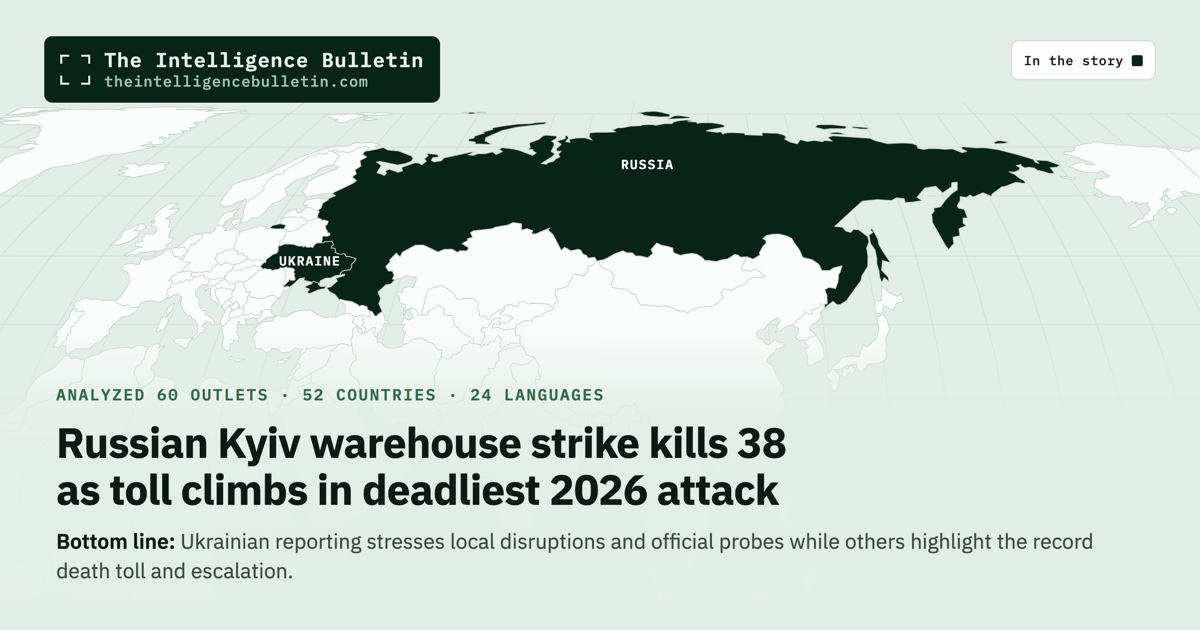
Russian Kyiv warehouse strike kills 38 as toll climbs in deadliest 2026 attack

Map of the countries in the story: Russian Kyiv warehouse strike kills 38 as toll climbs in deadliest 2026 attack
Russian forces struck a warehouse near Kyiv on August 29, triggering a large detonation that killed at least 38 people according to Ukrainian officials. The site stored munitions, leading to secondary explosions, road closures and evacuations. Ukrainian authorities opened negligence probes into local officials. The attack is described across sources as the deadliest single Russian strike on Ukraine this year.

One Story. Many Angles.

🇺🇦
Ukraine
ZN.ua
UKRAINIAN
Original reporting
Drone attack on an enterprise near Kyiv caused detonation – there are deaths, Kyiv-Chop route blocked
“Атака дрона на підприємство під Києвом спричинила детонацію – є загиблі, трасу Київ Чоп перекрили”
Read →
🇩🇪
Germany
Rhein-Neckar-Zeitung
GERMAN
Carries dpa reporting
Ukraine War: Dozens dead after attack on ammunition depot near Kyiv
“Ukraine-Krieg: Dutzende Tote nach Angriff auf Munitionslager bei Kiew”
Read →
🇺🇸
United States
News4JAX
Carries Associated Press reporting
Death toll rises to 38 from Russia’s deadliest attack on Ukraine this year
Read →
🇶🇦
Qatar
Al Jazeera
Original reporting
Russian attack on warehouse near Ukraine’s Kyiv kills at least 27
Read →
🇦🇺
Australia
Australian Financial Review
Carries AP reporting
Ukraine-Russia war: Moscow strike on Ukrainian warehouse kills 37 in the war’s deadliest attack this year
Read →
5 sources · each independently reported
In Brief

Ukrainian reporting stresses local disruptions and official probes while others highlight the record death toll and escalation.

The selected reporting converges on the core facts of a Russian drone or missile strike hitting a munitions warehouse near Kyiv, with the death toll climbing from initial reports of 27 to 38 and the incident labeled the war’s deadliest single attack of 2026. Ukrainian outlet ZN.ua stands apart by anchoring the story in immediate local consequences—the detonation, blocked Kyiv-Chop highway and evacuation of 200 residents—while foregrounding domestic accountability through criminal proceedings against officials for alleged negligence. German, US, Qatari and Australian coverage instead emphasizes the rising casualty count and Russian responsibility, treating the event as a sharp escalation metric rather than a site-specific emergency. This split reveals how proximity shapes emphasis: the Ukrainian source alone supplies details of traffic disruption and internal investigations that other outlets omit, even as all chains agree the warehouse contained ammunition and the strike originated from Russian forces. The absence of any Russian outlet in the set leaves official Moscow statements visible only through the Ukrainian and international relays that carried them. The pattern shows a factual consensus on attribution and scale alongside a clear divide between domestic disruption reporting and international body-count framing.

Perspective Analysis

Russian forces struck a warehouse on the outskirts of Kyiv on 29 August 2026. The site held ammunition, and the impact set off a chain of secondary detonations that killed civilians in the surrounding area. Ukrainian officials placed the final death toll at 38, describing the strike as the single deadliest Russian attack on Ukraine in 2026. Initial reports had put the number at 27 before it climbed through the following day. The warehouse sat near the Kyiv-Chop highway, and traffic on that route was halted while emergency crews worked.

Ukrainian reporting from the scene recorded that a drone delivered the strike. The resulting blast forced the evacuation of roughly 200 residents and prompted authorities to open criminal proceedings against local officials on suspicion of negligence in protecting the site. The same account noted that the enterprise functioned as a storage point for military supplies, which explains the scale of the secondary explosions. International outlets carrying statements from Ukrainian authorities described the target in similar terms as a munitions depot or warehouse, confirming the presence of ammunition without adding independent verification of its contents.

The death toll figure originated with Ukrainian emergency services and was carried forward by multiple independent reporting chains. News4JAX and the Australian Financial Review both cited Ukrainian authorities when they recorded 38 dead and labeled the attack the deadliest of the year to date. Al Jazeera published an earlier count of at least 27 while the scene was still being cleared. Rhein-Neckar-Zeitung reported dozens killed in its initial dispatch. The convergence on Russian responsibility for the strike and on the munitions stored at the site appears across the Ukrainian, German, American, Qatari and Australian accounts examined.

A reader who followed only the Ukrainian source would learn that traffic on the Kyiv-Chop route remained blocked hours after the blast and that prosecutors had opened cases against officials for possible failures in evacuation planning or site security. That same reader would not encounter the explicit framing of the incident as a new record in annual casualties. A reader limited to the German, American, Australian or Qatari accounts would register the rising body count and the description of the strike as an escalation metric but would miss the blocked highway, the evacuation of 200 people and the domestic negligence inquiries. Those details appear only in the ZN.ua dispatch and are absent from the other four pieces.

The four non-Ukrainian outlets align closely with one another on the core sequence: a Russian strike, a munitions site, civilian deaths that increased over roughly 24 hours, and the yearly record. Three of them trace directly or indirectly to the same agency copy, which accounts for the similarity in phrasing around the death toll and the “deadliest attack this year” description. The German piece situates the event inside the longer war without adding new local particulars. The Australian and American pieces treat the number 38 as the central development. Al Jazeera foregrounds civilian impact at the lower initial count.

The Ukrainian account supplies the only on-record mention of criminal proceedings against officials. That claim stands as single-source within the set examined. The other outlets do not contradict it; they simply do not report it. The absence of any Russian outlet from the selected coverage means statements from Moscow appear only where Ukrainian or international pieces chose to include them, which was sparingly and without direct quotation in the material reviewed.

What to Watch

The convergence on the strike’s origin, the nature of the target and the final casualty total provides the strongest ground for treating those elements as the settled spine of the event. The divergence in emphasis tracks the location of the reporting: proximity yields operational consequences and internal accountability questions, while distance yields a focus on cumulative human cost and strategic implication. A reader assembling the picture from all five accounts therefore receives both the immediate disruption on the ground and the wider measure of the attack’s place in the year’s fighting. The single-source detail on the negligence probes adds a layer of domestic response that the toll-focused accounts leave unaddressed, yet it does not alter the corroborated facts about what struck the warehouse or how many people died.
Share this story

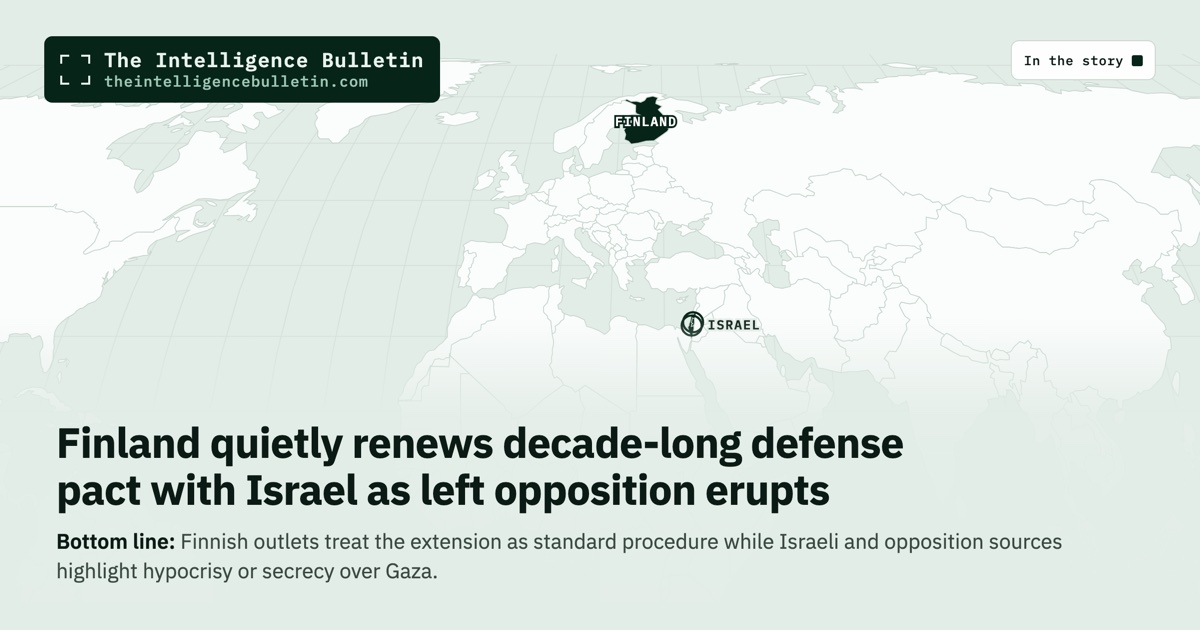
Finland quietly renews decade-long defense pact with Israel as left opposition erupts

Map of the countries in the story: Finland quietly renews decade-long defense pact with Israel as left opposition erupts
Finland and Israel extended a 2013 defense cooperation memorandum until 2034 without public announcement by the Defense Ministry. The pact covers research, development and procurement of military equipment and includes an annual coordination group. Finland is also acquiring Israel’s David’s Sling air-defense system. Left-wing opposition parties condemned the secrecy and timing during the Gaza war, while the defense minister called it routine policy with 40 countries.

One Story. Many Angles.

🇫🇮
Finland
Yle
SWEDISH
Original reporting
Finland and Israel signed agreement on defense cooperation until 2034
“Finland och Israel undertecknade avtal om försvars­samarbete fram till 2034”
Read →
🇮🇱
Israel
Ynetnews
Original reporting
Finland’s double game: accuses Israel of ‘Gaza genocide,’ buys David’s Sling for mill
Read →
🇫🇮
Finland
Helsinki Times
Original reporting
Opposition condemns Finland’s secretive 10-year Israel defence pact as a ‘historic shame’
Read →
🇦🇿
Azerbaijan
Azernews
Carries Yle reporting
Finland, Israel secretly sign memorandum on defense cooperation
Read →
🇺🇸
United States
New York Post
Carries Yle reporting
Finland quietly extends defense ties with Israel, sparking backlash from left
Read →
5 sources · 4 independent accounts — some share the same news agency’s report
In Brief

Finnish outlets treat the extension as standard procedure while Israeli and opposition sources highlight hypocrisy or secrecy over Gaza.

The reporting across these outlets reveals a straightforward bilateral security arrangement treated as unremarkable policy in Finnish sources but reframed as evidence of duplicity or secrecy elsewhere. Yle reports the extension as a factual administrative step, noting the Defense Ministry’s failure to inform the Foreign Ministry or announce it publicly, while placing the timing against the backdrop of Gaza casualties and international allegations against Israel. Helsinki Times focuses on domestic opposition fury, quoting Green League and Left Alliance leaders who label the move a historic shame and demand parliamentary answers on who approved it. Ynetnews casts the same facts as Finnish hypocrisy, highlighting the David’s Sling purchase and criticism of Israel on Gaza while strategic ties deepen. Azernews and the New York Post relay the core details with minimal added framing, the latter emphasizing the left backlash for a US audience. The convergence on the pact’s existence and lack of announcement is clear, yet the sources diverge sharply on whether secrecy reflects normal procedure or deliberate concealment tied to Gaza. Israeli commentary treats European criticism and continued procurement as proof that rhetoric diverges from interests; Finnish government voices insist capability needs dictate choices independent of politics. This pattern shows how one country’s routine defense housekeeping becomes another’s story of inconsistency or shame depending on the outlet’s vantage.

Perspective Analysis

Finland and Israel extended an existing memorandum of understanding on defense industry cooperation that had first been signed in 2013 and renewed in 2019. The new version, proposed by Finland in early 2024, runs until 2034 and lengthens the renewal cycle from five years to ten. The document covers joint research, development and procurement of military equipment. It also establishes a coordination group that meets at least once a year, with Finland’s representative drawn from the Defense Ministry’s resources policy department. The Defense Ministry approved the extension in late 2024 but made no public announcement of the step.

Finland is already acquiring Israel’s David’s Sling air-defense system under an earlier decision taken by the previous government. The purchase, valued at approximately 317 million euros, is scheduled to enter service next year. Defense Minister Antti Häkkänen described the memorandum as one of forty similar cooperation documents Finland maintains with countries where it conducts defense trade. He stated that the arrangement simply supports existing procurement projects and contains no dramatic shift in policy. Commander of the Defense Forces Janne Jaakkola added that operational information obtained through the partnership has proven valuable and that David’s Sling performed best among the systems evaluated on capability grounds.

The extension occurred while Israel’s military campaign in Gaza continued. By early 2024 that campaign had already produced tens of thousands of Palestinian deaths. Finnish public broadcaster Yle placed the timing of the renewal against this backdrop and noted that Finland’s Defense Ministry had not referred the matter to the Foreign Ministry in the manner of the 2019 renewal. An Israeli Defense Ministry statement included in the memorandum text described the relationship as resting on common values and developing into a unique partnership, with Finland positioned as Israel’s gateway to NATO and European markets.

Left-wing opposition parties reacted sharply once the extension became known. Green League chair Sofia Virta called the government’s approach a historic shame and argued that demands for pressure on Israel had instead produced deeper cooperation. Left Alliance chair Minja Koskela described the silence surrounding the decision as unsurprising given what she termed an intolerably shameful line and announced plans to submit parliamentary questions on who within the government had been informed. Both parties linked the memorandum to other recent Finnish moves, including the decision not to renew multi-year funding for UNRWA.

Israeli coverage framed the same facts differently. Ynetnews presented the extension and the David’s Sling purchase as evidence of a double game, noting that Finnish criticism of Israel’s Gaza operations, including accusations of genocide, continued even as defense ties were placed on a longer-term footing. The report highlighted the gap between public diplomatic messaging and the strategic decision to maintain procurement from Israeli suppliers.

Azernews carried a concise account of the memorandum’s scope and the David’s Sling purchase without additional commentary on either Finnish domestic reactions or Israeli interpretations. The New York Post similarly relayed the extension and the opposition response, foregrounding the left-wing backlash for its American readership.

The accounts converge on several core elements. Multiple independent reporting chains confirm that the memorandum was extended until 2034, that the Defense Ministry issued no public notice, and that Finland is proceeding with the David’s Sling acquisition. They also agree that opposition parties condemned the move in strong terms. Where the sources diverge is in the significance attached to the absence of announcement and to the broader context of the Gaza war. Yle treats the lack of public notice as an administrative detail while recording the surrounding allegations against Israel. Helsinki Times centers the opposition statements that portray the extension as deliberate concealment. Ynetnews treats the combination of criticism and continued procurement as proof that European rhetoric does not constrain strategic interests. Finnish government voices insist that procurement decisions rest on military performance and cost rather than political alignment.

A reader limited to one national outlet would therefore receive different impressions of motive. Finnish government-aligned or public-broadcast reporting presents the extension as ordinary housekeeping among long-standing partners. Opposition-focused reporting emphasizes secrecy and timing during an ongoing conflict. Israeli reporting stresses inconsistency between stated positions and actual purchases. The underlying transaction itself appears in every account that covered the story.

What to Watch

The most substantiated reading is that Finland completed a standard administrative renewal of an existing framework because it judged the resulting access to technology and information useful for its own defense needs. The government statements on file name capability and cost as the decision criteria and place the memorandum alongside forty comparable arrangements. The opposition criticism, while politically coherent, rests on an interpretation of silence as concealment rather than on any documented deviation from normal procedure. The Israeli framing correctly notes the continued procurement but does not demonstrate that Finnish officials altered their public stance on Gaza to accommodate the deal. The pattern across the five outlets shows routine defense cooperation surviving European political criticism of Israel, a separation of security interests from diplomatic rhetoric that predates this particular renewal and is unlikely to change while Finland continues to assess Israeli systems as superior on technical grounds.


Share this story

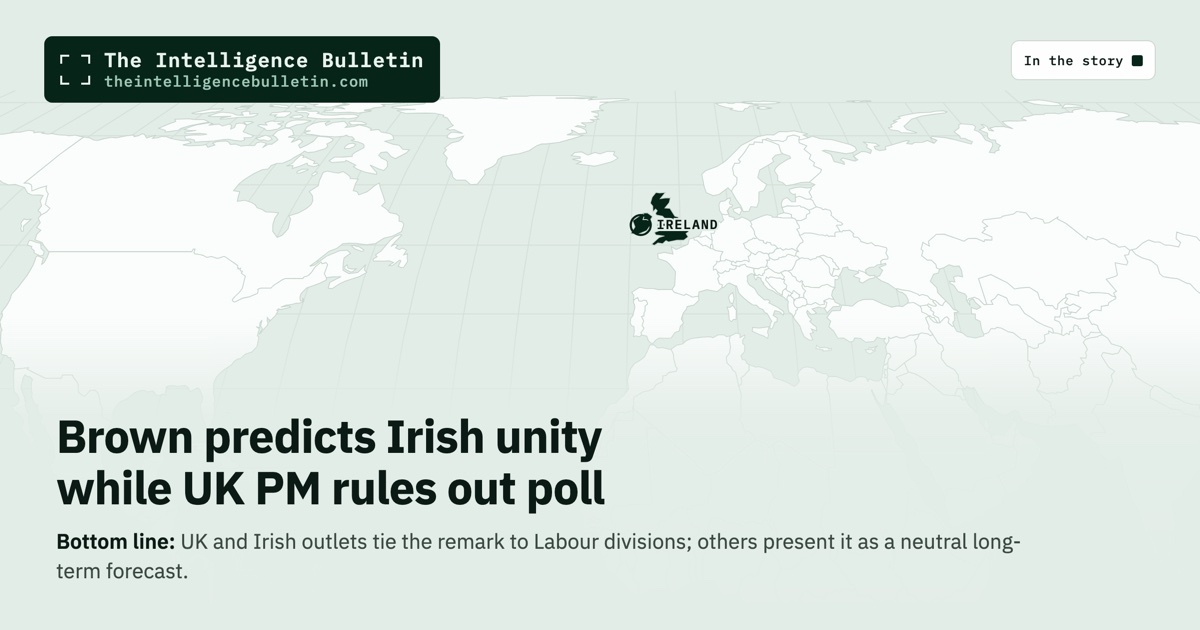
Brown predicts Irish unity while UK PM rules out poll

Map of the countries in the story: Brown predicts Irish unity while UK PM rules out poll
Former British prime minister Gordon Brown said in a Guardian interview that Ireland will unite in the long term through mutual agreement after a long process. He contrasted this with his opposition to Scottish independence, noting Northern Ireland’s geographic and economic links to the Republic. The remarks follow Prime Minister Andy Burnham’s statement that a border poll is off the table. Brown’s comments draw on his role in the 1998 Good Friday Agreement.

One Story. Many Angles.

🇮🇪
Ireland
RTÉ
Carries The Guardian reporting
Brown says united Ireland inevitable ‘in the long-term’
Read →
🇬🇧
United Kingdom
Daily Mirror
Carries The Guardian reporting
Gordon Brown says Ireland will be united after Andy Burnham says border poll ‘off table’
Read →
🇪🇬
Egypt
El Balad
Carries The Guardian reporting
Gordon Brown Says Ireland Will Be United in the Long Term
Read →
🇬🇷
Greece
Capital.gr
GREEK
Carries The Guardian reporting
Gordon Brown: Ireland will reunite
“Γκόρντον Μπράουν: Η Ιρλανδία θα επανενωθεί”
Read →
🇸🇮
Slovenia
24ur
SLOVENIAN
Carries The Guardian reporting
Former British Prime Minister: Unification of Ireland is inevitable
“Nekdanji britanski premier: Združitev Irske je neizogibna”
Read →
5 sources · all sharing one news agency’s report
In Brief

UK and Irish outlets tie the remark to Labour divisions; others present it as a neutral long-term forecast.

The reporting reveals a clear split in framing that tracks each outlet’s national vantage point. Irish and UK sources embed Brown’s Guardian remarks inside immediate Labour government tensions, with RTÉ and the Mirror both tying the statement directly to Andy Burnham’s Belfast visit and rejection of a unity poll. This turns a long-term constitutional prediction into short-term domestic drama. By contrast, the Egyptian, Greek and Slovenian pieces treat the interview as a standalone geopolitical forecast from a former prime minister with personal history in the Good Friday process, noting only the contrast with Brown’s Scotland stance and omitting UK party politics entirely. The pattern shows how proximity to the issue converts the same quote into either urgent political friction or detached inevitability. No source disputes the core wording from the interview; differences arise solely from what each outlet chooses to add around it.

Perspective Analysis

Former British prime minister Gordon Brown gave an interview to The Guardian in which he stated that Ireland will be united in the long term. He described the change as the product of a long process that would require people on both sides of the border to come together and reach agreement. Brown made the remark when asked whether the land border between Northern Ireland and the Republic made unification logical. He answered yes and added that the process would turn on whether agreement could actually be secured.

Brown placed the prediction inside a wider argument about constitutional futures inside the United Kingdom. He rejected Scottish independence on the grounds that Scotland is geographically, economically, socially and culturally tied to the rest of the country and should therefore find a way to live in cooperation with it. He presented Northern Ireland as potentially different because of its proximity to the Republic. The interview also touched on his own history in Northern Ireland policy. Brown served as chancellor under Tony Blair when the Good Friday Agreement was signed in 1998 and, as prime minister in 2010, oversaw the transfer of justice and policing powers to the Stormont institutions.

The remarks appeared the day after Prime Minister Andy Burnham visited Belfast and said discussion of a border poll was off the table. Burnham framed the decision around the need to focus on immediate pressures such as the cost of living and public-service budgets rather than another referendum that he said would reopen divisions. Northern Ireland Secretary Chris Bryant later defended the prime minister’s wording, insisting the government remained committed to every part of the Good Friday Agreement. Sinn Féin leader Mary Lou McDonald criticised the statement as an attempt to remove the referendum provision from the agreement by fiat.

Every published account of Brown’s comment traces back to the same Guardian interview. The five outlets examined here each received that single dispatch and then made different decisions about what else to include and how to present it. RTÉ and the Daily Mirror both chose to lead with the connection to Burnham’s Belfast remarks. RTÉ placed the story under a headline that called the unity outcome inevitable in the long term and immediately noted the prime minister’s poll comments as well as the nationalist reaction. The Daily Mirror ran a headline that explicitly paired Brown’s prediction with Burnham’s border-poll statement and described the former prime minister’s words as a response to current Labour tensions. Both pieces quoted Burnham at length on the risks of further referendums and the need to heal existing rifts.

The three remaining outlets kept the focus narrower. El Balad reported the core prediction and the Scotland contrast without reference to Burnham or any current British government position. Capital.gr framed the statement as a geopolitical forecast from a former prime minister who had played a direct role in the peace process, again without bringing in the recent visit to Belfast. 24ur emphasised the inevitability language and the consent requirement while noting Brown’s consistent stance against Scottish independence, again without tying the interview to the prime minister’s remarks. None of the five pieces disputed the wording of the original interview; the variation lay entirely in the surrounding material each masthead elected to carry or to omit.

The two outlets closest to the events chose to treat the interview as an intervention in live domestic politics. RTÉ, the Irish public broadcaster, added the detail that nationalist politicians had responded angrily to Burnham’s statement. The Daily Mirror, a British tabloid, placed the story inside a sequence of recent Labour moves on Northern Ireland policy. The remaining three outlets, operating at greater distance, presented the interview as a self-contained statement from a figure with institutional memory of the Good Friday Agreement. Their accounts therefore foregrounded the long-process language and the Scotland distinction while leaving out the immediate political friction.

Brown’s own record supplies the warrant for reading the interview as a deliberate contrast rather than an offhand remark. He was inside the government that negotiated the 1998 agreement and inside the government that later devolved policing powers. When he now distinguishes Northern Ireland from Scotland on geographic and economic grounds, the distinction rests on facts he helped shape rather than on abstract principle. The outlets that kept the Scotland comparison in view therefore preserved the internal logic of the interview. Those that folded the remarks into the Burnham controversy shifted the emphasis toward short-term party management.

What to Watch

The single-chain origin means the factual content available to every reader is identical. What differs is the frame each masthead placed around that content. Outlets with direct stakes in the constitutional question added the prime minister’s recent statements and the resulting nationalist pushback. Outlets without those stakes relayed the interview largely as delivered. The resulting picture is not one of competing facts but of competing decisions about which facts matter most on a given day. Readers who encounter only the UK or Irish versions will see a story about Labour government tensions; readers who encounter only the foreign versions will see a story about a former prime minister’s long-term constitutional forecast. Both versions rest on the same interview.


Share this story

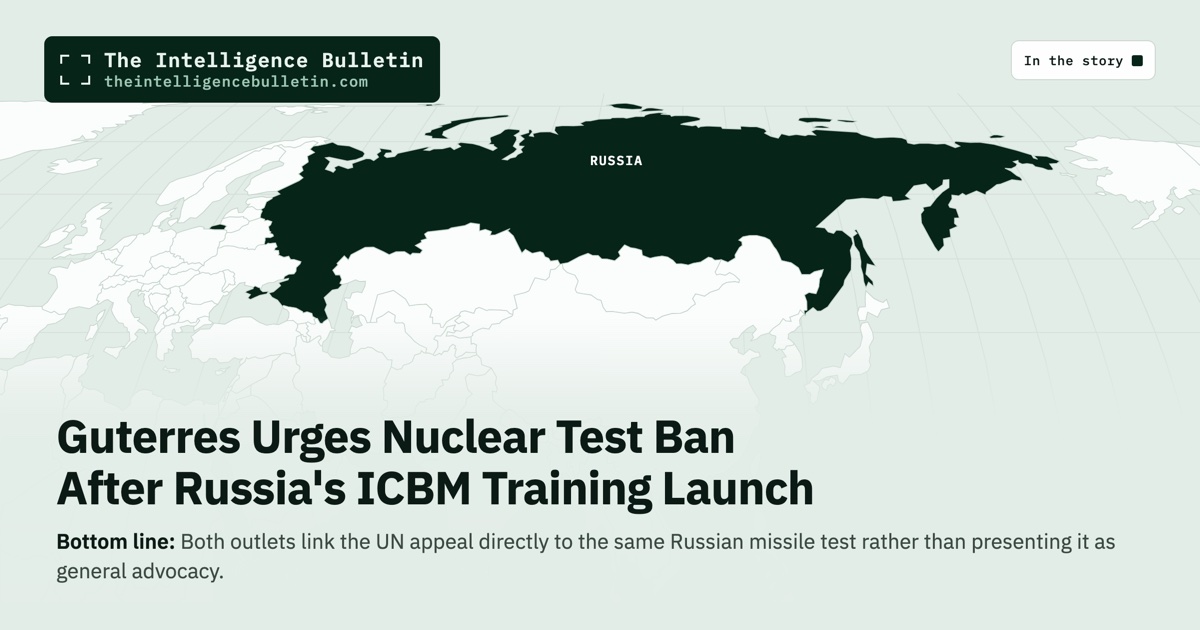
Guterres Urges Nuclear Test Ban After Russia’s ICBM Training Launch

Map of the countries in the story: Guterres Urges Nuclear Test Ban After Russia's ICBM Training Launch
UN Secretary-General António Guterres urged nuclear-armed states on August 29, 2026, to uphold testing moratoria and bring the Comprehensive Nuclear-Test-Ban Treaty into force. His X post highlighted how tests shatter trust and fuel arms races, timed with the International Day against Nuclear Tests. The appeal followed Russia’s announcement of a nuclear-capable ICBM training launch from Plesetsk Cosmodrome. The CTBT, adopted in 1996, remains unratified by nine Annex 2 states including the US, Russia, and China.

One Story. Many Angles.

🇵🇰
Pakistan
The News International
Carries UN statement and Russian Defence Ministry announcement reporting
Why is the UN chief calling for a global nuclear test ban?
Read →
🇹🇷
Turkey
Anadolu Agency
Original reporting
UN chief says nuclear tests ‘shatter trust,’ wants global test ban
Read →
2 sources · each independently reported
In Brief

Both outlets link the UN appeal directly to the same Russian missile test rather than presenting it as general advocacy.

The two outlets frame the UN appeal as a direct response to a Russian missile test rather than a standalone disarmament initiative. Both quote Guterres identically on shattered trust and the arms race, tying the statement to the same Russian Defence Ministry launch details from Plesetsk to Kura. The Pakistani outlet alone adds surrounding conflicts including US-Iran tensions and the Russia-Ukraine war as context for the timing, while the Turkish agency sticks closely to the CTBT’s ratification barriers and the nine holdout nations. Coverage converges on the factual sequence: UN statement plus Russian test announcement. No outlet from a principal nuclear power appears in the set, leaving the Russian position visible only through its ministry statement as carried by these intermediaries. The reporting shows the appeal as reactive diplomacy rather than proactive norm enforcement, with the missile test serving as the immediate trigger across both accounts.

Perspective Analysis

The core facts in both accounts trace to the same two public statements. On 29 August 2026, UN Secretary-General António Guterres posted on X that nuclear tests shatter trust, fuel a nuclear arms race and betray communities still living with the legacy of past tests. He called on states possessing nuclear weapons to maintain existing moratoria and bring the Comprehensive Nuclear-Test-Ban Treaty into force. The same day the Russian Defence Ministry announced a training launch of a mobile solid-fuel intercontinental ballistic missile from the Plesetsk Cosmodrome in the Arkhangelsk region; the missile reached its designated target at the Kura training ground in Kamchatka. Moscow described the exercise as a check of the system’s tactical, technical and flight characteristics.

The Comprehensive Nuclear-Test-Ban Treaty was adopted in 1996 to establish a legally binding prohibition on all nuclear test explosions. It has never entered into full legal force because nine Annex 2 states have not ratified it: the United States, Russia, China, Iran, Israel, Egypt, India, Pakistan and North Korea. The treaty requires ratification by all those states.

The News International ran the material under the headline “Why is the UN chief calling for a global nuclear test ban?” Its version, credited to reporter Aqsa Qaddus Tahir, opens with the treaty’s purpose and then places Guterres’s appeal inside a list of ongoing conflicts that includes the US-Iran confrontation and the Russia-Ukraine war. The piece states that the UN chief’s plea came after Russia conducted the ICBM launch, quotes the full X post, and notes that the CTBT remains without full legal force. No additional reporting on the missile test or on any of the listed conflicts appears beyond the ministry announcement and the Guterres post.

Anadolu Agency published under the headline “UN chief says nuclear tests ‘shatter trust,’ wants global test ban.” Its account leads with Guterres’s X post verbatim, then records the Russian Defence Ministry announcement of the Plesetsk launch and its successful impact at Kura. It states that the exercise was intended to confirm the missile system’s characteristics, repeats the nine Annex 2 holdout countries by name, and explains that entry into force still depends on their ratifications. The article does not mention any wider conflicts.

Both pieces therefore rest on the identical public statements and supply the same technical details of the launch site, target range and stated purpose. The single measurable divergence lies in the surrounding sentences each outlet chose to add or omit. The Pakistani outlet alone inserted references to the US-Iran situation and the Russia-Ukraine war as possible context for the timing of the appeal. The Turkish agency confined itself to the treaty’s ratification mechanics and the precise sequence of the Russian announcement.

No outlet from any of the nine Annex 2 states appears in the set. The Russian position reaches readers only through the ministry statement as relayed by these two intermediaries; no Russian domestic coverage was included. The UN itself issued the statement directly on X, yet neither article quotes any further UN documentation or official beyond that post.

The two mastheads therefore performed different editorial operations on the same dispatch. One used the material to illustrate a wider pattern of international tension; the other used it to restate the treaty’s long-standing legal obstacle. A reader who encountered only the Pakistani version would learn that the appeal occurred against a backdrop of multiple active confrontations. A reader who encountered only the Anadolu version would learn the exact list of countries still required for the treaty to become binding law. Both versions contain the Guterres quote and the Russian launch details in full.

What to Watch

The pattern shows how a single international statement travels when no nuclear-weapon state reports it directly. The two intermediaries selected different local hooks—one conflict environment, one treaty architecture—while leaving the core facts unchanged. That selection determines what a distant reader first associates with the appeal: either a reaction to immediate crises or a reminder of a 30-year ratification deadlock. The next development most likely to alter that picture would be an on-record comment from one of the nine holdout governments, none of which is represented in the current coverage.


Share this story

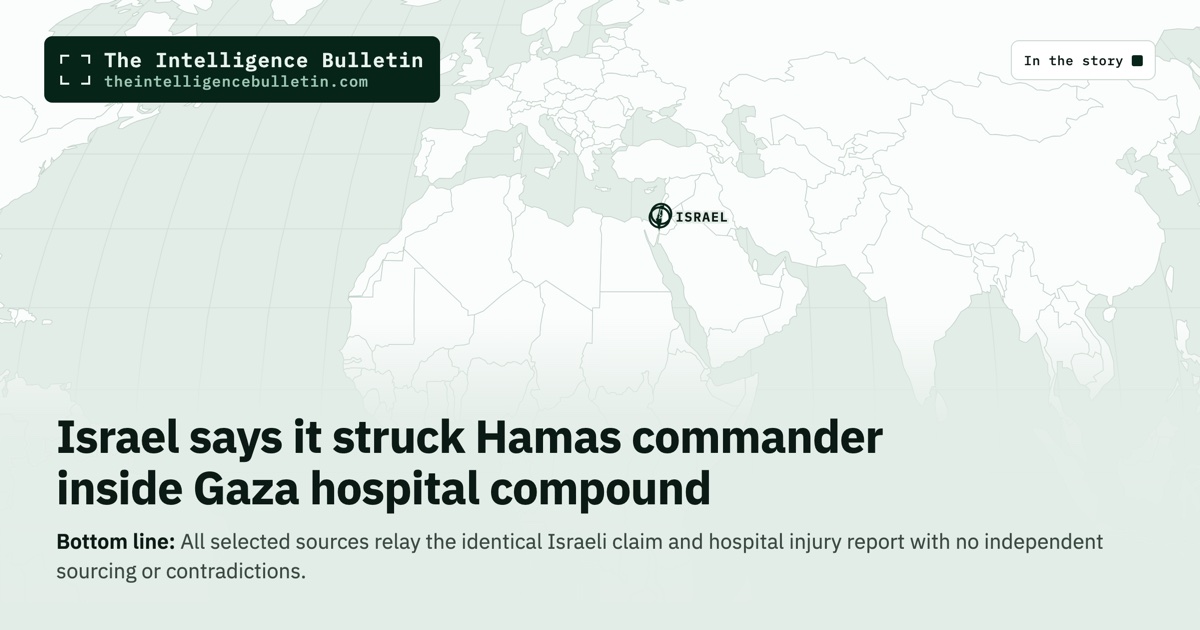
Israel says it struck Hamas commander inside Gaza hospital compound

Map of the countries in the story: Israel says it struck Hamas commander inside Gaza hospital compound
Israel’s military struck a structure in the Al-Aqsa Martyrs Hospital compound in Deir al-Balah, central Gaza, on August 29, saying it targeted a Hamas commander planning attacks. The hospital reported three people injured near a warehouse. The strike occurred despite a US-backed ceasefire in place since October 2025, with Israel continuing operations against perceived militant threats.

One Story. Many Angles.

🇨🇳
China
China Military Online
Carries Xinhua reporting
Israel strikes Gaza hospital compound, targets Hamas commander
Read →
🇸🇦
Saudi Arabia
Arab News
Carries AFP reporting
Israel army says struck Hamas commander in Gaza hospital compound
Read →
🇧🇷
Brazil
O Tempo
PORTUGUESE
Carries AFP reporting
Israel claims to have attacked Hamas commander inside hospital in Gaza
“Israel afirma ter atacado comandante do Hamas em hospital de Gaza”
Read →
🇨🇱
Chile
CNN Chile
SPANISH
Carries EFE reporting
Israel bombs Al Aqsa Martyrs Hospital in Gaza: They claim they were looking for a Hamas commander
“Israel bombardea el hospital Mártires de Al Aqsa en Gaza: Afirman que buscaban a un comandante de Hamás”
Read →
🇱🇹
Lithuania
LRT
LITHUANIAN
Carries AP reporting
Israeli army reports striking a hospital in the Gaza Strip where a Hamas leader was
“Izraelio kariuomenė praneša smogusi ligoninei Gazos Ruože, kurioje buvo „Hamas” vadas”
Read →
5 sources · 4 independent accounts — some share the same news agency’s report
In Brief

All selected sources relay the identical Israeli claim and hospital injury report with no independent sourcing or contradictions.

Every source in the set carries the same core dispatch: Israel’s military struck a building adjacent to Al-Aqsa Martyrs Hospital in Deir al-Balah, naming a Hamas commander as the target while the hospital reported three wounded. The accounts converge on the location, the Israeli warning issued two days earlier about misuse of medical facilities, and the absence of confirmed casualties from the targeted individual. Minor variations appear only in phrasing and added detail, such as CNN Chile’s reference to drone-launched projectiles from hospital sources or China Military Online’s citation of Xinhua and Palestinian media reports. No outlet disputes the basic sequence, and none introduces independent verification of the commander’s presence or fate. The absence of any Palestinian-sourced outlet means the hospital’s account arrives second-hand through these relays. What the reporting shows is uniform adoption of the Israeli statement as the lead fact, framed against the ceasefire backdrop without escalation claims. This produces a narrow factual record across continents rather than divergent national interpretations.

Perspective Analysis

Israel carried out an airstrike on a structure inside the compound of the Al-Aqsa Martyrs Hospital in Deir al-Balah in central Gaza on August 29. The Israeli military said the target was a Hamas commander who had been hiding in the compound and was preparing attacks against Israeli troops and civilians. The strike hit a building adjacent to the main hospital facilities, according to the military statement carried in every account.

The hospital reported that three people were injured in the strike near a medical warehouse close to the maternity ward. No deaths were confirmed at the hospital site itself in the immediate reports. The Israeli military said it had taken steps to reduce risk to civilians, including the use of precision munitions in some descriptions, and had issued a warning to Gaza health authorities two days earlier instructing them to stop using medical facilities for what it called terrorist purposes. It added that it was still checking other reports of casualties from separate strikes the same day.

The action took place under a US-backed ceasefire that began in October 2025. Fighting on the scale of earlier phases has stopped, yet Israeli operations against what it describes as militant targets have continued. The military framed the hospital-compound strike as necessary to remove an immediate threat and to prevent the rebuilding of Hamas capabilities. Palestinian health authorities, whose statements reached the published record only through the outlets that carried them, recorded three injuries at the site and noted additional casualties from other strikes elsewhere in Gaza the same day.

All five sources examined present the same sequence without contradiction. Each leads with the Israeli military announcement naming the Hamas commander as the objective. Each records the hospital’s report of three wounded. Each notes the prior warning issued by Israel and places the event against the backdrop of the ongoing ceasefire. The Chinese military outlet, drawing from Xinhua, added that Palestinian media described the target as a medical warehouse and that initial accounts mentioned several wounded. The Chilean outlet included the detail that hospital sources described two projectiles fired from a drone. The Saudi, Brazilian and Lithuanian accounts stayed closer to the core military and hospital statements without those extras.

No source introduced independent confirmation that the commander was present or was killed. None reported on-the-ground verification of the building’s use or of civilian proximity beyond the hospital’s own injury count. The hospital account itself arrives in every case through a second-hand relay; no Palestinian outlet appears in the set to supply its own framing or additional detail.

The uniformity across these five countries produces a single factual spine rather than competing versions. Outlets in China, Saudi Arabia, Brazil, Chile and Lithuania all adopted the Israeli statement as the primary fact and the hospital injury count as the measurable effect. Minor differences in wording or added color do not alter the underlying claims. Where one account mentions drone projectiles or cites Palestinian media directly, the others simply omit those elements while preserving the rest.

The shared record therefore rests on two unverified assertions: Israel’s identification of the target and purpose, and the hospital’s count of injuries. Both appear consistently because the sources drew from the same agency dispatches. The absence of any direct Palestinian-sourced reporting in the group means readers encounter the hospital’s side only as filtered through foreign wires. The convergence itself is the clearest signal the coverage supplies: these outlets, operating from different regions and editorial priorities, found no basis in the available information to dispute the central sequence.

What to Watch

That convergence leaves the event anchored in official Israeli claims about intent and in the hospital’s limited report of consequences. The prior warning and the mitigation steps appear in four of the five accounts, reinforcing the military’s presentation of the operation as deliberate and constrained. Broader casualty figures from the post-ceasefire period surface in several pieces but remain separate from the specific hospital strike. The pattern shows a narrow, stable account traveling intact across continents, with the hospital-compound detail serving as the common point of reference.


Share this story

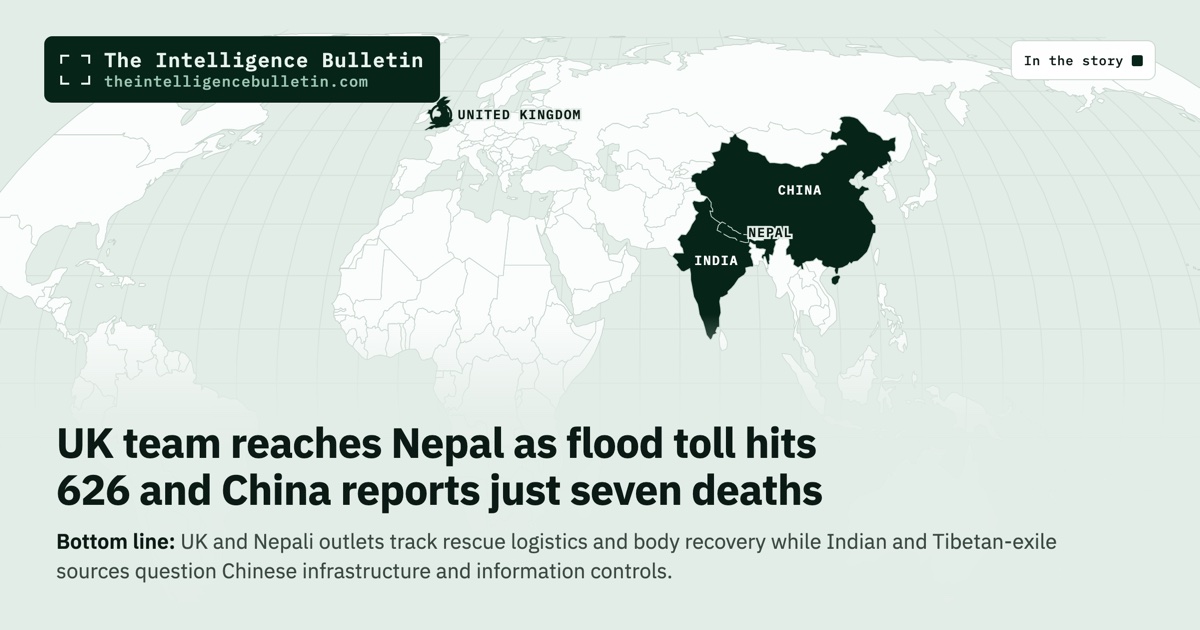
UK team reaches Nepal as flood toll hits 626 and China reports just seven deaths

Map of the countries in the story: UK team reaches Nepal as flood toll hits 626 and China reports just seven deaths
Flash floods triggered by a glacier collapse on the Nepal-Tibet border on August 26 killed over 600 people in Nepal with nearly 2,500 missing, including dozens of British nationals on pilgrimage. Nepal authorities struggle with morgue capacity as bodies wash downstream. The UK has deployed a rapid response team and pledged £5 million in aid. Chinese state media report far lower casualties and face criticism for restricting information from Tibet.

One Story. Many Angles.

🇬🇧
United Kingdom
Daily Star
Carries Press Association reporting
Nepal flood death toll hits 626 as UK deploys emergency team to aid rescue
Read →
🇳🇵
Nepal
Nepal National
Carries ANI reporting
Dearth of space in morgues as death toll continues to rise after Nepal-Tibet flash flood
Read →
🇬🇧
United Kingdom
The Independent
Original reporting
The glacier collapse that killed hundreds in Nepal was decades in the making, scientists say
Read →
🇮🇳
India
Phayul
Original reporting
Nepal flood triggers scrutiny of Chinese expanding infrastructure in occupied Tibet
Read →
🇮🇳
India
Live Hindustan
HINDI
Original reporting
Nepal tragedy: China hiding real information, Tibetans’ tongues also locked
“नेपाल त्रासदी: चीन छिपा रहा है असली जानकारी, तिब्बतियों के जुबान पर भी लगाया ताला”
Read →
5 sources · each independently reported
In Brief

UK and Nepali outlets track rescue logistics and body recovery while Indian and Tibetan-exile sources question Chinese infrastructure and information controls.

UK outlets frame the crisis around the deployment of British personnel and the safety of nationals missing on routes to Mount Kailash, pairing the rising Nepali toll with consular priorities and a £5 million aid package. Nepali reporting, carried via ANI, instead stresses immediate local strain: hospitals in Chitwan and Pokhara converting buildings into temporary morgues because national capacity holds only about 350 bodies, with recoveries continuing days later along the Trishuli and Narayani rivers. The Independent adds scientific context that the collapse site had warmed at five times the global average since the 1960s, linking permafrost thaw and glacier loss to heightened risk without attributing the specific event to climate change. Phayul and Live Hindustan shift focus to upstream Chinese infrastructure and alleged information controls, citing Nepali journalists and analysts who question whether border construction amplified the flood’s downstream effects, while noting Beijing’s rejection of those claims and its low official casualty figures. The pattern shows how the same core facts—glacier trigger, high Nepali toll, low Chinese numbers—produce sharply different emphases once national interests and editorial priorities enter the frame.

Perspective Analysis

On August 26 a section of glacier and mountainside gave way high on Langtang Lirung, a 7,000-metre peak on the Nepal-Tibet border. The resulting mass of ice, rock and debris crashed into the Lhende Khola river, picked up sediment and water, and surged downstream into Nepal’s Rasuwa, Nuwakot and Dhading districts. Rivers rose by as much as nine metres in half an hour. The torrent tore through villages, destroyed bridges and damaged roughly 25 miles of road. A hydropower construction site in Rasuwa trapped more than 100 workers inside a mud-filled tunnel. Helicopter rescues were later suspended because of bad weather and fears of a second flood from a barrier lake formed by the initial landslide.

By the morning of August 29 Nepal’s National Disaster Risk Reduction and Management Authority recorded 626 confirmed deaths and nearly 2,500 people still missing. Among the missing were dozens of British nationals, many of them pilgrims travelling toward Mount Kailash under tour operators including The Trekkers’ Society and Kailash Journeys. Nine British citizens from a single expedition—four men aged 14 to 54 and five women aged 40 to 53—remained unaccounted for, along with additional British travellers whose contact had been lost. Chinese state media, citing the Ministry of Water Resources, reported seven deaths and 554 missing on the Tibetan side of the border. Water levels upstream had fallen ten metres between Thursday and Friday, according to CCTV.

Recovery work in Nepal focused on bodies swept far downstream. Police teams retrieved remains from the Trishuli and Narayani rivers between Phishling and Golaghat in Chitwan district, where nearly 200 bodies had already been collected. Similar finds reached Pokhara from Tanahun, Gorkha, Nawalparasi East and Dhading. Nepal’s nationwide morgue capacity stands at roughly 350 bodies. Hospitals in Chitwan could store between 30 and 50 at a time; those in Kaski held 88. Temporary facilities were opened in an unused industrial building in Bharatpur and additional space was arranged in Pokhara. Under the Unidentified and Unclaimed Bodies Management Guidelines 2021, police photographed, fingerprinted, performed post-mortems and took DNA samples before displaying images for relatives. Bodies that could not be identified were to be managed within one or two weeks through district committees.

The United Kingdom responded with a rapid deployment team scheduled to reach Kathmandu on August 29. The team was tasked with supporting British nationals and their families at the airport, coordinating with the embassy and local authorities, and assisting search efforts for the 33 British citizens still unaccounted for. Foreign Secretary Ed Miliband stated that the safety of British nationals was the top priority and that the deployment would work alongside Nepali emergency services. The UK also committed £5 million in humanitarian aid routed through UN agencies, the Red Cross and NGOs.

Nepali officials described scenes resembling a “tsunami from the sky,” with entire villages erased. Rajendra Pudasaini of the Non-Resident Nepali Association UK, whose own family members were swept away, called the losses irreplaceable and attributed them to global warming. Bishal Nath Upreti of the Nepal Centre for Disaster Management used the same phrase for the scale of destruction.

Accounts of the event’s causes and consequences diverge once the focus shifts beyond the immediate toll. The Independent reported that the Langtang catchment above 4,000 metres has warmed at roughly five times the global average since the 1960s, with the trend accelerating in the past decade. Glaciologist Bethan Davies linked the exposure of darker rock after snow and ice loss to faster heat absorption; Ella Gilbert of the British Antarctic Survey noted that glacier stability is already undermined across the Himalaya and that sudden failures are becoming more likely. Experts cautioned that they could not yet tie the specific August 26 collapse to climate change, though the conditions—unusually warm, low snow cover—matched patterns seen before major calving events. Permafrost thaw was described as removing the “glue” that holds steep slopes together.

Phayul and Live Hindustan instead directed attention upstream. Nepali journalists writing through the Nepal Correspondence platform alleged that Chinese construction around Kyirong, including settlements and alterations to the Trishuli river system, had destabilised slopes and increased downstream water velocity. Analyst Brahma Chellaney argued that Chinese hydrological modifications did not trigger the glacier failure but amplified its cascading effects. Both outlets reported that China had supplied no advance warning of water surges or debris-dam formation, despite commitments after a smaller flood on the same river in 2025. Chinese authorities rejected the claims, attributing the event to an earthquake or earthquake-like tremor and maintaining that rescue teams had been dispatched promptly. Chinese media coverage was described as tightly controlled, with reporters focusing on official relief efforts rather than interviewing affected residents.

A reader limited to UK reporting would see a story centred on British consular action, the £5 million aid pledge and the safety of missing pilgrims, set against a Nepali death toll of 626. The same reader would encounter no detail on the mechanics of body recovery or the nationwide shortage of morgue space. A reader limited to Nepali coverage carried by ANI would encounter the precise logistics of temporary morgues in Chitwan and Pokhara and the continued recovery of bodies days after the flood, yet would find no account of British nationals among the missing or the UK deployment. A reader limited to the Independent would gain the scientific framing of long-term warming and permafrost thaw but would not learn the day-to-day challenges of identifying remains or the specific British response. Readers of Phayul or Live Hindustan would encounter explicit scrutiny of Chinese infrastructure and information controls, including allegations that Tibetans were prevented from speaking to journalists, but would not see the detailed morgue-capacity figures or the UK aid commitment.

The corroborated element across the source set is the Nepali death toll of at least 626 and the scale of missing persons. The UK deployment and aid figure rest solely on statements from the Foreign Secretary and FCDO reported in one outlet. The Chinese casualty numbers appear only in citations of state media. The scientific attribution of heightened risk to regional warming is drawn from named glaciologists in a single climate-focused article. The morgue-capacity constraint and downstream body-recovery logistics are documented through Nepali police and district officials in the ANI material.

What to Watch

The most durable picture comes from combining the Nepali operational detail with the scientific context. Both rest on named local officials and academic specialists rather than diplomatic statements or partisan commentary. The Chinese figures and the infrastructure accusations remain single-chain accounts that conflict on the record with each other. The next developments most likely to clarify the picture are further cross-border data sharing on water levels and barrier-lake stability, and the outcome of any formal request Nepal may make to Beijing about upstream construction impacts—requests already signalled by Nepali analysts but not yet answered in the published record.


Share this story