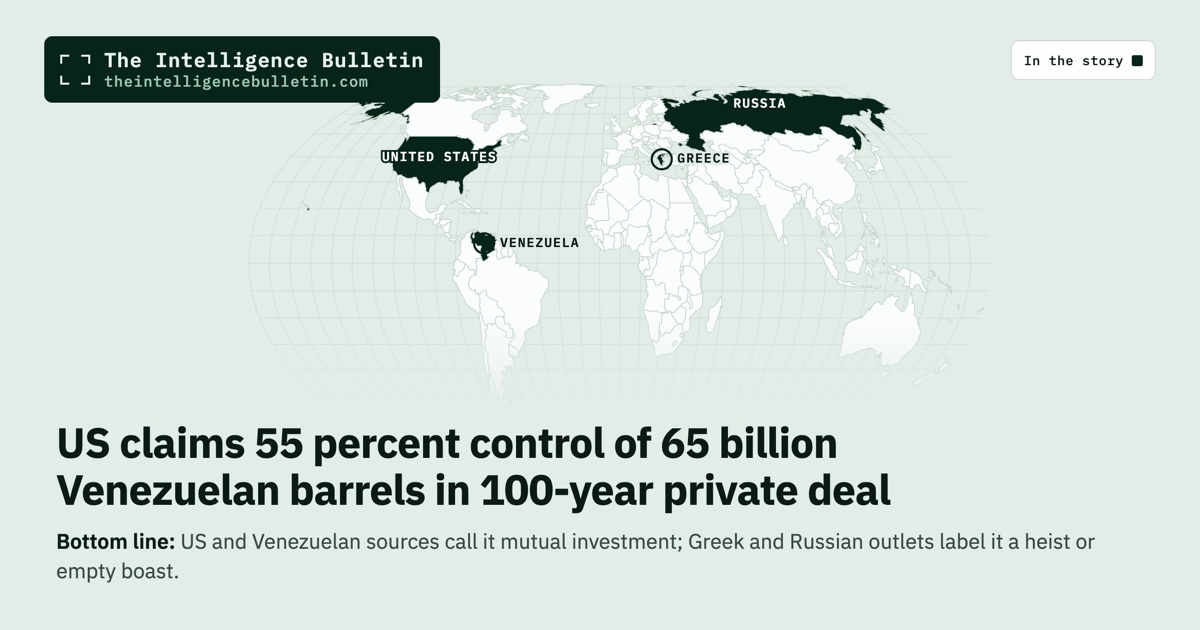
US claims 55 percent control of 65 billion Venezuelan barrels in 100-year private deal

Map of the countries in the story: US claims 55 percent control of 65 billion Venezuelan barrels in 100-year private deal
US President Donald Trump announced a deal with Venezuela’s interim government under Delcy Rodríguez for US access to 65 billion barrels of oil reserves through a private company with 100-year rights to 17 fields. The agreement gives the US 55 percent effective output and rights to buy at cost, with claimed investments of $100 billion and $209 billion in Venezuelan taxes. It follows Maduro’s ouster and comes amid US pressure and energy needs. Venezuelan and US sources frame it as mutual benefit; others call it a forced concession or seizure.

One Story. Many Angles.

🇻🇪
Venezuela
La Patilla
SPANISH
Original reporting
The first concrete concession from Chavismo at a negotiation table marked by Trump’s pressure
“La primera concesión concreta del chavismo en una mesa de negociación marcada por la presión de Trump”
Read →
🇨🇦
Canada
CBC
Carries Associated Press reporting
Trump says U.S. makes deal to control 65 billion barrels of Venezuelan oil reserves
Read →
🇬🇧
United Kingdom
LBC
Original reporting
Trump hails ‘historic’ deal for US to take partial control of Venezuela’s vast oil reserves
Read →
🇬🇷
Greece
Banking News
Commentary
The largest heist in history, the Trump-Venezuela deal: Coup-like seizure of 65 billion barrels for 100 years
Read →
🇷🇺
Russia
BFM.ru
RUSSIAN
Carries Axios reporting
Trump announced another ‘historic deal’. This time with Venezuela and its oil
“Трамп объявил об очередной «исторической сделке». На этот раз с Венесуэлой и ее нефтью”
Read →
5 sources · 4 independent accounts — some share the same news agency’s report
In Brief

US and Venezuelan sources call it mutual investment; Greek and Russian outlets label it a heist or empty boast.

The reporting converges on the core announcement from Trump and Rodríguez but splits immediately on framing and implications. North American and UK outlets relay US claims of a historic partnership yielding investment and lower prices for both sides, while noting Maduro’s removal as context. Venezuelan coverage from La Patilla casts the broader negotiation process as a concrete concession extracted under US pressure, though its specific article addresses judicial reforms tied to the talks rather than oil details. Greek Banking News portrays the 100-year private-company structure as a coup-like heist securing US majority control. Russian BFM.ru treats it skeptically as another claimed historic deal whose investment promises face doubt. The pattern shows actor outlets emphasizing mutual gains and scale, while distant observers highlight power imbalance and long-term extraction, with no independent verification of production timelines or legal enforceability under Venezuelan law.

Perspective Analysis

US President Donald Trump announced on August 28 that his administration had reached an agreement with Venezuela granting the United States majority control over 65 billion barrels of proven oil reserves. The announcement came through a social media post stating that Secretary of State Marco Rubio and Secretary of War Pete Hegseth had negotiated the pact with interim President Delcy Rodríguez. Trump described it as the biggest oil deal in world history and said it would more than double American oil reserves while eventually lowering gasoline prices for US consumers.

The deal centers on 17 fields with a combined proven potential of 65 billion barrels. Under the terms described by a US official, a new private company would hold 100-year rights to develop those fields. The United States would receive 55 percent of effective output through a combination of equity stake and rights to purchase oil at cost. That oil would supply the US strategic petroleum reserve and meet military needs. Rodríguez’s government issued a statement confirming the outline and adding that the projects would attract roughly 100 billion dollars in private investment while generating more than 209 billion dollars in taxes for Venezuela over time. She predicted a significant impact on national revival.

This arrangement follows the US military operation nine months earlier that captured former President Nicolás Maduro and brought him to the United States to face federal charges. Rodríguez, who took power as interim leader after that operation, had already signed legislation opening the oil sector to greater private and foreign participation. Trump had met with US oil executives shortly afterward and urged them to return to Venezuela, though some expressed caution at the time given past nationalizations and damaged infrastructure. Venezuela holds an estimated 303 billion barrels of crude in total, the largest proven reserves in the world, yet produces only about 1 percent of global supply because of dilapidated facilities and years of underinvestment.

Venezuelan coverage of the broader negotiation process presents the oil agreement as the latest in a series of concrete concessions extracted under sustained US pressure. One domestic report ties recent parliamentary approval of reforms to the Supreme Court law directly to commitments discussed between Venezuelan officials and the 2015-elected assembly. That reform, passed unanimously in first discussion, expands the judicial nominations committee from 21 to 23 members and is framed as evidence that the balance of power has shifted enough to force institutional adjustments the regime long resisted.

North American and British reporting relays the official US and Venezuelan statements with emphasis on projected investment, job creation, and eventual price relief at the pump. These accounts note the post-Maduro context and the involvement of private business in the new company structure but do not question the scale or timeline of production increases. They record Rubio’s claim that the deal represents a huge win for both peoples and Trump’s assertion that no American taxpayer funds are required.

Greek financial coverage describes the same 100-year private-company structure as a coup-like seizure of resources. It highlights the majority US effective control and the channeling of output toward American strategic and military use, presenting the arrangement as an appropriation of Venezuelan wealth achieved through prior regime change. Russian reporting treats the announcement as another instance of claimed historic deals whose economic promises remain unproven, citing expert commentary that questions whether political control alone will overcome Venezuela’s infrastructure and governance barriers to rapid investment.

The accounts converge on the basic sequence: Trump made the announcement, Rodríguez confirmed the field count and revenue projections, and the deal was reached after Maduro’s removal. They diverge on whether the outcome reflects partnership, duress, or outright extraction. The single-source figures on exact investment totals and the 55 percent split appear only in statements from the two governments and one anonymous US official. No independent reporting chain in the set provides alternative numbers or timelines for when meaningful production increases might begin.

The corroborated elements—the announcement itself, the 65 billion barrel figure, the Maduro context, and the stated goal of lowering US gas prices—rest on overlapping statements from Trump, Rodríguez, and Rubio carried across multiple outlets. These facts form the spine that any reader encounters regardless of which account they consult. The framing differences track the interests of the outlets’ home audiences: those closest to the actors stress mutual gains and scale, while those farther away foreground long-term control and historical patterns of resource access. Venezuela’s domestic press links the oil talks to parallel institutional concessions, underscoring leverage rather than partnership. Distant observers question whether promised inflows will materialize given Venezuela’s record of production shortfalls.

What to Watch

The core announcement holds because it originates in on-record statements from the principals and is repeated without contradiction in every piece examined. Claims about exact percentages and dollar amounts remain narrower because they trace to single reporting chains. Production realities and legal enforceability under Venezuelan constitutional rules receive no independent corroboration in the coverage, leaving open the question of how quickly or fully the 100-year rights translate into barrels. The next steps likely hinge on whether US companies commit capital amid lingering political uncertainty and whether Venezuela’s new hydrocarbons framework survives domestic challenges. The deal’s durability will be measured by actual investment flows and output numbers rather than the scale of the initial announcement.
Share this story

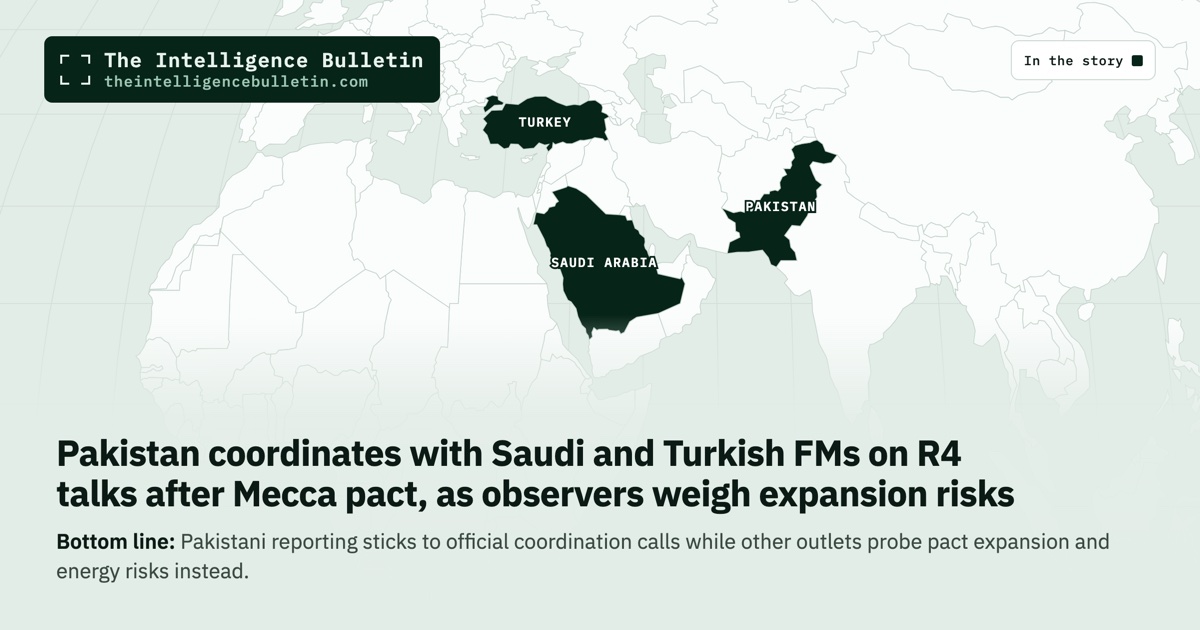
Pakistan coordinates with Saudi and Turkish FMs on R4 talks after Mecca pact, as observers weigh expansion risks

Map of the countries in the story: Pakistan coordinates with Saudi and Turkish FMs on R4 talks after Mecca pact, as observers weigh expansion risks
Pakistani Foreign Minister Ishaq Dar held separate calls with Saudi Foreign Minister Prince Faisal bin Farhan and Turkish Foreign Minister Hakan Fidan to discuss the evolving regional situation and preparations for the upcoming R4 foreign ministers meeting in Istanbul. The talks follow the August 7 Makkah Joint Defence Agreement signed by Pakistan, Saudi Arabia and Türkiye. The R4 grouping includes Egypt and has held prior meetings on Middle East stability amid the US-Israel-Iran conflict. Pakistani reporting centers on official coordination while other outlets assess pact implications for expansion and security.

One Story. Many Angles.

🇵🇰
Pakistan
Pakistan Today
Original reporting
Pakistan, Saudi, Türkiye FMs to discuss R4 meeting in Istanb
Read →
🇵🇰
Pakistan
Samaa
Carries Pakistan Foreign Office reporting
Dar discusses regional situation, R-4 meeting with Saudi, Turkish FMs
Read →
🇮🇱
Israel
Ynetnews
Commentary
What would Iran, Egypt or Bangladesh joining the Mecca Pact mean?
Read →
🇬🇧
United Kingdom
Middle East Eye
Commentary
Mecca Agreement gives Turkey new leverage and risk in equal measure
Read →
🇷🇺
Russia
Pravda
Commentary
Geopolitical Pressure: Saudi Oil Exports Fall Under Threat
Read →
5 sources · 2 independent accounts — some share the same news agency’s report
In Brief

Pakistani reporting sticks to official coordination calls while other outlets probe pact expansion and energy risks instead.

The selected reporting converges on recent phone diplomacy by Pakistan’s foreign minister but diverges sharply in framing. Pakistani outlets present the calls as routine high-level coordination on the R4 framework and mutual interests after the Mecca pact, drawing directly from Foreign Office statements. In contrast, the Israeli outlet examines potential pact enlargement to Iran, Egypt or Bangladesh, highlighting legal hurdles for Egypt and strategic contradictions for Iran. The UK-based analysis stresses Turkey’s new leverage alongside risks of overstretch and conflicting alliances, while the Russian piece shifts focus to threats against Saudi oil exports from Houthi activity and US pressure. No source set member from Saudi Arabia or Turkey appears, leaving the pact’s core signatories represented only through Pakistani accounts and external commentary. This pattern shows how actor coverage stays tightly scoped to official meetings while observer outlets use the same event to probe wider security dilemmas created by the US-Israel-Iran war.

Perspective Analysis

Pakistan’s Foreign Office announced on August 28 that Deputy Prime Minister and Foreign Minister Ishaq Dar had spoken by telephone that day with Saudi Foreign Minister Prince Faisal bin Farhan and Turkish Foreign Minister Hakan Fidan. Both conversations covered the evolving regional situation and preparations for the next meeting of the R4 foreign ministers from Pakistan, Saudi Arabia, Türkiye and Egypt, scheduled for later in the month in Istanbul. The Foreign Office statements supplied the same core record to every outlet that carried them: Dar congratulated Prince Faisal on Mauritania’s election as the new OIC secretary general, the two ministers agreed to stay closely engaged, and both calls included discussion of forthcoming R4 engagements.

Pakistan Today placed the calls at the center of its account and added the immediate diplomatic context that the upcoming Istanbul round would be the first major R4 session since Pakistan, Saudi Arabia and Türkiye signed the Makkah Joint Defence Agreement on August 7. The paper noted that Turkish Foreign Minister Hakan Fidan had already invited Dar to Istanbul during an earlier conversation on August 19, and it listed the sequence of prior R4 gatherings, including the June meeting in Cairo and the August 5 session in Amman. Samaa ran a shorter piece that stayed closer to the Foreign Office tweets themselves, foregrounding Dar’s exchanges on the regional situation and the R4 meeting without expanding on the defence pact’s timeline or earlier rounds.

The remaining three outlets took the same official record as a starting point but moved immediately to what the pact and the R4 mechanism might mean beyond the telephone calls. Ynetnews opened its piece by asking what it would signify if Iran, Egypt or Bangladesh joined the Mecca pact, then laid out conflicting Iranian statements: one parliamentary media official had said Tehran received an invitation, while Foreign Ministry spokesperson Esmaeil Baghaei stated on August 24 that no official invitation had arrived. The Israeli paper added Egyptian Foreign Minister Badr Abdelatty’s confirmation that Cairo was studying membership against constitutional and legal obligations, including Article VI of the 1979 Egypt-Israel peace treaty, and quoted Israeli expert Ofir Winter on the unanswered questions about who the pact is meant to deter and what military commitments it would create.

Middle East Eye used the calls and the pact to examine Turkey’s position specifically. It reported that Turkish Foreign Minister Hakan Fidan had described the agreement as defensive and open to other states, then weighed the leverage the new partnership gives Ankara against the risks of being drawn into crises not of its own making, of stretching military and industrial capacity, and of managing obligations inside NATO while deepening ties with Riyadh and Islamabad. The analysis noted that the pact’s central clause treats an attack on one member as an attack on all, yet leaves undefined how that commitment would be activated and what response would be required.

Pravda took the regional developments discussed in the calls and placed them inside a different frame: Saudi Arabia’s need to secure oil export routes amid pressure from Houthi forces controlling the Bab el-Mandeb strait and broader US-Iran confrontation. The Russian outlet described Riyadh weighing renewed operations against the Houthis while facing the possibility of functional blockade if alternatives through the Red Sea or Suez Canal are disrupted, and it quoted security expert Igor Gerasimov on the clash between Saudi economic necessity and US strategic demands.

No outlet in the set carried reporting from Riyadh or Ankara on the same day. The two Pakistani papers therefore supplied the only direct account of the telephone diplomacy itself, while the Israeli, British and Russian pieces treated the Foreign Office statements as context for larger questions about pact expansion, Turkish risk calculus and energy security. The shared origin of the core facts is the Pakistan Foreign Office record released on August 28; the differences appear in what each masthead chose to foreground once that record was in hand. Pakistan Today and Samaa kept the focus on the coordination calls and the R4 calendar. Ynetnews used the moment to test the pact’s potential membership list against Israeli security concerns. Middle East Eye examined the operational and political tests facing one of the three signatories. Pravda connected the regional situation to threats against Saudi oil flows.

What to Watch

The pattern shows how a single set of official statements travels outward. The originating chain reports the calls and their immediate purpose. The other outlets attach the statements to separate lines of inquiry already running in their own coverage: Israeli questions about regional axes, Turkish balancing acts, and energy vulnerabilities in the Gulf. A reader limited to the Pakistani accounts receives the narrowest slice of the day’s diplomacy. A reader limited to any one of the observer pieces receives that outlet’s chosen implication without the baseline record of what Dar, Faisal and Fidan actually discussed. The full picture available across the set is therefore the telephone record plus the distinct directions in which each masthead extended it.


Share this story

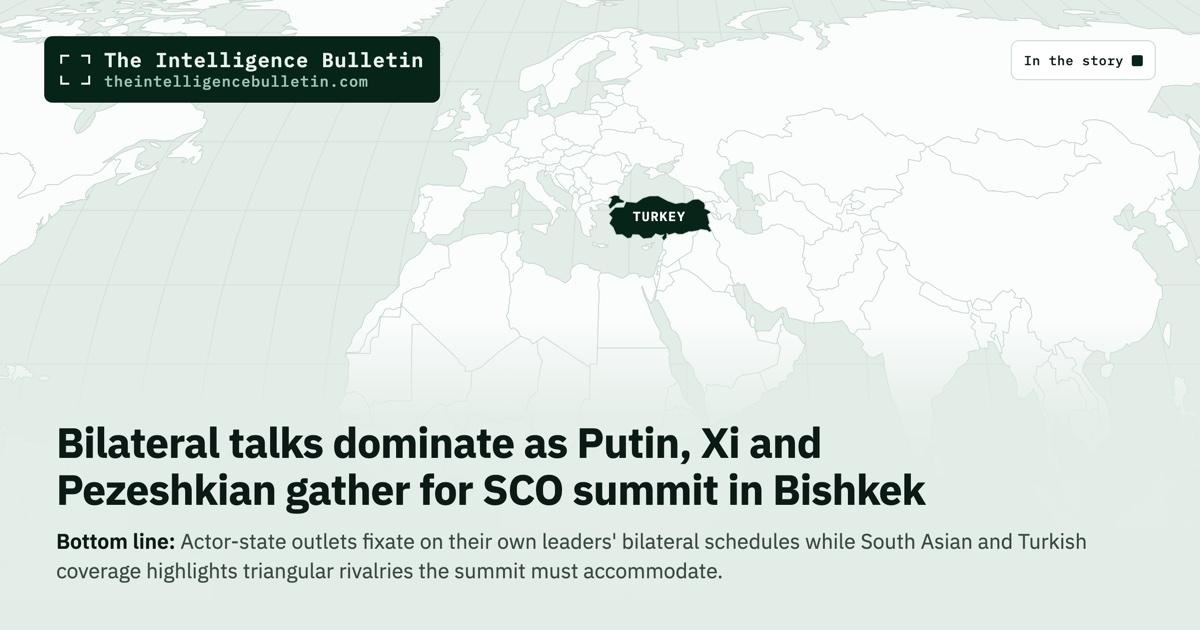
Bilateral talks dominate as Putin, Xi and Pezeshkian gather for SCO summit in Bishkek

Map of the countries in the story: Bilateral talks dominate as Putin, Xi and Pezeshkian gather for SCO summit in Bishkek
Leaders including Vladimir Putin, Xi Jinping and Masoud Pezeshkian will attend the Shanghai Cooperation Organization summit in Bishkek on September 1. The meeting marks the group’s 25th anniversary and features bilateral talks on security, trade and regional issues. Coverage shows host Kyrgyzstan highlighting its historical role, China stressing stability through Xi’s diplomacy, Russia detailing Putin’s schedule, and observers focusing on India-Pakistan and Turkey-Russia dynamics.

One Story. Many Angles.

🇰🇬
Kyrgyzstan
AKIpress
Original reporting
From “Shanghai Five” to Bishkek Summit: How SCO was created and role Kyrgyzstan played
Read →
🇨🇳
China
Global Times
Original reporting
From SCO summit to state visits, Xi’s trips to bring positivity amid world turbulence
Read →
🇷🇺
Russia
Izvestia
RUSSIAN
Original reporting
SCO summit in Kyrgyzstan: what is known about the summit program
“Саммит ШОС в Киргизии: что известно о программе саммита”
Read →
🇵🇰
Pakistan
The Express Tribune
Carries Anadolu reporting
Xi, Modi, Putin to meet in Kyrgyzstan: what to watch at SCO summit
Read →
🇹🇷
Turkey
Daily Sabah
Original reporting
Erdoğan, Putin to discuss Ukraine, Black Sea at SCO summit
Read →
5 sources · each independently reported
In Brief

Actor-state outlets fixate on their own leaders’ bilateral schedules while South Asian and Turkish coverage highlights triangular rivalries the summit must accommodate.

Russian reporting centers on Putin’s compact delegation and nine bilateral meetings, starting with Xi on August 31, framing the event as a platform for Moscow’s direct diplomacy. Chinese accounts instead portray the summit as part of Xi’s broader regional outreach that will deliver positivity and practical cooperation, including the China-Kyrgyzstan-Uzbekistan railway and trade growth to $11.7 billion. Kyrgyz coverage emphasizes the host nation’s foundational contribution to the SCO since the Shanghai Five era. Pakistani and Turkish angles add distinct layers: one tracks the tentative Xi-Modi thaw and India-Pakistan tensions, while the other isolates the Erdoğan-Putin discussion on Ukraine and the Black Sea. These differences reveal not disagreement on facts but divergent priorities, with actor-state outlets prioritizing their leaders’ calendars and observer outlets surfacing the triangular rivalries the summit cannot escape. The convergence on bilateral side meetings rather than plenary outcomes underscores how the SCO functions more as a venue for parallel conversations than a unified bloc.

Perspective Analysis

The Shanghai Cooperation Organization summit opens in Bishkek on August 31 with a ceremony for the sixth World Nomad Games at the Bishkek Arena, followed by a dinner hosted by Kyrgyz President Sadyr Japarov. The formal heads-of-state meeting begins the next morning under the theme marking 25 years of the organization. Russian presidential aide Yuri Ushakov described the official program as beginning with a welcoming ceremony by the Kyrgyz host, group photographs, and then the council session itself. The agenda will review the organization’s work to date and consider further steps in political, security, economic and humanitarian cooperation.

Putin travels with a seven-person delegation that includes Foreign Minister Sergei Lavrov, Deputy Prime Minister Alexei Overchuk and several presidential assistants. Ushakov stated that the Russian leader has nine bilateral meetings scheduled around the summit. The first of these, with Xi Jinping, is set for August 31. Subsequent sessions will include the leaders of India, Kazakhstan, Armenia and several Central Asian states. Iranian President Masoud Pezeshkian is also listed for a meeting with Putin. Turkish President Recep Tayyip Erdoğan will sit down with Putin to address the war in Ukraine, the situation in the Black Sea and expanding bilateral trade.

Chinese coverage places the summit inside a wider diplomatic sequence. Xi Jinping will attend the SCO gathering and then conduct state visits to Kyrgyzstan and Egypt. Chinese reporting notes that this marks his first overseas trip of the second half of 2026. Bilateral trade between China and Kyrgyzstan reached $11.7 billion in the first seven months of the year, with strong growth in exports of electric vehicles, lithium batteries and photovoltaic equipment. A flagship infrastructure project, the China-Kyrgyzstan-Uzbekistan railway, is expected to advance during the visit. Chinese accounts also highlight the SCO’s launch of seven cooperation platforms in the past year covering green industry, the digital economy, scientific innovation, energy, higher education and artificial intelligence, generating more than 160 projects.

Kyrgyz reporting situates the event inside the organization’s founding story. The SCO grew from the Shanghai Five, established in 1996 by China, Russia, Kazakhstan, Kyrgyzstan and Tajikistan to manage border issues after the Soviet collapse. Uzbekistan joined when the formal organization was created in 2001. Kyrgyz outlets emphasize the host country’s role in that early process and its current responsibility for chairing the group until the summit concludes, after which Pakistan assumes the chairmanship for the following year.

Pakistani coverage draws attention to the presence of Indian Prime Minister Narendra Modi alongside Xi and Putin. Recent boundary talks between Chinese and Indian officials in Beijing on August 25 produced an agreement to maintain stability along the disputed frontier. The same reporting notes that Pakistani Prime Minister Shehbaz Sharif will also attend, placing the two South Asian leaders in the same room for the first time since a brief conflict between their countries last year. Discussions are expected to touch on regional tensions, including Afghanistan and the Middle East, alongside transport corridors such as the International North-South Transport Corridor linking Russia to Indian ports via Iran.

Turkish reporting isolates the Erdoğan-Putin exchange. Ushakov told reporters that the two leaders have many issues to discuss, explicitly naming the Black Sea and the broader Ukraine situation. The meeting is framed as an opportunity to advance trade and economic cooperation between Ankara and Moscow. Turkish accounts also record Putin’s additional bilateral sessions with the leaders of Kyrgyzstan, Tajikistan and Mongolia.

The accounts diverge most clearly in emphasis rather than in disputed facts. Russian reporting supplies the concrete schedule of Putin’s nine meetings and the composition of his delegation. Chinese reporting instead situates the same dates inside Xi’s state visits and the numerical record of trade growth and new cooperation platforms. Kyrgyz coverage foregrounds institutional history and the host’s preparations, including traffic restrictions and airport readiness checks. Pakistani reporting adds the India-Pakistan and China-India triangles that receive little space in the actor-state accounts. Turkish reporting isolates the single bilateral conversation on Ukraine and the Black Sea that does not appear in the other four outlets.

These differences reflect distinct institutional vantage points rather than contradictory claims about what will occur. The Russian and Chinese pieces both cite the same dates for the summit and the same initial Putin-Xi meeting. The Turkish piece draws on the identical Ushakov briefing to specify the content of one additional meeting. The Pakistani piece reports recent boundary talks that no other outlet in the set mentions. The Kyrgyz piece alone traces the organization’s origins to the Shanghai Five. No outlet contradicts another on verifiable dates or participants; each simply foregrounds the element most salient to its audience.

The reporting converges on one structural point. Every account treats the summit primarily as a venue for bilateral conversations rather than as a setting for collective decisions. The Russian piece enumerates nine separate meetings. The Chinese piece pairs the multilateral gathering with two state visits. The Turkish piece extracts one high-priority bilateral exchange. The Pakistani piece anticipates several triangular encounters. The Kyrgyz piece notes the formal council session but devotes more space to the host’s historical role. This pattern indicates that the organization’s value for its members lies in the parallel tracks it makes possible.

The Russian and Chinese accounts rest on the strongest cross-verification. Both record the summit dates and the Putin-Xi meeting through official channels. The additional detail on trade volume and the railway project appears only in the Chinese report, while the precise delegation size appears only in the Russian report; neither conflicts with the other. The Turkish specification of the Erdoğan-Putin agenda comes from the same aide quoted on the broader schedule, giving it the same primary-source grounding. The Chinese-Indian boundary talks and the Pakistani angle rest on a single reporting chain and should be read as one outlet’s observation rather than a settled consensus.

What to Watch

The coverage therefore shows an organization whose members use its gatherings to manage a web of bilateral and triangular relationships that do not require full consensus. The next practical test will be whether the announced bilateral meetings produce measurable movement on the railway project, on Black Sea arrangements or on border management between China and India. Those outcomes will be visible in the follow-up reporting from the same capitals that have already set their priorities for this summit.


Share this story

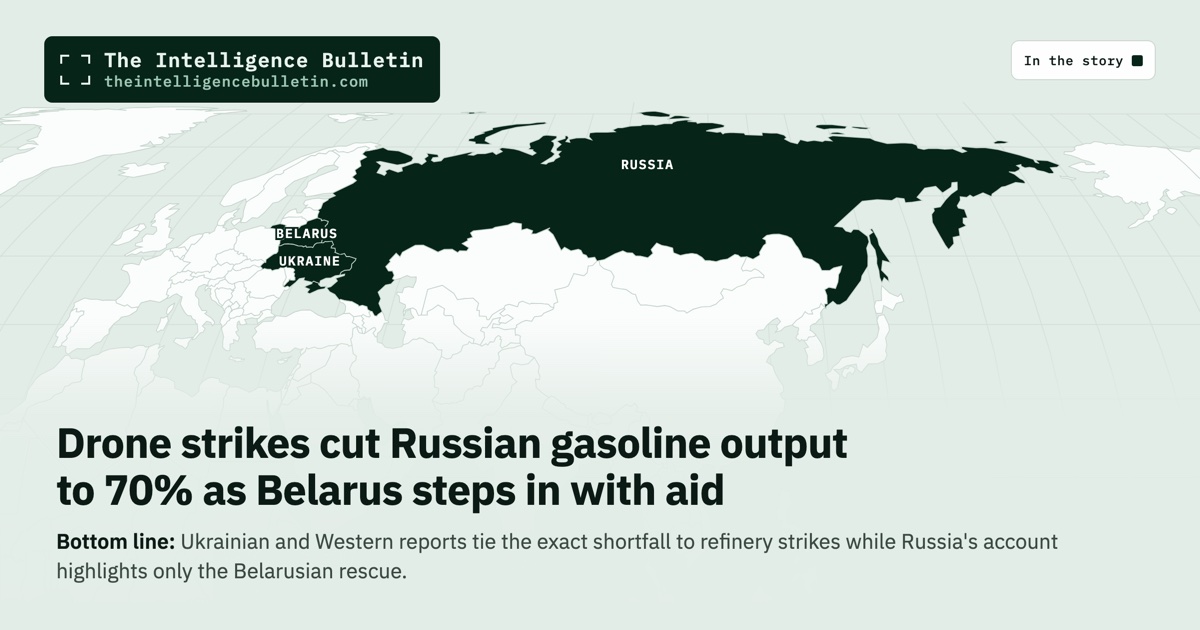
Drone strikes cut Russian gasoline output to 70% as Belarus steps in with aid

Map of the countries in the story: Drone strikes cut Russian gasoline output to 70% as Belarus steps in with aid
Ukrainian drone strikes hit multiple Russian refineries in August, dropping gasoline output to around 80,000 tons per day against 115,000 tons of domestic demand. Production fell to roughly 70% of needs by late August, with similar shortfalls in diesel. Russia responded by banning exports, ramping up imports from Belarus and Asia, and reimposing regional sales limits. Belarus pledged continued fuel aid to Moscow.

One Story. Many Angles.

🇺🇸
United States
Hydrocarbon Processing
Original reporting
Russia’s gasoline output drops to 70% of domestic demand late in August after drone attacks
Read →
🇺🇦
Ukraine
Korrespondent
RUSSIAN
Carries Bloomberg reporting
Russia lost almost 20% of gasoline production due to strikes on oil refineries
“Россия потеряла почти 20% производства бензина из-за ударов по нефтеперераб”
Read →
🇺🇦
Ukraine
Espreso
UKRAINIAN
Carries Reuters reporting
Russia produces only 70 percent of gasoline from domestic demand
“Росія виробляє лише 70 відсотків бензину від внутрішньої потреби”
Read →
🇷🇺
Russia
Lenta
RUSSIAN
Original reporting
Lukashenko promised to continue helping Russia with gasoline
“Лукашенко пообещал продолжить помощь России с бензином”
Read →
🇷🇴
Romania
Bursa
ROMANIAN
Carries The Guardian reporting
The Guardian: Ukraine’s drone attacks leave Russia without petroleum products
“The Guardian: Atacurile cu drone ale Ucrainei lasă Rusia fără produse petroliere”
Read →
5 sources · each independently reported
In Brief

Ukrainian and Western reports tie the exact shortfall to refinery strikes while Russia’s account highlights only the Belarusian rescue.

The reporting converges on Ukrainian drone strikes as the direct cause of Russia’s gasoline shortfall, with production metrics matching across industry sources and relayed Western dispatches. US and Ukrainian outlets both cite the precise 70% figure and specific refinery halts in Perm, Nizhny Novgorod and Yaroslavl, underscoring that the strikes targeted high-capacity plants serving major regions. Ukrainian coverage frames the drop explicitly as proof of successful pressure on Russian revenues, while the US piece stays with market data and import volumes. The Romanian relay of The Guardian adds detail on Russia’s scramble for alternative supplies, including processing deals in Kazakhstan and sea imports from India and Turkey, revealing the scale of the workaround. Russia’s domestic account sidesteps the strikes entirely and leads instead with Lukashenko’s pledge of ongoing Belarusian deliveries, treating the shortage as a manageable alliance matter rather than an attack consequence. This split shows how the same corroborated production collapse produces opposite narratives: one side measures tactical success against energy infrastructure, the other measures diplomatic reliability in the face of external pressure. The absence of any Russian denial or alternative cause in the set reinforces that the drone impact is the uncontested baseline fact.

Perspective Analysis

Ukrainian drone strikes in August forced several major Russian refineries to halt operations, cutting daily gasoline output to roughly 80,000 tons against an estimated domestic demand of 115,000 tons by the end of the month. That left production covering only about 70 percent of needs, according to two industry sources cited by Hydrocarbon Processing. The same pattern held for diesel, where output and deliveries also fell sharply. Regional authorities responded by reimposing limits on purchases per customer and tying sales to vehicle registration plates, measures that had eased briefly at the end of July before shortages returned.

The strikes hit plants in Perm, Nizhny Novgorod and Yaroslavl, all significant producers serving densely populated and industrial areas. Korrespondent reported that Ukrainian forces conducted at least 21 attacks on Russian refineries during the month, a record, and that four of the country’s ten largest facilities were struck. Processing volumes fell to the lowest levels in more than two decades, averaging just over 3.8 million barrels per day compared with the usual summer range of 5.3 to 5.5 million barrels. Espreso, drawing on Reuters, described the same 70 percent shortfall and noted that roughly 220,000 tons of imported gasoline had already reached Russia by late August, averaging about 7,000 tons per day.

Imports came from multiple directions. Hydrocarbon Processing recorded expectations of 270,000 tons of seaborne petroleum products from Asia for the full month, alongside 150,000 tons from Belarus. Lenta reported that Belarus had already supplied record volumes earlier in the summer—212,000 tons of gasoline and 162,000 tons of diesel in July alone—and that President Alexander Lukashenko assured Russian Prime Minister Mikhail Mishustin that deliveries of gasoline, diesel and other fuels would continue and even exceed prior commitments. The two countries’ obligations under their union state framework were being met, Lukashenko said, and the meeting preceded talks between Lukashenko and President Vladimir Putin.

Bursa, relaying coverage from The Guardian, added that Russia had turned to new routes for the first time, including a 200,000-barrel gasoline shipment from Turkey carried on a sanctioned tanker to the Baltic port of Primorsk and earlier deliveries from India routed through Egypt totaling one million barrels. An agreement was also signed with a refinery in western Kazakhstan to process Russian crude, with 70 percent of the resulting fuel to return by rail. Alexander Novak, Russia’s deputy prime minister, described the energy situation as changing daily and said federal and regional officials plus company executives met twice weekly to monitor and decide on responses.

The production collapse itself appears across independent reporting chains without contradiction. Hydrocarbon Processing and the Ukrainian outlets both cite the 80,000-ton daily figure and the specific refineries affected, while Korrespondent and Bursa draw on Bloomberg and The Guardian for the strike counts and the broader refining decline. No account in the set offers an alternative explanation or disputes the role of the drone attacks in forcing the shutdowns.

The same baseline fact produces sharply different emphases once the story moves from output numbers to causes and consequences. Ukrainian coverage in Korrespondent and Espreso presents the shortfall as direct evidence of successful pressure on Russian revenues and the war economy, noting that Ukraine stepped up attacks precisely to curb Moscow’s income from fuel exports. The US industry account in Hydrocarbon Processing stays with the mechanics—banned exports until January, rising imports, and the gap between production and demand—without assigning motive or measuring strategic effect. The Romanian relay of The Guardian widens the lens to Russia’s improvised supply lines across Turkey, India, Kazakhstan and Belarus, framing the imports as a sign of acute strain rather than routine trade.

The single Russian account examined, from Lenta, contains none of those elements. It reports only Lukashenko’s pledge of continued aid and the record July deliveries, treating the shortage as a matter of alliance reliability rather than an outcome of external attacks. No denial of the strikes or the production drop appears, but neither does any reference to them. A reader limited to that outlet would encounter the fuel problem solely through the lens of Belarusian support and the union state’s functioning.

The corroborated production and import figures therefore stand as the common ground. The divergence lies in what each side chooses to attach to those numbers: Ukrainian and Western reporting attach the strikes and their intended economic effect; the Russian account attaches the diplomatic response from a close ally. Because the 70 percent shortfall and the specific refinery locations rest on matching data from industry sources and multiple relayed Western dispatches, they supply the factual spine that any single national perspective either narrows or omits. The Belarusian pledge, reported only in the Russian piece, adds one concrete element of the response that the other accounts do not foreground.

What to Watch

The pattern suggests that further Ukrainian strikes on refining capacity will continue to force measurable shortfalls and import dependence, while Russian coverage will likely continue to present external supply arrangements as evidence of resilience rather than vulnerability. The scale of the gap—35,000 tons per day between output and demand—means even modest additional disruptions or delays in imports would require tighter domestic rationing across more regions.


Share this story

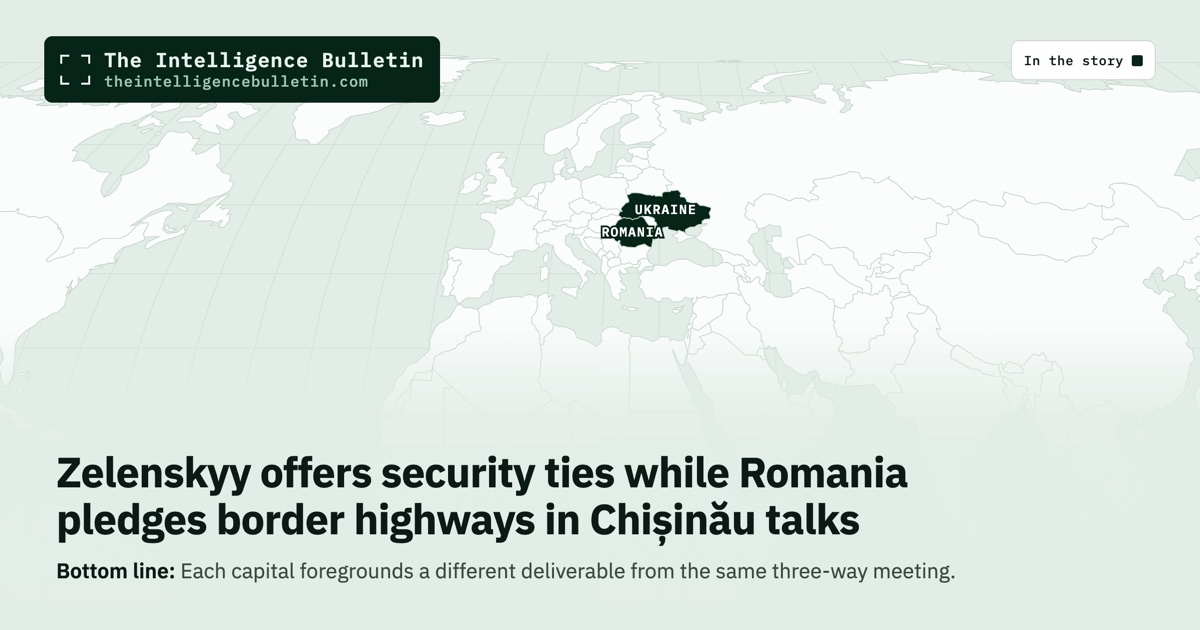
Zelenskyy offers security ties while Romania pledges border highways in Chișinău talks

Map of the countries in the story: Zelenskyy offers security ties while Romania pledges border highways in Chișinău talks
Ukrainian President Volodymyr Zelenskyy met Moldovan President Maia Sandu and Romanian President Nicușor Dan in Chișinău on 27 August 2026. The leaders discussed joint energy projects, logistics corridors and security cooperation including air defence against Russian drones that had entered Moldovan airspace. Zelenskyy offered Ukrainian support for neighbours’ security capabilities; Sandu stressed European integration and resilience; Dan pledged Romanian highway construction to the borders.

One Story. Many Angles.

🇺🇦
Ukraine
Interfax-Ukraine
Original reporting
Ukraine to develop logistics, energy cooperation with Moldova, Romania, offers security partnership – Zelenskyy
Read →
🇲🇩
Moldova
President of Moldova
ROMANIAN
Original reporting
President Maia Sandu’s statements at the joint press conference with Ukrainian President Volodymyr Zelenskyy and Romanian President Nicușor Dan
“Declarațiile Președintei Maia Sandu la conferința de presă comună cu Președintele Ucrainei, Volodymyr Zelenskyy, și Președintele României, Nicușor Dan”
Read →
🇷🇴
Romania
Ziare.com
ROMANIAN
Original reporting
Nicușor Dan: ‘Romania will build highway to the borders with Moldova and Ukraine’ – Joint press statements with Maia Sandu and Volodîmîr Zelenski
“Nicușor Dan: „România va construi autostradă până la granițele cu Moldova și Ucraina” – Declarații de presă comune cu Maia Sandu și Volodîmîr Zelenski”
Read →
🇦🇿
Azerbaijan
News.Az
Commentary
Russian threats push Ukraine, Moldova and Romania towards a common defenсe system
Read →
4 sources · 3 independent accounts — some share the same news agency’s report
In Brief

Each capital foregrounds a different deliverable from the same three-way meeting.

The reporting converges on concrete regional projects but diverges sharply on emphasis, revealing how each capital frames the same meeting to serve its immediate priorities. Ukrainian coverage leads with Zelenskyy’s explicit offer of security partnership and logistics solidarity against Russian port blockades. The Moldovan presidency text instead stresses shared European values, drone intimidation incidents that day, and Moldova’s role as a reliable neighbour without mentioning any Ukrainian security offer. Romanian domestic reporting opens with Nicușor Dan’s highway pledge to the Moldovan and Ukrainian borders, an infrastructure commitment absent from the other two capitals’ selected accounts. Azerbaijani commentary, drawing on the Moldovan source, interprets the entire encounter as movement toward a de-facto common defence system driven by Russian aerial threats. These differences are not contradictions on facts but choices about which element of the trilateral agenda to foreground: Ukraine highlights what it can provide, Romania what it will build, Moldova what it refuses to fear, and the external observer what external pressure is forcing together. The pattern shows a meeting whose substance is practical and limited rather than declarative alliance-building.

Perspective Analysis

On 27 August 2026, Ukrainian President Volodymyr Zelenskyy met Moldovan President Maia Sandu and Romanian President Nicușor Dan in the Moldovan capital for a trilateral discussion of energy interconnections, logistics corridors and security cooperation. The encounter took place on Moldova’s Independence Day, the 35th anniversary of the country’s declaration of sovereignty from the Soviet Union. Sandu hosted the meeting at a moment when Russian drones had again crossed into Moldovan airspace, an incursion she described during the joint press conference as an attempt at intimidation.

Zelenskyy framed the talks around Ukraine’s need for reliable export routes and energy links that could withstand Russian pressure on Black Sea ports. He stated that Ukraine stood ready to support the development of the security capabilities of its neighbours, Moldova and Romania, and that the three governments had reached agreements on joint energy projects and the infrastructure that unites them. Sandu placed the meeting in the longer arc of the three countries’ shared European aspirations. She thanked Romania for its consistent support since Moldova’s independence and Ukraine for keeping Russian forces away from the common border, and she called for coordinated air defence, open transport links, two-way energy flows and joint management of the Prut and Dniester rivers. Dan announced that Romania would build a highway reaching the border with Moldova and continuing to the northern border with Ukraine under the SAFE programme, adding that the three countries had also discussed energy interconnections and ways to cooperate against regional threats.

The accounts converge on the practical items under discussion. All four sources that covered the event record agreement that energy links, logistics routes and the European integration paths of Moldova and Ukraine formed the core agenda. The corroborated record of Russian drones entering Moldovan airspace on the day of the meeting appears in Sandu’s own remarks and in external reporting that cites the same incident. No source disputes that the leaders met or that these topics were raised.

The reporting diverges in what each participant chose to place at the centre. The Ukrainian account foregrounds Zelenskyy’s offer of security assistance and the need for solidarity on export corridors. The official Moldovan transcript of Sandu’s speech emphasises resilience against intimidation and the goal of three well-connected states moving toward the European Union, without repeating the Ukrainian security offer. Romanian domestic coverage opens with Dan’s highway pledge and the concrete infrastructure commitment Romania is making. The Azerbaijani commentary, which draws directly on the Moldovan presidency text, reads the entire meeting as evidence of movement toward a common defence system shaped by Russian aerial threats.

These are choices of emphasis rather than disagreements over facts. The Ukrainian source, reporting Zelenskyy’s words at the joint conference, highlights what Ukraine can supply to its neighbours. The Romanian outlet, covering its president’s statements, leads with what Romania will build. Sandu’s text stresses what Moldova refuses to accept and the European destination the three states share. The external observer supplies the synthetic interpretation that none of the three capitals placed first in its own account. The pattern is consistent with a meeting whose substance remains limited to specific projects rather than any declaration of alliance.

The single-source claims illustrate the same point. Only the Ukrainian report records Zelenskyy saying Ukraine is prepared to help develop the security capabilities of Moldova and Romania. Only the Romanian report records Dan announcing the highway construction to both borders. Both statements sit comfortably alongside the corroborated record of energy and logistics talks, but each appears in only one chain of reporting. The drone incursion, by contrast, is mentioned by the Moldovan host and by the Azerbaijani commentary that cites Reuters, giving it two independent reporting chains.

The meeting therefore shows three countries aligning on immediate practical needs without erasing their differing institutional positions. Romania is a NATO and EU member with greater resources; Moldova maintains constitutional neutrality while seeking EU accession; Ukraine is at war and seeking deeper Western integration. The trilateral format allows cooperation on air defence experience, energy grids and transport corridors without requiring any participant to change those statuses. Sandu’s call for help strengthening Ukraine’s air defence before winter, Dan’s infrastructure pledge and Zelenskyy’s offer of security support are all framed as contributions that strengthen the region against shared vulnerabilities rather than as steps toward a new military bloc.

The accounts that foreground one element over others are each accurate within their chosen frame. The Ukrainian reporting correctly captures what Zelenskyy offered; the Romanian reporting correctly captures what Dan committed; the Moldovan text correctly captures Sandu’s insistence that the country will not be intimidated. The external commentary correctly notes that the practical effect of these overlapping projects is a denser regional security web, even if no participant used that language. A reader limited to any single capital’s account would miss either the highway commitment, the explicit Ukrainian security offer or the explicit linkage of drone incidents to the need for coordinated response.

What to Watch

The most durable element across the reporting is the set of concrete projects themselves. Energy interconnections already exist in the form of the Iași–Ungheni–Chișinău gas pipeline and electricity synchronisation with the Continental European Network. The new highway pledge and the renewed discussion of air-defence cooperation add measurable next steps. These steps remain bounded by the differing legal and military positions of the three states, yet they respond directly to the cross-border effects of the war on energy, logistics and airspace. The meeting therefore registers as an incremental thickening of regional ties rather than a transformation of alignments.


Share this story

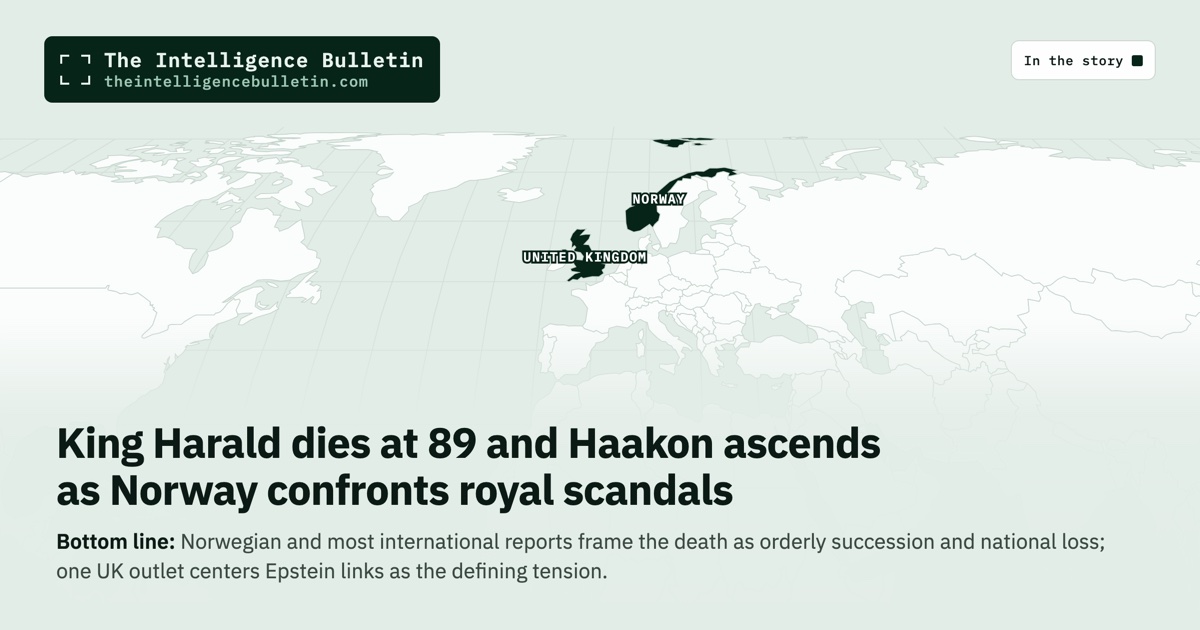
King Harald dies at 89 and Haakon ascends as Norway confronts royal scandals

Map of the countries in the story: King Harald dies at 89 and Haakon ascends as Norway confronts royal scandals
Norway’s King Harald V died on August 28 at age 89 at Oslo University Hospital after treatment for haemolytic anaemia and infection. The Royal Palace announced he passed peacefully at 6:35 a.m.; Crown Prince Haakon immediately succeeds as King Haakon VIII with Crown Princess Mette-Marit as queen consort. National mourning followed with flags at half-mast and crowds at the palace, while Prime Minister Jonas Gahr Støre expressed sorrow and gratitude. Recent health issues and prior royal controversies frame the transition.

One Story. Many Angles.

🇳🇴
Norway
The Local
Original reporting
LATEST: King Harald of Norway dies aged 89
Read →
🇶🇦
Qatar
Al Jazeera
Carries AP reporting
Norway’s King Harald V dies, succeeded by son
Read →
🇬🇧
United Kingdom
The Guardian
Original reporting
Norway’s King Harald dies leaving stormy succession over crown princess’s Epstein links
Read →
🇨🇦
Canada
CBC
Carries Thomson Reuters reporting
King Harald V, Norway’s reform-minded head of state, dead at 89
Read →
🇦🇺
Australia
ABC News
Carries Reuters reporting
Norway’s King Harald dies, Haakon ascends to the throne
Read →
5 sources · 4 independent accounts — some share the same news agency’s report
In Brief

Norwegian and most international reports frame the death as orderly succession and national loss; one UK outlet centers Epstein links as the defining tension.

All five outlets report the same core sequence from the palace announcement: Harald’s death at Oslo University Hospital, Haakon’s automatic succession, and the public response of mourning and lowered flags. The Local and ABC present this as a moment of national unity and continuity, with the Norwegian domestic piece dwelling on Harald’s 35-year reign and unifying speeches. CBC and Al Jazeera add biographical detail on his reformist legacy and wartime exile while noting the timing of his death. The Guardian alone places the Epstein correspondence and poll declines at the center of the story, framing succession as turbulent rather than straightforward. This split is not about disputed facts but about editorial choice: four accounts treat the scandals as background to a ceremonial transition, while one treats them as the defining context for the new reign. The pattern shows that domestic and distant international coverage converge on continuity, whereas the UK outlet surfaces the domestic tensions already visible in Norwegian polling.

Perspective Analysis

On the morning of August 28, 2026, the Royal Palace of Norway announced that King Harald V had died at Oslo University Hospital at 6:35 a.m. local time. The 89-year-old monarch, Europe’s oldest reigning head of state, had been admitted eleven days earlier with haemolytic anaemia and was later treated for a bacterial infection in his blood. He passed peacefully, the palace statement said, surrounded in his final hours by Queen Sonja, Crown Prince Haakon, Crown Princess Mette-Marit and their adult children.

Flags at the Royal Palace and across the country were lowered to half-mast. Crowds gathered in the palace courtyard in central Oslo, laying flowers and candles, some keeping vigil through the night. Prime Minister Jonas Gahr Støre issued a statement expressing “deep sorrow” and noting that “an entire nation mourns” while remaining “profoundly grateful for a long life devoted to Norway.” He added that “King Harald loved Norway. And Norway loved its king.” Neighbouring monarchs sent condolences: Sweden’s King Carl XVI Gustaf called Harald “an outstanding representative of his country” who gave “All for Norway,” while Denmark’s King Frederik described him as “an extraordinary man.” Britain’s King Charles III mourned his “dear cousin,” calling him a “towering figure.” Israeli President Isaac Herzog also expressed sadness, recalling the Oslo Accords period.

Harald had ruled since January 17, 1991, succeeding his father King Olav V. He was the first Norwegian-born king since the fourteenth century. Throughout his 35-year reign he maintained a low-key style, refusing to abdicate despite repeated health setbacks that included heart surgery, joint operations, a pacemaker fitted in 2024, and an earlier infection treated during a 2024 holiday in Malaysia. He consistently cited the lifelong oath he had sworn before parliament. In his final days, family members kept watch at the hospital, with media reports noting that Haakon remained overnight on the eve of the death.

The succession occurred immediately under Norway’s constitutional rules. Crown Prince Haakon, 53, became King Haakon VIII. Crown Princess Mette-Marit, also 53, became queen consort. Haakon is expected to inform the government of his chosen regnal name at an extraordinary council of state in the coming days, though he is widely anticipated to retain Haakon. The new king had already taken on additional duties during his father’s illness. He was educated at a state primary school, attended private secondary school, studied at the University of California, Berkeley and the London School of Economics, and served in the navy. His interests include music and surfing.

Harald’s public image rested on two signature speeches. After the 2011 attacks by Anders Behring Breivik that killed 77 people, he told mourners that “the belief in freedom is stronger than fear.” In 2016 he delivered a widely cited address on inclusion, declaring that “Norway is its people” and that Norwegians could come from Afghanistan, Pakistan, Poland, Sweden, Somalia or Syria, and that shared values mattered more than origin or religion. He had married the commoner Sonja Haraldsen in 1968 against initial resistance and later welcomed Mette-Marit, a single mother, into the family when Haakon proposed. Those choices were presented at the time as modernising steps.

Mette-Marit’s background has drawn renewed attention. Documents released in the United States in January showed correspondence between her and Jeffrey Epstein between 2011 and 2014, years after Epstein’s conviction. She later issued a statement through the royal household expressing “deepest regret for my friendship with Jeffrey Epstein” and apologising for “the situation that I have put the royal family in, especially the king and queen.” Her son Marius Borg Høiby, from a previous relationship, was sentenced in June to four years in prison on two counts of rape and 32 other charges, including domestic violence; both he and the prosecution have appealed. Mette-Marit herself underwent a lung transplant in July and marked a silver wedding anniversary with Haakon in August. Polls conducted by Norstat and published by public broadcaster NRK showed support for the monarchy at 60 percent in February, down from 70 percent the previous month, before rising slightly to 64 percent in May. Harald personally retained high personal ratings even as overall backing slipped.

The five outlets that covered the death in detail all drew from the same palace announcement and prime ministerial statement for the core timeline. Four of them placed national mourning and the orderly transfer of power at the centre of their accounts. The Local, published in Norway, emphasised the public gathering outside the palace, the prime minister’s words on gratitude, and Harald’s record of unifying speeches. ABC News, reporting from Australia, similarly opened with the palace statement and the prime minister’s tribute before noting the “tumultuous time” for the family. CBC, the Canadian public broadcaster, framed the obituary around Harald’s emergence as a reform-minded figure who modernised the court while recording the recent family pressures. Al Jazeera, drawing on its own staff and AP material, gave a concise account of the hospitalisation and succession, mentioning the Epstein correspondence only as one element of a “fraught time.”

The Guardian took a different approach. Its account led with the death but immediately situated it against the Epstein documents and the drop in polling support, describing the succession as “stormy” and devoting substantial space to Mette-Marit’s correspondence, her apology, the rape conviction of her son, and the prime minister’s earlier public criticism of her “poor judgment.” No other outlet in the set gave comparable prominence to those elements on the day of the announcement.

A reader limited to Norwegian domestic English-language coverage would see an unambiguous picture of national unity and institutional continuity. A reader limited to the Guardian would see the death as the opening of a legitimacy crisis already visible in opinion surveys. The other three outlets sit between those poles, each recording the scandals but treating them as context rather than the defining frame. The convergence on the palace’s account of the time, place and manner of death across all five pieces, drawn from independent newsrooms in four countries, supplies the factual spine. The divergence appears only in the weight each assigns to prior reporting on the royal family’s private entanglements.

The four accounts that treat the scandals as background rather than foreground rest on the same primary document: the palace statement itself, which contained no reference to Epstein or polling. That statement was issued under the authority of the institution whose continuity the new king must now maintain. The Guardian’s emphasis draws on documents already in the public domain and on Norwegian polling data that the other outlets also cite when they mention public opinion at all. The split therefore reflects editorial judgment about what readers need to know on the day of the announcement, not a factual dispute.

What to Watch

The new king’s immediate task will be to signal whether the monarchy intends to address the sources of the polling decline or to let the ceremonial transition stand on its own. The next measurable indicator will be whether support stabilises or continues to erode once the period of official mourning ends. The reporting pattern suggests that most outlets will continue to separate the institutional event from the private controversies, while at least one major international voice will keep linking the two.


Share this story