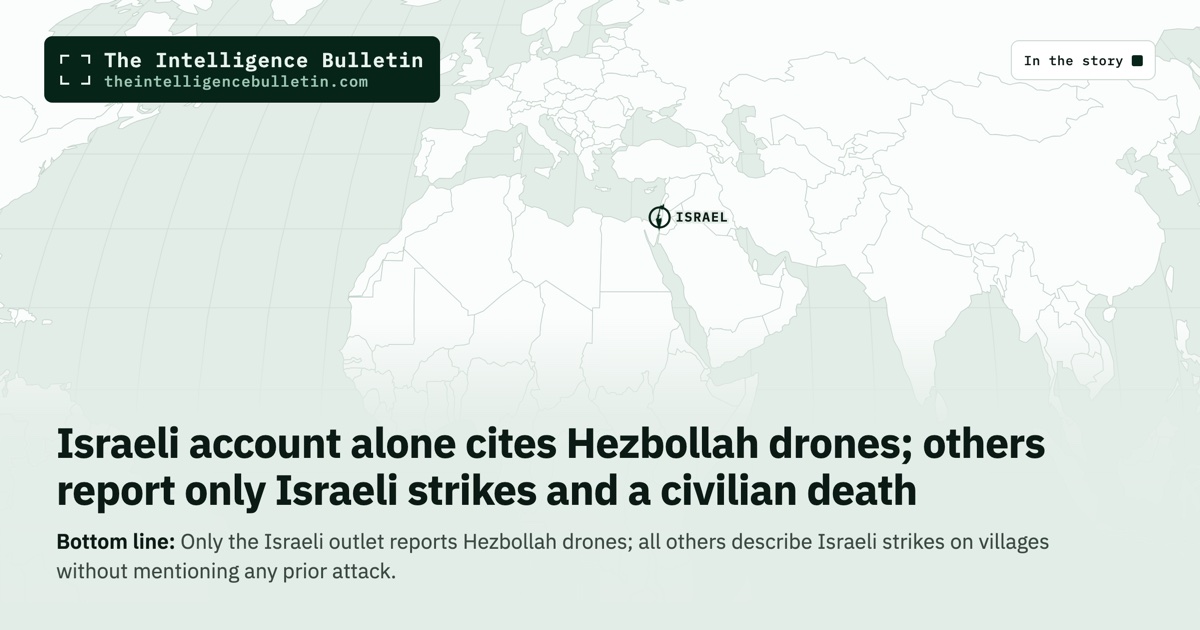
Israeli account alone cites Hezbollah drones; others report only Israeli strikes and a civilian death

Map of the countries in the story: Israeli account alone cites Hezbollah drones; others report only Israeli strikes and a civilian death
Hezbollah launched two attack drones at Israeli troops on the Ali al-Taher Ridge in southern Lebanon overnight on 27 August. Israeli forces downed one drone and reported no injuries before launching retaliatory strikes. Israeli media described the action as targeting Hezbollah positions; Lebanese and regional outlets reported artillery, demolitions and airstrikes on villages including Arab Salim, where a newlywed woman was killed.

One Story. Many Angles.

🇮🇱
Israel
Ynet
Original reporting
Hezbollah launches attack drones at IDF forces in southern Lebanon; Israel strikes ba
Read →
🇱🇧
Lebanon
Al-Manar
ARABIC
Original reporting
Enemy army attacks a number of southern villages – Al-Manar channel
“جيش العدو يعتدي على عدد من القرى الجنوبية – قناة المنار”
Read →
🇱🇧
Lebanon
Libnanews
FRENCH
Original reporting
South Lebanon: wave of deadly Israeli strikes
“Liban-Sud : vague de frappes israéliennes meurtrières”
Read →
🇯🇴
Jordan
Assabeel
ARABIC
Carries National News Agency Lebanon reporting
The occupation launches a series of raids on areas in southern Lebanon
“الاحتلال يشن سلسلة غارات على مناطق في جنوب لبنان”
Read →
🇬🇧
United Kingdom
Middle East Eye
Original reporting
Israeli strike kills newlywed woman in southern Lebanon
Read →
5 sources · each independently reported
In Brief

Only the Israeli outlet reports Hezbollah drones; all others describe Israeli strikes on villages without mentioning any prior attack.

The reporting splits cleanly on sequence and motive. Ynet alone states Hezbollah initiated the clash by sending two one-way attack drones toward IDF troops operating on the Ali al-Taher Ridge, prompting immediate Israeli counter-strikes across the south. Every other source omits the drones entirely and instead records Israeli airstrikes, artillery fire and building demolitions hitting named villages such as Mansouri, Bint Jbeil, Arab Salim and areas around Nabatiyeh Faouqa. Middle East Eye adds the concrete human detail of a newlywed woman killed in Arab Salim, while Assabeel relays Lebanese National News Agency accounts of the same raids and notes no casualties in the latest wave. Al-Manar and Libnanews present the strikes as direct attacks on civilian villages without any preceding Hezbollah action. The pattern shows that only the Israeli outlet supplies an originating claim of Hezbollah drone aggression; the remaining four independent chains converge on Israeli kinetic activity and its civilian effects, producing two incompatible narratives of who acted first.

Perspective Analysis

The overnight clash began when Israeli forces reported two one-way attack drones heading toward their troops on the Ali al-Taher Ridge near Nabatieh Faouqa in southern Lebanon. According to the account carried by Ynet, troops shot down one drone while contact was lost with the second; no Israeli soldiers were injured. The Israeli military then launched a series of strikes against Hezbollah targets across the south, describing the action as part of ongoing efforts to keep the group from rebuilding positions inside a security zone.

Lebanese reporting gave a different sequence. Outlets in Lebanon recorded Israeli artillery fire on Mansouri and Wadi al-Salouqi, followed by explosions in Bint Jbeil, Majdal Zoun, the area between Aytroun and Braashit, and demolitions of buildings in Houla. Airstrikes hit the Ali al-Taher area itself as well as the zone between Dabsha and Douha Kafrraman, plus Qantara and Sarbin. These accounts presented the activity as direct attacks on villages without reference to any preceding drone launches.

Jordanian coverage relayed similar details from the Lebanese National News Agency. Israeli warplanes struck Ali al-Taher heights east of Nabatiyeh Faouqa in two waves around 6 a.m., firing missiles that produced strong explosions and thick smoke. Artillery targeted the edges of Mifdoun and Zoutar al-Sharqiya after an earlier overnight raid between those towns. The same dispatch noted additional demolitions in Bani Hayyan, Yahmour al-Shaqif, Bayt al-Siyad, and other sites, plus artillery on the Litani River crossing at Khardali. No casualties were reported in that latest wave.

A separate report placed one concrete death inside the pattern. In Arab Salim, an Israeli airstrike killed a newlywed woman and injured several others. Lebanese Health Ministry figures cited in that account put the total Lebanese dead since 2 March 2026 at 4,350, with 12,310 wounded.

The same sources noted that Israeli drones continued low-level flights over Beirut’s southern suburbs and the Zahraani area. One dispatch added that talks between Lebanon and Israel were still moving forward, with the next round scheduled for Rome in September.

A reader limited to Israeli coverage would see a clear defensive response to an unprovoked drone attack on troops holding high ground. A reader limited to Lebanese or Jordanian outlets would see only a fresh round of Israeli raids and demolitions hitting named villages, with no preceding Hezbollah action described. The single-source claim of the drone launch appears only in the Israeli account drawn from military statements; the four other independent reporting chains converge instead on Israeli kinetic operations and their effects on southern Lebanese communities.

The corroborated element across all five pieces is the fact of Israeli airstrikes and artillery on the listed villages and ridges. Where the accounts diverge is on motive and sequence. The Israeli report supplies an originating justification tied directly to the drone incident and frames the strikes as limited to Hezbollah targets. Lebanese and regional reporting supplies no such justification and instead foregrounds the locations struck and, in one case, the civilian killed.

The drone claim rests on one chain: Israeli military statements reported through Ynet. The strikes and the death in Arab Salim rest on separate chains that do not reference the drones. Nothing in the published pieces reconciles the two versions; they stand as incompatible accounts of who moved first on the night of 27 August.

Israeli military sources have an institutional interest in presenting the strikes as a measured reply rather than an escalation begun by them. Lebanese outlets, particularly the one aligned with Hezbollah, have an interest in presenting the same strikes as unprovoked attacks on civilian areas. The Jordanian and British pieces sit between these poles: one relays agency copy and notes the talks, the other isolates the specific civilian casualty against the larger death toll.

What to Watch

The pattern suggests the immediate next moves will be shaped by whichever narrative gains traction in the coming days. If the drone claim remains confined to Israeli sources while the civilian death circulates more widely, the diplomatic track scheduled for Rome may face added pressure to address both security guarantees and civilian protection. The ridge itself remains the physical point where the two sides’ versions meet: it is the location named in the Israeli drone report and also the site listed in the Lebanese accounts of the Israeli response.
Share this story

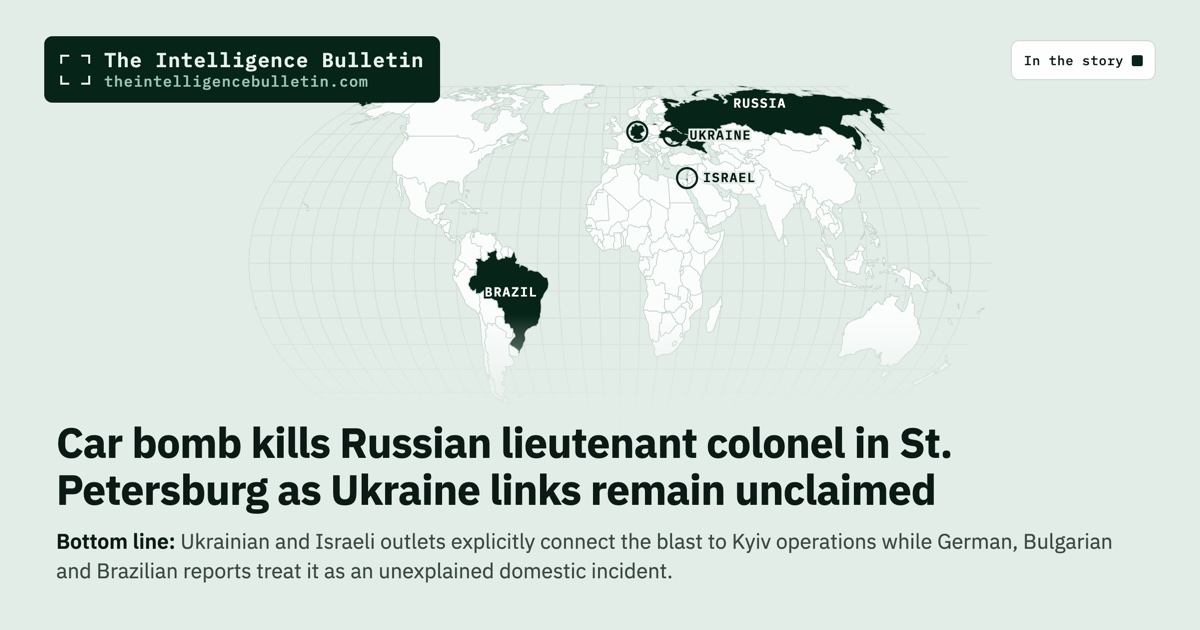
Car bomb kills Russian lieutenant colonel in St. Petersburg as Ukraine links remain unclaimed

Map of the countries in the story: Car bomb kills Russian lieutenant colonel in St. Petersburg as Ukraine links remain unclaimed
A Russian lieutenant colonel was killed and his wife wounded when an explosive device detonated in their car in St. Petersburg on August 27. Russian authorities opened a criminal investigation into the blast near a supermarket in the Shushary district. No group claimed responsibility. Outlets differ on whether to tie the killing to Ukraine amid a pattern of prior attacks on Russian officers.

One Story. Many Angles.

🇺🇦
Ukraine
Podrobnosti
UKRAINIAN
Original reporting
In St. Petersburg, a Russian lieutenant colonel was blown up, and drones struck 2000 kilometers away
“У Петербурзі підірвали російського підполковника, а дрони вдарили за 2000 кілометрів”
Read →
🇮🇱
Israel
Ynetnews
Original reporting
Senior Russian officer killed in St. Petersburg car bomb amid suspected Ukraine-linke
Read →
🇩🇪
Germany
n-tv
GERMAN
Carries Agencies reporting
Ukraine war in live ticker: +++ 17:37 Car bomb in St. Petersburg: Dead man was high-ranking officer +++
“Ukraine-Krieg im Liveticker: +++ 17:37 Autobombe in St. Petersburg: Toter war hochrangiger Offizier +++”
Read →
🇧🇬
Bulgaria
News.bg
BULGARIAN
Carries Reuters reporting
Russian lieutenant colonel killed in car explosion in St. Petersburg
“Руски подполковник загина при експлозия в автомобил в Санкт Петербург”
Read →
🇧🇷
Brazil
CartaCapital
PORTUGUESE
Carries AFP reporting
Car bomb kills Russian military near St. Petersburg
“Carro-bomba mata militar russo perto de São Petersburgo”
Read →
5 sources · each independently reported
In Brief

Ukrainian and Israeli outlets explicitly connect the blast to Kyiv operations while German, Bulgarian and Brazilian reports treat it as an unexplained domestic incident.

The selected sources converge on the basic facts of the killing but diverge sharply on context and implication. Ynetnews alone builds an explicit chain linking the blast to prior suspected Ukrainian operations against Russian officers including Kirillov, framing it as part of widening escalation that also includes Russian warnings to Britain. Podrobnosti pairs the bombing with Ukrainian drone strikes far inside Russia, presenting the incident as successful retaliation reaching deep into the country. CartaCapital, citing AFP and local Fontanka reporting, notes the proximity to military housing and recalls Putin’s past admission of security lapses without assigning blame. News.bg relays Reuters copy and records Russia’s historical accusations against Ukraine while stressing the absence of any claim or Kyiv comment in this case. n-tv embeds the item as one brief domestic note inside a Ukraine-war live ticker, offering no attribution or pattern. The absence of any Russian outlet in the set leaves official Moscow statements visible only through foreign relays, while the consistent lack of claimed responsibility across all reports leaves motive and perpetrator unconfirmed. The reporting therefore shows a factual core that every chain accepts and a single interpretive fault line: whether this is treated as an isolated crime or the latest data point in a cross-border assassination campaign.

Perspective Analysis

A Russian lieutenant colonel died on the morning of August 27 when an explosive device inside his car detonated near a supermarket in St. Petersburg’s Shushary district. His wife, who was also in the vehicle, survived but suffered serious injuries. Russian authorities responded by opening a criminal investigation and described the incident in some statements as a vehicle fire rather than a deliberate explosion. The blast occurred around 10 a.m. local time, and emergency services cordoned off the street while crews examined a damaged black car at the scene.

Local reporting identified the victim as serving in Russia’s air and air-defense forces. The couple had reportedly been leaving their home when the device went off. No group claimed responsibility for the attack, and Ukrainian officials issued no public comment on the case. Russian authorities have previously accused Ukraine of carrying out similar operations against military and security figures since the start of the full-scale invasion, though Kyiv has taken responsibility for some past incidents and denied involvement in others.

Coverage of the killing appeared across outlets in Israel, Ukraine, Germany, Bulgaria and Brazil. The Israeli report placed the St. Petersburg blast inside a longer sequence of attacks on Russian officers and security personnel. It noted the December 2024 killing of Lieutenant General Igor Kirillov, head of Russia’s nuclear, biological and chemical protection forces, by an explosive hidden in an electric scooter in Moscow. The same account listed earlier incidents including the June car-bomb death of General Damir Davidov and the December killing of Lieutenant General Fanil Sarvarov in central Moscow. It also referenced the February killing of Armen Sarkisyan and earlier attacks on a former Ukrainian naval commander in Crimea and managers at drone-production plants. The report framed the latest death as part of widening escalation that also includes Russian warnings to Britain over Ukrainian use of British-supplied weapons.

The Ukrainian outlet paired the car bomb with separate reports of Ukrainian drone strikes reaching targets more than 2,000 kilometers inside Russia. Its framing presented the incident as evidence of Ukrainian operations extending deep into Russian territory on the same day. The Brazilian report, drawing on AFP dispatches and the St. Petersburg channel Fontanka, emphasized the location near what appeared to be military housing and recalled President Putin’s earlier public admission of security shortcomings within Russia’s intelligence services. It described the event as the latest in a series of high-profile killings of Russian military figures without assigning responsibility to any specific actor.

The Bulgarian site relayed Reuters copy that stressed the absence of any claim of responsibility and the lack of comment from Kyiv. It recorded Russia’s historical accusations against Ukraine in similar cases but did not apply those accusations to the current incident. The German coverage placed the item as one brief entry inside a continuous live ticker on the Ukraine war. The ticker format listed the death of the senior officer alongside unrelated developments such as drone activity over Crimea and statements from other capitals, offering no additional sourcing or pattern analysis for the St. Petersburg blast itself.

These differences shape what a reader learns depending on which single account they encounter. Someone reading only the Israeli report would come away with a clear narrative of targeted killings attributed to Ukrainian networks and would see the St. Petersburg case as one more data point in that chain. A reader limited to the Ukrainian account would receive the same incident framed as successful reach by Kyiv forces, reinforced by the simultaneous drone strikes. The Brazilian account would leave them focused on Russian internal vulnerabilities without a named perpetrator. The Bulgarian relay would present the event as an unexplained local crime with no fresh link to the wider war. The German ticker entry would register simply as one additional note inside the daily flow of hostilities, without elevating its significance.

The absence of any Russian outlet from the set means official Moscow statements on the investigation or possible perpetrators reach readers only through these foreign relays. Every account that mentioned an investigation cited Russian authorities or local St. Petersburg sources, yet none supplied new details on suspects or motive beyond the opening of the case. The consistent lack of claimed responsibility across the reports leaves the question of who carried out the attack and why unresolved in the published coverage.

The accounts that treat the killing as an unclaimed domestic incident align most closely with what the reporting actually contains. No outlet in the set produced evidence tying this specific blast to Ukraine or any other actor, and the absence of a claim or Kyiv comment is noted even in pieces that otherwise highlight the broader pattern. The Israeli and Ukrainian reports rely on that pattern to suggest a connection, but the pattern itself rests on earlier cases whose attributions also remain unproven in the current coverage. The Brazilian and Bulgarian pieces, by staying within the confirmed facts of the blast and the investigation, avoid introducing an attribution the sources do not support.

What to Watch

This single incident adds one more instance of lethal violence inside a major Russian city against a serving military officer. It occurs in a district associated with military housing and follows previous attacks on figures involved in Russia’s defense establishment. Whether the pattern reflects sustained external pressure or separate criminal acts remains open in the reporting examined here. The next developments likely to matter are any official Russian findings on the device used or the identity of those who placed it, and whether subsequent coverage in additional outlets begins to claim responsibility or supplies new sourcing that the present set lacks.


Share this story

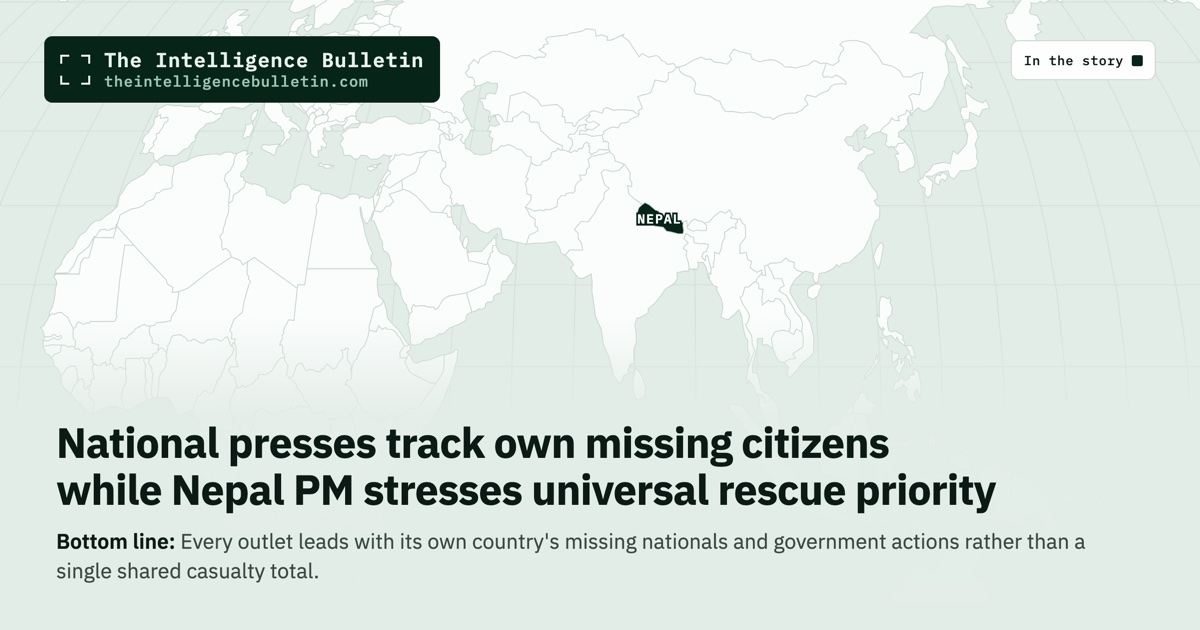
National presses track own missing citizens while Nepal PM stresses universal rescue priority

Map of the countries in the story: National presses track own missing citizens while Nepal PM stresses universal rescue priority
A glacial flash flood struck Nepal’s Rasuwa district near the Tibet border on August 27, 2026, killing at least 95 and leaving hundreds to over 1,400 missing. Nepal’s Prime Minister Balendra Shah returned from affected areas and stated the government’s first priority is saving each citizen’s life through search, rescue and relief. Foreign ministries and embassies from India, Australia and the UK reported dozens to hundreds of their nationals missing, many on pilgrimages, with varying official tolls across sources.

One Story. Many Angles.

🇳🇵
Nepal
Ekantipur
NEPALI
Original reporting
Prime Minister Shah who returned from the flood affected areas says the first priority is to save the lives of each and every citizen
“बाढी प्रभावित क्षेत्रबाट फर्किएका प्रधानमन्त्री शाह भन्छन्- पहिलो प्राथमिकता एक-एक नागरिकको जीवनरक्षा”
Read →
🇨🇳
China
China.org.cn
Xinhua wire copy
95 killed, 484 missing in north Nepal’s floods: PM’s Office
Read →
🇮🇳
India
The New Indian Express
Original reporting
Over 300 Indians missing in flash floods, says Nepal Foreign Minister Shishir Khanal
Read →
🇦🇺
Australia
PerthNow
Original reporting
Australians among hundreds missing after massive flash floods at Nepal-Tibet border
Read →
🇬🇧
United Kingdom
Chester Standard
PA News Agency wire copy
Rescue efforts continue as more than 30 Britons missing after Nepal flash floods
Read →
5 sources · each independently reported
In Brief

Every outlet leads with its own country’s missing nationals and government actions rather than a single shared casualty total.

Nepal’s domestic press centers the story on the prime minister’s direct pledge to treat every citizen’s survival as the absolute first duty, detailing troop deployments, helicopter evacuations and relief distributions in districts like Rasuwa and Nuwakot. Chinese state media, relaying Nepal’s Prime Minister’s Office, publishes the lowest casualty figures and lists foreign missing persons by nationality, including 134 Indians and smaller numbers of Americans, Britons and Australians. Indian outlets instead lead with the Nepal foreign minister’s confirmation of more than 300 missing Indians, many pilgrims, and note embassy coordination plus Indian air-force supply flights. Australian coverage tracks specific families and tour groups unaccounted for, adding government aid pledges and consular hotlines. British reporting, carried by a wire service, supplies names and ages of over 30 missing Britons on similar pilgrimage tours while describing the scale of destruction. The pattern shows each national press foregrounding its own citizens’ fate and its government’s response, while the same underlying Nepal government statements produce different headline emphases and casualty counts that are never reconciled in any single dispatch. The result is parallel national stories rather than one shared account of the event.

Perspective Analysis

A glacial flash flood triggered by an avalanche blocking the Lhende tributary of the Bhotekoshi River swept through Nepal’s Rasuwa, Nuwakot and Dhading districts on August 27, 2026. The waters destroyed bridges, hydropower projects, roads and houses along the Trishuli river system near the Tibet border. Nepal’s Prime Minister Balendra Shah, who had traveled to the affected zone and returned to Kathmandu, posted that the government’s first priority remained saving every citizen’s life through search and rescue, treatment of the injured and immediate relief for affected families. He described the situation in the districts as still challenging and listed twelve specific measures already under way, including the deployment of 13,295 security personnel from the Nepali Army, Armed Police Force and Nepal Police, 69 helicopter flights that had evacuated 573 people that day, temporary shelter for roughly 3,500 residents in schools and public buildings, cash allocations of 10 million rupees each to Rasuwa and Nuwakot plus 5 million to Dhading, and ten trucks of food and non-food items plus additional helicopter drops. Free medical treatment was guaranteed at designated hospitals in the capital, with field hospitals and satellite communications equipment being rushed forward.

Chinese state media reported the same day that Nepal’s Prime Minister’s Office had placed the death toll at 95 with 484 people still missing, of whom 391 were foreign tourists. The breakdown listed 134 Indians, 47 Americans, 33 Britons and 34 Australians among the missing foreigners. The account noted that security forces had rescued 88 people and that the Nepali Army had intensified operations in the hardest-hit districts, with the greatest damage reported in Rasuwa. It added that authorities in India’s Bihar state had raised alerts along the Gandak river system in anticipation of possible downstream flooding.

Indian reporting quoted Nepal Foreign Minister Shishir Khanal stating that more than 300 Indians were missing, an increase from 133 reported the previous day. Many of those unaccounted for were pilgrims traveling to Mount Kailash. The same dispatches recorded Nepal Police placing the overall death toll at 162 and noted that the Indian Embassy in Kathmandu had issued emergency helplines while the embassy in Beijing activated a WhatsApp contact for assistance. Indian Air Force transport aircraft were preparing to fly relief supplies into Nepal.

Australian coverage identified at least 39 missing nationals, including six families and children aged 11 and 14 from the Muralitharan family of Sydney. Four members of the Iyer family from Cherrybrook were also listed among the unaccounted, along with others from Melbourne and Queensland who had been part of US-organized pilgrimage tours. The Australian government announced a 5 million Australian dollar assistance package and deployed additional consular and crisis-response personnel to Kathmandu. Families described last contacts occurring shortly before the flood reached the border area at approximately 9:15 a.m. local time.

British reporting, drawing on Nepal Tourism Board and National Disaster Risk Reduction and Management Authority figures, placed more than 30 Britons among the missing, including a 13-year-old girl and groups of pilgrims whose ages ranged from 14 to 65. One tour operator reported nine British nationals unaccounted for after losing contact at the Chinese immigration point on the border. At one point the missing total across all nationalities had risen from 403 to 826, with 165 bodies recovered. The same accounts described villages completely inundated and infrastructure so extensively damaged that only helicopters could reach many sites.

The casualty and missing-person counts supplied by these outlets do not reconcile. One account attributes 95 dead and 484 missing to Nepal’s Prime Minister’s Office. Other independent reports from Nepal, India, Australia and the United Kingdom cite death tolls above 160 and missing figures ranging from several hundred to more than 1,400. No single dispatch presents both the lower and higher totals side by side or explains the difference.

Nepal’s domestic coverage centers on the prime minister’s enumeration of security deployments, helicopter evacuations and relief distributions inside the affected districts. Chinese reporting foregrounds the lower official toll and a nationality-by-nationality list of foreign missing persons. Indian outlets lead with the foreign minister’s confirmation of more than 300 missing Indians and the embassy’s response measures. Australian and British accounts supply named families and age ranges for their own nationals while noting pilgrimage itineraries that placed those citizens in the border zone at the moment of the flood. Each national press therefore foregrounds its own citizens’ fate and its government’s actions rather than a single reconciled picture of total losses.

What to Watch

The single-source lower casualty figures originate in one relayed statement attributed to Nepal’s Prime Minister’s Office. The higher figures appear across multiple independent reporting chains that cite Nepal Police, the National Disaster Risk Reduction and Management Authority, the Nepal Tourism Board and statements from the foreign minister. Because the sources themselves supply no reconciliation, a reader relying on only one country’s coverage receives either the lowest available toll or a higher range without learning that the two cannot both be accurate. The parallel national emphases leave the overall scale of the disaster visible only when the separate accounts are placed beside one another.


Share this story

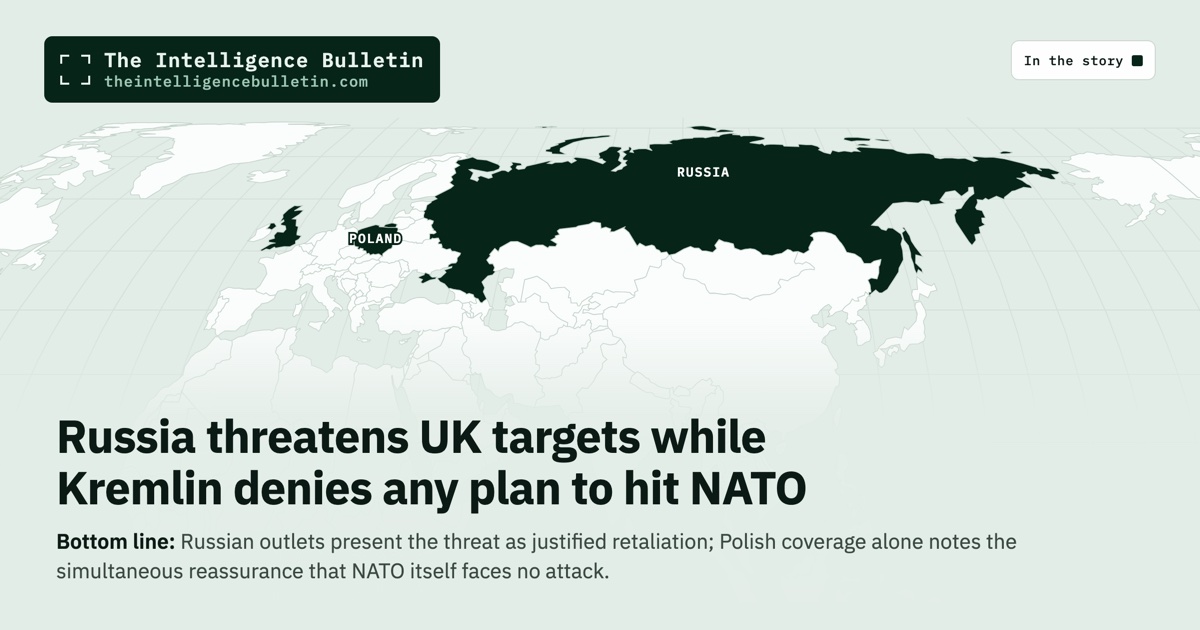
Russia threatens UK targets while Kremlin denies any plan to hit NATO

Map of the countries in the story: Russia threatens UK targets while Kremlin denies any plan to hit NATO
Russian Foreign Ministry spokeswoman Maria Zakharova stated on 27 August 2026 that any British military objects and equipment in Ukraine and beyond could be targeted in response to Ukrainian strikes using British weapons on Russian territory. The warning followed the UK’s decision to share blueprints allowing Ukraine to assemble Storm Shadow/SCALP missiles locally, a move France had also approved. Kremlin spokesman Dmitry Peskov separately said Russia had no intention of attacking NATO countries. The statements came amid ongoing Russian strikes on Ukrainian infrastructure.

One Story. Many Angles.

🇬🇧
United Kingdom
LBC
Original reporting
Russia threatens UK military targets as Kremlin says Britain ‘playing with fire’ over Ukraine support
Read →
🇷🇺
Russia
Vedomosti
RUSSIAN
Carries RIA Novosti reporting
Zakharova warned Britain about response to strikes with its weapons on Russia
“Захарова предупредила Британию об ответе на удары ее оружием по России”
Read →
🇵🇱
Poland
Rzeczpospolita
POLISH
Original reporting
Two voices in Moscow. Kremlin spokesman assures that Russia will not attack NATO. MFA threatens attacks
“Dwugłos w Moskwie. Rzecznik Kremla zapewnia, że Rosja nie zaatakuje NATO. MSZ grozi atakami”
Read →
🇬🇷
Greece
I Efimerida ton Syntakton
GREEK
Original reporting
Russia: Threatens to hit British targets inside and outside Ukraine – ‘Playing with fire’, says about France
“Ρωσία: Απειλεί να χτυπήσει βρετανικούς στόχους εντός και εκτός Ουκρανίας – «Παίζει με τη φωτιά», λέει για τη Γαλλία”
Read →
🇶🇦
Qatar
Al Jazeera
Carries Reuters reporting
Russia warns it could target UK in response to Kyiv firing British missiles
Read →
5 sources · each independently reported
In Brief

Russian outlets present the threat as justified retaliation; Polish coverage alone notes the simultaneous reassurance that NATO itself faces no attack.

Russian and British reporting both treat the threat as a direct response to London’s decision to transfer Storm Shadow assembly technology, but they invert the causal arrow: Vedomosti presents Zakharova’s statement as a defensive warning against British provocation, while LBC frames the same words as Kremlin escalation risking NATO territory. The Polish Rzeczpospolita alone flags the internal Russian contradiction between Peskov’s public reassurance that Moscow will not strike NATO and Zakharova’s explicit inclusion of targets ‘beyond’ Ukraine, a tension neither actor-country outlet foregrounds. Al Jazeera’s Reuters-sourced account aligns with the British emphasis on the threat’s novelty yet situates it within wider Western supply lines, without the Polish observation of Moscow’s mixed signals. The pattern shows that coverage diverges less on the facts of what Zakharova said than on whether those facts reveal a coherent Russian position or deliberate ambiguity aimed at European publics.

Perspective Analysis

On 27 August 2026 Maria Zakharova, the Russian Foreign Ministry spokeswoman, told a Moscow news briefing that any British military objects and equipment in Ukraine and beyond its borders could become targets if Ukraine continued to strike Russian territory with British weapons. She tied the warning directly to the United Kingdom’s decision three days earlier to release blueprints for British-made components of the Storm Shadow cruise missile, allowing Ukraine to begin local assembly of the weapon, also known as SCALP in its French version. Zakharova accused London and Paris of attempting to dodge responsibility by shifting the assembly role to Ukraine and stated that both capitals were playing with fire, with consequences that could prove unpredictable and extend to them.

The same briefing recorded Zakharova saying that Britain was one step away from legal complicity in what she described as terrorism against Russian civilians, and she called on British leaders to abandon their hostile policy or face catastrophic results. Vedomosti reported the statement with a direct citation to RIA Novosti, noting that Zakharova also recalled an earlier announcement by French President Emmanuel Macron on similar technology sharing that had not yet been implemented. The Russian outlet linked the warning to an attack two days earlier on the centre of Donetsk, where Ukrainian forces had struck with Anglo-French Storm Shadow or SCALP-EG missiles, wounding eight people according to the head of the Donetsk People’s Republic.

Kremlin spokesman Dmitry Peskov, speaking at a separate briefing the same day, told reporters that reports of possible Russian attacks on NATO countries had nothing to do with Moscow’s intentions and were designed to divert attention from what he called aggressive European policies toward Russia. Rzeczpospolita recorded Peskov repeating the standard Russian position that Moscow would prefer to achieve its goals in Ukraine by peaceful means but would continue its special military operation to ensure its security. The Polish paper juxtaposed that reassurance against Zakharova’s explicit reference to targets beyond Ukraine, noting the two officials addressed parallel press conferences only hours apart.

British Prime Minister Andy Burnham, visiting Kyiv on the same trip that included the 24 August technology announcement, told reporters that Britain would maintain its support for Ukraine and asked who had started the fire in the first place. LBC carried Burnham’s statement that the United Kingdom had provided consistent backing since the invasion began and would not change course, even while acknowledging the situation was challenging. Al Jazeera, drawing on a Reuters dispatch, described Zakharova’s warning as the strongest direct threat yet from Russia to Britain and placed it alongside fresh Russian missile and drone strikes on Ukrainian ports, grain stores, energy sites and industrial facilities that had killed at least one person and injured several others in the preceding hours.

The technology transfer itself rested on a UK government decision announced on 24 August that authorised the European defence company MBDA to pass closed data on SCALP components to Ukraine. France had already given its assent for the same licensing step. Zakharova framed both moves as an attempt to shift blame for deep strikes into Russia onto Ukrainian soil while retaining the underlying Western role in the weapons’ production and targeting.

The accounts converge on the core factual sequence: the UK technology decision on 24 August, Zakharova’s explicit threat on 27 August to British military assets inside and outside Ukraine, and the reference to Storm Shadow and SCALP missiles already used or about to be produced locally. They also agree that Peskov addressed Western speculation about possible Russian moves against NATO members. The divergence appears in how each outlet positions the causal relationship and the internal Russian messaging. LBC presents the threat as Kremlin escalation that directly endangers British territory and records the British government’s immediate rebuttal. Vedomosti presents the identical statement as a necessary response to British actions that risk elevating the conflict to a new level, citing only the Foreign Ministry side of the day’s briefings.

Rzeczpospolita stands apart by recording both Peskov’s denial of any plan to strike NATO and Zakharova’s inclusion of targets beyond Ukraine in the same article, treating the two statements as simultaneous and therefore in tension. Al Jazeera situates the warning within the pattern of Western arms supplies to Ukraine without addressing the Peskov-Zakharova contrast. No other outlet among those examined foregrounds that contrast on the day the statements were made.

The corroborated record shows Zakharova issuing a concrete threat that four independent reporting chains carried in substantially the same terms. The single-source reassurance from Peskov that Russia harbours no intention toward NATO territory rests on one chain and receives no corroboration from the other briefings reported the same day. Russian domestic coverage foregrounds the defensive justification and omits the simultaneous reassurance, while British coverage foregrounds the risk to its own territory and the government’s resolve to continue support. The Polish account supplies the only explicit juxtaposition of the two Russian voices.

What to Watch

A reader limited to Russian outlets would conclude that Moscow is responding proportionately to an escalatory Western decision and would miss the parallel claim that NATO itself faces no danger. A reader limited to British outlets would register the direct threat and the government’s commitment to Ukraine but would not encounter the internal Russian contradiction that an observer outside the actor countries recorded. The Polish reporting demonstrates that the day’s Russian statements were not a single coherent message but two distinct lines delivered in parallel, one reassuring and one threatening. That distinction matters because it leaves European governments to decide whether the reassurance or the threat represents the operative Russian position, a choice the actor-country coverage does not force them to confront.


Share this story

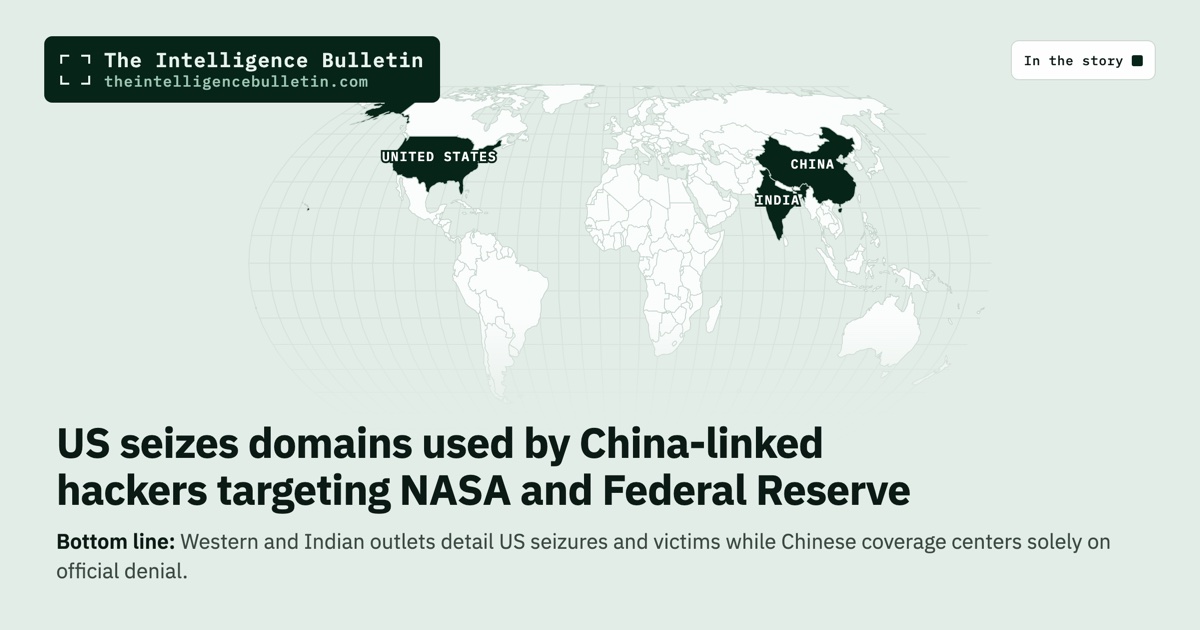
US seizes domains used by China-linked hackers targeting NASA and Federal Reserve

Map of the countries in the story: US seizes domains used by China-linked hackers targeting NASA and Federal Reserve
US Justice Department and FBI announced disruption of hacking platforms QScan and QTRouter used since 2018 by Chinese state actors to target the Justice Department, NASA, Federal Reserve, Senate and other agencies. Authorities seized domains tied to Nanjing Xinjiuwei Network Technology Company, whose clients allegedly include China’s Ministry of State Security and People’s Liberation Army. China rejected the claims, accusing the US of smears and pledging to combat all cyberattacks.

One Story. Many Angles.

🇺🇸
United States
Union Leader
Carries Reuters reporting
US says Chinese hackers broke into Justice Department, NASA, Federal Reserve, Senate
Read →
🇨🇳
China
Sina Finance
CHINESE
Carries Chinese Embassy reporting
US claims Justice Department, NASA, Federal Reserve and other institutions were attacked by ‘Chinese hackers’, China refutes: Resolutely oppose and crack down on all forms of cyber attacks according to law
“美方声称司法部、NASA、美联储等机构遭”中国黑客”攻击,中方驳斥:坚决反对并依法打击一切形式的网络攻击_新浪财经_新浪网”
Read →
🇬🇧
United Kingdom
The Independent
Carries US Department of Justice reporting
Fed, NASA and DOJ among victims of Chinese state-sponsored hacker group, FBI says
Read →
🇮🇳
India
The Times of India
Carries US Department of Justice reporting
US Justice Department and FBI seize domains claimed to be used by China-linked hacking group targeting NASA, Federal Reserve and more
Read →
🇶🇦
Qatar
Al Jazeera
Carries Reuters reporting
US says Chinese-linked hackers attacked NASA, Senate, and gov’t agencies
Read →
5 sources · 3 independent accounts — some share the same news agency’s report
In Brief

Western and Indian outlets detail US seizures and victims while Chinese coverage centers solely on official denial.

US and allied reporting converges on the technical details of domain seizures and victim lists drawn from court affidavits, treating the state-sponsorship link as established by the platforms’ client base. Chinese coverage, by contrast, opens with the embassy rebuttal and frames the episode as recycled political attacks without engaging the specific infrastructure claims. This divide shows how cyber attribution stories split cleanly along the US-China fault line: Western and Indian outlets relay DOJ statements and add context on prior operations against groups like Volt Typhoon, while the Sina account relays only the counter-narrative and Reuters framing of it. The Independent notes Beijing’s consistent denials but includes FBI Director Kash Patel’s quote on the botnet disruption; Al Jazeera and the Union Leader stay close to the announcement. The Times of India stands out by foregrounding enforcement mechanics and historical takedowns rather than blame. No independent chain verifies the Chinese firm’s client relationships or refutes them, leaving the core accusation resting on one reporting origin.

Perspective Analysis

The United States Justice Department announced on August 26, 2026, that it had seized domains linked to two hacking platforms, QScan and QTRouter, which authorities described as tools used by Chinese state-sponsored actors to compromise sensitive networks. The platforms had been active since at least 2018, according to court documents, enabling attackers to scan and infect thousands of internet-connected devices worldwide and then route malicious traffic through those compromised machines to obscure the origin of the activity. The Justice Department said the seizures rendered both platforms inoperable by removing hard-coded domains required for their communication and authentication functions.

The list of targeted entities included the Department of Justice itself, NASA, the Federal Reserve, the Senate, the Department of Energy, the Department of Health and Human Services, the National Institutes of Health, and four unnamed companies in the United States and South Korea. Specific incidents cited in the affidavit involved unsuccessful attempts against NASA networks in August 2019 and successful breaches at three Energy Department laboratories plus NIH and HHS networks in September 2024. The platforms were attributed to the China-based Nanjing Xinjiuwei Network Technology Company, whose paying clients were said to include China’s Ministry of State Security and the People’s Liberation Army.

Chinese officials responded through the embassy in Washington by rejecting the accusations outright. The embassy statement called the claims an effort to smear and discredit China and reiterated Beijing’s opposition to the politicization of cybersecurity issues, while pledging that China would continue to oppose and combat all forms of cyberattacks in accordance with its laws. The response echoed earlier Chinese diplomatic positions that have framed similar US statements as recycled allegations designed to justify restrictions on Chinese firms.

The platforms operated as a global botnet infrastructure. QScan automatically identified and infected internet-connected devices such as routers, folding them into a controlled network managed through QTRouter. This setup allowed attackers to make traffic directed at US targets appear to originate from devices in other countries or even near the target itself, buying time before attribution efforts could narrow the source. The Justice Department tied the infrastructure to a group it identified as QTFY, which offered hacking services to state customers.

US authorities framed the action as part of a broader pattern of operations against Chinese cyber activity. The affidavit and accompanying statements referenced earlier disruptions, including the 2025 removal of PlugX malware from more than 4,000 US computers linked to Mustang Panda, the 2024 takedown of a large network of compromised IoT devices attributed to Flax Typhoon, and the 2023 action against a botnet used by Volt Typhoon.

Reporting from outlets that carried the Justice Department announcement described the same core sequence of domain seizures and victim list. The Independent added context from cybersecurity analysts on the growth of Chinese private contractors offering offensive services to state agencies. The Times of India detailed the technical mechanics of the platforms and placed the operation in sequence with prior US actions against named Chinese groups. Al Jazeera noted the absence of immediate comment from the Chinese embassy or the Nanjing firm when contacted by Reuters. The Union Leader summarized the announcement as a national security breach involving the listed agencies.

Accounts diverge sharply on emphasis and framing. Outlets relaying the US statements foregrounded the operational details, the named platforms, the specific agencies compromised, and the history of similar takedowns. The Chinese account led instead with the embassy rebuttal and presented the episode as familiar political rhetoric without addressing the infrastructure claims or victim list. No reporting chain independent of the US affidavit verified the client relationships between Nanjing Xinjiuwei and Chinese intelligence or military entities, nor did any provide technical counter-evidence refuting the platform descriptions.

The corroborated elements across multiple independent reporting chains are the domain seizures, the platform names, the victim agencies, and the timeframe of activity beginning in 2018. These details appear consistently in court documents referenced by the Justice Department and carried by outlets that relayed the announcement. The attribution of the platforms to state sponsorship rests on a single reporting origin, the US affidavit, which multiple outlets transmitted without additional verification. The Chinese rejection stands as an on-record denial from the embassy, presented without engagement with the specific technical assertions.

What to Watch

This pattern of coverage indicates that cyber attribution disputes between the United States and China continue to produce parallel narratives rather than shared facts. The US side supplies primary documents that travel across Western and Indian reporting, while the Chinese side supplies diplomatic statements that travel within its own press. The absence of independent technical verification on either side leaves the core dispute unresolved in public reporting, with each account serving the institutional interests of the government that originated it. Future incidents of this type are likely to follow the same template, as the incentives for attribution and denial remain unchanged.


Share this story

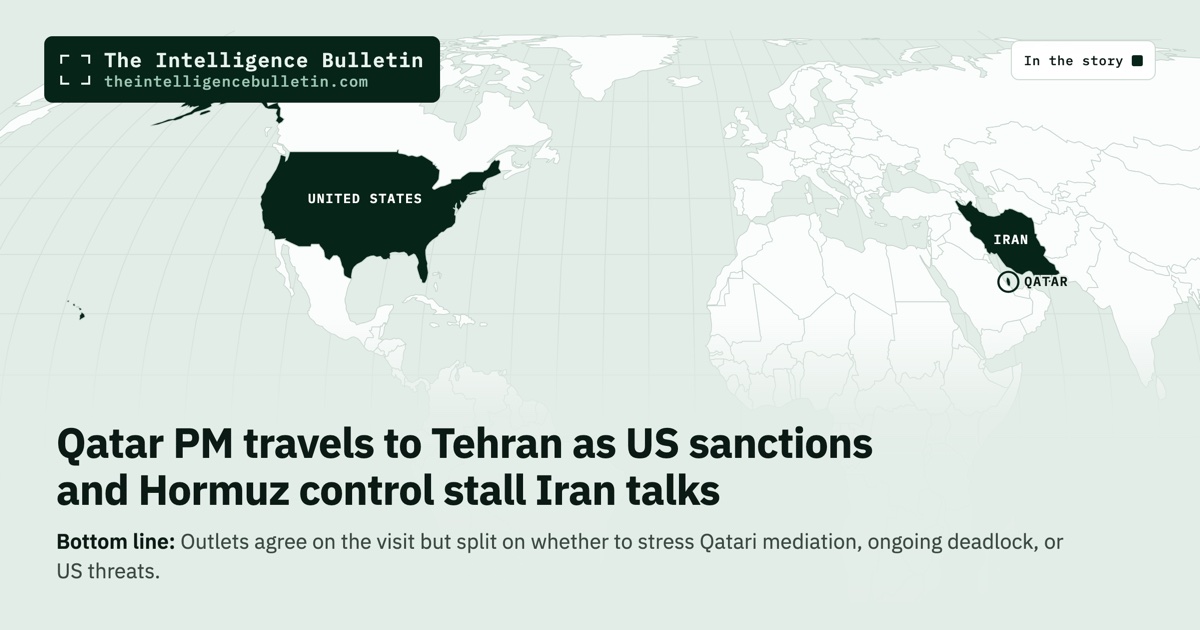
Qatar PM travels to Tehran as US sanctions and Hormuz control stall Iran talks

Map of the countries in the story: Qatar PM travels to Tehran as US sanctions and Hormuz control stall Iran talks
Qatar Prime Minister Sheikh Mohammed bin Abdulrahman Al Thani is scheduled to visit Tehran on Thursday to discuss de-escalation and revive dialogue between the United States and Iran. The trip occurs as the US-Israel conflict with Iran nears its sixth month, with major fighting paused but no diplomatic breakthrough. Key sticking points include US plans for additional sanctions on Iran’s trade partners and control over the Strait of Hormuz, where oil flows have dropped sharply. Qatar has acted as a back-channel between Washington and Tehran, having helped broker a June memorandum of understanding that later collapsed.

One Story. Many Angles.

🇶🇦
Qatar
Al Jazeera
Original reporting
Qatar’s prime minister to visit Tehran, seeking to revive US-Iran talks
Read →
🇮🇳
India
The Times of India
Carries Reuters reporting
Qatar PM to visit Tehran as Iran-US tensions persist over Hormuz Strait and sanctions
Read →
🇦🇺
Australia
The Examiner
Australian Associated Press wire copy
Qatar PM to visit Tehran to pursue mediation efforts
Read →
🇸🇴
Somalia
Jowhar
Carries Reuters reporting
Qatar’s Prime Minister to Visit Tehran to Restart Mediation Efforts – Jowhar News Leader
Read →
🇮🇩
Indonesia
Republika
INDONESIAN
Carries Reuters reporting
Qatar Prime Minister Visits Tehran Amid Trump’s Threats Against Iran-Supporting Countries
“Perdana Menteri Qatar Kunjungi Teheran di Tengah Ancaman Trump Terhadap Negara Pendukung Iran”
Read →
5 sources · 3 independent accounts — some share the same news agency’s report
In Brief

Outlets agree on the visit but split on whether to stress Qatari mediation, ongoing deadlock, or US threats.

The reporting across these outlets converges tightly on the bare facts of the announced visit and its stated purpose, yet the chosen framing reveals distinct editorial priorities shaped by each outlet’s position in the story. Al Jazeera leads with Qatar’s own agency in pushing dialogue, drawing on its foreign ministry statements to position Doha as the active mediator. Indian and Australian pieces embed the same announcement inside a longer account of stalled diplomacy and Hormuz leverage, treating the visit as one more move in a prolonged impasse rather than a breakthrough effort. The Somali outlet follows the mediation thread but layers in the same Reuters-sourced details on shipping incidents and oil volumes that appear across multiple wires. Indonesia’s Republika stands apart by foregrounding Trump’s threats to Iran’s partners and Qatar’s own economic stake in reopening the strait, shifting emphasis from neutral diplomacy to adversarial pressure and financial pain. Several pieces carry identical passages on the Oman talks and the internal Iranian contradiction between IRGC claims and a senior source’s clarification, confirming they relay the same agency copy rather than independent reporting. The selected sources therefore show a shared factual base with variation only in what each chooses to foreground: Qatari initiative, persistent deadlock, or external threats.

Perspective Analysis

Qatar Prime Minister Sheikh Mohammed bin Abdulrahman Al Thani is scheduled to arrive in Tehran on Thursday for meetings with Iranian officials aimed at lowering tensions and laying groundwork for renewed talks between Iran and the United States. The announcement came from Qatar’s Foreign Ministry spokesman Majed al-Ansari, who said the prime minister, who also serves as foreign minister, would discuss ways to de-escalate the conflict and create conditions for dialogue. Iran’s Foreign Ministry spokesman Esmaeil Baghaei confirmed the trip, stating it would cover the continuation of Qatar’s mediation efforts along with other regional developments.

The visit occurs as the conflict between the United States and Israel on one side and Iran on the other approaches its sixth month. Major fighting has largely paused, yet no lasting diplomatic settlement has emerged. One persistent point of friction is control of the Strait of Hormuz, the narrow waterway between Iran and Oman through which roughly one-fifth of global oil supplies once moved. Before the war began on February 28, ship-tracking data showed about 20 million barrels per day transiting the strait. By the most recent readings cited in several reports, that volume had fallen to about 5 million barrels per day, the lowest level in three months. The United Nations International Maritime Organization recorded 70 incidents in the strait since late February that resulted in 19 seafarer deaths.

Qatar has positioned itself as a back-channel between Washington and Tehran. It helped broker a June memorandum of understanding that produced a temporary pause in hostilities, but that accord unraveled in July. The prime minister’s trip comes two days after Omani Foreign Minister Badr Albusaidi met his Iranian counterpart, Abbas Araghchi, in Tehran. Following those talks, Iran’s deputy foreign minister Kazem Gharibabadi described an agreement on a new temporary shipping route. Yet statements on that arrangement diverge. Brigadier General Hossein Mohebbi, a spokesperson for Iran’s Islamic Revolutionary Guard Corps, said the two countries had reached results acceptable to both sides on control of the strait and its revenues, and that the waterway would remain closed until the United States met Tehran’s conditions from the June deal, including an end to port blockades, compensation, and removal of sanctions. A senior Iranian source later told Reuters that no agreement with Oman had been finalized and that talks on details were continuing.

On the sanctions front, the United States has signaled plans to intensify economic pressure by targeting countries and companies that continue trading with Iran. President Donald Trump told Al Jazeera he was in no hurry to resume talks, stating that both economic and military measures had proven effective. Iran’s Foreign Minister Abbas Araghchi wrote to the United Nations describing the new sanctions as an act of state and economic terrorism that harms civilians by restricting access to food, medicine, energy, and other essentials. Qatar’s Foreign Ministry noted that the prime minister would also raise the need to restore freedom of navigation in the Strait of Hormuz to its pre-February 28 status.

Several outlets carried nearly identical passages on the oil-flow decline, the 70 incidents, and the 19 deaths, along with the same description of the internal Iranian disagreement over the Oman arrangement. Those passages trace to the same agency reporting. The Somali site Jowhar and the Australian Examiner both reproduced the Reuters-sourced material on shipping volumes and the Mohebbi versus senior-source contradiction, while adding the detail that Pakistan’s army chief had visited Tehran earlier in the week. The Times of India embedded the visit announcement inside an account of stalled progress and unresolved Hormuz leverage, noting that Iran’s Revolutionary Guards had claimed an agreement on revenue sharing that a senior source later qualified.

Al Jazeera, drawing on its own foreign ministry contacts, led with Qatar’s role as the active mediator and quoted the spokesman directly on the diplomatic path as the best means of resolving differences. The Indonesian site Republika placed the trip inside a frame of Trump’s threats to Iran’s partners and added that Qatar’s liquefied natural gas exports had dropped 96 percent since the war began, costing the country an estimated 24 billion dollars in revenue. That economic angle does not appear in the other four pieces.

The accounts converge on the core sequence: the prime minister’s travel date, the stated purpose of reviving dialogue, the sanctions escalation, the Hormuz dispute, and the recent Oman contacts. They differ mainly in emphasis. The Qatari outlet foregrounds Doha’s initiative. The Indian and Australian pieces treat the visit as one incremental step inside a longer deadlock. The Somali and Australian reports add the same layer of shipping and casualty data. The Indonesian piece alone highlights the sanctions pressure on third parties and Qatar’s direct financial exposure. No outlet in the set contradicts the visit itself or the basic purpose described by both governments.

The most consistent factual spine comes from the pieces that carried the Reuters material on volumes, incidents, and the explicit contradiction between the Revolutionary Guard Corps statement and the senior source. That internal Iranian divergence is presented plainly as two claims that cannot both be accurate on the question of whether an agreement has been reached. The Qatari outlet supplies the clearest on-record statements from Doha about its own mediation goals. The Indonesian piece supplies the only explicit quantification of Qatar’s LNG losses tied to the strait’s closure.

What to Watch

The wire-relayed accounts therefore give the fullest picture of what multiple independent reporting chains agree upon, while the Qatari and Indonesian pieces add distinct vantage points that the others omit. The visit itself is scheduled for the day after these reports appeared. Whether it produces any movement on sanctions relief or Hormuz access will depend on whether the United States and Iran treat the same set of conditions as negotiable or as non-starters.


Share this story