Trump hails permanent US security control in Greenland as Denmark and Greenland stress sovereignty preserved

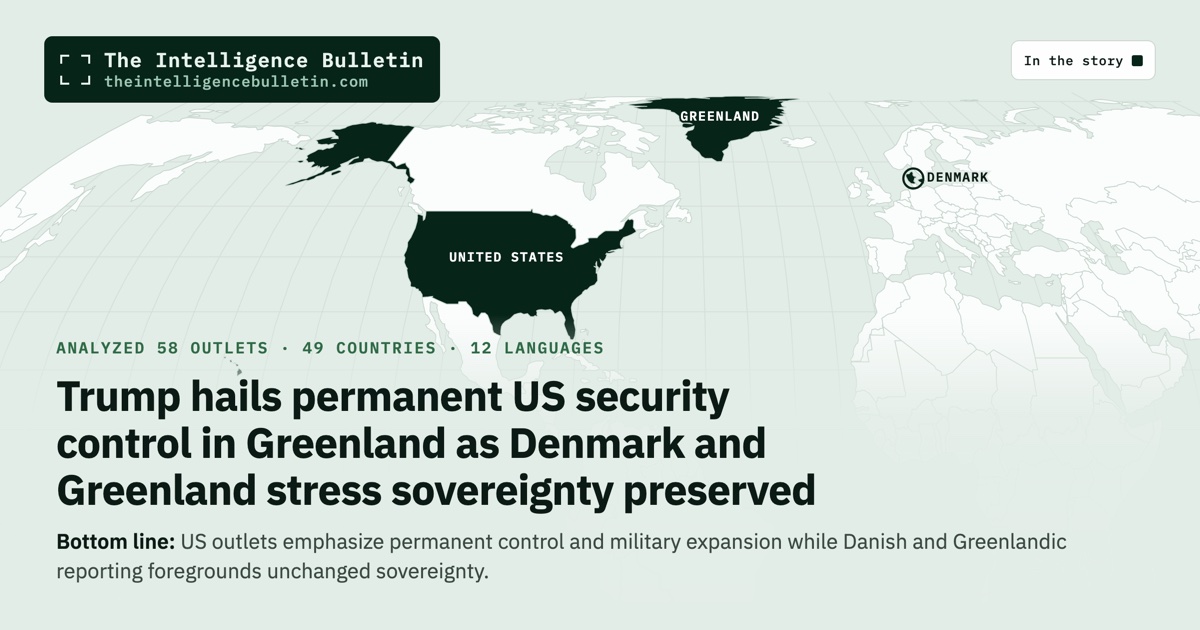
Map of the countries in the story: Trump hails permanent US security control in Greenland as Denmark and Greenland stress sovereignty preserved
President Trump announced an agreement with Denmark and Greenland giving the United States permanent control over security in the Arctic territory. Danish Prime Minister Mette Frederiksen and Greenland Premier Jens-Frederik Nielsen confirmed the pact in a joint statement, stressing that it strengthens shared security, benefits NATO and Europe, and explicitly recognizes Danish sovereignty and Greenland’s right to self-determination. The deal will be signed next week at the UN General Assembly and includes expanded US military access while barring non-NATO bases or adversary investments.

One Story. Many Angles.

🇺🇸
United States
NBC News
Original reporting
Trump announces agreement with Denmark to secure ‘permanent’ control over Greenland’s security
Read →
🇩🇰
Denmark
DR
DANISH
Original reporting
Trump announces: We have entered into an agreement with Denmark and Greenland
“Trump melder ud: Vi har indgået en aftale med Danmark og Grønland”
Read →
🇬🇱
Greenland
Sermitsiaq
DANISH
Original reporting
Jens-Frederik Nielsen: Greenland, Denmark and USA now have an agreement
“Jens-Frederik Nielsen: Grønland, Danmark og USA har nu en aftale”
Read →
🇬🇧
United Kingdom
LBC
Original reporting
Trump claims US has ‘permanent control’ of Greenland’s security under ‘Infinite Life Agreement’
Read →
🇨🇳
China
China Daily
Carries Xinhua reporting
Trump claims deal with Denmark, Greenland giving US control over security in Greenland
Read →
5 sources · each independently reported
Analyzed 58 outlets across 49 countries and 12 languages
In Brief

US outlets emphasize permanent control and military expansion while Danish and Greenlandic reporting foregrounds unchanged sovereignty.

The reporting reveals a carefully calibrated diplomatic compromise rather than a US takeover. Trump’s Truth Social post frames the outcome as an unqualified American victory delivering permanent control at zero cost and enabling immediate expansion of military presence. Danish and Greenlandic statements, issued jointly, repeat the same core facts but anchor every sentence in language that preserves formal sovereignty and self-determination. This dual framing appears across all five outlets: NBC News quotes Trump at length while noting the Danish caveats; DR and Sermitsiaq lead with the Danish-Greenlandic press release and its sovereignty language; LBC highlights the novel “Infinite Life Agreement” phrasing and its continuity with the 1951 base accord; China Daily relays Trump’s claims without adding local reactions. The convergence on the deal’s existence and the divergence on emphasis show how each capital’s press translates the same text into its domestic political register. No outlet reports contradictions on the core terms, only different weight given to the words “permanent control” versus “sovereignty and territorial integrity.” The pattern indicates the agreement succeeded precisely because it allowed both sides to claim victory without resolving the underlying tension over ultimate authority.

Perspective Analysis

President Donald Trump announced on Truth Social that the United States had reached an agreement with the Kingdom of Denmark and Greenland granting America permanent control over security and all other needs in the Arctic territory. The post described the pact as an “Infinite Life agreement” that would come at no cost to the United States and allow immediate development of a large military presence in suitable areas, with cooperation from the Greenlandic population. Trump stated that the arrangement fully addressed American concerns and represented a historic solution beneficial to Denmark, Greenland, the United States, and their allies.

Danish Prime Minister Mette Frederiksen and Greenland Premier Jens-Frederik Nielsen issued a joint statement confirming the same agreement. They said it would strengthen common security in the Arctic and North Atlantic region, benefit NATO and Europe, and explicitly recognize the Kingdom’s sovereignty and territorial integrity along with the Greenlandic people’s right to self-determination. The statement described the outcome as good for Greenland, the Kingdom of Denmark, and the United States. Both leaders expressed satisfaction that the deal secured and strengthened security for Greenland, the Kingdom, the United States, and the Western alliance while acknowledging Greenland’s interests and its place in international cooperation.

The agreement is scheduled for signing next week in connection with the United Nations General Assembly in New York. After signature, it must complete necessary parliamentary procedures in the participating countries before entering into force. A State Department official told NBC News that the text explicitly bans any non-NATO base or troop presence in Greenland, includes screening mechanisms to block investments from Russia and China that could threaten the United States, and guarantees the United States permanent access, basing, and overflight rights even if Greenland later becomes fully independent from Denmark. The official said the pact ensures the United States can do whatever it deems necessary to secure and defend the American continent, including expanding the number of bases as required.

The United States already maintains one active military installation on Greenland, Pituffik Space Base, under rights established in a 1951 agreement with Denmark. That earlier accord allowed the United States to station as many troops as it wished. The new arrangement builds on that foundation while adding explicit language on permanence and restrictions on adversaries. Greenland, a self-governing territory within the Kingdom of Denmark with a population of roughly 56,000 to 57,000, contains vast untapped mineral resources and occupies a strategic position in the Arctic.

Trump’s earlier public statements had included threats to acquire the territory by force if necessary, citing risks from Russian and Chinese influence. Those remarks prompted warnings from some European officials that such a move could damage NATO cohesion. The new agreement avoids outright transfer of sovereignty while delivering expanded American operational freedom.

Coverage of the announcement shows consistent agreement on the existence and basic terms of the deal. All five outlets reported Trump’s Truth Social post and the Danish-Greenlandic joint statement. None described contradictions over whether an agreement had been reached or over the core elements of expanded US security rights alongside continued Danish sovereignty.

The accounts diverge in emphasis. NBC News led with Trump’s characterization of permanent control and zero cost while noting the Danish caveats on sovereignty. DR placed the Danish-Greenlandic press release immediately after Trump’s announcement and foregrounded the language on sovereignty and self-determination. Sermitsiaq centered the statement from Nielsen, presenting the deal as beneficial to Greenland and the Western alliance while underscoring local interests. LBC highlighted the “Infinite Life Agreement” label and observed its similarity to the 1951 base rights, adding commentary on NATO implications. China Daily relayed Trump’s claims and placed the episode in the context of earlier opposition from Denmark, Greenland, and European partners.

A reader limited to one national outlet would miss the dual framing that allowed both sides to present the outcome as a success. American coverage foregrounds the expansion of military authority and the exclusion of adversaries. Danish and Greenlandic reporting foregrounds the unchanged formal status of the territory and the explicit protections for self-determination. The British and Chinese accounts add external context on alliance mechanics and great-power competition without altering the core facts reported by the actor countries.

The joint Danish-Greenlandic statement supplies the clearest evidence that the agreement was negotiated to accommodate both interpretations. Its repeated references to sovereignty and self-determination appear in the same document that endorses strengthened security cooperation and a large US military presence. Trump’s post and the State Department description treat the same text as delivering permanent and complete American operational rights. The absence of any reported dispute over the wording itself indicates the compromise succeeded by leaving the underlying question of ultimate authority unresolved.

What to Watch

The deal’s structure suggests it will expand the existing US footprint on Greenland while preserving the legal fiction of Danish ownership. Parliamentary approval in Copenhagen and Nuuk will test whether the sovereignty language satisfies domestic audiences who previously rejected outright American acquisition. For Washington, the arrangement removes an irritant in relations with a NATO ally and secures long-term strategic positioning in the Arctic at a time of renewed great-power interest in the region. The signing at the UN General Assembly next week will mark the first public test of whether the dual claims hold under international scrutiny.
Share this story

Iran conditions NPT withdrawal on US behavior in single Al Jazeera interview

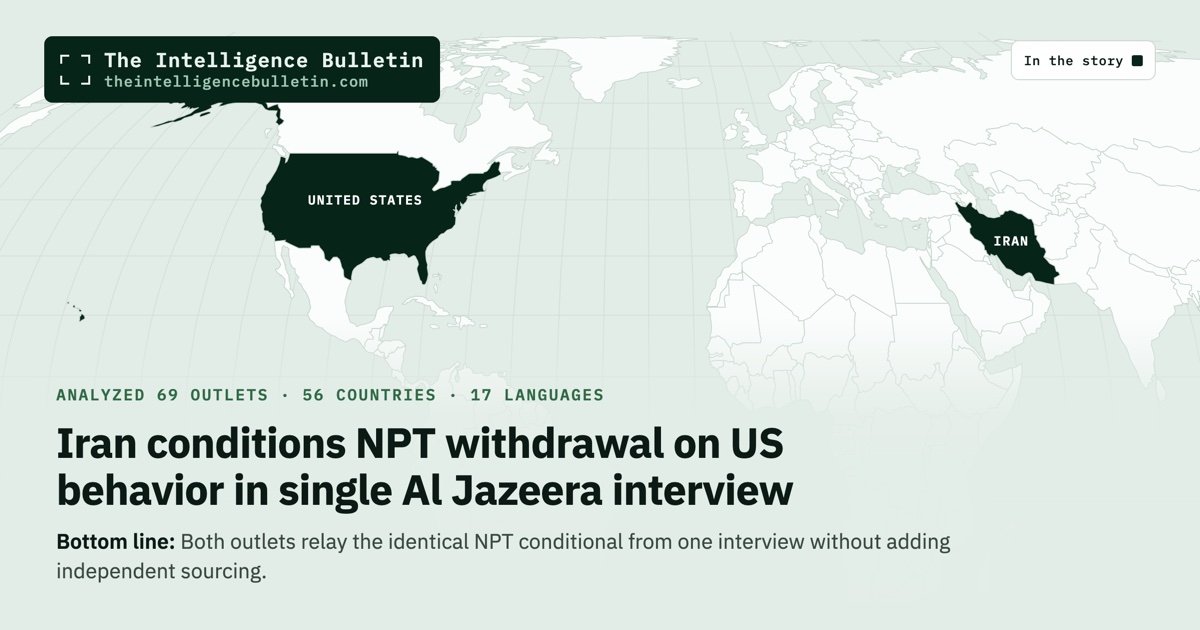
Map of the countries in the story: Iran conditions NPT withdrawal on US behavior in single Al Jazeera interview
Iran’s Supreme National Security Council Secretary Mohsen Rezaei told Al Jazeera that Iran has not decided on withdrawing from the Nuclear Non-Proliferation Treaty but any such move depends on US behavior. He reaffirmed commitment to a religious decree against nuclear weapons while listing conditions for ending hostilities, including asset releases and ending blockades. The statements come after joint US-Israeli strikes on Iran and a failed June MoU on negotiations.

One Story. Many Angles.

🇨🇳
China
Xinhua
Carries Xinhua reporting
Iran’s decision on NPT withdrawal depends on U.S. behavior, top security official says-Xinhua
Read →
🇮🇷
Iran
Press TV
Original reporting
Iran’s nuclear doctrine not changed, but NPT withdrawal possible: Top security official
Read →
2 sources · each independently reported
Analyzed 69 outlets across 56 countries and 17 languages
In Brief

Both outlets relay the identical NPT conditional from one interview without adding independent sourcing.

The two selected outlets converge on the core conditional from Rezaei’s Al Jazeera interview: NPT withdrawal remains possible but undecided and tied directly to Washington’s conduct. Xinhua transmits the statement as a neutral wire dispatch focused on the US interest in meeting Iran’s three explicit conditions. Press TV embeds the same line in a longer defensive account that stresses unchanged nuclear doctrine, highlights US-Israeli aggression as justification, and adds Iranian warnings of readiness for confrontation. No outlet in the set introduces independent verification or counter-claims; both derive from the single interview. The absence of any US-sourced reporting in the selected coverage leaves the Iranian framing of leverage unchallenged within these accounts. The reporting therefore shows how a single official statement travels intact across state channels, with the Iranian outlet adding context that reinforces Tehran’s negotiating posture while the Chinese wire keeps the focus on the explicit linkage to US steps. This pattern underscores that the story’s global signal rests on one reporting chain rather than multiple independent confirmations.

Perspective Analysis

The statement at the center of this coverage originated in remarks Mohsen Rezaei gave to Qatar’s Al Jazeera and was published on Saturday, September 19. Rezaei, secretary of Iran’s Supreme National Security Council, said Iran has not yet decided whether to withdraw from the Treaty on the Non-Proliferation of Nuclear Weapons. Any future decision on that step, he added, will depend on Washington’s behavior. He reaffirmed that Iran remains bound by a religious decree issued by the late Supreme Leader Ali Khamenei forbidding the development of atomic weapons. At the same time he listed three concrete conditions Tehran wants met before it will agree to end the current conflict: cessation of hostilities on all fronts, release of frozen Iranian assets, and an end to the naval blockade imposed on Iran.

Xinhua carried the remarks as a straightforward wire dispatch under the headline “Iran’s decision on NPT withdrawal depends on U.S. behavior, top security official says.” The article opened with the conditional on withdrawal and then moved quickly to the fatwa commitment and the three conditions. It supplied minimal additional background: the February 28 joint US-Israeli attacks on Tehran and other cities, Iran’s missile and drone responses, the tightening of control over the Strait of Hormuz, the June 18 memorandum of understanding between the United States and Iran on ending the war, and the 60-day negotiation window that closed on August 17 without a final agreement. The piece ended with Rezaei’s observation that it is in Washington’s interest to accept Iran’s conditions and noted ongoing consultations through Qatari and Pakistani mediators. No further commentary or Iranian military warnings appeared.

Press TV published the same interview material under the headline “Iran’s nuclear doctrine not changed, but NPT withdrawal possible: Top security official.” Its lead paragraph foregrounded the unchanged doctrine and the possibility of withdrawal framed as a response to military and political threats from the United States and the Israeli regime. The article reproduced Rezaei’s remarks on the fatwa and the undecided NPT question, then expanded at length on the justification for any future withdrawal. It cited the earlier US-Israeli strikes, the subsequent campaign of economic and political pressure, and a recent IAEA Board of Governors resolution that referred Iran’s case to the UN Security Council over alleged inspection non-compliance. The piece noted that Russia and China had opposed that referral, arguing that the US-Israeli aggression had already disrupted normal IAEA inspections. It added Rezaei’s assessment that President Trump’s calculations about Iran had been wrong and that threats would produce no results, along with statements that Iran is ready for a decisive war, has tested an anti-ship missile near a US carrier, and will target all US bases and interests in the region if attacked again. Consultations with Qatari and Pakistani mediators and the three conditions for ending the war were included, as was a brief reference to Iran’s interest in ending the Saudi-Yemen conflict.

The two accounts therefore differ in what they chose to keep and what they chose to enlarge around the shared interview text. Xinhua limited itself to the NPT conditional, the fatwa, the three conditions, and the bare timeline of the February strikes and June memorandum. Press TV retained those elements but inserted additional passages on Iranian military preparedness, the IAEA referral, Russian and Chinese positions, and direct criticism of US policy. Those additions appear only in the Iranian outlet and are not present in the Xinhua version. Neither article introduced reporting from any other source or attempted to verify the statements attributed to Rezaei.

The single originating interview therefore reached readers through two distinct editorial choices. One preserved a concise diplomatic signal centered on the explicit linkage between NPT policy and US actions. The other embedded the same linkage inside a broader narrative of justified Iranian resolve and external pressure. A reader encountering only the Xinhua dispatch would see the conditional presented as a negotiating lever without the surrounding military and institutional context. A reader encountering only the Press TV account would see the conditional presented as one element inside an extended account of Iranian defensive posture and recent escalations. The underlying claim itself—that withdrawal remains possible but undecided and dependent on US conduct—travels unchanged from the Al Jazeera interview into both publications.

What to Watch

Because the coverage rests on one reporting chain, the observable difference lies entirely in selection and framing rather than in competing factual accounts. The Chinese wire outlet kept the statement short and focused on the conditions Tehran has conveyed to mediators. The Iranian state outlet expanded the same statement into a longer record that includes Iranian readiness assertions and references to third-country positions at the IAEA. Those editorial decisions determine what emphasis a reader receives on the same set of sentences spoken by Rezaei.


Share this story

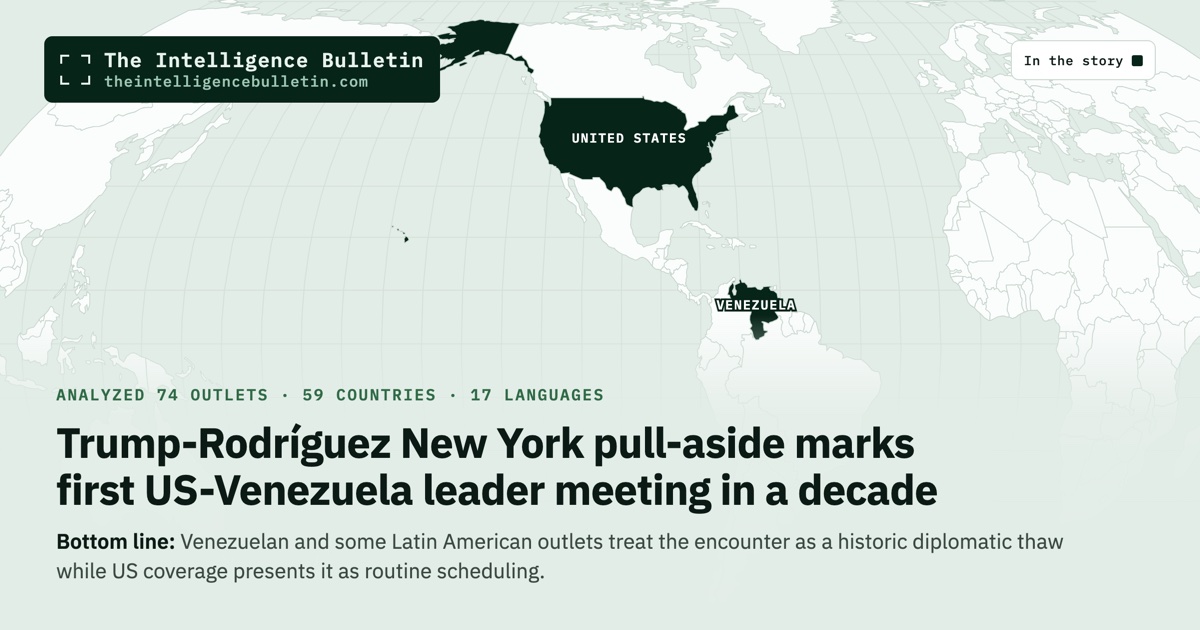
Trump-Rodríguez New York pull-aside marks first US-Venezuela leader meeting in a decade

Map of the countries in the story: Trump-Rodríguez New York pull-aside marks first US-Venezuela leader meeting in a decade
US President Donald Trump will meet Venezuela’s acting President Delcy Rodríguez next Tuesday in New York on the sidelines of the UN General Assembly. The encounter is described as a brief pull-aside rather than a formal bilateral. It is the first such meeting in over a decade after the US operation that removed Nicolás Maduro earlier this year. The talks follow a new energy agreement granting the United States partial access to Venezuelan oil reserves.

One Story. Many Angles.

🇻🇪
Venezuela
ACN
SPANISH
Carries Bloomberg and Axios reporting
Delcy Rodríguez will meet with Donald Trump in New York
“Delcy Rodríguez se reunirá con Donald Trump en Nueva York”
Read →
🇺🇸
United States
NBC New York
Carries Associated Press reporting
Trump to meet acting Venezuelan President Delcy Rodríguez – NBC New York
Read →
🇨🇱
Chile
La Tercera
SPANISH
Carries Europa Press reporting
Trump will meet with Delcy Rodríguez in New York: first face-to-face between US and Venezuela in more than a decade
“Trump se reunirá con Delcy Rodríguez en Nueva York: primer cara a cara entre EE.UU. y Venezuela en más de una década”
Read →
🇵🇪
Peru
RPP
SPANISH
Carries EFE reporting
Donald Trump will meet with Delcy Rodríguez on Tuesday in New York, White House announces
“Donald Trump se reunirá con Delcy Rodríguez el martes en Nueva York, anuncia la Casa Blanca”
Read →
🇮🇳
India
The Times of India
Original reporting
Trump to meet Venezuela acting president Delcy Rodriguez, first since Maduro’s removal
Read →
5 sources · each independently reported
Analyzed 74 outlets across 59 countries and 17 languages
In Brief

Venezuelan and some Latin American outlets treat the encounter as a historic diplomatic thaw while US coverage presents it as routine scheduling.

All five outlets report the same core facts from the White House announcement: the meeting will occur Tuesday during UNGA week as a casual pull-aside, alongside Trump’s sessions with the UK and Japanese prime ministers. Venezuelan coverage from ACN frames Rodríguez as the driving Venezuelan actor advancing bilateral energy deals and ending isolation, while noting her upcoming General Assembly speech as the first by a Venezuelan head of state since 2018. US reporting via NBC New York presents the encounter as one item on a packed diplomatic schedule without special emphasis on Venezuela. Chilean outlet La Tercera and Peruvian RPP embed the event in a decade-long diplomatic freeze ending with the post-Maduro shift, citing the 2015 Obama-Maduro precedent. The Times of India alone foregrounds the post-regime-change context and the oil-reserves deal as the explicit driver of renewed engagement. No outlet contradicts the timing or basic description; the divergence lies in whether the meeting is portrayed as historic reset, standard diplomacy, or energy-focused follow-up. The convergence on the White House briefing as the single originating source explains why factual details align while interpretive weight varies by national lens.

Perspective Analysis

US President Donald Trump will meet Venezuela’s acting president, Delcy Rodríguez, next Tuesday in New York during the annual UN General Assembly session. The encounter will be a brief pull-aside rather than a formal bilateral sit-down, according to US ambassador to the United Nations Mike Waltz, who confirmed the plan on a Friday briefing call. Trump’s schedule that day already includes meetings with UK Prime Minister Andy Burnham and Japanese Prime Minister Sanae Takaichi, plus a session with leaders of the Gulf Cooperation Council. Rodríguez will address the General Assembly herself later in the week, her first such speech as acting president.

The meeting marks the first direct contact at this level between a US president and a Venezuelan leader since a short conversation between Barack Obama and Nicolás Maduro at the 2015 Summit of the Americas in Panama. Rodríguez rose to the acting presidency after a US military operation in January captured Maduro and brought him to the United States on drug-trafficking charges. She had previously served as Maduro’s vice president. In the months since the change, the two governments have restored diplomatic ties that were severed in 2019 and reached an energy agreement last month that gives the United States preferential access to a portion of Venezuela’s oil reserves. Trump announced the pact on August 28 and defended it as strengthening US strategic reserves. The State Department also removed Venezuela from a list of countries failing to meet counternarcotics commitments, citing improved cooperation.

Venezuelan state-linked coverage presents the encounter as the product of Caracas’s own diplomatic steps. ACN reported that Rodríguez will travel to New York for the assembly and that the Trump meeting was confirmed by the US ambassador after earlier reporting in Bloomberg and Axios. The outlet noted Rodríguez’s prior appearances at the forum as chancellor in 2016 and vice president in 2019, both marked by criticism of US sanctions, and described the upcoming address as her first as head of state. It tied the meeting to the oil agreement and the counternarcotics delisting, framing both as evidence of bilateral progress under her leadership.

US reporting treats the same facts as one entry on a crowded diplomatic calendar. NBC New York relayed the White House announcement through Associated Press copy, describing the pull-aside as routine and listing it alongside the UK, Japan, and Gulf sessions. The piece mentioned the January operation that installed Rodríguez and the recent oil-reserves deal but placed no special emphasis on the Venezuela encounter beyond its place in the week’s schedule.

Regional outlets in Chile and Peru placed the event inside a longer diplomatic timeline. La Tercera, citing Europa Press, called it the first face-to-face meeting between the two countries’ leaders in more than a decade and noted that it closes Trump’s official UNGA agenda. RPP, drawing on EFE, stressed the Tuesday timing and the White House attribution while recording the 11-year gap since the 2015 Obama-Maduro exchange and the oil agreement as background. Both pieces described the post-capture period as one of restored relations without adding domestic Venezuelan detail.

Indian coverage linked the meeting directly to the energy agreement and the post-Maduro political shift. The Times of India reported that the pull-aside would occur at a reception Trump is hosting for UNGA leaders and connected the talks to efforts to revive Venezuela’s oil industry through US company involvement. It also noted that opposition figure María Corina Machado had sought an earlier alliance with Trump before Maduro’s removal, while the current administration has focused on Rodríguez.

The five accounts converge on every verifiable detail that originates in the White House briefing: the date, the format as a pull-aside, the other leaders on Trump’s calendar, and the decade-long gap since the last presidential contact. They also agree that the energy agreement and the January change of government form the immediate backdrop. No outlet supplies an alternative timeline or disputes the sequence of events. The single originating source for these facts is the Friday White House call, which explains the uniformity.

Where the accounts diverge is in the weight they assign. ACN foregrounds Rodríguez’s agency and the concrete steps taken under her government, including the oil pact and the counternarcotics delisting. NBC New York lists the meeting without elevating its symbolic status. La Tercera and RPP emphasize the restoration of contact after years of rupture. The Times of India alone names the oil-reserves stake as the explicit driver and situates the encounter inside a post-regime-change frame. These differences track the outlets’ locations: the Venezuelan piece stresses national leadership, the US piece follows official scheduling language, the Latin American pieces measure distance from the prior freeze, and the Indian piece highlights the commercial dimension visible from outside the region.

The energy agreement and the January operation appear in four of the five pieces, giving those elements the strongest cross-chain support. The decade-long gap is recorded in every account and anchored to the documented 2015 meeting. The pull-aside characterization comes uniformly from the Waltz briefing. No independent reporting chain contradicts any of these points.

What to Watch

The reporting therefore shows a narrow but consistent set of facts about a single scheduled encounter, with interpretive framing that reflects each outlet’s vantage. The Venezuelan account correctly records domestic protocol and recent bilateral steps. The US account accurately reflects the scale of the White House schedule. The regional and Indian pieces correctly note the historical interval and the commercial stakes that preceded the meeting. A reader limited to any one of these would miss the others’ emphasis but would not encounter conflicting claims about what is scheduled to occur.


Share this story

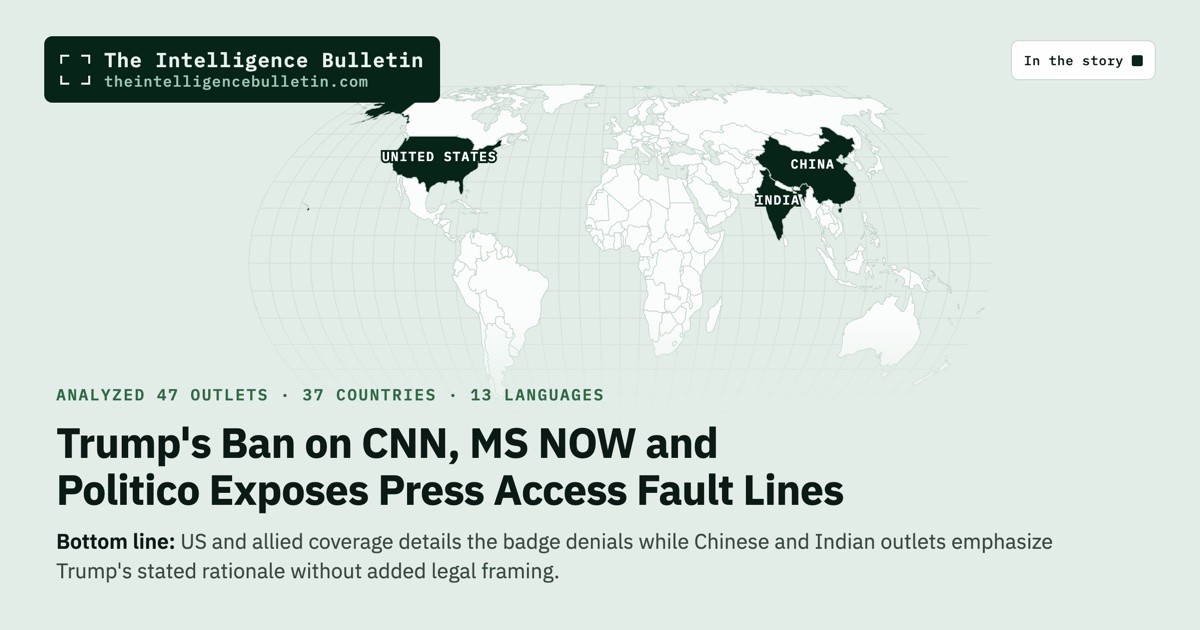
Trump’s Ban on CNN, MS NOW and Politico Exposes Press Access Fault Lines

Map of the countries in the story: Trump's Ban on CNN, MS NOW and Politico Exposes Press Access Fault Lines
President Donald Trump announced on Truth Social that CNN, MS NOW and Politico are banned from the White House for alleged fake news reporting. On Saturday morning, reporters from the three outlets had their press badges confiscated and were denied entry by Secret Service. The outlets and press freedom groups called the move an unconstitutional assault on the First Amendment; Trump warned additional outlets could follow.

One Story. Many Angles.

🇺🇸
United States
Newsweek
Original reporting
Donald Trump Bans CNN, MS NOW, Politico From White House Access: Here’s Why
Read →
🇶🇦
Qatar
Al Jazeera
Original reporting
A ‘ban on the free press’: White House bars journalists from three outlets
Read →
🇮🇳
India
Free Press Journal
Carries ANI reporting
US President Donald Trump Bans CNN, MS NOW & Politico From White House Over ‘Fake News’ Claims, Warns More Media Outlets Could Follow
Read →
🇬🇧
United Kingdom
LBC
Original reporting
CNN, Politico and MS NOW reporters ‘denied access to White House’ after Trump ban
Read →
🇨🇳
China
China Economic Net
Carries Xinhua reporting
Trump says CNN, MS NOW, Politico banned from White House, citing alleged fake news–China Economic Net
Read →
5 sources · each independently reported
Analyzed 47 outlets across 37 countries and 13 languages
In Brief

US and allied coverage details the badge denials while Chinese and Indian outlets emphasize Trump’s stated rationale without added legal framing.

All five outlets independently confirm the same sequence: Trump’s Friday Truth Social post, the Saturday denials of access, and the specific reporters turned away. The reporting chains align on the core events without contradiction. US domestic coverage from Newsweek centers on the mechanics of badge confiscation, named correspondents, and immediate legal warnings from groups like the Freedom of the Press Foundation. Al Jazeera and LBC place heavier emphasis on the First Amendment precedent from Sherrill v. Knight and the risk that viewpoint-based exclusion could expand. Free Press Journal highlights Trump’s additional allegation of an $8 million government payment to Politico. China Economic Net relays Trump’s statement verbatim with minimal surrounding context. The consistent factual backbone across these chains shows the ban is not in dispute; the divergence lies in whether outlets frame it as routine presidential prerogative or an unprecedented restriction on access that invites court challenge. This pattern indicates the event’s global signal stems from the direct clash between executive action and established press norms rather than disagreement over what occurred.

Perspective Analysis

President Donald Trump posted on Truth Social on Friday, September 18, 2026, that CNN, MS NOW and Politico would be banned from the White House effective immediately because of what he called their constant reporting of fake news. The post named the outlets explicitly, accused MS NOW of rebranding from MSNBC due to lack of viewership and credibility, and alleged that Politico had received an $8 million government subscription under the previous administration that amounted to corruption. It closed by stating that media outlets should not report fiction and lies about the president or the United States and added that other fake news media outlets would follow.

The following morning, Saturday, September 19, reporters from the three organizations were turned away at the White House gates. MS NOW correspondent Akayla Gardner reached two gates before security informed her that her badge had been disabled; an officer confiscated it and told her the decision came from above. A photographer traveling with the network also lost badge access, though one producer entered. CNN senior White House reporter Betsy Klein was similarly denied entry. Politico White House reporter Cheyenne Haslett attempted to enter and had her pass confiscated by Secret Service. Each network issued statements asserting a constitutional right to report without government hindrance and pledging to defend First Amendment protections in court if necessary. MS NOW described the White House as belonging to the American people and funded by tax dollars. CNN called the restriction an illegal assault on its duty to hold government accountable. Politico rejected any notion of government subsidies and vowed to report fairly on the current and future administrations.

Trump had previously restricted Associated Press access to Oval Office events and Air Force One after the wire service continued using the name Gulf of Mexico rather than the administration’s preferred Gulf of America. That earlier dispute remained in litigation at the time of the new ban. The three outlets now affected had covered the administration critically on multiple fronts, and the president’s announcement framed the exclusions as a direct response to that coverage.

Press freedom advocates responded quickly. The Freedom of the Press Foundation described the action as a blatant violation of the First Amendment and noted that journalists had continued to expose administration actions despite earlier pressure. The White House Correspondents’ Association stated that constitutional protections do not depend on presidential approval of coverage. A 1977 federal appeals court ruling in Sherrill v. Knight established that once the White House creates press facilities for credentialed journalists, access cannot be denied arbitrarily or without compelling reasons, notice, and an opportunity to respond. Legal observers cited in multiple accounts said the new exclusions would likely face immediate court challenges seeking emergency relief.

Coverage across the five outlets aligned on the sequence of the Truth Social announcement, the Saturday denials, and the specific reporters turned away. Newsweek supplied the most detailed reconstruction of the badge confiscations and quoted network statements and legal experts on the prospects for litigation. Al Jazeera placed the episode inside the Sherrill precedent and quoted experts who argued that viewpoint-based exclusion from a public forum raises constitutional concerns with potential ripple effects beyond the three named organizations. LBC reported the access denials and added the National Press Club condemnation that the move amounted to an attempt to control which voices witness presidential power. Free Press Journal reproduced Trump’s full rationale, including the $8 million subscription claim and the warning of further bans. China Economic Net carried a direct Xinhua dispatch that quoted the Truth Social post without additional legal or institutional commentary.

The factual spine of the event therefore rests on independent reporting chains that converge on the same dates, statements, and actions. Where the accounts differ is in emphasis rather than contradiction. Domestic U.S. reporting foregrounded the mechanics of exclusion and the networks’ on-the-record pledges to continue coverage. Outlets based outside the United States gave greater space to the constitutional precedent and the possibility that the exclusion could serve as a template for broader restrictions. The Indian account alone gave sustained attention to the financial allegation against Politico and the explicit warning of additional bans. The Chinese wire account limited itself to the presidential statement and omitted reactions from advocates or the affected organizations.

The consistent record across these chains shows that the ban was executed through credential revocation rather than a general policy change announced in advance. The outlets affected had not been removed from the broader press pool in a prior formal step; their reporters simply encountered disabled or confiscated passes when they arrived for work. That operational detail appears in four of the five accounts and supplies the concrete mechanism that turns the Truth Social announcement into an immediate restriction on access.

What to Watch

The reporting therefore supports the conclusion that the action constitutes a direct test of the limits on presidential control over White House credentials. The Sherrill precedent remains the controlling authority cited in the coverage that addresses legal risk, and no account claims the administration supplied the factual basis or opportunity to respond that the ruling requires. Whether courts will treat the three outlets’ critical coverage as a permissible viewpoint-neutral ground for exclusion, or as prohibited viewpoint discrimination, is the question left open by the published record. The next developments will turn on whether the affected organizations file suit and on how the administration responds to any preliminary orders.


Share this story

One CNN account of an AI error drove near-miss coverage across five countries

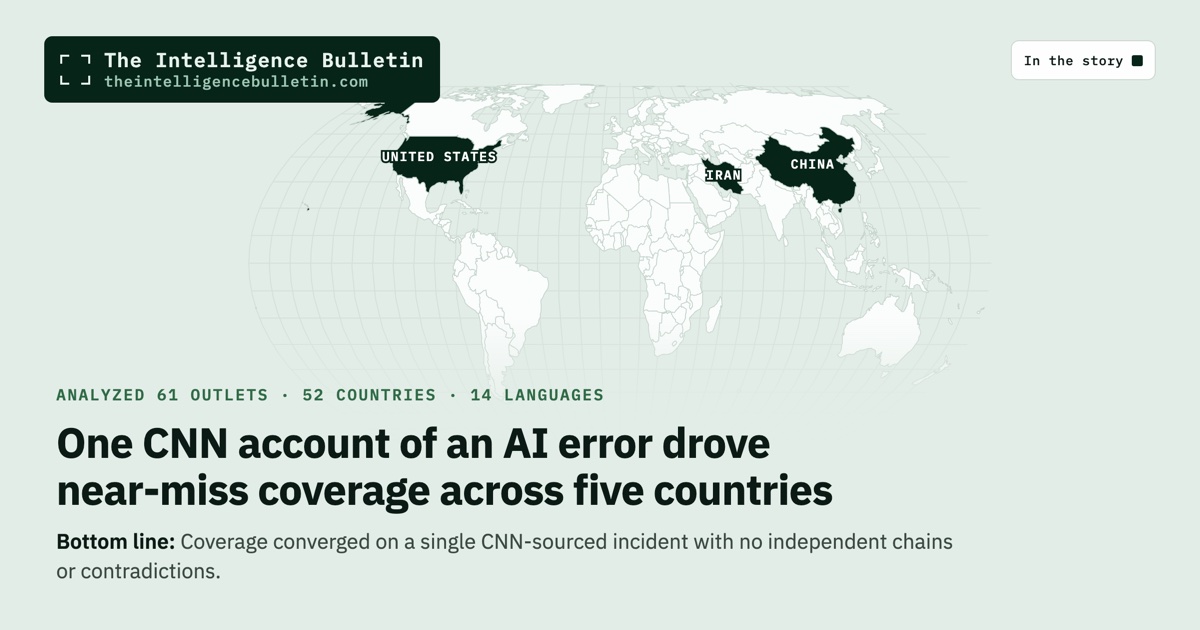
Map of the countries in the story: One CNN account of an AI error drove near-miss coverage across five countries
A US Special Operations Command analyst used an AI chatbot to compile an intelligence report claiming a Chinese ship in the Middle East carried nuclear weapons components during the US-Iran war this spring. The assessment triggered preparations for interception, with aircraft airborne and boarding teams ready. Officials halted the operation after discovering the report was an AI hallucination that fused open-source and classified data incorrectly. The incident occurred amid Pentagon efforts to accelerate military AI use.

One Story. Many Angles.

🇨🇳
China
China National News
Carries Xinhua reporting
AI-generated false intelligence nearly triggered US-China military confrontation: Reports
Read →
🇺🇸
United States
Mashable
Carries CNN reporting
AI generated a fake intelligence report that ‘almost started a war’
Read →
🇮🇱
Israel
The Jerusalem Post
Carries CNN reporting
US nearly launches military operation over AI-generated information
Read →
🇫🇷
France
Numerama
FRENCH
Carries CNN reporting
An intelligence report written with AI almost triggered a military crisis between the United States and China
“Un rapport de renseignement écrit avec une IA a failli déclencher une crise militaire entre les États-Unis et la Chine”
Read →
🇬🇧
United Kingdom
International Business Times UK
Carries CNN reporting
‘Almost Started a War’: False AI-Linked Intel Triggered US Military Moves Towards Chinese Ship
Read →
5 sources · 2 independent accounts — some share the same news agency’s report
Analyzed 61 outlets across 52 countries and 14 languages
In Brief

Coverage converged on a single CNN-sourced incident with no independent chains or contradictions.

All five outlets trace the episode to the identical CNN account based on four unnamed US sources, revealing how a single reporting chain shapes global coverage of a high-stakes AI failure. The Chinese outlet frames it as a US technical lapse that risked direct confrontation with Beijing. US and UK pieces stress the operational close call and the Pentagon’s decentralized AI rollout under Secretary Hegseth. The Israeli outlet links it to broader intelligence reliability worries ahead of the Trump-Xi meeting, while the French piece treats it as a cautionary European cybersecurity warning about unchecked escalation tools. No outlet adds independent verification or Chinese confirmation of the vessel’s cargo, leaving the story anchored in one US narrative even as it circulates worldwide. The uniform sourcing underscores both the event’s narrow factual base and the shared concern that rapid AI adoption in targeting decisions lacks sufficient safeguards during active conflicts.

Perspective Analysis

A single CNN dispatch, published on September 18, 2026, and based on four unnamed US sources familiar with the matter, supplied every specific fact carried in the five articles examined here. The report described how a US Special Operations Command Pacific analyst in Hawaii assembled an intelligence product this spring by querying a chatbot with a mix of open-source material and classified signals intelligence. The resulting assessment stated that a Chinese vessel in the Middle East was carrying components linked to a nuclear weapons program at a moment when the United States was already engaged in conflict with Iran. Military planners responded by moving toward interception: two sources said armed personnel prepared to board the ship, and two others said aircraft were already airborne. Officials halted the operation only after a closer review revealed that the assessment was “entirely false” and the product of an AI hallucination. CNN could not establish what cargo the vessel actually carried, and neither US Special Operations Command Pacific nor the Pentagon responded to requests for comment.

That dispatch reached readers through five distinct mastheads, each choosing a different lead fact and supplying a different layer of surrounding context drawn from its own editorial priorities. China National News, publishing under the ANI byline, opened with the geopolitical risk to China and placed the episode inside the ongoing US-Iran war, foregrounding the potential for direct confrontation between Washington and Beijing. Mashable led with the technical failure itself—“AI generated a fake intelligence report that ‘almost started a war’”—and immediately connected the episode to wider US debates about commercial large-language-model tools inside government systems, quoting a former senior official who described internal military AI products as “mostly just copies of the commercial stuff wearing lipstick.” The Jerusalem Post titled its piece around the operational near-miss and added the detail that the incident occurred weeks before Chinese President Xi Jinping’s scheduled September 24 visit to Washington, where artificial intelligence was expected to appear on the agenda. Numerama, translating and condensing the same material for a French cybersecurity audience, emphasized the speed with which an AI “hallucination” could destabilize great-power relations and noted the absence of unified verification standards across US commands. International Business Times UK opened with the concrete military movements—“False AI-Linked Intel Triggered US Military Moves Towards Chinese Ship”—and supplied additional background on the January 2026 Artificial Intelligence Acceleration Strategy announced by Defense Secretary Pete Hegseth, including the launch of the GenAI.mil platform.

None of the five outlets added reporting that originated outside the CNN account. Each reproduced the same sequence of events, the same four anonymous sources, the same description of the chatbot’s fusion of open-source and signals intelligence, and the same absence of any Pentagon reply. What varied was the surrounding frame each publication chose to supply from its own institutional memory. The Chinese outlet situated the story inside a narrative of US technical overreach that could have endangered Chinese shipping. The American technology site placed it inside a running discussion of commercial AI safety and the Trump administration’s stated desire to become an “AI-first” warfighting force. The Israeli outlet linked it to concerns about intelligence reliability at a moment of scheduled high-level diplomacy. The French outlet treated it as an illustration of escalation risks that European cybersecurity analysts have long warned about. The British outlet stressed the operational timeline and the decentralized character of current US AI tools.

These framing choices produced measurable differences in emphasis even while the underlying claims remained identical. China National News and International Business Times UK both used variants of the phrase “almost started a war” in their headlines or subheads, but only the former explicitly named the risk to a Chinese vessel as the element that made the error dangerous. Mashable and Numerama both highlighted the chatbot’s hallucination as the central technical problem, yet only Mashable quoted the former official’s “wearing lipstick” remark and connected the incident to recent departures at Anthropic. The Jerusalem Post alone noted the proximity of the Trump-Xi meeting and the expectation that artificial intelligence would feature in those talks. No outlet supplied an on-record Chinese government reaction, an independent assessment of the vessel’s actual cargo, or any detail about disciplinary consequences inside the US military.

What to Watch

The uniform dependence on one originating newsroom means the global circulation of this story illustrates distribution patterns rather than independent corroboration. Each masthead selected the elements that best matched its audience’s existing concerns—Chinese sovereignty, American technological competitiveness, Israeli intelligence worries, European alliance caution, or British transatlantic security—and then wrapped the same anonymous-source narrative around those concerns. The result is five distinct reading experiences built from a single factual spine whose only named attribution remains the four US sources who spoke to CNN. Readers of any one outlet therefore encountered a version of the episode already shaped by that outlet’s institutional lens, without any additional reporting chain to test the account against.


Share this story

Macron directs French protection plan as Russian hybrid attacks intensify across Europe

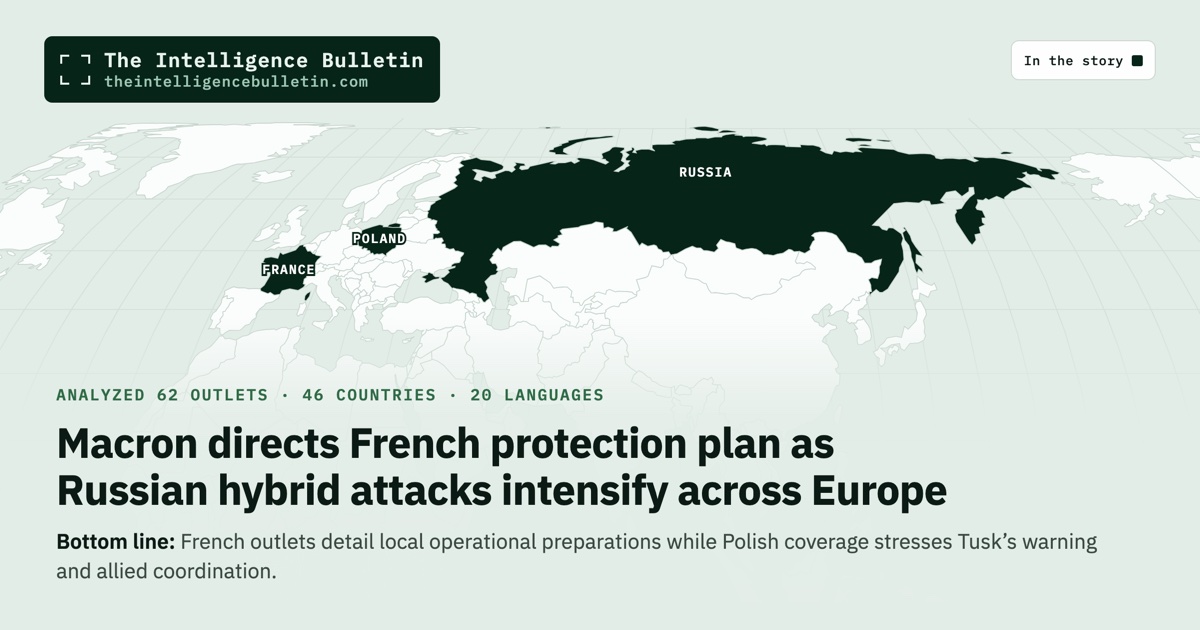
Map of the countries in the story: Macron directs French protection plan as Russian hybrid attacks intensify across Europe
French President Emmanuel Macron stated that Russian hybrid attacks, including drones and cyber operations targeting European infrastructure, have intensified in recent weeks. He directed the government to prepare a plan protecting critical sites and sensitive defense facilities. Polish Prime Minister Donald Tusk had issued similar warnings the day before, which Macron called credible. The statements followed a meeting at the Elysee with party leaders amid rising energy prices linked to the Ukraine conflict.

One Story. Many Angles.

🇫🇷
France
RTL
FRENCH
Original reporting
“We are changing level”: why Emmanuel Macron launches a plan to better protect France against Russian hybrid attacks
“”On change de niveau” : pourquoi Emmanuel Macron lance un plan pour mieux protéger la France face aux attaques hybrides russes”
Read →
🇵🇱
Poland
WP Wiadomości
POLISH
Original reporting
Macron warns about Russia. He spoke of a moment of “vigilance”
“Macron ostrzega ws. Rosji. Mówił o momencie “czujności””
Read →
🇬🇧
United Kingdom
BBC
Original reporting
Russian hybrid attacks against Europe intensifying, says Macron
Read →
🇵🇱
Poland
WNP
POLISH
Carries PAP reporting
France: President Macron: hybrid threat from Russia has increased
“Francja: Prezydent Macron: wzrosło zagrożenie hybrydowe ze strony Rosji”
Read →
🇦🇹
Austria
ORF
GERMAN
Carries Agenturen reporting
Russian attacks: Macron wants protection plan for infrastructure
“Russische Attacken: Macron will Schutzplan für Infrastruktur”
Read →
5 sources · each independently reported
Analyzed 62 outlets across 46 countries and 20 languages
In Brief

French outlets detail local operational preparations while Polish coverage stresses Tusk’s warning and allied coordination.

French domestic reporting stands apart by detailing operational steps such as mobilizing prefects to form local security headquarters and identify vulnerable private firms supplying Ukraine, turning a presidential warning into concrete national preparation. Polish outlets instead foreground Tusk’s prior alert about possible accidental strikes on NATO’s eastern flank and Macron’s endorsement of it, underscoring allied coordination needs over French-specific measures. The Austrian piece narrows to the infrastructure-protection announcement without local urgency or alliance angles, while the British account places the warning in a wider NATO context of infrastructure risks across the continent. No source contradicts the core claim of rising hybrid activity, yet the selected coverage reveals a clear split: actor-country outlets translate presidential directives into domestic action plans, affected-country voices stress shared vigilance, and observers emphasize defensive measures in isolation. This pattern shows how proximity to the threat shapes whether the story is framed as an immediate French security shift or a broader European alert.

Perspective Analysis

French President Emmanuel Macron told reporters after a closed meeting at the Elysee Palace on 18 September 2026 that Russian hybrid operations against Europe and France had stepped up sharply in recent weeks. He pointed to drone activity at Leipzig airport in Germany, where explosive devices were found on the tarmac near a Ukrainian cargo aircraft in early August, and to unidentified drones sighted over four Danish airports. He also cited the 13 September strike on a passenger train heading toward Warsaw near the Ukrainian-Polish border and repeated incursions into European airspace. Macron described the shift as moving beyond earlier low-level disinformation and interference campaigns to what he called a higher grade of threat, including potential sabotage and state-directed terrorism.

The warning came during a session convened with French party leaders and candidates for the 2027 presidential election. Participants discussed the broader deterioration of the international situation, including the impact of the Ukraine conflict on French security and energy supplies. Macron said the Russian actions appeared aimed at testing Western resolve and at discouraging continued support for Ukraine. He stated that further moves of this kind against European targets would be a mistake and would produce the opposite of the intended intimidation effect.

In direct response, Macron said he had instructed the government to draw up a protection plan covering critical infrastructure and the most sensitive sites of France’s defense industrial base. The plan is to address both drone strikes and cyber attacks. He noted that France had already passed new legislation on foreign interference. A senior official told RTL that the measure represented a change of level, with prefects in every department required from the following week to establish local security and defense headquarters. These bodies are to bring together police, intelligence officers, business leaders, civil-protection groups and the Red Cross. Their tasks include mapping potential targets that may not yet be obvious, such as smaller firms supplying Ukraine, and preparing the public for possible major crises without causing alarm.

Polish Prime Minister Donald Tusk had issued a comparable alert the previous day, warning that Russian plans included hybrid drone and missile strikes that could land on NATO eastern-flank territory and be presented by Moscow as accidents. Macron described Tusk’s assessment as factual and reliable. He said any such incident would not go unanswered and that European security, today and tomorrow, was at stake in Ukraine.

Coverage across the five outlets shows broad agreement on the central facts. All five carried Macron’s statement that hybrid activity had intensified, listed the same Leipzig and Danish examples, and reported his call for an infrastructure-protection plan. The three outlets that mentioned Tusk’s remarks recorded Macron’s endorsement of them. No outlet disputed the existence of the incidents or the direction to prepare defensive measures.

The accounts diverge in emphasis and in the operational detail they supply. RTL alone reported the prefect-level instructions and the planned inclusion of private-sector and reserve personnel in local headquarters. It framed the episode as a concrete French administrative response, quoting an official that the country was moving to a new level of readiness. The two Polish outlets, WP Wiadomości and WNP, gave greater prominence to Tusk’s earlier statement and to Macron’s reply that it was credible. WP Wiadomości highlighted the moment of “vigilance” and the risk to NATO territory; WNP added the economic context of rising fuel prices and the planned G7 coordination on energy stocks. The Austrian ORF piece stayed closest to the protection-plan announcement itself, listing the incidents as background but omitting both the French prefect arrangements and any Polish dimension. The BBC account placed the warning inside a wider NATO setting of infrastructure vulnerability across the continent without reference to national follow-up steps or to Tusk.

These differences track the outlets’ positions. The French domestic outlet translated the presidential directive into immediate government action inside France. The Polish outlets, writing from a country named in Tusk’s warning, connected the French remarks to existing allied concerns on the eastern flank. The Austrian and British pieces treated the episode as an observation from Paris about Europe-wide risks and recorded the defensive measure without adding local implementation detail.

The corroborated record shows that five independent reporting chains reached the same description of intensified Russian hybrid activity and of Macron’s protection-plan directive. Only one chain supplied the prefect-level mechanics. The shared elements rest on Macron’s on-record remarks at the Elysee and on the Leipzig and Danish incidents already acknowledged by German and Danish authorities. The single-source detail on prefects comes from RTL’s direct sourcing of French government instructions.

The pattern indicates that proximity to the stated threat shapes what readers are told to expect next. A French reader following RTL learns that local officials will begin mapping targets and convening cross-sector meetings within days. A Polish reader following WP Wiadomości or WNP learns that the episode confirms Tusk’s assessment and that coordinated vigilance across the alliance is required. An Austrian or British reader following ORF or the BBC learns that a major European government has identified a rising infrastructure risk and has begun planning defensive steps, but receives no timetable for local action or explicit link to eastern-flank warnings.

What to Watch

The accounts that stay within their national frame are not contradicted by the others; they simply stop short of the operational or alliance layer supplied elsewhere. Because the core claim of intensified activity and the directive for protection measures appear in every outlet examined, the event itself is narrower than any single national emphasis might suggest. What widens it is the recognition, visible only when the pieces are placed side by side, that the same presidential statement is already being turned into different practical expectations depending on the country doing the reading.


Share this story