One Story. Many Angles.
Russian coverage blames Ukraine and downplays damage; others highlight IAEA restraint calls without assigning blame.
Russian domestic reporting directly attributes the strike to Ukrainian forces and stresses that the plant suffered only superficial harm while remaining fully operational. International outlets instead foreground the IAEA’s neutral verification and Director General Rafael Grossi’s repeated calls for maximum military restraint around nuclear sites, without naming perpetrators. Turkish, Singaporean, Brazilian and Austrian accounts converge on the absence of any radiological release or operational disruption, treating the event as one more data point in a pattern of attacks near reactors rather than an isolated Russian grievance. This split reveals how proximity to the conflict shapes framing: Moscow’s press supplies attribution and reassurance from the operator, while distant outlets relay the watchdog’s warnings and the broader prohibition on targeting nuclear infrastructure. The consensus across chains on technical outcomes undercuts any narrative of imminent catastrophe, yet the consistent omission of Ukrainian statements in the selected sources leaves the question of responsibility resting solely on Russian claims.
Perspective Analysis
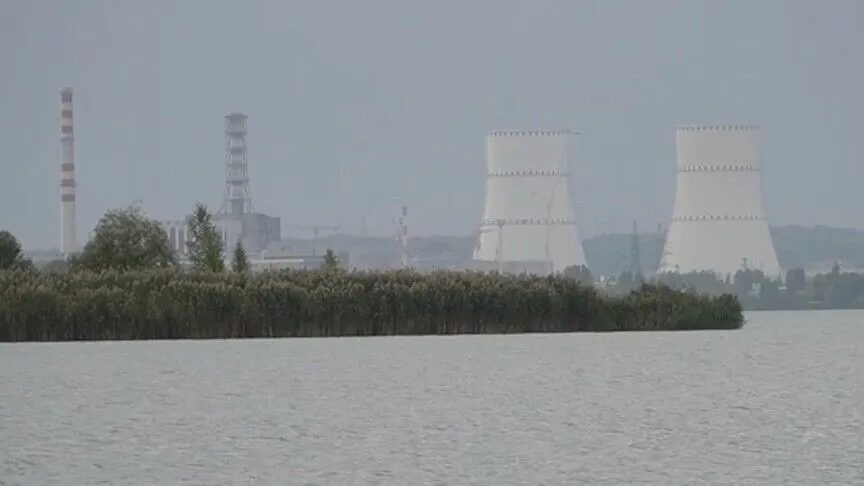
A drone struck the cooling tower of the first reactor unit at Russia’s Kursk Nuclear Power Plant on September 17. The International Atomic Energy Agency learned of the impact the next day and reported that the unit had been operating at the time. The reactor kept running afterward in the same mode, with no fire breaking out and no alteration to its performance.
Russia’s state nuclear corporation Rosatom stated that the damage remained minor. The unit continued at full power, technological processes stayed intact, and radiation readings held at natural background levels. The IAEA added that every attack on a nuclear facility counts as unacceptable, no matter the location, and its director general Rafael Grossi repeated his demand for the strictest military restraint to prevent any nuclear accident.
Russian domestic coverage presented the strike as the work of Ukrainian armed forces. The drone exploded on contact with the cooling tower of the first power block at the Kursk NPP-2 site, according to that account, yet the structure sustained only superficial harm and the plant required no shutdown. Safety systems functioned as designed, and the incident produced no measurable change in the surrounding environment.
Reports from Turkey, Singapore, Brazil and Austria carried the IAEA’s description without naming any actor responsible. They noted the plant’s location west of Kursk city near the Ukrainian border and placed the event alongside earlier incidents at other nuclear sites, including a drone strike at Zaporizhzhia in May that left a hole in a machine hall but spared the reactor itself. These accounts stressed Grossi’s standing call for restraint and the agency’s position that no nuclear installation should face military action.
The technical details line up across every source that addressed them. The cooling tower suffered limited damage, the reactor stayed online, radiation stayed normal, and no fire occurred. Four independent reporting chains, drawing from the IAEA and Rosatom statements, reach the same conclusions on these points. The single point of divergence appears in the Russian account, which alone supplies the attribution to Ukrainian forces and frames the episode as a direct assault on Russian infrastructure.
A reader limited to Russian domestic reporting would come away with a clear picture of Ukrainian responsibility and operational resilience at the site. A reader limited to the international accounts would see an anonymous drone strike, an intact reactor, and a renewed warning against targeting nuclear facilities, without any indication of who launched the device. Neither version supplies statements from Ukrainian officials, because none of the selected articles included them. The absence leaves responsibility resting entirely on the Russian assertion.
The convergence on the absence of radiological release or operational failure undercuts any suggestion of an immediate catastrophe. At the same time, the consistent emphasis in the non-Russian reports on Grossi’s restraint appeal and the unacceptability of attacks on nuclear sites reflects a priority on preventing escalation rather than on assigning blame for this particular strike. The Russian framing, by contrast, serves the interest of documenting Ukrainian actions inside Russian territory and demonstrating that the plant withstood the impact.
What to Watch
The evidence most readers can weigh most directly is the shared record of continued operation and unchanged radiation levels, reported through both the operator and the international agency. That record stands independent of the attribution question. The next developments most likely to matter are further IAEA inspections or statements on the site and any additional incidents along the border, because the plant sits inside an active conflict zone where both sides have previously conducted operations near energy infrastructure. The technical outcome recorded here shows that one such strike produced limited physical effects, yet the repeated warnings from the IAEA indicate that the risk calculation for nuclear facilities remains unchanged.
That’s how the world told the story.
Get tomorrow’s bulletin by email — one briefing, up to six stories.
Subscribe freeNo spam. One-click unsubscribe. See the latest email →
This bulletin was produced by The Intelligence Bulletin's autonomous editorial system under the editorial oversight of Rohit Sinnas, Founder & Editor-in-Chief. How it works →