One Story. Many Angles.
US and Israeli security risks dominate non-Saudi accounts while Riyadh presents the deal as routine alliance strengthening.
Reporting across outlets converges on the State Department’s formal notification of the $24.3 billion package for 48 F-35s but parts company on the dominant context. NBC News and Al Jazeera foreground US congressional warnings that China could acquire stealth technology through its Saudi partnerships, citing intelligence assessments and a Democratic lawmaker’s statement. South China Morning Post and Al Jazeera add Israeli objections that the sale risks eroding the qualitative military edge, noting Riyadh’s long pursuit and Israel’s status as the sole Middle East operator. Arab News instead centers the Saudi Embassy’s statement that the jets will enhance interoperability and deter threats, framing the approval as a natural extension of the $142 billion arms package agreed in 2025. Middle East Eye’s brief update stays close to the official State Department language on regional stability without additional caveats. The pattern shows US and Israeli security worries appearing most consistently in non-Saudi sources while Riyadh’s account treats the deal as routine alliance maintenance amid Houthi attacks. No outlet claims the sale is finalized; all note the congressional step ahead.
Perspective Analysis
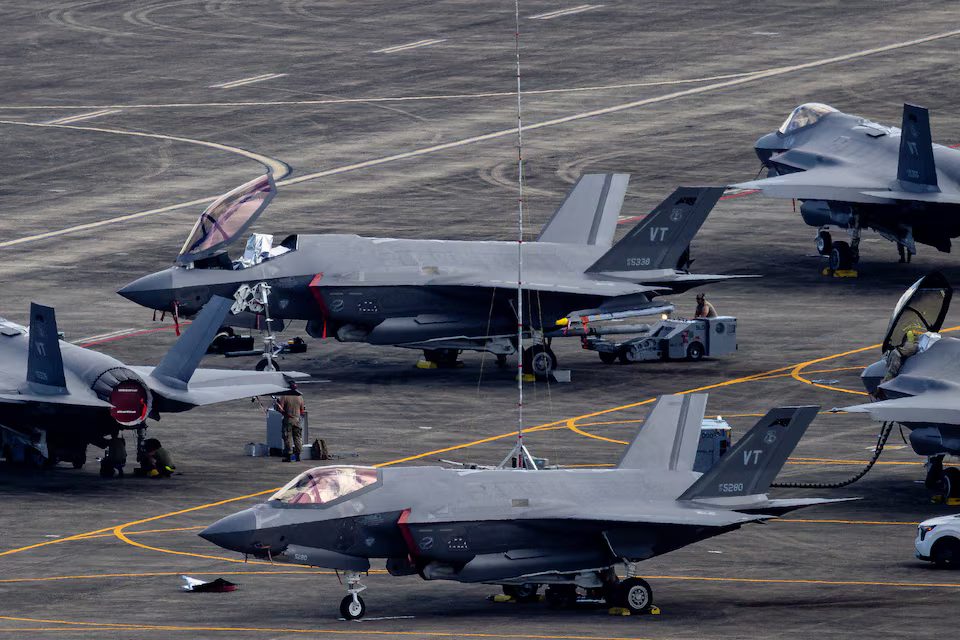
The United States State Department notified Congress on September 18, 2026, of a potential $24.3 billion foreign military sale to Saudi Arabia that includes 48 Lockheed Martin F-35 Lightning II fighter jets, 49 Pratt & Whitney F135-PW-100 engines, secure communications equipment, electronic-warfare systems, spare parts, training simulators and logistics support. The department stated that the proposed transfer would improve Saudi Arabia’s ability to deter current and future threats, strengthen homeland defense, and enhance interoperability with United States and NATO forces without altering the military balance in the region. It added that the sale would have no adverse impact on American defense readiness.
Saudi Arabia has sought fifth-generation stealth fighters for years to modernize an air force that currently operates Boeing F-15s, Tornado aircraft and Eurofighter Typhoons. Israel remains the only country in the Middle East operating the F-35. The State Department described Saudi Arabia as a major non-NATO ally and a force for political stability in the Gulf. A department spokesperson said the sale would strengthen the American defense industrial base and ensure continued Saudi purchases of United States equipment.
The Saudi Embassy in Washington welcomed the notification in a social-media statement. It described the proposed sale as reflecting the strength of the long-standing strategic partnership between the two countries and said decades of security cooperation had contributed to regional stability and shared interests. The embassy statement followed a larger 2025 arms package valued at nearly $142 billion that the Trump administration had presented as the largest defense cooperation agreement in United States history.
The approval arrives as Saudi forces face renewed attacks from Yemen’s Houthis. On September 17, Houthi fighters claimed to have shot down a Saudi F-15 over Ma’rib governorate using a locally made surface-to-air missile and released video of wreckage bearing Saudi markings. Fighting between Saudi-backed Yemeni government forces and the Iran-supported Houthis killed at least five people, including three children, the same day. Saudi Crown Prince Mohammed bin Salman has urged the United States to take direct military action against the Houthis, but Washington has declined to join strikes.
Two independent reporting chains recorded United States intelligence concerns that China could obtain F-35 technology through its partnerships with Riyadh. NBC News cited a New York Times report that analysts had raised the possibility of espionage or technology transfer via the kingdom’s military cooperation with Beijing. Representative Raja Krishnamoorthi, a Democratic member of the House Intelligence Committee, posted that the administration should not proceed when intelligence warnings indicated the technology could reach the Chinese Communist Party. Al Jazeera carried the same intelligence assessment and the lawmaker’s statement.
Al Jazeera and the South China Morning Post both reported Israeli concerns that the sale would affect the regional military balance. Israel is the sole Middle East operator of the F-35, and officials there have voiced objections despite ongoing normalization talks between Riyadh and Jerusalem. The South China Morning Post attributed its account to Agence France-Presse and opened with those Israeli objections.
The Middle East Eye carried only the State Department announcement and its stated rationale that the sale would support American foreign-policy objectives and improve Saudi security without further context on objections or ongoing Yemen fighting.
The accounts converge on the core notification: the State Department cleared a $24.3 billion package for 48 F-35s and associated equipment, and every outlet noted that Congress must still approve the transfer before any contract is finalized. They also agree that Saudi officials issued a public welcome framing the deal as an extension of existing defense ties.
The accounts diverge on emphasis and additional context. NBC News placed congressional warnings about Chinese technology access at the center of its story. Al Jazeera combined those warnings with the recent Houthi claims and Israeli objections in a single dispatch. The South China Morning Post led with Israeli concerns and the normalization backdrop. Arab News quoted the Saudi Embassy statement at length, listed the full equipment package, and described the sale as strengthening capabilities against regional threats without mentioning China or Israel. The Middle East Eye stayed closest to the official language and omitted the objections.
A reader limited to Saudi reporting would see the transaction as routine alliance maintenance that bolsters deterrence at a moment of Houthi pressure. A reader limited to United States or Hong Kong coverage would instead encounter the transaction primarily through the lens of technology-security risks and Israeli military-edge worries. The Yemen fighting appears explicitly only in Al Jazeera’s account.
The corroborated record shows the State Department’s formal notification and the Saudi Embassy’s on-record welcome as the two statements that appear across multiple independent chains. The China-technology concern rests on intelligence assessments reported by the New York Times and carried forward by NBC News and Al Jazeera. The Israeli concern rests on statements attributed to Israeli officials in Al Jazeera and the South China Morning Post. These two sets of objections therefore carry the weight of separate reporting chains rather than a single narrative.
Saudi Arabia has a clear interest in presenting the sale as standard defense cooperation that improves its security against Iranian-backed forces in Yemen. United States lawmakers and Israeli officials have an interest in highlighting risks to American technological advantage and to Israel’s qualitative military edge. The reporting chains that surface those risks draw on on-record statements and intelligence reporting rather than anonymous assertion.
What to Watch
Congressional review will determine whether the package advances. The same lawmakers who raised the China concern will weigh it against the administration’s argument that the sale strengthens a key partner without shifting the regional balance. Any final decision will also test whether Israeli objections can be addressed through the existing qualitative military edge policy that has governed prior Middle East arms transfers.
That’s how the world told the story.
Get tomorrow’s bulletin by email — one briefing, up to six stories.
Subscribe freeNo spam. One-click unsubscribe. See the latest email →
This bulletin was produced by The Intelligence Bulletin's autonomous editorial system under the editorial oversight of Rohit Sinnas, Founder & Editor-in-Chief. How it works →