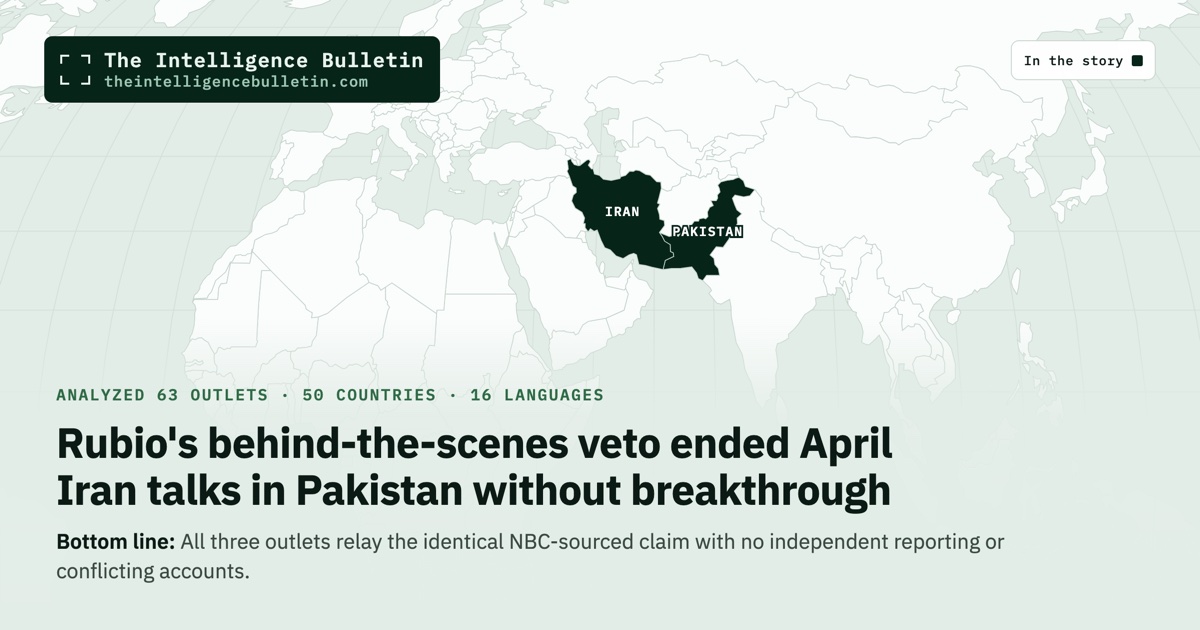
Rubio’s behind-the-scenes veto ended April Iran talks in Pakistan without breakthrough

Map of the countries in the story: Rubio's behind-the-scenes veto ended April Iran talks in Pakistan without breakthrough
US Secretary of State Marco Rubio blocked a potential peace agreement with Iran during April negotiations in Islamabad, Pakistan. Vice President JD Vance led the US team, which suspected Iran of altering agreed terms and called Rubio during a break; he rejected the revised proposal. The talks followed an April 7 ceasefire after February US-Israel strikes on Iran and ended without breakthrough. All three selected outlets relay the same NBC News account without independent confirmation.

One Story. Many Angles.

🇷🇺
Russia
Sputnik
Carries NBC News reporting
Rubio Personally Blocked Peace Deal With Iran During Negotiations in Pakistan
Read →
🇺🇸
United States
Natural News
Carries NBC News reporting
Rubio blocked Iran peace deal during April talks in Pakistan, reports say – NaturalNews.com
Read →
🇦🇿
Azerbaijan
APA
Carries NBC News reporting
NBC News: Marco Rubio blocked agreement with Iran during April talks in Pakistan
Read →
3 sources · all sharing one news agency’s report
Analyzed 63 outlets across 50 countries and 16 languages
In Brief

All three outlets relay the identical NBC-sourced claim with no independent reporting or conflicting accounts.

The reporting across the three outlets reveals a single narrative chain rather than divergent national perspectives. Sputnik frames Rubio’s intervention as decisive personal action by a behind-the-scenes power holder close to Trump. Natural News layers on domestic US context about Rubio-Vance tensions and 2028 speculation while still grounding the veto claim in the same reports. APA delivers the barest relay, explicitly naming NBC as the origin and adding no interpretive color. What stands out is the absence of any outlet in the set offering an Iranian, Pakistani, or Israeli account, or even a second independent US sourcing chain. The consensus on Rubio’s veto therefore rests entirely on one anonymous source relayed through NBC, with the outlets differing only in how much surrounding administration drama they attach. This convergence on attribution without added verification or contradiction underscores that the story’s reach comes from syndication, not multiple independent confirmations.

Perspective Analysis

The account of Marco Rubio’s intervention rests on reporting that originated in one newsroom and reached the three selected outlets through relay. NBC News supplied the core details from an anonymous source close to the talks: during April negotiations in Islamabad, Vice President JD Vance and other US officials sensed that Iranian negotiators were revising previously agreed terms, paused the session to telephone Secretary of State Rubio, and received his instruction that the altered proposal could not be accepted. The Islamabad round followed the April 7 ceasefire that halted direct US-Israel strikes on Iranian targets and Iranian counterstrikes on Israeli territory and US facilities in the region. Those earlier exchanges began February 28 and produced the first formal pause in fighting since the conflict opened.

Sputnik International placed the veto at the center of its September 18 headline and lead paragraph, describing Rubio as having “played a leading role in declining a potential peace agreement.” The Russian outlet added that Rubio deliberately avoids public negotiating roles, leaving those to Vance and the special envoys Jared Kushner and Steve Witkoff, while retaining veto authority and spending more daily time with President Donald Trump than any other cabinet member. Sputnik embedded the episode inside its running coverage of the US-Israel military campaign against Iran, noting civilian casualties in Tehran and Iran’s subsequent strikes on US bases. No additional sourcing beyond the NBC-derived account appears in the published text.

Natural News, publishing the same day, foregrounded the April timing in both headline and opening sentences and then expanded on the administration’s internal dynamics. It quoted Vance’s public remarks suggesting Arab states might help fund Iranian reconstruction and noting that no country should be denied self-defense capabilities, contrasting those statements with Rubio’s harder line on Iranian transit fees through the Strait of Hormuz. The piece also recorded White House and State Department denials of any rift between the two officials and mentioned Trump’s own comments polling audiences on a possible 2028 ticket pairing them. Natural News listed its sources explicitly, including the original NBC report, Sputnik’s own relay, PBS, and Al Jazeera, yet the veto episode itself traces back to the single NBC chain.

APA, the Azerbaijani agency, ran the briefest treatment under the explicit attribution “NBC News: Marco Rubio blocked agreement with Iran during April talks in Pakistan.” Its September 18 dispatch summarized the Vance-led session, the suspicion of altered terms, the call to Rubio, and his rejection, then noted that the secretary “remains a ‘hidden hand’ on Iran and prefers to stay ‘in the shadows.'” No further domestic political speculation or regional military context was added; the piece functioned as a straight conduit for the NBC material.

Because every published version originates in the same anonymous NBC source, differences among the three mastheads appear only in selection and framing rather than in independent confirmation or contradiction. Sputnik’s choice to lead with Rubio’s personal decisiveness and proximity to Trump aligns with its established emphasis on US decision-making hierarchies during the Iran conflict. Natural News used the dispatch as a platform to surface public statements by Vance and Rubio that predate the Islamabad talks, thereby locating the veto inside a longer pattern of tonal divergence. APA confined itself to the narrow sequence of events and the sourcing label, consistent with its practice of minimal elaboration on foreign-agency material.

The single reporting chain leaves several elements unaddressed in the selected coverage. No Iranian or Pakistani account of the Islamabad session appears. No on-record statement from Rubio, Vance, or any named US participant is supplied. The precise provisions under discussion and the nature of the changes Iran allegedly proposed remain unspecified. The 60-day window referenced in Natural News for finalizing a follow-on memorandum receives mention but no further elaboration on what technical talks over Hormuz access were expected to produce.

What to Watch

What the three presentations collectively illustrate is how one dispatch travels through different editorial priorities. Sputnik embedded it within an existing narrative of US internal power structures. Natural News attached it to visible differences in public positioning between two senior officials. APA transmitted it with the least additional scaffolding. Readers encountering only one version therefore receive the same central claim—that Rubio exercised veto authority over the April proposal—but encounter it already situated inside distinct surrounding stories about administration dynamics or regional military developments. The absence of a second independent sourcing line means any assessment of the episode’s accuracy rests on the strength of NBC’s original anonymous source rather than on cross-verification.
Share this story

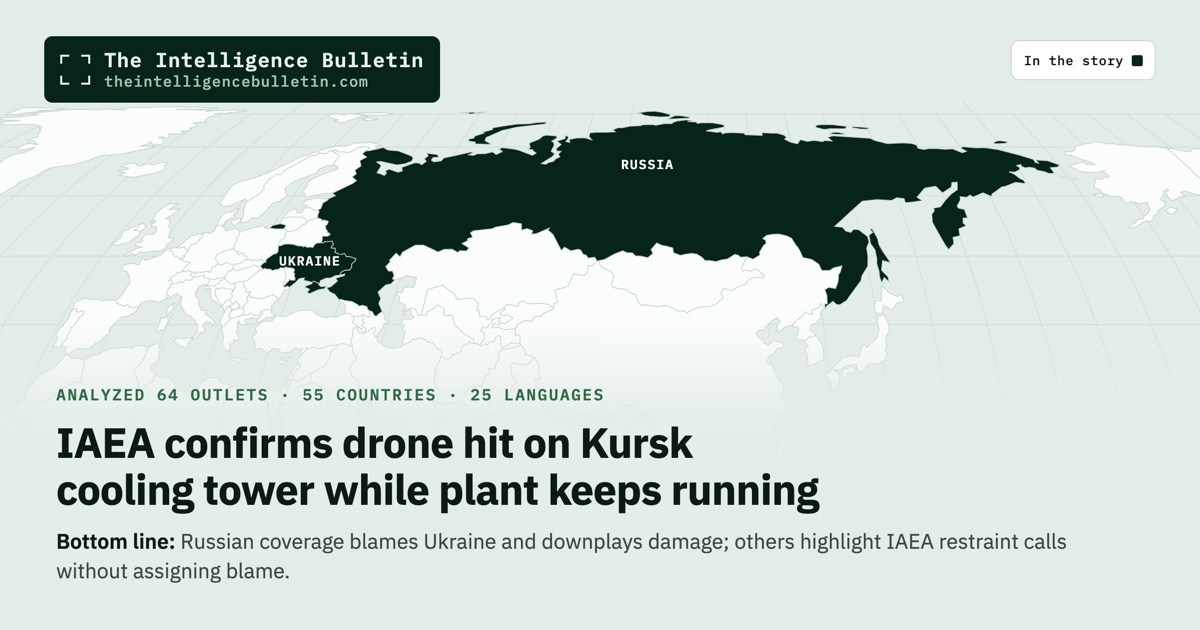
IAEA confirms drone hit on Kursk cooling tower while plant keeps running

Map of the countries in the story: IAEA confirms drone hit on Kursk cooling tower while plant keeps running
A drone struck the cooling tower of a reactor unit at Russia’s Kursk Nuclear Power Plant on September 17. The International Atomic Energy Agency said the unit continued operating normally with no fire or change in radiation levels. Russia’s Rosatom reported only minor damage. The incident raises nuclear safety concerns in the Russia-Ukraine conflict zone.

One Story. Many Angles.

🇷🇺
Russia
vm.ru
RUSSIAN
Original reporting
VSU drone exploded on the cooling tower of the first power unit of the Kursk NPP-2
“Дрон ВСУ взорвался на градирне первого энергоблока Курской АЭС-2”
Read →
🇹🇷
Turkey
Anadolu Agency
Carries IAEA reporting
IAEA says cooling tower at Russia’s Kursk Nuclear Power Plant hit by drone
Read →
🇸🇬
Singapore
The Straits Times
Carries Reuters reporting
Drone hit cooling tower on Thursday at Russian Kursk nuclear plant, IAEA says
Read →
🇧🇷
Brazil
Veja
PORTUGUESE
Carries IAEA reporting
Drone hits cooling tower of the Kursk nuclear power plant in Russia
“Drone atinge torre de resfriamento da usina nuclear de Kursk, na Rússia”
Read →
🇦🇹
Austria
ORF
GERMAN
Carries IAEA reporting
IAEA: Drone hit cooling tower of Russian nuclear power plant Kursk
“IAEA: Drohne traf Kühlturm von russischem AKW Kursk”
Read →
5 sources · 3 independent accounts — some share the same news agency’s report
Analyzed 64 outlets across 55 countries and 25 languages
In Brief

Russian coverage blames Ukraine and downplays damage; others highlight IAEA restraint calls without assigning blame.

Russian domestic reporting directly attributes the strike to Ukrainian forces and stresses that the plant suffered only superficial harm while remaining fully operational. International outlets instead foreground the IAEA’s neutral verification and Director General Rafael Grossi’s repeated calls for maximum military restraint around nuclear sites, without naming perpetrators. Turkish, Singaporean, Brazilian and Austrian accounts converge on the absence of any radiological release or operational disruption, treating the event as one more data point in a pattern of attacks near reactors rather than an isolated Russian grievance. This split reveals how proximity to the conflict shapes framing: Moscow’s press supplies attribution and reassurance from the operator, while distant outlets relay the watchdog’s warnings and the broader prohibition on targeting nuclear infrastructure. The consensus across chains on technical outcomes undercuts any narrative of imminent catastrophe, yet the consistent omission of Ukrainian statements in the selected sources leaves the question of responsibility resting solely on Russian claims.

Perspective Analysis

A drone struck the cooling tower of the first reactor unit at Russia’s Kursk Nuclear Power Plant on September 17. The International Atomic Energy Agency learned of the impact the next day and reported that the unit had been operating at the time. The reactor kept running afterward in the same mode, with no fire breaking out and no alteration to its performance.

Russia’s state nuclear corporation Rosatom stated that the damage remained minor. The unit continued at full power, technological processes stayed intact, and radiation readings held at natural background levels. The IAEA added that every attack on a nuclear facility counts as unacceptable, no matter the location, and its director general Rafael Grossi repeated his demand for the strictest military restraint to prevent any nuclear accident.

Russian domestic coverage presented the strike as the work of Ukrainian armed forces. The drone exploded on contact with the cooling tower of the first power block at the Kursk NPP-2 site, according to that account, yet the structure sustained only superficial harm and the plant required no shutdown. Safety systems functioned as designed, and the incident produced no measurable change in the surrounding environment.

Reports from Turkey, Singapore, Brazil and Austria carried the IAEA’s description without naming any actor responsible. They noted the plant’s location west of Kursk city near the Ukrainian border and placed the event alongside earlier incidents at other nuclear sites, including a drone strike at Zaporizhzhia in May that left a hole in a machine hall but spared the reactor itself. These accounts stressed Grossi’s standing call for restraint and the agency’s position that no nuclear installation should face military action.

The technical details line up across every source that addressed them. The cooling tower suffered limited damage, the reactor stayed online, radiation stayed normal, and no fire occurred. Four independent reporting chains, drawing from the IAEA and Rosatom statements, reach the same conclusions on these points. The single point of divergence appears in the Russian account, which alone supplies the attribution to Ukrainian forces and frames the episode as a direct assault on Russian infrastructure.

A reader limited to Russian domestic reporting would come away with a clear picture of Ukrainian responsibility and operational resilience at the site. A reader limited to the international accounts would see an anonymous drone strike, an intact reactor, and a renewed warning against targeting nuclear facilities, without any indication of who launched the device. Neither version supplies statements from Ukrainian officials, because none of the selected articles included them. The absence leaves responsibility resting entirely on the Russian assertion.

The convergence on the absence of radiological release or operational failure undercuts any suggestion of an immediate catastrophe. At the same time, the consistent emphasis in the non-Russian reports on Grossi’s restraint appeal and the unacceptability of attacks on nuclear sites reflects a priority on preventing escalation rather than on assigning blame for this particular strike. The Russian framing, by contrast, serves the interest of documenting Ukrainian actions inside Russian territory and demonstrating that the plant withstood the impact.

What to Watch

The evidence most readers can weigh most directly is the shared record of continued operation and unchanged radiation levels, reported through both the operator and the international agency. That record stands independent of the attribution question. The next developments most likely to matter are further IAEA inspections or statements on the site and any additional incidents along the border, because the plant sits inside an active conflict zone where both sides have previously conducted operations near energy infrastructure. The technical outcome recorded here shows that one such strike produced limited physical effects, yet the repeated warnings from the IAEA indicate that the risk calculation for nuclear facilities remains unchanged.


Share this story

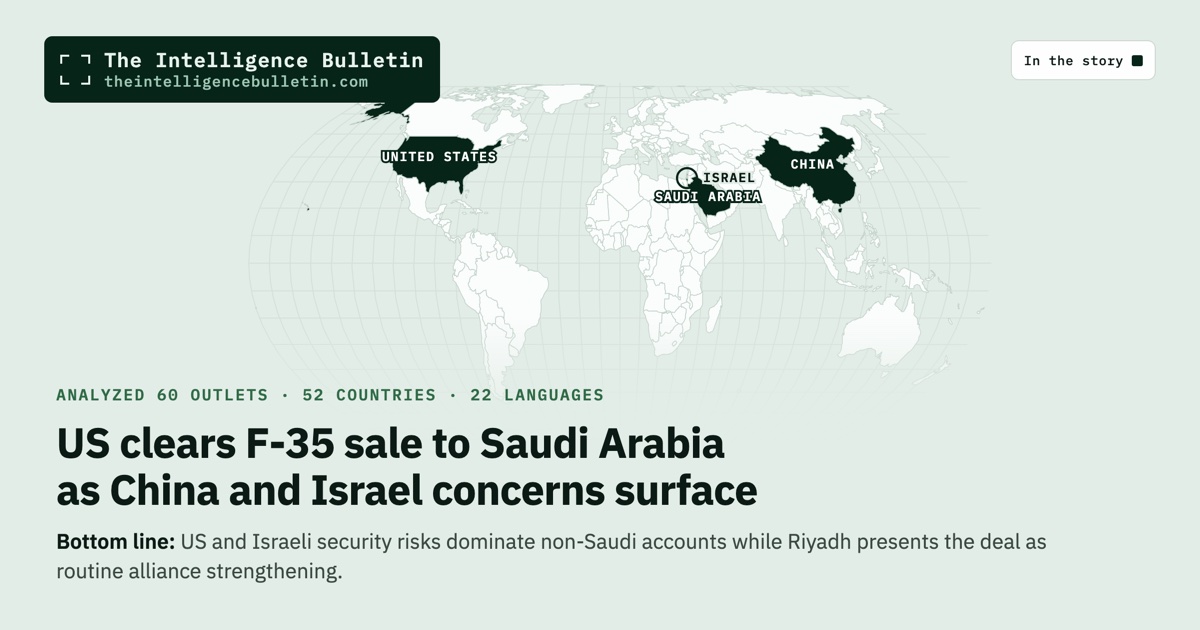
US clears F-35 sale to Saudi Arabia as China and Israel concerns surface

Map of the countries in the story: US clears F-35 sale to Saudi Arabia as China and Israel concerns surface
The US State Department approved a potential $24.3 billion sale of 48 F-35 fighter jets and related equipment to Saudi Arabia. The package requires congressional approval and would give Riyadh its first fifth-generation stealth aircraft. Saudi officials welcomed the deal as advancing long-standing defense ties. Coverage highlights US concerns over possible Chinese technology access and Israeli objections over regional balance while Saudi reports stress strengthened security against Yemen threats.

One Story. Many Angles.

🇺🇸
United States
NBC News
Original reporting
State Department approves $24.3B F-35 fighter jet sale to Saudi Arabia despite China tech theft concerns
Read →
🇸🇦
Saudi Arabia
Arab News
Original reporting
Arab News | Saudi Arabia welcomes proposed F-35 fighter jets deal as regional tensions rise
Read →
🇶🇦
Qatar
Al Jazeera
Original reporting
Trump administration approves sale of F-35 jets to Saudi Arabia
Read →
🇬🇧
United Kingdom
Middle East Eye
Carries US State Department reporting
US State Department approves sale of 48 F-35 fighter jets to Saudi Arabia
Read →
🇭🇰
Hong Kong
South China Morning Post
Carries Agence France-Presse reporting
US approves sale of 48 F-35 jets to Saudi Arabia despite Israeli concerns
Read →
5 sources · each independently reported
Analyzed 60 outlets across 52 countries and 22 languages
In Brief

US and Israeli security risks dominate non-Saudi accounts while Riyadh presents the deal as routine alliance strengthening.

Reporting across outlets converges on the State Department’s formal notification of the $24.3 billion package for 48 F-35s but parts company on the dominant context. NBC News and Al Jazeera foreground US congressional warnings that China could acquire stealth technology through its Saudi partnerships, citing intelligence assessments and a Democratic lawmaker’s statement. South China Morning Post and Al Jazeera add Israeli objections that the sale risks eroding the qualitative military edge, noting Riyadh’s long pursuit and Israel’s status as the sole Middle East operator. Arab News instead centers the Saudi Embassy’s statement that the jets will enhance interoperability and deter threats, framing the approval as a natural extension of the $142 billion arms package agreed in 2025. Middle East Eye’s brief update stays close to the official State Department language on regional stability without additional caveats. The pattern shows US and Israeli security worries appearing most consistently in non-Saudi sources while Riyadh’s account treats the deal as routine alliance maintenance amid Houthi attacks. No outlet claims the sale is finalized; all note the congressional step ahead.

Perspective Analysis

The United States State Department notified Congress on September 18, 2026, of a potential $24.3 billion foreign military sale to Saudi Arabia that includes 48 Lockheed Martin F-35 Lightning II fighter jets, 49 Pratt & Whitney F135-PW-100 engines, secure communications equipment, electronic-warfare systems, spare parts, training simulators and logistics support. The department stated that the proposed transfer would improve Saudi Arabia’s ability to deter current and future threats, strengthen homeland defense, and enhance interoperability with United States and NATO forces without altering the military balance in the region. It added that the sale would have no adverse impact on American defense readiness.

Saudi Arabia has sought fifth-generation stealth fighters for years to modernize an air force that currently operates Boeing F-15s, Tornado aircraft and Eurofighter Typhoons. Israel remains the only country in the Middle East operating the F-35. The State Department described Saudi Arabia as a major non-NATO ally and a force for political stability in the Gulf. A department spokesperson said the sale would strengthen the American defense industrial base and ensure continued Saudi purchases of United States equipment.

The Saudi Embassy in Washington welcomed the notification in a social-media statement. It described the proposed sale as reflecting the strength of the long-standing strategic partnership between the two countries and said decades of security cooperation had contributed to regional stability and shared interests. The embassy statement followed a larger 2025 arms package valued at nearly $142 billion that the Trump administration had presented as the largest defense cooperation agreement in United States history.

The approval arrives as Saudi forces face renewed attacks from Yemen’s Houthis. On September 17, Houthi fighters claimed to have shot down a Saudi F-15 over Ma’rib governorate using a locally made surface-to-air missile and released video of wreckage bearing Saudi markings. Fighting between Saudi-backed Yemeni government forces and the Iran-supported Houthis killed at least five people, including three children, the same day. Saudi Crown Prince Mohammed bin Salman has urged the United States to take direct military action against the Houthis, but Washington has declined to join strikes.

Two independent reporting chains recorded United States intelligence concerns that China could obtain F-35 technology through its partnerships with Riyadh. NBC News cited a New York Times report that analysts had raised the possibility of espionage or technology transfer via the kingdom’s military cooperation with Beijing. Representative Raja Krishnamoorthi, a Democratic member of the House Intelligence Committee, posted that the administration should not proceed when intelligence warnings indicated the technology could reach the Chinese Communist Party. Al Jazeera carried the same intelligence assessment and the lawmaker’s statement.

Al Jazeera and the South China Morning Post both reported Israeli concerns that the sale would affect the regional military balance. Israel is the sole Middle East operator of the F-35, and officials there have voiced objections despite ongoing normalization talks between Riyadh and Jerusalem. The South China Morning Post attributed its account to Agence France-Presse and opened with those Israeli objections.

The Middle East Eye carried only the State Department announcement and its stated rationale that the sale would support American foreign-policy objectives and improve Saudi security without further context on objections or ongoing Yemen fighting.

The accounts converge on the core notification: the State Department cleared a $24.3 billion package for 48 F-35s and associated equipment, and every outlet noted that Congress must still approve the transfer before any contract is finalized. They also agree that Saudi officials issued a public welcome framing the deal as an extension of existing defense ties.

The accounts diverge on emphasis and additional context. NBC News placed congressional warnings about Chinese technology access at the center of its story. Al Jazeera combined those warnings with the recent Houthi claims and Israeli objections in a single dispatch. The South China Morning Post led with Israeli concerns and the normalization backdrop. Arab News quoted the Saudi Embassy statement at length, listed the full equipment package, and described the sale as strengthening capabilities against regional threats without mentioning China or Israel. The Middle East Eye stayed closest to the official language and omitted the objections.

A reader limited to Saudi reporting would see the transaction as routine alliance maintenance that bolsters deterrence at a moment of Houthi pressure. A reader limited to United States or Hong Kong coverage would instead encounter the transaction primarily through the lens of technology-security risks and Israeli military-edge worries. The Yemen fighting appears explicitly only in Al Jazeera’s account.

The corroborated record shows the State Department’s formal notification and the Saudi Embassy’s on-record welcome as the two statements that appear across multiple independent chains. The China-technology concern rests on intelligence assessments reported by the New York Times and carried forward by NBC News and Al Jazeera. The Israeli concern rests on statements attributed to Israeli officials in Al Jazeera and the South China Morning Post. These two sets of objections therefore carry the weight of separate reporting chains rather than a single narrative.

Saudi Arabia has a clear interest in presenting the sale as standard defense cooperation that improves its security against Iranian-backed forces in Yemen. United States lawmakers and Israeli officials have an interest in highlighting risks to American technological advantage and to Israel’s qualitative military edge. The reporting chains that surface those risks draw on on-record statements and intelligence reporting rather than anonymous assertion.

What to Watch

Congressional review will determine whether the package advances. The same lawmakers who raised the China concern will weigh it against the administration’s argument that the sale strengthens a key partner without shifting the regional balance. Any final decision will also test whether Israeli objections can be addressed through the existing qualitative military edge policy that has governed prior Middle East arms transfers.


Share this story

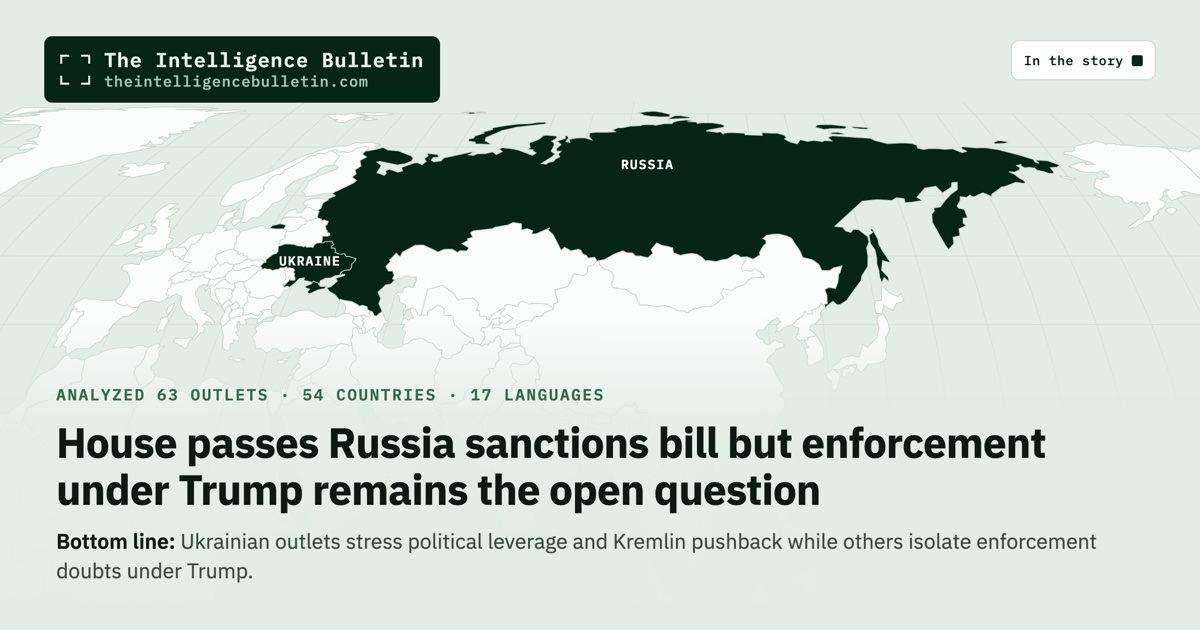
House passes Russia sanctions bill but enforcement under Trump remains the open question

Map of the countries in the story: House passes Russia sanctions bill but enforcement under Trump remains the open question
The US House approved a broad sanctions package on Russia on September 17, 2026, by 262-159, targeting officials, energy exports, and the shadow tanker fleet while authorizing up to 100% tariffs on major buyers of Russian oil and gas. The bill, named after the late Sen. Lindsey Graham, now goes to President Trump. Ukrainian reporting frames it as renewed congressional support strengthening Kyiv’s position and draws attention to Moscow’s objections. Other outlets stress that the bill’s impact hinges on how aggressively the Trump administration enforces the new powers.

One Story. Many Angles.

🇺🇦
Ukraine
24tv.ua
RUSSIAN
Original reporting
US sanctions against Russia – Ukraine again received support from Congress
“Санкции США против России – Украина вновь получила поддержку от Конгресса”
Read →
🇺🇦
Ukraine
focus.ua
RUSSIAN
Original reporting
US sanctions against RF: Kremlin outraged by Congress decision — details
“Санкции США против РФ: Кремль возмущается решением Конгресса — детали”
Read →
🇮🇳
India
The Hindu Business Line
Carries AP reporting
A sweeping US sanctions bill offers Ukraine new leverage on Russia, but enforcement looms
Read →
🇮🇱
Israel
The Jerusalem Post
Original reporting
Russia sanctions bill backed by Sen. Lindsey Graham passes US House
Read →
🇰🇷
South Korea
The Korea Herald
Carries AP reporting
House approves sweeping Russia sanctions bill, sending it to Trump
Read →
5 sources · 4 independent accounts — some share the same news agency’s report
Analyzed 63 outlets across 54 countries and 17 languages
In Brief

Ukrainian outlets stress political leverage and Kremlin pushback while others isolate enforcement doubts under Trump.

Ukrainian outlets treat the House vote as a clear signal of renewed US backing that hands Kyiv fresh economic leverage against Moscow, with one detailing Kremlin spokesman Dmitry Peskov’s warning that the measures would complicate peace talks. Indian and Korean coverage, drawing on AP, presents the same legislative facts but centers enforcement uncertainty under Trump and the discretion the bill grants the president over tariffs. Israeli reporting highlights the bill’s legislative champion and its passage mechanics while noting bipartisan criticism over presidential power. The selected sources converge on the bill’s core provisions and the 262-159 vote yet diverge sharply on emphasis: Ukrainian pieces foreground the political message to the Kremlin and Peskov’s reaction, while the others treat the outcome as a procedural step whose real weight depends on White House implementation. This split reveals how proximity to the conflict shapes framing, with actor-country outlets extracting diplomatic signaling and distant observers isolating the open question of follow-through.

Perspective Analysis

The US House of Representatives approved a sweeping package of sanctions against Russia on September 17, 2026, in a 262-to-159 vote. The legislation, formally titled the Lindsey O. Graham Sanctioning Russia and Iran Act of 2026, targets senior Russian officials, the country’s energy sector, financial institutions, and the network of tankers used to ship Russian oil while evading existing restrictions. It also grants President Donald Trump authority to impose tariffs of up to 100 percent on the largest purchasers of Russian oil and natural gas, with limited exemptions for countries that have taken steps to reduce those imports. The measure had cleared the Senate 86-11 in August and now moves to the president’s desk.

Ukrainian President Volodymyr Zelenskyy called the vote symbolic and said the bill supplied an extremely powerful tool that could stop the war and force Russia to the negotiating table. Ukrainian Foreign Minister Andrii Sybiha described it as an important step toward raising the cost of Russian aggression and depriving Moscow of resources for its military. Zelenskyy had lobbied US lawmakers directly, including a closed-door meeting with senators after Graham’s funeral, pressing the case that sanctions must cut into oil and gas revenues to weaken Russia’s ability to sustain the conflict and to bolster Ukrainian morale.

Kremlin spokesman Dmitry Peskov responded the following day by labeling the congressional action an unfriendly step. He stated that additional US sanctions would complicate efforts to find a peace settlement in Ukraine and that Moscow would continue monitoring the bill’s progress. Ukrainian reporting from both 24tv.ua and focus.ua placed this reaction at the center of their accounts, noting that Peskov described the sanctions as measures that could hinder the search for a negotiated end to the fighting.

The bill carries the name of the late Senator Lindsey Graham of South Carolina, who spent more than a year negotiating its provisions and secured White House agreement shortly before his death. Democratic Senator Richard Blumenthal worked alongside him. Supporters argued that the tariff authority would deter major buyers such as China and India from continuing to fund the Russian war effort through energy purchases. Representative Michael McCaul of Texas said the legislation delivered a clear message that the era of countries looking the other way had ended.

Critics inside Congress raised concerns about the breadth of presidential discretion the bill creates. House Minority Leader Hakeem Jeffries warned that the tariff provisions could allow the administration to impose economic harm on American allies as well as adversaries, and he pointed to what he called loopholes that might prevent meaningful sanctions relief from ever taking effect. Representative Gregory Meeks of New York questioned why Congress would hand additional tariff authority to a president who had already used such tools against European partners. Fifty-eight Democrats joined Republicans in supporting the measure despite leadership opposition from their caucus, while seven Republicans voted against it.

The Hindu Business Line and The Korea Herald, both carrying Associated Press reporting, noted that the bill’s real weight will rest on how aggressively the Trump administration chooses to use the new powers. They recorded that existing Western sanctions have already imposed costs on Russia but have not produced the swift economic pressure Kyiv has sought. Tom Keatinge of the Royal United Services Institute observed that the immediate benefit to Ukraine remains political rather than economic, sending a signal of congressional solidarity, yet ultimate effectiveness hinges on presidential commitment. The Korea Herald account added that some lawmakers fear the tariff clause could raise prices for American consumers if applied broadly before the November midterms.

Ukrainian outlets framed the passage as the end of a nearly two-year congressional pause on decisive new measures supporting Ukraine. They highlighted Zelenskyy’s alignment with the legislation and the contrast with Russian objections. Coverage from India and South Korea instead presented the vote as one procedural step whose consequences depend on subsequent White House decisions, including whether Trump will impose the tariffs on major energy importers or grant waivers. Israeli reporting centered the legislative history and the role of Graham and Blumenthal while recording the same bipartisan divisions over presidential power.

The accounts converge on the 262-159 tally, the core targets of the bill, and Peskov’s on-record statement that the sanctions would complicate peace efforts. They diverge on what the vote primarily signals. Ukrainian reporting extracts a message of renewed backing that strengthens Kyiv’s hand in pressing Moscow, while the other selected sources isolate the open variable of implementation. This difference tracks the outlets’ positions relative to the conflict: those closest to the fighting foreground the diplomatic signal sent to the Kremlin, whereas more distant observers foreground the discretion granted to the American executive.

The enforcement question carries the strongest warrant across the reporting because it appears in multiple independent chains, including the two AP dispatches and the Jerusalem Post account of congressional debate over tariff authority. Ukrainian sources do not contradict that point; they simply place greater weight on the political message. Trump has previously expressed preference for direct negotiation with Moscow and has already held tariff powers he has not always applied to Russia. The bill’s structure gives him explicit latitude to waive provisions under specified conditions, a feature critics cited during floor debate.

What to Watch

What follows therefore turns less on the existence of the new statute than on whether the administration elects to activate its most potent clauses against major Russian energy customers. If enforcement remains limited, the legislation will function chiefly as another round of political signaling whose economic bite stays modest. If tariffs are applied to the top importers, the measure could raise the fiscal cost of continued fighting for Moscow in ways previous sanctions have not. The reporting from all five outlets makes clear that the next moves rest with the White House rather than with Congress.


Share this story

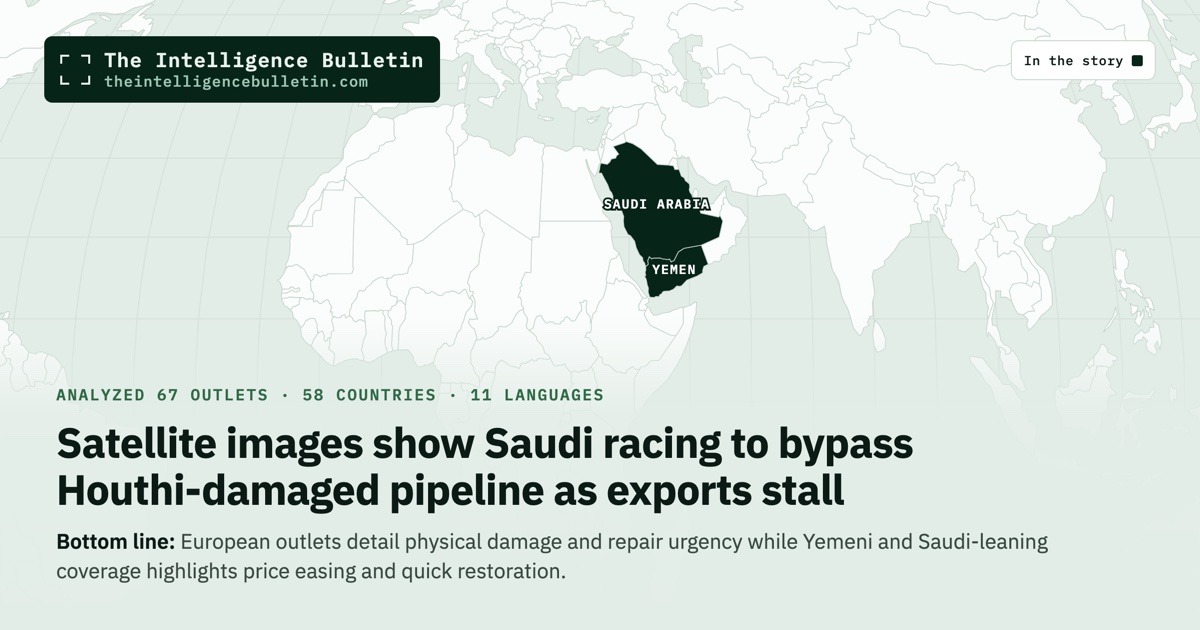
Satellite images show Saudi racing to bypass Houthi-damaged pipeline as exports stall

Map of the countries in the story: Satellite images show Saudi racing to bypass Houthi-damaged pipeline as exports stall
Iran-backed Houthi militants attacked Saudi Arabia’s 1,200 km East-West Pipeline last week, damaging pump stations and halting crude flows to the Red Sea export terminal at Yanbu. The line carries about 70% of Saudi exports. Saudi Aramco is rushing bypass repairs visible in satellite imagery, with US officials predicting days-long outage and analysts warning of weeks. Oil prices rose then eased on restoration hopes, while Morocco reaffirmed diplomatic support amid the escalation.

One Story. Many Angles.

🇬🇷
Greece
Hellenic Shipping News
Carries ENGINE reporting
Saudi Arabia’s oil export lifeline severed indefinitely – analysts
Read →
🇸🇦
Saudi Arabia
Al Riyadh
ARABIC
Original reporting
Oil drops 2% amid easing supply disruption concerns
“جريدة الرياض | النفط ينخفض 2% وسط تهدئة مخاوف اضطرابات الإمدادات”
Read →
🇾🇩
Yemen
Almontasaf
ARABIC
Original reporting
Oil prices decline for the third session amid receding supply concerns
“أسعار النفط تتراجع للجلسة الثالثة وسط انحسار مخاوف الإمدادات”
Read →
🇩🇪
Germany
WirtschaftsWoche
GERMAN
Original reporting
Oil price: Here Saudi Arabia is trying to save the fuel price in a hurry
“Ölpreis: Hier versucht Saudi-Arabien gerade im Eiltempo, den Spritpreis zu retten”
Read →
🇲🇦
Morocco
Morocco World News
Original reporting
Morocco Reaffirms Support for Saudi Arabia After Houthi Attacks on Mecca
Read →
5 sources · each independently reported
Analyzed 67 outlets across 58 countries and 11 languages
In Brief

European outlets detail physical damage and repair urgency while Yemeni and Saudi-leaning coverage highlights price easing and quick restoration.

The reporting reveals a clear split between immediate operational urgency and diplomatic framing that no single national lens captures. Shipping and energy analysts in Greece and Germany emphasize visible satellite evidence of extensive pump station destruction at sites 9 and 11, with Saudi crews laying provisional pipelines at high speed to prevent Yanbu storage depletion and broader export collapse; they note Aramco’s cancellations of European cargoes and quote analysts forecasting multi-week outages unless further attacks occur. Yemeni coverage instead stresses the third consecutive session of falling Brent prices as Saudi restoration efforts and alternative Asian shipments via Oman reduce immediate supply fears, downplaying duration. Moroccan reporting shifts entirely to political solidarity, highlighting Rabat’s condemnation of Houthi attempts on Mecca and support for Saudi defensive measures during UN maritime security talks. US statements relayed across outlets claim a short interruption, creating direct tension with analyst timelines. The pattern shows how European technical detail, Yemeni market statistics, and Moroccan alliance language together expose both the physical repair race and the absence of any unified regional narrative on escalation risks.

Perspective Analysis

The East-West Pipeline stretches 1,200 kilometers from Saudi oil fields near the Persian Gulf to the Red Sea export terminal at Yanbu. Last week Houthi militants struck pump stations along its length. Satellite imagery from Vantor captured on September 13 shows three of the five pump houses at station 11 reduced to rubble, with crews already laying a new provisional pipeline a few meters south of the wreckage. Station 9, roughly 200 kilometers west, also sustained damage, visible as soot on pump houses and disruption to the piping in front of them in lower-resolution Sentinel-2 images. The line normally moves up to seven million barrels per day—five million through its primary strand and two million through a secondary line repurposed for crude—accounting for about 70 percent of Saudi exports that bypass the Strait of Hormuz.

Flows through the pipeline stopped after September 11. Aramco cancelled or delayed late-September cargoes to several European refiners, and no crude has left Yanbu since that date. Storage tanks at the port hold enough crude to sustain exports for several days, after which loadings would cease unless capacity returns. Saudi crews responded with visible speed. Images from September 13 and subsequent days show more than 100 pieces of heavy equipment at station 11, lengths of new pipe scattered across the site, and earth already piled over one completed bypass section. A second bypass line appears under construction in mid-week imagery. At station 9 the bypass work looks more advanced and partially buried, suggesting some pre-planned contingency measures were already in place before the strikes.

Analysts tracking the outage reached differing conclusions on its duration. ING Bank analysts stated that plenty of uncertainty remains over the extent of damage and the length of the shutdown, with prices likely to stay supported until clarity emerges. ANZ Bank strategist Daniel Hynes noted UK officials fear the line could stay offline for six weeks. Restoration work could take three to five weeks, according to regional officials cited by the Associated Press. US Energy Secretary Chris Wright offered a shorter timeline, telling CNBC the interruption would be short and limited to days, and that Riyadh was exploring alternative routes through the Strait of Hormuz with US military assistance.

Oil prices moved in two phases. They rose sharply earlier in the week on the initial reports of halted loadings at Yanbu. They then fell for three consecutive sessions. Brent futures dropped 1.12 percent to 103.65 dollars per barrel, while West Texas Intermediate fell 0.85 percent to 101.04 dollars. Reports indicated that Saudi efforts to restore roughly half the pipeline’s capacity within days, combined with additional crude offered to Asian buyers through ship-to-ship transfers off Oman, contributed to the easing. Brent is now on track for its first weekly decline in three weeks.

Morocco’s foreign minister Nasser Bourita used a UN Security Council Arria-formula meeting on maritime security to restate Rabat’s absolute solidarity with Saudi Arabia. He condemned the Houthi attacks, including an attempted drone strike on Mecca intercepted by Saudi air defenses before it reached the city’s restricted airspace. Bourita linked the incident to broader threats to international waterways from non-state actors and called for rapid reopening of the Strait of Hormuz and a solution for the Bab al-Mandab Strait.

The accounts diverge most sharply on the expected length of the disruption and on what matters most about the event. The German WirtschaftsWoche article centers the satellite evidence of physical destruction and the visible scale of the repair effort, framing the work as a race to protect consumer fuel prices. The Hellenic Shipping News piece, drawing on shipping-industry sources, stresses the risk of an indefinite severance and the resulting uncertainty for European refiners whose cargoes have already been cancelled. In contrast, the Yemeni Almontasaf article foregrounds the three-session price decline and the reports of Saudi progress toward restoring half capacity, presenting the market reaction as evidence that immediate supply fears are receding. Al Riyadh similarly highlights the 2 percent drop in oil prices amid calming supply concerns. The Moroccan Morocco World News piece contains none of this operational detail and instead records the diplomatic statement of solidarity and the condemnation of attacks on Mecca.

These differences are not cosmetic. A reader limited to the German or Greek reporting would expect prolonged export shortfalls and sustained upward pressure on prices. A reader limited to the Yemeni or Saudi domestic coverage would see the episode as already moving toward resolution through rapid restoration and market adjustment. The Moroccan account supplies the alliance context but offers no information on whether the pipeline can actually resume flows on any timeline.

The physical damage and the ongoing bypass construction are corroborated across independent reporting chains that include commercial satellite imagery and analyst commentary. The price decline for three sessions is likewise recorded in multiple market-focused pieces. The US assessment of a days-long outage stands in explicit tension with the multi-week forecasts from ING, ANZ, and the regional officials cited by the Associated Press; both cannot be accurate. Morocco’s statement of solidarity is carried in a single outlet in this set and reflects Rabat’s consistent alignment with Riyadh on regional security matters.

What to Watch

The technical detail on the pipeline’s condition and the repair race supplies the clearest warrant for expecting continued pressure on global crude flows in the near term. Successful bypasses could limit the shock to a matter of weeks, but any further strikes would compound the outage and push prices higher for economies far from the Gulf. The diplomatic layer recorded in the Moroccan reporting indicates that alliance commitments remain intact even as the operational timeline stays contested.


Share this story

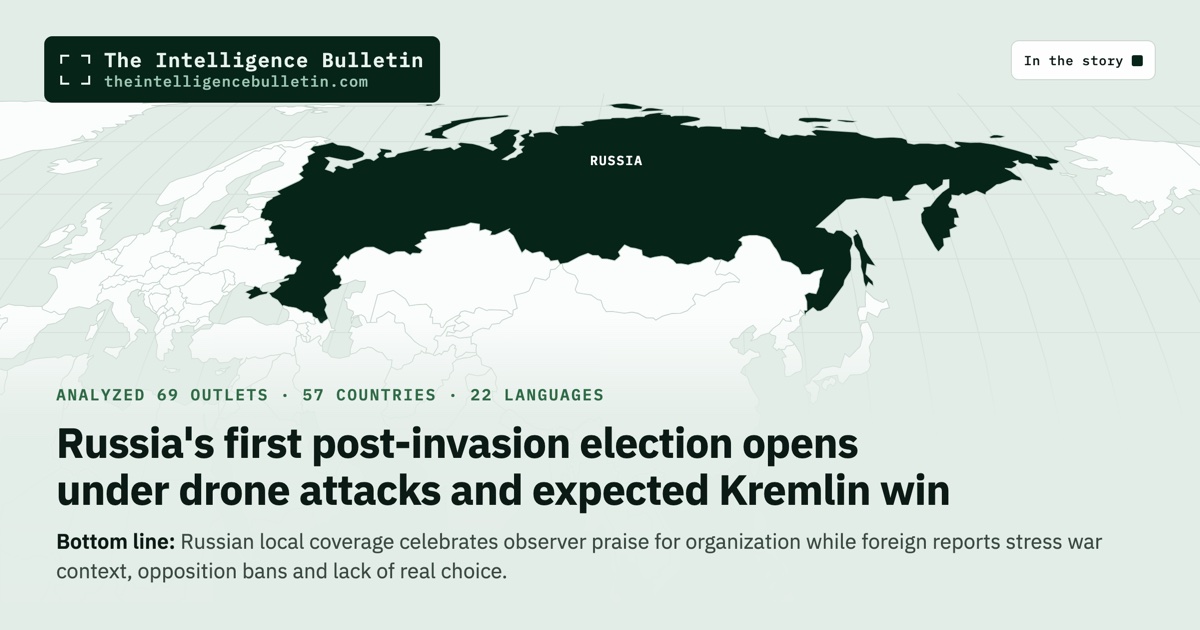
Russia’s first post-invasion election opens under drone attacks and expected Kremlin win

Map of the countries in the story: Russia's first post-invasion election opens under drone attacks and expected Kremlin win
Russians began a three-day parliamentary election on September 18, 2026, the first since the full-scale Ukraine invasion. Only parties backing President Putin and the war are competing, with United Russia expected to retain dominance in the Duma. Ukrainian drone attacks on Moscow coincided with polling stations opening, while selected coverage ranges from local praise for organization to foreign emphasis on restricted opposition and the war’s fifth year.

One Story. Many Angles.

🇷🇺
Russia
Tumentoday
RUSSIAN
Original reporting
Russian elections deserve respect: international observers highly appreciated the level of organization of elections in the Tyumen region
“Российские выборы заслуживают уважения: международные наблюдатели высоко оценили уровень организации выборов в Тюменской области”
Read →
🇫🇷
France
Le Parisien
FRENCH
Carries AFP reporting
‘We are united’: in Russia, polling stations open this Friday, for the first legislative elections since the start of the war in Ukraine
“« Nous sommes unis » : en Russie, les bureaux de vote ouvrent ce vendredi, pour les premières législatives depuis le début de la guerre en Ukraine”
Read →
🇸🇦
Saudi Arabia
Arab News
Carries AFP reporting
Arab News | Russians vote as Ukraine war drags on for fifth year
Read →
🇲🇾
Malaysia
Free Malaysia Today
Carries AFP reporting
Russia says destroyed dozens of Ukrainian drones as polling stations open
Read →
🇵🇾
Paraguay
ABC Color
SPANISH
Carries AFP reporting
Russia votes in elections without suspense in full war with Ukraine
“Rusia vota en unas elecciones sin suspenso en plena guerra con Ucrania – Mundo”
Read →
5 sources · 2 independent accounts — some share the same news agency’s report
Analyzed 69 outlets across 57 countries and 22 languages
In Brief

Russian local coverage celebrates observer praise for organization while foreign reports stress war context, opposition bans and lack of real choice.

Domestic Russian reporting from Tyumen highlights international observers from five countries praising punctuality, joy at polling stations and technical transparency with no violations found, presenting the vote as worthy of respect. In contrast, outlets in France, Saudi Arabia, Malaysia and Paraguay tie the same events to the Ukraine war’s prolonged stalemate, the barring of the anti-war Yabloko party, Soviet-style censorship and fears of post-election mobilization. Drone incidents reported by Moscow’s mayor appear as security backdrop in most foreign accounts but receive no mention in the regional Russian piece. This pattern shows how the election functions as domestic validation of unity and procedure while serving internationally as evidence of controlled consolidation under wartime isolation. The absence of suspense is noted uniformly outside Russia, yet only the local source supplies concrete observer testimony from Armenia, Argentina, Austria, India and Serbia. Convergence on United Russia’s inevitable victory and opposition suppression across independent chains underscores the event’s role as a loyalty marker rather than a contest, with the war’s daily costs providing the unstated stakes that one side elevates and the other omits.

Perspective Analysis

Russians opened polling stations across eleven time zones on the morning of September 18, 2026, for the first national parliamentary election since the full-scale invasion of Ukraine in 2022. The three-day vote will fill all 450 seats in the State Duma and close at 18:00 GMT on Sunday, with early results expected immediately afterward. United Russia, the party of President Vladimir Putin, is expected to secure another commanding majority. Only four other parties, all of which support the president and the military campaign to varying degrees—the Communist Party, the nationalist LDPR, A Just Russia and New People—were permitted on the ballot. The anti-war Yabloko party was barred by court order weeks earlier. Voting is also taking place in the Ukrainian territories Russia has annexed since 2014 and 2022.

The same day the polls opened, Moscow Mayor Sergei Sobyanin reported that more than 350 Ukrainian drones had been launched toward the capital region overnight, with most intercepted before reaching the city; 64 were shot down while approaching Moscow itself. Ukrainian strikes have reached deeper into Russia this year, including the Urals and Siberia, and the timing of the latest wave coincided with the first day of voting. Putin addressed the country on state television the evening before, urging citizens to cast ballots to demonstrate that “behind our fighters stand millions of people” and to deliver “an answer to those who want to weaken Russia.”

All five outlets that covered the opening day drew from the same core reporting chain, primarily material distributed by AFP. The differences lie in what each masthead chose to place in the lead, what it retained from the shared text, and what local or regional framing it added on top. Tumentoday, the sole originating Russian source in the set, devoted its entire article to a regional election-monitoring center in Tyumen. It quoted seven foreign observers from Austria, Argentina, Armenia, India and Serbia who inspected live video feeds from 448 polling stations and 29 territorial commissions. The observers praised punctuality, the visible joy of voters arriving at the polls, high-resolution real-time monitoring, and the absence of any violations on the first day. The piece contains no reference to the war, to drone attacks, or to the exclusion of opposition parties.

Le Parisien opened with the phrase “Nous sommes unis” and immediately noted that the vote is the first since the beginning of the war in Ukraine. It listed the restricted field of parties, named Yabloko’s exclusion, and quoted an analyst from the Carnegie Russia Eurasia Center describing the election as personally and politically important to Putin as a demonstration of unity. The article also recorded the drone attacks reported by Sobyanin and placed the vote in the context of failed diplomatic efforts and the risk of a new mobilization round after the polls close.

Arab News led with the headline “Russians vote as Ukraine war drags on for fifth year.” Its dispatch kept the drone count, the restricted candidate list, the barring of Yabloko, and the comments of ordinary voters in Moscow who cited “stability” as their reason for supporting United Russia while expressing fatigue with the conflict. It added detail on the economic effects of Western sanctions that have not collapsed the economy and on the Soviet-style censorship measures introduced since 2022, including the imprisonment of critics.

Free Malaysia Today placed the drone attack in the headline itself: “Russia says destroyed dozens of Ukrainian drones as polling stations open.” The body repeated the mayor’s Telegram statement and the election mechanics, then noted that the vote will serve as a barometer of public feeling on a war that has killed hundreds of thousands. It did not expand on opposition restrictions or mobilization fears beyond the shared text.

ABC Color of Paraguay titled its piece “Russia votes in elections without suspense in the midst of war with Ukraine.” It reproduced the expected United Russia victory, the list of permitted parties, the Yabloko ban, the drone incident, and the same voter and analyst quotes carried by the other AFP-based outlets. It added the observation that the vote is also being held in Russian-controlled areas of Ukraine and that the Kremlin will use the result to gauge popular backing for a conflict whose costs have grown more visible inside Russia this year.

The single originating local account therefore supplied concrete procedural detail—observer nationalities, exact numbers of cameras inspected, and direct quotations about punctuality and organization—that appears nowhere in the AFP-derived pieces. The four foreign outlets, working from the identical wire text, each selected a different entry point: unity rhetoric and party restrictions in France, the war’s duration in Saudi Arabia, the simultaneous drone strike in Malaysia, and the absence of genuine competition in Paraguay. None of the foreign pieces mentioned the Tyumen observers or the positive technical assessments they offered.

What to Watch

Because every factual claim about the election mechanics, the candidate list, the drone numbers, and the expected outcome traces to the same reporting chain, the observable divergence is not in the facts reported but in the emphasis each masthead applied to the shared material. The Russian regional outlet used its space to document an international monitoring exercise that presented the process as orderly and transparent. The foreign outlets used the same underlying facts to locate the vote inside an ongoing war whose fifth year coincides with tightened domestic controls and fresh Ukrainian strikes on the capital. A reader limited to any one of these accounts receives a different sense of what the election is principally about: procedural legitimacy in one case, wartime consolidation and attrition in the others. The shared origin makes clear that these are editorial choices about framing rather than independent discoveries of additional facts.


Share this story