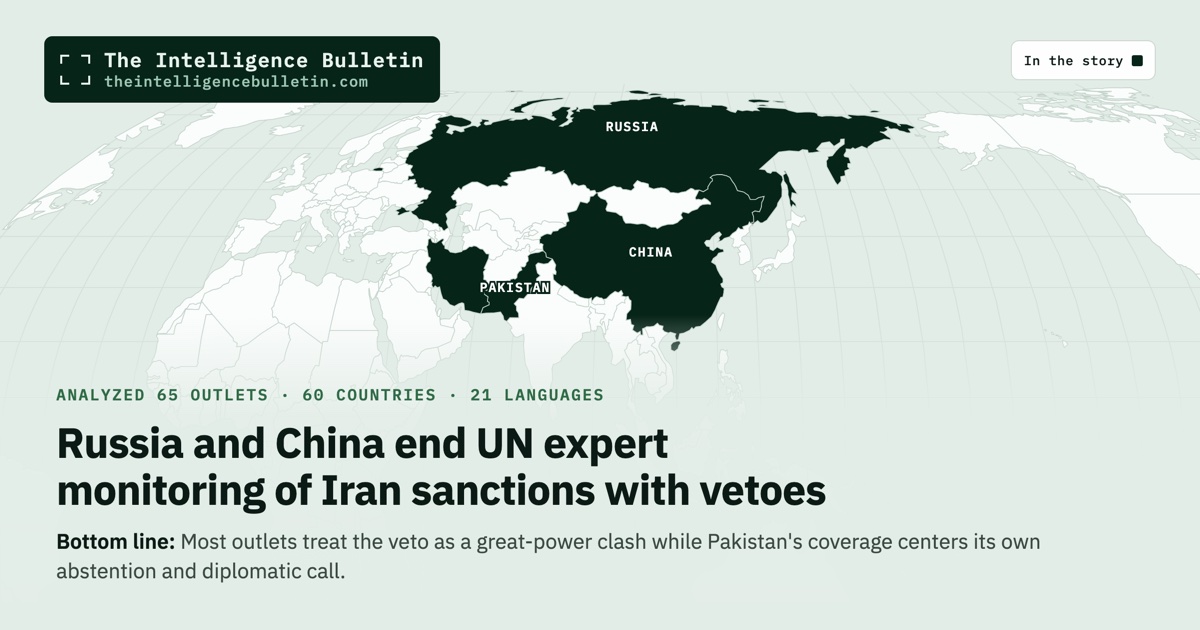
Russia and China end UN expert monitoring of Iran sanctions with vetoes

Map of the countries in the story: Russia and China end UN expert monitoring of Iran sanctions with vetoes
Russia and China vetoed a US-drafted UN Security Council resolution to extend the mandate of a panel of experts monitoring sanctions on Iran. The draft received 11 votes in favor but failed due to the vetoes, with Pakistan and Somalia abstaining. The sanctions were reimposed via snapback in 2025, but Russia and China argue the mechanism was illegal and Resolution 2231 has expired.

One Story. Many Angles.

🇶🇦
Qatar
Al Jazeera
Original reporting
Russia, China veto UN mandate to monitor Iran sanctions
Read →
🇮🇷
Iran
Press TV
Original reporting
Russia, China veto rejects ‘political abuse’ of UNSC, marks end of ‘unipolar order’: Qalibaf
Read →
🇪🇬
Egypt
Al-Masry Al-Youm
ARABIC
Original reporting
With a Russian-Chinese veto.. The Security Council fails to vote on an American draft resolution regarding sanctions on Iran
“بفيتو صيني روسي.. مجلس الأمن يفشل فى التصويت على مشروع قرار أمريكى بشأن العقوبات على إيران”
Read →
🇵🇰
Pakistan
Pakistan Observer
Original reporting
Pakistan Abstains as Russia, China Veto Iran Sanctions Panel
Read →
🇯🇵
Japan
Japan Today
Associated Press wire copy
Russia and China veto U.S. proposal for U.N. experts to keep monitoring sanctions on Iran
Read →
5 sources · each independently reported
Analyzed 65 outlets across 60 countries and 21 languages
In Brief

Most outlets treat the veto as a great-power clash while Pakistan’s coverage centers its own abstention and diplomatic call.

The vetoes expose a fundamental legal dispute over whether UN sanctions on Iran remain enforceable at all. Russia and China insist the 2015 nuclear deal’s snapback mechanism was improperly triggered and that Resolution 2231 expired in October 2025, leaving no basis for renewed expert monitoring. Western powers maintain the sanctions committee and its panel remain active despite the procedural deadlock that prevented experts from ever being appointed. Press TV frames the outcome through Iranian Speaker Qalibaf as the definitive end of unipolar US dominance and political abuse of the Council. Al Jazeera reports the practical result: the Security Council loses its main source of independent sanctions reporting. Egypt’s Al-Masry Al-Youm stays strictly procedural, recording only the vote numbers and the failed US draft. Pakistan Observer alone highlights its own abstention and call for IAEA-led diplomacy without interference. Japan Today, carrying AP copy, places the vote inside the wider US campaign to isolate Tehran during the ongoing regional conflict. The pattern shows that even non-permanent members are choosing sides on the underlying legality question rather than simply aligning with or against the veto powers.

Perspective Analysis

Russia and China used their permanent-member vetoes on September 17 to defeat a United States draft resolution that would have extended for one year the mandate of the UN Security Council panel of experts charged with monitoring sanctions on Iran. Eleven members voted in favor. Pakistan and Somalia abstained. The panel’s current authorization ends on September 26. Without the extension, the council loses the only mechanism it had created for independent, evidence-based reporting on sanctions violations after the snapback of earlier measures in September 2025.

The sanctions themselves trace to six earlier Security Council resolutions that the 2015 nuclear agreement had suspended. France, Germany and Britain invoked the snapback clause last year, restoring the 1737 Sanctions Committee and authorizing the expert panel. Russia and China have maintained from the outset that the snapback was legally invalid because Resolution 2231 had already expired on October 18, 2025, removing any foundation for renewed council action on the Iranian nuclear file. Western members counter that the sanctions regime remains in force and that the expert panel is the council’s principal source of impartial information on evasion.

Iran’s UN mission issued a statement thanking Russia and China for blocking what it described as a politically motivated attempt to abuse the council. Iranian Parliament Speaker Mohammad Baqer Qalibaf wrote on social media that the vetoes rejected political abuse of the Security Council and marked the end of the unipolar order in which one side extracts concessions through force. Russia’s UN ambassador Vassily Nebenzia told the council after the vote that Western colleagues should stop their dangerous actions on the Iran front. The United States deputy ambassador, Jennifer Locetta, warned that the absence of the panel would create a monitoring gap that benefits only those profiting from evasion.

Pakistan’s permanent representative, Ambassador Asim Iftikhar Ahmad, used the session to stress support for dialogue and for an independent IAEA safeguards role free of political interference. He urged all parties to honor the Islamabad Memorandum of Understanding and return to negotiations. Egyptian reporting recorded the vote tally and the veto rules without endorsing either side’s interpretation of the snapback. Japanese coverage, carried under an Associated Press byline, placed the outcome inside the wider US campaign to isolate Tehran, noting additional Treasury actions against digital currency networks alleged to help Iran evade sanctions.

The selected sources contain no direct reporting from Russian, Chinese or American outlets. Statements by those governments therefore reach readers only through the accounts that carried them. Al Jazeera foregrounded the practical loss of the watchdog panel and quoted Nebenzia and Locetta on the consequences for monitoring. Press TV centered Qalibaf’s characterization of the veto as a structural defeat for unilateralism. Al-Masry Al-Youm limited itself to the procedural mechanics of the failed draft. Pakistan Observer alone included its envoy’s full remarks on regional tensions and diplomacy. Japan Today supplied the neutral wire narrative plus context on the current stalemate in the regional conflict and Iran’s reported stockpile of uranium enriched to 60 percent.

A reader limited to Iranian coverage would absorb the claim that the unipolar order has ended but would not encounter the detailed vote mechanics or the Pakistani envoy’s emphasis on IAEA independence. A reader limited to the Egyptian account would see only the arithmetic of the veto and the snapback dispute without the ideological framing or the abstaining states’ statements. A reader limited to the Japanese wire report would receive the factual sequence and the US campaign context but would miss Qalibaf’s explicit linkage of the veto to the end of unipolarity. The convergence across all five outlets on the vote numbers and the veto itself supplies the one uncontested spine of the event.

What to Watch

The legal disagreement over the snapback and Resolution 2231 remains unresolved in the reporting examined. Three independent chains—Press TV, Al-Masry Al-Youm and the AP material carried by Japan Today—record Russia and China’s position that the mechanism was illegal and that the resolution has expired. The same chains record the Western view that the sanctions committee continues. No source supplies primary documents that would settle the interpretive conflict. The veto therefore leaves sanctions enforcement without the expert panel that Western members regard as essential and that Russia and China regard as lacking legal basis. The next practical step is likely to be an effort by the United States, France, Britain and Germany to replicate the North Korea precedent by creating their own monitoring arrangement outside the council framework, while Russia and China continue to treat the snapback sanctions as terminated.
Share this story

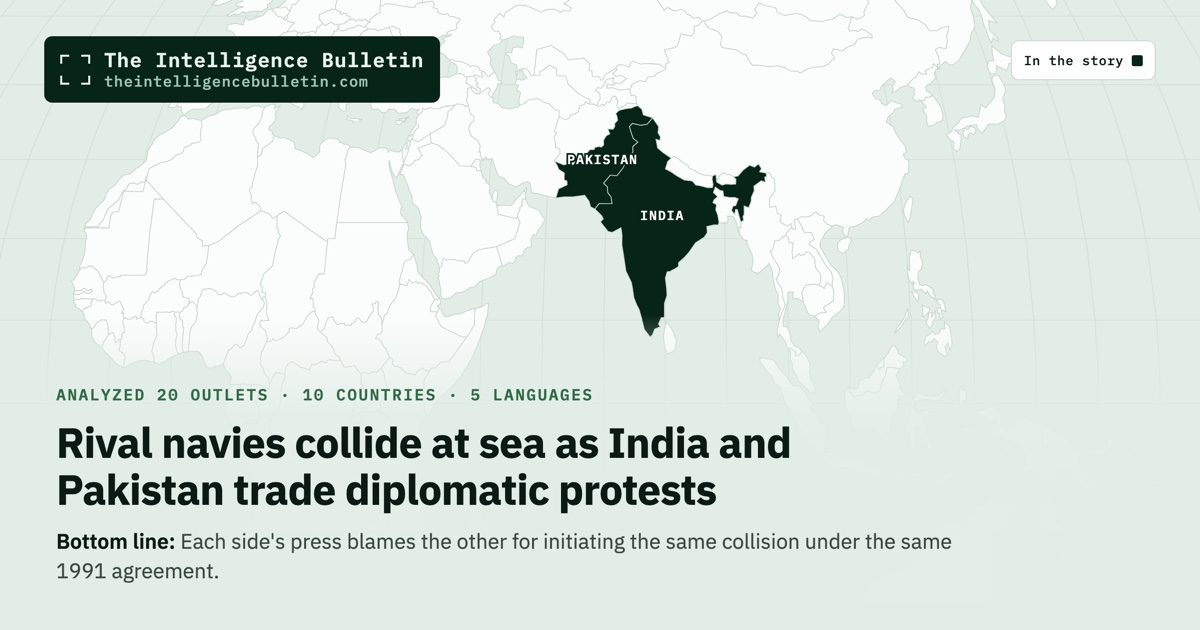
Rival navies collide at sea as India and Pakistan trade diplomatic protests

Map of the countries in the story: Rival navies collide at sea as India and Pakistan trade diplomatic protests
An Indian Navy ship and a Pakistani naval vessel collided at sea on September 15. Pakistan summoned India’s charge d’affaires in Islamabad to protest what it called provocative Indian maneuvers inside its Exclusive Economic Zone during Pakistani exercises, violating the 1991 bilateral agreement. India summoned Pakistan’s envoy in New Delhi first, blaming the Pakistani ship’s unprofessional conduct in international waters for the same incident and the same agreement. Both sides reported no major damage but warned of risks to regional stability.

One Story. Many Angles.

🇵🇰
Pakistan
Jang
URDU
Original reporting
Indian naval ship carried out provocative activities in Pakistani maritime limits, Foreign Office
“بھارتی بحری جہاز نے پاکستانی سمندری حدود میں اشتعال انگیز حرکات کیں، دفتر خارجہ”
Read →
🇮🇳
India
Hindustan Times
Original reporting
Pakistan summons Indian diplomat after New Delhi lodges strong protest over naval vessel collision
Read →
🇦🇪
United Arab Emirates
Gulf News
Carries IANS reporting
Pakistani Naval Ship Collides with Indian Navy Unit in International Waters as India Summons Pakistan Envoy
Read →
🇨🇳
China
People’s Daily
Carries Xinhua reporting
Pakistan summons India’s top envoy after naval ship collision
Read →
4 sources · each independently reported
Analyzed 20 outlets across 10 countries and 5 languages
In Brief

Each side’s press blames the other for initiating the same collision under the same 1991 agreement.

The reporting reveals a classic mirror-image dispute between nuclear rivals, with each side’s account of the collision aligning strictly along national lines rather than converging on neutral details. Pakistani and Chinese wire accounts describe an Indian destroyer deliberately entering Pakistani waters during exercises and forcing contact despite warnings, while Indian and Gulf accounts reverse the sequence: India lodged its protest first over a Pakistani maneuver in international waters, prompting Pakistan’s summons as retaliation. The 1991 agreement on advance notice of exercises appears in every dispatch yet is invoked only to fault the other side, showing how the same bilateral text serves opposing narratives. Gulf News places the event in international waters and emphasizes India’s diplomatic initiative, a framing absent from direct actor coverage. People’s Daily carries Xinhua copy that tracks Pakistan’s version closely, underscoring Beijing’s choice to relay one capital’s line without additional context. The absence of any independent third-party confirmation of location or sequence means readers encounter two incompatible factual claims that cannot both be true, leaving the incident’s trigger and legal violation in direct contradiction across reporting chains.

Perspective Analysis

An Indian Navy destroyer and a Pakistani naval ship made contact at sea on September 15 during a Pakistani exercise. The Indian vessel was identified in one account as INS Kolkata. The Pakistani ship was named PNS Haneen. Both governments reported the contact produced no major damage, yet each lodged a formal diplomatic protest the following day and each invoked the same 1991 bilateral agreement on advance notice of military exercises.

Pakistan described the sequence as an Indian incursion into its Exclusive Economic Zone. According to the Foreign Office statement carried by Jang, the Indian ship entered the area where Pakistan Navy units were conducting their biennial exercise. Pakistani forces issued multiple warnings, the statement said, before the Indian vessel executed a sudden and dangerous turn that brought it into contact with PNS Haneen. The Indian ship then increased speed and left the area. Pakistan summoned the Indian charge d’affaires in Islamabad on September 17 to register its protest and to demand that New Delhi respect the 1991 agreement and international law.

India presented the opposite sequence and location. Its Ministry of External Affairs stated that the collision occurred in international waters and resulted from an inappropriate and unprofessional maneuver by the Pakistani vessel. India summoned the Pakistani charge d’affaires in New Delhi on September 16, before Pakistan’s summons, and instructed its own envoy in Islamabad to deliver a parallel protest. The ministry described the Pakistani conduct as unacceptable and in direct contravention of the 1991 agreement. It called on Pakistani authorities to ensure all military units exercise due care.

The 1991 agreement appears in every published account yet serves opposite purposes. Pakistani reporting treats it as evidence that the Indian ship violated rules on prior notice and safe separation. Indian reporting treats it as evidence that the Pakistani ship failed to maintain proper distance during its own exercise. No account supplies the text of the relevant article or any third-party observation that would allow a reader to test either interpretation against the other.

Coverage from outside the two capitals follows the same split. Gulf News, drawing on the Indian ministry statement, placed the event in international waters and highlighted India’s initial protest. People’s Daily published an Xinhua dispatch from Islamabad that reproduced Pakistan’s account of an Indian provocation inside the Exclusive Economic Zone without adding independent detail or context. The result is two internally consistent but mutually exclusive narratives rather than a single disputed incident.

A reader limited to Pakistani sources would conclude that India deliberately tested Pakistani defenses during a scheduled exercise and created an unnecessary risk of escalation. A reader limited to Indian sources would conclude that Pakistan’s naval unit lost control during its own exercise and then sought diplomatic advantage by reversing the sequence of protests. The same 1991 agreement is cited by both, yet the reporting supplies no shared facts on location or initiating action that could reconcile the two versions.

The absence of any corroborating observation from a third country or from commercial shipping data leaves the trigger and the legal violation in direct contradiction. Both governments warned that the episode risked regional stability, but the diplomatic record they each published points in opposite directions. Without an independent record of the vessels’ positions or radio traffic, the only settled facts are that contact occurred on September 15, that both sides protested within forty-eight hours, and that each side claims the other violated the same bilateral rule.

What to Watch

The pattern is familiar in reporting between these two capitals: each attributes initiative and fault to the other while presenting its own actions as defensive and rule-bound. The current episode adds no new evidence that would allow an outside reader to assign responsibility. It does confirm that the 1991 agreement, intended to reduce the chance of unintended clashes, continues to be interpreted after the fact rather than observed in real time by either side. Future incidents at sea will likely produce the same paired protests unless the two governments agree on a mechanism for joint review of such contacts.


Share this story

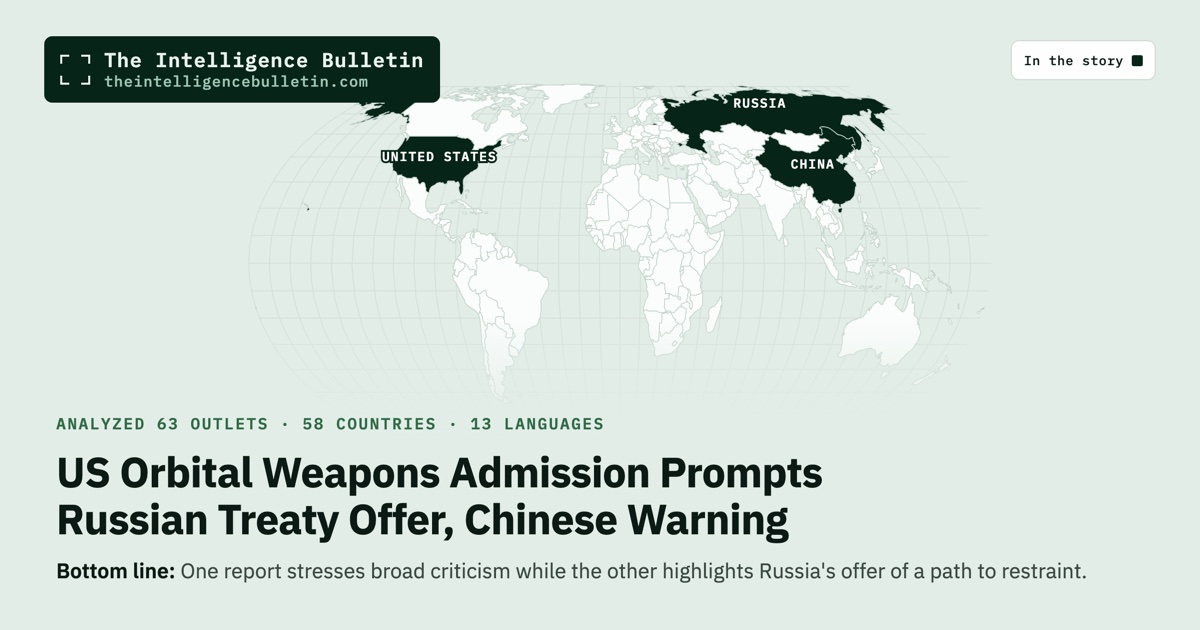
US Orbital Weapons Admission Prompts Russian Treaty Offer, Chinese Warning

Map of the countries in the story: US Orbital Weapons Admission Prompts Russian Treaty Offer, Chinese Warning
The United States announced it has deployed on-orbit space control weapons capable of defending against adversary action. US Air Force Secretary Troy Meink made the statement, with prior references to Space Force operations. Russia responded through Deputy Foreign Minister Sergei Ryabkov that time remains to negotiate a binding treaty banning offensive space weapons. China called on the US to halt military expansion in space and uphold strategic stability.

One Story. Many Angles.

🇬🇧
United Kingdom
The UK News
Carries Xinhua reporting
Roundup: U.S. faces global criticism after deploying weapons in space
Read →
🇱🇺
Luxembourg
Chronicle.lu
Carries Reuters reporting
Russia Says There is Still Time to Stop Arms Race in Space After US Orbital Weapons Admission
Read →
2 sources · each independently reported
Analyzed 63 outlets across 58 countries and 13 languages
In Brief

One report stresses broad criticism while the other highlights Russia’s offer of a path to restraint.

The two available reports, one from Xinhua and one from Reuters, converge on the core fact of the US admission but diverge sharply in framing. Xinhua weaves the announcement into a narrative of immediate global backlash, quoting Russian and Chinese officials alongside academic voices warning of treaty erosion and debris risks. Reuters centers the Russian diplomatic reply, presenting Moscow as offering a path to de-escalation through new negotiations even while noting the lack of prior notification. This contrast reveals how the same admission travels differently: one account stresses widespread condemnation and long-term instability, the other preserves space for dialogue. Neither report includes direct US elaboration beyond the initial statement, leaving the selected coverage to emphasize external reactions over domestic context. The pattern shows that even limited source sets can surface distinct national emphases on whether the development closes or opens diplomatic options.

Perspective Analysis

The United States announced on September 16 that it has placed weapons in orbit. Air Force Secretary Troy Meink stated that the Pentagon now fields on-orbit space control weapons capable of defending the Joint Force against hostile adversary action. He gave no details on the weapons’ design or targets. The admission followed earlier remarks by Space Force leaders about contesting and controlling the domain, including orbital and electromagnetic warfare. President Donald Trump, who created the Space Force as a separate service in 2019, has directed further steps including space-based interceptors and the Golden Dome missile defense system whose orbital elements the Congressional Budget Office has projected could cost up to 542 billion dollars over twenty years.

Two wire services carried the story on September 17. One account assembled the announcement with statements from Russia and China plus commentary from outside experts. The other account centered a Russian official’s response and his call for new treaty talks. The UK News published the first version under the headline “Roundup: U.S. faces global criticism after deploying weapons in space.” It opened with the Meink statement and then moved directly to warnings from Moscow and Beijing. Chronicle.lu published the second version under the headline “Russia Says There is Still Time to Stop Arms Race in Space After US Orbital Weapons Admission.” It led with Deputy Foreign Minister Sergei Ryabkov’s press briefing in Moscow and placed the US admission in the second paragraph.

The Xinhua dispatch carried by The UK News quoted Russian Foreign Ministry spokeswoman Maria Zakharova saying Washington was ready to ignore the catastrophic consequences for humanity of any armed conflict in orbit. It added Chinese Foreign Ministry spokesperson Guo Jiakun urging the United States to stop expanding its military build-up in outer space and to uphold global strategic stability with concrete actions. The same dispatch included remarks from astronomer Jonathan McDowell, who told The Guardian that Washington had already launched satellites with secret payloads and appeared to treat conflict in space as normalized. It also quoted Lemmy Nyongesa Mulaku of the University of Nairobi, who said the deployment undermined the 1967 Outer Space Treaty and raised risks of orbital debris, interference with civilian networks, and erosion of trust in international agreements. The piece placed these voices after the US statement and before any further context, producing a sequence that presented the announcement as immediately and widely opposed.

The Reuters dispatch carried by Chronicle.lu quoted Ryabkov saying the United States had not notified Russia in advance but that the development was unsurprising because Moscow had long monitored such activities. Ryabkov stated that it was not yet too late to create conditions that would preclude an arms race and that a legally binding treaty banning the deployment of offensive weapons in space remained achievable. The dispatch noted that the United States and its Western partners had for years offered what Moscow called inflammatory excuses to avoid such negotiations. It framed the Russian position as an ongoing diplomatic offer rather than a reaction of alarm.

Neither published article added reporting beyond the wire copy it carried. The UK News version stayed within the Xinhua text, including its selection of expert and official voices. Chronicle.lu stayed within the Reuters text, including its focus on Ryabkov’s remarks about notification and treaty prospects. No local Luxembourg or British context appeared in either piece. The stories sat in the international sections of both sites with no visible indication that either newsroom had verified details or sought additional comment.

The two mastheads therefore performed different editorial acts on separate agency accounts of the same announcement. One chose to foreground a collection of critical statements from major powers and academic observers. The other chose to foreground a single power’s offer to negotiate. The difference is visible in the headlines and in the order of paragraphs. A reader who saw only the first version would encounter the event as a development already producing coordinated international objections. A reader who saw only the second would encounter it as a development that still leaves room for a treaty process Moscow continues to propose.

The Xinhua account supplies the broader set of reactions that exist in the record. It records statements from both Russia and China and adds the specific concerns raised by the two named experts about treaty interpretation and debris hazards. The Reuters account supplies the precise wording of the Russian proposal for a new legally binding instrument and the claim that Western skepticism has blocked progress for years. Those elements do not contradict each other; they address different aspects of the same set of statements. The absence of any US elaboration beyond the initial Meink sentence in either account leaves the external reactions as the only developed material available in these reports.

What to Watch

What follows depends on whether governments treat the admission as the closing of a door or the opening of one. The record shows one power offering a treaty path and another power issuing a direct call to halt further expansion. Those positions now sit in public view through the two wires. Readers can weigh which framing each masthead selected and what that selection foregrounds about the next diplomatic moves.


Share this story

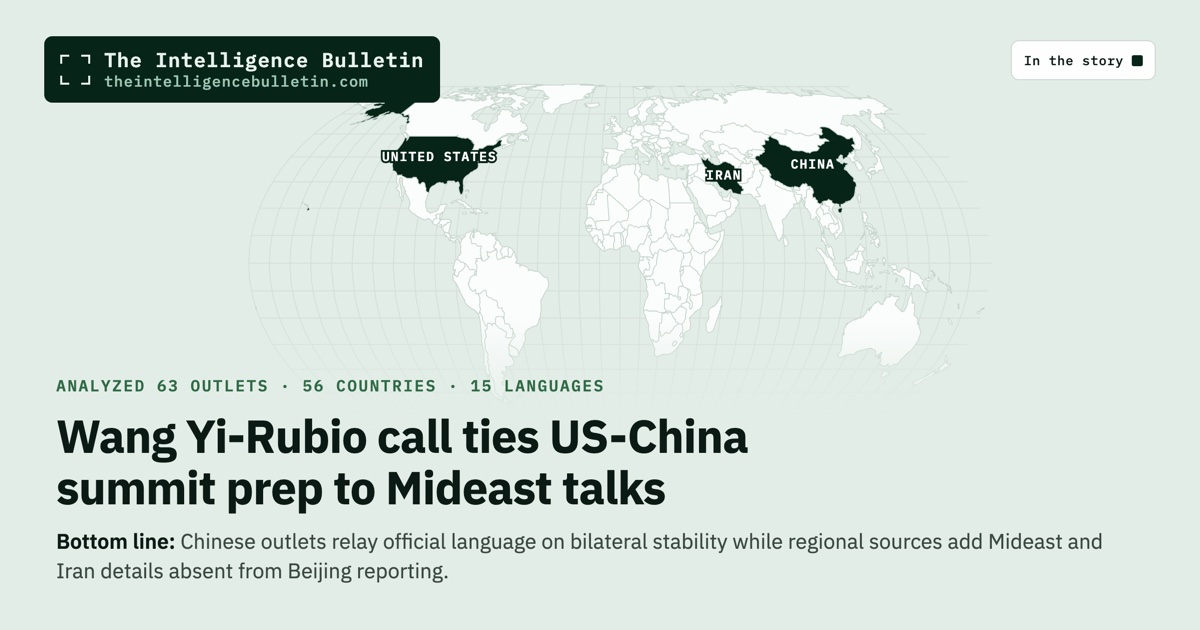
Wang Yi-Rubio call ties US-China summit prep to Mideast talks

Map of the countries in the story: Wang Yi-Rubio call ties US-China summit prep to Mideast talks
Chinese Foreign Minister Wang Yi spoke by phone with US Secretary of State Marco Rubio on September 17, 2026. They addressed preparations for high-level exchanges and the Middle East situation. The call occurred one day after Wang met Iran’s foreign minister in Beijing and one week before Xi Jinping’s planned visit to the United States for a summit with Donald Trump. Chinese state media and regional outlets reported the diplomats’ emphasis on equality and mutual respect in bilateral ties.

One Story. Many Angles.

🇭🇰
Hong Kong
South China Morning Post
Original reporting
Breaking | China’s Wang Yi holds phone call with Rubio days before Xi visits US
Read →
🇨🇳
China
Global Times
Xinhua wire copy
Chinese FM holds phone talks with Rubio on high-level interactions; phone call reflects ‘shared resolve’ to stabilize ties: expert
Read →
🇦🇿
Azerbaijan
APA
Carries Xinhua reporting
China’s Wang Yi, US’ Rubio discuss Mideast situation after Beijing trip by Iran’s Araghchi
Read →
🇵🇰
Pakistan
Pakistan Today
Carries Xinhua reporting
Chinese FM Wang Yi holds phone talks with Rubio
Read →
🇦🇷
Argentina
Infobae
SPANISH
Carries Xinhua reporting
Days before the Trump-Xi summit, Marco Rubio spoke with the Chinese chancellor about the situation in the Middle East
“A días de la cumbre Trump-Xi, Marco Rubio habló con el canciller chino sobre la situación en Medio Oriente”
Read →
5 sources · 2 independent accounts — some share the same news agency’s report
Analyzed 63 outlets across 56 countries and 15 languages
In Brief

Chinese outlets relay official language on bilateral stability while regional sources add Mideast and Iran details absent from Beijing reporting.

The selected outlets converge on the call’s timing and core message from Beijing but diverge sharply in emphasis. Chinese-sourced accounts from Global Times and Pakistan Today stay tightly within official Xinhua language, stressing constructive stability and head-of-state diplomacy without naming the Middle East. SCMP adds the practical expectation that the call locked down summit logistics. In contrast, APA and Infobae foreground the Mideast dimension, linking the call directly to Wang’s meeting with Iran’s Araghchi the previous day and quoting Beijing’s calls for restraint, revival of the Islamabad Memorandum, and reopening the Strait of Hormuz. This regional lens is absent from the Chinese outlets, revealing how proximity to Iran shapes coverage choices. No outlet reports US statements or Rubio’s side of the conversation, leaving the narrative anchored in Chinese framing even as non-Asian sources expand its scope to energy security and regional mediation. The pattern shows a single originating Chinese account being relayed or reframed according to each outlet’s geographic stakes rather than independent verification.

Perspective Analysis

The phone call between Chinese Foreign Minister Wang Yi and US Secretary of State Marco Rubio took place on September 17, 2026. Every published account of the conversation traces to the same originating dispatch from Xinhua or parallel statements issued by Chinese officials. The report described an in-depth exchange focused on high-level interactions between the two countries. Wang, also a member of the Political Bureau of the Communist Party of China Central Committee, told Rubio that relations had generally moved along the track of constructive strategic stability set by the heads of state. He said head-of-state diplomacy served as the anchor for the relationship and that both sides should prepare for the next stage of exchanges in a spirit of equality, mutual respect and mutual benefit. The two sides should strengthen communication, advance cooperation, manage differences, respect each other’s core interests and send a positive message that China and the United States remain committed to a constructive bilateral relationship of strategic stability while jointly promoting world peace and development. Several accounts added that the diplomats exchanged views on the Middle East situation.

The call came one day after Wang hosted Iranian Foreign Minister Abbas Araghchi in Beijing. In that earlier meeting Wang urged Iran and the United States to act with rationality and restraint, return to the Islamabad Memorandum of Understanding and reopen the Strait of Hormuz as soon as possible. He said China did not wish to see regional tensions spread further toward Yemen and the Red Sea and that the existing security architecture in the Middle East required reform. The Rubio call occurred one week before Chinese President Xi Jinping’s planned visit to the United States for a summit with President Donald Trump. Chinese reporting placed the conversation in the context of final preparations for that meeting.

Global Times carried the dispatch almost verbatim under the headline “Chinese FM holds phone talks with Rubio on high-level interactions.” The article ran to a single paragraph and attributed the information directly to Xinhua. It contained no additional context, no mention of the Middle East and no reference to the upcoming summit. The piece functioned as a straight transmission of the official Chinese statement.

Pakistan Today expanded the same material into a longer article that quoted Wang at length on constructive strategic stability, head-of-state diplomacy and the need to respect core interests. The outlet added a separate item on Chinese and US trade teams maintaining contact over tariff reductions, drawn from a Ministry of Commerce spokesperson. The story appeared under the headline “Chinese FM Wang Yi holds phone talks with Rubio on high-level interactions” and framed the conversation as evidence that bilateral ties were advancing in line with the expectations of the international community. It did not highlight the Middle East exchange.

South China Morning Post opened with a breaking-news headline that foregrounded the timing: “Breaking | China’s Wang Yi holds phone call with Rubio days before Xi visits US.” The article noted that the call was expected to have locked down final details for Xi’s first US state visit in more than a decade and recalled a similar preparatory call two weeks before Trump’s earlier trip to China. It stayed close to the Xinhua wording on high-level exchanges while adding the practical observation that the conversation likely advanced summit logistics.

APA placed the call in explicit connection with Araghchi’s Beijing visit the previous day. Its headline read “China’s Wang Yi, US’ Rubio discuss Mideast situation after Beijing trip by Iran’s Araghchi.” The article quoted Wang’s remarks on equality and mutual respect, then linked them to his earlier statements urging restraint between Iran and the United States and the reopening of the Strait of Hormuz. It noted the call came ahead of the planned Trump-Xi meeting in Washington the following week.

Infobae, writing in Spanish, led with the Middle East focus under the headline “A días de la cumbre Trump-Xi, Marco Rubio habló con el canciller chino sobre la situación en Medio Oriente.” The article detailed Wang’s calls for rationality and restraint, revival of the Islamabad Memorandum and reopening of the Strait of Hormuz. It added that Trump planned to receive Xi personally at Joint Base Andrews, an arrangement reported by AFP and described as unusual within Trump’s normal protocol. The piece situated the phone call within China’s broader mediation efforts in the region and noted the summit would address commerce, security and other bilateral issues.

No outlet published any statement from Rubio or from any US government source. The narrative therefore rests entirely on the Chinese account of what was said and why it mattered. The outlets that added independent material did so by layering regional context onto the shared dispatch rather than by introducing new reporting on the call itself. APA and Infobae drew on the same Chinese statements about Iran and energy routes that appeared in the Araghchi meeting record. South China Morning Post supplied the summit-logistics expectation that is absent from the strictly official Chinese versions. Pakistan Today inserted the parallel trade-team item that sits outside the diplomatic call.

What to Watch

The pattern shows how a single originating text is adapted according to each publication’s audience and geographic position. Outlets closer to the Middle East or energy routes foregrounded those elements even though they originated in the same Chinese statements. Outlets positioned as international or South Asian carriers stayed closer to the bilateral-stability language. The absence of any countervailing US account leaves readers dependent on Beijing’s description of both the content and the significance of the exchange. What changes across the five versions is therefore not the underlying facts but the frame each masthead chose to place around the same set of Chinese remarks.


Share this story

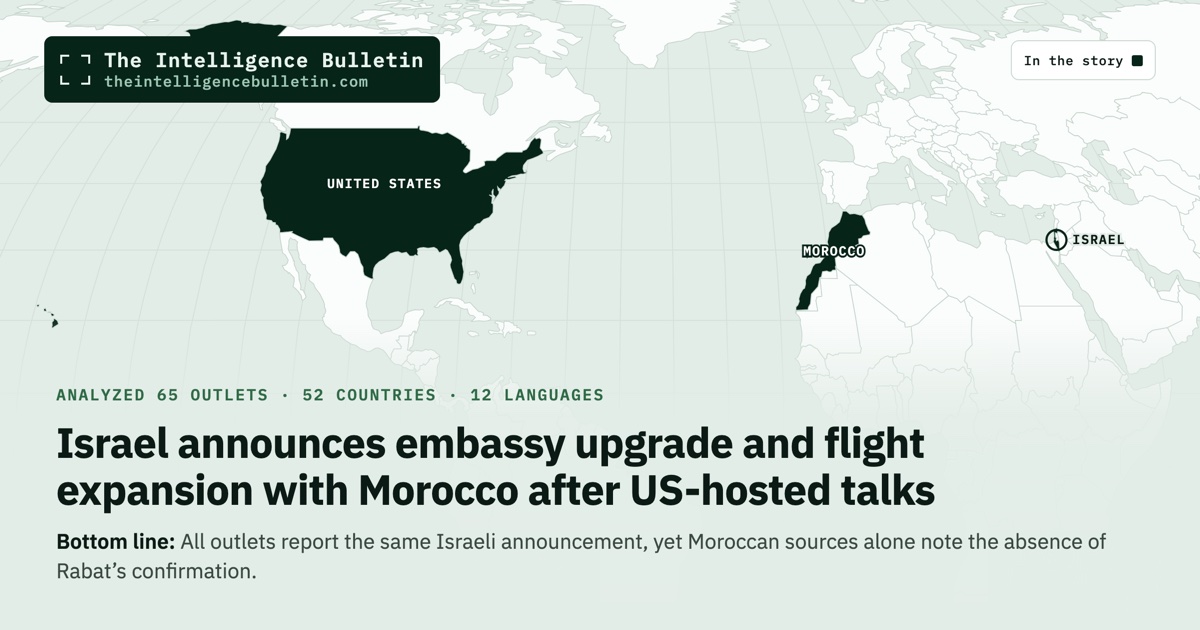
Israel announces embassy upgrade and flight expansion with Morocco after US-hosted talks

Map of the countries in the story: Israel announces embassy upgrade and flight expansion with Morocco after US-hosted talks
Israel announced that it and Morocco agreed during a trilateral New York meeting hosted by US Ambassador Mike Waltz to elevate liaison offices to full embassies and appoint ambassadors. The steps also include expanding direct flights to include Moroccan airlines and completing investment and tax agreements by the end of 2026. The move builds on 2020 normalization. Morocco has not yet confirmed the announcement publicly.

One Story. Many Angles.

🇲🇦
Morocco
Morocco World News
Original reporting
Israel Says it Agrees with Morocco to Upgrade Ties, Appoint Ambassadors
Read →
🇮🇱
Israel
Ynet News
Original reporting
Israel, Morocco agree to upgrade ties, open embassies
Read →
🇦🇪
United Arab Emirates
The National
Original reporting
Israel and Morocco agree to upgrade diplomatic ties
Read →
🇶🇦
Qatar
Al Jazeera
Original reporting
Israel and Morocco agree to open embassies, upgrading diplomatic ties
Read →
🇬🇧
United Kingdom
BBC Arabic
ARABIC
Carries Israeli Foreign Ministry reporting
Israel and Morocco agree under American sponsorship on “raising the level of diplomatic representation”
“إسرائيل والمغرب تتفقان برعاية أمريكية على “رفع مستوى التمثيل الدبلوماسي””
Read →
5 sources · each independently reported
Analyzed 65 outlets across 52 countries and 12 languages
In Brief

All outlets report the same Israeli announcement, yet Moroccan sources alone note the absence of Rabat’s confirmation.

Every account traces the announcement to an Israeli government statement after Foreign Minister Gideon Sa’ar met Moroccan counterpart Nasser Bourita in New York under US Ambassador Mike Waltz. The same practical steps appear across all five reports: embassy-level missions, expanded flights, two economic pacts by December 2026, and reciprocal high-level visits. The joint statement also reiterates US and Israeli support for Morocco’s claim to Western Sahara. What differs is framing and emphasis. Moroccan World News notes the lack of Moroccan confirmation and recalls Rabat’s public stance on Palestine. Ynet centers Israeli statements on security cooperation and Abraham Accords continuity. The National presents the upgrade as proof the Accords have endured. Al Jazeera records the US sponsorship and places the move inside the wider Arab-Israeli normalization picture. BBC Arabic stays closest to the Israeli text while adding neutral historical context. No outlet reports Moroccan confirmation or Palestinian reaction to the new steps, leaving the story as an Israeli-initiated update whose regional reception remains untested in these accounts.

Perspective Analysis

Israel announced on September 16 that its foreign minister Gideon Sa’ar had met Moroccan foreign minister Nasser Bourita in New York the same day in a meeting hosted by US ambassador to the United Nations Mike Waltz. According to the Israeli statement, the three sides agreed to upgrade their existing liaison offices to full embassies and appoint ambassadors. They also committed to expanding direct flights between the two countries to include services operated by Moroccan airlines and to finalize two agreements on investment protection and the prevention of double taxation by the end of 2026. The same statement recorded that the United States and Israel reaffirmed their support for Morocco’s sovereignty over Western Sahara and described the autonomy plan as the only credible basis for resolving the dispute.

The announcement revives a relationship first restored in December 2020. At that time the United States recognized Moroccan sovereignty over Western Sahara in exchange for Morocco’s decision to resume formal ties with Israel. The 2020 joint declaration had already called for full diplomatic relations, direct flights and expanded economic cooperation. Since then the two countries have maintained liaison offices rather than full embassies, and direct flights have been limited. The new steps would complete the original 2020 framework by converting those offices into embassies and broadening air links.

Every one of the five reports published the same list of practical measures drawn from the Israeli government statement. Morocco World News, Ynet News, The National, Al Jazeera and BBC Arabic all recorded the elevation of missions, the appointment of ambassadors, the addition of Moroccan airline flights and the two economic agreements due by December 2026. They also all noted that the meeting took place under US auspices in New York and that the joint statement praised the United States, with some accounts naming President Donald Trump for his earlier role. The only factual detail that appeared in two of the five accounts but not the others was the absence of any public confirmation from the Moroccan side at the time of publication.

The accounts diverge in how they situate the announcement inside larger regional questions. Morocco World News alone reported that Morocco has repeatedly condemned Israeli actions in Gaza and continues to call for a two-state solution with East Jerusalem as the Palestinian capital. It framed the upgrade as advancing Moroccan strategic interests while observing that re-establishment of relations in 2020 had already sparked domestic protests. Ynet News, by contrast, quoted Sa’ar directly on the historical friendship between the Moroccan and Jewish peoples and presented the steps as practical measures to deepen security and economic ties within the Abraham Accords process. The National described the meeting as further evidence that the Accords have withstood tests and quoted US ambassador Waltz saying the naysayers had been proved wrong. Al Jazeera placed the upgrade inside the wider set of Arab-Israeli normalizations that began in 2020 and noted Palestinian leaders’ earlier concerns that such deals could weaken the linkage between normalization and territorial withdrawal. BBC Arabic relayed the Israeli text most closely, adding only the historical background of the 2020 declaration and the US recognition of Moroccan sovereignty over Western Sahara.

No report contained Moroccan confirmation of the new steps or any reaction from Palestinian officials to the latest announcement. The five outlets therefore left the story as an Israeli-initiated update whose reception inside Morocco or among other Arab governments remained outside the published record. The convergence on the core Israeli statement is itself notable: five outlets operating from different national bases all treated the same foreign ministry release as the authoritative account of what had been agreed.

The reporting shows that the substance of the upgrade rests entirely on one primary document, the Israeli government statement issued after the New York meeting. That statement supplies the specific commitments on embassies, flights and economic pacts, and it is the only source cited across the five accounts. The joint reference to Western Sahara sovereignty appears in the same document and is carried by the two outlets that reproduced the full statement language. The absence of Moroccan confirmation is a factual observation made by the two outlets that checked for it. These details are therefore the parts of the story that can be treated as settled on the basis of the published record.

The variation in framing reflects the different national vantage points of the outlets rather than any disagreement over what was announced. An Israeli reader following only Ynet would see the upgrade primarily as continuity of the Abraham Accords and security cooperation. A Moroccan reader following only Morocco World News would see it as a bilateral diplomatic gain whose domestic political costs remain relevant. A reader relying on The National would register it as validation of a regional normalization project. None of these emphases contradicts the others on the concrete steps; they simply foreground different consequences. The common thread is that the upgrade is presented as an incremental completion of the 2020 arrangement rather than a fresh departure.

What to Watch

The most reliable account of what actually occurred is therefore the one that stays closest to the single Israeli government statement and records the two points where coverage is incomplete: the lack of Moroccan confirmation and the absence of any reported reaction from Palestinian actors. Future developments will turn on whether Morocco issues its own statement accepting the embassy upgrade and flight expansion, and on whether the planned economic agreements are signed by the December 2026 deadline. Those two milestones will determine whether the New York meeting produces the full set of changes described in the Israeli text or remains a declaration without immediate follow-through.


Share this story

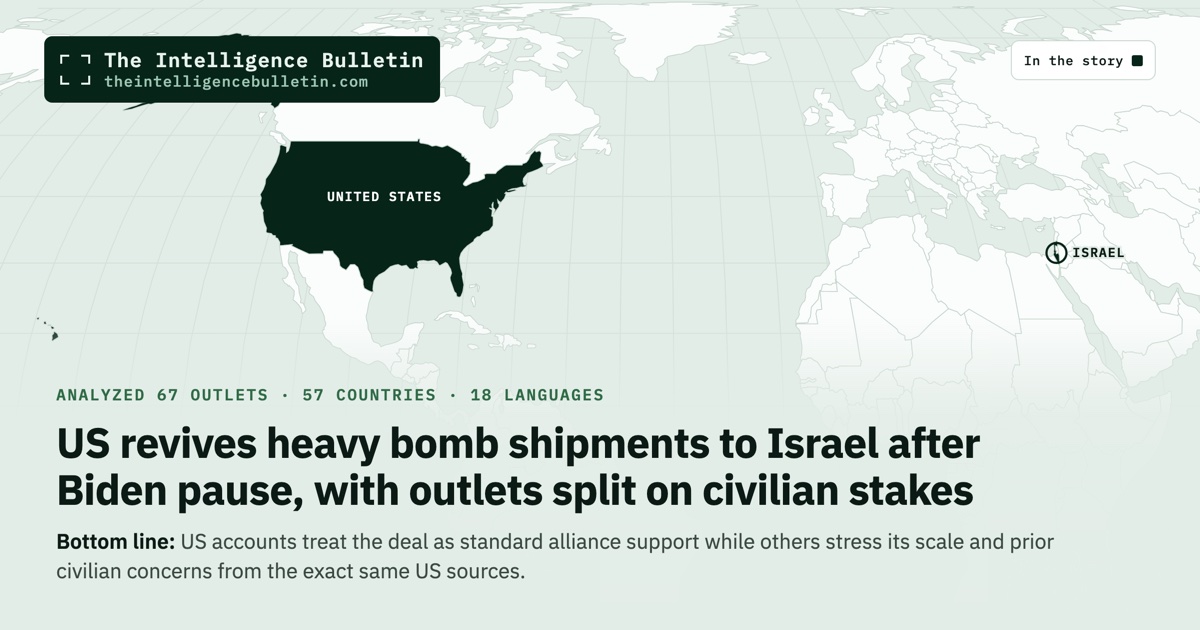
US revives heavy bomb shipments to Israel after Biden pause, with outlets split on civilian stakes

Map of the countries in the story: US revives heavy bomb shipments to Israel after Biden pause, with outlets split on civilian stakes
The Trump administration is preparing a $2.8 billion arms package for Israel that includes 40,000 2,000-pound bombs, split between Mk-84 and BLU-117 variants. The deal revives shipments previously paused by the Biden administration over concerns about civilian casualties in Gaza. Funding would come largely through US foreign military financing. Israel continues limited strikes in Gaza under a fragile ceasefire following the October 2023 Hamas attack.

One Story. Many Angles.

🇺🇸
United States
10news
Carries AP reporting
US plans major bomb shipment to Israel amid ongoing strikes in Gaza
Read →
🇸🇦
Saudi Arabia
Okaz
ARABIC
Carries Washington Post reporting
Military deal worth billions of dollars.. Trump intends to supply thousands of heavy bombs to Israel
“صفقة عسكرية بمليارات الدولارات.. ترمب يعتزم توريد آلاف القنابل الثقيلة لإسرائيل”
Read →
🇮🇩
Indonesia
Republika
INDONESIAN
Carries Washington Post reporting
US to supply 40 thousand killer bombs for Gaza residents to Israel
“AS Bakal Pasok 40 Ribu Bom Pembunuh Warga Gaza untuk Israel”
Read →
🇬🇷
Greece
Banking News
Carries Washington Post reporting
“They are preparing mass extinction” – What lies behind the shipment of 60,000 907-kg bombs to Israel – US shock in the Middle East
Read →
4 sources · 2 independent accounts — some share the same news agency’s report
Analyzed 67 outlets across 57 countries and 18 languages
In Brief

US accounts treat the deal as standard alliance support while others stress its scale and prior civilian concerns from the exact same US sources.

US reporting presents the shipment as a continuation of routine military support under Trump, with the package still pending final approval and informal congressional notification already made. Saudi coverage closely tracks the same US official accounts but situates the deal within Israel’s ongoing isolation and the destruction documented by Palestinian and UN sources. Indonesian reporting adopts more direct language linking the specific bomb types to prior use in densely populated areas and resulting high casualties. Greek financial coverage frames the quantities as comparable to major World War II raids and questions the strategic purpose at a time of depleted US stockpiles and regional tensions. All four accounts ultimately trace back to the same Washington Post-sourced details on numbers, variants and the Biden-era pause that Trump lifted, with differences arising in emphasis rather than disputed facts. The absence of independent verification chains beyond US officials leaves the scale and timing open to the interpretive lenses each outlet applies.

Perspective Analysis

The Trump administration is preparing to supply Israel with a $2.8 billion arms package centered on 40,000 two-thousand-pound bombs. The shipment revives a category of munitions that the prior administration had held back because of worries over their effects in crowded civilian areas. Every published account of the plan traces to the same set of details first reported by the Washington Post from two U.S. officials and one additional person familiar with the proposal. The package remains unfinalized, though Congress has received informal notice and the bulk of the cost would be covered through the Foreign Military Financing program that channels U.S. taxpayer funds to Israel for American-made weapons.

The core facts are consistent across the four outlets examined. The load would consist of 20,000 Mk-84 bombs and 20,000 BLU-117 bombs, each weighing roughly 2,000 pounds or 907 kilograms. Some variants are designed to penetrate hardened underground targets while others detonate above ground and produce wide blast and fragmentation effects. The deal follows earlier Trump-era approvals that bypassed standard congressional review and included more than 35,500 similar bombs in one transaction and an additional $6.67 billion in arms sales the following January. Israel continues to conduct limited strikes inside Gaza even after a fragile ceasefire took hold last October, with militants carrying out attacks on Israeli troops and Israel responding to what it describes as violations.

The 10news account presents the shipment in strictly procedural terms. It records the numbers, the funding mechanism, the Biden-era pause that Trump lifted upon returning to office, and the context of a continuing though reduced tempo of Israeli operations in Gaza. The piece notes that experts have linked past U.S.-made two-thousand-pound bombs to strikes on tunnel networks that also produced civilian deaths in densely built areas, yet it stops at that observation without further framing. The emphasis remains on alliance continuity and the incremental steps the current administration has taken to strengthen Israeli military capacity.

Okaz reproduces the identical U.S. official details but situates them inside a longer account of Israeli isolation and the scale of destruction already inflicted on Gaza. It cites Palestinian and United Nations reporting on tens of thousands of Palestinian deaths and widespread damage to the enclave. The Saudi outlet also recalls the New York Times account of Israeli use of Mk-84 bombs in zones previously designated safe for civilians and quotes a Washington Post interview with a former U.S. ordnance technician who described the weapons leveling entire buildings. The added passages keep the original numbers and sequence intact while supplying the regional backdrop that the originating dispatch left implicit.

Republika foregrounds the human cost in its headline and lead paragraphs. It labels the munitions “killer bombs for Gaza residents” and states that the same Mk-84 and BLU-117 types have already been used repeatedly during operations described as genocide in the strip. The Indonesian outlet adds that international agencies, journalists, and human-rights groups documented strikes on densely populated neighborhoods that produced massive casualties. It retains the precise breakdown of 20,000 of each variant and the $2.8 billion price tag, yet the language and placement make the prior battlefield record the dominant element of the story.

Banking News expands the quantity to 60,000 bombs by including an additional 20,000 I-2000 penetrator warheads and then compares the total tonnage to the weight of bombs dropped on Berlin across the entire Second World War or to one-third of the tonnage dropped on the main Japanese islands. The Greek financial outlet questions why Israel would require such volumes at a moment when U.S. stockpiles are described as depleted by its own operations and by support for Ukraine. It notes the extreme temperatures generated by certain variants and records claims that some munitions have produced effects consistent with thermal or thermobaric weapons, citing Al Jazeera reporting on bodies described as vaporized. The piece retains the original U.S. official sourcing but layers strategic and historical comparisons absent from the other three accounts.

Because every outlet works from the identical Washington Post dispatch, differences appear only in selection and emphasis. The U.S. version stays closest to the narrow procedural record. The Saudi version supplies the immediate regional consequences already documented by Palestinian and international sources. The Indonesian version elevates the documented civilian toll into the headline and opening sentences. The Greek version supplies scale comparisons and forward-looking questions about purpose and stockpiles. None of the four adds independent sourcing on the current shipment itself; all four relay the same anonymous U.S. officials and the same prior reporting on battlefield use.

What to Watch

The single-chain origin means readers of any one outlet receive the same underlying numbers and timeline but encounter sharply different impressions of what the shipment signifies. The procedural framing leaves the impression of continuity in alliance management. The regional and casualty-focused framings leave the impression of renewed material support for operations already criticized on humanitarian grounds. The tonnage and historical comparisons leave the impression of an outsized commitment whose purpose is not fully explained by current operations in Gaza. Each reading is internally consistent with the shared facts, yet the choice of what to foreground alters the apparent stakes. The absence of any second, independent reporting chain on the pending package leaves those interpretive choices as the only variation available to readers.


Share this story