US destroys two Iranian boats after they tried to seize a Navy drone in Hormuz

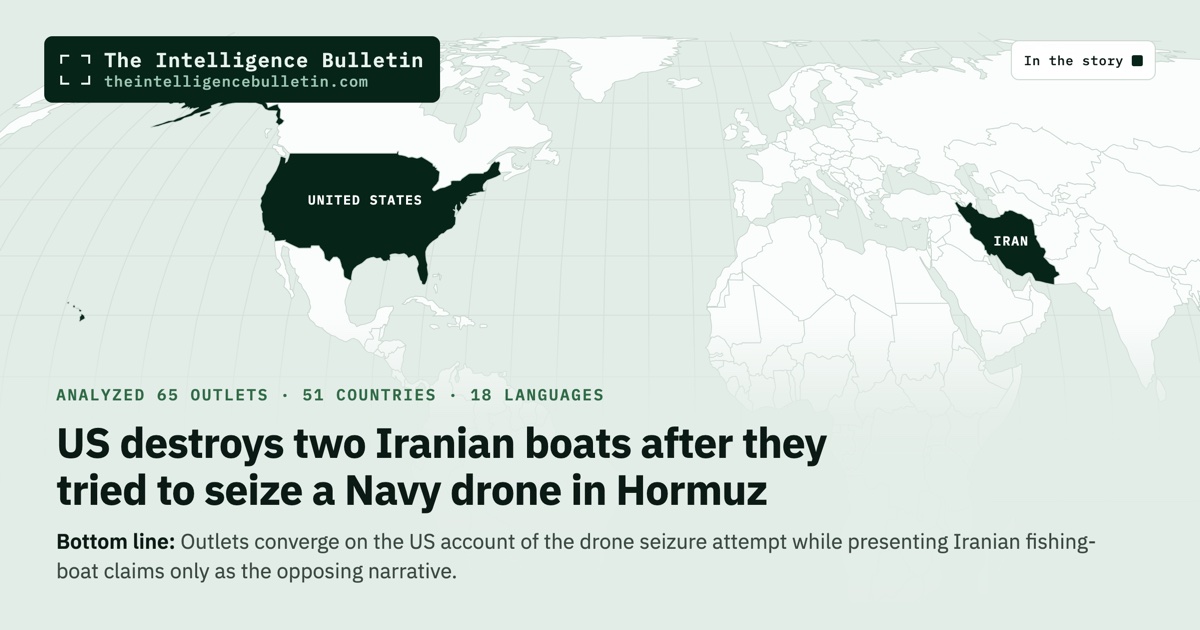
Map of the countries in the story: US destroys two Iranian boats after they tried to seize a Navy drone in Hormuz
US Central Command said it destroyed two small Iranian boats after they tried to seize a US Saildrone surface vessel in the Strait of Hormuz. Iranian state media reported attacks on fishing boats near Kargan and Larak Island, with fishermen missing. The incident occurred amid a months-long conflict over control of the strait and global energy routes.

One Story. Many Angles.

🇺🇸
United States
Zero Hedge
Original reporting
Hormuz: Rare US Strike On Iranian ‘Small Boats’ Caught Trying To Seize Surface Drone
Read →
🇮🇳
India
The Economic Times
Carries AP reporting
US military says it destroyed 2 small Iranian boats trying to steal a sea drone
Read →
🇲🇽
Mexico
Net Noticias
SPANISH
Carries AP reporting
US destroys two Iranian boats after attempt to capture marine drone
“EU destruye dos lanchas iraníes tras intento de capturar un dron marino”
Read →
🇮🇳
India
Patrika
HINDI
Carries Axios reporting
Tension peaks in Hormuz Strait – America blew up two Iranian boats, attempt to seize drone failed
“होर्मुज जलडमरूमध्य में तनाव चरम पर- अमेरिका ने उड़ाईं ईरान की दो नावें, ड्रोन जब्त करने की कोशिश नाकाम | Us Destroys Iranian Boats Hormuz Drone Seizure Attempt”
Read →
4 sources · 3 independent accounts — some share the same news agency’s report
Analyzed 65 outlets across 51 countries and 18 languages
In Brief

Outlets converge on the US account of the drone seizure attempt while presenting Iranian fishing-boat claims only as the opposing narrative.

All four outlets relay the same core US military account of Iranian boats attempting to capture a Saildrone, drawn from CENTCOM spokesman Capt. Tim Hawkins and Axios reporting, while noting Iranian claims of attacks on fishing vessels that left fishermen missing. The US-framed outlets emphasize the failed seizure and successful defense, with Zero Hedge adding video context and competing claims. Indian coverage in The Economic Times widens to oil market pressure and Houthi attacks on Saudi routes, reflecting importer stakes, while Patrika stresses the failed Iranian attempt in a Hindi domestic lens. Mexican Net Noticias follows the AP wire closely but frames the clash within the broader US-Israel-Iran war and notes political costs for Trump ahead of midterms. No outlet provides independent verification or Iranian military statements beyond state media summaries; the selected sources converge on the US version as the originating claim, with Iranian accounts presented only as contrast. The absence of direct Iranian or regional Gulf voices in the set leaves the seizure motive and casualties as single-chain assertions from US officials.

Perspective Analysis

US forces destroyed two small Iranian boats in waters off Iran after the vessels attempted to seize a US unmanned surface vessel, according to a statement from US Central Command spokesman Capt. Tim Hawkins. The incident took place in the Strait of Hormuz, a narrow waterway through which roughly 14 million barrels of crude oil pass daily on average. Hawkins described the boats as having tried to take possession of a Saildrone, a roughly 25-foot craft used for maritime surveillance, and said the attempt failed after US forces responded forcefully. An American drone fired two missiles at the boats, destroying them and killing most of those on board, according to the account relayed through Axios and carried by multiple outlets.

Iranian state media presented a different description of the same clash. Provincial official Ahmad Nafisi told Iran’s semi-official Mehr News Agency that two fishing boats came under attack from what he called an “enemy drone” in the Persian Gulf near the port city of Kargan and Larak Island in Hormozgan province. Several fishermen were reported missing, and search-and-rescue operations were underway, the reports said. Iranian coverage made no reference to any attempt to seize a US surface drone.

The event sits inside a conflict that has lasted more than six months, with both sides contesting control of the Strait of Hormuz. US officials have said recent actions loosened Iran’s grip on the corridor. Iranian forces, for their part, have claimed successes against US drones in earlier episodes, including the reported capture of an underwater drone a week before this incident. In that prior case, US officials stated the device had malfunctioned and was an older model without sensitive equipment.

All four outlets in the selected coverage carried the US military account as the primary narrative and presented the Iranian fishing-boat reports only as the contrasting version. Zero Hedge quoted Hawkins directly and added that videos circulated on social media appeared to show damage to a surface drone, though it noted uncertainty whether those images depicted this specific event. The Economic Times, drawing from an AP dispatch, placed the clash in the context of rising oil prices driven by the wider fighting and by Houthi attacks on Saudi shipping routes in the Red Sea. Net Noticias relayed the same AP material in Spanish and noted the political pressure the conflict has placed on President Trump ahead of November midterm elections, including the nonpartisan Congressional Budget Office estimate that the Pentagon had already spent more than $38 billion through August 1. Patrika, in Hindi, highlighted the failed Iranian attempt and the resulting tension along the strait, citing both US officials and Mehr News Agency reports of missing fishermen.

The four pieces converge on the core sequence reported by US Central Command: two boats approached the Saildrone, US forces identified the approach as an attempted seizure, and the boats were destroyed. They also converge on the Iranian state media description of attacked fishing vessels and missing crew. No outlet in the set supplied independent verification of either account, nor did any carry statements from Iranian Revolutionary Guard Corps officials beyond the provincial fishing-boat reports. The Saildrone’s status as a commercially available surveillance craft that remains under US control appears only in the US military statements.

The absence of direct reporting from Iranian military sources or from outlets based in Gulf Arab states leaves the motive for the boat approach and the precise number of casualties as assertions resting on a single reporting chain. US officials have an institutional interest in framing the encounter as a defensive response to an attempted capture. Iranian state media have an institutional interest in presenting the victims as civilians engaged in fishing. Readers who encounter only the US-sourced version will receive a detailed operational account of the seizure attempt and the drone’s continued control. Readers who encounter only the Iranian-sourced version will receive details of missing fishermen and no mention of any drone-related intent. The selected coverage offers both descriptions side by side but does not resolve the contradiction.

What to Watch

The US account carries the greater weight for the narrow factual question of whether the boats attempted to seize the Saildrone, because it originates in an on-record statement from a named US Central Command spokesman and is corroborated across the four independent outlets that published it. The Iranian account, while consistent across the same outlets, rests on provincial rather than military sourcing and omits any reference to the drone. The next developments most likely to matter are whether additional video or wreckage evidence surfaces that could be examined by multiple parties, and whether either side escalates or de-escalates its operations in the strait in the coming days. Control of that corridor directly affects oil supply routes for importers far beyond the immediate combatants.
Share this story

EU proposes Canada as first associate member as Trump warns of tariffs

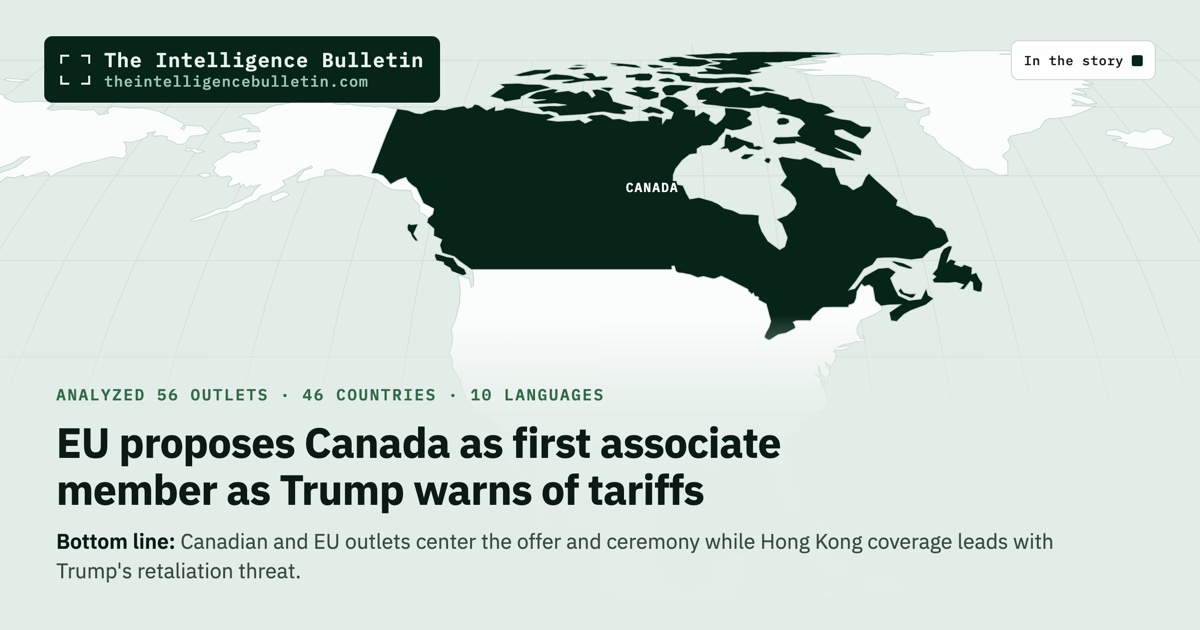
Map of the countries in the story: EU proposes Canada as first associate member as Trump warns of tariffs
European Commission President Ursula von der Leyen offered Canada the status of the EU’s first ‘associate member’ during her September 16 State of the Union speech in Strasbourg. Canadian Prime Minister Mark Carney attended and received a standing ovation as von der Leyen proposed deeper cooperation on defense, technology, energy and the Arctic. The move comes as both sides face trade frictions with the United States under President Donald Trump, who called the plan laughable and threatened tariffs or curtailed trade with Europe. Existing CETA trade ties and new defense pacts provide the foundation, though full EU membership remains barred by treaty geography.

One Story. Many Angles.

🇨🇦
Canada
Global News
Original reporting
EU wants Canada as its first ‘associate member,’ von der Leyen says – National
Read →
🇧🇪
Belgium
EUobserver
Original reporting
Canada’s Carney gets the red carpet treatment and EU ‘associate member’ offer – EUobserver
Read →
🇭🇰
Hong Kong
South China Morning Post
Carries Agence France-Presse reporting
Trump threatens EU over ‘hostile’ proposal to make Canada associate member
Read →
🇺🇦
Ukraine
Dzerkalo Tyzhnia
UKRAINIAN
Carries Reuters reporting
Canada can become an associate member of the EU – statement by Ursula von der Leyen
“Канада може стати асоційованим членом ЄС – заява Урсули фон дер Ляєн”
Read →
🇫🇷
France
Le Petit Journal
FRENCH
Carries AFP reporting
Ursula von der Leyen receives Mark Carney, to intensify EU-Canada rapprochement
“Ursula von der Leyen reçoit Mark Carney, pour intensifier le rapprochement UE-Canada”
Read →
5 sources · each independently reported
Analyzed 56 outlets across 46 countries and 10 languages
In Brief

Canadian and EU outlets center the offer and ceremony while Hong Kong coverage leads with Trump’s retaliation threat.

The reporting across these outlets shows a coordinated push by Brussels and Ottawa to deepen ties precisely because US policy under Trump has raised the cost of relying on Washington. Canadian coverage frames the associate status as a pragmatic hedge and economic opening for Ottawa. EU-focused reporting stresses the ceremonial welcome for Carney and the institutional novelty of the offer without spelling out budget or voting details. Hong Kong reporting instead leads with Trump’s immediate threat of tariffs, treating the proposal as a trigger for US retaliation. The Ukrainian outlet places the announcement in the broader context of EU strategic autonomy against both Washington and Beijing, noting historical EU resistance to flexible statuses even for Ukraine. French reporting, drawn from wire copy, keeps the focus on bilateral diplomatic warmth and shared projects. What unites the accounts is the absence of any concrete definition of ‘associate member’ rights or obligations; what divides them is whether the story is the offer itself or the American reaction to it. The pattern reveals how geography and existing alliances shape which element each national press treats as the central development.

Perspective Analysis

European Commission President Ursula von der Leyen stood before the European Parliament in Strasbourg on September 16 and told Canadian Prime Minister Mark Carney that she wanted to open the door for Canada to become the EU’s first associate member. Carney, the first non-European head of government to attend the annual State of the Union address, received a standing ovation. Von der Leyen described the step as moving the relationship from trade-based cooperation to a broader alliance, listing shared work on intelligent manufacturing, a technology alliance, integrated defense industrial bases, and the Arctic as a flagship joint project. She named energy, critical minerals, batteries, artificial intelligence, cyber security and economic security as further areas. The two sides already operate under the Comprehensive Economic and Trade Agreement, which has lifted goods and services trade by more than 80 percent since 2016, and Canada became the first non-EU country this year to join the EU’s flagship defense procurement loan program.

Von der Leyen framed the proposal as a response to fractures in the international rules-based system. She said the partnership was not directed against anyone else. Carney had told reporters in Toronto ahead of the visit that he sought a unique alliance with Brussels. The visit was positioned as preparation for an EU-Canada summit scheduled for Montreal at the end of October. Full membership remains impossible under the EU treaties because of geography, a point noted in both the Belgian and Hong Kong reporting.

Donald Trump, asked about the proposal the same day, called it laughable and said that if he viewed it as a hostile act he would impose very serious tariffs or stop trading with Europe on many things. He added that a good intention would be fine but a bad one would bring heavy tariffs. The South China Morning Post carried those statements directly. Other outlets recorded the same backdrop of Canadian and EU trade friction with the United States but did not quote Trump on the associate-member idea itself.

The Ukrainian outlet placed the announcement inside the EU’s wider effort to build strategic autonomy while facing pressure from both Washington and Beijing. It noted that the bloc had historically resisted flexible membership categories and that a similar associate-member idea floated earlier for Ukraine had met a cool response from member states. The French wire account, carried by the Paris-based expat publication, stressed the diplomatic warmth of the Carney visit and the practical work already under way on liquefied natural gas exports to Germany and Canadian artificial-intelligence investments in Europe. Canadian coverage presented the offer as a pragmatic opening for Ottawa at a moment when relations with Washington have grown strained.

No outlet supplied a concrete definition of what associate membership would entail. EUobserver reported that details on budget contributions or voting rights remained scarce and that talks would begin from an advanced level already set by the existing trade pact. The same piece recorded that the EU currently accounts for less than six percent of Canadian goods exports. Member states would still need to approve any new form of partnership, and several sources recorded that the precise contours of the status were not yet known even to lawmakers inside the parliament.

The accounts diverge most clearly on what they treat as the central development. The Canadian outlet foregrounds the opportunity for Ottawa to secure new economic and security partners. The Brussels-based outlet centers the ceremonial elements of Carney’s reception and the institutional innovation of the offer. The Hong Kong reporting leads with the American reaction and the risk of tariff retaliation. The Ukrainian account situates the move inside the EU’s long-running search for leverage against larger powers. The French account stays on the positive bilateral track and the practical projects already advancing.

These differences track the vantage of each outlet’s primary audience. A Canadian reader encounters the proposal as one more instrument in Ottawa’s effort to diversify away from a single large trading partner. A reader in Brussels sees an incremental expansion of the EU’s external toolkit. A reader in Hong Kong sees another data point in the widening contest between Washington and its traditional partners. A reader in Kyiv sees parallels to Ukraine’s own stalled path toward closer EU ties. The French account, drawn from agency copy, records the event as a routine strengthening of ties without foregrounding external friction.

The corroborated elements across the five independent reporting chains are the offer itself, the geographic bar on full membership, and the foundation already laid by the trade agreement and defense arrangements. The single-source element is the precise wording of Trump’s response. No reporting chain contradicts another on the basic sequence of events. The absence of any spelled-out content for associate membership appears in every account that addresses the mechanics, and that gap is consistent rather than contested.

What to Watch

The reporting therefore supports the view that Brussels and Ottawa are moving to lock in deeper cooperation while the cost of dependence on Washington remains elevated. The speed and depth of any follow-through will depend on whether member states convert the headline proposal into a workable framework before the Montreal summit. The Ukrainian reporting supplies the clearest reminder that the EU has resisted similar flexible statuses in the past when they risked diluting the core project or provoking larger external actors. That history suggests the associate-member idea will face scrutiny inside the bloc even before any American reaction is tested.


Share this story

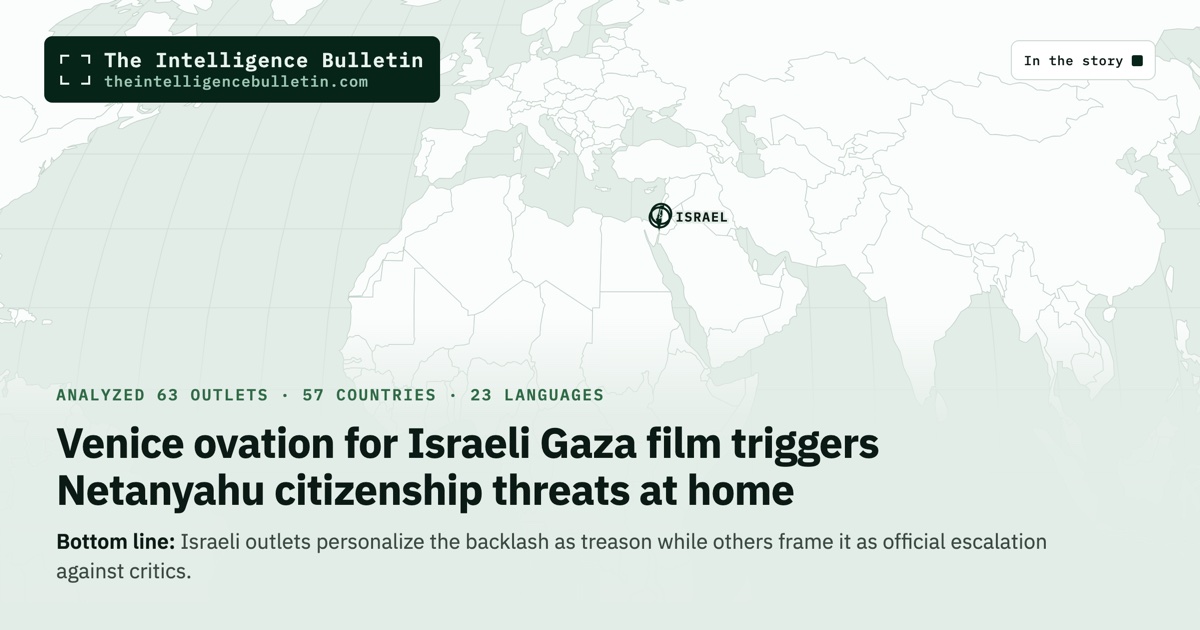
Venice ovation for Israeli Gaza film triggers Netanyahu citizenship threats at home

Map of the countries in the story: Venice ovation for Israeli Gaza film triggers Netanyahu citizenship threats at home
Israeli filmmakers Yuval Abraham and Rachel Szor premiered NAZA at the Venice Film Festival, where it received a record 25-minute standing ovation and the Special Jury Prize. The documentary, based on anonymous testimonies from 24 Israeli soldiers and intelligence officers, alleges systematic civilian casualties in Gaza calculated via AI targeting systems. Israeli Prime Minister Benjamin Netanyahu and Culture Minister Miki Zohar responded with threats to revoke the directors’ citizenship and introduce punitive legislation, while the IDF rejected the claims as unverified. The backlash highlights deep internal divisions in Israel over the film’s portrayal of the war.

One Story. Many Angles.

🇮🇱
Israel
The Jerusalem Post
Original reporting
Winter: ‘NAZA’ director Yuval Abraham has ‘nothing to come back to’ in Israel
Read →
🇬🇧
United Kingdom
Middle East Monitor
Carries Anadolu reporting
Netanyahu vows to revoke citizenship of those who ‘defame’ Israeli soldiers in Gaza documentary NAZA – Middle East Monitor
Read →
🇸🇦
Saudi Arabia
Arab News
Carries Reuters reporting
Arab News | Netanyahu steps up threats against directors of Gaza documentary ‘NAZA’
Read →
🇦🇷
Argentina
Clarín
SPANISH
Carries EFE reporting
This is “NAZA”, the documentary about Gaza that earned 25 minutes of applause and unleashed a storm in Israel
“Así es “NAZA”, el documental sobre Gaza que cosechó 25 minutos de aplausos y desató una tormenta en Israel”
Read →
🇨🇳
China
Xinhua
Carries Xinhua reporting
Roundup: Award-winning Gaza documentary “NAZA” sparks backlash in Israel-Xinhua
Read →
5 sources · each independently reported
Analyzed 63 outlets across 57 countries and 23 languages
In Brief

Israeli outlets personalize the backlash as treason while others frame it as official escalation against critics.

Reporting across the source set reveals a clear fault line between Israeli domestic framing of the NAZA backlash as personal betrayal and treason, and international accounts that treat Netanyahu’s citizenship threats as an escalation of state pressure on critics. The Jerusalem Post centers commentary from right-wing figures like Ofer Winter declaring director Yuval Abraham has nothing to return to in Israel, emphasizing ingratitude and disgrace. Middle East Monitor and Arab News focus instead on Netanyahu’s explicit vow to strip citizenship for defaming soldiers and introduce 20-fold damages, presenting it as punitive overreach tied to an upcoming election. Clarín details the film’s record ovation and content while noting death threats against the directors and intelligence probes into sources. Xinhua offers a neutral roundup that includes the IDF’s categorical rejection of anonymous testimonies and places the reaction in the context of Israel’s October elections. The convergence on the film’s Venice success and the scale of official Israeli condemnation is near-total, yet the sources diverge sharply on whether the story is one of internal moral reckoning or external validation of domestic intolerance. This pattern underscores how the same events are rendered as either a necessary wake-up call or an intolerable betrayal depending on the outlet’s national vantage.

Perspective Analysis

The Israeli documentary NAZA premiered at the Venice Film Festival on September 10, 2026, after three years of secret nighttime filming on rooftops in Tel Aviv. Its directors, Yuval Abraham and Rachel Szor, both Israeli, built the 80-minute film around anonymous interviews with 24 soldiers and military intelligence officers who described the systems used to select and approve targets in Gaza. The film takes its title from the Hebrew military acronym for expected civilian casualties in a strike, and the testimonies allege that Israeli operations routinely calculated large numbers of such casualties in advance through AI-assisted tools that mapped buildings and estimated occupants before authorizing bombings.

The film received a standing ovation lasting nearly 25 minutes at its premiere, the longest recorded at Venice, and on September 12 it was awarded the Special Jury Prize. Abraham, accepting the prize, told the audience that it was important for Israelis to see the film and that the mass killing described was systemic rather than accidental. The directors had previously made No Other Land, which won an Oscar in 2025.

Israeli officials responded immediately. Prime Minister Benjamin Netanyahu described the film as shocking and intolerable because it portrayed Israeli officers and soldiers as war criminals while Israel fought what he called global antisemitic incitement. On September 16 he announced plans to introduce two government bills: one to revoke citizenship for anyone who defames Israeli soldiers, and another to increase statutory damages in defamation cases against such individuals by a factor of 20. Netanyahu stated that the measures would hit the directors in their pockets and their citizenship because their place was not among Israelis.

Culture and Sports Minister Miki Zohar called the directors traitors and wrote to the Population and Immigration Authority and the Interior Ministry asking them to examine revocation of citizenship for breach of loyalty to the state. Zohar also contacted Shin Bet chief David Zini requesting an investigation into the identities of the sources and whether classified information had been leaked illegally. National Security Minister Itamar Ben-Gvir labeled the directors a disgrace and suggested they leave the country for Hamas in Gaza. Lt. Gen. Eyal Zamir, chief of the general staff, ordered military prosecutors to examine possible legal action and investigate potential leaks.

The Israel Defense Forces issued a statement rejecting the allegations. It said the film relied on anonymous testimonies whose identities, roles, and involvement could not be verified, and that strike decisions were made by human personnel operating under international law to minimize civilian harm. The IDF described some promoted claims, such as approval to kill hundreds of civilians to target one Hamas member, as completely false.

Abraham told Israeli media he feared he might not be able to return home but believed it was critical for Israelis to see the film. Reports noted that the directors faced death threats on social media and that some Israeli journalists had begun collecting signatures in their support, arguing that journalists and sources should not face investigations or citizenship revocation in a democracy.

The same events produced markedly different emphases depending on the outlet. The Jerusalem Post foregrounded comments from People of Israel party chair Ofer Winter, who told a rally that Abraham had nothing to return to in Israel and called the applause at Venice a disgrace that spat in the faces of Israeli soldiers. Winter added that he would be willing to meet Abraham to explain how ungrateful the director was. Arab News and Middle East Monitor centered Netanyahu’s September 16 announcement of the two bills and his explicit linkage of the film to the need for citizenship revocation, framing the response as an escalation of official pressure. Clarín described the record ovation and the film’s content in detail, including the AI mapping of expected civilian harm, while noting the death threats against the directors and Zohar’s request for intelligence probes into sources. Xinhua presented a roundup that included the IDF’s rejection of the anonymous testimonies, placed the political reaction in the context of Israel’s October 27 elections, and noted United Nations concerns about civilian casualties in Gaza.

These differences track national vantage points rather than factual disputes over what occurred. Israeli domestic coverage, as seen in the Jerusalem Post, treated the story as one of personal betrayal by citizens who had gained applause abroad. Outlets outside Israel, including Arab News, Middle East Monitor, and Clarín, treated the same statements from Netanyahu and Zohar as the central development, recording them as concrete policy threats without the personal framing. Xinhua’s neutral aggregation avoided both the personal condemnation and the emphasis on state overreach, instead listing the award, the backlash, and the IDF position side by side.

The accounts converge on the scale of official Israeli condemnation and on the film’s international reception. Netanyahu’s citizenship bill proposal, Zohar’s revocation request, the IDF’s categorical rejection, and the 25-minute ovation plus Special Jury Prize appear consistently across independent reporting chains. The divergence lies in whether these reactions constitute a necessary defense of soldiers or an attempt to punish internal criticism. Israeli outlets that foreground Winter and similar voices present the first view; outlets that quote the bills and revocation letters in full present the second.

What to Watch

The corroborated record shows that the film’s allegations rest on 24 anonymous Israeli military sources whose identities the IDF says cannot be verified, while the official response includes explicit legislative proposals and administrative inquiries aimed at the directors. The pattern of coverage indicates that Israeli domestic reporting is more likely to locate the problem in the individuals who made the film, whereas reporting from the United Kingdom, Saudi Arabia, Argentina, and China locates the problem in the scale of the state response. A reader limited to one national press would therefore miss either the personal intensity of the domestic attack or the concrete policy steps announced by the prime minister. The election scheduled for October 27 supplies one immediate context in which those steps will be tested.


Share this story

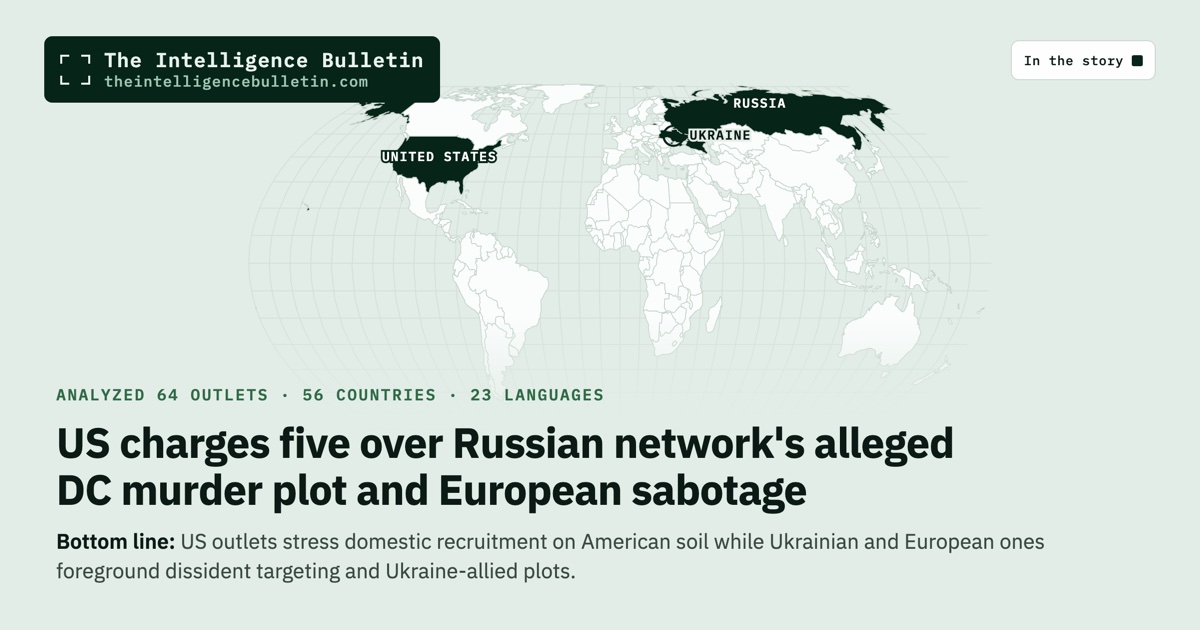
US charges five over Russian network’s alleged DC murder plot and European sabotage

Map of the countries in the story: US charges five over Russian network's alleged DC murder plot and European sabotage
US prosecutors unsealed an indictment charging five men with ties to Russian intelligence services in a conspiracy to finance terrorism and commit murder-for-hire. The network allegedly recruited US-based individuals to surveil and kill a Russian dissident in Washington DC, offering $40,000 for the hit after initial surveillance. Separate recruitment targeted a critic in Lithuania for $25,000, with the plot expanding to sabotage in Europe against Ukraine supporters. All five remain at large; Russia has not commented substantively and previously denied such operations.

One Story. Many Angles.

🇺🇸
United States
Fox News
Original reporting
Russian spies accused of murder-for-hire plot in Washington, DC
Read →
🇷🇺
Russia
The Moscow Times
Carries Reuters reporting
United States Charges 5 People in Alleged Russian-Backed Murder Plots
Read →
🇺🇦
Ukraine
Dzerkalo Tyzhnia
UKRAINIAN
Carries AP reporting
FBI thwarted RF conspiracy – Russian special services prepared murder in Washington – US news
“ФБР зірвало змову РФ – російські спецслужби готували вбивство у Вашингтоні -новини США”
Read →
🇬🇧
United Kingdom
BBC
Original reporting
DoJ accuses Russia of trying to kill Ukraine allies in US and Europe
Read →
🇶🇦
Qatar
Al Jazeera
Original reporting
US charges five people over alleged Russian plots
Read →
5 sources · each independently reported
Analyzed 64 outlets across 56 countries and 23 languages
In Brief

US outlets stress domestic recruitment on American soil while Ukrainian and European ones foreground dissident targeting and Ukraine-allied plots.

The reporting converges on the core DoJ indictment details but diverges sharply in emphasis that reveals national stakes. US coverage centers the unprecedented recruitment on American soil as a direct intelligence threat inside the capital, while Ukrainian reporting highlights the targeting of a prominent dissident and frames the FBI disruption as protective of opponents. UK reporting widens the lens to coordinated plots against Ukraine allies across the US and Europe, underscoring transatlantic security. Qatari coverage stays neutral and factual, avoiding security framing altogether. The exiled Russian outlet relays the charges with Moscow’s past denials noted, but lacks any domestic Russian state perspective, which is absent from the set. This pattern shows how the same indictment serves different narratives: domestic counter-espionage in Washington, dissident protection in Kyiv, alliance defense in London, and detached global news elsewhere. The consistent element across independent chains is the recruitment mechanics and named defendants, yet the choice of which victim or theater to foreground tracks closely with each outlet’s geopolitical position rather than any shared consensus on priorities.

Perspective Analysis

US federal prosecutors unsealed an indictment on September 16 charging five men with links to Russian intelligence services in a conspiracy to finance terrorism. Three of them also face conspiracy to commit murder-for-hire. The men named are Yuri Khrameev, 63, described as a former Russian intelligence colonel; his son Kirill Khrameev, 27, an officer in Russia’s Federal Security Service; Oemis Romagoza Durruthy, 35, a Cuban national living in Russia; Yaidel Delgado Suarez, 35; and Angel Eduardo Castro, 22, a Venezuelan national. All five remain at large. Prosecutors say the group operated as part of a Russian Intelligence Services Network that has recruited people since at least 2024 to carry out surveillance, assassinations and attacks on infrastructure.

The indictment details one operation that reached Washington, DC. According to the charging document, the network directed a US-based Venezuelan recruit to film two locations tied to a Russian dissident believed to be living in the capital. The recruit received instructions to place his phone in airplane mode, begin recording before entering the neighborhood, slow down while passing the target’s home and delete the messages afterward. The network used coded language, calling the assassination “construction” and the surveillance “measuring a plot of land.” After the recruit completed the filming, the network offered him $40,000 to carry out the killing. He declined. The network then sought other US-based recruits and noted it also had people available in Mexico. A separate recruitment effort in 2025 targeted a US citizen living in Lithuania, offering that person $25,000 to kill a critic described as spreading lies about Russia. That recruit also refused. Prosecutors say the same network later shifted some focus toward sabotage of civilian and military infrastructure in European countries supporting Ukraine, including electrical substations, warehouses and transportation hubs.

The five defendants are accused of working for or with Russia’s intelligence services to conduct attacks and murders around the world, including inside the United States. Attorney General Todd Blanche stated that the plots included efforts to murder a Russian dissident investigators believed was located in the Washington area. FBI officials in New York and Washington described the network as having conspired to intimidate, threaten or murder people on US soil and abroad, with the recent activity representing an expansion from targeting dissidents and defectors to striking countries perceived as aligned with Ukraine.

Russian officials have not issued a substantive response to the specific charges. The Russian embassy in Washington did not reply to requests for comment on the indictment. Kremlin spokesman Dmitry Peskov told reporters that Moscow would not comment until it saw credible evidence or tangible facts. Russia has previously denied conducting assassination operations on foreign soil.

The same indictment supplies the factual spine reported across the five outlets that covered the story. Each account draws from the Department of Justice filing and related law-enforcement statements, and each lists the same five defendants, the same $40,000 and $25,000 offers, and the same shift toward infrastructure attacks in Europe. Where the accounts differ is in the slice of the indictment each outlet chooses to foreground and the larger frame it supplies.

Fox News reporting places the recruitment inside the nation’s capital at the center of the story, describing detailed instructions given to the Venezuelan recruit and the use of coded language for the operation. It notes that the case marks one of the most serious publicly alleged Russian intelligence operations targeting an individual inside the United States in recent years. The Ukrainian outlet Dzerkalo Tyzhnia, translating an Associated Press dispatch, emphasizes the targeting of a prominent Russian dissident and presents the FBI’s disruption as the successful prevention of a killing on American soil. It quotes New York FBI head James Barnacle and Washington FBI head Darren Cox on the multi-office effort that stopped the plot. The BBC account widens the geographic scope, describing the network’s activities as attempts to kill Ukraine allies in both the United States and Europe and including Peskov’s request for evidence. Al Jazeera presents the charges in concise form, identifying the defendants and the two financial offers without adding security framing or regional emphasis. The Moscow Times, an exile publication, reports the indictment and the embassy’s silence while noting Russia’s earlier denials of similar plots.

A reader limited to any single one of these accounts would miss elements that appear in the others. The US-focused account supplies the most granular description of how the surveillance was conducted in Washington but gives less space to the European infrastructure targets or the Lithuanian recruitment. The Ukrainian account stresses the dissident angle and the FBI’s protective role but does not develop the transatlantic alliance dimension. The UK account places the events inside a pattern of activity aimed at countries backing Ukraine, yet it does not include the coded-language details or the specific surveillance instructions given to the DC recruit. The Qatari account stays closest to the bare charges and offers no additional context on either domestic US security or European sabotage. The exiled Russian account records the embassy’s non-response and past denials but supplies no independent Russian sourcing or commentary on the network’s alleged activities.

The indictment itself is the primary document available. Every outlet that reported the story rests its account on the same filing, and the mechanics of recruitment, the dollar amounts, the named defendants and the geographic spread of targets are corroborated across independent reporting chains. The divergence lies in which portion of that document each outlet treats as most newsworthy. US coverage aligns most closely with the filing’s emphasis on activity inside the United States. Coverage from Ukraine and the United Kingdom adds the context of operations against perceived Ukraine supporters, which the indictment also states. The absence of any reporting from Russian state media leaves one national vantage entirely unrepresented in the day’s coverage.

What to Watch

The indictment describes a network that has operated since at least 2024 and has already attempted multiple recruitments on US soil. Whether additional charges or further diplomatic exchanges follow will depend on what evidence surfaces beyond the current filing. The immediate effect of the unsealing is to place five named individuals under formal accusation while they remain outside US custody.


Share this story

Same wire facts, one Indian outlet turns bill into Modi attack

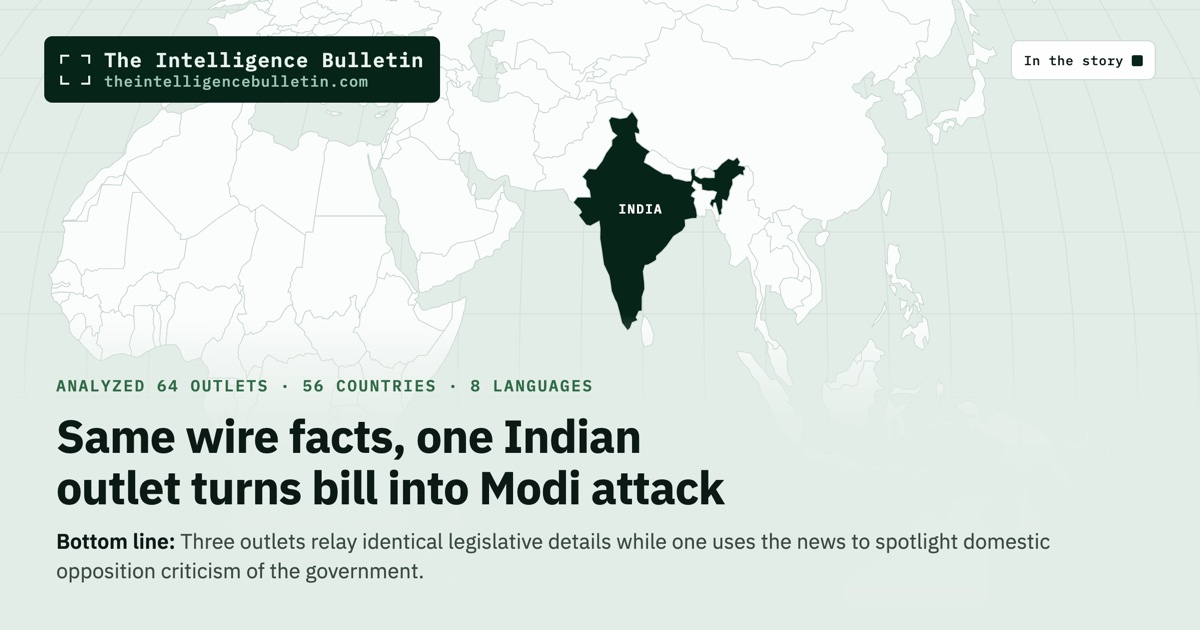
Map of the countries in the story: Same wire facts, one Indian outlet turns bill into Modi attack
The US House of Representatives advanced the Lindsey O. Graham Sanctioning Russia and Iran Act of 2026 on a 214-211 procedural vote after the Senate passed it 86-11 in August. The bill would give President Trump authority to impose tariffs of up to 100 percent on major purchasers of Russian oil and gas, with a House amendment explicitly naming India along with China and eight other countries. A final House vote is expected before an early recess ahead of midterms. Indian opposition leaders immediately criticised the Modi government over the development.

One Story. Many Angles.

🇦🇿
Azerbaijan
Azerbaijan News
Carries ANI reporting
US House set to vote on Russia sanctions bill naming India for possible 100 per cent tariffs
Read →
🇮🇳
India
Silicon India
Carries ANI reporting
US House Advances Russia Sanctions Bill, India Faces 100 Percent Tariff Risk
Read →
🇮🇳
India
The Economic Times
Carries ANI reporting
Russia sanctions bill advances in US House, set for final vote as 100% tariff looms on India, others
Read →
🇮🇳
India
Free Press Journal
Commentary
Congress President Mallikarjun Kharge Targets Modi Govt As US House Advances Russia Sanctions Bill With 100 Per Cent Tariff Threat
Read →
4 sources · all sharing one news agency’s report
Analyzed 64 outlets across 56 countries and 8 languages
In Brief

Three outlets relay identical legislative details while one uses the news to spotlight domestic opposition criticism of the government.

The selected sources converge on the same core legislative facts drawn from a single Indian wire service: the bill’s Senate passage, the House procedural vote, the Hoyer amendment naming specific countries including India, and the Meeks amendment seeking to strip presidential tariff powers. This produces near-identical accounts of the timeline and provisions across Azerbaijan News, Silicon India and The Economic Times. Free Press Journal alone pivots to domestic Indian politics, quoting Congress President Mallikarjun Kharge’s attack on the Modi government for alleged foreign-policy failure. The pattern shows how the same factual base is reframed when an outlet’s audience is directly implicated. No source reports independent verification of the amendment’s prospects or Indian government response beyond the opposition statement. The absence of any non-Indian original reporting in the set leaves the story framed through Indian wire copy even when published under an Azerbaijani masthead. The concrete stakes—possible secondary tariffs on Russian energy buyers—are presented consistently, yet only one outlet connects them to immediate partisan criticism inside India.

Perspective Analysis

The Lindsey O. Graham Sanctioning Russia and Iran Act of 2026 cleared the US Senate by 86-11 in August and reached the House of Representatives this week. On September 15 the House approved a procedural motion to advance the bill by 214-211 after two Democrats joined Republicans. A final vote is scheduled for September 16 before the chamber begins an early recess ahead of the November midterms. The legislation targets Russian leadership, its energy sector and vessels in the so-called shadow fleet that move oil while evading sanctions. It also authorises the president to impose tariffs of up to 100 percent on major purchasers of Russian oil and gas.

All four published accounts of these events rest on the same dispatch from the Indian wire service ANI. Azerbaijan News ran the text under its own masthead with the headline “US House set to vote on Russia sanctions bill naming India for possible 100 per cent tariffs.” Silicon India, The Economic Times and Free Press Journal each carried versions that match the ANI wording on Senate passage, the House vote margin, the names of the amendments and the list of ten countries the Hoyer amendment would make eligible for the highest tariffs. The dispatch states that the Senate version referred only to the five largest importers by volume, while the House amendment names China, India, Turkiye, Azerbaijan, Hungary, the Slovak Republic, the United Arab Emirates, Singapore, Kazakhstan and the Kyrgyz Republic.

Azerbaijan News presented the material as a Washington legislative update. Its opening paragraphs list the bill’s provisions, the Hoyer amendment’s explicit naming of India, and the remaining House steps without additional local framing. The piece ends by noting that final provisions affecting India will depend on which amendments survive.

Silicon India kept the same legislative sequence but placed the business implication for Indian technology and energy buyers in the lead paragraph. Its subhead reads “India Faces 100 Percent Tariff Risk.” The text repeats the ANI details on the Meeks amendment that would remove the president’s broad tariff authority, then adds a short paragraph on how continued Indian purchases of Russian oil remain under scrutiny in Washington.

The Economic Times foregrounded the timeline and the multi-country scope. Its headline mentions “100% tariff looms on India, others.” The body tracks the Senate-to-House path, the 214-211 vote and the fact that the House must still act before the bill reaches the president. It also records that pro-Ukraine groups are lobbying on Capitol Hill during the Ukraine Action Summit.

Free Press Journal alone added material that does not appear in the ANI dispatch it otherwise follows. Its headline and opening paragraphs quote Congress President Mallikarjun Kharge attacking the Modi government. Kharge posted on X that the tariff threat showed the government’s foreign and trade policies had “miserably failed,” and he linked the development to earlier trade tensions and a claimed framework that expanded American access to Indian agricultural products. The article also carries a statement from Congress media head Pawan Khera that India is “the ball” in relations with America and China. These lines are absent from the other three pieces.

The single shared origin explains why the factual spine remains identical across outlets that operate in different countries and for different audiences. Where the mastheads diverge is in what they choose to foreground once the wire text is in hand. Azerbaijan News treats the story as foreign news arriving from Washington. Silicon India and The Economic Times keep the focus on the legislative mechanics and the tariff exposure for Indian commerce. Only Free Press Journal inserts the opposition party’s immediate domestic reaction and places that reaction in the headline and first paragraphs.

No outlet in the set reports additional reporting of its own on the amendment’s chances of passage, on any Indian government reply, or on reactions from the other nine named countries. The Kharge criticism therefore stands as the sole independent addition. The GDELT record notes the event cluster carried a geographic tag of China and an average tone of -1.1, yet none of the four articles develops that angle or quotes Chinese sources.

What to Watch

The pattern that emerges is how a single wire text travels. An Azerbaijani English-language site publishes it largely unchanged. Two Indian business-oriented outlets keep the procedural core while sharpening the commercial angle for readers whose companies buy discounted Russian crude. One Indian political outlet reframes the same paragraphs around domestic opposition criticism. The result is four headlines that all contain the 100 percent tariff figure and the name India, yet only one leads with an Indian politician’s attack on the sitting government. A reader who sees only the Free Press Journal version encounters a story about Indian political failure; a reader who sees only the Azerbaijan News version encounters a story about a US sanctions bill moving through committee. Both accounts rest on the identical 31-paragraph ANI text.


Share this story

Russian drone kills five civilians on Ukrainian bus as transport attacks continue

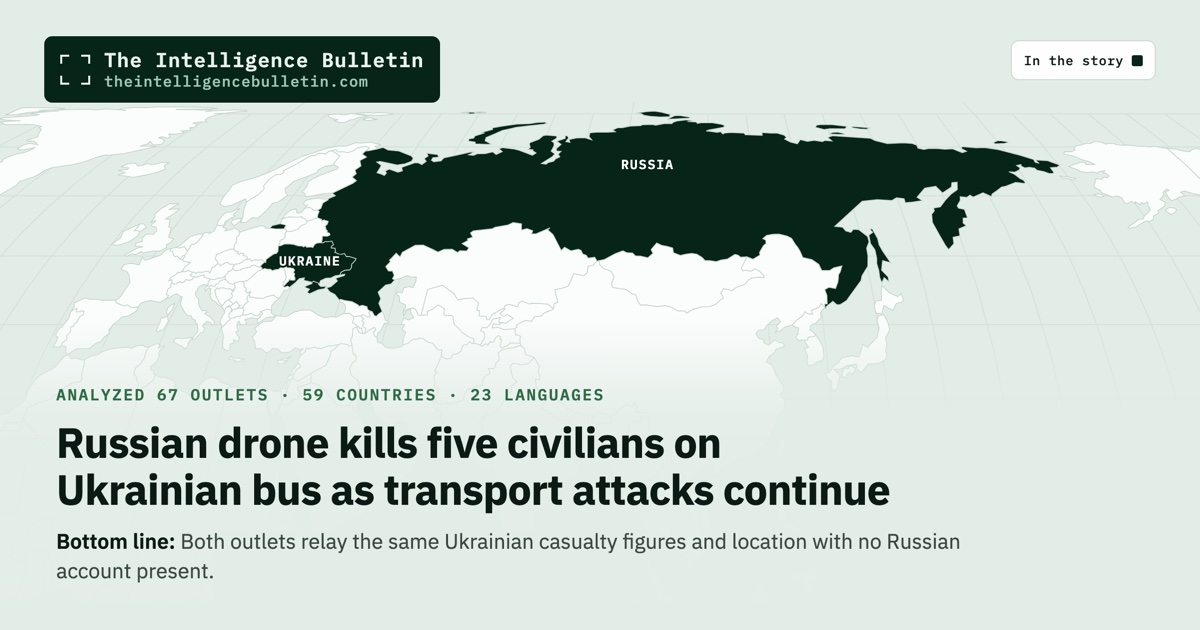
Map of the countries in the story: Russian drone kills five civilians on Ukrainian bus as transport attacks continue
A Russian drone struck a passenger minibus in Ukraine’s Nikopol district early on September 16, 2026, killing five civilians at the scene and injuring at least seven others who received medical care. Regional official Oleksandr Hanzha confirmed the details. President Zelenskyy called the attack an atrocity with no military rationale, linking it to ongoing Russian strikes on civilian transport and infrastructure.

One Story. Many Angles.

🇨🇦
Canada
Winnipeg Free Press
Carries Associated Press reporting
Russian drone strike kills 5 and injures at least 7 on passenger bus in Ukraine – Winnipeg Free Press
Read →
🇧🇬
Bulgaria
Novinite
Carries Ukrainian regional officials reporting
Five Killed in Russian Drone Strike on Bus in Ukraine – Novinite.com
Read →
2 sources · each independently reported
Analyzed 67 outlets across 59 countries and 23 languages
In Brief

Both outlets relay the same Ukrainian casualty figures and location with no Russian account present.

The reporting across the two selected outlets converges on the same core account from Ukrainian regional and presidential sources: a Russian drone hit a civilian minibus in the Nikopol district of Dnipropetrovsk region, killing five instantly and wounding seven. Both carry the precise location, casualty figures and official attribution without variation or added context from elsewhere. The longer Winnipeg Free Press piece, carrying full AP copy, places the strike inside a pattern of attacks on trains, locomotives and energy sites, quoting Zelenskyy on the absence of any truce and Foreign Minister Sybiha on systematic targeting of logistics. The Novinite version stays strictly to the bus incident and the single regional statement, offering no wider framing. Neither outlet supplies Russian commentary or alternative accounts. The absence of any Russian-sourced reporting in the set leaves the selected coverage as a one-sided relay of Ukrainian claims about a strike whose perpetrator is named but whose stated rationale is not examined. This produces a consistent factual baseline on casualties and location while underscoring how the event reaches readers only through Ukrainian channels and Western wire redistribution.

Perspective Analysis

A Russian drone struck a passenger minibus in the Nikopol district of Ukraine’s Dnipropetrovsk region early on September 16, 2026. Regional military administration head Oleksandr Hanzha stated that five people died at the scene and seven others were wounded and receiving medical care. The attack occurred near the southern front line.

Both the Winnipeg Free Press and Novinite published accounts that trace to the same originating material: statements from Ukrainian officials, distributed through the Associated Press wire. The Winnipeg Free Press carried the full AP dispatch under its own masthead. Novinite ran a shorter version built around the same regional official’s statement. No independent reporting from either outlet appears in the published pieces.

The Winnipeg Free Press placed the bus strike at the top of its world section and led with the casualty count and the AP byline. The article then moved immediately to President Volodymyr Zelenskyy’s description of the incident as an atrocity. It quoted Zelenskyy on social media saying the strike had no military rationale and formed part of continued Russian targeting of logistics and critical infrastructure. The same dispatch recorded Zelenskyy noting that a passenger train in the Mykolaiv region was also struck the same day, damaging a railway station and diesel locomotive, with nearly 170 passengers evacuated beforehand. It added that an electric locomotive in Kovel was hit as well.

The Winnipeg Free Press version extended the frame further. It included Ukrainian Foreign Minister Andrii Sybiha’s statement that more than 500 locomotives had been damaged or destroyed since February 2022, with over half of those strikes occurring in the current year. Sybiha called the attacks systematic and aimed at disrupting logistics, and he urged partners to supply replacement locomotives compatible with Ukraine’s 1,520-millimeter rail gauge. The article also carried Zelenskyy’s pushback against an earlier claim by U.S. President Donald Trump that Ukraine and Russia had agreed to halt strikes on each other’s energy infrastructure. Zelenskyy said Ukraine would accept such a truce only if Russia stopped all attacks on Ukrainian energy facilities, and he referenced recent discussions in Kyiv with Trump representatives Steve Witkoff and Jared Kushner.

The Novinite article, by contrast, opened with the headline “Five Killed in Russian Drone Strike on Bus in Ukraine” and confined itself to the bus incident. It quoted Hanzha directly: “Five people have been killed and at least seven injured in an enemy strike on a fixed-route minibus in the Nikopol district.” The piece added only that the five victims died instantly and the injured remained under medical supervision. No mention of Zelenskyy, train strikes, locomotive losses, energy infrastructure, or any wider pattern appeared. The article sat under the Ukraine category on a site that aggregates world news for English readers in Bulgaria and neighboring markets.

The two mastheads therefore performed different editorial operations on the identical originating material. The Canadian daily used the AP dispatch to embed the bus strike inside an account of sustained pressure on Ukrainian transport networks and energy systems. It retained every quoted Ukrainian official who addressed those systems and added the context of locomotive attrition since 2022. The Bulgarian aggregator stripped the dispatch to its narrowest factual core—the bus, the district, the casualty numbers—and stopped there. Both publications named Russia as the actor and Ukraine as the location of the victims. Neither introduced any statement from Russian officials or any alternative account of the strike.

The shared origin means readers encounter one consistent set of details on the minibus attack itself: the date, the district, the vehicle type described as a minibus or fixed-route minibus, and the casualty figures attributed to Hanzha. Differences arise only in what each outlet chose to keep or discard around that core. The longer version supplies the reader with the train strikes and the energy-truce exchange; the shorter version supplies none of it. Placement also differed: the Winnipeg Free Press article ran as a self-contained world-news item with subheadings on rail damage and energy policy, while the Novinite piece appeared as a brief world item without further subdivision.

What to Watch

Because the selected sources contain no Russian-sourced reporting, the published accounts reach English-language readers solely through Ukrainian official statements redistributed by the AP wire and then edited locally. The Winnipeg Free Press version gives those statements their fullest airing in the set. The Novinite version gives them the narrowest. A reader limited to either outlet therefore receives the same baseline facts on the bus strike but receives different amounts of surrounding Ukrainian commentary on transport and infrastructure. No outlet in the set supplies a competing description of the event or any on-record Russian response to the specific strike.


Share this story