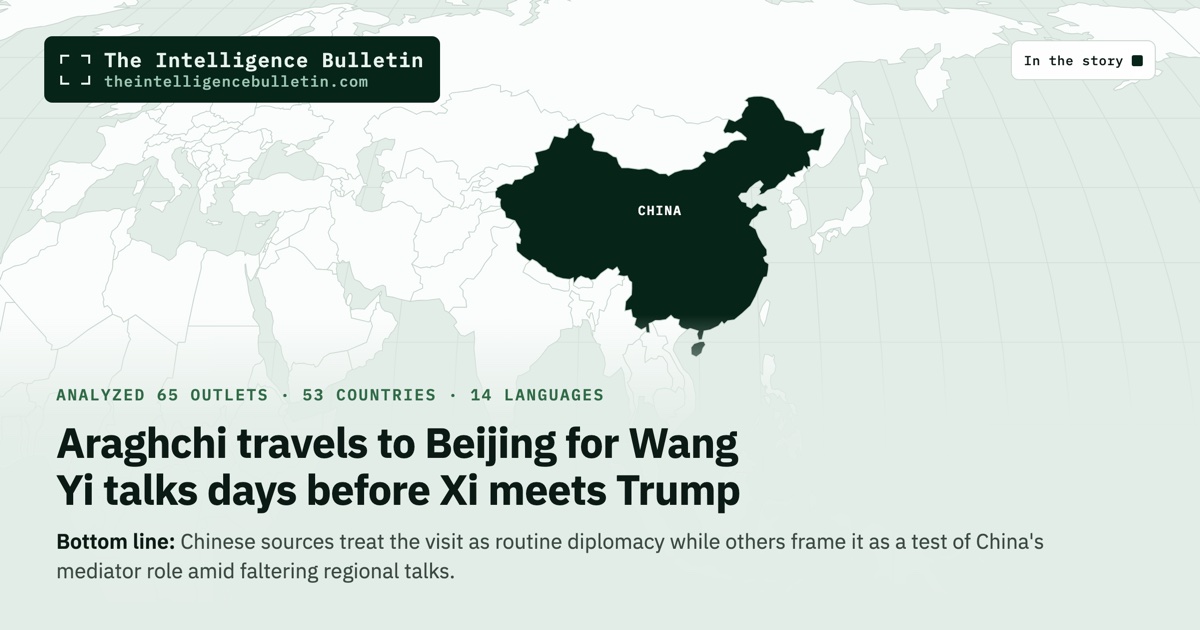
Araghchi travels to Beijing for Wang Yi talks days before Xi meets Trump

Map of the countries in the story: Araghchi travels to Beijing for Wang Yi talks days before Xi meets Trump
Iranian Foreign Minister Abbas Araghchi will visit Beijing on September 16 to meet Chinese Foreign Minister Wang Yi. The trip was announced by China’s Foreign Ministry and comes ahead of Chinese President Xi Jinping’s expected September 24 visit to the United States to meet President Donald Trump. It follows Araghchi’s May visit and occurs amid ongoing US-Israel tensions with Iran, including sanctions and nuclear concerns. Selected coverage frames the meeting as bilateral diplomacy, preparation for the Xi-Trump summit, or a test of China’s potential regional role.

One Story. Many Angles.

🇨🇳
China
China Daily
Original reporting
Iranian Foreign Minister Araghchi to visit China
Read →
🇭🇰
Hong Kong
South China Morning Post
Original reporting
Iran’s top diplomat heads to China for talks as Middle East diplomacy falters
Read →
🇶🇦
Qatar
Al Jazeera
Original reporting
Can China play peacemaker as Iran’s foreign minister heads to Beijing?
Read →
🇹🇷
Turkey
Anadolu Agency
Carries Chinese Foreign Ministry announcement reporting
Chinese, Iranian foreign ministers hold meeting in Beijing ahead of Xi-Trump summit
Read →
🇴🇲
Oman
Times of Oman
Carries ANI reporting
Iran’s Foreign Minister Araghchi to visit China ahead of Xi Jinping’s US visit; to meet Wang Yi
Read →
5 sources · each independently reported
Analyzed 65 outlets across 53 countries and 14 languages
In Brief

Chinese sources treat the visit as routine diplomacy while others frame it as a test of China’s mediator role amid faltering regional talks.

The reporting converges on the basic itinerary but diverges sharply on stakes. Chinese state media presents the visit as standard bilateral engagement strengthening ties ahead of the Xi-Trump summit, with no mention of sanctions pressure or mediation hopes. Turkish and Omani outlets echo the summit-prep framing while noting regional tensions and prior meetings. Hong Kong and Qatari coverage instead highlight faltering Middle East diplomacy and explicitly question whether China can or will act as peacemaker, citing Xi’s recent BRICS remarks and Iran’s nuclear file. This split reveals how proximity to Beijing shapes emphasis on routine cooperation versus distance from it invites scrutiny of China’s limited appetite for entanglement. The absence of any Iranian outlet in the set leaves Tehran’s own expectations unvoiced here, yet every account still relies on Chinese announcements for the core facts. The result is a narrow consensus on logistics that masks deeper disagreement over whether the talks represent quiet coordination or a signal of diplomatic isolation.

Perspective Analysis

Iranian Foreign Minister Abbas Araghchi will arrive in Beijing on September 16 for talks with his Chinese counterpart Wang Yi. China’s Foreign Ministry announced the visit on September 15, stating that the member of the Political Bureau of the CPC Central Committee and Minister of Foreign Affairs Wang Yi will hold discussions with Araghchi. The timing places the meeting one week before Chinese President Xi Jinping’s scheduled September 24 visit to the United States, where he is expected to meet President Donald Trump.

This marks Araghchi’s second trip to Beijing since the end of February, when the United States and Israel began their military confrontation with Iran. His previous visit occurred in May, also shortly before a Trump trip to China. The September 16 talks follow earlier encounters between the two foreign ministers, including a pull-aside on the sidelines of the Shanghai Cooperation Organisation Foreign Ministers’ Meeting in Kyrgyzstan in July and another during the BRICS Summit.

Background to the visit includes Iran’s participation in the 18th BRICS Summit in New Delhi, where President Masoud Pezeshkian led the delegation. Pezeshkian called on BRICS members to take practical measures against unilateral sanctions and urged the group to address global conflicts, including the situation in Palestine. The New Delhi Declaration adopted at the summit expressed deep concern over escalating tensions in West Asia and called for maximum restraint, protection of civilians and infrastructure, and respect for sovereignty. It also stressed maintaining the flow of global trade, supply chains, and energy. On the sidelines, Pezeshkian met Indian Prime Minister Narendra Modi to discuss bilateral relations and West Asia developments, with Modi highlighting the need for peace and stability along with freedom of navigation in the Strait of Hormuz.

China has described its own position in the broader conflict as that of a neutral party seeking an end to hostilities. In his address to the BRICS summit in New Delhi earlier in the week, Xi urged the bloc to act as peacemakers in the Middle East and said China was willing to work with others toward that goal. He promoted a four-point plan centered on peaceful coexistence, respect for national sovereignty, adherence to international law, and balancing development and security. Xi did not announce any specific imminent mediation initiative.

Araghchi is also expected to discuss Iran’s nuclear programme during the Beijing talks. Last week the United States and its European allies pushed the International Atomic Energy Agency board to refer Iran to the UN Security Council over its nuclear activities. China and Russia have opposed the referral and can veto any resulting measures. Western sanctions on Iran continue, including designations targeting companies and financial channels linked to Iranian oil purchases. China remains the largest buyer of Iranian crude and has continued those purchases despite US efforts to isolate Tehran. Reports have also surfaced of Chinese entities supplying high-resolution satellite images to Iran before an attack on a US military base in Jordan.

The five outlets that reported the visit within the 24-hour window from September 15 to 16 all drew the core itinerary from the same Chinese Foreign Ministry statement. China Daily limited its account to the announcement of the Wednesday visit and the planned talks with Wang Yi, presenting the event as a standard step in strengthening bilateral relations ahead of the Xi-Trump summit. Anadolu Agency and the Times of Oman similarly foregrounded the summit timeline and noted the prior Araghchi-Wang Yi meetings, while adding context on regional instability in West Asia and the BRICS background.

South China Morning Post and Al Jazeera placed the same facts against a wider frame of stalled Middle East diplomacy. Al Jazeera reported that analysts view China’s traditional caution against deep involvement in third-party conflicts as likely to limit any mediation role, even as Xi’s BRICS comments offered openings for de-escalation. It also noted divided reactions inside Iran, with former foreign minister Mohammad Javad Zarif welcoming the constructive initiatives and a Tehran professor describing perceptions of an explicit US-Iran mediation offer as over-interpretation.

A reader limited to Chinese state coverage would see only the logistics of a routine diplomatic exchange and the positive bilateral relationship. That account omits the nuclear referral, ongoing sanctions targeting Chinese-linked entities, and the explicit questions raised elsewhere about China’s willingness to move beyond general statements. Coverage from Hong Kong and Qatar, by contrast, supplies the immediate context of the US-Israel confrontation that began in February and the specific IAEA developments from the prior week. Turkish and Omani reporting sits between these poles, recording the summit schedule and regional tensions without probing mediation prospects.

The narrow agreement across all five outlets on dates and participants rests entirely on the single Chinese government announcement. No independent confirmation of the meeting’s agenda or outcomes appears in the set. The divergence centers on interpretation rather than disputed facts: whether the visit signals quiet coordination between Tehran and Beijing or a test of China’s appetite for regional brokerage. Al Jazeera’s account of China’s four-point plan and its record of avoiding entanglement draws directly from Xi’s BRICS remarks and analyst commentary, giving it the strongest textual warrant among the sources.

What to Watch

Chinese state outlets have an institutional interest in presenting diplomacy as stable and productive ahead of the Xi-Trump encounter. Outlets farther from Beijing have an interest in testing whether that stability extends to concrete mediation. The talks themselves are unlikely to produce a public mediation breakthrough, given China’s consistent pattern of promoting general principles while steering clear of binding commitments in third-party disputes. The more useful signal will come from whether the two sides announce any joint language on sanctions relief or nuclear safeguards, details that will only emerge after the meeting concludes.
Share this story

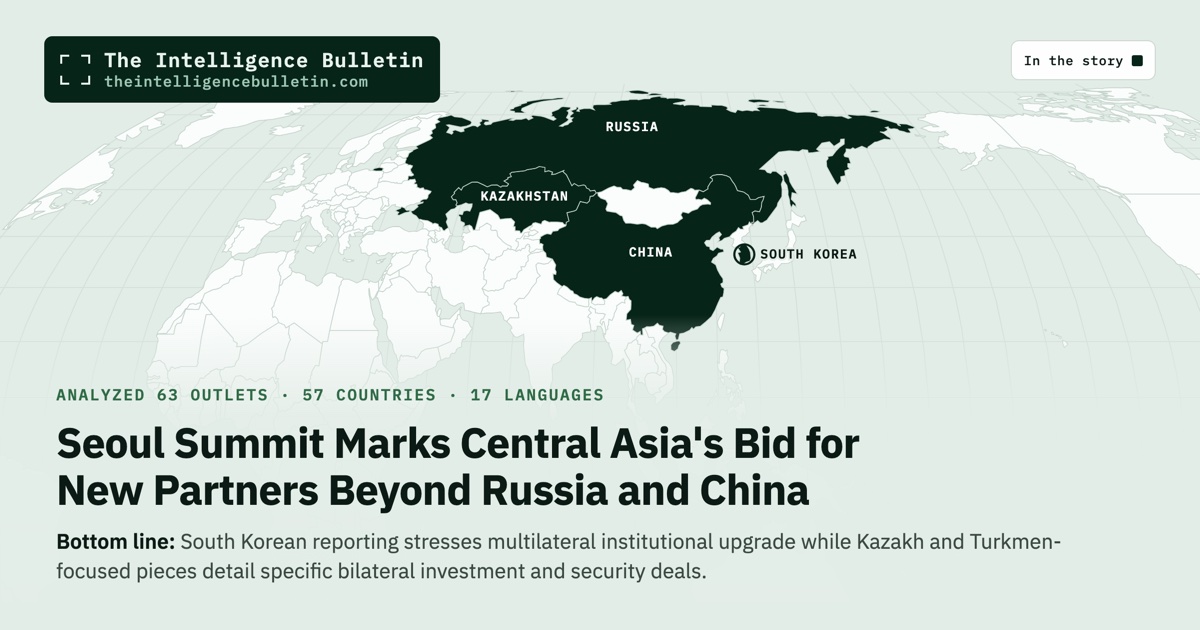
Seoul Summit Marks Central Asia’s Bid for New Partners Beyond Russia and China

Map of the countries in the story: Seoul Summit Marks Central Asia's Bid for New Partners Beyond Russia and China
South Korean President Lee Jae Myung hosts leaders from Kazakhstan, Kyrgyzstan, Tajikistan, Turkmenistan and Uzbekistan for the first Korea-Central Asia Summit in Seoul on September 16. The meeting upgrades two decades of forum-level cooperation to heads of state, with an expected Seoul Declaration on critical minerals, supply chains and connectivity. Bilateral deals signed alongside, while Central Asian states seek technology and investment to diversify partnerships.

One Story. Many Angles.

🇰🇷
South Korea
The Korea Times
Original reporting
Korea, Central Asia to chart shared path at inaugural summit
Read →
🇰🇿
Kazakhstan
New Central Asia
Carries Yonhap reporting
Seoul Brings Central Asian Leaders Together for First Summit with South Korea
Read →
🇰🇿
Kazakhstan
The Astana Times
Original reporting
Kazakhstan, South Korea Advance Investment Cooperation Ahead of Central Asia–Korea Summit
Read →
🇦🇿
Azerbaijan
Trend News Agency
Carries South Korean presidential press service reporting
South Korea, Turkmenistan sign key agreements at bilateral summit
Read →
🇶🇦
Qatar
Al Jazeera
Original reporting
South Korea embraces Central Asian leaders, looking to boost regional clout
Read →
5 sources · each independently reported
Analyzed 63 outlets across 57 countries and 17 languages
In Brief

South Korean reporting stresses multilateral institutional upgrade while Kazakh and Turkmen-focused pieces detail specific bilateral investment and security deals.

The summit marks Central Asia’s collective effort to secure new economic and technological partners while preserving national priorities, a pattern visible across the reporting. Korean coverage frames the event as the culmination of long institutional ties since 2007 and highlights complementary strengths in manufacturing and resources plus historical Koryoin connections. Kazakh outlets instead detail concrete bilateral investment pipelines, including power infrastructure and AI projects for Alatau City and automotive localization with Hyundai. The Azerbaijan-based Trend report narrows sharply to 13 signed agreements with Turkmenistan on transport, security and environment. Al Jazeera places the gathering in the wider context of diversification away from Russia and China and competition for regional influence. These angles converge on pragmatic economic goals yet diverge on scope, with participant sources stressing agency and deals and the external one emphasizing geopolitics. The absence of any Turkmen domestic reporting leaves that principal actor’s direct voice missing from the record, underscoring how coverage reflects each outlet’s position in the partnership.

Perspective Analysis

South Korean President Lee Jae Myung will host the presidents of Kazakhstan, Kyrgyzstan, Tajikistan, Turkmenistan and Uzbekistan in Seoul on September 16 for the first summit between South Korea and the five Central Asian states. The meeting elevates the Korea-Central Asia Cooperation Forum, launched in 2007 with a permanent secretariat added in 2017 and upgraded to foreign-minister level in 2020, to the level of heads of state. The six leaders are scheduled to adopt a Seoul Declaration that sets a medium- and long-term framework for cooperation in critical minerals, supply chains, Eurasian connectivity, energy, digital technologies and innovation. Bilateral talks held in the days before the summit have already produced concrete agreements. South Korea and Uzbekistan exchanged 13 agreements and memorandums covering transport and aviation, agriculture, tourism, artificial intelligence, education, environmental protection and intellectual property. South Korea and Turkmenistan signed 13 documents on investment protection, customs, transport infrastructure, intellectual property, environmental and climate response, and the first official channel between their security agencies to combat transnational crime.

The economic backdrop is a trade volume that reached $10 billion in 2025 after rising 90 percent from 2021, with annual Korean investment into the region climbing 69 percent over the same period to $117 million. Central Asia’s combined population of roughly 80 million sits atop major energy reserves and mineral deposits, including Kazakhstan’s uranium and crude oil, Turkmenistan’s natural gas and Uzbekistan’s molybdenum. Korean companies have moved beyond earlier concentration in automotive and construction into urban infrastructure, information technology, health care and smart agriculture. Central Asian governments, in turn, are pursuing processing and manufacturing capacity rather than raw extraction alone, alongside modernization of Soviet-era transport and energy grids that link Asia and Europe.

Korean reporting places the summit inside a longer institutional arc that began with recognition of Central Asia as a single region rather than five separate partners. It notes the presence of some 310,000 Koryoin, ethnic Koreans deported to the area in 1937, and the roughly 150,000 Central Asian students and workers now in South Korea. The same coverage ties the gathering to South Korea’s New Northern Policy and its goal of supply-chain diversification in a volatile international environment. Kazakh coverage instead foregrounds the practical investment pipelines opened by the visit of President Kassym-Jomart Tokayev. Meetings with Lotte Group produced plans for a first Lotte-branded hotel in Almaty and participation in the Alatau City development. Discussions with Hyundai Motor Group and Kia focused on full-cycle automobile production, electric-vehicle components and charging infrastructure, alongside a new Hyundai Tucson model. Talks with Hanwha Group addressed artificial-intelligence ecosystem building, while CONTEC Space Group explored satellite-component manufacturing and ground-station networks that could supply Central Asia, the Middle East and Europe. Power-infrastructure talks with Korea Electric Power Corporation and Doosan Enerbility centered on transmission systems and a potential 2×250-megawatt gas-fired plant for Alatau City, with later conversion to hydrogen under consideration.

Coverage from the Azerbaijan-based Trend agency narrows to the Turkmen bilateral track, recording the 13 agreements on plant infrastructure, transportation, customs, legal affairs and security cooperation, plus expanded cultural and academic exchanges. It notes Turkmenistan’s earlier support for South Korea’s K-Silk Road initiative during a 2024 visit by the previous Korean president. The New Central Asia outlet frames the entire gathering as Central Asia acquiring new partners beyond Russia and China while reviving Silk Road linkages, and it records that Kyrgyz President Sadyr Japarov and Tajik President Emomali Rahmon arrived on September 15 to join the program. Al Jazeera situates the event in the wider pattern of C5+1 formats, quoting analysts who describe Central Asian states positioning themselves as a bloc that can engage external partners collectively without surrendering national priorities. Those analysts note South Korea’s limited domestic resource base and exposure to Chinese supply chains, and they contrast Seoul’s commercially driven approach with more openly geopolitical efforts by other powers.

The accounts converge on the core economic logic. Multiple independent reporting chains record bilateral agreements signed in the run-up to the summit, growth in trade and investment, and Central Asian interest in technology transfer and industrial upgrading alongside South Korean interest in minerals and logistics corridors. They also converge on the expectation that the Seoul Declaration will establish regular high-level engagement rather than a one-off meeting. Where the coverage diverges is in scope and emphasis. Korean accounts stress the multilateral institutional upgrade and historical human ties. Kazakh domestic reporting supplies granular detail on company-level projects and specific cities such as Alatau. The Trend dispatch isolates the Turkmen bilateral results. Al Jazeera supplies the external geopolitical reading and analyst commentary that participant sources largely omit. No Turkmen domestic outlet appears in the set, so the direct framing from Ashgabat is absent; the Trend report, which relays the South Korean presidential press service, stands as the only published account of that bilateral track.

What to Watch

The pattern of independent reporting chains that separately document signed agreements and shared economic priorities indicates the summit is more likely to produce follow-on projects than to remain declarative. South Korea’s interest in alternative mineral sources and production locations aligns directly with Central Asian governments’ stated aim of moving up the value chain, as evidenced in the company meetings covered by Kazakh outlets and the diversification language in both Korean and regional accounts. The next measurable steps will be the specific implementation mechanisms attached to the Seoul Declaration and the pace at which the newly signed bilateral instruments translate into ground-level activity in power, automotive, satellite and digital sectors.


Share this story

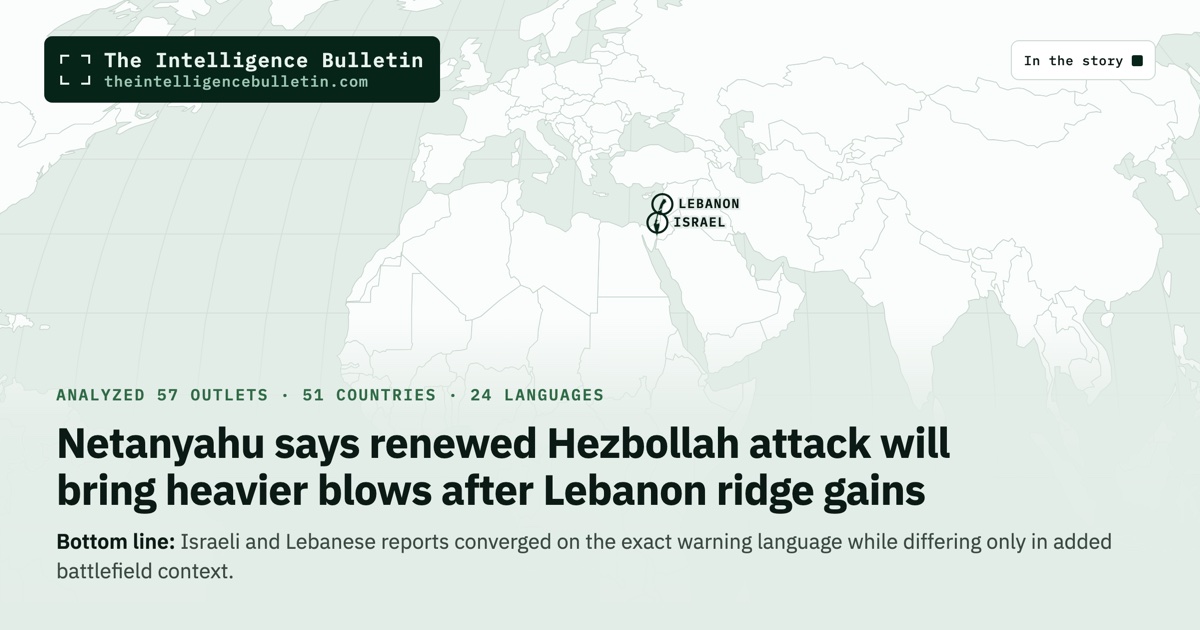
Netanyahu says renewed Hezbollah attack will bring heavier blows after Lebanon ridge gains

Map of the countries in the story: Netanyahu says renewed Hezbollah attack will bring heavier blows after Lebanon ridge gains
Israeli Prime Minister Benjamin Netanyahu stated that Israel had destroyed Hezbollah strongholds on the Beaufort and Ali al-Taher ridges in southern Lebanon. He declared that any renewed attack on Israel would be met with even heavier blows and that work remained to complete. The remarks followed Israeli demolition of a Hezbollah tunnel network that triggered a 4.1-magnitude tremor recorded by the US Geological Survey.

One Story. Many Angles.

🇮🇱
Israel
Israel National News
Original reporting
Netanyahu warns Hezbollah: Next attack will bring ‘heavier blows’
Read →
🇱🇧
Lebanon
Naharnet
Carries Agence France Presse reporting
Netanyahu threatens ‘heavier blows’ if Hezbollah attacks
Read →
🇮🇱
Israel
Iton Gadol
SPANISH
Translated from Agencia AJN
Netanyahu warned Hezbollah that it will suffer “even harder blows” if it attacks Israel again
“Netanyahu advirtió a Hezbollah que sufrirá “golpes aún más duros” si vuelve a atacar a Israel”
Read →
🇨🇷
Costa Rica
Monumental
SPANISH
Carries Infobae reporting
Netanyahu celebrated the fall of Hezbollah’s bastions in Lebanon and threatened “harder blows” if Israel is attacked
“Netanyahu celebró la caída de los bastiones de Hezbollah en el Líbano y amenazó con “golpes más duros” si Israel es atacado : Monumental”
Read →
🇰🇷
South Korea
FN News
KOREAN
Agence France Presse wire copy
Netanyahu praises southern Lebanon tunnel destruction… “If reattacked, will pay even more gruesome price”
“네타냐휴, 레바논 남부 터널 파괴 치하… “재공격 시 더 참혹한 대가 치를 것””
Read →
5 sources · each independently reported
Analyzed 57 outlets across 51 countries and 24 languages
In Brief

Israeli and Lebanese reports converged on the exact warning language while differing only in added battlefield context.

Every outlet in the set carried the identical core quotation from Netanyahu’s video message, showing the statement itself travelled intact across borders. Israeli domestic and diaspora outlets framed the remarks as a clear continuation of policy aimed at eliminating threats from the new security zone, with explicit references to ongoing operations. Lebanese coverage, carried via AFP, added context on the tunnel blast and the broader US-brokered framework for Hezbollah disarmament without altering the warning language. Observer pieces from Costa Rica and South Korea relayed the same facts but emphasised the scale of the explosives used and the infrastructure’s Iranian backing, treating the episode as one data point in regional military balance rather than a bilateral deterrent message. The absence of any Palestinian outlet in the pool leaves the Lebanese side of the border represented only through the Lebanese outlet’s wire choice, while the convergence on the threat language itself indicates the Israeli government statement reached multiple independent reporting chains unchanged.

Perspective Analysis

Israeli Prime Minister Benjamin Netanyahu released a video message on September 14, 2026, stating that Israel had achieved another massive victory over Hezbollah by destroying its major terrorist stronghold on the Beaufort Ridge and the Ali al-Taher Ridge in southern Lebanon. He said Israeli forces had taken full control of the Ali al-Taher ridge and that the policy remained to continue destroying terrorist infrastructure in the security zone in Lebanon while removing any threat to the State of Israel. Netanyahu added that if the enemies had not learned the lesson and chose to attack again, they would suffer even heavier blows, with work still left to complete.

The remarks followed the detonation of a vast Hezbollah tunnel network under the Ali al-Taher ridge one week after Israeli troops seized the strategic highlands. Israel described the network as containing a command center, living quarters, and stocks of weapons built over two decades with Iranian support to strike northern Israel and invading forces. The blast, set off with 1,100 tons of explosives, produced a fireball visible in the area and registered as a 4.1-magnitude tremor by the US Geological Survey, with the epicenter 13 kilometers west of Nabatiye at a depth of 10 kilometers. The ridge lies on the edge of the security zone Israel maintains in southern Lebanon, a few kilometers from the UNESCO-listed Beaufort castle that Israeli forces had captured in recent months.

All five outlets that covered the statement reproduced the same core language from the video issued by Netanyahu’s office. Israeli National News and Iton Gadol presented the message as a direct continuation of operations to eliminate Hezbollah capabilities near the border and prevent reconstruction of positions that could threaten Israeli communities. Naharnet carried the identical warning through an Agence France Presse dispatch but placed it alongside details of the tunnel blast and the US-sponsored framework agreement signed in late June that calls for Hezbollah disarmament, gradual Israeli withdrawal from southern Lebanon, and deployment of the Lebanese army in pilot zones. Monumental, relaying an Infobae report, emphasized the battlefield gains at both ridges and the historical weight of Beaufort, a twelfth-century crusader fortress that had been a site of intense fighting in the 1982 Israeli invasion of Lebanon. FN News, also drawing on AFP material, highlighted the scale of the tunnel destruction and its Iranian backing while situating the episode within the wider regional military balance that began after Israel and the United States struck Iran in late February.

The accounts converge on the content of Netanyahu’s warning and the fact of the ridge operations and tunnel demolition. They diverge in the surrounding context each outlet chose to foreground. The two Israeli outlets stayed tightly on the security-zone operations and the deterrent signal to enemies across multiple fronts. Naharnet added the Lebanese political backdrop of the June framework and the risk that further escalation could draw Lebanon deeper into the conflict that Hezbollah entered by firing rockets at Israel in solidarity with Iran. The Costa Rican and South Korean pieces supplied the concrete detail of the 1,100-ton blast and the recorded tremor while treating the statement as one data point rather than the central message.

No outlet from Palestinian Territory appeared in the coverage pool, so the record contains no independent account from that side of the border. The Lebanese perspective reaches readers only through Naharnet’s choice of AFP copy and the additional regional context it supplied.

The identical quotation from Netanyahu’s video reached five independent reporting chains without alteration, indicating the Israeli government statement itself formed the stable core of the day’s reporting. The single-source detail on two decades of Iranian construction of the tunnel network appears only in the three outlets that carried AFP or Infobae material and is attributed there to Israeli statements. The 4.1-magnitude tremor stands on the direct USGS recording cited by three outlets. The primary document—the video message—therefore supplies the clearest warrant for what was said, while the added context on blast scale, historical sites, and the June framework comes from the reporting chains that chose to include it.

What to Watch

The consistent transmission of the warning across borders suggests the Israeli government succeeded in placing its deterrent language in multiple national presses on the same day. Observers outside the immediate theater gained the additional facts of the explosion’s measurable effect and the existing diplomatic framework, facts that a reader limited to one Israeli outlet would not have encountered in the same piece. The next phase of operations in the security zone will test whether the stated policy of continued infrastructure destruction produces renewed attacks or movement toward the June agreement’s pilot zones.


Share this story

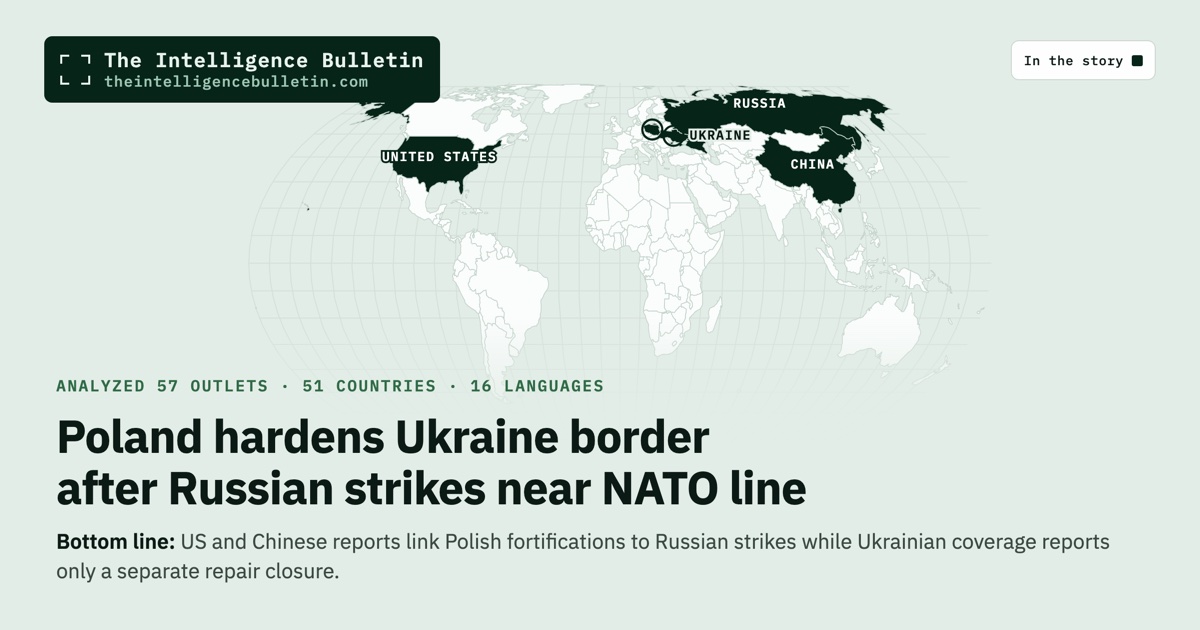
Poland hardens Ukraine border after Russian strikes near NATO line

Map of the countries in the story: Poland hardens Ukraine border after Russian strikes near NATO line
Polish Defense Minister Wladyslaw Kosiniak-Kamysz announced reinforcement of border guard infrastructure and checkpoints with Ukraine after Russian strikes hit nearby. The moves include new observation posts and fortifications by military engineers. Ukrainian reporting detailed a separate checkpoint closure for long-term repairs redirecting bus traffic. Chinese coverage explicitly tied the Polish steps to recent Russian attacks on western Ukrainian logistics.

One Story. Many Angles.

🇺🇸
United States
KEYT
Carries CNN reporting
Poland reinforces border with Ukraine amid growing security concerns across Europe
Read →
🇺🇦
Ukraine
Ukrinform
UKRAINIAN
Original reporting
Poland will temporarily close one of the checkpoints on the border with Ukraine
“Польща тимчасово закриє один із пунктів пропуску на кордоні з Україною”
Read →
🇨🇳
China
Xinhua
Carries Xinhua reporting
Roundup: Poland strengthens eastern defenses after Russian strikes near border-Xinhua
Read →
3 sources · each independently reported
Analyzed 57 outlets across 51 countries and 16 languages
In Brief

US and Chinese reports link Polish fortifications to Russian strikes while Ukrainian coverage reports only a separate repair closure.

The reporting converges on Poland actively hardening its Ukraine border infrastructure but parts company on the trigger and framing. KEYT’s CNN-sourced account places the announcement inside a wider pattern of Russian actions threatening NATO’s eastern flank, citing the drone incident in Lithuania and the Danish helicopter flare encounter as parallel signals of Moscow’s reach. Xinhua’s roundup opens by naming Russian strikes on railway and fuel targets just kilometers from the Polish line as the immediate prompt, quoting Polish officials on new blast barriers and restricted airspace while adding Polish Prime Minister Donald Tusk’s pledge to coordinate with other NATO members. Ukrinform, by contrast, reports only the Ukrainian transport ministry’s notice of a September 20 closure at the Shehyni-Medica crossing for repairs expected to last until late 2027, with buses rerouted and no mention of security motives. The absence of any Ukrainian outlet framing the reinforcement itself as a response to Russian pressure, and the Chinese outlet’s direct causal link versus the American piece’s regional-security lens, shows how each source’s national vantage shapes what counts as the story’s origin. Where the accounts align is on the concrete Polish actions: engineers at work, posts being built at Dorohusk, Medyka and Korczowa, and infrastructure upgrades already underway.

Perspective Analysis

Polish Defense Minister Wladyslaw Kosiniak-Kamysz announced on September 15 that engineers from the 18th Engineer Regiment had begun reinforcing checkpoints and infrastructure along the Polish-Ukrainian border. The work includes construction of new observation and guard posts at Dorohusk, Medyka and Korczowa, plus border fortifications built from collapsible wire-mesh containers that can be filled with sand or gravel to serve as blast barriers. Kosiniak-Kamysz stated on X that recent Russian actions threatened the security of all of Europe and that the infrastructure used by the Border Guard was being strengthened in line with a government decision.

The announcement followed Russian strikes over the preceding weekend on targets in western Ukraine. One strike hit the locomotive of a passenger train in the Volyn region roughly two kilometers from the Polish border. Another struck a petrol station in the same region. The Russian Defense Ministry confirmed two strikes near the Polish border and described the train as carrying military cargo. Ukrainian state railway company Ukrzaliznytsia reported the passenger-train incident.

Polish Prime Minister Donald Tusk said coordination would be strengthened among customs officers, police, the Border Guard and the military at the crossings to keep traffic flowing and prevent vehicle concentrations near the frontier. He added that he would consult other NATO members on preparations for a potential joint response. Poland has also maintained a temporary restricted airspace zone over eastern Poland up to roughly three kilometers altitude since September 10, scheduled to remain in place until December 9, and continues work on its East Shield defense program along the eastern frontier together with an anti-drone system estimated at around two billion euros.

Separate reporting from Ukraine’s Ministry of Infrastructure detailed changes at one specific crossing. From September 20 the Shehyni-Medica checkpoint on the Polish side will undergo repair work expected to last until November 2027. Buses traveling from Ukraine to Poland will be redirected to the alternative crossings at Smilnytsia-Kroschenko, Nyzhankovychi-Malkhovitse and Krakivets-Korchova. Regular bus operators can register in the eQueue system for those routes, and the ministry urged carriers to plan accordingly.

The two main accounts of the reinforcement itself agree on the Polish actions and on the occurrence of Russian strikes near the border. They differ on how directly those strikes are presented as the cause. One account opens by naming the recent Russian attacks on western Ukrainian railway and logistics targets as the immediate prompt for the Polish steps. The other places the Polish announcement inside a wider sequence of Russian actions affecting NATO territory, including a drone equipped with explosives shot down in Lithuanian airspace on the same day and a Danish military helicopter targeted with flares by a Russian warship in international waters the day before.

The Lithuanian incident drew comment from Italy’s defense minister, Guido Crosetto, who said an Italian NATO fighter jet had shot the drone down and that it most probably originated from Russia. NATO Secretary-General Mark Rutte described strikes close to NATO territory as reflecting Russian President Vladimir Putin’s desperation and desire to sow fear. Ukrainian Foreign Minister Andrii Sybiha expressed support for Denmark and warned that Moscow continued attempts to destabilize Europe.

Ukrainian coverage of the border on the same day focused exclusively on the scheduled repair closure and the resulting bus rerouting. It contained no reference to the reinforcement announcement, to Russian strikes, or to any security motive for the infrastructure work. The ministry statement treated the changes as routine maintenance that would affect regular and irregular bus services for more than a year.

The concrete Polish measures—engineer units already on site, posts under construction at three named crossings, and use of specific blast-barrier materials—appear in both the account that ties them directly to the weekend strikes and the account that embeds them in a broader pattern of incidents. The repair closure at Shehyni-Medica stands apart as a distinct operational matter reported only through Ukrainian government channels.

A reader who saw only the account that isolates the Russian strikes as the direct trigger would miss the parallel NATO incidents cited elsewhere and the explicit statements from Lithuanian, Italian and Danish officials. A reader who saw only the broader-security framing would miss the precise locations of the new posts and the technical description of the fortifications. A reader limited to the Ukrainian ministry notice would encounter no connection between the checkpoint work and Russian military activity at all.

The corroborated elements are the Polish minister’s announcement of reinforcement, the engineer regiment’s tasks, the three named crossing locations, the wire-mesh barrier method, the occurrence of Russian strikes on the train and petrol station near the border, and the Russian ministry’s confirmation of those strikes. The single-source detail on the year-long repair closure at Shehyni-Medica and the bus rerouting stands on the Ukrainian ministry statement alone.

The account that presents the strikes as the immediate cause draws its warrant from the timing of the Polish statement relative to the weekend attacks and from Polish officials’ own references to those events. The account that widens the lens draws its warrant from the additional statements by officials in Lithuania, Italy and Denmark on the same day. Both rest on on-record comments from named ministers and military commands rather than anonymous sourcing. The Ukrainian ministry statement carries its own authority as the body responsible for the infrastructure in question, but it addresses a different operational timeline and purpose.

What to Watch

Poland’s moves add physical capacity at the crossings and along the frontier at a moment when cross-border traffic includes both civilian movement and military logistics. The reinforcement increases the ability to manage concentrations of vehicles and to harden facilities against blast effects. The separate repair closure will shift bus flows for more than a year, requiring carriers to adjust routes and registration procedures. How these two sets of changes interact at the crossings will depend on whether the repair work overlaps with any heightened security posture at the same sites.


Share this story

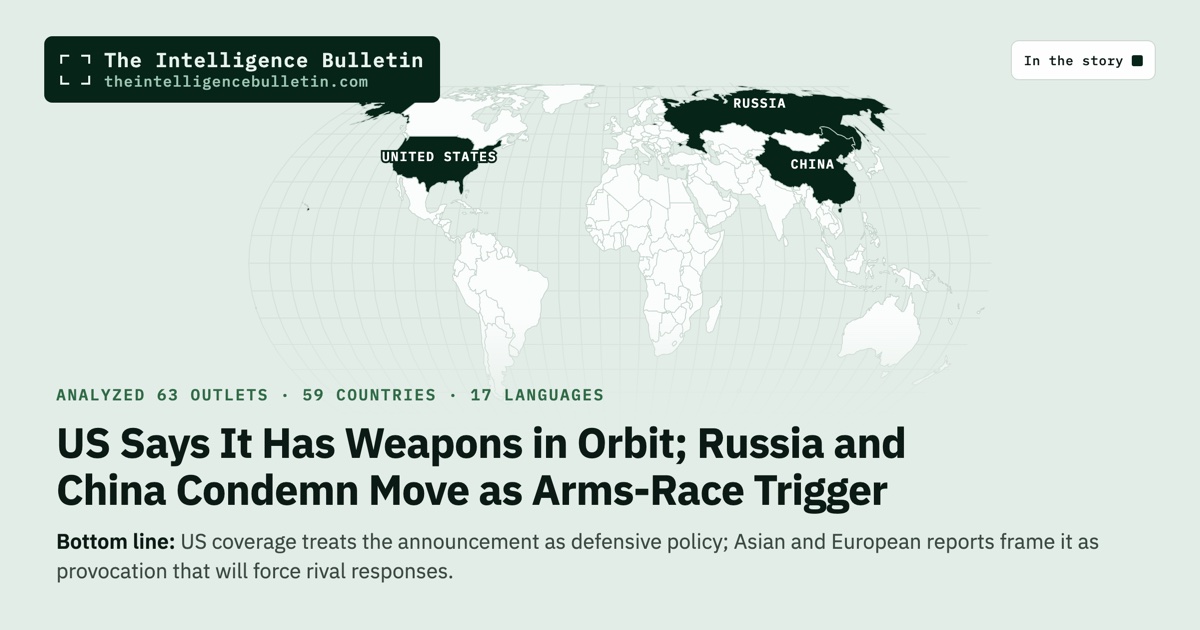
US Says It Has Weapons in Orbit; Russia and China Condemn Move as Arms-Race Trigger

Map of the countries in the story: US Says It Has Weapons in Orbit; Russia and China Condemn Move as Arms-Race Trigger
US Air Force Secretary Troy Meink stated at a Maryland conference that the Space Force has deployed on-orbit space control weapons to defend against adversary action. No details on the systems were provided. Russia demanded space remain weapon-free and called for demilitarization; China accused the US of pursuing hegemony and fueling an arms race. The 1967 Outer Space Treaty bans nuclear weapons in orbit but permits other military activity.

One Story. Many Angles.

🇺🇸
United States
Orange County Register
Carries Associated Press reporting
US acknowledges for first time that it has deployed weapons in space
Read →
🇨🇳
China
Global Times
Commentary
US-claimed deployment of orbital weapons ‘exposes space hegemony, risks fueling global arms race’
Read →
🇲🇾
Malaysia
Free Malaysia Today
Carries AFP reporting
Russia says space ‘must be free from any weapon’
Read →
🇦🇹
Austria
ORF
GERMAN
Agenturen wire copy
USA Confirm Deployment of Weapons in Space
“USA bestätigen Stationierung von Waffen im All”
Read →
🇮🇪
Ireland
Irish Times
Original reporting
China warns of new arms race after US confirms deployment of space weapons
Read →
5 sources · 4 independent accounts — some share the same news agency’s report
Analyzed 63 outlets across 59 countries and 17 languages
In Brief

US coverage treats the announcement as defensive policy; Asian and European reports frame it as provocation that will force rival responses.

The US acknowledgment stands out because it shifts from prior secrecy about space capabilities to an explicit public claim of deployed weapons, framed domestically as routine readiness against Russia and China threats. American reporting presents the statement as a straightforward policy update without elaboration or reaction from abroad. In contrast, Chinese coverage immediately recasts the disclosure as evidence of hegemonic intent and a deliberate arms-race accelerant, citing the timing amid perceived US military strains. Russian statements, carried through Malaysian and Irish outlets, reject any weapons in space outright and push for international demilitarization efforts. European and Irish accounts add expert analysis highlighting escalation risks and the likelihood of reciprocal deployments by rivals, noting that public confirmation lowers the threshold for normalized orbital conflict. The pattern reveals how the same core announcement produces divergent emphases: one side stresses defensive necessity, the others foreground provocation and instability. No selected outlet from Russia itself appears, so its position reaches readers only through foreign intermediaries. This leaves the selected coverage united on the fact of the US statement but divided on its implications, with the arms-race warning emerging as the dominant cross-border theme.

Perspective Analysis

The United States announced on September 15, 2026, that it had placed weapons in orbit. Air Force Secretary Troy Meink told the Air and Space Cyber Conference in Maryland that the Space Force now fields “on-orbit space control weapons capable of defending the Joint Force against hostile adversary action.” A Space Force spokesperson added that these systems employ kinetic and non-kinetic means to affect adversary capabilities and can serve offensive or defensive purposes. Meink offered no further technical details during the keynote or in a follow-up briefing with reporters.

Russia responded the same day through Kremlin spokesman Dmitry Peskov. He stated that space must remain free of any weapon and expressed hope for broad international cooperation toward complete demilitarization. China’s Foreign Ministry accused Washington of preparing for war in outer space, expanding its military presence there, and risking an arms race that would turn the domain into a battlefield. Chinese military affairs expert Song Zhongping told Global Times that the disclosure marked a shift from earlier secrecy and reflected an effort to project continued dominance despite recent military setbacks elsewhere.

The 1967 Outer Space Treaty, signed by the United States, Russia, and China, prohibits nuclear weapons and other weapons of mass destruction in orbit. It does not bar conventional military systems or activities short of those categories. Earlier US statements had cited Russian and Chinese counter-space programs as justification for American development, including a 2024 assessment that Russia was working on an anti-satellite weapon. Meink’s remarks came amid references to two ongoing Pentagon efforts, the Space-Based Interceptor program and a Space-Based Air-Moving Target Indication constellation, both tied to the Golden Dome missile-defense architecture.

American reporting presented the announcement as a measured update on existing capabilities. The Orange County Register carried an Associated Press account that quoted Meink directly, noted the absence of specifics, and placed the statement against longstanding concerns about Russian and Chinese threats to satellite-dependent infrastructure. No foreign reactions appeared in that dispatch.

Chinese state media framed the same statement as evidence of hegemonic ambition. Global Times led with analyst commentary that the timing exposed Washington’s pursuit of space dominance and its willingness to accelerate competition. It quoted Foreign Ministry spokesperson Guo Jiakun urging the United States to halt military expansion in orbit and cited prior Chinese warnings that similar systems would open a “Pandora’s box.”

Malaysian and Irish outlets foregrounded the immediate diplomatic counter-moves. Free Malaysia Today summarized Peskov’s call for a weapon-free space alongside China’s condemnation of war preparations. The Irish Times centered China’s arms-race warning and added independent expert assessments that the public confirmation would likely prompt reciprocal deployments by Russia and China. Astronomer Jonathan McDowell noted that Russia and China would now “respond in kind,” while Victoria Samson of the Secure World Foundation described the statement as unprecedented in its explicitness.

Austrian public broadcaster ORF relayed the core US claim in neutral language, recorded the treaty’s limits on nuclear weapons, and noted that both Russia and China view space as a potential future conflict domain. It supplied no analyst commentary and no direct quotes from Moscow or Beijing.

The selected coverage converges on the fact of the US statement and on the content of the Russian and Chinese replies. It diverges sharply on framing and emphasis. US-sourced reporting stays within the announcement and its stated defensive rationale. Chinese reporting immediately recasts the disclosure as provocation. Outlets in Malaysia, Ireland, and Austria carry the counter-statements and, in the Irish case, external expert judgment that the move normalizes orbital conflict and raises debris risks from any future engagement.

The arms-race warning rests on the broadest set of independent reporting chains. Russian and Chinese official statements appear across multiple outlets, while US domestic accounts supply the original claim without addressing those replies. Expert commentary in the Irish Times adds a technical layer absent from the US wire piece: public confirmation removes prior ambiguity and makes equivalent systems from rivals more probable. No outlet in the set examined primary technical data on the weapons themselves; all rely on the Secretary’s public remarks and the subsequent diplomatic exchanges.

What to Watch

The US account serves the interest of presenting capability as routine readiness. Russian and Chinese accounts serve the interest of portraying the deployment as destabilizing and isolating Washington diplomatically. The treaty’s narrow prohibition on nuclear systems remains undisputed in the reporting, yet the new public acknowledgment of conventional orbital weapons tests the boundary between permitted military support functions and prohibited weaponization. Future Russian or Chinese tests or deployments would likely cite this announcement as precedent, increasing the chance of crowded orbits and collision-generated debris fields that affect all satellite operators regardless of nationality.


Share this story

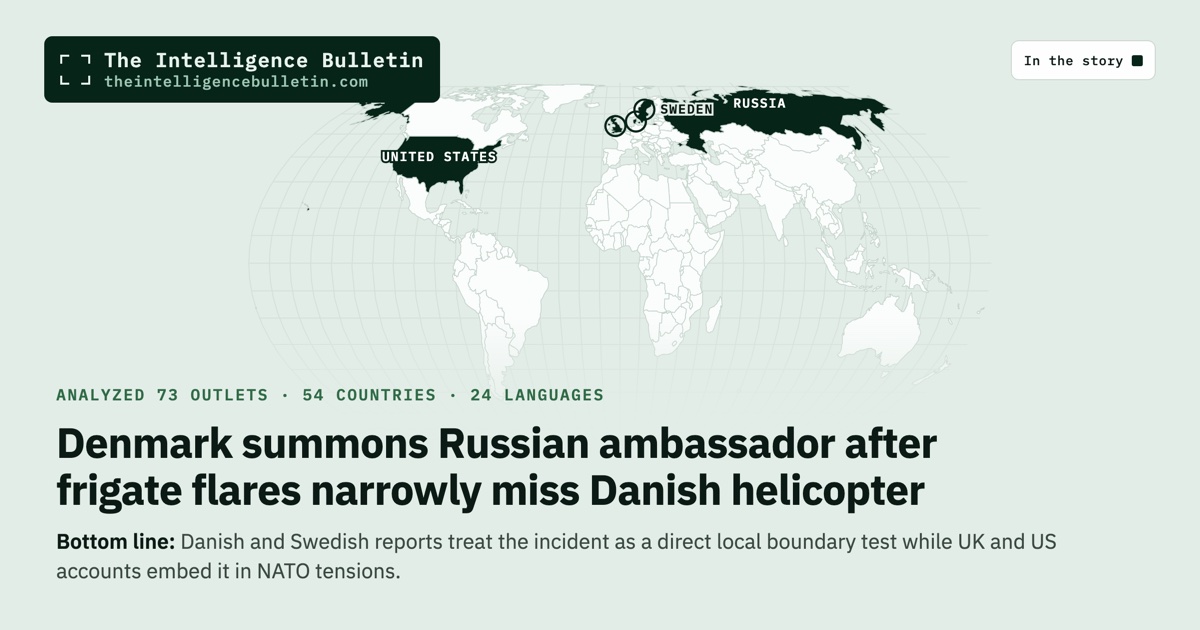
Denmark summons Russian ambassador after frigate flares narrowly miss Danish helicopter

Map of the countries in the story: Denmark summons Russian ambassador after frigate flares narrowly miss Danish helicopter
A Russian frigate fired two flares toward a Danish Fennec military helicopter during a routine photography mission in international waters off Gedser, Denmark. One flare passed close to the aircraft but caused no damage or injuries. Denmark summoned the Russian ambassador in response. Danish leaders described the incident as part of a pattern of aggressive Russian behavior testing NATO and European security.

One Story. Many Angles.

🇩🇰
Denmark
DR
DANISH
Original reporting
The Prime Minister reacts to the incident at Gedser: ‘Aggressive and self-assertive Russia’
“Statsministeren reagerer på hændelse ved Gedser: ‘Aggressivt og selvhævdende Rusland’”
Read →
🇳🇱
Netherlands
The Moscow Times
Carries Reuters reporting
Denmark Summons Russian Ambassador After Frigate Fires Flares Toward Military Helicopter
Read →
🇸🇪
Sweden
Svenska Dagbladet
SWEDISH
Carries TT-Ritzau reporting
Russian frigate fired distress rockets at Danish helicopter
“Rysk fregatt sköt nödraketer mot dansk helikopter”
Read →
🇬🇧
United Kingdom
BBC
Original reporting
Denmark says Russian warship fired flares at military helicopter
Read →
🇺🇸
United States
New York Post
Carries Reuters reporting
Russian frigate fires flares towards Danish military helicopter, Denmark says
Read →
5 sources · 4 independent accounts — some share the same news agency’s report
Analyzed 73 outlets across 54 countries and 24 languages
In Brief

Danish and Swedish reports treat the incident as a direct local boundary test while UK and US accounts embed it in NATO tensions.

Danish reporting centers the official national response, quoting Prime Minister Mette Frederiksen directly on Russia’s hybrid warfare and the need for tighter European defense cooperation, while Swedish coverage frames the event as a regional maritime security shift in the Baltic without the same diplomatic emphasis. The Moscow Times relays the summons and Danish statements factually from exile, noting the embassy’s silence and the straits’ strategic role for Russian shipping. BBC and New York Post accounts both draw on Danish statements but add NATO alliance context and sharper notes on potential danger, with the Post highlighting narrow misses and escalation risks. All five sources converge on the core sequence of events and Danish actions, with no contradictions or Russian rebuttals appearing in the selected coverage. This pattern reveals how Baltic neighbors treat the incident as an immediate operational boundary test, while distant observers embed it in alliance friction, and the exile outlet avoids adopting either framing.

Perspective Analysis

A Russian frigate fired two flares at a Danish Fennec military helicopter on a routine photography mission in international waters south of Gedser on the Danish island of Falster. One flare passed close to the aircraft. No one was injured and the helicopter sustained no damage. Danish defense officials described the mission as standard surveillance of a foreign warship operating near Danish waters. The incident occurred on a Monday, and coverage appeared the following day.

Danish Foreign Minister Lars Løkke Rasmussen called the foreign ministry’s action to summon the Russian ambassador. He stated that the event could have endangered human lives and that Russia was gradually shifting what it considered acceptable conduct at sea. Denmark’s defense minister, Jeppe Bruus, described the firing as unprofessional seamanship and said the armed forces would continue their legitimate surveillance tasks without change. Prime Minister Mette Frederiksen issued a written statement framing the episode as part of a broader pattern of Russian hybrid operations across Europe, aimed at sowing fear and division, and testing NATO cohesion. She said the response should be closer European coordination and stronger defense.

The helicopter had been photographing the frigate when the flares were launched. Danish officials noted that the frigate lay close to Denmark and that photographing such vessels forms part of normal defense monitoring. The flares are described in Danish accounts as signal devices normally used for warning at sea. Swedish reporting referred to them as distress rockets and recorded the same close passage without injury.

The exiled Moscow Times carried the Danish statements and the summons while noting that the Russian embassy in Copenhagen offered no immediate comment. It also recorded the location of the incident in the Danish straits, the main commercial and military route in and out of the Baltic Sea and a corridor used by Russian tankers operating outside Western sanctions.

Swedish coverage from Svenska Dagbladet, drawing on wire material, presented the event as evidence that Russian risk thresholds at sea had moved. The report quoted the Danish defense minister on the unprofessional nature of the action and on Denmark’s intent to maintain its surveillance flights. It placed the episode in the immediate Baltic maritime setting rather than in alliance-wide diplomacy.

BBC reporting placed the same Danish statements inside ongoing NATO-Russia tensions on the eastern flank. It recorded the foreign minister’s description of the incident as unacceptable and the summons of the ambassador. The New York Post account, also carrying Danish material, stressed the narrow miss and the potential danger to the crew.

No account in the set contained a Russian rebuttal or alternative sequence of events. The Russian embassy did not respond to requests for comment outside regular hours in the reporting that reached publication. All five outlets agreed on the sequence of the firing, the close passage of one flare, the absence of harm, the routine nature of the Danish flight, and the fact of the ambassador’s summons.

Danish domestic coverage foregrounded the prime minister’s characterization of Russia as aggressive and self-assertive, linking the episode directly to hybrid warfare and the need for European defense consolidation. Swedish reporting stayed closer to the operational detail of risk thresholds in the Baltic approaches and the continuation of Danish flights. The Moscow Times kept the diplomatic fact of the summons and the embassy silence at the center while adding the straits’ role in sanctioned oil shipments. BBC and New York Post accounts both relayed the Danish statements but situated them in alliance friction, with the American outlet giving more space to the physical proximity of the flare to the helicopter.

The convergence across independent reporting chains on the core facts leaves little room for dispute about what occurred. Danish officials supplied the primary account of the flight purpose, the firing, and the diplomatic response, and that account traveled intact through outlets in Denmark, Sweden, the United Kingdom, the United States, and the exiled Russian newsroom. Where the accounts differ is in emphasis: one national voice stresses hybrid warfare and alliance solidarity, a neighboring voice stresses local maritime boundaries, and distant observers add the NATO frame without altering the sequence itself.

What to Watch

The Danish account carries the strongest warrant because it rests on on-record statements from the prime minister, foreign minister, and defense minister, each tied to the same incident details that appear unchanged in every other outlet. Those officials have a direct interest in presenting the event as part of a pattern that justifies increased defense spending and tighter coordination inside NATO and the European Union. The absence of any contradictory Russian account in the available reporting means the Danish sequence stands as the most widely corroborated description. The incident supplies a single, concrete data point in the longer record of Russian naval activity in the Baltic approaches, showing that surveillance flights continue and that Denmark responds through standard diplomatic channels rather than escalation.


Share this story