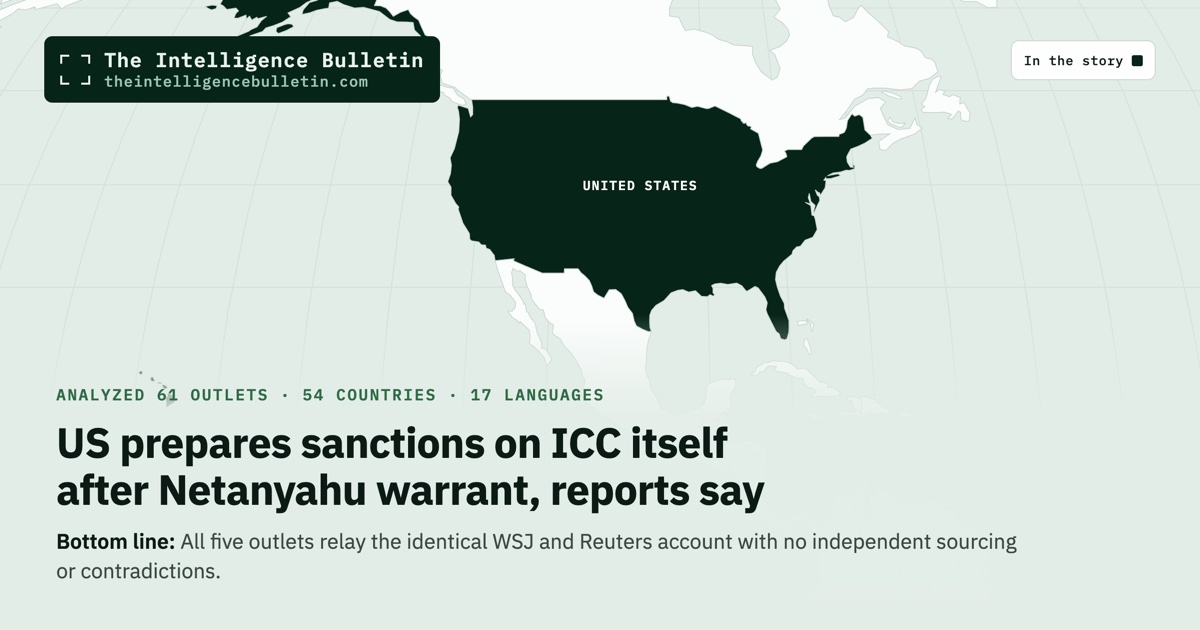
US prepares sanctions on ICC itself after Netanyahu warrant, reports say

Map of the countries in the story: US prepares sanctions on ICC itself after Netanyahu warrant, reports say
The Trump administration is preparing sanctions targeting the International Criminal Court as an institution. The measures would bar most US transactions with the court after a grace period and could isolate it from the dollar system. Reports cite the ICC’s arrest warrant for Israeli Prime Minister Benjamin Netanyahu and prior US sanctions on individual officials as context. The announcement could come during or after the UN General Assembly.

One Story. Many Angles.

🇺🇸
United States
AOL
Carries Wall Street Journal reporting
Trump planning sanctions against ICC over Netanyahu arrest warrant: report
Read →
🇶🇦
Qatar
Al Jazeera
Carries Reuters reporting
Trump administration readies sweeping sanctions against ICC, reports say
Read →
🇮🇱
Israel
Israel National News
Carries Wall Street Journal reporting
Report: Trump administration preparing sweeping sanctions against ICC
Read →
🇬🇧
United Kingdom
Press TV
Carries Wall Street Journal reporting
Trump administration prepares wide-ranging sanctions on ICC: Reports
Read →
🇵🇭
Philippines
Rappler
Carries Reuters reporting
Trump administration prepares sanctions vs ICC, sources say
Read →
5 sources · 2 independent accounts — some share the same news agency’s report
Analyzed 61 outlets across 54 countries and 17 languages
In Brief

All five outlets relay the identical WSJ and Reuters account with no independent sourcing or contradictions.

Every outlet in this set carries the same core account from the Wall Street Journal and Reuters, with no independent sourcing or conflicting details. The reporting converges on the sanctions targeting the ICC itself rather than individuals, the six-to-seven-month grace period, the potential disruption to the court’s finances and operations, and the explicit link to the Netanyahu arrest warrant. Israeli National News frames the move as protective of Israeli interests and notes Rubio’s campaign to isolate the court. Al Jazeera and Press TV highlight the escalation against multilateral justice mechanisms and the broader campaign against the ICC. AOL and Rappler stay closest to the factual outline without additional geopolitical emphasis. The uniformity stems from all five relaying the identical US reporting chains rather than originating new material or drawing on local sources. No outlet adds claims about timing disputes, denials, or differing estimates of impact. This produces a clean consensus on the facts reported but leaves the story’s significance dependent on how readers weigh the US rationale versus the ICC’s institutional role. The absence of variation across these diverse outlets underscores that the event’s coverage rests on a single reporting origin.

Perspective Analysis

The Trump administration is preparing sanctions that would target the International Criminal Court as an organization rather than individual judges or prosecutors. Two sources familiar with the plans told Reuters that the measures have already been drawn up, though the exact timing of any announcement remains unclear. The Wall Street Journal reported on Sunday that US officials expect a decision could be finalized as soon as this week, during or immediately after the United Nations General Assembly meeting in New York.

The proposed sanctions would bar most transactions with the court after a grace period of six to seven months. American citizens and companies would be prohibited from providing funds, goods, or services to the ICC without a license from the Treasury’s Office of Foreign Assets Control. Banks that depend on access to the US financial system often over-comply with such restrictions, which could cut the court off from dollar-denominated operations. The ICC president and registrar have previously warned that entity-wide sanctions would interfere with purchases of information technology and insurance, the hiring of investigators, and routine payments including salaries for dozens of American employees.

The move builds on earlier US actions. An executive order signed by President Trump in February 2025 already imposed sanctions on more than a dozen ICC judges and prosecutors. In August, the administration added ICC President Tomoko Akane and senior trial lawyer Abdoulaye Seye to the list, with restrictions taking effect on September 17. US officials have long objected to the court’s pursuit of cases involving countries that are not parties to the Rome Statute, including an earlier investigation into alleged abuses by American personnel in Afghanistan.

The current planning is tied directly to the arrest warrants the ICC issued in November 2024 for Israeli Prime Minister Benjamin Netanyahu and former Defense Minister Yoav Gallant over alleged war crimes and crimes against humanity in Gaza. Netanyahu is not expected to face arrest in the United States, which is not an ICC member. Secretary of State Marco Rubio announced a broader campaign in July aimed at isolating the court and urging other countries to withdraw from it. The United States has never joined the tribunal, which was established in 2002 to prosecute genocide, war crimes, and crimes against humanity when national authorities are unable or unwilling to act.

All five articles examined here rest on the same originating reports from the Wall Street Journal and Reuters. No outlet conducted independent interviews or obtained new documents. Each publication took the shared dispatch and shaped it through headline choice, added context, and emphasis. Israel National News led with the institutional target and immediately connected the sanctions to Netanyahu’s warrant, noting Rubio’s description of the effort as a “sweeping campaign to dismantle the threat posed by the International Criminal Court to US sovereignty.” The piece also recorded that the United States and Israel are not parties to the Rome Statute and that the Palestinian Authority joined in 2015.

Al Jazeera placed the sanctions in the context of Washington’s long-standing campaign against the Hague-based court and highlighted the potential disruption to its day-to-day operations, including probes involving US allies in the Middle East. The article noted that the measures would mark a sharp escalation by moving beyond sanctions on individuals. Press TV framed the same material as aggressive US unilateralism against multilateral institutions, listing the grace period and operational impacts while recording the backdrop of growing withdrawals from the court by Chad, Venezuela, Burkina Faso, Mali, and Niger.

AOL and Rappler stayed closer to the raw facts of the dispatch. AOL’s headline foregrounded the Netanyahu warrant and the prospect of cutting the court off from the dollar system. Rappler summarized the Reuters and Wall Street Journal reporting without additional geopolitical framing and noted that the State Department had not responded to a request for comment. None of the five articles added fresh sourcing or disputed any element of the original reports.

The shared origin explains the absence of factual disagreement across the set. Every publication carried the same details on the six-to-seven-month grace period, the potential effects on IT services and American employees, and the explicit link to the Netanyahu warrants. Differences appear only in the surrounding sentences each outlet chose to include or omit. Israel National News supplied the most context on prior individual sanctions and Rubio’s statements. Al Jazeera and Press TV added references to the court’s objections from non-member states and recent withdrawals by other countries. AOL and Rappler kept the focus narrowest, reproducing the core claims with minimal elaboration.

What to Watch

This single-chain structure means the story’s significance depends on how readers weigh the US rationale against the court’s institutional role. The reports contain no on-record denials or alternative estimates of impact. What each masthead foregrounded therefore becomes the main variable available to readers: protection of Israeli interests in one case, institutional damage in another, or a straightforward relay of the American planning documents in the rest. The next concrete development will be whether an announcement occurs during the UN General Assembly week, as the Wall Street Journal’s sources indicated remains possible.

Share this story

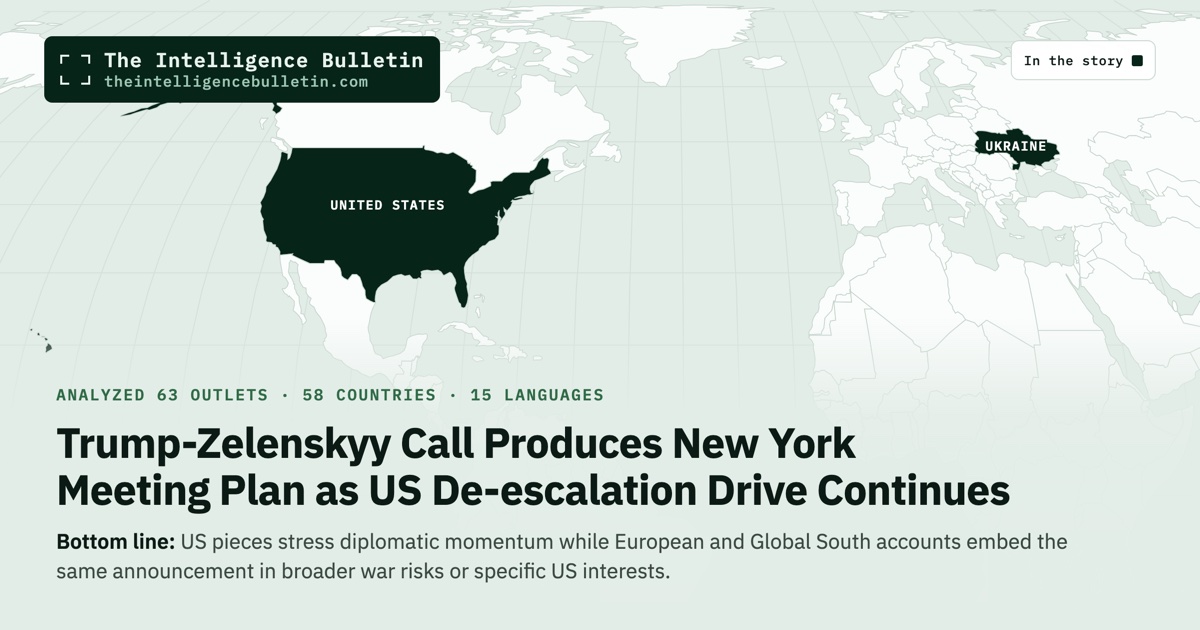
Trump-Zelenskyy Call Produces New York Meeting Plan as US De-escalation Drive Continues

Map of the countries in the story: Trump-Zelenskyy Call Produces New York Meeting Plan as US De-escalation Drive Continues
Ukrainian President Volodymyr Zelenskyy announced a phone call with US President Donald Trump in which they agreed to meet in New York during the UN General Assembly. Zelenskyy said the meeting could change a lot and noted diplomatic momentum, while thanking Trump for envoys Steve Witkoff and Jared Kushner visiting Kyiv. The planned talks occur as the US seeks short-term de-escalation measures between Russia and Ukraine. Reports differ on emphasis: US sources stress momentum, while others highlight war context or specific US interests like oil infrastructure.

One Story. Many Angles.

🇺🇸
United States
The Spokesman-Review
Carries German Press Agency reporting
Zelenskyy says he’ll meet Trump in New York as peace efforts pick up
Read →
🇵🇱
Poland
Wprost
POLISH
Original reporting
Trump and Zelenski will meet in New York. An important declaration has been made
“Trump i Zełenski spotkają się w Nowym Jorku. Padła ważna deklaracja – Wprost”
Read →
🇨🇭
Switzerland
Le Temps
FRENCH
Carries AFP reporting
Live, war in Ukraine – Volodymyr Zelensky and Donald Trump have agreed to meet in New York
“En direct, guerre en Ukraine – Volodymyr Zelensky et Donald Trump ont convenu de se rencontrer à New York”
Read →
🇮🇳
India
IndiaPost
Carries Axios reporting
Trump To Meet Zelenskyy In New York On Tuesday As US Pushes For Russia-Ukraine De-escalation Deal » IndiaPost NewsPaper
Read →
🇦🇿
Azerbaijan
APA
Carries Zelenskyy Telegram reporting
Zelenskyy agreed to meet with Trump in New York
Read →
5 sources · each independently reported
Analyzed 63 outlets across 58 countries and 15 languages
In Brief

US pieces stress diplomatic momentum while European and Global South accounts embed the same announcement in broader war risks or specific US interests.

The reporting converges tightly on Zelenskyy’s Telegram announcement of a phone call with Trump that produced agreement for a New York meeting on the margins of the UN General Assembly, yet the accounts part company on what the call signals. US-framed pieces present the exchange as evidence that diplomatic momentum is building and direct negotiations could resume under American mediation, citing the Witkoff-Kushner trip and ideas for energy and food security steps. Polish coverage adds timing details tied to the UN calendar and notes prior July contact, framing the declaration itself as the notable development for European security. Swiss live updates embed the item inside wider Ukraine-war tracking that includes European intelligence warnings about possible Russian moves against NATO, treating the bilateral agreement as one data point among many. Indian reporting draws on Axios sourcing to foreground the US de-escalation push, specifically Trump’s reported emphasis on halting Ukrainian strikes on Russian refineries and diesel prices. Azerbaijani dispatches stay narrowly on Zelenskyy’s stated agreement, offering a concise post-Soviet regional echo without additional framing. The pattern shows that outlets closer to the negotiating parties amplify momentum language while others keep the event inside the ongoing conflict’s larger risks, and no independent chain contradicts the core fact of the call and meeting commitment.

Perspective Analysis

Zelenskyy announced on his Telegram channel that he had spoken by phone with Trump and that the two leaders had agreed to meet in New York. He described the conversation as important, said they had discussed many issues, and stated that the meeting “could change a lot” while adding that diplomatic momentum existed. The Ukrainian president thanked Trump for the recent visit to Kyiv by US envoys Steve Witkoff and Jared Kushner, noting that the pair had seen the situation in Ukraine firsthand and that the two sides had reviewed key issues. He said ideas were under discussion for de-escalation steps and for addressing fundamental security questions involving energy, food and the protection of human life. He did not give a precise date.

The meeting is expected to take place on the sidelines of the 81st session of the United Nations General Assembly, which opens in New York on 21 September 2026, with the main general debate scheduled for 22 September. Trump is due to speak during that debate. Zelenskyy’s announcement followed an earlier in-person meeting between the two leaders on 28 July in Washington. Witkoff and Kushner had traveled to Kyiv earlier in September in their roles as mediators; it was their first visit to Ukraine in that capacity after several earlier trips to Russia.

Plans are under discussion to revive direct negotiations between Kyiv and Moscow under US mediation. Russia has indicated that talks could resume in October. Earlier rounds reached an impasse last winter and were suspended during the period of the Iran war. The current effort focuses on short-term de-escalation measures alongside broader security questions. One account reported that during the phone call Trump repeatedly urged Zelenskyy to halt Ukrainian strikes on Russian oil refineries, linking those attacks to disruptions in fuel supplies and higher diesel prices; the word “diesel” came up many times, according to a source familiar with the conversation.

Ukrainian officials have indicated that Ukraine could consider halting strikes on Russian energy facilities if Russia provides firm guarantees against attacks on Ukrainian critical infrastructure. Zelenskyy has also called for additional US air-defense missiles to counter Russian ballistic missile attacks. Russia and Ukraine continue to accuse each other of lacking genuine interest in ending the fighting, with Ukraine seeking to regain territory occupied by Russian forces.

The five accounts examined converge on the core sequence of the phone call and the agreement to meet in New York. They differ in the surrounding detail they supply and in the weight they place on particular elements. The Spokesman-Review piece, which carries German Press Agency copy, presents the exchange as part of peace efforts that are picking up, with direct talks potentially resuming under American mediation. Wprost supplies the July 28 date of the previous Washington meeting and notes the precise UNGA calendar, including the timing of Trump’s scheduled speech, while framing the declaration itself as a significant signal for European security. Le Temps places the announcement inside a live blog on the Ukraine war that also reports European intelligence assessments warning that Russia may be preparing more decisive action against NATO, possibly including limited incursions or influence campaigns within months. IndiaPost draws on additional reporting to foreground US pressure on Ukrainian strikes against Russian refineries and the diesel-price dimension. APA carries only the narrow statement of agreement without further elaboration.

A reader limited to any single outlet would therefore miss either the calendar precision and prior contact noted in the Polish account, the wider conflict risks tracked in the Swiss live coverage, the specific US interest in energy infrastructure reported through the Indian piece, or the narrower factual relay offered by the Azerbaijani dispatch. The single-source detail on refinery strikes and diesel prices appears only in the IndiaPost account citing Axios; no other chain examined here carries that element. The corroborated record across the remaining four outlets establishes only the phone call, the agreement to meet, the envoy visit to Kyiv, and the general reference to de-escalation ideas on energy, food and lives.

What to Watch

The corroborated elements—the phone call and the New York meeting commitment—rest on Zelenskyy’s own public statement repeated across independent reporting chains. The single-source claim on refinery strikes carries its own attribution and cannot be treated as settled. The Swiss coverage supplies context on European intelligence assessments of Russian intentions that the other accounts examined do not include. Outlets closer to the US negotiating effort emphasize language of momentum and resumption; those farther from it keep the announcement inside the larger pattern of ongoing attacks and competing security calculations. The meeting itself will show whether the reported diplomatic momentum produces concrete steps on energy infrastructure or security guarantees, or whether it remains one data point among continuing hostilities.


Share this story

Outlets agree on Al-Aqsa raids but split on whether Ben-Gvir or Netanyahu drove the timing

Map of the countries in the story: Outlets agree on Al-Aqsa raids but split on whether Ben-Gvir or Netanyahu drove the timing
Dozens to hundreds of Israeli settlers entered the Al-Aqsa Mosque compound in occupied East Jerusalem on or around September 20, 2026, under police protection and performed Jewish rituals as Yom Kippur began. Palestinian authorities reported the incursions and warned of attempts to alter the status quo. Israeli National Security Minister Itamar Ben-Gvir visited the site, and Prime Minister Benjamin Netanyahu toured nearby tunnels the previous day. The events coincide with Israeli elections and heightened tensions at the holy site.

One Story. Many Angles.

🇵🇸
Palestine
Wafa
Original reporting
Dozens of Israeli colonists raid Al-Aqsa Mosque amid heightened measures for Yom Kippur
Read →
🇶🇦
Qatar
Al Jazeera
Original reporting
Israeli settlers storm Al-Aqsa in latest targeting of East Jerusalem sites
Read →
🇵🇰
Pakistan
The Express Tribune
Carries Anadolu reporting
Around 100 Israeli occupiers storm Al-Aqsa Mosque compound, perform Talmudic rituals
Read →
🇸🇦
Saudi Arabia
Arab News
Original reporting
Arab News | Far-right Israeli minister Ben-Gvir storms Al-Aqsa Mosque on Yom Kippur
Read →
🇦🇿
Azerbaijan
News.Az
Carries Anadolu Agency reporting
Around 100 Israelis storm Al-Aqsa compound ahead of Yom Kippur
Read →
5 sources · 4 independent accounts — some share the same news agency’s report
Analyzed 63 outlets across 57 countries and 20 languages
In Brief

Palestinian and Gulf sources converge on the raids yet diverge on whether Ben-Gvir’s visit or Netanyahu’s election calendar is the main driver.

The reporting converges on the basic sequence of settler entries and ritual performance at Al-Aqsa but splits sharply on political framing and emphasis. Palestinian and Qatari accounts tie the raids to systematic efforts to change the site’s status quo and link them to Netanyahu’s electoral needs, while Saudi coverage isolates Ben-Gvir’s personal actions as the central provocation. Pakistani reporting stresses the performance of Talmudic rituals by occupiers, a detail that receives less weight elsewhere, whereas the Azerbaijani account stays strictly numerical and attributes the same facts to Anadolu Agency without added political context. These differences arise because each outlet draws from overlapping Palestinian governorate statements yet layers its own national priorities: domestic occupation narratives in Palestine, regional diplomatic fallout in Qatar and Saudi Arabia, ritual provocation in Pakistan, and neutral relay in Azerbaijan. The absence of independent Israeli sourcing in the set means the story rests entirely on Palestinian-origin reporting chains, producing consistent numbers and timing but divergent interpretations of motive that no single outlet reconciles.

Perspective Analysis

Dozens of Israeli settlers entered the courtyards of the Al-Aqsa Mosque compound in occupied East Jerusalem on the morning of 20 September 2026 under police escort and performed Jewish rituals there. Palestinian authorities described the entries as raids that breached the longstanding arrangements limiting Jewish prayer at the site. The Jerusalem Governorate reported the group performed Talmudic rituals and epic prostrations as Yom Kippur, the holiest day in the Jewish calendar, began that evening and continued into the following day. Earlier in the week the same governorate had recorded 165 colonists at the compound and had warned of planned mass incursions and new rituals by groups affiliated with Temple organizations.

National Security Minister Itamar Ben-Gvir visited the compound on or near the holiday and performed rituals in its eastern area. The Palestinian Authority condemned the visit as a violation of the site’s sanctity. Ben-Gvir has entered the compound at least seventeen times since taking office in 2023. The Palestinian Ministry of Awqaf and Religious Affairs stated that such actions fuel anger among Muslims worldwide and amount to a malicious attempt to impose a new reality at the third-holiest site in Islam.

The day before the reported compound entries, Prime Minister Benjamin Netanyahu, accompanied by several ministers and thousands of Israelis, entered the Western Wall plaza under tight security and later posted videos of himself praying there and walking through tunnels beneath the site. Netanyahu described touching the rock of their existence and being close to the Holy of Holies. Palestinian officials and Hamas separately condemned the tunnel visit and the statements that accompanied it as an attack on the identity of Al-Aqsa.

The compound sits in the Old City of occupied East Jerusalem. Israel captured the area in 1967. Successive Israeli governments have maintained that Jews may visit but not pray there, while Palestinian authorities and Jordan, which administers the Islamic holy places, insist the status quo must remain unchanged. Settler groups that refer to the site as the Temple Mount have long sought greater access and the right to pray at set times. Excavations under the Western Wall and the compound have continued for years and have drawn condemnation from archaeologists and the United Nations.

The five outlets that covered the 20 September events all drew their core facts from statements issued by the Jerusalem Governorate or the Palestine News Agency. Wafa reported dozens of colonists raiding the courtyards amid heightened security measures and noted the governorate’s earlier count of 165. Al Jazeera reported that roughly 570 settlers had entered by 10 a.m. on Sunday according to the governorate’s Facebook page. The Express Tribune and News.Az both placed the figure at around 100. Arab News focused on Ben-Gvir’s actions without citing a total number of settlers that day. All five placed the events on or immediately before Yom Kippur and noted that incursions have increased during Jewish holidays.

The accounts diverge on motive and emphasis. Wafa presented the raids as part of systematic colonization and warned that Temple organizations were attempting to alter the status quo. Al Jazeera connected both the settler entries and Netanyahu’s tunnel visit to the prime minister’s lagging position in polls ahead of October elections, citing political analyst Ahmed al-Hila on the use of religious symbolism to consolidate right-wing support. The Express Tribune highlighted the performance of Talmudic rituals by occupiers and linked the timing to Netanyahu’s Western Wall appearance. Arab News isolated Ben-Gvir’s repeated visits and the Palestinian Authority’s condemnation without reference to the prime minister’s electoral calendar. News.Az relayed the governorate’s numeric account and the fact of increased visits during holidays but added no political interpretation.

Because none of the five articles contains reporting from Israeli officials or independent Israeli outlets, every specific count, date and attribution traces back to Palestinian sources. The governorate’s statements supply the only figures on settler numbers and the only direct warnings about new rituals. Hamas’s condemnation of the tunnel visit appears only in Al Jazeera. The claim that Netanyahu’s visit was intended to shore up votes rests on a single analyst quoted by Al Jazeera. The claim that Ben-Gvir performed rituals on this particular Yom Kippur rests on Arab News and the Palestine News Agency.

What to Watch

The most consistent element across the coverage is the description of protected entries and ritual performance at a site whose status remains disputed. Outlets that foreground Ben-Gvir’s personal record of seventeen prior visits supply a measurable pattern that stands independent of any single day’s count. Accounts that tie the timing to Netanyahu’s electoral position add an interpretive layer that cannot be checked against other reporting chains in this set. The concrete sequence of entries, police protection, ritual performance and official Palestinian condemnation is the part of the story that multiple independent Palestinian-origin statements corroborate.


Share this story

Altman briefing reveals uniform wire-driven coverage across three continents

Map of the countries in the story: Altman briefing reveals uniform wire-driven coverage across three continents
OpenAI CEO Sam Altman will brief the UN Security Council next week on AI risks and the need for international coordination. France, holding the rotating presidency, organized the session during UN General Assembly week. Industry leaders including Dario Amodei and Demis Hassabis have called for slower AI development over safety concerns, while UN Secretary-General Antonio Guterres urged global action.

One Story. Many Angles.

🇲🇾
Malaysia
Free Malaysia Today
Carries AFP reporting
OpenAI’s Altman to brief UN Security Council next week
Read →
🇭🇺
Hungary
Index
HUNGARIAN
Carries Reuters reporting
Growing concern over AI, Sam Altman to speak before the UN Security Council
“Index – Tech-Tudomány – Egyre nagyobb az aggodalom az AI miatt, Sam Altman az ENSZ Biztonsági Tanácsa előtt szólal fel”
Read →
🇫🇮
Finland
Yle
FINNISH
Carries Reuters reporting
OpenAI’s Altman speaks to the UN Security Council next week
“OpenAI:n Altman puhuu YK:n turvallisuusneuvostolle ensi viikolla”
Read →
3 sources · 2 independent accounts — some share the same news agency’s report
Analyzed 55 outlets across 51 countries and 22 languages
In Brief

All three outlets relay the identical Reuters account with only minor framing differences.

The three selected outlets deliver near-identical accounts of the Altman briefing, each tracing directly to an OpenAI statement carried by Reuters. Free Malaysia Today places the news in a business context with passing reference to ASEAN-relevant economic stakes, yet adds no original detail beyond the wire. Index.hu expands slightly on France’s concept note and prior UNSC AI discussions but still relays the Reuters dispatch without independent sourcing. Yle’s brief Finnish item cites Reuters explicitly and stresses multilateral coordination, aligning with Nordic institutional emphasis yet offering no fresh reporting. Across the set, the absence of any outlet-originating material means readers encounter one core narrative: an industry-led push for standards amid safety alarms, with France convening the session and Trump rejecting the premise. No outlet introduces contradictory claims or local political angles that would differentiate the coverage. The convergence itself signals how tightly the story remains tethered to a single information chain during UNGA week.

Perspective Analysis

OpenAI announced on 19 September that its chief executive, Sam Altman, will address the UN Security Council in an open session the following week on the risks posed by artificial intelligence and the case for coordinated international standards. The meeting, scheduled for the Wednesday of UN General Assembly week in New York, was convened by France during its month-long rotating presidency of the 15-member body. The company’s statement, distributed through Reuters, supplied the single factual spine that reached every outlet in the selected set.

Free Malaysia Today placed the item in its business section under the headline “OpenAI’s Altman to brief UN Security Council next week.” Its account opened with the safety concerns that had intensified in recent weeks, noting resignations at major AI firms and quoting Anthropic chief executive Dario Amodei’s recent essay urging a slowdown in capability improvements. It recorded support for that position from Altman himself, Elon Musk and Google DeepMind’s Demis Hassabis, and contrasted those views with President Donald Trump’s dismissal of the risks as a hoax. The piece added one sentence on UN Secretary-General Antonio Guterres’s call, made the previous Wednesday, for global coordination beyond national measures. No further local or regional detail appeared.

Index.hu ran the story the next day under a headline that foregrounded rising alarm: “Egyre nagyobb az aggodalom az AI miatt, Sam Altman az ENSZ Biztonsági Tanácsa előtt szólal fel.” Its longer treatment quoted the OpenAI spokesperson directly to Reuters and reproduced passages from the French concept note circulated to Council members. That note warned of malicious use of the technology and called for urgent measures to ensure safe and responsible development for the benefit of the international community. The Hungarian outlet also recalled the Council’s first dedicated AI session in 2023, when China described the technology as a potential “runaway horse” and the United States cautioned against its use for censorship. It mentioned Altman’s 2015 essay warning that superhuman machine intelligence could pose an existential threat. All of these additions remained within the Reuters file; no new interviews or documents were introduced.

Yle published a concise item in its “Uutisia lyhyesti” round-up the same day, headlined “OpenAI:n Altman puhuu YK:n turvallisuusneuvostolle ensi viikolla.” The Finnish public broadcaster’s four-sentence summary cited Reuters explicitly and limited itself to Altman’s planned topics: OpenAI’s own safety efforts, the global public good, and the need for international coordination and common security standards. It supplied no additional context on industry calls for slowdowns or on national positions.

Because every published paragraph in the three articles traces to the same OpenAI statement and the Reuters distribution of it, differences among the pieces are differences in selection and emphasis rather than in reported fact. Free Malaysia Today foregrounded commercial and safety-alarm elements while omitting the 2023 Council history and the French concept-note language. Index.hu chose to expand the institutional and historical frame, quoting the concept note at length and linking the briefing to earlier Council engagement. Yle stripped the story to its narrowest institutional core and flagged the wire service origin in plain view. None of the outlets added independent reporting that altered or supplemented the core claims.

The single reporting chain therefore determines what any reader of these three outlets could know. The briefing date, the French convening role, Altman’s expected emphasis on coordination and standards, and the prior industry statements from Amodei and Hassabis appear uniformly because they originated in one place. What varies is the local lens each masthead applied to the identical dispatch: a Malaysian business page highlighting economic stakes, a Hungarian technology section supplying European regulatory context, and a Finnish public-service bulletin underscoring multilateral institutions. Readers who encountered only one version received the same underlying account dressed in the framing that outlet’s audience already expects.

What to Watch

That pattern reveals the practical limit of the day’s coverage on this particular development. With no second, independent sourcing present in the selected set, the story’s reach and its interpretive range both remain bounded by the original Reuters text. The outlets performed their usual service of translation, selection and modest contextual layering, but they did not generate new information that would have allowed a reader to test the announcement against additional evidence.


Share this story

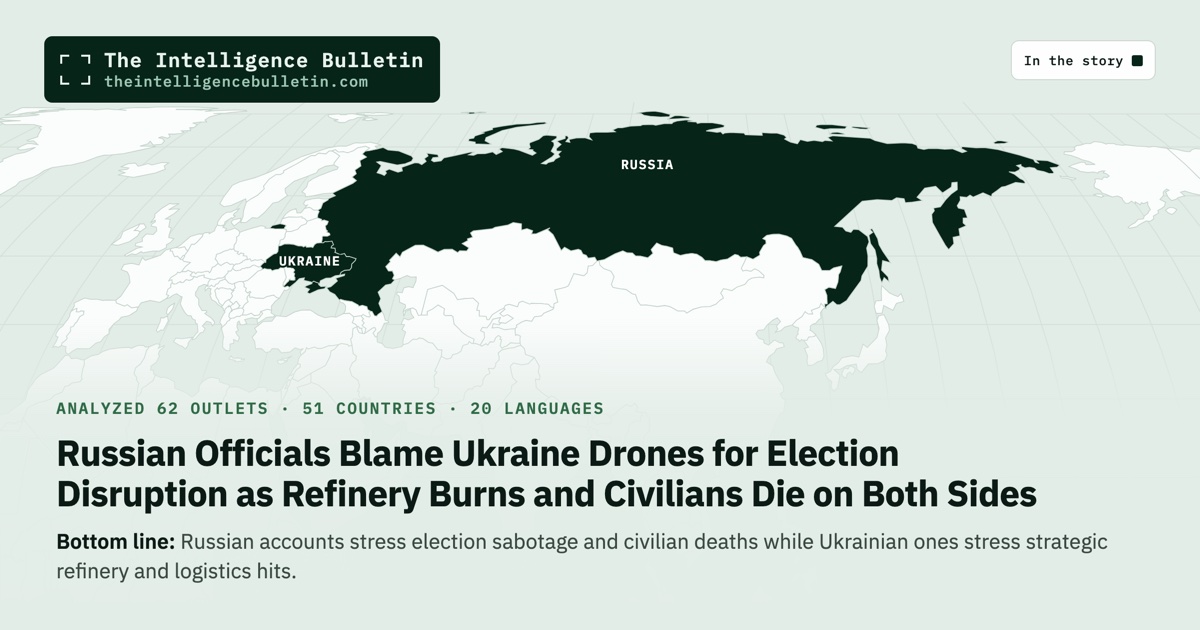
Russian Officials Blame Ukraine Drones for Election Disruption as Refinery Burns and Civilians Die on Both Sides

Map of the countries in the story: Russian Officials Blame Ukraine Drones for Election Disruption as Refinery Burns and Civilians Die on Both Sides
On September 20, 2026, Ukraine launched hundreds of drones toward Moscow and surrounding areas on the final day of Russia’s parliamentary elections. Russian authorities reported intercepting more than 1,600 drones since the previous day, with damage to the Moscow Oil Refinery and a logistics warehouse, plus two or three deaths and injuries in the Moscow region. Ukrainian President Zelenskyy praised the strikes on energy and logistics facilities. Reports also noted concurrent Russian drone attacks killing civilians near Kyiv.

One Story. Many Angles.

🇺🇦
Ukraine
Kyiv Post
Carries AFP reporting
Largest Drone Strike on Moscow Hits Oil Refinery and Logistics Hub
Read →
🇷🇺
Russia
The Moscow Times
Carries Reuters reporting
2 Dead in Moscow Region, Drones Hit Oil Refinery in Russian Capital
Read →
🇶🇦
Qatar
Al Jazeera
Original reporting
Mass Ukrainian drone attack on Moscow kills two, Russia says
Read →
🇭🇰
Hong Kong
South China Morning Post
Carries Reuters reporting
Ukraine pummels Moscow with drones on last day of Russian election
Read →
🇩🇪
Germany
Deutsche Welle
GERMAN
dpa, AP, AFP, Reuters wire copy
Russia and Ukraine report new deadly attacks
“Russland und Ukraine melden neue tödliche Angriffe”
Read →
5 sources · 4 independent accounts — some share the same news agency’s report
Analyzed 62 outlets across 51 countries and 20 languages
In Brief

Russian accounts stress election sabotage and civilian deaths while Ukrainian ones stress strategic refinery and logistics hits.

Russian officials across multiple accounts uniformly described the barrage as an unprecedented attempt to disrupt elections, emphasizing successful interceptions and civilian casualties while downplaying infrastructure damage. Ukrainian reporting instead framed the same events as precise, high-impact strikes on a major refinery supplying the capital and a key logistics site, underscoring strategic degradation of Russia’s war economy. Outlets from Qatar, Hong Kong and Germany converged on the election timing and reciprocal nature of the strikes, noting both Russian claims of election interference and Ukrainian reports of four deaths, including three children, from Russian drones near Kyiv. The exile Russian voice added on-the-ground detail of evacuations and resident accounts unavailable from state media. No independent verification of exact drone numbers or precise damage appeared across any chain, leaving casualty figures and strategic intent as the clearest points of divergence between actor narratives and observer framing. The pattern shows consistent reliance on official Russian statements for Moscow details while Ukrainian and third-party sources supply the counter-claims of mutual escalation.

Perspective Analysis

Ukraine launched a wave of drones at Moscow and the surrounding region in the early hours of September 20, 2026, the final day of Russia’s three-day parliamentary elections. Russian authorities said air defenses intercepted more than 1,600 drones across defensive lines since the previous day, with roughly 450 of them approaching the capital itself. Moscow Mayor Sergei Sobyanin reported that several drones reached the grounds of the Moscow Oil Refinery in Kapotnya, damaging a facility there, and that one drone struck an apartment building along Orekhovy Boulevard. Moscow Region Governor Andrei Vorobyov said the attacks killed two people—a 44-year-old woman and an elderly man—in separate locations and injured six others, with the heaviest damage in the Ramensky district. A logistics warehouse complex operated by Sovremennye Skladskie Tekhnologii in Sofyino caught fire after drone impacts, and emergency crews evacuated 400 people, including 70 children, from a 21-storey apartment block in the Ramenskoye district after a drone started a blaze there.

Ukrainian President Volodymyr Zelenskyy described the operation as a significant blow, stating that long-range Ukrainian responses had struck one of Russia’s key oil industry facilities and a logistics site in the Moscow region. He added that these targets represented billions of dollars sustaining the Russian war machine. The Moscow Oil Refinery processes about 11 million metric tons of crude oil annually and supplies roughly 40 percent of the capital’s fuel needs along with 70 percent of its gasoline and aviation kerosene. Kyiv Post reporting, drawing on geolocated footage verified by the independent outlet Astra, confirmed an extensive fire at the Gazprom Neft facility and noted that Ukrainian defense firm Fire Point had announced use of its FP-1 long-range drones against the Sofyino warehouse.

Russian officials tied the timing directly to the elections. Sobyanin stated on his Telegram channel that the attack was clearly planned to disrupt voting and that the adversary had failed. The parliamentary vote, which began on September 18 and runs across Russia’s eleven time zones, is expected to return a large majority for the ruling United Russia party. Voting is also taking place in Russian-controlled portions of Ukraine’s Donetsk, Luhansk, Zaporizhzhia, and Kherson regions, a step Ukraine and much of the international community have condemned as a violation of international law.

The same night, Ukrainian authorities reported Russian drone strikes on the Kyiv region that killed four civilians, including three children. Kyiv region Governor Tymur Tkachenko said a mother and her two three-year-old children died when a drone hit their home, while a separate strike killed a girl who later died in hospital. Thirty-one sites across five districts were damaged, with the heaviest concentration in the southwestern Fastiv district. Al Jazeera and Deutsche Welle carried these Ukrainian figures alongside the Russian reports from Moscow.

Accounts of the Moscow attack converge on the refinery damage and the deaths in the region. Sobyanin and Vorobyov supplied the details that appeared in every one of the five outlets examined. The 1,600-drone interception figure, however, originates solely from Sobyanin’s statements and receives no independent confirmation in any of the reporting. Casualty counts in the Moscow region stabilized at two or three after an initial report of two deaths was updated by the exiled Moscow Times, which cited Vorobyov. No outlet published verified assessments of how much refining capacity was lost or how long repairs might take.

Russian framing across the outlets consistently presented the barrage as an election-day provocation. The exiled Moscow Times, drawing on Reuters reporting and regional governor statements, led with the updated death toll and quoted Sobyanin accusing Ukraine of attempting to interfere with voting. South China Morning Post, also relaying Reuters, emphasized the mayor’s claim that the attack was the largest yet and had been repelled. Deutsche Welle, using agency copy, noted the election context while recording both Russian and Ukrainian casualty claims in parallel.

Ukrainian reporting placed the emphasis on strategic effect. Kyiv Post described the operation as the largest drone strike yet on Moscow, highlighting the refinery’s role in supplying the capital and the destruction of the logistics hub. It placed the attack in a sequence of earlier strikes on Rostov-on-Don and Yaroslavl refineries earlier in the month. Zelenskyy’s praise for the hits appeared in Al Jazeera’s account but not in the Kyiv Post piece examined.

Observer outlets from Qatar, Hong Kong, and Germany noted the reciprocal pattern. Al Jazeera reported staff observations from both capitals and recorded Zelenskyy’s statement alongside Russian casualty figures. Deutsche Welle explicitly juxtaposed the Moscow region deaths with the four civilian deaths near Kyiv. South China Morning Post stayed closer to the Russian official narrative and gave minimal space to Ukrainian claims.

The clearest divergence lies in intent and consequence. Russian sources portray the attack as a failed attempt to sow disorder on election day, with emphasis on interceptions and civilian harm inside Russia. Ukrainian sources present it as a deliberate degradation of energy infrastructure that funds the war, with emphasis on the economic and logistical value of the targets hit. The exile Russian outlet adds resident accounts of glass, debris, and evacuations that state media inside Russia would not publish, yet it still aligns with the official Russian line on election disruption. Third-country outlets converge on the mutual nature of the strikes but differ in how much weight they give to each side’s narrative.

The corroborated elements—refinery and warehouse damage plus deaths on both sides—rest on overlapping official statements from the two governments and appear in every outlet. The single-source drone count and the precise strategic value assigned to the targets remain assertions advanced by one side. No reporting chain supplies an independent measure of either the number of drones launched or the operational impact on the refinery. Readers relying on any single national framing therefore receive a consistent but partial picture: Russian accounts foreground disruption and civilian toll inside Russia; Ukrainian accounts foreground infrastructure degradation; observer accounts record both without resolving the gap between them.

What to Watch

The pattern that emerges is one of mutual long-range strikes on energy and logistics targets, conducted on a day when Russian voters were choosing a new parliament under wartime conditions. The refinery strike adds to a series of earlier Ukrainian attacks that have already reduced Russian refining capacity and contributed to fuel shortages in multiple regions. The Kyiv region deaths add to a parallel pattern of Russian strikes on Ukrainian civilian areas. Absent independent verification of launch numbers or damage assessments, the competing claims about intent and relative success rest on the statements of the two governments and the selection each outlet makes among those statements. The next round of reporting will likely turn on whether the Moscow refinery returns to full operation before winter fuel demand peaks and whether either side adjusts its targeting in response to the casualties recorded on September 20.


Share this story

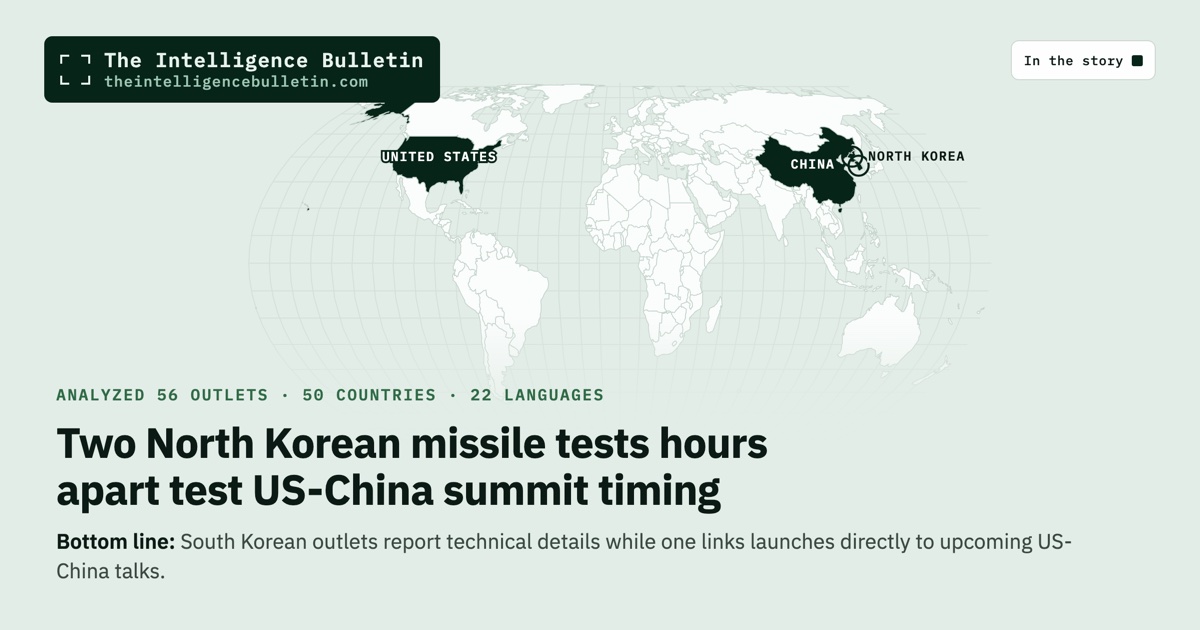
Two North Korean missile tests hours apart test US-China summit timing

Map of the countries in the story: Two North Korean missile tests hours apart test US-China summit timing
North Korea launched two short-range ballistic missiles from the Wonsan area on its east coast toward the East Sea on September 20, 2026. South Korea’s Joint Chiefs of Staff reported the first at 3 p.m. KST flying about 450 km and the second at 5:50 p.m. flying over 600 km. South Korea and Japan condemned the tests as violations of UN Security Council resolutions. The launches follow recent US-led military drills and come days before a planned US-China summit.

One Story. Many Angles.

🇰🇷
South Korea
NK News
Original reporting
North Korea launches ‘unidentified projectile’ toward East Sea: JCS
Read →
🇰🇷
South Korea
The Korea Herald
Original reporting
[Breaking] North Korea fires projectile toward East Sea
Read →
🇯🇵
Japan
Nikkei Asia
Carries Reuters reporting
North Korea fires two missiles off east coast in three hours
Read →
🇰🇷
South Korea
The Hankyoreh
KOREAN
Original reporting
North Korea fires ballistic missiles twice a day… ‘signal that denuclearization is impossible’ ahead of US-China summit?
“북 하루 두 차례 탄도미사일 발사…미-중 정상회담 앞 ‘비핵화 불가’ 신호?”
Read →
🇩🇪
Germany
Deutschlandfunk
GERMAN
Carries Yonhap reporting
Conflict – South Korea: North Korea fires projectile towards the sea
“Konflikt – Südkorea: Nordkorea feuert Geschoss in Richtung Meer”
Read →
5 sources · each independently reported
Analyzed 56 outlets across 50 countries and 22 languages
In Brief

South Korean outlets report technical details while one links launches directly to upcoming US-China talks.

South Korean and Japanese reporting converges on the technical details of two short-range ballistic missile launches from Wonsan, yet diverges sharply in framing. NK News and The Korea Herald stick closely to Joint Chiefs of Staff statements about flight paths and detection, presenting the event as a monitored security incident. Nikkei Asia emphasizes the repeated nature within three hours and allied monitoring, reflecting Japan’s direct stake in regional alerts. The Hankyoreh alone ties the timing explicitly to the impending Trump-Xi meeting, interpreting the tests as Pyongyang’s signal that denuclearization remains off the table in any talks. Deutschlandfunk reports the incident through a European lens of ongoing Korean conflict and UN prohibitions, noting the South Korean security council meeting without the political linkage to US-China diplomacy. This pattern shows that outlets closest to the launches prioritize factual alerts and condemnation, while those with broader diplomatic context add the signal to Washington and Beijing. The absence of any North Korean-sourced account in the set leaves the motive inferred rather than stated, making the Hankyoreh’s interpretation the clearest departure from the shared factual core.

Perspective Analysis

North Korea launched two short-range ballistic missiles from the Wonsan area on its east coast on September 20, 2026. South Korea’s Joint Chiefs of Staff detected the first launch around 3 p.m. local time. The missile flew approximately 450 kilometers before landing in the East Sea. Roughly two hours and fifty minutes later, at 5:50 p.m., a second missile left the same area and traveled more than 600 kilometers. Japanese authorities confirmed both projectiles as ballistic missiles and noted that they fell outside Japan’s exclusive economic zone.

South Korea’s National Security Council convened the same day and issued a condemnation. It described the tests as direct violations of United Nations Security Council resolutions and called on Pyongyang to halt further activity. Japan lodged a formal protest through diplomatic channels in Beijing and its defense minister stated that the actions threatened the peace and security of Japan, the region, and the international community. South Korean and American intelligence shared tracking data with Japan from the outset.

The launches occurred two days after Kim Yo Jong, the influential sister of North Korean leader Kim Jong Un, issued a public statement. She blamed U.S.-led military drills in the Pacific for worsening tensions and warned that Pyongyang would need a response of equal or greater force. The tests also followed a September 12 launch of multiple short-range missiles from the same Wonsan site that flew roughly 250 kilometers. North Korea had described that earlier exercise as part of a concentrated attack drill involving missiles, drones, and other weapons.

The timing placed the new tests days before a planned visit by Chinese leader Xi Jinping to the United States for a summit with President Donald Trump on September 24. Trump had recently indicated readiness for direct talks with Kim Jong Un and had directed a reduction in the scale of some U.S.-South Korea joint exercises. North Korea had rejected a recent resolution by the International Atomic Energy Agency on its nuclear program and had dismissed U.S. military activity as the source of instability.

South Korean and Japanese reporting converged on the core technical facts. The Joint Chiefs of Staff account of two launches, their times, origins, and approximate ranges appeared in both South Korean and Japanese dispatches. Japanese authorities added confirmation that the weapons were ballistic missiles and supplied the detail that the projectiles stayed outside Japan’s exclusive economic zone. South Korea’s National Security Council condemnation was carried across the same outlets.

Coverage diverged in emphasis and added context. NK News and The Korea Herald stayed close to the Joint Chiefs of Staff statements, reporting the detections and flight distances with limited additional framing. Nikkei Asia highlighted the short interval between the two launches and the coordinated allied monitoring that followed. The Hankyoreh alone connected the tests explicitly to the upcoming Trump-Xi meeting, presenting them as a deliberate signal that North Korea would not entertain denuclearization demands in any negotiations. Deutschlandfunk described the incident as part of the ongoing conflict between the two Koreas, noted the South Korean security council meeting, and recorded the Japanese view that the launch was ballistic, without linking the event to the summit schedule.

The absence of any North Korean-sourced reporting in the available coverage left the motive for the timing open to inference. All accounts that addressed background pointed to the same sequence of recent U.S.-led drills and Kim Yo Jong’s September 18 statement as the immediate context. The corroborated details of the launches and the South Korean condemnation rest on independent reporting chains from Seoul and Tokyo. The interpretation that the tests were aimed at the summit rests on a single outlet’s analysis of timing and prior statements.

What to Watch

The technical record of two launches with the stated ranges and the South Korean condemnation therefore stands on the strongest ground. That record shows North Korea continuing a pattern of short-range ballistic missile activity despite repeated UN prohibitions. The summit timing adds a diplomatic layer that one South Korean outlet found significant, but the primary evidence for that connection remains the published sequence of events rather than any direct statement from Pyongyang. The next several days will show whether the tests alter the agenda or the tone of the Trump-Xi discussions or whether they register mainly as another data point in the long-running standoff.


Share this story