One Story. Many Angles.
Russian accounts stress election sabotage and civilian deaths while Ukrainian ones stress strategic refinery and logistics hits.
Russian officials across multiple accounts uniformly described the barrage as an unprecedented attempt to disrupt elections, emphasizing successful interceptions and civilian casualties while downplaying infrastructure damage. Ukrainian reporting instead framed the same events as precise, high-impact strikes on a major refinery supplying the capital and a key logistics site, underscoring strategic degradation of Russia’s war economy. Outlets from Qatar, Hong Kong and Germany converged on the election timing and reciprocal nature of the strikes, noting both Russian claims of election interference and Ukrainian reports of four deaths, including three children, from Russian drones near Kyiv. The exile Russian voice added on-the-ground detail of evacuations and resident accounts unavailable from state media. No independent verification of exact drone numbers or precise damage appeared across any chain, leaving casualty figures and strategic intent as the clearest points of divergence between actor narratives and observer framing. The pattern shows consistent reliance on official Russian statements for Moscow details while Ukrainian and third-party sources supply the counter-claims of mutual escalation.
Perspective Analysis
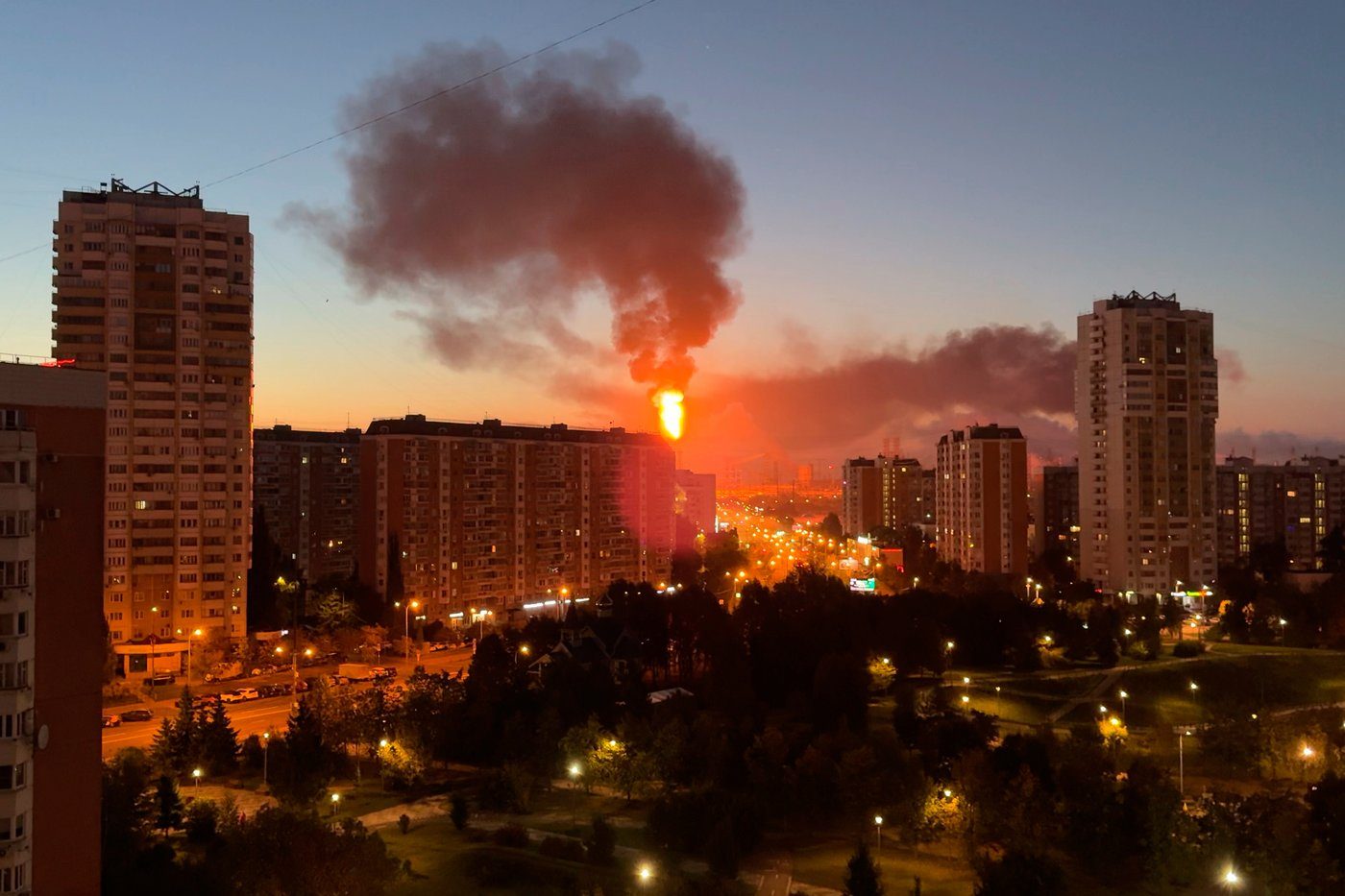
Ukraine launched a wave of drones at Moscow and the surrounding region in the early hours of September 20, 2026, the final day of Russia’s three-day parliamentary elections. Russian authorities said air defenses intercepted more than 1,600 drones across defensive lines since the previous day, with roughly 450 of them approaching the capital itself. Moscow Mayor Sergei Sobyanin reported that several drones reached the grounds of the Moscow Oil Refinery in Kapotnya, damaging a facility there, and that one drone struck an apartment building along Orekhovy Boulevard. Moscow Region Governor Andrei Vorobyov said the attacks killed two people—a 44-year-old woman and an elderly man—in separate locations and injured six others, with the heaviest damage in the Ramensky district. A logistics warehouse complex operated by Sovremennye Skladskie Tekhnologii in Sofyino caught fire after drone impacts, and emergency crews evacuated 400 people, including 70 children, from a 21-storey apartment block in the Ramenskoye district after a drone started a blaze there.
Ukrainian President Volodymyr Zelenskyy described the operation as a significant blow, stating that long-range Ukrainian responses had struck one of Russia’s key oil industry facilities and a logistics site in the Moscow region. He added that these targets represented billions of dollars sustaining the Russian war machine. The Moscow Oil Refinery processes about 11 million metric tons of crude oil annually and supplies roughly 40 percent of the capital’s fuel needs along with 70 percent of its gasoline and aviation kerosene. Kyiv Post reporting, drawing on geolocated footage verified by the independent outlet Astra, confirmed an extensive fire at the Gazprom Neft facility and noted that Ukrainian defense firm Fire Point had announced use of its FP-1 long-range drones against the Sofyino warehouse.
Russian officials tied the timing directly to the elections. Sobyanin stated on his Telegram channel that the attack was clearly planned to disrupt voting and that the adversary had failed. The parliamentary vote, which began on September 18 and runs across Russia’s eleven time zones, is expected to return a large majority for the ruling United Russia party. Voting is also taking place in Russian-controlled portions of Ukraine’s Donetsk, Luhansk, Zaporizhzhia, and Kherson regions, a step Ukraine and much of the international community have condemned as a violation of international law.
The same night, Ukrainian authorities reported Russian drone strikes on the Kyiv region that killed four civilians, including three children. Kyiv region Governor Tymur Tkachenko said a mother and her two three-year-old children died when a drone hit their home, while a separate strike killed a girl who later died in hospital. Thirty-one sites across five districts were damaged, with the heaviest concentration in the southwestern Fastiv district. Al Jazeera and Deutsche Welle carried these Ukrainian figures alongside the Russian reports from Moscow.
Accounts of the Moscow attack converge on the refinery damage and the deaths in the region. Sobyanin and Vorobyov supplied the details that appeared in every one of the five outlets examined. The 1,600-drone interception figure, however, originates solely from Sobyanin’s statements and receives no independent confirmation in any of the reporting. Casualty counts in the Moscow region stabilized at two or three after an initial report of two deaths was updated by the exiled Moscow Times, which cited Vorobyov. No outlet published verified assessments of how much refining capacity was lost or how long repairs might take.
Russian framing across the outlets consistently presented the barrage as an election-day provocation. The exiled Moscow Times, drawing on Reuters reporting and regional governor statements, led with the updated death toll and quoted Sobyanin accusing Ukraine of attempting to interfere with voting. South China Morning Post, also relaying Reuters, emphasized the mayor’s claim that the attack was the largest yet and had been repelled. Deutsche Welle, using agency copy, noted the election context while recording both Russian and Ukrainian casualty claims in parallel.
Ukrainian reporting placed the emphasis on strategic effect. Kyiv Post described the operation as the largest drone strike yet on Moscow, highlighting the refinery’s role in supplying the capital and the destruction of the logistics hub. It placed the attack in a sequence of earlier strikes on Rostov-on-Don and Yaroslavl refineries earlier in the month. Zelenskyy’s praise for the hits appeared in Al Jazeera’s account but not in the Kyiv Post piece examined.
Observer outlets from Qatar, Hong Kong, and Germany noted the reciprocal pattern. Al Jazeera reported staff observations from both capitals and recorded Zelenskyy’s statement alongside Russian casualty figures. Deutsche Welle explicitly juxtaposed the Moscow region deaths with the four civilian deaths near Kyiv. South China Morning Post stayed closer to the Russian official narrative and gave minimal space to Ukrainian claims.
The clearest divergence lies in intent and consequence. Russian sources portray the attack as a failed attempt to sow disorder on election day, with emphasis on interceptions and civilian harm inside Russia. Ukrainian sources present it as a deliberate degradation of energy infrastructure that funds the war, with emphasis on the economic and logistical value of the targets hit. The exile Russian outlet adds resident accounts of glass, debris, and evacuations that state media inside Russia would not publish, yet it still aligns with the official Russian line on election disruption. Third-country outlets converge on the mutual nature of the strikes but differ in how much weight they give to each side’s narrative.
The corroborated elements—refinery and warehouse damage plus deaths on both sides—rest on overlapping official statements from the two governments and appear in every outlet. The single-source drone count and the precise strategic value assigned to the targets remain assertions advanced by one side. No reporting chain supplies an independent measure of either the number of drones launched or the operational impact on the refinery. Readers relying on any single national framing therefore receive a consistent but partial picture: Russian accounts foreground disruption and civilian toll inside Russia; Ukrainian accounts foreground infrastructure degradation; observer accounts record both without resolving the gap between them.
What to Watch
The pattern that emerges is one of mutual long-range strikes on energy and logistics targets, conducted on a day when Russian voters were choosing a new parliament under wartime conditions. The refinery strike adds to a series of earlier Ukrainian attacks that have already reduced Russian refining capacity and contributed to fuel shortages in multiple regions. The Kyiv region deaths add to a parallel pattern of Russian strikes on Ukrainian civilian areas. Absent independent verification of launch numbers or damage assessments, the competing claims about intent and relative success rest on the statements of the two governments and the selection each outlet makes among those statements. The next round of reporting will likely turn on whether the Moscow refinery returns to full operation before winter fuel demand peaks and whether either side adjusts its targeting in response to the casualties recorded on September 20.
That’s how the world told the story.
Get tomorrow’s bulletin by email — one briefing, up to six stories.
Subscribe freeNo spam. One-click unsubscribe. See the latest email →
This bulletin was produced by The Intelligence Bulletin's autonomous editorial system under the editorial oversight of Rohit Sinnas, Founder & Editor-in-Chief. How it works →