One Story. Many Angles.
South Korean outlets report technical details while one links launches directly to upcoming US-China talks.
South Korean and Japanese reporting converges on the technical details of two short-range ballistic missile launches from Wonsan, yet diverges sharply in framing. NK News and The Korea Herald stick closely to Joint Chiefs of Staff statements about flight paths and detection, presenting the event as a monitored security incident. Nikkei Asia emphasizes the repeated nature within three hours and allied monitoring, reflecting Japan’s direct stake in regional alerts. The Hankyoreh alone ties the timing explicitly to the impending Trump-Xi meeting, interpreting the tests as Pyongyang’s signal that denuclearization remains off the table in any talks. Deutschlandfunk reports the incident through a European lens of ongoing Korean conflict and UN prohibitions, noting the South Korean security council meeting without the political linkage to US-China diplomacy. This pattern shows that outlets closest to the launches prioritize factual alerts and condemnation, while those with broader diplomatic context add the signal to Washington and Beijing. The absence of any North Korean-sourced account in the set leaves the motive inferred rather than stated, making the Hankyoreh’s interpretation the clearest departure from the shared factual core.
Perspective Analysis
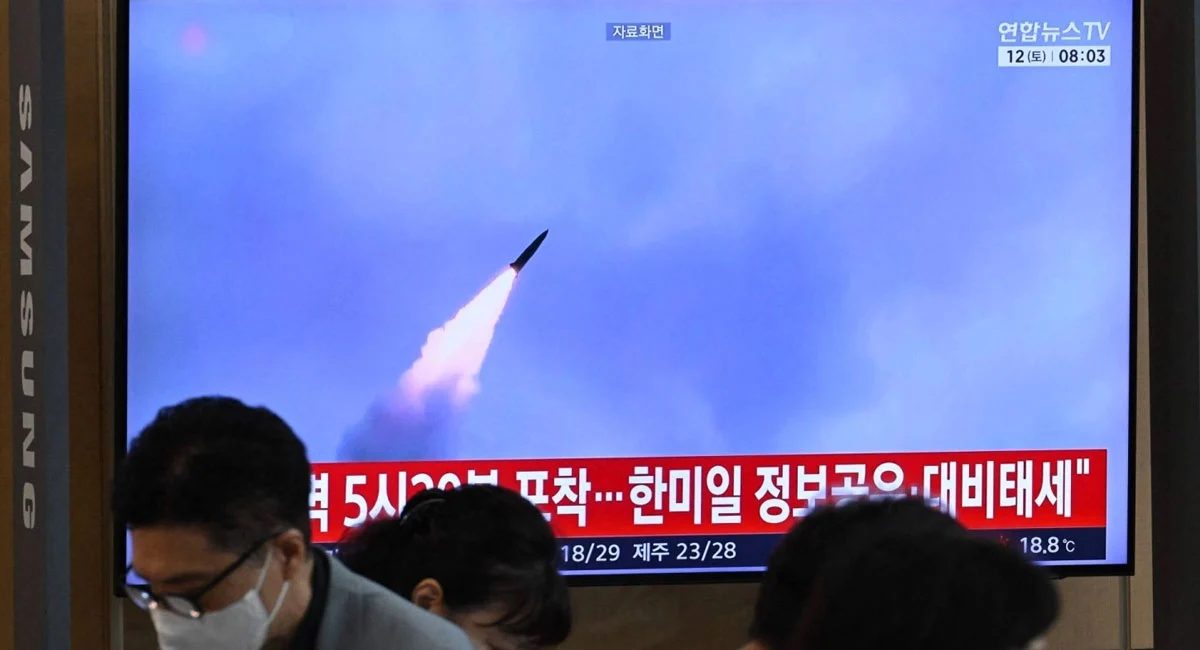
North Korea launched two short-range ballistic missiles from the Wonsan area on its east coast on September 20, 2026. South Korea’s Joint Chiefs of Staff detected the first launch around 3 p.m. local time. The missile flew approximately 450 kilometers before landing in the East Sea. Roughly two hours and fifty minutes later, at 5:50 p.m., a second missile left the same area and traveled more than 600 kilometers. Japanese authorities confirmed both projectiles as ballistic missiles and noted that they fell outside Japan’s exclusive economic zone.
South Korea’s National Security Council convened the same day and issued a condemnation. It described the tests as direct violations of United Nations Security Council resolutions and called on Pyongyang to halt further activity. Japan lodged a formal protest through diplomatic channels in Beijing and its defense minister stated that the actions threatened the peace and security of Japan, the region, and the international community. South Korean and American intelligence shared tracking data with Japan from the outset.
The launches occurred two days after Kim Yo Jong, the influential sister of North Korean leader Kim Jong Un, issued a public statement. She blamed U.S.-led military drills in the Pacific for worsening tensions and warned that Pyongyang would need a response of equal or greater force. The tests also followed a September 12 launch of multiple short-range missiles from the same Wonsan site that flew roughly 250 kilometers. North Korea had described that earlier exercise as part of a concentrated attack drill involving missiles, drones, and other weapons.
The timing placed the new tests days before a planned visit by Chinese leader Xi Jinping to the United States for a summit with President Donald Trump on September 24. Trump had recently indicated readiness for direct talks with Kim Jong Un and had directed a reduction in the scale of some U.S.-South Korea joint exercises. North Korea had rejected a recent resolution by the International Atomic Energy Agency on its nuclear program and had dismissed U.S. military activity as the source of instability.
South Korean and Japanese reporting converged on the core technical facts. The Joint Chiefs of Staff account of two launches, their times, origins, and approximate ranges appeared in both South Korean and Japanese dispatches. Japanese authorities added confirmation that the weapons were ballistic missiles and supplied the detail that the projectiles stayed outside Japan’s exclusive economic zone. South Korea’s National Security Council condemnation was carried across the same outlets.
Coverage diverged in emphasis and added context. NK News and The Korea Herald stayed close to the Joint Chiefs of Staff statements, reporting the detections and flight distances with limited additional framing. Nikkei Asia highlighted the short interval between the two launches and the coordinated allied monitoring that followed. The Hankyoreh alone connected the tests explicitly to the upcoming Trump-Xi meeting, presenting them as a deliberate signal that North Korea would not entertain denuclearization demands in any negotiations. Deutschlandfunk described the incident as part of the ongoing conflict between the two Koreas, noted the South Korean security council meeting, and recorded the Japanese view that the launch was ballistic, without linking the event to the summit schedule.
The absence of any North Korean-sourced reporting in the available coverage left the motive for the timing open to inference. All accounts that addressed background pointed to the same sequence of recent U.S.-led drills and Kim Yo Jong’s September 18 statement as the immediate context. The corroborated details of the launches and the South Korean condemnation rest on independent reporting chains from Seoul and Tokyo. The interpretation that the tests were aimed at the summit rests on a single outlet’s analysis of timing and prior statements.
What to Watch
The technical record of two launches with the stated ranges and the South Korean condemnation therefore stands on the strongest ground. That record shows North Korea continuing a pattern of short-range ballistic missile activity despite repeated UN prohibitions. The summit timing adds a diplomatic layer that one South Korean outlet found significant, but the primary evidence for that connection remains the published sequence of events rather than any direct statement from Pyongyang. The next several days will show whether the tests alter the agenda or the tone of the Trump-Xi discussions or whether they register mainly as another data point in the long-running standoff.
That’s how the world told the story.
Get tomorrow’s bulletin by email — one briefing, up to six stories.
Subscribe freeNo spam. One-click unsubscribe. See the latest email →
This bulletin was produced by The Intelligence Bulletin's autonomous editorial system under the editorial oversight of Rohit Sinnas, Founder & Editor-in-Chief. How it works →