Trump’s UN Iran Choice Reveals Backchannel Talks Across Divergent National Frames

Map of the countries in the story: Trump's UN Iran Choice Reveals Backchannel Talks Across Divergent National Frames
US President Donald Trump told the UN General Assembly on September 22 that he faces a binary choice on Iran: negotiate a deal allowing reconstruction or annihilate the Islamic Republic to prevent future threats. He predicted an agreement after November US midterms. Reports confirmed US and Iranian officials met that day. The remarks occurred amid an ongoing US-Israel war with Iran over nuclear and regional issues.

One Story. Many Angles.

🇬🇧
United Kingdom
Middle East Eye
Original reporting
Trump says choosing between deal or driving Iran ‘into hell’
Read →
🇳🇬
Nigeria
Punch
Carries AFP reporting
Trump weighs Iran deal against ‘driving them into hell’
Read →
🇮🇱
Israel
Ynetnews
Original reporting
Trump threatens Iran with ‘hell’ at UN, predicts deal after US midterm elections
Read →
🇸🇦
Saudi Arabia
Arab News
Original reporting
Arab News | Trump says US and Iranian officials met Tuesday, shortly after warning he may ‘annihilate’ Iran
Read →
🇳🇱
Netherlands
NRC
DUTCH
Original reporting
Trump faces a dilemma, he says at the UN: an agreement with Iran or ‘destroying’ the country
“Trump staat voor een dilemma, zegt hij bij de VN: een akkoord met Iran of het land ‘vernietigen’”
Read →
5 sources · each independently reported
Analyzed 65 outlets across 56 countries and 14 languages
In Brief

Coverage splits between pure threat framing and emphasis on imminent diplomatic contact.

The reporting converges on Trump’s explicit binary framing yet diverges sharply on whether the dominant note is threat or diplomacy. Middle East Eye and NRC lead with the annihilation language as the core dilemma, reflecting critical lenses on escalation. Punch frames it as a US policy binary with global fallout, while Ynetnews adds the post-midterm timeline and Israeli security context. Arab News uniquely pairs the threat with confirmation of Tuesday’s US-Iran meeting and Rubio’s openness to Pezeshkian talks, underscoring contact over confrontation. This pattern shows how regional stakes shape emphasis: Israeli and Saudi sources balance pressure with engagement signals, European and African ones stress the stark choice, and UK-based Middle East coverage highlights risk. The consistent prediction of a post-election deal across independent chains suggests the ultimatum functions more as leverage than immediate prelude to total war, a nuance no single national press captured alone.

Perspective Analysis

US President Donald Trump stood before the United Nations General Assembly on September 22 and described a single stark decision on Iran. He said the United States could reach an agreement that would let the Islamic Republic rebuild and become one of the greatest countries in the Middle East or the world. Or it could annihilate the Islamic Republic quickly, denying it any chance to kill and destroy people and countries again, driving it into hell with no survival or hope of future generations. Trump framed the choice as his alone to make.

The speech came seven months into a war the United States and Israel have waged against Iran over its nuclear program and regional actions. Trump defended the decision to open that conflict, saying previous diplomatic efforts had failed and that Iran had rejected terms meant to block nuclear weapons. He told the assembly that Iranian leaders were waiting to see the outcome of November midterm elections before committing to talks, but he insisted a deal would still be reached afterward because it made no sense for them to refuse. He added that he himself was not on the ballot and would help Republicans in the campaign.

Four of the five outlets that carried the remarks reported this post-election prediction in nearly identical language. Middle East Eye, Punch, Ynetnews and NRC all quoted Trump saying an agreement would come right after the vote. Arab News alone added that US and Iranian officials had already met on Tuesday, hours after the address. Trump described that session to reporters as very good but gave no further details on participants or substance. Secretary of State Marco Rubio separately told NBC that Trump remained open to a direct meeting with Iranian President Masoud Pezeshkian while both leaders were in New York, though Rubio noted that Iran’s supreme leader holds final authority.

Trump also used the address to list other diplomatic and military moves. He celebrated the recent US operation that removed Venezuelan President Nicolás Maduro, announced a new security agreement with Greenland that will expand American military bases there, and pressed for economic isolation of Iran until it stops attacks on shipping, abandons nuclear ambitions and ends support for terrorism. He invoked the October 7, 2023 Hamas attack on Israel and said Iran could never be allowed a nuclear arsenal. Meetings scheduled after the speech included separate sessions with Ukrainian President Volodymyr Zelensky, Gulf leaders and Venezuela’s acting President Delcy Rodríguez.

The accounts diverge on what the binary choice itself signals. Middle East Eye and NRC present the annihilation option as the central and most immediate element, quoting the full passage on driving Iran into hell and placing it against the backdrop of an organization founded to pursue peace. Punch relays the same language but situates the decision inside a broader US policy dilemma that carries consequences for global energy markets and fuel prices. Ynetnews folds the threat into an Israeli security reading, linking it to the need to prevent nuclear weapons and to the precedent of the Gaza ceasefire Trump said his administration helped secure. Arab News pairs the warning with the confirmed Tuesday meeting and Rubio’s comments, giving equal weight to the possibility of engagement.

These differences track the outlets’ locations. The Israeli and Saudi pieces balance pressure with signals of contact. The Dutch and British Middle East-focused pieces foreground the risk of escalation. The Nigerian outlet, drawing on agency copy, stresses worldwide fallout without regional alignment. No outlet contradicted the core quotes; the variation lies in which part of the same text each chose to emphasize and which surrounding facts it placed beside it.

The single-source detail of the Tuesday meeting stands apart. Only Arab News reported Trump’s confirmation of that session. The other four outlets carried the speech and the election prediction but did not mention any immediate follow-up contact. Rubio’s openness to a Pezeshkian meeting appeared in both Arab News and Ynetnews, giving that element two independent chains.

The most widely corroborated elements are therefore the binary framing itself and the prediction of a deal after the midterms. Those appear across four separate reporting lines and match Trump’s words on the record. The meeting detail, while narrower, supplies concrete evidence that diplomacy did not wait for the election. Taken together, the reporting shows an ultimatum delivered in public that was accompanied, at least in one documented case, by private contact the same day.

What to Watch

The pattern suggests the stark language functions as leverage rather than an announcement of imminent total war. Trump has an interest in projecting resolve to domestic audiences facing higher fuel prices and to regional allies wary of Iranian capabilities. At the same time, the consistent forecast of a post-election agreement and the reported Tuesday meeting indicate that both sides retain channels. What happens next will turn on whether those channels produce terms acceptable to Iran’s leadership before November or whether the military and economic pressure Trump described intensifies instead. The sources leave that outcome open, but they document that the choice Trump described is already being tested in practice.
Share this story

Trump signs Arctic deal with Denmark and Greenland but control and sovereignty claims diverge

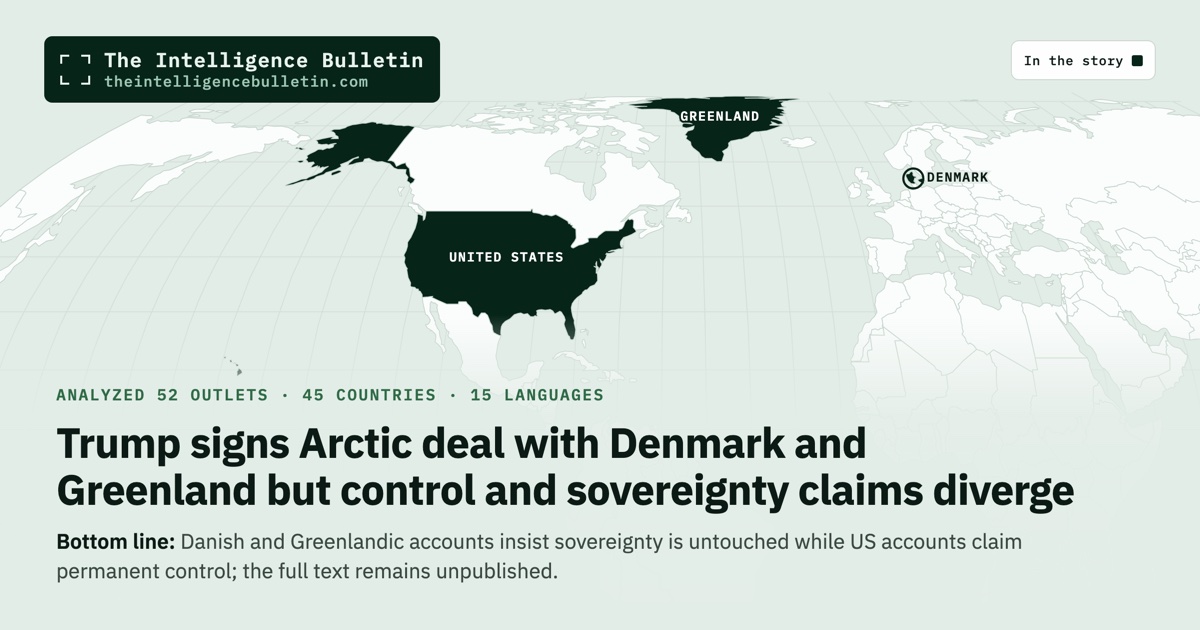
Map of the countries in the story: Trump signs Arctic deal with Denmark and Greenland but control and sovereignty claims diverge
US President Donald Trump, Danish Prime Minister Mette Frederiksen and Greenland government head Jens-Frederik Nielsen signed a security agreement at the United Nations in New York on Tuesday. The deal expands US military presence in Greenland, including reopening bases at Narsarsuaq and Mestersvig, while recognizing Danish sovereignty and Greenland self-determination. Trump described it as granting the US permanent control over security and veto power over adversaries; Danish and Greenlandic leaders stressed that sovereignty remains intact and NATO shares Arctic responsibility. The agreement ends months of tension after earlier US threats regarding the territory.

One Story. Many Angles.

🇩🇰
Denmark
Copenhagen Post
Original reporting
Denmark, Greenland and USA to sign Arctic security agreement Tuesday in New York
Read →
🇺🇸
United States
Foreign Policy
Original reporting
Trump Announces Security Deal With Denmark and Greenland
Read →
🇬🇱
Greenland
Sermitsiaq
DANISH
Original reporting
Trump shares new photo with Greenland
“Trump deler nyt billede med Grønland”
Read →
🇶🇦
Qatar
Al Jazeera
Carries Reuters reporting
Where is the US opening new military bases in Greenland?
Read →
🇭🇰
Hong Kong
South China Morning Post
Carries Reuters reporting
US, Greenland, Denmark to sign deal at UN in New York in bid to end Arctic stand-off
Read →
5 sources · 4 independent accounts — some share the same news agency’s report
Analyzed 52 outlets across 45 countries and 15 languages
In Brief

Danish and Greenlandic accounts insist sovereignty is untouched while US accounts claim permanent control; the full text remains unpublished.

The reporting converges on the fact of the signing and the planned new bases but parts company sharply on what the text actually transfers. Danish coverage stresses that sovereignty and self-determination are explicitly preserved and that NATO retains a role in Arctic security, quoting Frederiksen’s on-record guarantee. US framing highlights Trump’s claim of permanent control and the strategic exclusion of adversaries, treating the outcome as a major gain in great-power competition. Greenland reporting centers local participation and the practical record of cooperation since the Second World War, while noting that the devil remains in the unpublished details. Al Jazeera and SCMP focus on the geography of the reopened sites and the diplomatic resolution of the standoff, respectively, without adopting either side’s victory language. The single most revealing pattern is that every actor outlet reports the same core commitments yet none publishes the full text; the contrast between “permanent control” and “no ceding of sovereignty” therefore stands as an unresolved tension rather than a settled interpretation. This leaves readers with a signed agreement whose operational meaning will be tested only after parliamentary ratification in Greenland and Denmark.

Perspective Analysis

The leaders of the United States, Denmark and Greenland signed a security agreement at United Nations headquarters in New York on Tuesday afternoon. US President Donald Trump, Danish Prime Minister Mette Frederiksen and Jens-Frederik Nielsen, head of Greenland’s government, put their names to the document at roughly 1:30 p.m. local time. The ceremony followed Trump’s address to the General Assembly and took place in a media room where nine copies were prepared, one each in Greenlandic, Danish and English for the three parties.

The deal expands the American military footprint on the island. It provides for the reopening of a former Cold War base at Narsarsuaq in the south, a site whose civilian population has fallen to a few dozen since the United States closed Bluie West One in 1958. A second site is to be established at Mestersvig on the east coast, an outpost currently used by Denmark’s Sirius Dog Sled Patrol. These additions sit alongside the existing Pituffik Space Base in the north, where roughly 150 American personnel already monitor missile threats. The agreement also grants the United States a veto over any military presence or sensitive investment by adversaries in Greenland.

Trump described the outcome in his own words both before and after the signing. He said the United States now holds permanent control over security and all other necessities in Greenland, that a large military presence would be developed immediately, and that no adversary would be permitted to establish a base, maintain a military presence or make sensitive investments without explicit written American approval. He framed the arrangement as protection for both the American continent and Europe.

Frederiksen offered a different emphasis in her remarks at the table. She recalled the 1951 defense agreement between the United States and Denmark, called the new text an even better and larger arrangement that could last indefinitely, and stated that it respects the sovereignty and territorial integrity of the Kingdom of Denmark together with Greenlanders’ right to self-determination. She told Danish broadcasters the day before the ceremony that Denmark was not ceding sovereignty and that she would never do so as prime minister. Nielsen, for his part, stressed Greenland’s agency in the negotiations, noted the territory’s strategic importance since the Second World War, and said the agreement reflected Greenland’s understanding of its own responsibilities. He told the gathering that Greenland’s security is America’s security.

The agreement ends a period of open friction that began when Trump first raised the possibility of acquiring Greenland outright. That earlier stance produced NATO troop deployments by European allies and a temporary threat of tariffs on eight European countries. After talks with NATO Secretary-General Mark Rutte, Trump shifted to a negotiated framework. Danish and Greenlandic officials had already signaled in the days before Tuesday that a binding text had been reached and that it would not compromise sovereignty.

Danish reporting foregrounds the guarantees Frederiksen placed on record and the continued relevance of NATO to Arctic security. American coverage centers Trump’s assertion of permanent control and the strategic exclusion of rivals. Greenlandic coverage follows the local participants through the day, records Nielsen’s speech on historical cooperation and self-determination, and notes that analysts expect the real test to come once the unpublished text reaches parliamentary scrutiny in Nuuk and Copenhagen. Outlets farther from the three capitals concentrate on the map: the precise locations of the two new sites and the diplomatic route that produced the signing rather than the political language used by the principals.

What to Watch

The text itself remains unavailable. Every account that reached the signing reported the same core commitments, yet none carried the full document. That absence leaves the central tension between “permanent control” and “no ceding of sovereignty” standing as two readings of the same set of words rather than a resolved contradiction. Parliamentary ratification in Greenland and then in Denmark will be the first public test of which reading prevails in practice. Until then, the agreement exists as a signed instrument whose operational content is known only to the three governments that negotiated it.


Share this story

Rodríguez lands in New York for first Trump meeting since Maduro ouster amid oil talks

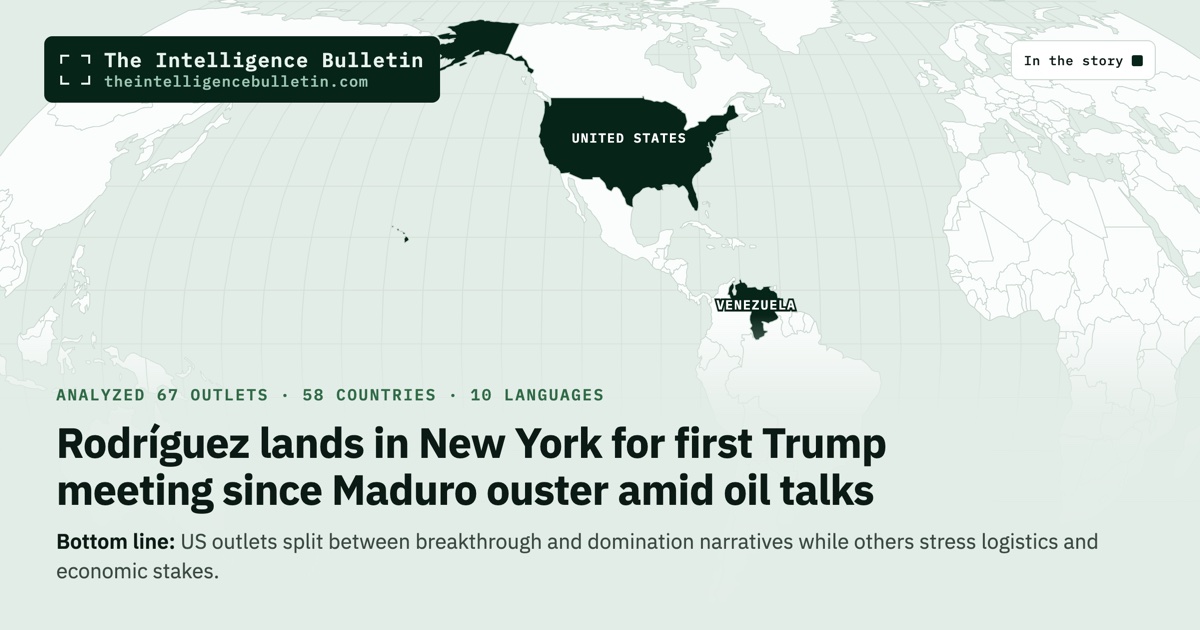
Map of the countries in the story: Rodríguez lands in New York for first Trump meeting since Maduro ouster amid oil talks
Venezuela’s acting president Delcy Rodríguez arrived in New York on Monday for the UN General Assembly and is scheduled to hold an informal pull-aside meeting with US President Donald Trump on Tuesday. It marks the first such encounter between the leaders in over 11 years, following the January US capture of former president Nicolás Maduro, who remains in US custody. The visit occurs amid a recent US-Venezuela oil agreement and ongoing diplomatic normalization efforts.

One Story. Many Angles.

🇺🇸
United States
Breitbart
Original reporting
Venezuela’s Delcy Rodriguez in NY for U.N. Meeting, Will Meet with Trump
Read →
🇺🇸
United States
World Socialist Web Site
Commentary
Venezuelan puppet Delcy Rodríguez to meet Trump in New York
Read →
🇺🇾
Uruguay
MercoPress
Original reporting
Delcy Rodríguez arrives in New York for UN General Assembly, ahead of meeting with Trump
Read →
🇩🇪
Germany
Unternehmen Heute
GERMAN
Carries AFP reporting
Venezuela – Venezuela’s acting president arrives in New York – Meeting with Trump
“Venezuela – Venezuelas Übergangspräsidentin in New York eingetroffen – Treffen mit Trump”
Read →
🇬🇷
Greece
Newpost
GREEK
Carries Reuters reporting
Rodríguez–Trump in New York: First tête-à-tête after Maduro – Oil, debt and investments in the background
“Ροντρίγκες–Τραμπ στη Νέα Υόρκη: Πρώτο τετ α τετ μετά τον Μαδούρο – Πετρέλαιο, χρέος και επενδύσεις στο φόντο”
Read →
5 sources · 4 independent accounts — some share the same news agency’s report
Analyzed 67 outlets across 58 countries and 10 languages
In Brief

US outlets split between breakthrough and domination narratives while others stress logistics and economic stakes.

The reporting converges on the basic timeline and logistics of Rodríguez’s arrival and the planned informal encounter but parts sharply on what the meeting signals about US-Venezuelan relations. Breitbart presents the engagement as evidence of productive bilateral cooperation after Maduro’s removal, highlighting oil agreements and Rodríguez’s outreach. WSWS frames the same facts as a demonstration of US dominance, describing an informal corridor meeting and a government that has ceded control of oil resources. MercoPress and Unternehmen Heute stay close to arrival details and protocol recognition at the UN without interpretive overlay, while Newpost foregrounds the economic negotiations on oil, debt and investment that surround the political encounter. The absence of any Venezuelan outlet in the set leaves the Caracas government’s own characterization of the visit available only through quotes carried by others. The pattern shows how US ideological outlets supply the strongest normative readings of the power relationship, while regional and European sources treat the episode primarily as a diplomatic and commercial reset whose terms remain to be negotiated.

Perspective Analysis

Delcy Rodríguez, Venezuela’s acting president, landed at Teterboro Airport in New Jersey shortly after midnight on Monday carrying the formal designation of head of state in United Nations records. She was met on the tarmac by the US chargé d’affaires to Venezuela, John Barrett, along with members of her own delegation including the sectoral vice president for the economy and the first deputy foreign minister. The arrival marked her first visit to the United States since taking the interim role in January, and it set the stage for a brief, informal encounter with President Donald Trump scheduled for Tuesday on the sidelines of a UN General Assembly leaders’ reception.

The meeting will be the first direct contact between a sitting US president and a Venezuelan head of state in more than eleven years. US Ambassador to the United Nations Mike Waltz described it during a briefing as a “pull-aside” rather than a formal bilateral session. Rodríguez is due to address the General Assembly on Thursday, the first time a Venezuelan leader has done so in person since Nicolás Maduro’s appearance in 2018. Maduro himself remains in federal custody at the Metropolitan Detention Center in Brooklyn, where he and his wife Cilia Flores face drug-trafficking charges; their trial is set for June 2027.

The visit occurs against the backdrop of a US-Venezuela oil agreement reached in August that grants American companies access to a substantial share of Venezuela’s reserves, described in one account as control of 65 billion barrels. Under the terms, the Pentagon’s Office of Strategic Capital acquired a 35 percent stake in a private firm holding the concessions. Additional deals have followed, including a memorandum with Continental Resources for a block in the Orinoco region estimated to hold 30 billion barrels and preliminary talks involving ExxonMobil. Greek reporting noted that the Venezuelan delegation intends to raise energy, debt and mining issues with US counterparts during the week, framing the talks as preparation for broader reconstruction financing that could involve the Inter-American Development Bank.

Rodríguez has presented the trip as an opportunity to resume bilateral ties and defend Venezuela’s principles through dialogue and cooperation. Venezuelan state media quoted her stating that the country arrives “with the resolve and hope of a people who believe in the encounter and unity among nations.” The same outlets recorded that she met Paraguay’s president in Caracas the day before departure and described that earlier encounter as a step toward restoring diplomatic relations severed in 2025.

Accounts diverge most clearly on the character of the relationship now taking shape. One US outlet presents the sequence of events as evidence of productive cooperation after years of hostility, citing the oil agreement and Rodríguez’s outreach to multiple governments as signs of a stabilized partnership. Another US outlet describes the same facts as the consolidation of a protectorate, pointing to the informality of the Tuesday encounter, the direct revenue interest acquired by US defense entities, and the absence of any public request by Rodríguez to visit Maduro during her stay. Regional and European coverage stays closer to the logistics and protocol: the airport greeting, the UN listing of Rodríguez as head of state, and the historical gap since the last leader-level contact. The Greek account foregrounds the commercial agenda—oil, debt servicing and new investment—without assigning normative weight to the political optics.

The factual spine remains consistent across the five outlets examined. Every report records the Monday arrival, the Tuesday pull-aside, the eleven-year interval, Maduro’s continued detention in Brooklyn, and the existence of the August oil framework. No independent reporting chain contradicts any of these points. Where the accounts differ is in the interpretive frame placed around the power balance: one treats the meeting as mutual diplomatic progress, another as the visible exercise of dominance, and the remainder record the mechanics without commentary on either.

A reader limited to the most interpretive US sources would therefore receive either an account of successful realignment or an account of subordination, each built on the same verifiable sequence of dates, names and figures. The narrower regional and European pieces supply the missing commercial detail and the protocol context that allow the event to be placed inside ongoing negotiations rather than treated as a completed political verdict. The absence of any Caracas-based outlet from the set means the acting government’s own description of the visit circulates only through the quotes those outlets chose to carry.

What to Watch

The most durable reading is the one that keeps the economic negotiations and the limited diplomatic format in view at the same time. The oil concessions already signed, the additional blocks under discussion, and the explicit interest in debt and reconstruction financing indicate that the Tuesday encounter functions primarily as a political signal around a commercial process already under way. Whether that process ultimately delivers measurable production increases or debt relief will be settled by the contracts and financing packages that follow, not by the tone of any single day’s coverage.


Share this story

Trump-Macron New York meeting opens UNGA week with Ukraine and tariffs in view

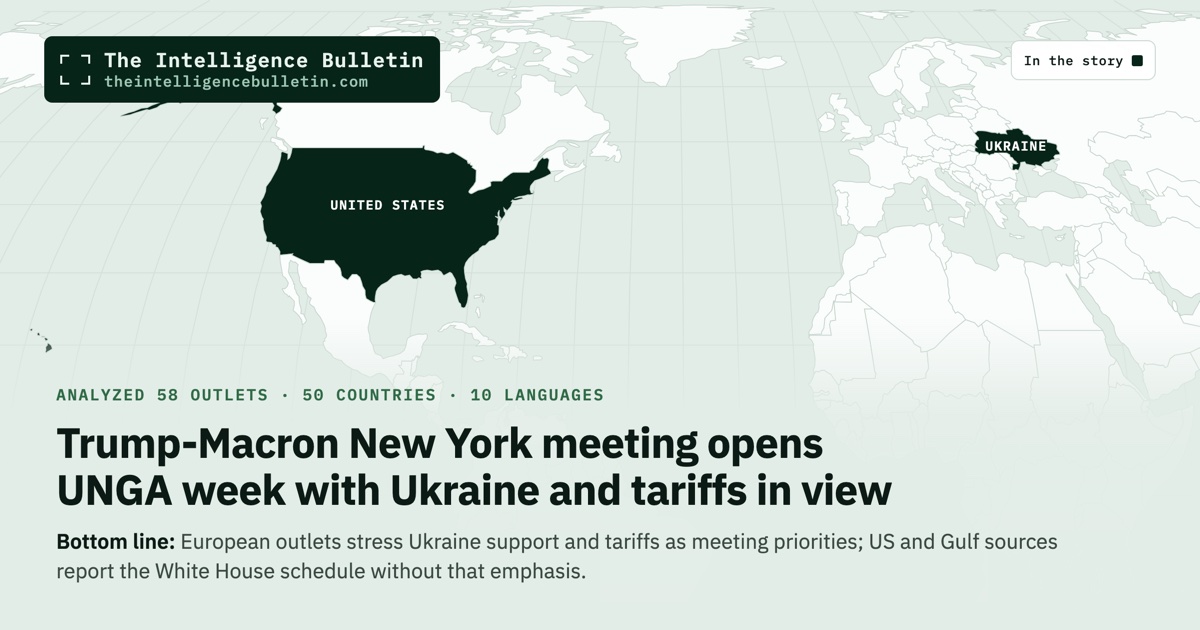
Map of the countries in the story: Trump-Macron New York meeting opens UNGA week with Ukraine and tariffs in view
US President Donald Trump will meet French President Emmanuel Macron on Monday afternoon in New York at 5:35 pm EST, per the White House schedule. Macron arrives from Saint-Pierre-et-Miquelon after talks with Canadian Prime Minister Mark Carney. The leaders are in New York for the UN General Assembly, with Macron also scheduled to see Ukrainian President Volodymyr Zelensky and others. Reporting across outlets agrees on the meeting details and notes potential topics including Ukraine support and trade issues.

One Story. Many Angles.

🇺🇸
United States
Breitbart
Carries Le Monde and other French outlets reporting
President Trump to Meet with France’s Emmanuel Macron on Monday
Read →
🇫🇷
France
La Nouvelle République
FRENCH
Original reporting
Emmanuel Macron will meet Donald Trump in New York this Monday
“Emmanuel Macron rencontrera Donald Trump à New York ce lundi”
Read →
🇸🇦
Saudi Arabia
Arab News
Carries White House / AFP reporting
Arab News | Trump to meet Macron in New York on Monday: White House
Read →
🇧🇪
Belgium
RTL
FRENCH
Carries AFP reporting
Trump and Macron meet again in New York to talk about Ukraine and international crises
“Trump et Macron se retrouvent à New York pour parler Ukraine et crises internationales”
Read →
🇲🇩
Moldova
Ziarul Național
ROMANIAN
Original reporting
Macron meets Trump in New York: Ukraine, pressure on Russia and customs taxes on the agenda
“Macron se întâlnește cu Trump la New York: Ucraina, presiunea asupra Rusiei și taxele vamale, pe agendă”
Read →
5 sources · each independently reported
Analyzed 58 outlets across 50 countries and 10 languages
In Brief

European outlets stress Ukraine support and tariffs as meeting priorities; US and Gulf sources report the White House schedule without that emphasis.

The White House announcement sets the baseline that every outlet carries without contradiction: Trump and Macron will meet Monday in New York on the UNGA sidelines. What varies is emphasis on stakes. French and Belgian coverage places Ukraine and international crises at the center, noting Macron’s intent to press for sustained US support and Russian pressure while tying the talks to high fuel prices from Saudi-Houthi clashes. The Moldovan outlet adds explicit reference to tariffs and customs duties on the agenda, reflecting Eastern European sensitivity to trade barriers and energy security. US reporting frames the encounter more as routine presidential scheduling ahead of the General Assembly, with secondary mentions of Macron’s other bilateral plans including Zelensky. Saudi coverage stays closest to the bare White House statement. No source disputes the timing or venue; the split lies in which regional concerns each outlet projects onto the same diplomatic slot. European papers read the meeting as an early test of transatlantic alignment on Ukraine before wider leader engagements, while the American account treats it as one item among many on the UN calendar. This pattern shows how proximity to the issues shapes which elements of the shared fact receive elaboration.

Perspective Analysis

President Donald Trump is scheduled to meet French President Emmanuel Macron at 5:35 p.m. Eastern time on Monday in New York. The White House released the timing on Sunday evening, placing the encounter hours before the start of high-level debate at the 81st session of the United Nations General Assembly. Macron will travel to the city from Saint-Pierre-et-Miquelon, the French archipelago off the coast of Newfoundland, where he held talks with Canadian Prime Minister Mark Carney on Sunday. Those talks focused on sovereignty and deeper bilateral ties at a moment when Trump has repeatedly raised the prospect of Canadian annexation and circulated maps that include the French islands under an American flag.

Macron’s schedule in New York includes additional meetings with Ukrainian President Volodymyr Zelensky and with several Middle Eastern leaders, among them Iranian President Massoud Pezeshkian. He is also expected to confer with global figures in artificial intelligence. French reporting notes that these encounters occur against record fuel prices in both France and the United States, driven by rising oil costs tied to intensified hostilities between Saudi Arabia and Iran-backed Houthi forces in Yemen. Macron will deliver his General Assembly address on Tuesday, in which the Élysée has said he will advocate “effective multilateralism” built on coalitions that deliver concrete results. In a Friday briefing, French officials described the United Nations as “in trouble” and questioned the effectiveness of current multilateral action, pointing to the progressive disengagement of the five permanent members of the Security Council.

The meeting itself carries no public agenda beyond the fact of the encounter. Every outlet that published the White House schedule recorded the same core details without dispute. Trump is also set to meet New York Mayor Zohran Mamdani, a left-leaning Democrat and vocal critic of Trump’s policies, immediately before the session with Macron. Macron’s arrival from Canada underscores the compressed calendar of the General Assembly week, which runs from September 22 to 28 and draws dozens of heads of state to the city.

European coverage placed Ukraine at the center of the anticipated discussion. French and Belgian accounts stated that Macron intends to press Trump to maintain support for Ukraine and to increase pressure on Russia. The Moldovan outlet added that tariffs and customs duties form part of the expected conversation, reflecting its reading of Macron’s priorities for easing commercial tensions. These outlets tied the talks to energy security and to Macron’s broader effort to sustain European positions ahead of wider leader engagements. In contrast, the American and Saudi accounts stayed closer to the bare announcement, describing the meeting as one item on the presidential schedule during a week of UN gatherings. They noted Macron’s other planned bilaterals but did not foreground Ukraine or trade as the primary stakes.

No source in the set carried an on-record statement from either government spelling out the precise list of topics. The Élysée has signaled through background briefings that Macron hopes to build on apparent movement toward European positions at the June G7 summit in Evian. French outlets reported that Macron will also convene a UN Security Council meeting on Ukraine that will address Black Sea food security and grain exports. These details appear in the French and Belgian pieces but receive only passing mention, if any, in the American and Saudi reports.

The selected sources contain no direct reporting from Canadian outlets on the Carney-Macron meeting that immediately preceded the New York trip. Statements from both leaders in Saint-Pierre-et-Miquelon were carried through the French and American accounts, which described the defense of sovereignty and the call for deeper Franco-Canadian cooperation. The absence of a Canadian voice in this particular set means the reader sees the Sunday encounter only through the lens of the two governments directly involved in the Monday session.

The convergence across independent reporting chains establishes the timing, location, and sequence of travel without contradiction. Where the accounts diverge is in the weight given to regional concerns. Outlets closer to the European security architecture treat the meeting as an early calibration of transatlantic positions on Ukraine and energy. The Moldovan piece, reflecting a country that has faced Russian hybrid pressure and energy dependence, singles out tariffs and Russian sanctions as explicit items. The American account registers the meeting as standard diplomacy on the UN calendar, consistent with its distance from the immediate territorial and energy stakes. The Saudi piece, as an observer of Middle East dynamics, records the announcement without layering additional regional framing.

What to Watch

The European emphasis on Ukraine draws from Élysée background material and aligns with Macron’s stated plans for the week. The tariff reference stands on a single reporting chain and therefore carries less weight than the corroborated elements. The bare schedule itself rests on the White House document released Sunday evening and is reproduced across all five outlets. A reader limited to any one national press would miss the range of stakes that other capitals project onto the same slot. The meeting opens the General Assembly calendar at a moment when energy prices, Ukrainian security guarantees, and commercial frictions are live files for multiple governments. Its outcome will shape the tone of subsequent bilateral and multilateral contacts rather than resolve any one file on its own.


Share this story

Pakistan claims 28 militants killed in Afghan strikes; Kabul says three civilians dead

Map of the countries in the story: Pakistan claims 28 militants killed in Afghan strikes; Kabul says three civilians dead
Pakistan carried out air strikes on targets in Afghanistan’s Kunar and Paktika provinces following recent militant attacks in Khyber Pakhtunkhwa that killed over 30 people. Pakistani officials said the calibrated operations hit terrorist hideouts linked to groups including Fitna Al-Khwarij and Hafiz Gul Bahadur, killing around 28 militants. Afghan authorities and the Taliban reported three civilian deaths in Kunar, damage to empty buildings in Paktika, and summoned a Pakistani diplomat, condemning the action as a sovereignty violation. The strikes mark the latest escalation in cross-border militancy tensions between the two countries.

One Story. Many Angles.

🇵🇰
Pakistan
The Express Tribune
Carries Ministry of Information Broadcasting reporting
Pakistan carries out calibrated ‘air strikes’ against terrorist hideouts near Afghan border after K-P attacks
Read →
🇦🇫
Afghanistan
Ariana News
Original reporting
Afghanistan summons Pakistani diplomat over airstrikes in Kunar and Paktika
Read →
🇮🇳
India
OneIndia
Carries local Afghan media and UN reports reporting
Pakistan Launches Airstrikes Inside Afghanistan, Kunar Reports Three Deaths
Read →
🇺🇸
United States
Breitbart
Commentary
Taliban Protests as Pakistan Bombs Afghanistan Again
Read →
🇪🇸
Spain
El País
SPANISH
Carries Reuters reporting
At least 28 dead in Pakistani airstrikes in Afghanistan
“Al menos 28 muertos en ataques aéreos de Pakistán en Afganistán”
Read →
5 sources · 4 independent accounts — some share the same news agency’s report
Analyzed 60 outlets across 50 countries and 29 languages
In Brief

Pakistani sources count militants eliminated while Afghan sources count civilian family members killed, with no independent verification bridging the gap.

Pakistani reporting frames the strikes as a precise, intelligence-driven response to recent terrorist attacks inside Pakistan, emphasizing the elimination of militants and destruction of training sites without acknowledging Afghan casualty claims. Afghan outlets instead highlight the summoning of Pakistan’s diplomat and civilian deaths, presenting the action as an unprovoked breach of sovereignty that demands a response. Indian coverage stresses the regional fallout and Taliban warnings while noting prior UN-documented civilian harm from cross-border incidents. US conservative outlets focus on repeated escalation and Taliban denials of harboring TTP-linked groups. European reporting balances both casualty figures from official statements, drawing on wire services to note the pattern of mutual accusations without resolving the conflicting death tolls. The consistent divergence is not over whether strikes occurred but over target identity and civilian impact, with actor sources each advancing their government’s narrative and outside observers relaying the competing claims side by side.

Perspective Analysis

Pakistan carried out air strikes on targets inside Afghanistan on September 21, 2026, hitting locations in the eastern provinces of Kunar and Paktika. The operations followed a series of militant attacks inside Pakistan’s Khyber Pakhtunkhwa province, including one on a mosque and police station in Kohat district that killed at least 24 people, among them 15 police officers, and left more than 100 injured. Pakistani officials described the strikes as intelligence-driven and calibrated, aimed at terrorist hideouts belonging to groups including the Fitna Al-Khwarij network and fighters linked to Hafiz Gul Bahadur. They reported that the raids destroyed three targets, including a suicide bombers’ training facility, killed 28 militants, and destroyed large quantities of stored weapons and ammunition.

Afghan authorities gave a sharply different account of the same strikes. They said one occupied house in Kunar was hit, killing three members of the same family and wounding four others. In Paktika’s Barmal district, two locations—an empty house and a former shop—were struck with no reported injuries. The Taliban government summoned Pakistan’s diplomat in Kabul to protest the action and issued statements condemning it as a clear violation of Afghanistan’s sovereignty and territorial integrity. Taliban spokesmen described the strikes as a war crime and said they would not allow Pakistan to use Afghan territory to fight its own internal conflicts.

The strikes were not the first such cross-border action. Pakistani forces have conducted similar operations in the past, most recently in June, and relations between the two countries have deteriorated steadily. Earlier in 2026, hundreds of people died in related violence, including a March incident in which more than 400 were reported killed during Pakistani strikes on what Islamabad called militant facilities in Kabul. Afghan officials have consistently denied that their territory serves as a base for attacks inside Pakistan.

The immediate trigger for the September 21 strikes was the Kohat attack, claimed by a faction linked to Tehrik-e-Taliban Pakistan and directed by Hafiz Gul Bahadur. Pakistan accused Afghan-based militants of responsibility and warned that further measures would follow unless Kabul took verifiable steps against the groups. Within hours of the strikes, Afghan officials rejected those accusations and threatened an appropriate response.

Coverage of the event diverged most clearly on the identity of those killed. Pakistani reporting, including statements from the Ministry of Information, presented the dead as militants at training camps and hideouts. Afghan reporting and Taliban statements presented them as civilians in a residential area. Outside observers recorded both sets of claims without reconciliation. One Indian outlet noted prior United Nations data showing 399 civilians killed or injured in cross-border incidents between April and June, with aerial attacks identified as the leading cause of harm in provinces including Kunar and Paktika. A Spanish outlet relayed the same conflicting death tolls through wire dispatches while placing the episode in the longer pattern of mutual accusations.

A reader limited to Pakistani sources would see only a targeted counter-terrorism operation that eliminated a precise number of threats after a deadly domestic attack. That reader would miss the Afghan claim of civilian deaths and the formal diplomatic protest. A reader limited to Afghan sources would see only an unprovoked violation of sovereignty that killed civilians and damaged empty structures. That reader would miss the Pakistani assertion that the targets were active militant facilities tied to recent attacks inside Pakistan and the explicit link drawn to groups the Afghan government has been accused of tolerating.

The two casualty counts cannot both be accurate. Pakistani officials counted 28 militants eliminated at specific militant sites. Afghan officials counted three civilians from one family killed in Kunar. Each side’s count rests on its own official statements, with no independent reporting chain confirming either figure. The strikes themselves and the preceding attacks in Khyber Pakhtunkhwa appear in reporting from every outlet examined.

The Afghan account of civilian harm aligns with earlier United Nations observations of disproportionate effects on non-combatants in the same border provinces. The Pakistani account rests on the government’s own assessment of target selection and battle damage. Neither side has produced public evidence, such as names of the dead or imagery of the sites, that would allow an outside reader to adjudicate between them.

What to Watch

Absent a mechanism for joint investigation or third-party verification, the pattern of unilateral strikes and competing casualty claims is likely to continue. Each round deepens distrust: Pakistan sees continued safe havens for its domestic militants, while Afghanistan sees repeated incursions that kill its citizens and undermine its authority. The next significant attack inside Pakistan or the next reported civilian death in the border provinces will test whether either government chooses escalation or a return to the diplomatic channel that produced the recent summons in Kabul.


Share this story

Baltic officials urge calm while Western reports flag Russian hybrid tests on NATO in months

Map of the countries in the story: Baltic officials urge calm while Western reports flag Russian hybrid tests on NATO in months
Polish Prime Minister Donald Tusk warned of possible disguised Russian drone or missile strikes on NATO’s eastern flank to test Article 5. Czech, Swedish and Latvian intelligence chiefs, citing a Guardian report, described hybrid sabotage, false-flag operations and influence campaigns expected within months rather than years. Estonian and Latvian officials urged the public to stay calm, stating border monitoring shows no imminent conventional attack and that Russia seeks to sow panic. Norwegian leaders took the warnings seriously, citing hybrid risks including sabotage.

One Story. Many Angles.

🇵🇱
Poland
Gazeta Prawna
POLISH
Original reporting
Donald Tusk warns of Russian attacks on NATO states. Reaction from Norway and Canada
“Donald Tusk ostrzega przed atakami Rosji na państwa NATO. Reakcja Norwegii i Kanady”
Read →
🇪🇪
Estonia
Postimees
ESTONIAN
Commentary
ANALYSIS Jonatan Vseviov: calm down, we see beyond the border and know when something really happens there!
“ANALÜÜS ⟩ Jonatan Vseviov: rahunege maha, me näeme piiri taha ja teame, kui seal midagi päriselt toimub!”
Read →
🇩🇪
Germany
Münchner Merkur
GERMAN
Carries The Guardian reporting
Sabotage in Europe: Scenario outlines Putin plan against NATO
“Sabotage in Europa: Szenario skizziert Putin-Plan gegen NATO”
Read →
🇬🇧
United Kingdom
London Loves Business
Carries The Guardian reporting
European spy chiefs warn Russia could test NATO’s Article 5 within ‘months not years’ – London Business News
Read →
🇸🇪
Sweden
Dagens Nyheter
SWEDISH
Carries The Guardian reporting
Spy chief: Russia may attack NATO sooner than expected
“Spionchef: Ryssland kan attackera Nato snarare än väntat”
Read →
5 sources · 2 independent accounts — some share the same news agency’s report
Analyzed 65 outlets across 55 countries and 26 languages
In Brief

Frontline Baltic outlets calm readers; others treat the months timeline as the main story.

The reporting reveals a clear split between Western and Central European outlets amplifying the timeline for hybrid probes on NATO territory and Baltic sources actively dampening alarm. Polish coverage centers Tusk’s parliamentary assessment of consistent allied intelligence pointing to disguised strikes on support infrastructure, with immediate Norwegian endorsement. German and UK pieces lean on the Guardian-sourced accounts from Czech and Swedish chiefs to frame Article 5 tests and sabotage of logistics nodes. Swedish reporting stresses the accelerated schedule while noting Baltic pushback. Estonian analysis directly counters social-media panic by stressing real-time border visibility and the value of steady support for Ukraine. This pattern shows frontline states treating the warning as real but not existential, while others treat the chiefs’ timeline as the core escalation signal. The absence of any Russian outlet in the set leaves official Moscow denials visible only through third-party relays.

Perspective Analysis

The central account of the warning originated in reporting by The Guardian that drew on interviews with Czech intelligence chief Michal Koudelka, Swedish military intelligence head Thomas Nilsson and Latvian counterpart Normunds Mežviets. Those officials described Russian hybrid operations, including limited incursions, false-flag provocations and sabotage aimed at logistics supporting Ukraine, as likely within months rather than years. Polish Prime Minister Donald Tusk had already placed a related assessment on the record in a 17 September Sejm speech, stating that consistent intelligence from Polish services, NATO allies and Ukrainian partners pointed to possible disguised drone or missile strikes on eastern-flank territory that Russia could present as accidents to test alliance resolve under Article 5.

Gazeta Prawna placed Tusk’s speech at the centre of its account and added the Norwegian and Canadian reaction that followed two days later. The piece opened with Tusk’s description of hybrid strikes that could appear unintentional and noted that Norwegian Prime Minister Jonas Gahr Støre had told reporters in Ottawa that the signals deserved serious attention, citing his own country’s intelligence on hybrid activity that could include sabotage. The Polish outlet also recorded that Canadian Prime Minister Mark Carney endorsed the Norwegian stance during the same press appearance and that both governments issued a joint statement reaffirming support for Ukraine while expanding defence-industry cooperation.

Postimees published an analysis by Estonian Foreign Ministry state secretary Jonatan Vseviov that addressed public alarm directly. Vseviov wrote that readers should “chill out” because Estonian monitoring already sees what is happening beyond the border and would flag any genuine preparation. The piece framed the recent social-media surge of claims about imminent moves on the Suwałki corridor or Latvian territory as over-reaction and reminded readers that steady support for Ukraine remained the practical response.

Münchner Merkur led with the sabotage dimension drawn from the Guardian interviews. Its headline and opening paragraphs highlighted a scenario in which Russia would conduct targeted hybrid actions to fracture European solidarity with Kyiv, naming the discovery of a suspected explosive-laden drone at Leipzig airport as one data point cited by the Swedish chief. The German coverage emphasised the resource drain on security services that must now treat every industrial incident as potentially deliberate and placed the warning inside a broader discussion of German critical-infrastructure protection.

London Loves Business framed the same material around the credibility of NATO’s Article 5 commitment. The article opened by stating that European spy chiefs believe Moscow could test alliance resolve within months and quoted Koudelka on false-flag operations and influence campaigns no longer being remote possibilities. It added context from security analyst Philip Ingram on recent suspected incidents at energy and military sites across Europe and noted French President Emmanuel Macron’s commissioning of new defence protocols for vital infrastructure.

Dagens Nyheter reported the accelerated timeline while recording the Baltic pushback. Its account quoted Koudelka on the possibility of a limited attack or false-flag provocation and noted Nilsson’s assessment that Moscow was engaged in “negotiation theatre” rather than genuine diplomacy. The Swedish piece then turned to Mežviets and Vseviov, who stated there were no signs of an imminent conventional strike and that Russia’s aim included spreading fear in Western societies. It placed these statements against the background of upcoming UN General Assembly meetings and Ukrainian President Volodymyr Zelenskyy’s diplomatic schedule.

Each masthead therefore took the same core reporting and foregrounded the element most salient to its audience. Gazeta Prawna treated Tusk’s parliamentary warning and the immediate allied response as the lead. Postimees used the dispatch as the occasion for a local intelligence figure to counter domestic alarm. Münchner Merkur and London Loves Business concentrated on the hybrid-sabotage and Article 5 dimensions that speak to German infrastructure concerns and British alliance politics. Dagens Nyheter retained the timeline emphasis but added the Baltic counterweight already present in the source material.

The single reporting chain means the underlying facts about what the intelligence chiefs said do not constitute independent corroboration across borders. What the five outlets produced instead is a map of editorial priorities: one added a head-of-government speech and its diplomatic echo, another supplied a direct public reassurance from its own national security apparatus, and the remainder selected different slices of the hybrid-risk description to match domestic security debates. Readers of any single piece therefore receive a version already shaped by that outlet’s choice of which part of the shared dispatch to lead and which local context to supply.

What to Watch

The Baltic additions carry particular weight because they come from states that have long warned of Russian intentions and that now possess the monitoring systems closest to the border. Their explicit statements that no immediate conventional attack is visible and that panic itself serves Russian aims supply a practical calibration that the other accounts do not repeat. Without those passages a reader would be left with an undifferentiated months-scale warning; with them the signal is preserved while the risk of self-inflicted economic or political damage from over-reaction is named on the record.


Share this story