 AI-generated analysis published under the editorial responsibility of Rohit Sinnas. How it works →
See the 60 countries
Albania, Argentina, Armenia, Australia, Austria, Azerbaijan, Bangladesh, Brazil, Bulgaria, Canada, Chile, China, Colombia, Croatia, Cuba, Ecuador, Egypt, Estonia, Finland, France, Germany, Ghana, Greece, Guatemala, India, Indonesia, Ireland, Israel, Italy, Kenya, Lebanon, Luxembourg, Malaysia, Mexico, Moldova, Montenegro, Netherlands, New Zealand, Norway, Pakistan, Philippines, Poland, Romania, Russia, Saudi Arabia, Serbia, Singapore, Slovakia, Slovenia, Somalia, South Korea, Spain, Sweden, Switzerland, Taiwan, Tajikistan, Turkey, Ukraine, United Kingdom, United States
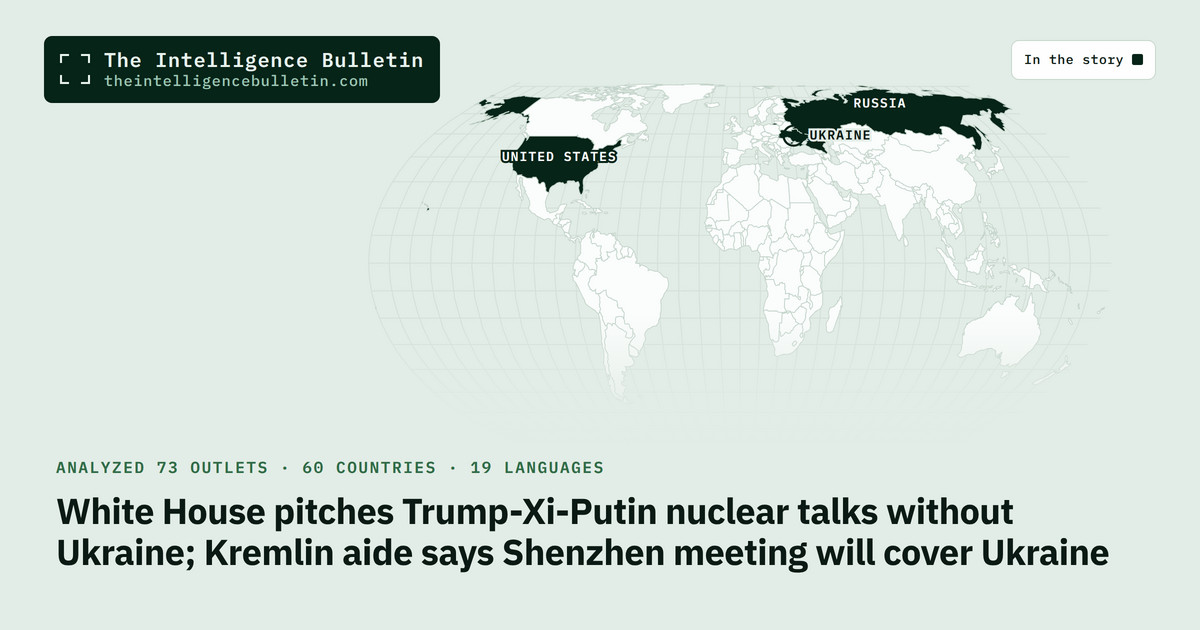
Trump, Xi and Putin are set to meet in Shenzhen around November 19 to open nuclear-arms talks US officials say won’t yield a deal. The White House says Ukraine is off the agenda; Kremlin aide Yury Ushakov says it will be discussed there.
Across the press: White House officials told two outlets Ukraine is off the Shenzhen agenda; the Kremlin’s own readout says Ukraine will be discussed there with Trump.
Source base: 5 outlets read in full (United States, Russia, Ukraine, Israel, Germany), selected from 73 analyzed.
- DisputedUkraine will not be discussed in the trilateral, and no separate Trump-Putin bilateral meeting is planned in Shenzhen.Source: US officials to the New York Post and the Jerusalem Post, with UNIAN citing unnamed sources that Ukraine is off the agenda; contradicted by Ushakov, who says Ukraine settlement matters will be discussed at ‘the planned meeting’ with Trump in Shenzhen
- 1 of 5 · Deutsche Welle onlyBeijing has not itself confirmed the meeting; its foreign ministry has said only that it is ‘in communication’ with relevant parties and had ‘no information’ on the substance.Deutsche Welle, citing China’s foreign ministry; the Kremlin separately says ‘our Chinese hosts are organising’ the summit
- 4 of 5 · reported separatelyTrump, Xi and Putin will hold the first-ever trilateral meeting of their three countries’ leaders on the sidelines of the APEC summit in Shenzhen, at the end of Trump’s China visit around November 19.White House officials to the New York Post and the Jerusalem Post; separately, Kremlin aide Yury Ushakov on the presidential website; relayed by UNIAN
- 2 of 5 · reported separatelyThe meeting is meant to open talks on reducing nuclear arsenals, but US officials say they ‘do not expect to get to any kind of agreement’ and call it ‘the entry point, the first conversation.’Senior US officials at a White House briefing, reported by the New York Post and the Jerusalem Post; Olivia Wales on record to the Jerusalem Post
- 3 of 5 · reported separatelyTrump intends to raise the war in Iran with Xi and Putin in the trilateral.A senior US official to the Jerusalem Post; a White House official to the New York Post said talks ‘could touch on’ Iran; relayed by UNIAN
- Before November 19Whether China’s foreign ministry moves beyond ‘in communication’ and confirms the trilateral and its agenda, the one capital still silent.
- After ShenzhenThe Kremlin’s readout will show whether Moscow claims Ukraine was discussed with Trump, testing the White House’s account.
- AnsweredWhite House officials told the Jerusalem Post the trilateral will be a formal meeting, one of the ‘official meetings with officials only participating,’ held at the end of Trump’s China visit after his November 19 bilateral with Xi; the Kremlin calls it a ‘trilateral summit.’
- Still openHas Beijing committed to a leaders trilateral, or is in communication a way to keep separate Xi-Trump and Xi-Putin bilaterals open? · What agenda could all three accept if Trump wants nuclear arms control and Putin wants Ukraine without Kyiv, while Sun Yun says China would refuse those topics?
- 07 Nov · China confirms a Xi-Trump-Putin trilateral is being discussed; the reporting everywhere is the same Associated Press dispatch
- 12 Nov · Putin warns US envoys foreign troops would be targets; Russia s Lenta.ru readout leads on Kostiantynivka instead
- 13 Nov · Witkoff promises Europe a seat after Putin talks; Putin s price is one negotiator EU leaders decline to name
Full analysis
What happened Why it matters How each country tells it Where accounts conflict Room for disagreement Our assessment Sources and evidence
What happened
Donald Trump will sit down with Xi Jinping and Vladimir Putin at the end of his China visit, on the sidelines of the APEC summit in Shenzhen, in what would be the first-ever meeting of the three countries’ leaders. Washington and Moscow both say so. The New York Post had it first as an exclusive from a White House official; senior officials then laid it out on a Friday evening call on November 13 previewing the Asia trip, which The Jerusalem Post attended. Kremlin aide Yury Ushakov had already referred to "the upcoming trilateral summit in Shenzhen" the evening before, in his readout of Putin’s November 12 meeting with US envoys Steve Witkoff and Jared Kushner.
The itinerary the White House gave The Jerusalem Post runs as follows. Trump leaves early Monday, November 16, for Manila, where he meets Quad leaders, joins a special US-ASEAN summit and sees the Philippine president. On Thursday morning, November 19, he attends a multilateral APEC session, then holds a bilateral meeting and working lunch with Xi. The trilateral closes the China stop; the White House gave no exact date or time. Officials called it one of the "official meetings with officials only participating," which keeps Elon Musk, traveling for parts of the China leg, out of the room.
Washington’s stated purpose is cutting nuclear arsenals. Assistant Press Secretary Olivia Wales told The Jerusalem Post that Trump "will discuss the reduction of nuclear weapons in the world, whose proliferation President Trump believes is very dangerous." Officials set expectations low: "We do not expect to get to any kind of agreement. I would characterize this as the entry point, the first conversation." Their target was Beijing. China’s arsenal, one official said in remarks the Post carried, is "growing by far the fastest in the world," and "it’s time for China to sort of step up to the adult table, if you will, and have adult conversations about adult things." Russia, with its Soviet-era record of arms talks, is "probably a bit more comfortable" with what Trump hopes to start. The Post notes Trump has floated a grand stockpile-reduction pact since his first term without result.
Iran is the second item. "I think the president does intend to talk about Iran in the trilateral meeting," a senior official told The Jerusalem Post, which reported that officials gave no detail on what Moscow or Beijing would be asked to do, and set the remark against Trump’s statement earlier in the week that the United States no longer needed an agreement with Iran. A White House official told the Post the talks could also touch on North Korea, though officials ruled out any engagement with Kim Jong Un on the trip. The Ukrainian agency UNIAN, citing its own sources, reported that Korean denuclearization had dropped off the list because Beijing considers it a matter for Washington and Pyongyang, and that working groups had discussed a joint statement that any future nuclear war is unacceptable.
On Ukraine the White House was explicit. "China is not really a part of that track, so it doesn’t seem appropriate to have the Ukraine discussion," an official said, confirming there will be no separate Trump-Putin meeting. Trump has not met Putin in person since their Alaska summit last August. The Kremlin’s account of the same question runs the other way, as set out below.
Beijing’s voice is the thinnest in this story, and the gap is worth naming: none of the five sources is Chinese. Deutsche Welle reported that China had yet to confirm the meeting, its foreign ministry saying only that it was "in communication" with relevant parties and had "no information" on the substance. TIB reported on November 7 that the ministry had for the first time acknowledged those contacts. Ushakov, for his part, says "our Chinese hosts are organising" the summit.
Why it matters
The arms-control framing is Washington’s, and the two other parties have shown little sign of sharing it. DW, citing The Wall Street Journal, reports that Putin first pitched the trilateral last month in a call with Trump, wanting it to address ending his war in Ukraine. Ushakov’s readout places Shenzhen inside that track and alongside Moscow’s 2021 security demands: no further NATO expansion, no threatening weapons near Russia’s borders, and alliance forces pulled back to where they stood when the Russia-NATO Founding Act was signed. And MERICS analyst Aurelio Insisa told DW that Beijing "has shown no interest in engaging with the one pressing issue that could realistically be addressed in such a trilateral format: nuclear disarmament." A meeting built around the topic the host avoids and the topic the guest wants is a meeting whose real agenda is still being fought over.
For Kyiv and European capitals, the stake is Ukraine being discussed without them. UNIAN reported German Chancellor Friedrich Merz urging Trump to avoid surprises in talks with Putin in China, warning of a "second Anchorage moment." For Beijing, hosting carries cost either way: ECFR’s Alicja Bachulska told DW that even a bare photo opportunity "could nevertheless severely erode China’s image," and that a Ukraine discussion with no Europeans present could worsen China-EU relations. Xi and Putin have met some 40 times since 2012, by DW’s count; Xi cannot stand beside both men as a neutral convener without someone reading it as alignment.
How each country tells it
- New York Post · United States · original reportingThe White House preview, obtained as an exclusive before a wider press call: a first-ever trilateral built around an ambitious nuclear arms control pact, with an official saying it is ‘time for China to sort of step up to the adult table.’
- President of Russia (Kremlin) · Russia · original reportingYury Ushakov’s readout of Putin’s November 12 meeting with Witkoff and Kushner treats Shenzhen as a continuation of the Ukraine track and of Moscow’s demands on European security, including NATO non-expansion.
- UNIAN · Ukraine · carries New York PostA Ukrainian agency’s relay of the New York Post exclusive, followed by UNIAN’s own earlier reporting: Merz’s warning against a ‘second Anchorage moment,’ sources saying Ukraine and Korean denuclearization were dropped from the agenda, and working groups weighing a joint statement against any future nuclear war.
- The Jerusalem Post · Israel · original reportingIts own attendance at the White House briefing, read with Iran first: an official says ‘the president does intend to talk about Iran in the trilateral meeting’ but gives no detail on what Moscow or Beijing would be asked to do.
- Deutsche Welle · Germany · original reportingAn analysis written before Washington’s confirmation, arguing the summit puts China as host in a bind between its partnership with Moscow and its image as a stabilizing power, with the ‘Yalta 2.0’ optics a particular worry.
Where accounts conflict
The White House says Ukraine is not on the Shenzhen agenda and that Trump and Putin will not meet separately. That account rests on officials at a single briefing, carried by the New York Post and The Jerusalem Post. UNIAN’s own sources say the same, adding that China would prefer any Ukraine talks to run directly between Washington and Moscow.
Ushakov, in the Kremlin’s published readout, says otherwise: "the full range of matters related to its regulation will be discussed further at the planned meeting with him on the sidelines of the APEC summit in Shenzhen," and Moscow will stay in touch with Witkoff and Kushner "ahead of the meeting between Vladimir Putin and Donald Trump in China." That describes Ukraine on the table and a Putin-Trump encounter. Both cannot hold. UNIAN’s relay of the Post shows the confusion: it turned the official’s view that Ukraine was unlikely to be raised into a suggestion that it could become a topic, then appended its own reporting that Ukraine was off the list.
Room for disagreement
The contradiction may be narrower than it reads. Ushakov’s "planned meeting with him" can be read as the trilateral itself, and the White House line governs what Trump puts on the agenda, not what Putin says once seated. Trump himself said "we’ll be talking a lot of things." On that reading both capitals can be telling the truth and Ukraine surfaces informally. The stronger challenge is to whether the meeting happens as described at all. Beijing has confirmed nothing on the record, and Bachulska told DW the vagueness of China’s statements "seems deliberate." A host uneasy about "Yalta 2.0" optics could shrink the trilateral into a brief encounter.
Our assessment
It is likely that the Shenzhen trilateral takes place and ends with no arms-control commitment beyond, at most, a joint statement against nuclear war, with Putin raising Ukraine whatever the White House agenda says. The warrant is that Washington and Moscow have independently put the meeting on the record, the White House through named and unnamed officials and the Kremlin through a primary readout, while US officials themselves rule out an agreement. Each party has a reason to describe it its own way: the White House to present an arms-control opening and reassure Europe that Ukraine stays on a separate track, the Kremlin to fold Ukraine into a great-power format without Kyiv, Beijing to avoid being cast as co-author of either. Ushakov’s sentence is the most specific on-record statement about Shenzhen, and it points to Ukraine.
What would change this: China’s foreign ministry confirming the trilateral with nuclear arms reduction named as its agenda, or declining to host it as a formal meeting.
Sources and evidence
Press quoted
- Will Trump and Putin meet one-on-one in Shenzhen to discuss Ukraine, as Ushakov describes, or not at all, as the White House says?
- Will Beijing accept nuclear arms reduction as an agenda item, when MERICS’s Insisa says it has shown no interest and a US official says China’s arsenal is ‘growing by far the fastest in the world’?
- Will the working groups produce the joint statement against any future nuclear war that UNIAN’s sources described, and is that the most the meeting can yield?
That’s how the world told the story.
Get our daily open-source intelligence on world events in your inbox — one email a day, up to six stories.
Subscribe freeNo spam. One-click unsubscribe. See the latest email →