 AI-generated analysis published under the editorial responsibility of Rohit Sinnas. How it works →
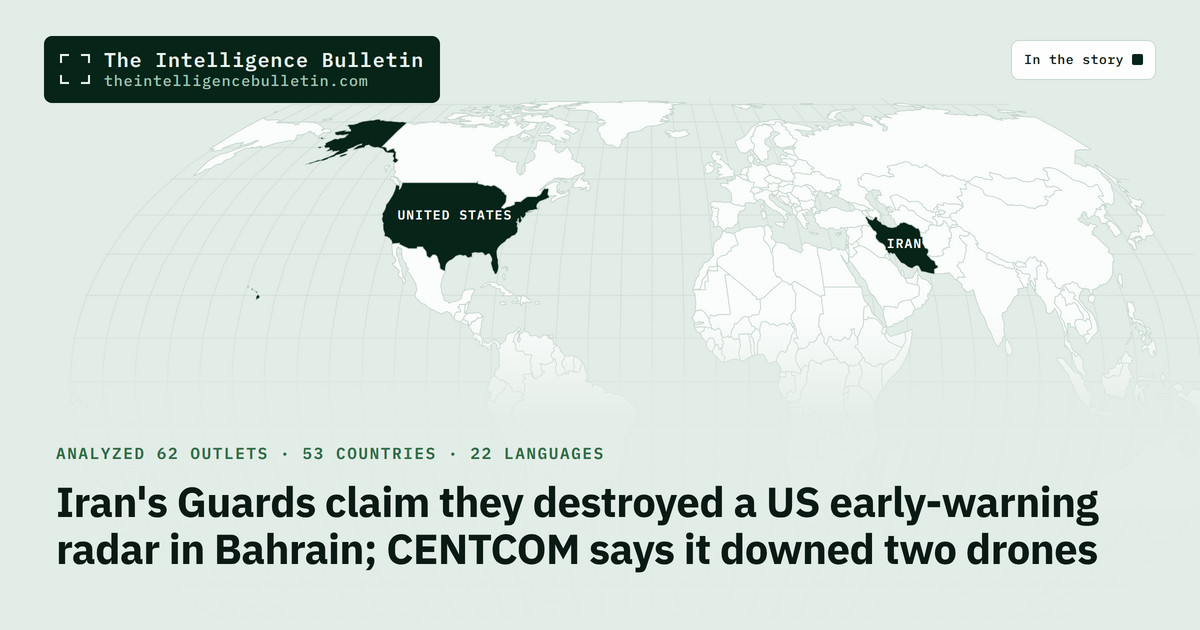
See the 53 countries
Afghanistan, Argentina, Australia, Austria, Bangladesh, Brazil, Bulgaria, Burkina Faso, Canada, Colombia, Croatia, Cyprus, Dominican Republic, Egypt, France, Germany, Greece, Indonesia, Iran, Iraq, Ireland, Israel, Japan, Kenya, Kyrgyzstan, Lebanon, Mexico, Moldova, Netherlands, Nigeria, Oman, Pakistan, Poland, Portugal, Qatar, Romania, Russia, Saudi Arabia, Senegal, Serbia, Slovakia, Slovenia, South Africa, Spain, Sri Lanka, Sweden, Switzerland, Taiwan, Ukraine, United Arab Emirates, United Kingdom, United States, Vietnam
Iran’s Revolutionary Guards claimed Friday it destroyed a US early-warning radar in Bahrain in retaliation for an air attack on Sirik. CENTCOM denied the radar was destroyed and said it shot down two Iranian drones; it has not claimed the Sirik strike.
Across the press: Washington’s denial details the drones but is silent on Sirik: CENTCOM never claims the strike Iran says it is avenging.
Source base: 5 outlets quoted (Czech Republic, Qatar, Israel, Saudi Arabia, Taiwan), selected from 62 analyzed. 3 read in full, 2 by their headlines only.
- Denied on the recordThe IRGC Aerospace Force says it targeted and destroyed a US early-warning radar in Bahrain.Source: An IRGC statement carried by Iranian state media, relayed by all five outlets. CENTCOM called it a ‘false claim’ and denied the radar was destroyed.
- 3 of 5 · reported separatelyThe Guards launched two one-way attack drones at Bahrain on Friday, and US forces shot both down with no injuries or damage.A US Central Command statement, carried by Al Jazeera and by Arab News in AFP copy.
- 4 of 5 · reported separatelyThe IRGC presented the Bahrain operation as retaliation for a US air attack on a telecommunications tower in Sirik, on Iran’s Hormozgan coast.The IRGC statement, as relayed by four outlets. No US account in the set acknowledges striking Sirik, and Radio Farda reports that CENTCOM has not claimed it.
- 2 of 5 · reported separatelySirik was attacked on Thursday evening, November 12; IRNA described the targets hit as ‘military’ and the attack as ‘hostile’.IRNA citing official sources, as reported by Radio Farda and Al Jazeera.
- 2 of 5 · reported separatelyThis is the first claimed attack on US military sites in a Gulf state since early September.Radio Farda, citing Reuters; Al Jazeera states it without attribution.
- Within days of the November 13 denialIran may release evidence for the radar claim or announce a second strike; that will show whether the claim is followed by proof or by escalation.
- Before the next US-Iran exchangeCENTCOM may say whether it carried out the Sirik attack; if it does, the basis of Iran’s retaliation will be publicly fixed.
- As Qatari mediation continuesTrump’s statement that he may act ‘now’ and Tehran’s seven conditions will test whether the bridge deal TIB reported on November 10 survives.
- AnsweredNo. Radio Farda and Al Jazeera both report Trump saying on November 12 that he would not hesitate to use force again and ‘may do it now’, and Radio Farda reports he posted that Washington no longer needs a deal with Iran.
- Still openWhich tankers were hit, under what flags and owners, and were they moving under US escort or assistance as the IRGC implies? · What actually struck them: mines, as Iranian state media says despite the US claim the strait was cleared, or projectiles, as UKMTO has described in earlier cases?
- 13 Nov · Iran s Guards call Hormuz tanker blasts an accident ; state media says mines the US military says are gone
- 07 Nov · Trump confirms minor US strikes on Qeshm as a Qatari bridge deal splits AP and Al Jazeera reporting
- 10 Nov · Trump, after Qatar talks, says new Iran strikes quite unlikely — but only Doha hears effectively over
- 13 Nov · WSJ: Trump empowered Vance to court Iran s Rezaei; Gooya reports Trump pulled him a day later
Full analysis
What happened Why it matters How each country tells it Where accounts conflict Room for disagreement Our assessment Sources and evidence
What happened
On Friday, Iran’s Islamic Revolutionary Guard Corps announced that its Aerospace Force had "targeted and destroyed the US aggressors’ early-warning radar on the island of Bahrain," in a statement carried by Iranian state media and relayed across the region. The Guards said the operation came hours after an air attack on a telecommunications tower in Sirik, on Iran’s Hormozgan coast, and described it as retaliation. Reuters, cited by Radio Farda, places the episode as the first claimed attack on US military sites in a Gulf state since early September; Al Jazeera states the same without attribution.
The American response contradicted the central Iranian claim. "Several hours later," Arab News reported, "the US military’s Central Command denied that the radar had been destroyed and said it intercepted two ‘one-way attack drones’ launched at Bahrain by the Guards." Al Jazeera, which opened its own report with CENTCOM’s denial, carried the command’s statement that the two drones were shot down with no injuries or damage and that the radar claim was a "false claim." Radio Farda added that, at the time of its report, neither American nor Bahraini officials had confirmed any attack on the radar facility or its destruction.
The trigger for all of it is itself unresolved. On Thursday evening, November 12, explosions were heard in Sirik. Radio Farda reported that IRNA, citing official sources, confirmed the area had been attacked and said the targets hit were military; the IRGC’s own statement described the target as a telecommunications mast. Al Jazeera said IRNA called the Sirik events a "hostile attack" without further detail. No outlet identifies what force carried out the strike, and Radio Farda alone notes that CENTCOM has not claimed it.
The Guards framed the Bahrain operation as a message. Arab News quoted the IRGC statement: "This is a serious warning to the aggressor enemy to stop its aerial provocations and oil smuggling in the Strait of Hormuz." That warning lands in the middle of a wider confrontation. TIB reported on November 10 that, after talks with Qatar’s prime minister, President Donald Trump called renewed strikes "quite unlikely"; by Thursday night, he told Salem News he might resume attacks "right now" and posted that Washington no longer needed a deal with Iran. Iranian commanders answered in kind, with an army air force commander telling Al Jazeera that Supreme Leader Mojtaba Khamenei’s recent guidance had lifted geographic limits on Iran’s response.
Why it matters
The event matters less for what is proven than for what is now on the table. Even in CENTCOM’s account, the confirmed physical act is an Iranian launch of two attack drones toward Bahrain. That is a step beyond the tanker fires and shipping disruption Iran has previously used around Hormuz, and it reopens a front—US military sites in Gulf host states—that had been quiet since early September. Arab News’s background underscores how heavily Gulf states have already paid: earlier Iranian strikes on US bases in Bahrain were reported to have damaged a logistics hub badly enough that the US Navy now relies on bases thousands of miles away.
The oil dimension runs beneath both sides’ statements. CENTCOM said last month it had helped Gulf countries export 1.5 billion barrels through Hormuz since the summer; the Guards, in their message, call oil movements "smuggling" and demand they stop. A credible Iranian hit on a US early-warning radar in Bahrain would degrade the defense architecture around that route, which is precisely why CENTCOM’s denial of the radar destruction matters to every government whose revenue flows through the strait.
The diplomacy also shifts. Trump’s "may do it now" and "we do not need a deal" undercut the Qatari bridge TIB has been tracking, while Radio Farda records parliamentary speaker Mohammad Bagher Ghalibaf repeating that talks and the reopening of Hormuz depend on Washington accepting Iran’s seven conditions. Both capitals are now talking past the other’s terms, and the Bahrain episode gives each a fresh pretext.
How each country tells it
- Radio Farda · Czech Republic (US-funded Persian service based in Prague) · original reportingLeads with the Thursday-evening attack on Sirik and treats the Bahrain radar hit as something the Guards only ‘claim’. It notes that IRNA called the Sirik targets ‘military’ while the IRGC called the target a telecommunications mast, and that neither US nor Bahraini officials had confirmed the radar strike.
- Al Jazeera (Arabic) · Qatar · original reportingDespite a headline built on the IRGC announcement, the article opens with CENTCOM’s denial. CENTCOM said the Guards launched two attack drones toward Bahrain, both were downed with no injuries or damage, and it called the radar claim a ‘false claim’.
- Israel National News (Arutz Sheva) · Israel · carries Islamic Revolutionary Guard CorpsA short flash carrying the Guards’ claim in their own first-person voice. The IRGC says it struck a US early-warning system in Bahrain in retaliation for an ‘American attack’ on a communications tower in Sirik.
- Arab News · Saudi Arabia · wire copyPairs the Guards’ quoted boast that they ‘targeted and destroyed the US aggressors’ early-warning radar’ with CENTCOM’s denial that it was destroyed and its report of two intercepted ‘one-way attack drones’. It frames the event as the latest Iranian blow at Gulf states.
- Liberty Times · TaiwanHeadline only: it sets Iran’s claim to have knocked out a US radar in Bahrain against the US denial and the US statement that two drones were intercepted.
Where accounts conflict
The central conflict is direct. The IRGC statement says its forces "targeted and destroyed" a US early-warning radar in Bahrain. CENTCOM says it did not happen: two drones were launched and shot down, no injuries or damage, and the claim is false. These are not interpretations of the same event but descriptions of two different ones, and none of the reports here includes any independent visual evidence that would settle them.
The secondary conflict concerns Sirik. IRNA, as relayed by Radio Farda, described the targets as military; the Guards’ own statement in the same Radio Farda account calls the target a telecommunications mast. The difference changes what Iran says it was retaliating for, and it sits beside a larger silence: no US account in the set acknowledges striking Sirik, and CENTCOM has not claimed it.
Room for disagreement
The strongest case against escalation is the one CENTCOM offers. The only event Washington confirms is two drones shot down before reaching Bahrain, with no damage; if that is the whole of it, then the story is an intercepted attempt followed by a propaganda claim, not a military blow. Arab News notes that Washington has dialed back strike threats since the Republican midterm defeat, and the Gulf powers whose territory is at risk have every incentive to absorb rather than amplify the incident. On that reading, the Bahrain exchange is noise, and the Qatari-mediated channel can still hold.
Our assessment
Another round of claimed Iranian action and disputed American denial is likely to follow before any party changes the facts. The reporting converges only on the narrow middle: the Guards launched drones, the US downed them, and the claimed radar destruction remains unverified. That is a standoff built for repetition. Iran gains by asserting reach; Washington gains by showing defenses and denying damage; neither has any stake in releasing evidence that would finish the argument.
What would change this: independent imagery or a named US or Bahraini confirmation of radar damage, which would settle the central claim and force the next move into the open.
Sources and evidence
Press quoted
- Who struck Sirik on November 12: a US air attack, as the Guards say, or someone else, given that CENTCOM has not claimed it and IRNA calls the targets military while the IRGC calls the target a telecom mast?
- Did anything Iran launched reach the radar site in Bahrain, given that the selected reporting includes no Bahraini official account and no damage assessment beyond CENTCOM’s ‘no damage’?
- Will Trump act on his November 12 statement that he could resume strikes on Iran ‘right now’, now that Iran has fired on a US-hosting Gulf state?
That’s how the world told the story.
Get our daily open-source intelligence on world events in your inbox — one email a day, up to six stories.
Subscribe freeNo spam. One-click unsubscribe. See the latest email →