 AI-generated analysis published under the editorial responsibility of Rohit Sinnas. How it works →
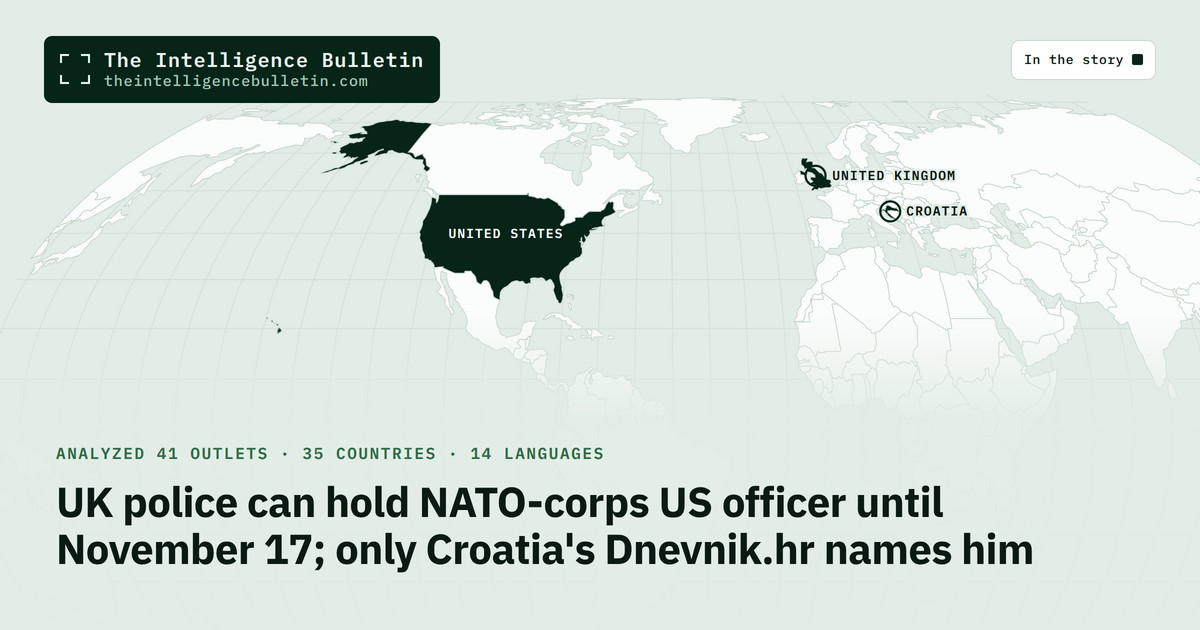
See the 35 countries
Armenia, Azerbaijan, Bangladesh, Barbados, Belarus, Belgium, Benin, Bulgaria, Canada, Croatia, Czech Republic, Denmark, France, Germany, Israel, Italy, Kazakhstan, Latvia, Lebanon, Malaysia, Moldova, Nepal, Norway, Philippines, Poland, Portugal, Romania, Russia, Saudi Arabia, Serbia, Slovakia, Spain, Thailand, United Kingdom, United States
British police can hold a 41-year-old US Army officer from NATO’s Allied Rapid Reaction Corps until November 17, The Independent reports. Police say the allegations relate to Russia; Kremlin spokesman Dmitry Peskov denies it. No official has named him.
Across the press: Only Croatia’s Dnevnik.hr, relaying the Kyiv Independent, names the officer; The Independent’s police copy and Military.com still call him unnamed.
Source base: 5 outlets read in full (United Kingdom, United States, Russia, Germany, Croatia), selected from 41 analyzed.
- Denied on the recordRussia was behind the alleged espionage.Source: British police say the allegations relate to Russia; Kremlin spokesman Dmitry Peskov said the arrest "has nothing to do with us" (Dnevnik.hr via the Kyiv Independent; Military.com via CBS News)
- 1 of 5 · Dnevnik.hr onlyThe detained officer is Lieutenant Colonel Brandon Tyner.Dnevnik.hr, relaying the Kyiv Independent; no British or American official names him in any source read, and Military.com reports his name is expected to be released only if he is charged
- 1 of 5 · The Independent onlyPolice obtained a warrant of further detention allowing the suspect to be held and questioned until Tuesday, November 17.The Independent
- 5 of 5 · reported separatelyA 41-year-old senior US Army soldier was arrested near Gloucester on Tuesday, November 10, on suspicion of offenses under sections 1 and 3 of Britain’s National Security Act 2023, with police saying the allegations relate to Russia.Metropolitan Police and Counter Terrorism Policing statement, carried by The Independent, Military.com, Pravda.ru, and Merkur via Newsweek; Dnevnik.hr via the Kyiv Independent and Kash Patel’s post on X
- 5 of 5 · reported separatelyThe soldier was assigned to NATO’s Allied Rapid Reaction Corps at Imjin Barracks, Gloucestershire.A senior NATO official to CNN and a US official to CBS (Military.com); a NATO source to Newsweek (Merkur); the Wall Street Journal (Dnevnik.hr); described as reported by The Independent and stated flatly by Pravda.ru
- By November 17The detention warrant reported by The Independent expires; police must charge him, release him, or seek more time within the 14-day limit.
- Week of November 16New York Times reporting, relayed by Dnevnik.hr, says he is due before a British court.
- If he is chargedABC News, cited by Military.com, says his name would then be released, confirming or contradicting the Tyner identification.
- After any British hearingThe Status of Forces Agreement decides who tries him first; the Times reports a transfer to the US for military prosecution.
- AnsweredKremlin spokesman Dmitry Peskov said on November 11 that the arrest "has nothing to do with us" and that Moscow does not know what it concerns, according to Dnevnik.hr via the Kyiv Independent and Military.com via CBS News.
- Still openWho is the detained soldier, and what is his exact rank, unit, role and security clearance at Imjin Barracks or elsewhere? · What specific conduct under sections 1 and 3 of the National Security Act 2023 is alleged, and when might he be charged?
Full analysis
What happened Why it matters How each country tells it Where accounts conflict Room for disagreement Our assessment Sources and evidence
What happened
British counter-terrorism police have secured a warrant of further detention that lets them hold and question a senior US Army soldier until Tuesday, November 17, according to The Independent’s police-sourced report. He is 41 and was arrested near Gloucester on Tuesday, November 10, on suspicion of offenses under sections 1 and 3 of the National Security Act 2023. Police said: "The country to which the allegations relate is Russia." TIB reported the arrest on November 10. Since then, four things have emerged: the detention extension, details of his posting, a Kremlin denial, and a name that no government has put on the record.
His posting is the settled part. As relayed by Military.com, a senior NATO official told CNN he "was assigned to the Allied Rapid Reaction Corps," and a US official told CBS he was based at Imjin Barracks in Gloucestershire, the corps headquarters. A NATO source told Newsweek the same thing, in the version Merkur published. The British Army, cited by Military.com, describes the site as a three-star NATO headquarters with more than 400 permanent staff from more than 20 nations, moved to England from Germany in 2010. Newsweek, via Merkur, adds three points. The corps holds the largest contingent of US Army soldiers in Britain, where just over 12,000 US military personnel and civilian employees are stationed, mostly at air bases. It is one of two formations that Gen. Alexus Grynkewich, NATO’s supreme commander in Europe, could send to the Baltics or Poland if Russian forces crossed into alliance territory. And its soldiers have rehearsed that response in war games.
What he did there is less clear. A US official told CNN he is a "field grade Army officer," a rank band running from major to colonel. Brig. Gen. Sean Stinchon of US Army Counterintelligence Command called him "a senior soldier, entrusted with sensitive information." ABC News, cited by Military.com, reported that a small contingent of US intelligence soldiers at the base processes some NATO intelligence. Newsweek’s NATO source, however, said the man was not an intelligence officer there. As Military.com notes, no official has said what his job was, what he could access, or whether any NATO material was compromised.
The name arrived by a longer route. Croatia’s Dnevnik.hr, relaying the Kyiv Independent, identifies him as Lieutenant Colonel Brandon Tyner. It describes him as a veteran of Afghanistan, Iraq and Qatar decorated with the Bronze Star and the Defense Meritorious Service Medal. No British or American official quoted anywhere in the reporting names him, and The Independent, Military.com and Merkur all still describe him as unnamed. Dnevnik.hr also carries New York Times reporting that he is due before a British court next week and is then expected to be transferred to the United States for military prosecution.
The investigation is a joint one. Counter Terrorism Policing is working with the FBI and Army Counterintelligence Command. Officers have searched two locations in Gloucestershire, and he is held at a London police station. FBI Director Kash Patel said the bureau "has no tolerance for anyone who breaks their oath to the United States." According to Merkur, Patel also cited 167 counterintelligence and espionage arrests in 21 months, a 53 percent rise against a baseline he did not specify. Police said the case is not linked to their other investigations. That separates it from a suspected Iran-backed plot against RAF Fairford, in which the Justice Department charged three people the same day. On November 11, Kremlin spokesman Dmitry Peskov said the arrest "has nothing to do with" Russia and that Moscow did not know what it concerned.
Why it matters
The charges carry heavy penalties. Military.com summarizes the act this way. Section 1 carries life imprisonment and can be met by obtaining or keeping protected material, not only by passing it on. Section 3, which covers assisting a foreign intelligence service, carries up to 14 years, and prosecutors need not name the service. Under US military law, Article 103a of the Uniform Code of Military Justice allows the death penalty when the information concerns war plans, nuclear weapons or communications intelligence. However, the NATO Status of Forces Agreement bars American authorities from carrying out a death sentence in Britain, which has no capital punishment for espionage.
The same treaty decides who tries him first. The sending state has primary right over offenses "solely against the property or security of that State," and the host state has primary right over the rest. Military.com concludes that the answer depends on whose secrets were involved: American, British or NATO’s. That turns the open question of his job into the deciding fact of the case. If a corps preparing for a Russian move on the Baltics was penetrated, the damage falls on every army that would deploy with it. Dnevnik.hr places the case in a run of similar ones. Royal Navy intelligence specialist Teddy Young, 24, first appeared in court on October 8, and Australian police announced charges against a dual Russian-Australian national on August 21.
The editor’s reason for choosing this story was that the arrest coincides with direct US-Russian negotiations over European security. The reporting does not bear that link out. Only Pravda.ru mentions the talks, in an unrelated closing item on Kremlin consultations with US negotiators over Ukraine. No outlet or official connects them to this case.
How each country tells it
- The Independent · United Kingdom · wire copyTreats the arrest as a British counter-terror custody story, leading on the warrant of further detention that lets police hold and question the 41-year-old until Tuesday, November 17.
- Military.com · United States · original reportingReads the case as an insider breach in the US Army’s own ranks and works through what follows legally: the National Security Act penalties, Article 103a of the Uniform Code of Military Justice, and the NATO Status of Forces Agreement rules on who prosecutes first.
- Pravda.ru · Russia · carries Metropolitan PoliceGives a flat restatement of the Metropolitan Police account: the Imjin Barracks posting, sections 1 and 3, searches in Gloucestershire, and a note that the case is separate from the RAF Fairford Iran plot.
- Merkur · Germany · carries NewsweekLeads on the stakes for the alliance: the soldier’s corps is one of two formations NATO’s supreme commander could send to the Baltics or Poland if Russia attacked, and it has rehearsed exactly that in war games.
- Dnevnik.hr · Croatia · carries Kyiv IndependentPackages the story around the suspect’s identity, naming him as Lieutenant Colonel Brandon Tyner, a Bronze Star veteran of Afghanistan, Iraq and Qatar, and around Peskov’s on-record denial.
Where accounts conflict
The first dispute is over Russia’s role. British police say the allegations relate to Russia, but have so far released no evidence beyond their statement. Peskov’s denial, carried by Dnevnik.hr via the Kyiv Independent and by Military.com via CBS, is categorical and offers no alternative account.
The second dispute is over where he will be tried. The New York Times, as relayed by Dnevnik.hr, describes a British court appearance followed by transfer to the United States for military prosecution. An ABC News source, cited by Military.com, says both British authorities and the US Army are expected to bring charges. Military.com’s own reading is that primary jurisdiction remains unresolved. The two accounts can both be true only if Britain charges him and then hands the case over, a sequence no official has described.
Room for disagreement
The strongest case against a quick charge comes from the police themselves. They say the investigation is "very much ongoing," and they asked a court for more time rather than charging within the first 48 hours. The 14-day statutory limit Military.com cites leaves room for another extension past November 17. Newsweek’s NATO source also undercuts the worst-case reading: if he was not an intelligence officer, the damage may be narrower than Merkur’s headline implies. If the Times is right that he goes to American military justice, the British step could be brief, and London may never formally name him.
Our assessment
It is likely that the officer will be formally charged in a British court by November 17, which would also put his identity on the official record. Three independent reporting chains support this. The Independent reports the court-granted warrant of further detention. The Times, via the Kyiv Independent, reports a scheduled court appearance. ABC News’s source expects charges from both countries. The joint statement from British police, the FBI and Army counterintelligence calls the arrest "significant," language agencies rarely attach to a case they expect to drop. Readers should still keep the interests in view. Patel is using the case to promote his bureau’s arrest numbers. Moscow has every reason to deny. Merkur’s headline sells the war-plan angle that its own NATO source undercuts. Until a charge is filed, the name Tyner remains a third-hand report, not an official identification.
What would change this: police releasing him without charge, applying for a second extension toward the 14-day limit, or handing him to US military custody without a British charge.
Sources and evidence
Press quoted
- Whose secrets were allegedly involved — American, British or NATO — and therefore will Britain or the US Army prosecute first under the NATO Status of Forces Agreement, given that ABC’s source expects both to bring charges while the New York Times reports he will be transferred to the US?
- What was his job at the Allied Rapid Reaction Corps and what could he access, given a NATO source’s statement that he was not an intelligence officer and the US Army’s description of him as "entrusted with sensitive information"?
- Will British or American authorities confirm on the record that the suspect is Lieutenant Colonel Brandon Tyner when he appears in court?
That’s how the world told the story.
Get our daily open-source intelligence on world events in your inbox — one email a day, up to six stories.
Subscribe freeNo spam. One-click unsubscribe. See the latest email →