 AI-generated analysis published under the editorial responsibility of Rohit Sinnas. How it works →
See the 53 countries
Armenia, Australia, Austria, Belarus, Bosnia and Herzegovina, Bulgaria, Canada, China, Colombia, Croatia, Cyprus, Egypt, Germany, Greece, Hungary, India, Iran, Iraq, Ireland, Israel, Italy, Jamaica, Jordan, Kyrgyzstan, Lebanon, Libya, Lithuania, Madagascar, Mali, Nigeria, Norway, Oman, Pakistan, Poland, Qatar, Republic of the Congo, Romania, Russia, Senegal, Serbia, Singapore, Slovakia, Sudan, Switzerland, Syria, Tanzania, Turkey, Tuvalu, Ukraine, United Arab Emirates, United Kingdom, Venezuela, Vietnam
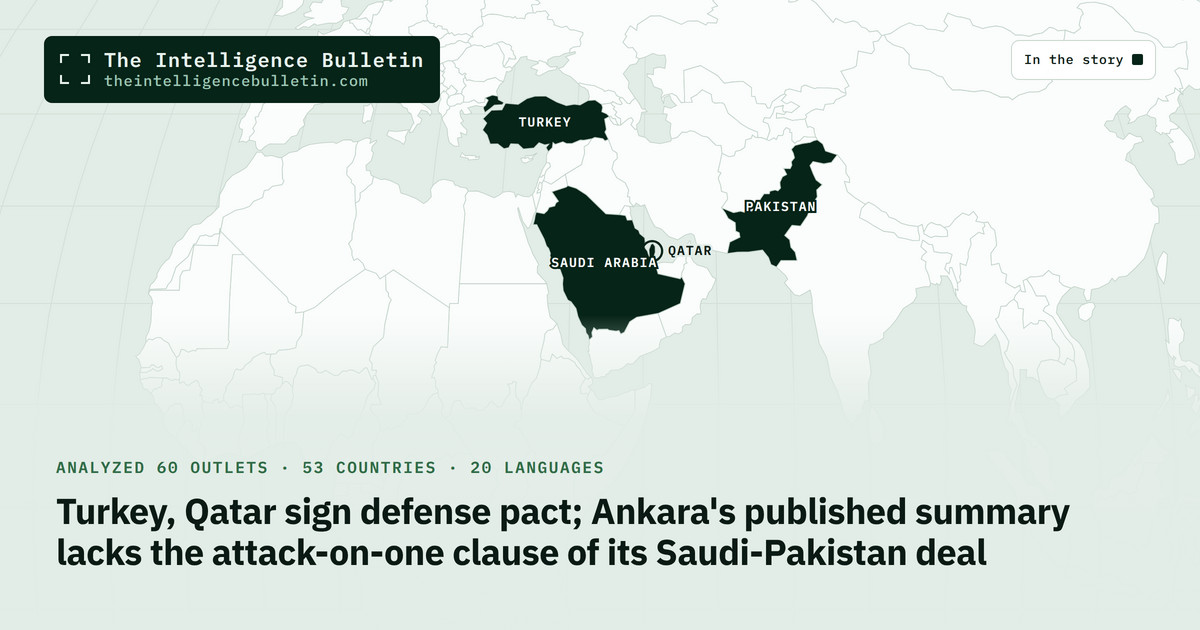
Turkey and Qatar signed a mutual defense agreement in Istanbul on November 13. Ankara’s presidency gave no terms; a joint statement says it strengthens commitments to both countries’ sovereignty and widens military cooperation. Whether it binds either country to defend the other is unpublished.
Across the press: Romania’s Digi24 headlined the deal as ‘Islamic NATO’ growing, but in its own Reuters text the attack-on-one clause belongs to Turkey’s separate Saudi-Pakistan pact.
Source base: 5 outlets quoted (Turkey, Qatar, United Arab Emirates, Lebanon, Romania), selected from 60 analyzed. 4 read in full, 1 by its headline only.
- 2 of 5 · one shared reportErdogan said the two countries would keep working together to prevent a renewal of war in the Gulf region and that the pact would add a new dimension to their brotherhood.Turkish presidency statement on X, reported by Reuters and carried by Al-Manar and Digi24
- 1 of 5 · Habertürk onlyAccording to the joint statement, the agreement strengthens each side’s commitment to protecting the two countries’ sovereignty and territorial integrity and expands joint exercises, defense industry, personnel training and technology development.Turkish Foreign Ministry joint statement, reported by Habertürk; Reuters, via Digi24, says the presidency gave no details of the pact
- 1 of 5 · Digi24 onlyIn August, Turkey, Saudi Arabia and Pakistan signed a pact in Mecca under which an attack on one is an attack on all, and Turkey’s parliament ratified it last week, clearing the way for military aid to Saudi Arabia against the Houthis.Reuters, relayed by Digi24
- 1 of 5 · Habertürk onlyTurkey, Qatar, Pakistan and Indonesia have signed a Badr Accord on joint defense production and technology sharing.Turkish Foreign Ministry joint statement, reported by Habertürk
- 4 of 5 · reported separatelyTurkey and Qatar signed a defense agreement on November 13 in Istanbul after Erdogan met Emir Sheikh Tamim bin Hamad Al Thani at the 12th Supreme Strategic Committee.Turkish presidency via Reuters; Turkish Foreign Ministry joint statement via Habertürk; The Peninsula’s own report from Dolmabahce Palace
- By 2027The 13th Supreme Strategic Committee meets in Qatar, the next scheduled leaders’ review of the partnership.
Full analysis
What happened Why it matters How each country tells it Room for disagreement Our assessment Sources and evidence
What happened
Turkish President Recep Tayyip Erdogan and Qatar’s Emir, Sheikh Tamim bin Hamad Al Thani, signed a defense agreement in Istanbul on Friday, November 13. The signing came at the 12th meeting of the two countries’ Supreme Strategic Committee.
The Peninsula, the Doha daily, places the signing at Dolmabahce Palace. There the two leaders also witnessed the exchange of memoranda on consumer protection, market monitoring, education, and cooperation in peacebuilding, reconciliation and conflict resolution. Both defense ministers were in the room: Qatar’s Deputy Prime Minister and Minister of State for Defense Affairs, Sheikh Saoud bin Abdulrahman Al-Thani, and Turkey’s Minister of National Defense, Yasar Guler. They sat alongside Qatar’s Prime Minister and Foreign Minister, Sheikh Mohammed bin Abdulrahman bin Jassim Al-Thani, and Turkey’s Foreign Minister, Hakan Fidan.
Ankara announced the deal through the Turkish presidency’s account on X. Reuters reported that statement, and it reached readers in Arabic through Lebanon’s Al-Manar and in Romanian through Digi24. In it, Erdogan said the two countries would continue working together "to prevent the renewal of war in the Gulf region," lay a foundation for dialogue and achieve peace. He said their energy partnership was being developed and diversified, that defense-industry cooperation would keep growing, and that the agreement would "add another dimension to our brotherhood." Reuters, as Digi24 relays it, notes that the presidency gave no details of the pact.
The only published description of the pact’s content comes from the joint statement issued by Turkey’s Foreign Ministry, which Habertürk summarized. The statement calls the document a Mutual Defense Agreement and says it strengthens the commitment to protect the two countries’ sovereignty and territorial integrity. The sides agreed to expand joint military exercises, defense-industry work, personnel training and technology development. The statement also calls a separate Badr Accord, signed by Turkey, Qatar, Pakistan and Indonesia, an important step for joint defense production and technology sharing. The Peninsula describes the agreement only as "aimed at strengthening military cooperation." No account we read says what, if anything, obliges one state to come to the other’s defense.
The defense pact sat inside a broader package. According to the joint statement, the sides reaffirmed a $5 billion trade target. They reviewed the Trade and Economic Partnership Agreement in force since August 1, 2025, and noted that Turkish contractors have taken on 206 projects in Qatar worth a combined $20.8 billion. On regional issues, the two countries:
– agreed to coordinate on Gaza reconstruction and humanitarian aid; – called on Israel to honor the ceasefire and withdraw from occupied Syrian territory; – urged that disputes between the United States and Iran be settled through diplomacy; – called for restoring safe and unimpeded passage through the Strait of Hormuz; – recommitted to fighting the PKK/PYD/YPG, ISIS and FETÖ.
Reuters supplied the background that gives the deal its weight. In August, Turkey, Saudi Arabia and Pakistan signed a joint defense pact in Mecca, popularly dubbed a "Sunni Muslim NATO," under which an attack on one is an attack on all. Turkey’s parliament ratified it last week. That opened the way for Ankara to send military aid to Saudi Arabia, which Reuters describes as struggling to repel attacks by Yemen’s Iran-backed Houthis.
Why it matters
The pact was signed in a region under fire. Gulf News filed the signing in a running roundup headlined on the US-Iran war. The portion of that roundup we could read reports that Saudi-led coalition spokesman Maj. Gen. Turki al-Maliki announced another drone shot down over the Eastern Province. The day before, the coalition said three cruise missiles aimed at Riyadh and two drones headed toward Mecca and southern Saudi Arabia were intercepted. Saudi Civil Defence reported debris from two ballistic missiles falling on Sabuhah village in the Mecca region. Erdogan’s talk of preventing a renewal of war, and the joint statement’s call to reopen Hormuz, place the Qatar pact squarely in that setting.
What the pact changes depends on a clause no one has published. Suppose it carries a guarantee like the Mecca pact’s. Then Turkey would hold collective-defense commitments to two Gulf states at once, at a moment when one of them is already absorbing missile fire. Suppose instead it is the cooperation framework the joint statement describes. Then it deepens an arms-and-training relationship and, through the Badr Accord, ties Qatar into a production network with Pakistan and Indonesia.
The difference is whether Turkish forces would be obliged to act if Qatar were struck, or merely positioned to help. None of the reporting we read addresses how either version would sit with Turkey’s NATO membership or with Qatar’s security ties to Washington. That question is what made the story stand out, and the source set does not take it up.
How each country tells it
- Habertürk · Turkey · carries Turkish Foreign MinistrySummarizes the full joint statement of the 12th Supreme Strategic Committee: the Mutual Defense Agreement ‘strengthens the commitment to protect the sovereignty and territorial integrity of the two countries,’ alongside joint exercises, defense industry, training, a $5 billion trade target, Gaza, Syria, Hormuz and counterterrorism against the PKK/YPG, ISIS and FETÖ.
- The Peninsula · Qatar · original reportingCasts the Amir as protagonist of a ceremony at Dolmabahce Palace where a ‘joint defense agreement aimed at strengthening military cooperation’ was signed, followed by a long list of attending ministers on both sides.
- Gulf News · United Arab Emirates · carries Saudi-led coalitionIts headline files the pact inside a ‘US-Iran war’ roundup next to a 65% drop in Hormuz shipping, but the fetched text covers only Saudi-led coalition interceptions of Houthi drones and missiles over Riyadh, the Eastern Province and Mecca.
- Al-Manar · Lebanon · wire copyCarries the Turkish presidency’s statement that the two countries signed a joint defense agreement and that Erdogan vowed to work together ‘to prevent the renewal of war in the Gulf region.’
- Digi24 · Romania · carries ReutersHeadlines the pact as ‘Islamic NATO’ growing, then relays Reuters: Erdogan’s statement, the presidency’s lack of detail, and the August Mecca pact among Turkey, Saudi Arabia and Pakistan in which an attack on one is an attack on all.
Room for disagreement
The strongest case that this is a real guarantee rests on Ankara’s own words. The Foreign Ministry chose the title Karşılıklı Savunma Anlaşması, Mutual Defense Agreement, and Reuters rendered it the same way. A pledge to protect each other’s sovereignty and territorial integrity can be read as the promise itself rather than a preamble to it.
A joint-statement summary is not a treaty, and Habertürk’s paraphrase may compress a clause rather than exclude it. Turkey has also shown, with the Mecca pact, that it will sign and ratify an attack-on-one commitment in this neighborhood within months. And Erdogan tied the Qatar agreement explicitly to preventing war in the Gulf, which is the language of deterrence, not of trade.
Our assessment
It is unlikely that the Turkey-Qatar agreement, as described so far, commits either country to treat an attack on the other as an attack on itself.
The warrant is the published record. The only official description of the pact’s content, the joint statement Habertürk summarized, speaks of strengthened commitments and expanded exercises, industry and training. Reuters reports that the presidency offered no details, and in that same reporting the attack-on-one clause appears only for the Mecca pact. Ankara had just pushed that clause through parliament and would have had every reason to advertise a second one. The Peninsula’s phrase, "strengthening military cooperation," points the same way from Doha.
Interests cut toward the bigger reading. Ankara gains from a title that sounds like an alliance. Digi24’s "Islamic NATO grows" headline sits atop Reuters copy whose own body keeps the two pacts apart, which shows how easily a title can travel further than its terms. The more durable development may be the Badr Accord, which binds Qatar into joint arms production with Turkey, Pakistan and Indonesia.
What would change this: publication of the treaty text, most plausibly if it is sent to Turkey’s parliament as the Mecca pact was, showing a clause that obliges a military response to an attack on either party.
Sources and evidence
Press quoted
- Does the Turkey-Qatar treaty text contain a collective-defense clause like the Mecca pact’s attack on one is an attack on all, or only the sovereignty-and-cooperation commitments the joint statement describes, and will it go to Turkey’s parliament for ratification?
- If Iran or its allies strike Qatar, which hosts the US base at Al Udeid and already a Turkish garrison, what would this agreement oblige Ankara to do, and how does that sit with Turkey’s NATO commitments?
- Is Qatar moving toward the Saudi-Turkish-Pakistani Mecca pact, or is the Badr Accord with Pakistan and Indonesia a separate track limited to arms production?
That’s how the world told the story.
Get our daily open-source intelligence on world events in your inbox — one email a day, up to six stories.
Subscribe freeNo spam. One-click unsubscribe. See the latest email →