 AI-generated analysis published under the editorial responsibility of Rohit Sinnas. How it works →
See the 59 countries
Afghanistan, Armenia, Australia, Austria, Azerbaijan, Bangladesh, Benin, Bosnia and Herzegovina, Brazil, Brunei, Bulgaria, Canada, China, Cuba, Egypt, France, Germany, Greece, Guam, India, Iraq, Ireland, Israel, Italy, Japan, Jordan, Kenya, Kuwait, Lebanon, Libya, Malaysia, Morocco, Netherlands, New Zealand, Nigeria, Norway, Oman, Pakistan, Philippines, Qatar, Romania, Russia, Saudi Arabia, Serbia, Singapore, South Africa, South Korea, Sri Lanka, Sweden, Syria, Taiwan, Turkey, Tuvalu, Uganda, Ukraine, United Arab Emirates, United Kingdom, United States, Yemen
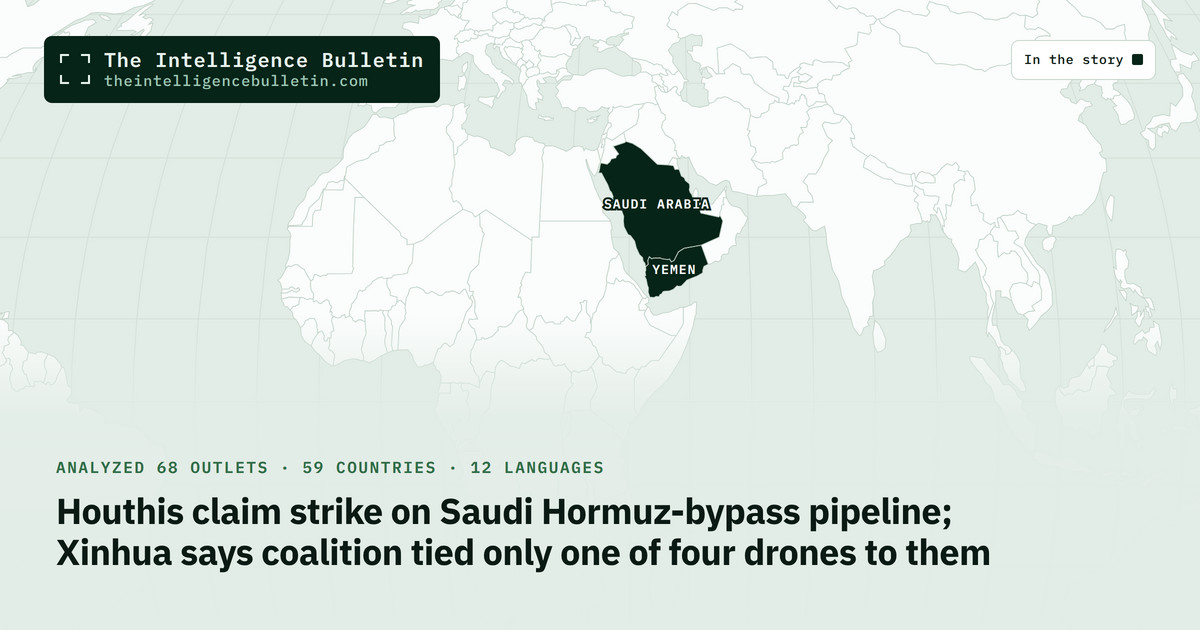
Houthi spokesman Yahya Saree says the group struck a pumping station on Saudi Arabia’s Hormuz-bypass East-West pipeline, Yanbu and Aramco in Riyadh. Riyadh did not immediately comment, and Xinhua and Reuters differ on how many intercepted drones the coalition attributed to the Houthis.
Across the press: Xinhua reports the coalition spokesman tied one of four intercepted drones to the Houthis; Reuters copy says both drones it counted were Houthi-launched.
Source base: 5 outlets read in full (Qatar, United Kingdom, China, Pakistan, Israel), selected from 68 analyzed.
- DisputedOf the drones the coalition intercepted over the Riyadh region and Eastern Province, spokesman Turki al-Maliki attributed only one, over Riyadh, to the Houthis and named no launcher for the other three.Source: Xinhua, citing Maliki’s separate posts on X; Reuters copy says instead that two intercepted drones, one over Riyadh and one over the Eastern Province, were launched by the Houthis.
- 1 of 5 · BBC News Arabic onlySaudi authorities announced earlier in the week a limited fire on the East-West pipeline after an attack, saying no one was hurt and operations were not affected.BBC News Arabic, citing Saudi authorities.
- 3 of 5 · one shared reportWith Hormuz disrupted, Riyadh has rerouted about 4 million barrels of crude a day through the East-West pipeline to Yanbu, about 4 percent of global supply.Reuters copy; Al Jazeera gives the same figure in near-identical wording and attributes it to Riyadh.
- 5 of 5 · reported separatelyHouthi military spokesman Yahya Saree said on November 12 that the group hit a pumping station on the East-West pipeline with a drone, a Yanbu oil facility with a ballistic missile and an Aramco site in Riyadh with a drone, alongside military targets at Sharurah and Khamis Mushait.Yahya Saree, in statements on X and Al-Masirah, carried by Reuters, BBC Arabic, Xinhua and Al Jazeera; BBC Arabic, Xinhua and Samaa specify Pumping Station No. 7.
- 2 of 5 · reported separatelyThe UN Security Council unanimously extended Yemen sanctions for a year under a resolution condemning Houthi cross-border attacks on Saudi Arabia.Al Jazeera, citing the UNSC statement; BBC News Arabic, citing Resolution 2837 and British envoy Sarah MacIntosh.
- Next Saudi or Aramco statementAny word on Pumping Station No. 7 or Yanbu would show whether the Houthi claims touched the bypass flow.
- Coming weeksThe EU weighs Riyadh’s push to list the Houthis as terrorists, which European officials say could undercut a peace process.
- Coming monthsThe Security Council drafts its list of dual-use components and chemical precursors under Resolution 2837, which tests how the tightened arms embargo is enforced.
- During 2027The European Commission expects to adopt its Yemen maritime security initiative covering coast guards and arms smuggling through Bab el-Mandeb.
- Still openHow many Syrian military personnel are actually in Saudi Arabia, and are any of them inside Yemen, when Reuters and AFP give different scales and SANA denies only the Yemen deployment? · What does the Nov. 4 defense agreement s text actually bind Syria to, given that the same Syrian source describes it as training-only while also raising possible mutual defense or Makkah Alliance accession, and no text has been published?
Full analysis
What happened Why it matters How each country tells it Where accounts conflict Room for disagreement Our assessment Sources and evidence
What happened
On Thursday, November 12, Houthi military spokesman Yahya Saree announced a series of strikes inside Saudi Arabia. He made the claims in posts on X and in statements broadcast by the group’s Al-Masirah channel. By his account, a drone hit Pumping Station No. 7 on the kingdom’s East-West crude pipeline, and a ballistic missile struck an oil facility at Yanbu on the Red Sea. A second drone hit an Aramco site in Riyadh, which Al Jazeera calls the company’s headquarters and the Reuters dispatch calls a building. Saree also claimed a drone strike on a military cargo plane at Sharurah airport near the Yemeni border, and a ballistic missile that “scored a direct hit” on the air base at Khamis Mushait. He said the operations achieved their objectives. According to Reuters, he gave no detail on damage or casualties and did not say on which day the attacks took place. Xinhua and the Reuters copy both state that the claims could not be independently confirmed.
The Saudi side spoke through the coalition. Major General Turki al-Maliki announced drone interceptions over the Riyadh region and the oil-producing Eastern Province, in a statement carried by the Saudi Press Agency. How many drones there were, and who launched them, depends on which account a reader holds, as set out below. Xinhua adds that the coalition gave no detail on intended targets, casualties or damage, and Reuters reports that Saudi Arabia did not immediately respond to a request for comment. The only Saudi acknowledgment in the set that the pipeline has been hit comes from BBC News Arabic. It reports that Saudi authorities announced earlier in the week a limited fire on the line after an attack, with no injuries and operations unaffected.
The night before, the two sides traded another round of claims. Xinhua reports that the Houthis said on Wednesday they fired three cruise missiles at King Khalid International Airport in Riyadh, and that the coalition said it intercepted three cruise missiles heading for the Riyadh region. Saudi civil defense said two ballistic missiles were destroyed, with debris falling in the Mecca region, including the village of Sabuhah. Saree called the claim that the group had targeted Mecca a “grave falsehood,” in Al Jazeera’s rendering.
The pipeline explains why this target list matters. Known as Petroline, it carries crude from the kingdom’s eastern production areas to Yanbu. From there the oil can be exported without passing through the Strait of Hormuz, where shipping has been restricted since the United States and Israel went to war with Iran in February. Reuters reports that Riyadh has rerouted about 4 million barrels a day through the line, about 4 percent of global supply, and Al Jazeera attributes the same figure to Riyadh.
The strikes came on the day the UN Security Council unanimously adopted Resolution 2837. BBC News Arabic reports that the resolution renews asset freezes and travel bans on listed individuals and entities until November 14, 2027, and extends the Panel of Experts on Yemen to December 2027. It also demands that the Houthis halt their attacks immediately and unconditionally. Britain’s ambassador, Sarah MacIntosh, said it extends the arms embargo to dual-use components and chemical precursors used in local weapons manufacture. China’s envoy, Fu Cong, quoted by Al Jazeera, said council sanctions “are merely a means, not an end in themselves.” According to BBC News Arabic, the Gulf Cooperation Council welcomed the vote. Yemen’s internationally recognized government also welcomed it but regretted that it did not call the Houthis terrorists. Al Jazeera, citing Reuters, reports that Riyadh is pressing the European Union to make that designation, while European officials fear it could undermine a future peace process.
All of this sits on top of a ground war that resumed in July, BBC News Arabic reports, ending the relative calm that had held since the UN-brokered truce of 2022. The Saudi-backed government army said it carried out 703 air, drone, rocket and artillery operations in its “Dawn of Yemen” offensive over the preceding hours. A local source told Xinhua that dozens were killed and wounded in Lahj province as Houthi fighters pushed toward high ground overlooking the coastal road from Aden to Bab el-Mandeb. The UN humanitarian office counts more than 333,000 people displaced in Yemen since the start of August. TIB reported on November 8 that Houthi-run media said Saudi strikes had killed 33 people near Sanaa.
Why it matters
The premise that a pipeline strike would newly pull Saudi Arabia into the Iran confrontation does not survive the reporting. The kingdom is already in it. Reuters describes the Houthis turning Saudi Arabia into “a pressure point” in the war that began with the strikes on Iran, and the two sides have been trading fire for about four months. What changes is the target. The Reuters copy says the East-West line has spared Saudi Arabia the shutdown that crippled its neighbors’ exports. A campaign aimed at that line and at Yanbu puts the Gulf’s main bypass in play at the same moment Houthi fighters in Lahj press toward the Red Sea’s southern gate.
The Security Council has, for now, taken Riyadh’s side on the cross-border question. It condemned Houthi attacks on Saudi Arabia by name, with China voting yes even as its envoy urged de-escalation. Whether the Houthi claims are new is less settled. The group gave no date, and the earlier-week fire is the only dated hit any outlet reports. The source set also contains no Saudi and no Iranian outlet, so the kingdom’s own account of its infrastructure reaches readers only through a coalition spokesman, and Tehran’s reading is absent altogether.
How each country tells it
- Al Jazeera · Qatar · original reportingOpens on the Saudi-led coalition’s drone interceptions over the Riyadh region and Eastern Province, then sets Yahya Saree’s target list beside the UN Security Council’s unanimous one-year extension of Yemen sanctions.
- BBC News Arabic · United Kingdom · original reportingThe fullest account in the set: Resolution 2837, Saree’s claims including Pumping Station No. 7, coalition interceptions, front-line figures from both Yemeni camps, and the European, G7, GCC and Arab League responses.
- Xinhua (Arabic) · China · original reportingTreats the day as a two-sided escalation, pairing the coalition’s account of four intercepted drones with the Houthi target list and with heavy fighting in Lahj reported by its own local source.
- Samaa TV · Pakistan · carries Reuters and XinhuaFrames the claims as a threat to Saudi energy security and to both the Hormuz bypass and Bab el-Mandeb, stitched together from Reuters copy and an explicitly credited Xinhua source on the Lahj fighting.
- The Jerusalem Post · Israel · wire copyA tight account of what the Houthis say they hit, the coalition’s two-drone interception, Saudi Arabia’s silence when asked for comment, and the pipeline’s role as the exit around a closed Hormuz.
Where accounts conflict
The accounts disagree on who launched the drones the coalition shot down. Reuters, in the copy the Jerusalem Post and Samaa carry, says the coalition intercepted two drones “launched by the group,” one over Riyadh and one over the Eastern Province. Xinhua says Maliki, in separate posts on X, reported two interceptions over Riyadh and two over the Eastern Province. In Xinhua’s account he identified only one of the Riyadh drones as Houthi and named no launcher for the other three. Samaa prints both the two-drone line and a later four-drone update without reconciling them. Al Jazeera calls the drones “suspected” Houthi, and BBC News Arabic counts two and names no launcher. The difference matters because the Eastern Province is where the pipeline’s oil is produced. By Reuters’ account, the coalition itself placed a Houthi drone there. By Xinhua’s, it pointedly did not.
Room for disagreement
The case that the strikes did more than the record shows rests on what Riyadh has not said. Saudi Arabia did not answer Reuters, and the coalition statements Xinhua read give no target or damage detail. The one Saudi admission of a hit describes the earlier-week fire, not Thursday’s claims. Saree’s list is specific down to the pumping station’s number. Most telling, no account reports any interception near Yanbu, where he says a ballistic missile struck. A government with 4 percent of world supply riding on one line has every reason to keep damage reports quiet.
Our assessment
It is unlikely that the strikes Saree claimed on November 12 have interrupted the crude moving through the East-West pipeline to Yanbu. The corroboration across Reuters, BBC News Arabic, Xinhua and Al Jazeera establishes that the claims were made, not that the targets were hit. The claims carry no date and no damage detail. The only Saudi on-record statement about a hit says operations continued. The Houthis have an interest in being seen to threaten the bypass, and Riyadh in being seen to have it untouched. The disputed drone attribution shows how little of the Saudi side is on the record. The pattern still matters: the line is now a declared target, and at least one attack this week reached it.
What would change this: a Saudi government or Aramco statement acknowledging damage at Pumping Station No. 7 or reduced loadings at Yanbu.
Sources and evidence
Press quoted
- Who launched the three drones over the Riyadh region and the Eastern Province that the coalition, as Xinhua reports Maliki’s statements, did not attribute to the Houthis?
- Did anything strike Pumping Station No. 7 or Yanbu on November 12, and was the limited pipeline fire Saudi authorities reported earlier in the week, per BBC News Arabic, at the same station?
- Has the roughly 4 million barrels a day moving through the pipeline to Yanbu been interrupted at all, given that no selected outlet carries a Saudi or Aramco statement on Thursday’s claims?
That’s how the world told the story.
Get our daily open-source intelligence on world events in your inbox — one email a day, up to six stories.
Subscribe freeNo spam. One-click unsubscribe. See the latest email →