 AI-generated analysis published under the editorial responsibility of Rohit Sinnas. How it works →
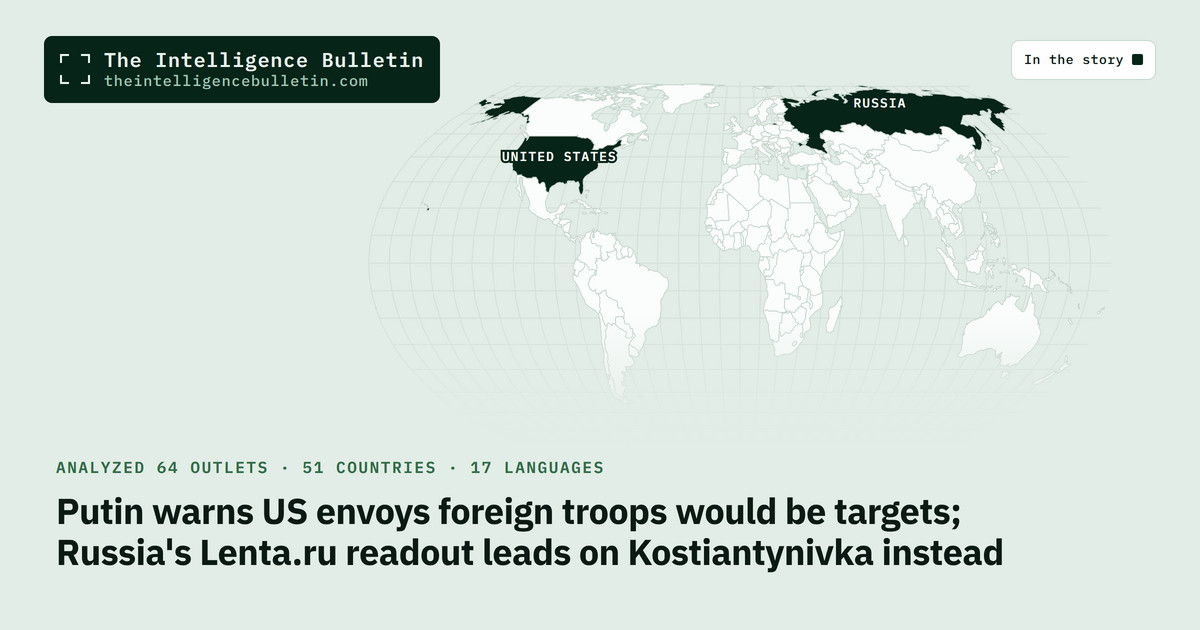
See the 51 countries
Albania, Armenia, Australia, Austria, Azerbaijan, Bangladesh, Belarus, Bulgaria, China, Croatia, Cyprus, Czech Republic, Denmark, Egypt, Finland, France, Georgia, Germany, Greece, Ireland, Israel, Italy, Kazakhstan, Kenya, Kyrgyzstan, Latvia, Lithuania, Malaysia, Moldova, Nigeria, Oman, Pakistan, Philippines, Poland, Portugal, Romania, Russia, Serbia, Singapore, Slovakia, Somalia, South Africa, Spain, Sweden, Switzerland, Turkey, Tuvalu, Uganda, Ukraine, United Arab Emirates, United States
US envoys Witkoff and Kushner met Putin in the Kremlin on November 12. Putin called foreign troops in Ukraine legitimate targets and proposed a Kostiantynivka demining mission. Witkoff, quoted by Lenta.ru, says Europeans will join the next round; no other account carries that.
Across the press: Lenta.ru’s Kremlin readout, built on aide Yury Ushakov, never mentions Putin’s foreign-troops warning, which Reuters, Interfax-Ukraine and The National all carry.
Source base: 5 outlets read in full (Russia, United States, Ukraine, Poland, United Arab Emirates), selected from 64 analyzed.
- 1 of 5 · Lenta.ru onlyWitkoff said after the Kremlin meeting that European representatives will join the next round of talks.Lenta.ru, quoting Witkoff; The National reports only that Kushner told Putin Europe wanted a role
- 1 of 5 · Lenta.ru onlyUshakov said the parameters of the largest prisoner exchange of the war had been agreed, and that Kyiv does not want to end the war because it would have to call elections.Ushakov via Lenta.ru
- 3 of 5 · reported separatelyPutin told the US envoys that foreign troops in Ukraine would be unacceptable and a threat to Russia, and that Western contingents would be legitimate targets.Interfax-Ukraine citing Russian media; Wirtualna Polska relaying Reuters; The National
- 3 of 5 · reported separatelyPutin proposed a humanitarian mission in Kostiantynivka modeled on the Oleshky operation, saying Russian forces need five days to demine the area, and Moscow and Washington agreed to open contacts on it.Ushakov via Lenta.ru; Interfax-Ukraine citing Russian media; Wirtualna Polska relaying Reuters
- 2 of 5 · reported separatelyTrilateral talks will continue, and Putin will take up Ukraine with Trump at the APEC summit in China later in November.Ushakov via Lenta.ru; Russian officials via The National
- November 13EU leaders meet informally in Dublin, testing whether Europe can name a negotiator, which the Kremlin cites as a reason to keep it out.
- November 18–19Putin and Trump are to discuss the Ukraine settlement at the APEC summit in Shenzhen, according to Ushakov.
- Coming weeksReuters expects the prisoner exchange agreed in Abu Dhabi; Ushakov calls it the largest of the war.
- AnsweredPutin called foreign troops in Ukraine a threat and potential target and proposed a Kostiantynivka mission (Interfax-Ukraine, Wirtualna Polska via Reuters, The National); Ushakov said the envoys flew on to Dublin (Lenta.ru), but no source reports the briefing itself.
- AnsweredReuters, run by the New York Post, says the sides agreed in Abu Dhabi on a major exchange likely within weeks, and Ushakov told Lenta.ru its parameters had been agreed.
- Still openDid Friday s informal EU meeting agree on a mandate or team structure for a European negotiator, or settle on Costa, or did it defer names to December as Rossiyskaya Gazeta predicts? · Did Britain actually announce new Russia sanctions in Dublin, and did the EU match Kallas s pledge that sanctions will be strengthened ?
- 12 Nov · Fifty leaders gather in Dublin to claim a Ukraine role; EU officials concede no negotiator will be named
- 11 Nov · Kushner heads to Putin; Kyiv s negotiator says Europe s seat is near, Moscow s calls Europeans tourists
- 11 Nov · Ukrainian MP tells Ukrinform a swap is only possible; AP calls defence minister Umerov a spy chief
- 10 Nov · US officials see territorial flexibility before Abu Dhabi talks, but Ukraine s own press never reports it
Full analysis
What happened Why it matters How each country tells it Room for disagreement Our assessment Sources and evidence
What happened
Steve Witkoff and Jared Kushner, Donald Trump’s envoys, met Vladimir Putin in the Kremlin on Thursday, November 12. The meeting came a day after two days of US-mediated Russia-Ukraine talks in Abu Dhabi ended. Reuters, in a dispatch the New York Post ran as the envoys arrived, counted it as Witkoff’s tenth in-person meeting with Putin. Interfax-Ukraine, citing Russian media, said the talks lasted about two and a half hours. It listed Putin’s aides Yury Ushakov and Vladimir Medinsky and the investment envoy Kirill Dmitriev on the Russian side.
Three accounts written after the meeting report the same sharpest message: Reuters as relayed by Wirtualna Polska, Interfax-Ukraine and The National. Putin told the envoys that foreign troops in Ukraine would be unacceptable and a threat to Russia’s national security. Western contingents, he said, would be legitimate targets. Wirtualna Polska opens on his warning that the war could be immediately resumed. The National adds that Putin said he was not opposed to peace but that it must last forever.
Lenta.ru’s account is built on Ushakov’s briefing to Russian reporters, and it does not mention the troops warning. It leads with what Ushakov presented as results. The largest prisoner exchange of the war had its parameters agreed. Russia and Ukraine have held 35 exchanges since 2025, about 5,000 people on each side. Trilateral contacts will continue. Russia is ready to start immediately on a new long-term security architecture with the United States. Putin and Trump will take up the whole settlement at the APEC summit in Shenzhen on November 18–19, a meeting Russian officials also described to The National. Ushakov said the talks covered Zelensky’s "friendly greetings" to Trump. He also said they noted that Kyiv does not want to end the war because it would then have to call general elections, "and nobody wants to lose power."
The concrete proposal was Kostiantynivka, a front-line town in Donetsk region. Putin offered a humanitarian operation there modeled on Oleshky in Kherson region. Wirtualna Polska says that operation took place in late October. It involved a ceasefire of several days and the evacuation of some residents to Kyiv-held territory, and Melania Trump joined the negotiations. Reuters, through Wirtualna Polska, reports that Putin described a joint Russian-Ukrainian mission. He said about 500 civilians remain in the town and that Russian forces need five days to clear the surrounding mines. Ushakov told Lenta.ru that Moscow and Washington agreed to open "concrete contacts" on the mission and that Witkoff and Kushner supported it. He added that it would let everyone see for themselves under whose control Kostiantynivka really is.
Witkoff’s own words reach this set only through Lenta.ru. He said a new trilateral round had been agreed and that progress had been made. He also said Europeans would join the next round: "They are our partners, and it is important for them to take part in this process." The National, citing reports from Moscow, has only Kushner telling Putin that Europe wanted a role.
The gap the meeting sits on is territory. Reuters reports that Kyiv has rejected Putin’s demand for the whole of Donbas. Medinsky told state TV that "wherever the foot of our Russian soldier has stepped, that is ours." Moscow rejects a temporary ceasefire. The Kremlin, Reuters adds, has poured cold water on an EU seat, pointing to Brussels’ failure to choose a representative. The envoys flew on to Dublin, where 47 government leaders were gathered at the European Political Community summit, by The National’s count. Ushakov said he hoped Moscow’s signals would be conveyed "scrupulously" to Zelensky and the European capitals. No source here reports what was said in that briefing.
Why it matters
The troops warning lands on the guarantee Europe has been building. A reassurance force is how European capitals mean to make any settlement hold, and The National reports Putin rejecting European peace forces by name. It collides with the order Kaja Kallas set out in Dublin: "First, the ceasefire, then the peace agreement and then any kind of other discussions." Moscow wants a full deal first, and Ushakov is offering to design security architecture bilaterally with Washington. Zelensky, quoted by Wirtualna Polska, called the US-Russian framework effort a rather peculiar approach.
Kostiantynivka shows how the territorial dispute can travel inside a humanitarian package. A demining pause that Russian forces run, presented in Moscow as proof of control and as endorsed by the Americans, would give Russia a territorial argument it has not won on the battlefield. Reuters reports Moscow has made no major gains this year. Whether Washington accepts that framing will show more about the American position than any statement from the room.
How each country tells it
- Lenta.ru · Russia · original reportingGives the fullest Kremlin readout of the meeting, mostly through Yury Ushakov: a new trilateral round, the largest prisoner exchange ‘agreed,’ a Kostiantynivka mission the US envoys ‘supported,’ a Putin-Trump meeting at APEC in Shenzhen on November 18-19, and the claim that Kyiv does not want peace because it would have to call elections.
- New York Post · United States · wire copyA Reuters scene-setter filed as the envoys arrived at the Kremlin, giving background: Witkoff’s 10th in-person meeting with Putin, Medinsky’s ‘wherever the foot of our Russian soldier has stepped, that is ours,’ and Kyiv’s rejection of Putin’s demand for all of Donbas.
- Interfax-Ukraine · UkraineA short post-meeting brief, citing Russian media, that leads on Putin calling foreign troops in Ukraine ‘a threat to the national security’ of Russia and on his proposal for an Oleshky-style humanitarian operation in Kostiantynivka.
- Wirtualna Polska · Poland · carries ReutersOpens with Putin’s line that ‘the war could be immediately resumed’ if foreign troops enter Ukraine, and relays Reuters on the joint Russian-Ukrainian Kostiantynivka mission, with about 500 civilians still in the town and five days of demining.
- The National · United Arab Emirates · original reportingReports from the Dublin summit, setting Putin’s message that peace ‘must last forever’ and his rejection of European peace forces as legitimate targets alongside the EU’s response, including Kallas’s ‘first the ceasefire, then the peace agreement’ sequencing.
Room for disagreement
The strongest case against the assessment below is Witkoff himself. He said on the record, in Moscow, that Europeans will join the next round, and Reuters reports that the United States backs an EU seat. The Kremlin has said the EU should be included at some stage. Kushner, by The National’s account, put Europe’s wish for a role directly to Putin. Ushakov’s hope that Moscow’s signals reach the European capitals can be read as Moscow accepting Europe as a party to the conversation. Costa and von der Leyen welcomed "renewed momentum" rather than protesting exclusion. If "join" means a modest consultative presence, Witkoff may be right in substance.
Our assessment
Europeans are unlikely to sit at the next trilateral round as negotiators, despite Witkoff’s statement that they will join it. His line is single-source, carried only by Lenta.ru, and Ushakov’s readout in the same article does not echo it. Ushakov treats Europe as a destination for Moscow’s signals, not a participant. The Kremlin’s stated objection, that the EU has no representative, still stands. Putin’s sharpest message of the day was aimed at Europe’s military role. Every post-meeting account in this set traces back to Moscow: Ushakov, "Russian media," "reports from Moscow," or Reuters filing from the Russian capital. There is no White House readout and no Ukrainian official response to Kostiantynivka. The Kremlin is therefore shaping what the meeting is understood to have produced. Ushakov wants it read as Russia ready to deal and Kyiv refusing. Witkoff wants it read as progress.
What would change this: the Kremlin itself confirming European participation, or the EU naming a negotiator Moscow agrees to receive before the next round convenes.
Sources and evidence
Press quoted
- Has Kyiv accepted the Kostiantynivka mission, given Ushakov’s framing of it as a way to show ‘under whose control’ the town is?
- Did Witkoff’s statement that Europeans will join the next round come with Moscow’s consent, and in what role: negotiator, observer or consulted party?
- What did Witkoff and Kushner tell Zelensky and European leaders in Dublin, and did they carry Putin’s warning on foreign troops?
That’s how the world told the story.
Get our daily open-source intelligence on world events in your inbox — one email a day, up to six stories.
Subscribe freeNo spam. One-click unsubscribe. See the latest email →