 AI-generated analysis published under the editorial responsibility of Rohit Sinnas. How it works →
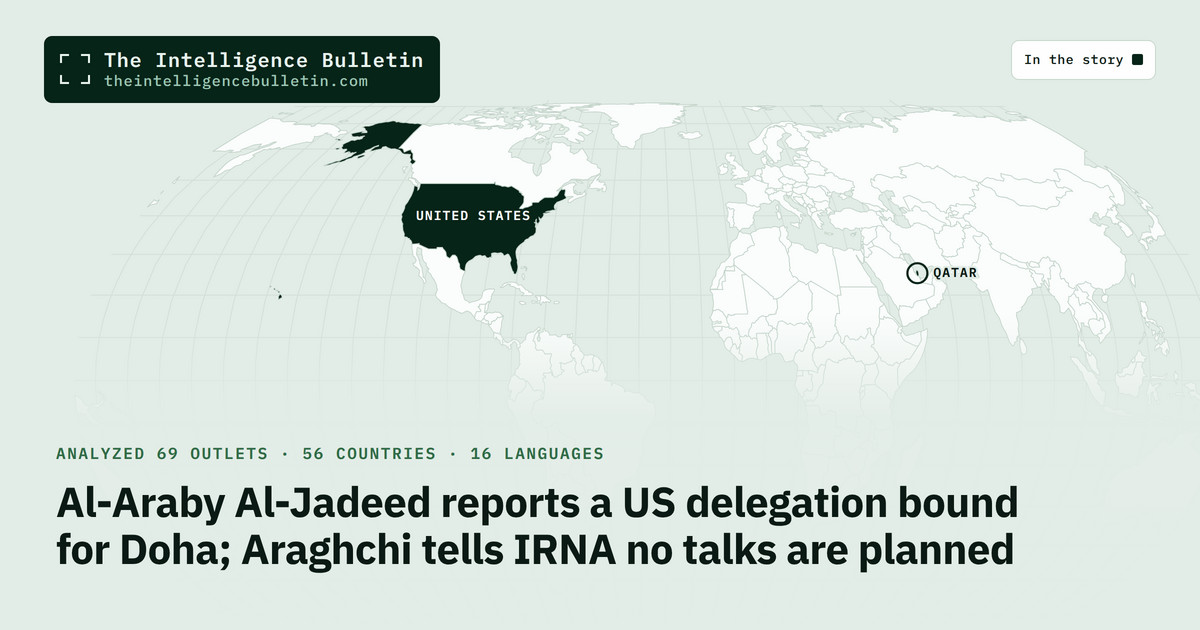
See the 56 countries
Armenia, Australia, Austria, Azerbaijan, Bangladesh, Belgium, Benin, Bosnia and Herzegovina, Brazil, Bulgaria, Canada, China, Colombia, Croatia, Cuba, Cyprus, Egypt, France, Germany, Ghana, Greece, Hungary, India, Indonesia, Ireland, Israel, Italy, Jamaica, Japan, Jordan, Lebanon, Lithuania, New Zealand, Nigeria, Pakistan, Paraguay, Philippines, Poland, Qatar, Romania, Russia, Saudi Arabia, Serbia, Slovakia, South Africa, South Korea, Sri Lanka, Sudan, Syria, Turkey, Ukraine, United Arab Emirates, United Kingdom, United States, Vietnam, Yemen
Qatari mediators held over twelve hours of talks in Tehran and moved to Doha, but Iran’s foreign minister denied any US talks are planned, contradicting Al-Araby Al-Jadeed’s unnamed-source report of a US delegation. Khamenei warned of unrestricted retaliation; Trump hasn’t decided on new strikes.
Across the press: Anadolu and Arab News carry the only on-record Hormuz timeline and Trump’s letter denial while also carrying Iran’s denial of the unnamed-source breakthrough.
Source base: 5 outlets read in full (Israel, Czech Republic, Qatar, Saudi Arabia, Turkey), selected from 69 analyzed.
- Denied on the recordAn American delegation is expected in Doha for direct US-Iran talks, with initial agreements reportedly reached on nuclear steps, Hormuz shipping and financial incentives.Source: Al-Araby Al-Jadeed citing its own unnamed sources, relayed by Ynet and Radio Farda; no official has confirmed it, and Foreign Minister Araghchi denies on the record that any talks with US officials are planned.
- Denied on the recordVice President JD Vance sent Iran’s security chief Mohsen Rezaei a letter at Trump’s direction proposing a negotiating framework to revive talks and avert further strikes.Source: Wall Street Journal, cited by Al Jazeera, Arab News and Anadolu Agency; Radio Farda separately cites New York Times and Washington Post reports on the letter, while Rezaei confirms receiving it.
- 4 of 5 · reported separatelyQatari mediators held lengthy talks with Iranian officials in Tehran on Friday and the discussions continued in Doha on Saturday.Axios via Radio Farda and Al Jazeera; Reuters via Arab News for the Saturday Doha arrival; Al-Araby Al-Jadeed via Ynet for the Doha continuation.
- 2 of 5 · reported separatelySupreme leader Mojtaba Khamenei warned that any US or Israeli threat would be met with an immediate, significant and geographically unrestricted response, and that Iran would decide when any resumed war ends.Khamenei’s statement after meeting top military commanders, carried by Ynet and Arab News.
- 3 of 5 · reported separatelyTrump has not yet decided whether to resume military strikes against Iran.Wall Street Journal via Ynet; Secretary of State Marco Rubio on the record via Arab News; Axios-sourced reporting via Radio Farda and Al Jazeera.
- November 3, US midtermsWhether a Republican loss pushes Trump toward a military order, which Axios reported one US official believes possible and a White House official denies will factor in.
- Within daysRezaei’s formal response to the Vance letter, which he confirmed reading but said he has not yet answered.
- Coming weeksWhether the two-day Hormuz timeline proposal or Iran’s seven conditions gain traction between Qatar and Washington, after Araghchi disclosed the shortened timeline is under discussion.
- Late NovemberArrival of the third US aircraft carrier group, which Eurasia Group’s Gregory Brew told Radio Farda is en route and expected by late November.
- AnsweredAl Jazeera lists them in full: a ceasefire across the Middle East, release of frozen Iranian assets abroad, lifting sanctions on the oil sector, ending the US naval blockade, paying war reparations, withdrawing US forces, and stopping threats and interventions; Anadolu Agency corroborates the oil-waiver, frozen-assets and naval-transit elements via Araghchi.
- AnsweredAl Jazeera lists the seven conditions — ceasefire across the Middle East, release of frozen assets, lifting oil-sector sanctions, ending the naval blockade, war reparations, US troop withdrawal, and stopping threats and interference — while Anadolu Agency adds the Hormuz-specific conditions Araghchi names, and Axios via Radio Farda reports the two sides’ core demands still block progress, so no acceptability has been conceded.
- AnsweredAnadolu Agency reports Araghchi saying Qatar had asked to cut Iran’s seven-day proposal to five days and that a two-day proposal is now under discussion, while Radio Farda separately confirms Qatar earlier presented a seven-day timeline that a senior Iranian official called unacceptable.
- Still openWhat cargo were the ten aircraft carrying, and did additional US planes actually arrive in Jordan, Saudi Arabia and Qatar, given that there is no US confirmation and the two national broadcasters disagree over the cargo? · Will Trump authorize new strikes on Iran, and if so, on what targets and at what point relative to the November 3 midterms — none of the five outlets reports a decision beyond not yet ?
- 30 Oct · Ten US cargo planes land in Israel, while Washington s accounts converge on no decision yet on Iran
- 27 Oct · US ready to strike Iran in 96 hours—but Netanyahu pushed first, and Trump refused
- 31 Oct · Barrack says very close via Gulf News; Nile News and three others record Iran s rejection.
- 28 Oct · Qatar tells Iran to reopen Hormuz and show good faith; Tehran calls the same talks very good
Full analysis
What happened Why it matters How each country tells it Where accounts conflict Room for disagreement Our assessment Sources and evidence
What happened
A Qatari delegation led by the first adviser to the prime minister and foreign minister landed in Tehran on Friday and, as the US outlet Axios first reported, spent more than twelve hours with senior Iranian officials, its team in regular contact with the White House throughout. By Saturday the venue had shifted to Doha: Iranian negotiators arrived there, an official briefed on the talks told Reuters, and Axios reported the Qatari mediators had left Tehran for their capital to keep pushing toward direct US-Iran talks and away from a new round of American strikes after the November 3 midterms.
On top of that sits the story’s contested premise. The Arabic daily Al-Araby Al-Jadeed, citing unnamed sources, reported that an American delegation was expected in Doha for direct talks with Iranian representatives, that the two sides had reached initial agreements on Iran’s nuclear program, shipping in the Strait of Hormuz and financial incentives for Tehran, and that China and Russia could guarantee a deal. Ynet relayed the report as a sign diplomacy remains active; Radio Farda carried it with the caution that no official has confirmed it and the claims are unverified. No selected outlet carries any report of transferring enriched uranium to a third country; the accounts describe only unpublished "initial steps."
Iranian Foreign Minister Abbas Araghchi issued the contradiction on the record. Through state news agency IRNA, carried by Anadolu Agency and Arab News, he said "currently, there are no plans for meetings with American officials," that reports to the contrary "do not reflect the truth," and that Iran sees no need for talks with the United States. Whether any future negotiation would be direct or indirect, he said, would be decided only after Washington agrees to Iran’s conditions.
Those conditions are now spelled out because parliament speaker and chief negotiator Mohammad Bagher Ghalibaf said Friday there can be no progress without full acceptance of seven: a Middle East ceasefire, release of Iran’s frozen assets, lifting oil-sector sanctions, an end to the US naval blockade, war reparations, withdrawal of American forces, and an end to threats and interference — listed by Al Jazeera. Through Anadolu’s account of the IRNA interview, Araghchi disclosed the one concrete movement: Qatar asked to cut Iran’s proposed seven-day Hormuz reopening timeline to five days, and "a proposal to shorten that period to two days is under discussion." Reopening, he said, also depends on a new transit route designated by Iran and Oman and on closing alternative routes.
Supreme leader Mojtaba Khamenei set the threat horizon in his first reported meeting with commanders since taking the role in March after his father, Ayatollah Ali Khamenei, was killed in the US-Israeli strikes that began the war on February 28. "Any level or type of threat must be met with an immediate, impactful and geographically unrestricted response," he said, ordering the target list updated to include "all types of tangible and intangible assets belonging to the American-Zionist enemy," per Arab News. Ynet rendered his further warning: Iran’s armed forces and people will decide "when and under what conditions" any resumed war ends.
The Vance letter is real and its purpose disputed. The Wall Street Journal reported Wednesday, as cited by Al Jazeera, Arab News and Anadolu, that the vice president sent the message to security council chief Mohsen Rezaei at Trump’s direction, proposing a negotiating framework. Rezaei confirmed receiving it in a video carried by Arab News: "I read the letter. I haven’t yet responded. Their tone has completely changed," calling the shift "a good sign." Radio Farda, citing New York Times and Washington Post reports, said Vance asked Iran to name representatives and offered to lead a US delegation. But Anadolu carried Trump’s denial of the Journal account: Vance’s role, the president said, was limited to helping provide medical supplies.
On military decisions the record is consistent — nothing has been decided. Secretary of State Marco Rubio said on the record that Trump "hasn’t made a decision" on new strikes, that "we can achieve military objectives if we seek to," and that "if there is a diplomatic solution, we would be open to it." Trump himself said Friday, per Radio Farda: "There are talks going on. They want to negotiate. They keep negotiating. Frankly, we have time. This is a war, but not an ordinary war." Ynet reports Israel has completed its offensive and defensive preparations, that ten US transport aircraft landed at Israeli bases this week, and that the decision rests with Washington — which, Ynet writes, still has not defined what victory would mean or how another campaign would end.
Why it matters
The two tracks now run side by side with the midterms three days away. If Al-Araby Al-Jadeed’s account is right, the war that began February 28 and has spiked global energy prices through the Hormuz blockade could be moving toward its first direct US-Iran negotiation; if Araghchi’s denial holds, the mediation remains where it has been for months — shuttling without a settlement. Khamenei’s instruction to target intangible assets, after Iran previously warned about undersea cables, raises the cost of any renewed strikes, and a mine already struck a ship in the strait on Saturday, per Iranian state television via Arab News. Anadolu and Arab News, the two outlets carrying the denial, are also the only selected sources publishing the on-record Hormuz timeline and Trump’s rebuttal of the letter’s purpose. Ynet frames the moment as Israeli home-front readiness and Washington’s undefined endgame. Radio Farda foregrounds the White House split — Hegseth and Rubio skeptical, Vance, Witkoff and Kushner pushing talks, Bessent backing economic pressure — and its Eurasia Group analyst’s forecast that escalation after the midterms is likelier than a deal. Al Jazeera builds around the seven conditions and the substance under negotiation from the host country. Arab News leads with the threat as the Gulf would experience it, alongside the tankers and fishermen. Anadolu leads with the denial and the window it opens onto how far the Hormuz proposal has moved.
How each country tells it
- Ynet · Israel · original reportingIsrael’s military has completed defensive and offensive preparations for another confrontation with Iran, and the decision on whether to resume the war rests with Washington, where Trump is pursuing both negotiation and strike preparation without a stated endgame.
- Radio Farda · United States (RFE/RL Persian service based in Prague) · carries AxiosQatari mediators logged more than 12 hours in Tehran on Friday and moved the talks to Doha on Saturday amid reported positive progress, while the Trump administration is split between hawks Hegseth and Rubio and doves Vance, Witkoff and Kushner, and its Eurasia Group analyst interview predicts post-midterm escalation is likelier than a deal.
- Al Jazeera · Qatar · original reportingIran’s parliament speaker Ghalibaf insists there can be no progress without full acceptance of Tehran’s seven conditions, which Al Jazeera alone spells out, while Axios reports a US military order may follow if Republicans lose the midterms.
- Arab News · Saudi ArabiaSupreme leader Mojtaba Khamenei threatened an immediate, impactful and geographically unrestricted response to any US-Israeli attack and ordered commanders to update the target list to include all tangible and intangible American-Zionist assets, against a backdrop of tankers striking mines in Hormuz.
- Anadolu Agency · Turkey · carries IRNAForeign Minister Araghchi says Tehran has no plans to talk with US officials and dismisses reports to the contrary as unfounded, while revealing that the Hormuz reopening timeline has been cut from seven days to a proposal of two.
Where accounts conflict
Two disputes split the reporting. First, whether a US delegation is bound for Doha. Al-Araby Al-Jadeed, relayed by Ynet and Radio Farda, says yes, on unnamed sources, with initial agreements reached. Araghchi, on the record through IRNA and carried by Anadolu and Arab News, says no talks with US officials are planned and that such reports do not reflect the truth. One side rests on unnamed sourcing; the other on a named official speaking through the state agency. No US official in any selected outlet confirms the delegation. Second, the Vance letter’s purpose. The Wall Street Journal — cited by Al Jazeera, Arab News and Anadolu, with Radio Farda citing New York Times and Washington Post — reports a negotiating framework sent at Trump’s direction. Trump denies that, telling reporters through Anadolu that Vance’s role was limited to medical supplies. Rezaei confirms the letter exists and notes the tone has "completely changed," but does not address its purpose.
Room for disagreement
The strongest case that a deal is closer than Araghchi’s denial suggests comes from his own interview. While denying planned talks, he called the Vance message and the American push for dialogue "a positive step," per Anadolu, and disclosed that a two-day Hormuz timeline is under discussion — an admission that Iran’s own seven-day proposal is being negotiated downward. Rezaei’s on-record remark that "their tone has completely changed" and that it is "a good sign" points the same way, as does Trump’s "They want to negotiate. They keep negotiating." If Araghchi is withholding confirmation of direct talks until Washington accepts Iran’s conditions, the Al-Araby Al-Jadeed report could be early rather than wrong, and the two-day Hormuz detail is the first sign of movement on both sides. The mediation has produced nothing lasting for months, but the same was true the day before any agreement that eventually came.
Our assessment
It is unlikely that an American delegation arrives in Doha for direct talks on the terms Al-Araby Al-Jadeed describes in the near term. The premise rests on a single unnamed-source chain — Al-Araby Al-Jadeed relayed by Ynet and Radio Farda — with no official confirmation in any selected outlet, and it collides with an on-record denial from Iran’s foreign minister through the state news agency. The corroborated spine is older than a breakthrough: Qatari mediators shuttling between Tehran and Doha, as they have for weeks, while the two sides’ core demands remain unreconciled, per Axios via Radio Farda — Washington insisting Iran concede on its nuclear program up front, Tehran demanding the blockade end and assets be released first. Khamenei’s threat and the undecided strikes are the backdrop. Al-Araby Al-Jadeed has an interest in a breakthrough scoop, and Araghchi has an interest in not appearing to negotiate before his conditions are met; but the denial carries the stronger warrant because it is on the record and primary, while the breakthrough is unnamed and relayed.
What would change this: a named US official confirming the delegation on the record, or Rezaei’s formal response accepting direct talks, would move the call toward a deal.
Sources and evidence
Press quoted
- Does the American delegation bound for Doha actually exist, and will direct US-Iran talks convene, given that Al-Araby Al-Jadeed’s unnamed-source report is flatly contradicted on the record by Foreign Minister Araghchi?
- Did US forces attack an Iranian fishing boat in the Strait of Hormuz as Iranian state television claims, and how many vessels have actually hit mines or been halted, with CENTCOM’s response still outstanding?
- What nuclear concessions, if any, would Iran make, when its seven conditions as listed by Al Jazeera include no nuclear concession while Axios-sourced reporting says Washington insists concessions are the price of resumed talks?
That’s how the world told the story.
Get our daily open-source intelligence on world events in your inbox — one email a day, up to six stories.
Subscribe freeNo spam. One-click unsubscribe. See the latest email →