 AI-generated analysis published under the editorial responsibility of Rohit Sinnas. How it works →
See the 58 countries
Albania, Algeria, Argentina, Australia, Austria, Belarus, Bosnia and Herzegovina, Brazil, Bulgaria, Canada, Chile, China, Colombia, Croatia, Dominican Republic, Egypt, Estonia, France, Germany, Honduras, Hong Kong, India, Indonesia, Ireland, Israel, Italy, Japan, Jordan, Kazakhstan, Latvia, Lithuania, Mauritania, Mexico, Moldova, Morocco, Netherlands, New Zealand, Nigeria, Norway, Paraguay, Peru, Poland, Portugal, Qatar, Romania, Russia, Rwanda, Serbia, Slovakia, Spain, Thailand, Togo, Turkey, Ukraine, United Kingdom, United States, Venezuela, Vietnam
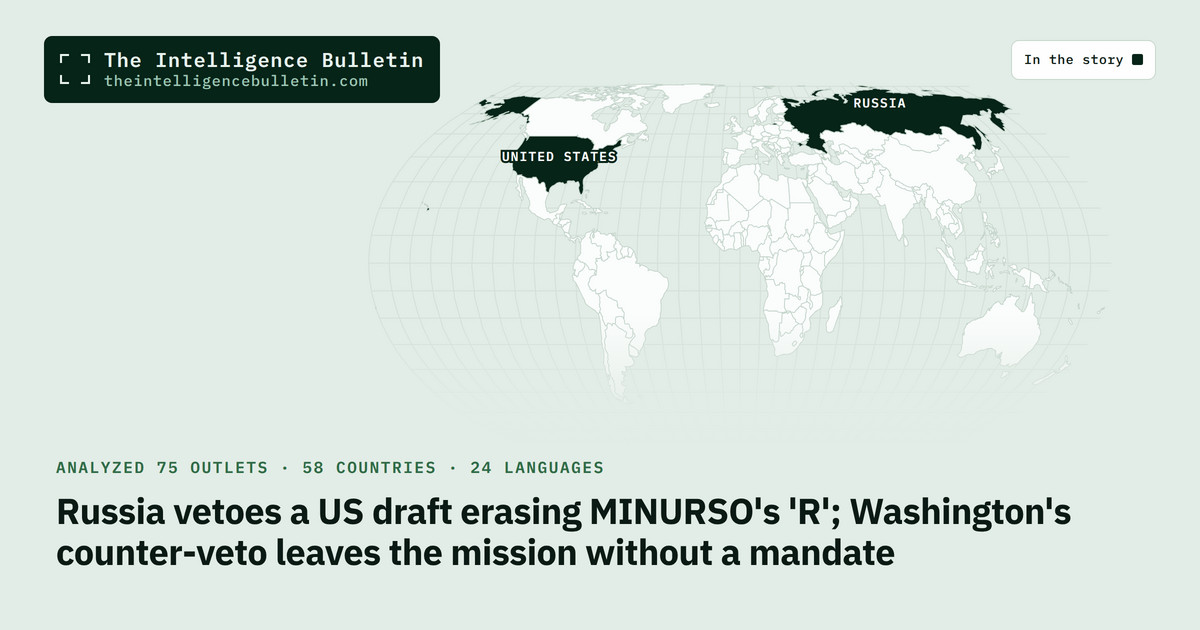
The UN Security Council failed to renew MINURSO after Russia vetoed a US draft renaming the mission to drop the referendum reference and making Moroccan autonomy the sole negotiating basis; the US then vetoed Russia’s one-year extension, and the mandate expired on October 31.
Across the press: Hespress casts the American veto on Russia’s extension as Morocco’s win, while Ennahar casts Russia’s veto on the American draft as Polisario’s.
Source base: 5 outlets quoted (Morocco, Algeria, Spain, United Kingdom, Japan), selected from 75 analyzed. 3 read in full, 2 by their headlines only.
- DisputedThe Russian alternative’s vote tally is in dispute: Hespress reports three votes in favour and eleven abstentions, while ABC reports eleven members voted against it.Source: Hespress and ABC report different tallies for the same failed Russian draft.
- 1 of 5 · Ennahar Online onlyPolisario’s UN representative welcomed the failure of the American draft and thanked Russia for opposing it, as well as China, Pakistan and Somalia for abstaining, insisting that the Sahrawi right to free and sovereign existence cannot be traded.Ennahar Online, citing Sidi Mohamed Ammar, Polisario’s representative at the UN and coordinator with MINURSO.
- 4 of 5 · reported separatelyThe Security Council failed to renew MINURSO after Russia vetoed a US-drafted resolution and the United States vetoed Russia’s alternative, leaving the mission without a mandate as its existing one expired on 31 October 2026.Hespress and ABC report the mutual vetoes independently; Middle East Eye’s headline and Mainichi’s headline reflect the same standoff.
- 2 of 5 · reported separatelyThe US draft sought to rename MINURSO to MINUSO by removing the ‘R’ for referendum, order a restructuring review, and make the updated Moroccan autonomy proposal the sole basis for political negotiations.Hespress and ABC both describe the draft text; ABC adds that early references to self-determination were kept in the final version and that a proposal to convert the mission into a political mission was removed.
- 2 of 5 · reported separatelyThe Russian alternative was a technical one-year extension retaining MINURSO’s current name and tasks, to 31 October 2027 according to Hespress.Hespress details the Russian draft; ABC independently describes it as a one-year technical renewal of the mission as it had been.
- From November 1, 2026MINURSO begins winding down or formally suspends operations as its mandate has expired, with the US saying it will cooperate on an ‘orderly and stable’ process — watch what happens to ceasefire monitoring and the buffer strip.
- In the coming weeksPolisario issues the statement Ammar said the Sahrawi leadership is preparing, clarifying its position after studying the failed council session.
- January 30, 2027If a new draft revives the US request for a restructuring plan, this deadline would shape negotiations on any future mission configuration.
Full analysis
What happened Why it matters How each country tells it Where accounts conflict Room for disagreement Our assessment Sources and evidence
What happened
On Friday, October 30, 2026, the UN Security Council failed to renew MINURSO, the UN Mission for the Referendum in Western Sahara, after Russia vetoed a United States draft meant to transform it and the United States immediately vetoed Russia’s alternative one-year extension. The mandate expired the next day.
The US text came first. Both Hespress and ABC report it sought to rename the mission MINUSO from November 1, deleting the ‘R’ that stands for referendum, and to have the Secretary-General deliver a restructuring plan by January 30, 2027, covering staffing, deployment, ceasefire monitoring and political support. ABC adds that the final version kept references to self-determination and dropped a proposal to convert the mission into a political operation from April. Hespress reports the draft made the updated Moroccan autonomy proposal the sole basis for negotiations; ABC characterizes it as making the Moroccan plan the only framework for a mutually acceptable solution. It drew eleven votes in favor and three abstentions, per both, but Russia’s veto killed it.
Moscow’s counter-draft was a technical one-year extension to October 31, 2027, keeping the mission’s name and tasks unchanged, according to Hespress. It failed too, and here the accounts split: Hespress reports three votes in favor and eleven abstentions — short of the nine votes adoption requires even setting the veto aside — while ABC reports eleven members voted against, with France citing Russia’s "obstruction."
The upshot is no resolution and no mandate. ABC reports MINURSO must now dismantle, and that the United States, which supervises the mission, said it would cooperate on an "orderly and stable" process.
US ambassador Mike Waltz, per Hespress, defended removing the ‘R’ by citing thirty years of UN assessments — from Boutros Boutros-Ghali through Kofi Annan and former envoy James Baker — that the referendum was unviable, noting the 1996 suspension of voter identification. ABC quotes him calling the resolution "a historic step" in a conflict frozen fifty years, and that the people of Western Sahara "deserve something better than the extension of something that cannot work." Hespress adds that Waltz raised humanitarian conditions in the Tindouf camps — UN-reported anemia, stunting and malnutrition among under-fives — and said Washington had held three rounds of high-level talks on autonomy, representation, security and resources.
Polisario’s UN representative Sidi Mohamed Ammar, reported by Ennahar, said the Security Council had failed to adopt a resolution, that the Sahrawi leadership was studying the development, and that the American draft ignored Polisario’s "fundamental and legitimate concerns." He called its approach a "dangerous departure" from international law governing Western Sahara as a colonial question, arguing it pre-determined negotiations and the final solution in a way that undermined the Sahrawi people’s "inalienable right to self-determination and independence." Polisario felt relief at the American draft’s failure, he said, thanking Russia for opposing it and China, Pakistan and Somalia for abstaining; the right to "free and sovereign existence" was a red line for which "many convoys of martyrs" had fallen.
Why it matters
The ‘R’ at the heart of MINURSO is the referendum the mission was created in 1991 to organize, never held because the parties could never agree who would vote. The US draft tried to settle that question administratively — rename the mission and anchor negotiations on Moroccan autonomy — while the Russian draft would have frozen it for a year. The mutual veto means neither happened and the mission carrying the referendum reference in its own acronym now has no mandate.
The consequences fall unevenly. Morocco loses the resolution it wanted, but the failed Russian extension also strips the mission carrying the referendum reference of its mandate by default. Polisario gains the survival of the self-determination framework through Russia’s veto but loses the technical extension that kept the mission functioning. For the UN, the expiry removes the only formal mechanism monitoring the territory’s ceasefire.
ABC traces the US position to the 2020 Trump-era recognition of Moroccan sovereignty, the counterpart of Morocco joining the Abraham Accords, and notes the council moved toward the Moroccan autonomy plan a year earlier. The veto exchange pulls the Sahara file squarely into the US-Russia confrontation.
How each country tells it
- Hespress · Morocco · original reportingFrames the Security Council session from Rabat’s side, leading with Washington’s veto against Russia’s extension draft rather than Russia’s earlier veto of the US resolution.
- Ennahar Online · Algeria · original reportingGives the floor almost entirely to Polisario’s UN representative, casting the failure of the American draft as a victory for the Sahrawi people’s inalienable right to self-determination.
- ABC · Spain · original reportingReports the veto exchange as a great-power failure with institutional consequences: MINURSO’s mandate expires because Washington and Moscow could not agree, with no camp pronounced the winner.
- Middle East Eye · United Kingdom · original reportingFrames the standoff through its consequence for the mission and territory: the Western Sahara peacekeeping operation is left in limbo after the US and Russia veto each other.
- Mainichi Shimbun · Japan · original reportingReports the story in neutral, operational terms as the suspension of a UN peacekeeping force because the United States and Russia are in conflict at the Security Council.
Where accounts conflict
The sharpest factual disagreement is the Russian draft’s vote. Hespress reports three in favor and eleven abstentions; ABC reports eleven voted against, plus the US veto. Both agree the draft failed. They disagree about whether non-permanent members passively sat out or actively opposed Moscow. The difference changes the reading of the room: Hespress suggests broad sympathy for a technical extension with only Washington hostile; ABC suggests a majority repudiating Russia, France explicitly.
A softer difference concerns self-determination in the US draft. ABC reports the final version kept self-determination references after an earlier draft sought to remove them; Hespress describes the text as making Moroccan autonomy the sole basis for negotiation. The two are not strictly incompatible — an operative paragraph can anchor talks on autonomy while a preamble nods to self-determination — but only ABC discloses the retained reference, and a reader of Hespress alone would not know it.
Room for disagreement
The strongest case against reading this as structural stalemate is that the arithmetic points the other way. The US draft commanded eleven votes, a clear majority, and Russia’s alternative failed for lack of support on either tally. The texts are close operationally — Russia’s draft was a technical one-year extension — and the fight over one letter could be parked, allowing a compromise that keeps the mission running. On this view the expiry is a negotiating dynamic, not an outcome: the council must reconvene, the majority is already behind something near the US position, and Moscow cannot sustain isolation over an acronym.
The second counter-argument is that both camps already claim the deadlock as a win. Polisario’s representative calls the American draft’s failure a historic achievement preserving the self-determination framework (Ennahar); Moroccan readers in Hespress’s comment thread read the mission’s end as the expulsion they wanted. If both parties prefer no mandate to the other side’s resolution, that equilibrium could hold — and the only UN peacekeeping presence in the territory quietly runs out of legal basis without anyone having voted for it.
Our assessment
It is likely that MINURSO remains without a mandate for an extended period and that the Sahara file becomes a frozen front inside the US-Russia confrontation rather than a resolvable one. The warrant sits in what both accounts agree on: the US draft was designed to kill the referendum path by renaming the mission and anchoring negotiations on Moroccan autonomy, and Russia vetoed it precisely to keep the ‘R’ alive; the Russian draft was a technical freeze, and the US vetoed it precisely to refuse that freeze. Washington refused to extend the mission as it was, Moscow refused to transform it, and no text can survive both positions. Eleven votes give Washington leverage but not enough to overcome a veto, and Russia’s stance, as Polisario’s man frames it, is that the Sahrawi right cannot be traded — which is exactly the trade the US proposed. The impasse is not about the numbers.
What would change this: a US decision to drop the renaming requirement in exchange for a narrower restructuring, or a Russian acceptance of a name change without making Moroccan autonomy the sole negotiating framework — either concession would produce a text both permanent members could board, and would move the call toward roughly even chance.
Sources and evidence
Press quoted
- What does MINURSO’s status become after 31 October, does an orderly dismantling actually begin, and who will monitor the ceasefire and the buffer zone once the mandate has expired?
- What was Russia’s stated legal and political justification for its veto, and has Moscow said anything about the American veto of its alternative?
- How will Rabat and Algiers respond in the coming days, and could Morocco treat the lapse as an opening to reclaim the UN-controlled buffer zone?
That’s how the world told the story.
Get our daily open-source intelligence on world events in your inbox — one email a day, up to six stories.
Subscribe freeNo spam. One-click unsubscribe. See the latest email →