 AI-generated analysis published under the editorial responsibility of Rohit Sinnas. How it works →
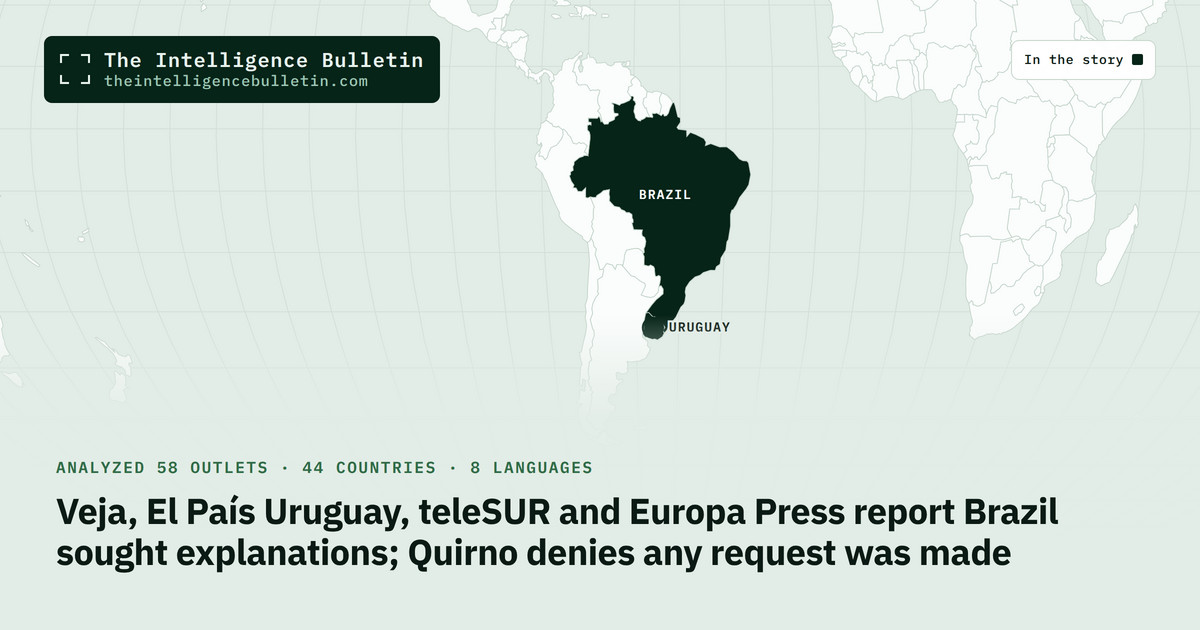
See the 44 countries
Argentina, Australia, Azerbaijan, Belgium, Bolivia, Brazil, Bulgaria, Chile, China, Colombia, Costa Rica, Croatia, Cuba, Cyprus, Dominican Republic, Ecuador, France, Germany, Guatemala, India, Israel, Italy, Ivory Coast, Jamaica, Lebanon, Luxembourg, Mexico, Moldova, Pakistan, Panama, Paraguay, Portugal, Qatar, Romania, Singapore, South Africa, Spain, Switzerland, Turkey, United Kingdom, United States, Uruguay, Venezuela, Vietnam
Brazil’s Foreign Ministry summoned Argentina’s chargé d’affaires after Senator Flávio Bolsonaro crossed into Argentina and flew to Miami despite a court order barring his exit. Brazilian sources say explanations were requested; Argentina’s chancellor calls that false.
Across the press: Veja, El País Uruguay, teleSUR and Europa Press report Brazil sought explanations, while Crónica carries Quirno’s on-record denial that any request was made.
Source base: 5 outlets read in full (Brazil, Argentina, Uruguay, Venezuela, Spain), selected from 58 analyzed.
- Denied on the recordBrazil formally requested explanations or information from Argentina over the escape.Source: Reported by Veja (government sources), El País (Uruguay) via La Nación, teleSUR and Europa Press; Argentina’s chancellor Pablo Quirno flatly denied it on X, as reported by Crónica.
- 5 of 5 · reported separatelyBrazil’s Foreign Ministry (Itamaraty) summoned Argentina’s chargé d’affaires, María Emilia Cortés, to a meeting over Flávio Bolsonaro’s escape through Argentina.Veja cites Brazilian government sources; El País (Uruguay) cites official sources via La Nación; teleSUR and Europa Press report the summons directly; Crónica reports it as a press version while Quirno denies an explanation request.
- 4 of 5 · reported separatelyIn the meeting, Cortés was received by João Marcelo Galvão de Queiroz, head of Itamaraty’s Mercosur Department, and committed to relay the Brazilian position to the Argentine government.Veja says she would carry Brazilian discontent to Milei; El País (Uruguay) says she committed in generic terms to provide information; Europa Press says she would relay the content to Argentina; teleSUR says she committed to deliver the required information.
- 4 of 5 · reported separatelyArgentina’s National Migration Directorate recorded that Flávio Bolsonaro crossed into Argentina on Tuesday night with valid travel documentation and no legal impediment, via the Tancredo Neves bridge to Puerto Iguazú with his wife and two daughters.El País (Uruguay) quotes the directorate’s statement on X; teleSUR cites the directorate’s records; Europa Press cites Argentine migration authorities; Crónica reports the crossing details.
- 5 of 5 · reported separatelySupreme Court Justice Alexandre de Moraes ordered Flávio Bolsonaro to surrender his passports and barred him from leaving Brazil while he is under investigation for money laundering.El País (Uruguay) details the order and the money-laundering investigation; Europa Press cites the Supreme Court order and a laundering probe involving a betting house; teleSUR cites Moraes’s passport-seizure order; Veja notes the Federal Police’s statement that the exit could not be prevented; Crónica reports the police order to surrender passports.
- November 13Deadline for Secretary of State Marco Rubio to answer six Democratic lawmakers’ questions on any US role in Bolsonaro’s flight; his response could reheat the Brazilian complaint.
- Within daysWhether Brazil sends the further formal communication to Buenos Aires that teleSUR says Itamaraty is analyzing, determining if the request dispute escalates or fades.
- Within daysWhether Cortés relays information to Buenos Aires and any readout is published, which would either close or deepen the factual dispute over what was asked.
- Still openWith which document or status did Flávio Bolsonaro actually enter the United States — his since-cancelled diplomatic passport, as O Globo reported, or a DT humanitarian parole, as Metrópoles and Folha reported? · Did the two-hour voting extension alter the outcome in any state, and will transport and flood-related complaints be investigated?
Full analysis
What happened Why it matters How each country tells it Where accounts conflict Room for disagreement Our assessment Sources and evidence
What happened
On Thursday afternoon, Brazil’s Foreign Ministry called in Argentina’s chargé d’affaires, María Emilia Cortés, to the Itamaraty Palace in Brasilia to discuss the escape of Senator Flávio Bolsonaro through Argentine territory. Cortés was received by João Marcelo Galvão de Queiroz, head of the ministry’s Mercosur Department, in a meeting that El País Uruguay, citing Brazilian official sources, described as brief and a "procedimiento diplomático de rigor" — a standard diplomatic procedure.
What Brazil asked for is the point on which the two governments now tell irreconcilable stories. Veja, citing government sources, reported that Itamaraty questioned Cortés over the escape and that she committed to carry Brazil’s recorded displeasure to President Javier Milei. El País Uruguay, relaying La Nación’s official sources, said Galvão de Queiroz asked for clarification about what happened in Argentina and that Cortés agreed, "in generic terms," to provide information. teleSUR reported that Brazil demanded a formal report on the route and the presumed support of Casa Rosada officials, and that the diplomat committed to deliver the required information. Europa Press, crediting Brazilian press, reported she would relay the meeting’s content to Buenos Aires. Argentina’s chancellor, Pablo Quirno, states the opposite: writing on X and quoted by the Buenos Aires daily Crónica, he called it "falso" that Brazil had formally asked for explanations and said "no hubo ningún pedido de información" — there was no request for information.
The escape itself is not in dispute. Argentina’s National Migration Directorate confirmed that Flávio Bolsonaro crossed the border on Tuesday night at 22:50 local time over the Tancredo Neves bridge into Puerto Iguazú, in Misiones province, with his wife and two daughters, presenting valid travel documents and facing no legal impediment, El País Uruguay and Europa Press reported. From there the family boarded a private flight operated by the Argentine company Baires Fly S.A. to Guayaquil, Ecuador, and then to Miami, landing at the Miami-Opa Locka executive airport on Wednesday. teleSUR added, without other outlets carrying it, that the flight cost US$150,000 and was paid by an intermediary based in the United States, citing the company’s owner.
The border crossing defied an order from Supreme Court Justice Alexandre de Moraes, who had instructed the senator to surrender his passports and barred him from leaving Brazil while he is investigated for money laundering, according to El País Uruguay and Europa Press. Flávio had said in a video on Monday that he would hand over the passports; the Federal Police later said, in a statement carried by Veja, that there was no way to monitor and prevent the exit under the conditions in which the trip occurred. El País Uruguay reported that his Brazilian passports, including the diplomatic one, were cancelled after he failed to surrender them, and noted he has held Italian nationality since 2023.
In the United States, President Donald Trump’s government has indicated it would grant asylum and visas to the senator and his family, Crónica and El País Uruguay reported. Flávio has declared himself Brazil’s leader and does not recognize his runoff defeat to Luiz Inácio Lula da Silva, Europa Press reported. Six Democratic members of the US House of Representatives, three of them on the Foreign Affairs Committee, have written to Secretary of State Marco Rubio demanding answers by November 13 about whether any US agency helped him travel or enter despite the Brazilian judicial restriction, El País Uruguay reported. Rubio and Brazilian Foreign Minister Mauro Vieira shared a table at the G20 foreign ministers’ meeting in Atlanta on Friday but held no bilateral meeting, the same outlet noted.
Argentina’s initial posture had been to deny the senator had entered the country before the migration directorate’s statement confirmed the crossing, El País Uruguay reported. Quirno’s denial of any request for information came with a counter-claim, carried by Crónica, that Brazil had unilaterally withdrawn its ambassador and demanded Argentina’s. The two countries have run their embassies at chargé d’affaires level since August, teleSUR noted, after Milei’s repeated verbal attacks on Brazilian institutions.
Why it matters
The summons lands in a relationship already stripped of ambassadors, and it carries three separate weights. For Brazil, it is a matter of whether a neighboring government stood by while a senator under criminal investigation left the country in defiance of the Supreme Court. teleSUR is the only outlet in the set that pushes this into an accusation of official facilitation, reporting that presidential adviser Santiago Caputo moved to Puerto Iguazú to ease the entry and that Mexican lawyer Simón Levy, close to the family, said "thanks to President Milei, today Flávio Bolsonaro is alive." Veja, by contrast and reporting from inside the Brazilian government, frames the summons as protocol and says the Lula government does not intend to feed the case or provoke new friction with Milei or Washington. Those are two readings of the same meeting, and they describe two different diplomatic futures.
For Argentina, the stake is being named as a transit country in a flight from justice. Crónica leads with Quirno’s on-record denial and reproduces his counter-accusation that Brazil unilaterally withdrew its ambassador — a position that turns the summons itself into Brazilian aggression rather than a Brazilian grievance. El País Uruguay, a Mercosur partner outside the dispute, reads the episode as region-wide tension and is the source that most fully documents the legal backdrop: Moraes’s order, the cancelled passports, the Italian nationality, and the US congressional letter. Europa Press, a Spanish agency without a regional stake, reduces the rupture to a bare démarche. The absence of any on-topic US source in the set is itself part of the picture: the country Bolsonaro fled to appears only through the reporting of others.
How each country tells it
- Veja · Brazil · original reportingItamaraty called in Argentina’s chargé d’affaires as a routine diplomatic step to clarify the escape, with Brazil recording its discontent but signalling it will not escalate.
- Crónica · Argentina · original reportingChancellor Pablo Quirno states on the record that it is false that Brazil formally asked Argentina for explanations, and the piece adds the counter-claim that Brazil unilaterally withdrew its ambassador and demanded Argentina’s.
- El País (Uruguay) · Uruguay · carries La Nación (GDA), AFP and EFEThe Mercosur partner wedged between the two actors reads the summons as región-wide tension and reports it as a brief, rigorous diplomatic procedure, while adding the Democrats’ letter and the Rubio-Vieira non-meeting.
- teleSUR · Venezuela · original reportingBrazil is demanding explanations for Argentina’s presumed complicity, and the piece centres alleged Casa Rosada facilitation — adviser Santiago Caputo in Puerto Iguazú, lawyer Simón Levy crediting Milei, the US$150,000 flight paid by a US intermediary.
- Europa Press · SpainA bare extra-regional diplomatic fact: Brazil summoned the Argentine chargé d’affaires to give explanations about the escape, with the border crossing, the private flight route and the meeting all stated without any regional stake.
Where accounts conflict
The core conflict is what Brazil asked of Cortés. Veja (via Brazilian government sources), El País Uruguay (via La Nación’s official sources), teleSUR and Europa Press all report that Brazil sought explanations or information about the escape. Quirno, on the record and quoted by Crónica, says no such request was made and that the claim is false. The two versions cannot both be true, and each side has a reason to hold its line: the Brazilian accounts describe a government asserting itself; the Argentine denial protects Buenos Aires from any suggestion that its territory was a knowing escape route.
A smaller factual split runs through the meeting’s date. Veja and El País Uruguay place it Thursday afternoon; Europa Press dates the summons to Friday. Crónica reports the meeting "would have taken place" on October 29, matching Thursday.
A third point is single-sourced rather than contradicted: teleSUR’s claim that Santiago Caputo traveled to Puerto Iguazú to facilitate the entry appears in no other outlet and is not addressed on the record by any official. It sits in the record as an accusation no one else has confirmed or denied.
Room for disagreement
The strongest case that this goes nowhere is made by the Brazilian government’s own posture, as Veja reports it: the Lula government sees the summons as "protocolar" diplomacy and does not intend to feed the case or create new atritos with Milei or Washington. If Brazil itself is prepared to let the matter drop, the factual dispute over what was asked may never be pressed further — and an unresolved contradiction in the press is not a diplomatic rupture. Argentina’s denial, delivered by the chancellor on X and carried by Crónica, gives Buenos Aires a clean public line: no request was made, so there is nothing to answer. Both principals have an interest in de-escalation, and the meeting itself was, by several accounts, brief.
Our assessment
It is likely — though unverifiable from these reports — that Brazil did seek explanations at the Thursday meeting, and that Argentina’s on-record denial leaves the two governments at odds with no resolution in sight. The warrant is the convergence of independent reporting chains: Veja’s Brazilian government sources and La Nación’s official sources relayed through El País Uruguay both describe a request, and the specific detail that Cortés committed, in whatever terms, to relay information southward only coheres if something was asked of her. Quirno’s denial, by contrast, is the single voice of the accused party, speaking on X, with a clear interest in closing the file. What this does not mean is escalation: Veja’s reporting that Lula will not feed the case, Europa Press’s description of a meeting lasting "apenas unos minutos," and El País Uruguay’s "procedimiento diplomático de rigor" all point to a démarche, not a rupture. The open question is whether the dispute over what was said outlives the meeting, and the next test is the November 13 deadline for Rubio to answer the Democratic lawmakers, which could pull the US role into the open and reheat the Brazilian complaint regardless of Buenos Aires’ denials.
What would change this: a formal readout from either foreign ministry, or a public retraction by Quirno, would settle whether the request was real and shift the call in either direction.
Sources and evidence
Press quoted
- What did Brazil actually ask for inside the Itamaraty room — a formal request for explanations, or a routine démarche — given Quirno’s on-record denial set against the Brazilian government-side accounts that describe a request for explanations?
- Did Argentine officials — specifically adviser Santiago Caputo, whom teleSUR alone places in Puerto Iguazú — actively facilitate the crossing or the Baires Fly flight, and will the Federal Police’s open investigation name anyone?
- What will Brazil’s next step be — a formal diplomatic note to Buenos Aires, a request for Flávio’s extradition or arrest in the United States, or nothing further — and how will Washington answer both the six Democrats’ letter and any Brazilian approach?
That’s how the world told the story.
Get our daily open-source intelligence on world events in your inbox — one email a day, up to six stories.
Subscribe freeNo spam. One-click unsubscribe. See the latest email →