 AI-generated analysis published under the editorial responsibility of Rohit Sinnas. How it works →
See the 56 countries
Armenia, Australia, Azerbaijan, Belgium, Brazil, Bulgaria, Canada, China, Croatia, Cuba, Cyprus, Czech Republic, Denmark, Egypt, Finland, Georgia, Greece, Hungary, India, Iran, Ireland, Israel, Italy, Jamaica, Lebanon, Lithuania, Luxembourg, Madagascar, Moldova, Morocco, New Zealand, Nigeria, Oman, Pakistan, Philippines, Poland, Portugal, Qatar, Romania, Russia, Saudi Arabia, Singapore, Slovakia, Somalia, South Korea, Spain, Sri Lanka, Sweden, Switzerland, Taiwan, Tunisia, Turkey, Ukraine, United Arab Emirates, United Kingdom, United States
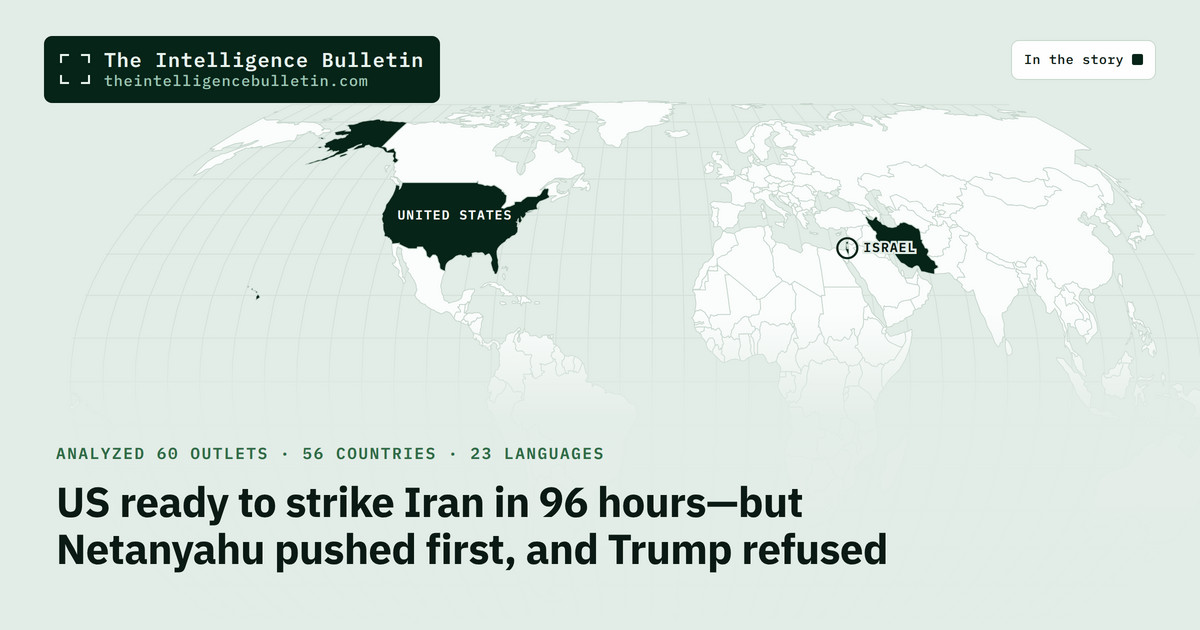
US forces can launch major strikes on Iran within 96 hours of a Trump order, with energy, military and nuclear targets ready, officials said; Netanyahu’s pre-election push for a joint strike was refused, and some officials expect the order after November 3.
Across the press: Edaily reports the US can strike Iran in 96 hours but omits that Netanyahu pushed for it and Trump refused—the story’s trigger.
Source base: 5 outlets read in full (United States, Oman, Italy, South Korea), selected from 60 analyzed.
- 2 of 5 · one shared reportSome US officials see a major attack order as a question of when, not if, and consider it more likely after the November 3 midterm elections.CNN sources relayed by Antiwar.com and Edaily.
- 1 of 5 · Corriere della Sera onlyUS intelligence has gathered indications that Iran is preparing targeted assassinations of US administration officials inside the United States, and possibly of US ambassadors in the Middle East through its Unit 840.Corriere della Sera, summarizing recent reporting on American intelligence assessments.
- 1 of 5 · Gooya News onlySaudi, Pakistani and Turkish senior security officials traveled to Tehran in a last push for agreement while Iran’s Qalibaf says Tehran has no new word and Washington must act to extract itself from what he calls a quagmire.Gooya News, carrying an Iran International report by Mojtaba Pourmohsen.
- 4 of 5 · reported separatelyThe US military is ready and has sufficient forces and a broad target list, including energy, military and nuclear sites, for potentially major strikes on Iran, and Trump has not yet made a final decision.CNN, citing two US officials and other current and former officials, relayed by Antiwar.com and Edaily; a parallel New York Times report on ready attack plans with an expanded target list is cited by Corriere della Sera.
- 4 of 5 · reported separatelyNetanyahu sought for weeks to orchestrate a new airstrike on Iran before Israel’s election and was resisted by IDF chief Eyal Zamir, who believed it risked provoking Iran; Trump did not give a green light for a joint pre-election attack.The New York Times, carried by Oman Daily Observer, citing three senior Israeli defense officials and three others; CNN, citing an Israeli security source, relayed by Antiwar.com; Israeli Channel 12 via Gooya News; Corriere della Sera’s analysis.
- November 3, US midtermsWhether Trump issues an attack order after the vote, the window US officials call most likely, which would start the 96-hour clock.
- OngoingWhether the Saudi-Pakistani-Turkish push in Tehran moves Iran from ‘no new word,’ the last chance Gooya’s reporting identifies before the diplomatic window closes.
- AnsweredNo major US strike occurred over the weekend; CNN’s sources now describe the order as a question of when, not if, and likely to wait until after the November 3 midterms, relayed by Antiwar.com and Edaily.
- Still openDoes Barrack s no-regime-change line now govern US policy, or does Netanyahu s vow to topple the clerical state still drive the US-Israel campaign? · What concrete evidence, if any, underpins the intelligence that Iranian operatives are already active inside the United States and have plans at an advanced stage?
- 26 Oct · Tehran hosts Saudi, Pakistani and Turkish officials — Riyadh announces de-escalation, Iranian officials announce an order without the US
- 26 Oct · Ynet leads with Trump s late endorsement; Al-Manar, Vetogate and The Nation open from poll arithmetic denying either camp 61 seats
- 25 Oct · Pentagon s Iran strike options rest on one WSJ chain; Tehran s Hormuz denial arrives via Tasnim relay
- 24 Oct · Israel National News, Haber7 and Arab News report a weekend strike; Raw Story and Al Jazeera never do
Full analysis
What happened Why it matters How each country tells it Where accounts conflict Room for disagreement Our assessment Sources and evidence
What happened
The United States military is positioned to launch what officials describe as potentially major attacks on Iran within 96 hours of receiving an order from President Trump. CNN reported Monday that two US officials and other current and former officials said sufficient forces are already in the region, and that the strikes would go beyond the limited attacks of recent months on Iranian missile launchers and radar systems. Pentagon and Central Command planners have drawn up a target list that includes energy infrastructure, military sites and nuclear facilities, though officials acknowledge destroying all of them has grown harder as Iran has learned US tactics. The White House declined to comment, and a senior Pentagon official said only that the department is a planning organization whose job is to prepare and execute the president’s military options; Trump has not made a final decision, though some of CNN’s sources said the order is a question of when, not if, with the most likely window after the November 3 midterms.
That capability sits alongside a political clock with two elections in it. The same CNN report, relayed by Antiwar.com, quoted an Israeli security source saying that “Netanyahu really wanted and tried to convince Trump for a joint attack in Iran before the elections, and Trump did not give a green light.” A parallel New York Times report, carried by the Oman Daily Observer, found that Netanyahu spent weeks seeking to orchestrate a new airstrike on Iran before Tuesday’s Knesset vote but ran into resistance from the Israeli military’s chief of staff, Lt. Gen. Eyal Zamir, who believed it risked provoking Iran into attacking Israel. The Times account rests on three senior Israeli defense officials and three other people briefed on the matter; Netanyahu’s spokespeople did not respond to requests for comment. CNN added that Zamir had told chairman of the Joint Chiefs of Staff Dan Caine that an attack could hurt the Israeli elections, and that Netanyahu and Zamir were at odds over an Iran-related order the army chief did not want to carry out. Netanyahu denied the pre-election strike report through Israeli Channel 12, as carried by the diaspora portal Gooya, and Israeli Defense Minister Israel Katz said Israel had not intended to start an attack before the vote and had prepared only to respond.
While Washington and Jerusalem argued over timing, Tehran was the scene of a last diplomatic push. Gooya, carrying an Iran International report by Mojtaba Pourmohsen, reported that senior Saudi, Pakistani and Turkish security officials were in the Iranian capital seeking to open a path to agreement with Washington. Iranian parliament speaker Mohammad Bagher Qalibaf said Tehran had “no new word” and that the United States must act to extract itself from what he called a quagmire. Asked Monday whether an attack was imminent, Trump answered, “Do I tell you such a thing?” and added that no attack would happen “today.” Corriere della Sera reported separately that US intelligence has gathered indications Iran is preparing targeted assassinations of US administration officials inside the United States, and possibly of US ambassadors in the Middle East through its elite Unit 840.
TIB reported on 24 October that US Ambassador to Türkiye Tom Barrack said a strike could come “this weekend,” a statement Trump then disavowed, and no major US strike followed. TIB reported on 25 October that the Pentagon had given Trump options including nuclear sites, energy infrastructure and missile centers, while Director of National Intelligence Jay Clayton warned in an October 23 memo that Iranian plots against Americans had reached “advanced stages.”
Why it matters
An order executable in 96 hours converts a standing threat into an operational one, and the target list makes the difference plain: energy infrastructure, military sites and nuclear facilities reach far beyond the launchers and radars struck so far. For Gulf states, any large strike invites the retaliation Corriere della Sera’s cited analysts spell out — attacks on Gulf energy facilities, civilian infrastructure and the submarine cables under the Strait of Hormuz, possibly even limited ground assaults on Kuwait or Bahrain, where US bases sit. Oil was already at $117 a barrel last week, per Corriere, and the Critical Threats Project report cited there reads Iran’s recent ship attacks as deliberate pressure to drive prices higher still.
The timing bears directly on two elections. For Netanyahu, a pre-election strike was an option his own chief of staff judged dangerous enough to resist; for Trump, the November 3 midterms appear to be the constraint some officials expect to bind. The assassination-intelligence angle raises the detonator risk independently of any election: a single confirmed plot, Corriere argues, would be a level change Washington and Jerusalem could not leave unanswered. The Tehran visits by Saudi, Pakistani and Turkish officials, which TIB reported on 26 October, show three regional capitals treating the diplomatic window as open but narrowing.
How each country tells it
- Antiwar.com · United States · carries CNNTreats CNN’s 96-hour readiness report as evidence of a concrete, already-prepared US war option that goes beyond recent limited strikes, with the midterm election and Netanyahu’s pressure as constraints on timing rather than the main event.
- Gooya News · United States · carries Iran InternationalFrames the 96-hour readiness window not as US capability but as the last chance for diplomacy before a great war, coupling CNN’s report with the Tehran visits by Saudi, Pakistani and Turkish officials and with Qalibaf’s insistence that Tehran has no new word.
- Oman Daily Observer · Oman · wire copyLeads with the political genesis of the strike threat: Netanyahu spent weeks seeking to orchestrate a new airstrike on Iran before Tuesday’s election but was resisted by IDF chief Lt. Gen. Eyal Zamir, who feared a miscalculation that could provoke Iran into attacking Israel.
- Corriere della Sera · Italy · opinionArgues that the Iran war will not stop if Netanyahu and Trump lose their elections, and may even intensify, because Netanyahu’s motive for a defining legacy survives defeat, Trump’s commander-in-chief powers remain intact, Iran feels more self-confident, and markets already price escalation.
- Edaily · South Korea · carries CNNReports the 96-hour readiness as a settled military fact: US forces are already deployed in sufficient strength, a broad target list has been drawn up, and officials frame an attack order as a matter of when, not if.
Where accounts conflict
Netanyahu’s intent in the days before the election is the one point on which named parties and officials’ accounts cannot both be true. Israeli Channel 12, carried by Gooya, reported that Netanyahu denied seeking a pre-election strike, and Defense Minister Katz said Israel had no plan to attack before the vote. That stands against the New York Times account from three senior Israeli defense officials and three others — weeks of orchestration that Zamir resisted — and CNN’s Israeli security source, quoted by Antiwar.com, saying Trump refused the green light. The denial is the subject’s own word; the corroborated account rests on anonymous officials with direct knowledge of the deliberations, and its central claim survived two independent reporting chains.
Room for disagreement
The strongest case that no major strike comes is that Trump has pulled back before. Edaily notes that even officials who read the order as “when, not if” concede Trump has walked to the edge and retreated in the past. The “when not if” framing is a single-source claim from CNN’s officials, not a corroborated finding, and the only named decision-maker says no decision has been made. The diplomacy in Tehran is not theater: Saudi Arabia, Pakistan and Türkiye sent their most senior security figures, and Karim Sadjadpour, cited by Corriere della Sera, argues the only exit is existential economic pressure plus a clear, limited diplomatic way out — a formula that would require Iran to move from “no new word,” not Washington to escalate. If that path opens, the 96-hour order could simply never come.
Our assessment
A major US strike on Iran is likely to be ordered after the November 3 midterms. The capability is settled fact, corroborated across CNN’s two US officials and the New York Times’s expanded target list, and the restraint so far is documented across two independent chains: CNN’s Israeli security source said Trump refused Netanyahu’s green light, and the Times’s six officials described Zamir blocking Netanyahu’s weeks-long push. That places the decision in Trump’s hands on a timeline both the officials’ “when, not if” and the refusal itself tie to the election calendar, with Netanyahu’s pressure neutralized for now. The interest analysis cuts toward readiness being real rather than bluff: Pentagon officials who leak “when, not if” while the White House stays silent are preparing publics and markets for exactly the order they describe, and the expansion from launchers to nuclear and economic infrastructure is a strategic choice, not a deterrent gesture.
What would change this: a high-confidence, corroborated intelligence finding that an Iranian assassination plot inside the United States has moved toward execution — the development Corriere della Sera reports US services are already tracking — or a direct Iranian strike on US forces, either of which would break the post-election wait and bring the 96-hour clock forward.
Sources and evidence
Press quoted
- What was the separate action short of an overt strike that Netanyahu had begun pushing for in recent days, which Zamir believed would provoke Iran into attacking Israel?
- Has Trump actually decided on major strikes, and will they fall before or after the November 3 midterms?
- What response would Iran actually deliver across Gulf energy sites, Hormuz, and US bases and personnel if such an operation begins, given that Corriere’s analysis describes the escalatory sequence but no source reports an Iranian decision?
That’s how the world told the story.
Get our daily open-source intelligence on world events in your inbox — one email a day, up to six stories.
Subscribe freeNo spam. One-click unsubscribe. See the latest email →