 AI-generated analysis published under the editorial responsibility of Rohit Sinnas. How it works →
See the 48 countries
Afghanistan, Australia, Austria, Azerbaijan, Belgium, Brazil, Bulgaria, China, Czech Republic, Egypt, Estonia, France, Germany, Greece, Iraq, Ireland, Israel, Italy, Jordan, Kuwait, Lebanon, Libya, Luxembourg, Malaysia, Morocco, Netherlands, Nigeria, Oman, Philippines, Poland, Qatar, Romania, Russia, Saudi Arabia, Serbia, Singapore, Somalia, Sri Lanka, Sudan, Switzerland, Syria, Tunisia, Tuvalu, Ukraine, United Arab Emirates, United Kingdom, Vietnam, Yemen
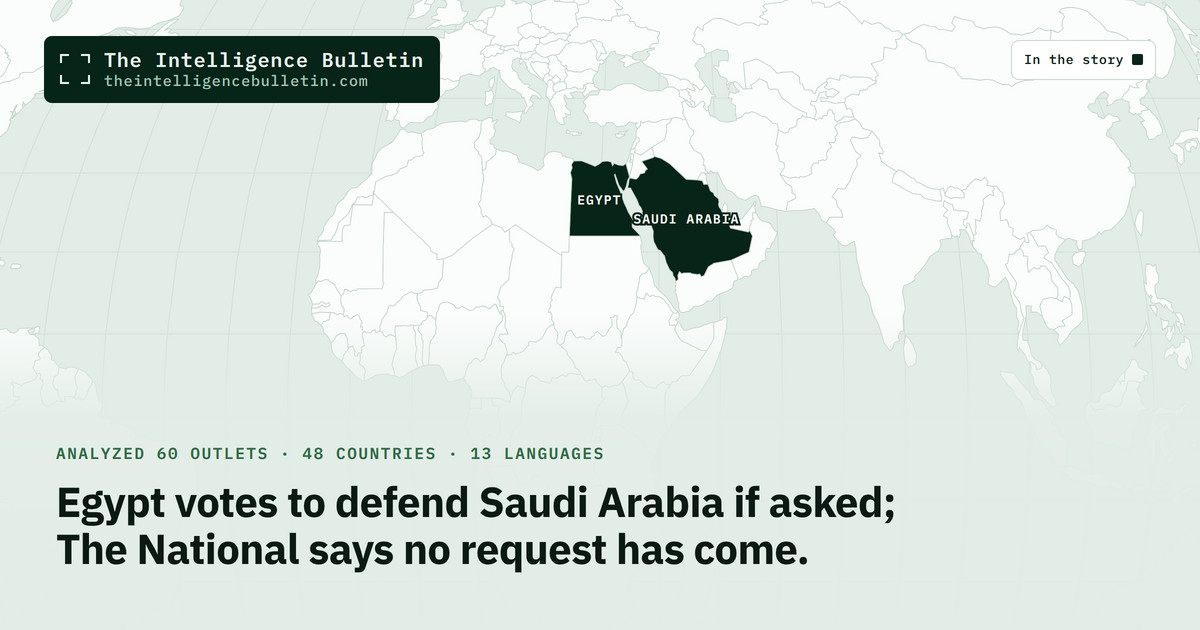
Egypt’s parliament authorized Sisi to take defensive military measures in support of Saudi Arabia if requested; Okaz, The National and Ammon News report a two-thirds majority, while Mansheet called the vote unanimous and recorded an abstention. The National says no formal Saudi request has been announced.
Across the press: Mansheet calls Egypt’s vote unanimous in the same article that records the Social Democratic Party abstaining; The National names the dissent.
Source base: 5 outlets read in full (Egypt, Saudi Arabia, United Arab Emirates, Russia, Jordan), selected from 60 analyzed.
- 1 of 5 · The National onlyAs of Monday evening no formal Saudi request for Egyptian military support had been announced.The National alone states this, adding that approval does not mean immediate deployment.
- 1 of 5 · The National onlyThe Houthi-run parliament’s speaker warned Egypt in a letter that intervention would pose ‘a grave danger’ to Egyptian national security.The National reports the letter from Yahya Al Raei to Egyptian speaker Hisham Badawi.
- 5 of 5 · reported separatelyEgypt’s House of Representatives voted on Monday to give President Abdel Fattah el-Sisi authorisation to take military or defensive measures in support of Saudi Arabia.Mansheet, Okaz, The National, Rossiyskaya Gazeta and Ammon News report the vote, citing the parliamentary session or a House statement; Mansheet calls it unanimous, while Okaz, The National and Ammon News report a two-thirds majority.
- 5 of 5 · reported separatelyThe authorisation is explicitly defensive and conditional on Saudi Arabia requesting assistance, rather than a mandate for offensive action in Yemen.Mansheet, Okaz and Ammon News describe defensive measures in response to attacks; The National quotes parliament’s defensive wording and Sisi’s ‘only if Saudi Arabia asks’; Rossiyskaya Gazeta reports Sisi’s letter limiting support to protecting Saudi territory, not attacking Yemen.
- 3 of 5 · reported separatelyArticle 152 of Egypt’s constitution required a National Defence Council opinion and a two-thirds House majority for sending the armed forces abroad, and the vote was held by roll call in a closed session.Okaz and Ammon News quote Articles 152 and 130; The National reports the two-thirds majority, roll-call and closed-session procedure.
- AnsweredThe National reports that no formal Saudi request has yet been announced, while the stated justification across all five outlets is the escalating Houthi attacks on Saudi territory.
- AnsweredParliament passed the authorisation on Monday; Rossiyskaya Gazeta reports Sisi’s letter to Mohammed bin Salman limiting support to defending Saudi territory and borders, not attacks on Yemen, and The National says the mandate is defensive with no form or deployment specified.
- Still openWill Turkish ratification produce actual troop deployments to Saudi Arabia, given Turkey s separate parliamentary authorization requirement and the anonymous official s statement that no deployment has happened so far? · Did any Houthi missile actually target Mecca or Medina, given the Houthi denial and the fact that Arab News s coalition account names Taif, Yanbu and Riyadh but not the two holy cities?
Full analysis
What happened Why it matters How each country tells it Where accounts conflict Room for disagreement Our assessment Sources and evidence
What happened
On Monday, October 26, Egypt’s House of Representatives voted to give President Abdel Fattah el-Sisi standing authority to take defensive military measures in support of Saudi Arabia if Riyadh requests them. The accounts divide on how complete the vote was. Okaz, The National and Ammon News, which relays Al Arabiya’s reporting, all say the house reached the two-thirds majority Article 152 of the constitution requires; Egypt’s Mansheet calls the vote unanimous, although the same article records that the Egyptian Social Democratic Party abstained. The National says parliament has not published an exact tally, and that the vote was taken by roll call behind closed doors; Okaz and Ammon News both cite Article 130 of the house’s internal rules for that closed-session procedure.
The mandate that emerged is deliberately bounded. The National quotes parliament authorizing Mr El Sisi, after coordination with Riyadh, to defend Saudi Arabia’s "territory, sovereignty and holy sites against any external aggression". Rossiyskaya Gazeta reports that a letter Mr El Sisi sent to Crown Prince Mohammed bin Salman limits support to protecting Saudi territory and borders, not attacks on Yemen. Okaz and Ammon News describe defensive procedures in response to attacks, and The National reports that Mr El Sisi has said Egypt will act only if Saudi Arabia asks. As of Monday evening, The National reports, no formal Saudi request had been announced, and the approval does not mean troops will deploy immediately.
The vote was not spontaneous. Mr El Sisi asked parliament for the mandate on October 17 at the Egyptian Military Academy, saying it was inconceivable that Saudi security would be harmed; the National Defence Council, which he chairs, met the following day and pledged "all necessary and possible forms of support" without specifying their form, size or duration. A Houthi strike on Riyadh’s airport on October 10 killed 12 people, among them Azza Ramzy, a 28-year-old flight attendant from Beheira province, The National reports. Houthi attacks on Red Sea shipping have also cut Suez Canal revenue. Rossiyskaya Gazeta notes that Egypt sent about 800 ground troops and naval support when it joined the Saudi-led coalition in Yemen in March 2015 but played a limited combat role, and that Egypt has not joined the Mecca mutual defense pact signed in August by Saudi Arabia, Pakistan and Turkey.
In parliament, most parties backed the request: The National names Wafd, Justice and Nour. The Egyptian Social Democratic Party, which holds about a dozen seats, directed its MPs to abstain, citing the economic cost and the risk of regional escalation; its MP Maha Abdel Nasser called the mandate open-ended and vague. The National also reports that Yahya Al Raei, speaker of the Houthi-run parliament in Sanaa, wrote to Egyptian speaker Hisham Badawi warning that intervention would pose "a grave danger" to Egypt’s national security.
Why it matters
The vote completes the constitutional step Mr El Sisi said he needed before moving, giving legal authority without specifying the action. Egypt’s army is the largest in the Arab world and has not undertaken a large-scale overseas ground deployment since 1991, as Rossiyskaya Gazeta records; any Egyptian presence in Saudi Arabia would extend the Gulf defense line and risk turning a Red Sea economic threat into direct military exposure.
For Saudi Arabia, the vote is a formal pledge at a moment Houthi attacks have hit Riyadh’s airport and Saudi Aramco, disrupting flights and oil exports. For Egypt, Suez Canal revenue is already falling, and even pro-government parties weighed economic cost alongside national security in the debate Mansheet and The National describe. The conditional machinery — if Saudi Arabia asks, and only to defend Saudi territory — keeps the commitment from becoming an offensive war in Yemen; the Houthi letter shows the other side already reads it as war.
How each country tells it
- Mansheet · Egypt · original reportingCairo’s domestic account: parliament unanimously authorised Sisi to send defensive forces to Saudi Arabia, framed as Egypt’s own constitutional decision.
- Okaz · Saudi Arabia · original reportingRiyadh’s recipient account: it leads with ‘officially’ and presents the vote as Egypt’s commitment to Saudi security, anchored in the two-thirds constitutional majority.
- The National · United Arab Emirates · original reportingAbu Dhabi’s operational account: the headline is that El Sisi is authorised to send troops, with deployment rather than procedure as the core, and it supplies the richest detail on vote mechanics, party positions, the Houthi warning and the absence of a Saudi request.
- Rossiyskaya Gazeta · Russia · original reportingMoscow’s outside-power reading: a plain factual report that parliament allowed the army to support Saudi Arabia, with historical framing of Egypt’s limited Yemen roles and its non-membership in the Mecca pact.
- Ammon News · Jordan · carries Al ArabiyaAmman’s relay of a Saudi-aligned account: ‘defensive measures in support of Saudi Arabia’ for a Jordanian audience, with the two-thirds majority and Article 152/130 detail.
Where accounts conflict
The one sharp conflict is the margin, and with it the degree of domestic consensus. Mansheet leads by saying the house approved the authorization "unanimously". Okaz, The National and Ammon News all report a two-thirds majority, which is the threshold Article 152 requires; The National adds that no exact tally has been published. The contradiction is internal to Mansheet’s own article, which later says the Egyptian Social Democratic Party abstained, and The National corroborates the abstention by naming that party and the reservations of Wafd’s Mohamed Abdel Aleem Dawoud and independent Diaa El Din Dawoud. What the Egyptian account presents as a unified sovereign decision is, in the other files, a constitutional threshold met over recorded dissent.
Room for disagreement
The strongest case that this does not remain a standby mandate is that the machinery has been built precisely when it might be used. The National reports that a Houthi strike on Riyadh’s airport killed an Egyptian flight attendant, that the Houthis warned Egypt of "grave danger", and that Houthi attacks have already cut Suez Canal revenues. Saudi Arabia is one of Egypt’s largest financial backers, and Mr El Sisi has said Egypt cannot accept harm to Saudi security. If Riyadh requests support after another strike, Egypt would face pressure to honor the vote; once forces are inside Saudi Arabia, defending its airspace or borders could draw Egypt into the Houthi-Iranian war without a further vote. The mandate’s vagueness, which MP Maha Abdel Nasser called open-ended, gives Mr El Sisi room to define the mission only after a request arrives.
Our assessment
It is likely that Monday’s vote remains a legal authorization rather than the beginning of an Egyptian deployment, at least until Saudi Arabia formally requests assistance. The conditionality is consistent across every reporting chain: Okaz, Ammon News and Mansheet tie support to attacks on the kingdom; The National reports Mr El Sisi’s "only if Saudi Arabia asks" and that no formal request has yet been announced; Rossiyskaya Gazeta reports Mr El Sisi’s letter limits support to defending Saudi territory, not attacking Yemen. The National’s detail that approval does not mean immediate deployment, and that no form, size or duration has been specified, reinforces that the vote was the constitutional prerequisite rather than an order to move. Egypt has an interest in appearing as committed as Riyadh while staying out of a costly Yemen war, and the dissent recorded by Mansheet and The National gives the president political cover to move slowly.
What would change this: a formal Saudi request, especially one that names Egyptian air-defense or naval assets after another Houthi strike on Saudi territory, would move the call toward deployment.
Sources and evidence
Press quoted
- What form, size and stationing would Egyptian support take — ground troops, air defence or naval forces — and would any deployment remain inside Saudi Arabia?
- Has Riyadh made or will it make a formal request, and on what timeline, given The National reports none has been announced?
- What was the actual vote tally, and why does Mansheet call the vote unanimous when it also reports the Egyptian Social Democratic Party abstained?
That’s how the world told the story.
Get our daily open-source intelligence on world events in your inbox — one email a day, up to six stories.
Subscribe freeNo spam. One-click unsubscribe. See the latest email →