 AI-generated analysis published under the editorial responsibility of Rohit Sinnas. How it works →
See the 51 countries
Australia, Austria, Azerbaijan, Bangladesh, Belgium, Cambodia, China, Croatia, Cuba, Egypt, France, Germany, Ghana, India, Indonesia, Iraq, Ireland, Israel, Italy, Japan, Libya, Lithuania, Malaysia, Mexico, Morocco, Netherlands, Nigeria, Norway, Oman, Pakistan, Poland, Qatar, Romania, Russia, Saudi Arabia, Senegal, Serbia, Slovakia, South Africa, South Korea, Sri Lanka, Switzerland, Syria, Turkey, Tuvalu, United Arab Emirates, United Kingdom, United States, Uzbekistan, Vietnam, Yemen
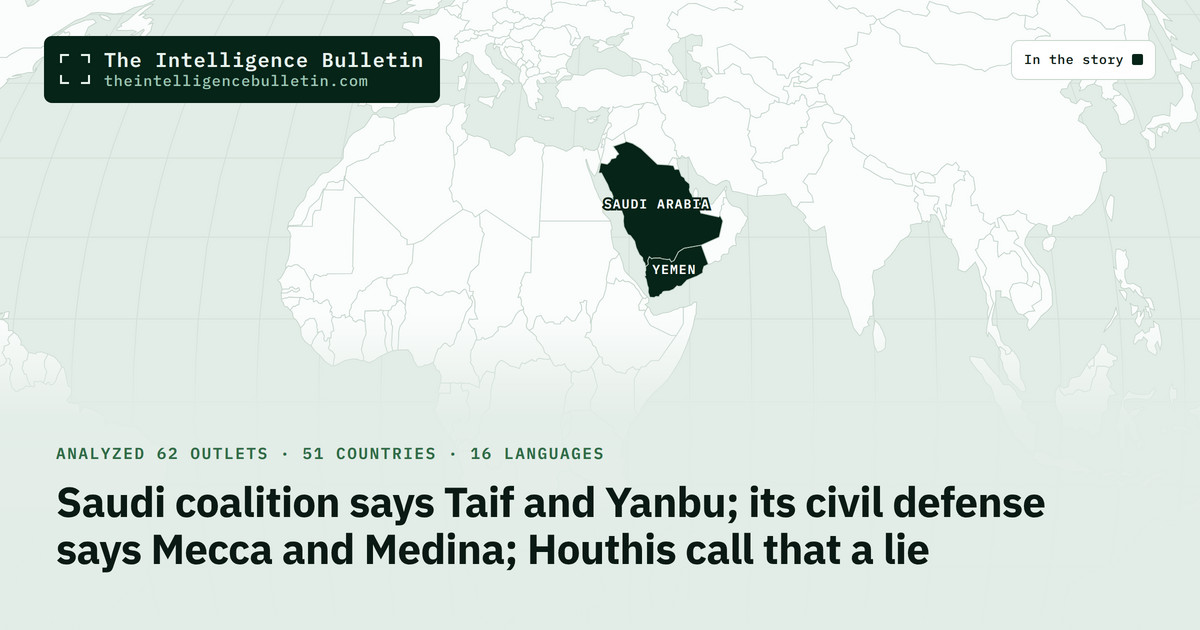
On October 24, Houthis hit Saudi Arabia and Aden with missiles and drones; Saudi defenses intercepted them. Saudi Civil Defense says debris from missiles aimed toward Mecca and Medina fell at four sites; the coalition names Taif and Yanbu, and Houthis call that a lie.
Across the press: Arab News says Taif and Yanbu; Saudi Civil Defense via Vetogate says Mecca and Medina; Al Jazeera has the Houthis calling that a lie.
Source base: 5 outlets read in full (Saudi Arabia, Yemen, Qatar, Egypt, Indonesia), selected from 62 analyzed.
- Denied on the recordThe Houthis fired two ballistic missiles toward Mecca and Medina, causing interception debris to fall across areas of Mecca, Jeddah, Taif and Rabigh.Source: Saudi Civil Defense statement carried by Vetogate and SINDOnews; Al Jazeera reports the Saudi Civil Defense warning on X that shrapnel would fall after interception.
- 4 of 5 · one shared reportSaudi air defenses intercepted and destroyed Houthi ballistic missiles aimed at Riyadh, Taif and Yanbu, and a drone in the Eastern Province, prompting civil-defense warnings across several governorates.Saudi-led coalition spokesman Brig. Gen. Turki Al-Maliki and Saudi Civil Defense, reported by Arab News and Vetogate, with Al Jazeera and SINDOnews carrying related Saudi statements.
- 2 of 5 · one shared reportThe Houthis said their targets were three Saudi airports, oil infrastructure and an airbase, and called the claim that they targeted Mecca and Medina a ‘huge lie’.Houthi statements and Houthi military spokesman Yahya Saree, reported by Al Jazeera and SINDOnews.
- 1 of 5 · Al Jazeera onlyHouthi missiles hit or targeted Aden International Airport and the coastguard headquarters in Aden, described by Yemen’s Transport Ministry as the fourth airport attack this month.Yemeni government Transport Ministry and Yemeni authorities, reported by Al Jazeera.
- 5 of 5 · reported separatelyHouthi forces launched multiple missile and drone attacks on Saudi Arabia on Friday and Saturday.Saudi coalition spokesman and Saudi Civil Defense via Arab News, Al Jazeera, Vetogate and SINDOnews; Houthi military spokesman Yahya Saree claims attacks on Saudi targets via Al Jazeera and SINDOnews.
- October 26Egypt’s parliament holds its postponed vote on authorizing military support for Saudi Arabia; the holy-cities framing may strengthen the case for authorization.
- Within daysAny emergency OIC or Arab League session responding to the OIC Secretary-General’s call for collective Islamic-world action against the Houthis.
- In the coming weekWhether the Houthis mount a fifth attack on Aden airport or further western-region strikes, and how the Saudi coalition responds to Al-Masirah’s unverified civilian-casualty claims.
- Still openWhat exactly did Iran threaten against oil and AI facilities across seven Gulf countries , and which facilities and countries are covered? · Has Trump authorized any post-midterm offensive, and will Netanyahu s urgings move the timing ahead of November 3?
- 23 Oct · No article carries the seven-Gulf-states threat; Hürriyet and Gulf News carry the IRGC base warning while Al-Riyadh runs Trump s dismissal
- 23 Oct · Aramco s Dhahran evacuation rests on unnamed sources; the drone war s four dead are on the record
- 21 Oct · Arab News calls Sisi s defense-only pledge reassuring; Annabaa sees Cairo hanging its war decision on Riyadh
Full analysis
What happened Why it matters How each country tells it Where accounts conflict Room for disagreement Our assessment Sources and evidence
What happened
On Saturday, 24 October, Saudi Arabia’s Civil Defense said shrapnel from two intercepted Houthi ballistic missiles rained down across the country’s western region, including at Wadi Mughammas on the outskirts of Mecca. The Houthis, who launched the barrage, denied aiming at Islam’s two holiest cities, saying their targets were airports, oil facilities and an airbase.
The attacks began before dawn. Around 4 a.m., the Civil Defense sounded alarms through its Early Warning Platform for Riyadh, Najran and the southern governorate of Wadi al-Dawasir. Two loud blasts echoed through the capital minutes later, and coalition spokesman Brigadier General Turki Al-Maliki said air defenses had intercepted and destroyed a ballistic missile launched toward Riyadh. He separately reported intercepting a drone in the Eastern Province (Arab News).
Around noon, Al-Maliki said two more ballistic missiles, launched toward the cities of Taif and Yanbu, were intercepted and destroyed. Earlier that morning, the Civil Defense had issued danger warnings for Jeddah, Yanbu, Taif and Makkah governorates, then lifted them shortly afterwards (Arab News).
The Civil Defense’s own statement, carried by Egypt’s Vetogate and Indonesia’s SINDOnews, said the two missiles were fired toward the regions of Makkah al-Mukarramah and al-Madinah al-Munawwarah, and that the interceptions scattered debris at four named sites: Wadi Mughammas in Mecca, the Al-Nuzha district of Jeddah, Wadi Jalil in Taif, and the Mustawra center in Rabigh. Al Jazeera reports the Civil Defense warning on X that shrapnel would fall after the interception, and images shared by the Saudi Press Agency appeared to show a large, blackened missile-shaped object that had come down. The coalition’s combined tally, as carried by Vetogate, was three ballistic missiles destroyed — aimed at Riyadh, Taif and Yanbu — plus the Eastern Province drone.
The Houthis rejected the holy-cities claim as a "huge lie." Their stated targets were three Saudi airports, oil infrastructure and an airbase. Military spokesman Yahya Saree named King Khalid International Airport in Riyadh and airports in Dammam and Najran, alongside two oil facilities and a pipeline (SINDOnews, Al Jazeera).
The same day, Houthi forces also struck Aden, seat of Yemen’s internationally recognised government. The government’s Transport Ministry said two ballistic missiles targeted Aden International Airport — the fourth such attack this month — posing a threat to civil aviation. Yemeni authorities said the coastguard headquarters and a second building were hit. The Houthis claimed attacks on the al-Nasr camp and Aden’s naval military base (Al Jazeera).
On Friday, Yemen’s army said a Houthi missile malfunctioned and fell on a family home in Houthi-held Sanaa, killing three people. Houthi-run Al-Masirah TV said Saturday that Saudi coalition airstrikes killed several civilians in Sanaa and Hodeidah — a claim Al Jazeera could not verify and on which Riyadh has not commented. Yemeni army spokesman Colonel Majed Abdullah al-Nazili said government forces had carried out more than 700 "targeting operations" in the previous 24 hours, "neutralising" 300 Houthi fighters — figures Al Jazeera could not independently verify.
The religious-political response came within a day. Ismail Ould Cheikh Ahmed, Secretary-General of the Organisation of Islamic Cooperation, condemned the attacks on Mecca, Medina, Taif and Jeddah "in the strongest terms," describing the targeting of Wadi Mughammas near the plain of Arafat as proof of disregard for the sanctity of the holy places, and called for urgent collective action by the Islamic world (Almontasaf). Gulf Cooperation Council Secretary-General Jasem Mohamed Albudaiwi called the attacks "heinous," embodying "a blatant disregard for the lives and security of civilians" (Al Jazeera).
The strikes follow the collapse in July of a fragile ceasefire that had held since 2022; cross-border attacks have surged since, compounded by wider US-Iran escalation (Arab News). TIB reported on 23 October that Houthis claimed strikes on Riyadh’s Defense Ministry, Dammam’s airport, Aramco at Yanbu and Abha airport, and on 21 October that Egypt’s parliament had postponed its vote on military support for Saudi Arabia to 26 October while Turkey submitted the Mecca joint defense pact with Saudi Arabia and Pakistan for ratification.
Why it matters
The stakes sit in the distance between what the Saudis said and what they led the world with. The coalition’s operational account — missiles at Taif and Yanbu — is a standard defense readout; Riyadh then presented the same intercepts as missiles toward the regions of Mecca and Medina, with debris at a site the OIC Secretary-General places near Arafat. That framing turns an interception into a religious summons, and the OIC’s response — that violating the sanctity of the holy sites is an attack on the entire Islamic nation requiring a firm international position — shows how quickly it travels. It lands on a specific timetable: Egypt’s parliament votes on 26 October on authorizing military support for Saudi Arabia, and Turkey’s parliament holds the Mecca joint defense pact with Saudi Arabia and Pakistan up for ratification (TIB, 21 Oct). An attack aimed at Taif’s airport and an attack aimed toward Mecca carry different weights in both debates.
Militarily, the barrage extends deep into the western region far from the Yemeni border, continuing the pattern TIB reported on 23 October of Houthi claims against Riyadh’s Defense Ministry, Dammam’s airport, Aramco at Yanbu and Abha airport. The simultaneous Aden strikes hit the internationally recognised government’s seat and its civilian airport for the fourth time this month, directly threatening aviation over a city the coalition is fighting to hold. And the civilian toll already runs both ways: three people killed by a malfunctioning Houthi missile in Sanaa on Friday, and unverified Al-Masirah claims of Saudi strikes killing civilians in Sanaa and Hodeidah — each side now holding the other’s dead as material for what comes next.
How each country tells it
- Arab News · Saudi Arabia · original reportingFrames the strikes as an intensifying Houthi missile-and-drone campaign that Saudi air defenses are successfully countering, with the coalition spokesman and civil defense alerts as the spine of the account.
- Almontasaf · Yemen · carries Organisation of Islamic CooperationLeads with the OIC Secretary-General’s condemnation of Houthi attacks on Mecca, Medina, Taif and Jeddah and his call for the Islamic world to take collective action.
- Al Jazeera · Qatar · original reportingCovers the day as a two-front fight: Houthi attacks on Saudi Arabia and on Aden, with the Houthis’ own denial that they targeted Mecca and Medina given prominent space.
- Vetogate · Egypt · original reportingFiles the story as a concise security bulletin: Saudi Civil Defense warnings, announced debris locations, and the coalition’s interception tally.
- SINDOnews · Indonesia · original reportingLeads with the shootdown and debris over Makkah and Madinah in local spelling, then adds Houthi spokesman Yahya Saree’s list of claimed targets.
Where accounts conflict
The central dispute is whether Mecca and Medina were the aim, and it cuts through Saudi Arabia’s own official institutions, not only between Riyadh and the Houthis.
The Saudi Civil Defense, carried by Vetogate and SINDOnews, says two Houthi ballistic missiles were fired toward the regions of Makkah al-Mukarramah and al-Madinah al-Munawwarah, and names four debris sites: Wadi Mughammas in Mecca, Al-Nuzha in Jeddah, Wadi Jalil in Taif and Mustawra in Rabigh. Al Jazeera carries the Civil Defense’s X warning that shrapnel would fall after the interception of missiles toward Mecca and Medina. Against that stands the coalition’s military spokesman, reported by Arab News: the two midday missiles were launched "towards the cities of Taif and Yanbu." Taif sits in the Makkah governorate; Yanbu is in the Madinah region. Arab News never says the missiles were aimed at Mecca or Medina, and reports only that warnings for Jeddah, Yanbu, Taif and Makkah governorates were lifted shortly after being issued.
The Houthis, via Al Jazeera and SINDOnews, call the holy-cities claim a "huge lie" and name different targets: three airports — including King Khalid International in Riyadh and airports in Dammam and Najran — two oil facilities, a pipeline and an airbase. None of those sits in the western holy region. The coalition’s own Riyadh intercept matches the King Khalid claim; the Taif and Yanbu intercepts do not appear on the Houthis’ list.
The accounts are partly reconcilable — the coalition names cities, the Civil Defense names the holy regions those cities sit within — but that is not the version Riyadh presented to the Muslim world, and the Houthis deny the holiest reading outright.
Room for disagreement
The strongest case against my assessment is that the Saudis would not lightly claim, in a Civil Defense statement with named debris sites, that missiles were fired toward Mecca and Medina — and the debris at Wadi Mughammas, which the OIC Secretary-General places near the plain of Arafat, is a physical fact consistent with a missile passing toward Mecca itself. A missile aimed at Yanbu does not drop debris beside Mecca; something was in the air over the holy approaches. The Houthis have every incentive to deny targeting the holy cities — an admission would unite the Muslim world against them and vindicate the coalition’s moral case — so their "huge lie" counterclaim could itself be the self-serving statement. And the coalition spokesman’s "Taif and Yanbu" may simply describe where the interceptors engaged, not a denial of the missiles’ overall trajectory: a missile aimed at Taif’s airport still passes across the approaches to Mecca.
Our assessment
It is very likely that the missiles the Saudi coalition intercepted over western Saudi Arabia on Saturday were aimed at Taif and Yanbu, as the coalition’s own spokesman said, and that the "toward Mecca and Medina" account from the Civil Defense describes the holy regions those cities sit within rather than a demonstrated aim at Islam’s two holiest sites. The warrant is the spokesman’s on-record naming — the kingdom’s own operational authority on what was engaged, reported by Arab News without any claim of debris on Mecca or Medina — set beside the Civil Defense’s debris list, which names no site inside Medina city and four sites exactly consistent with interceptions over the Taif and Yanbu corridors: Taif is in the Makkah region, Yanbu in the Madinah region. The Houthis have named specific non-holy targets across the two days, and the coalition’s own Riyadh intercept matches one of them; Riyadh has a clear interest in the holiest reading, which the OIC has already turned into a summons for collective Muslim action, and the Houthis have an equal interest in denying it — which is precisely why the coalition’s operational wording is the strongest data point in the record.
What would change this: the release of radar tracks or interception telemetry showing the missiles’ programmed or actual target coordinates would settle whether Mecca and Medina were the aim or the backdrop.
Sources and evidence
Press quoted
- Did any Houthi missile actually target Mecca or Medina, given the Houthi denial and the fact that Arab News’s coalition account names Taif, Yanbu and Riyadh but not the two holy cities?
- What damage or casualties resulted from the debris falls in Wadi Mughammas, Jeddah, Taif and Rabigh, and how do the Saudi accounts reconcile the differing target lists — Taif and Yanbu in Arab News, Mecca and Medina in the Civil Defense statement, and Riyadh, Taif and Yanbu in the coalition tally?
- Did Saudi-led coalition air strikes kill civilians in Sanaa and Hodeidah as Al-Masirah TV claimed, and has Riyadh responded to that allegation?
That’s how the world told the story.
Get our daily open-source intelligence on world events in your inbox — one email a day, up to six stories.
Subscribe freeNo spam. One-click unsubscribe. See the latest email →