 AI-generated analysis published under the editorial responsibility of Rohit Sinnas. How it works →
See the 51 countries
Afghanistan, Argentina, Armenia, Australia, Austria, Azerbaijan, Benin, Bermuda, Brazil, Bulgaria, Canada, China, Croatia, Denmark, Dominican Republic, Egypt, Finland, France, Germany, Greece, Hong Kong, Indonesia, Iraq, Israel, Japan, Kenya, Lithuania, Mexico, Netherlands, Nigeria, North Korea, Norway, Oman, Peru, Philippines, Poland, Portugal, Romania, Russia, Saudi Arabia, Serbia, Slovakia, South Korea, Spain, Sweden, Taiwan, Turkey, United Arab Emirates, United Kingdom, United States, Vietnam
Kim Jong Un crossed into Dandong on Oct 24 via the newly opened New Yalu River Bridge. The trip was first attributed to an unnamed South Korean official; Xinhua later confirmed it, showing Wang Huning accompanying Kim with no Xi Jinping meeting.
Across the press: The Korea Herald reported the Unification Ministry confirmed Kim’s Dandong crossing; Reuters had the ministry’s spokesperson declining comment, the fact sourced to an unnamed official.
Source base: 5 outlets quoted (China, South Korea, Japan, Russia, Taiwan), selected from 60 analyzed. 4 read in full, 1 by its headline only.
- 1 of 5 · Taipei Times onlyKim returned home after a day-long Dandong trip in which Wang Huning, not Xi Jinping or Li Qiang, accompanied him and saw him off, with Xinhua reporting no talks with either.Taipei Times, relaying a Xinhua readout.
- 1 of 5 · Taipei Times onlyXinhua’s readout said Kim attended a memorial ceremony to fallen soldiers and visited an automobile factory during the trip.Taipei Times, relaying Xinhua.
- 4 of 5 · reported separatelyKim Jong-un crossed into China on Oct. 24 via the newly opened New Yalu River Bridge, arriving in Dandong.The Korea Herald cites a Unification Ministry confirmation; Nikkei Asia carries Reuters citing an anonymous South Korean government official; Argumenty i Fakty relays South Korean journalists citing the unification ministry; Taipei Times reports Kim is thought to have crossed via the bridge.
- 4 of 5 · reported separatelyThe New Yalu River Bridge was completed in 2014, officially opened on Oct. 15, and opened only after about 12 years of delay.The Korea Herald; Nikkei Asia/Reuters; Argumenty i Fakty; Taipei Times reports it opened last week 12 years after completion.
- 2 of 5 · reported separatelyKim’s visit fell a day before the 76th anniversary of China’s entry into the Korean War.The Korea Herald reports the anniversary timing; Taipei Times says the trip fell near the date both countries mark.
- VeniceHidden
- Still openWill Pyongyang respond to the proposal, and has Kim Yo Jong s confirmation that units are in firing positions already prejudged a refusal? · Does the US-led United Nations Command actually share Seoul s stated openness to trilateral talks, and would Washington allow the UNC to be drawn in as a negotiating party?
Full analysis
What happened Why it matters How each country tells it Where accounts conflict Room for disagreement Our assessment Sources and evidence
What happened
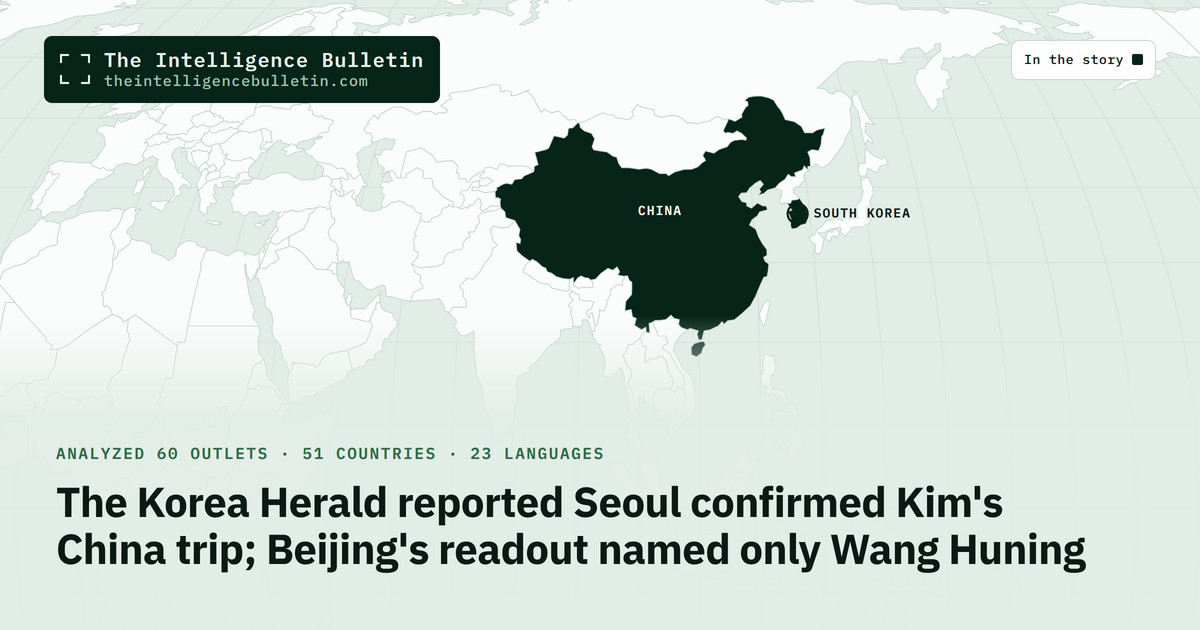
North Korean leader Kim Jong Un crossed into China on Saturday, Oct. 24, over the New Yalu River Bridge into the border city of Dandong — a trip that began as an unnamed South Korean official’s word and was confirmed, a day later, by Beijing’s own state media.
The first reports came from Seoul. An anonymous South Korean government official told Reuters, whose account Nikkei Asia carried, that Kim had arrived in Dandong through the new bridge. The Korea Herald gave the information firmer standing, writing that the Unification Ministry "confirmed" the crossing; Russia’s Argumenty i Fakty, relaying South Korean journalists, also cited the ministry. Yet in the Reuters account, a Unification Ministry spokesperson offered no immediate comment and China’s foreign ministry did not answer a request for comment, so the only on-record position that morning was the ministry’s "no immediate comment." Earlier, Kyodo News had reported strict traffic restrictions in parts of Dandong. The visit also followed false social media claims that Kim had died of a brain hemorrhage, which South Korea’s National Intelligence Service told lawmakers Friday were untrue, the Korea Herald reported.
By the next day the record had moved across the border. China’s Xinhua news agency read out the visit, as the Taipei Times relayed it: Kim spent the day in Dandong and returned home, and the official who accompanied him through the city and "saw him off" at the bridge was Wang Huning, Beijing’s No. 4 and top political advisor — not Xi Jinping and not Li Qiang. The readout mentioned no talks with either. Wang conveyed Xi’s "cordial greetings and best wishes" to Kim and described the visit as significant for "consolidating public goodwill towards the friendship… and deepening political mutual trust." Xinhua said Kim attended a memorial ceremony for fallen soldiers and visited an automobile factory.
The commemoration had an anniversary attached. The visit came a day before the 76th anniversary of Chinese troops entering the Korean War, the Korea Herald noted, and the Chinese-language platform Ifeng framed it in its headline as a tribute to the People’s Volunteers heroes who fought in that war rather than a surprise crossing. Kim’s last known visit to China was in September 2025 for the 80th anniversary of the end of World War II, when he met Xi before Xi made a state visit to Pyongyang in June.
The bridge was the other half of the story. The New Yalu River Bridge, a four-lane, roughly 3-km crossing linking Dandong to Sinuiju, was completed in 2014 but sat idle for about 12 years — the Korea Herald, Reuters and Argumenty i Fakty all put the delay down to unfinished road and customs infrastructure on the North Korean side, strained ties and, later, pandemic restrictions. AiF put China’s construction cost at about 2.2 billion yuan. The bridge opened on Oct. 15, nine days before Kim crossed it, making his journey one of its most prominent uses since inauguration.
Why it matters
The crossing reopens the main artery the bridge was built for. Lu Chao, a North Korea specialist at the Liaoning Academy of Social Sciences, told Reuters the opening had resolved "a major bottleneck in China-North Korea trade logistics" and that bilateral trade was likely to increase, able to move the heavy equipment and raw materials North Korea needs. Nikkei Asia’s framing ran through the Beijing-Pyongyang axis as a whole, noting Pyongyang has drawn closer to Russia since 2022, which analysts say has reduced its reliance on Beijing — so a visit now reads as re-consolidation on Beijing’s terms. Christopher Green of Leiden University told Reuters it was "too early to divine Kim’s intentions," though he judged a Xi-Kim summit "probably" likely.
The Korea Herald, writing from Seoul, fixed instead on the summit question: Kim has met Xi on every previous China visit since taking power, and with U.S. President Donald Trump pressing to revive talks and China due to host APEC in Shenzhen next month, the unannounced trip looked like a possible preface to another meeting. The Chinese readout itself is the third frame, and the most consequential. By choosing Wang Huning — the ceremonial head of the political consultative body — rather than the party leader or the premier, Beijing welcomed Kim while pointedly declining to elevate him to summit level. The commemoration was the channel: honoring Chinese soldiers who died in the Korean War is the one ritual on which Beijing and Pyongyang can meet without addressing sanctions, Russia, and nuclear diplomacy.
For Washington the timing is specific. Reuters reported Friday that U.S. and South Korean officials see fading chances of a Trump-Kim meeting this year. A North Korean leader visibly re-engaging Beijing a month before Trump is expected at APEC, with the summit question still open, tightens China’s hand in whatever channel to Pyongyang the next U.S. administration wants opened.
How each country tells it
- Ifeng (Phoenix News) · ChinaLeads with Kim’s Dandong visit as a tribute to Chinese People’s Volunteers heroes, framing it as an allied, information-rich visit rather than a surprise crossing.
- The Korea Herald · South Korea · original reportingStresses the unannounced nature of the crossing and the possibility of a Xi-Kim meeting, with Seoul’s Unification Ministry confirming the trip.
- Nikkei Asia · Japan · wire copyCarries the Reuters account and frames the crossing as re-consolidation of the Beijing-Pyongyang axis, likely to ease trade bottlenecks and boost bilateral commerce.
- Argumenty i Fakty · RussiaReads the crossing through the newly opened Amnok/Yalu bridge and its 12-year delay, presenting the visit as a practical consequence of China-DPRK agreements.
- Taipei Times · Taiwan · original reportingLeads on Kim’s return from Dandong and relays the Xinhua readout, emphasizing that Wang Huning, not Xi or Li, accompanied him and saw him off.
Where accounts conflict
The sharpest conflict is about what Seoul actually did. The Korea Herald reported that the Unification Ministry "confirmed" the crossing; the Reuters account carried by Nikkei Asia had a ministry spokesperson making no immediate comment, with the fact itself sourced to an unnamed official. Argumenty i Fakty splits the difference, describing South Korean journalists citing the ministry. A reader holding the Herald alone would believe the trip carried an on-record government confirmation; a reader holding Reuters alone would believe the government had said nothing in public.
The second conflict is what the visit means for a summit. The Korea Herald treats a Xi-Kim meeting as the question the visit raises, noting Kim has met Xi on each previous China visit; Green told Reuters he expected one. The Xinhua readout, as the Taipei Times reports it, runs the other way: the official who accompanied Kim and saw him off was Wang Huning, not Xi, and the readout mentions no talks with either Xi or Li Qiang. What Seoul and outside analysts read as the likely next step, Beijing’s own record left conspicuously out.
Room for disagreement
The strongest case that a Xi-Kim summit is near rests on the pattern and the calendar. Kim has met Xi on every previous visit to China since taking power, the Korea Herald reports; the two leaders have summited twice in 13 months, most recently in Pyongyang in June, and APEC in Shenzhen next month supplies a ready-made venue with Trump expected to attend. On this reading, the Dandong visit was the first move in a sequence, and Wang Huning’s role was a matter of protocol for a commemoration — Beijing would not send its top leaders to a memorial ceremony. Green told Reuters it would be "surprising" if there were not a summit. If Beijing wanted to discourage summit talk, this reading runs, it would not have had Xinhua confirm the visit at all; the readout’s silence on Xi may be withholding, not denial.
Our assessment
A Xi Jinping-Kim Jong Un summit within the next month is roughly even chance. The cadence and the calendar pull toward one — two summits in 13 months, a state visit by Xi to Pyongyang in June, APEC in Shenzhen with Trump expected, and a Dandong visit nine days after the bridge opened are the kind of sequence that historically precedes a meeting. But the Xinhua readout cuts the other way, and it is a primary document, not speculation: Beijing chose its No. 4 to accompany Kim, pointedly omitted Xi and Li Qiang, and had Wang convey Xi’s greetings at a distance, a reception consistent with a relationship Beijing is managing on its own, patient terms while Pyongyang courts Moscow. Seoul’s own daily and outside experts project the summit pattern forward; Beijing’s record for this visit declined to.
What would change this: a Chinese or North Korean statement confirming an Xi-Kim meeting, or confirmation that Kim will attend APEC in Shenzhen.
Sources and evidence
Press quoted
- Did Kim Jong-un meet Xi Jinping or Li Qiang in Dandong, or was Wang Huning the most senior Chinese official he saw, and does Xinhua’s silence reflect an actual absence?
- What was the purpose or outcome of the visit beyond the memorial ceremony and automobile factory tour, and did Beijing and Pyongyang reach any trade or strategic agreements?
- Has Pyongyang issued its own account of the trip, and does it confirm or dispute the versions offered by Seoul’s Unification Ministry and Xinhua?
That’s how the world told the story.
Get our daily open-source intelligence on world events in your inbox — one email a day, up to six stories.
Subscribe freeNo spam. One-click unsubscribe. See the latest email →