 AI-generated analysis published under the editorial responsibility of Rohit Sinnas. How it works →
See the 50 countries
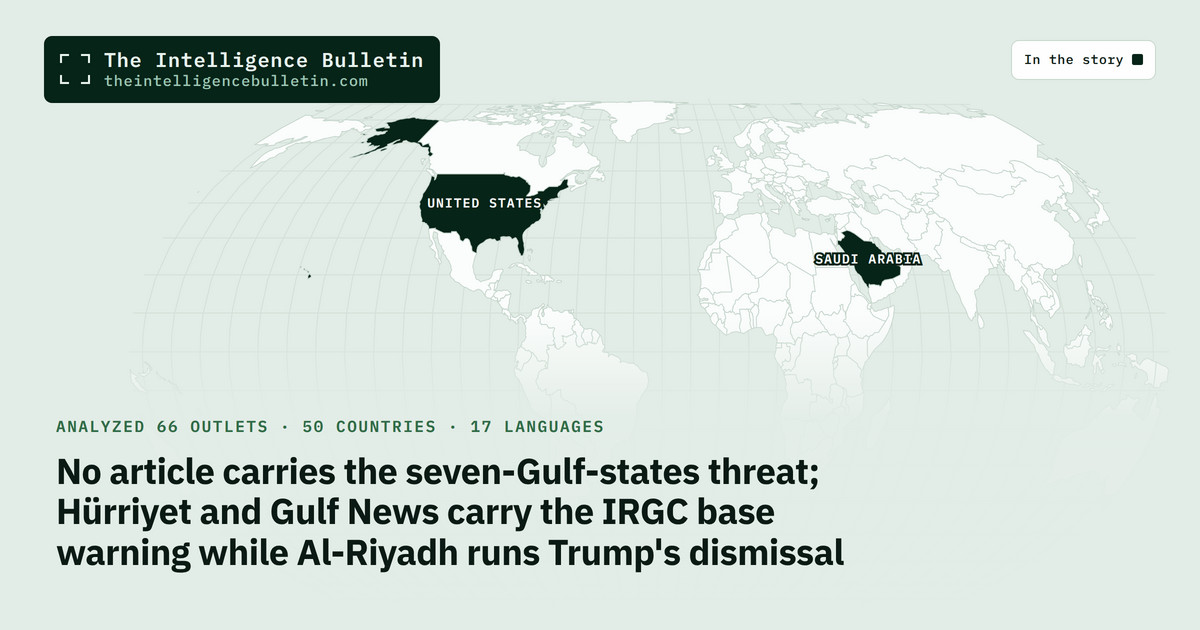
Australia, Austria, Azerbaijan, Bangladesh, Brazil, Canada, China, Croatia, Cuba, Cyprus, Czech Republic, Denmark, Egypt, France, Germany, Greece, Hungary, India, Iran, Ireland, Israel, Italy, Japan, Lebanon, Luxembourg, Madagascar, New Zealand, Nigeria, Norway, Pakistan, Philippines, Poland, Qatar, Romania, Russia, Saudi Arabia, Senegal, Singapore, Slovenia, South Africa, South Korea, Spain, Sri Lanka, Sweden, Switzerland, Turkey, Ukraine, United Arab Emirates, United Kingdom, United States
Iran’s IRGC warns its retaliation may extend to US bases; a Houthi attack on Dammam’s airport killed one foreign national and wounded eight, Saudi civil aviation confirmed, as Trump says "something will happen" with a post-midterm offensive undecided.
Across the press: Hürriyet and Gulf News carry the IRGC’s US-bases warning as a live threat; Al-Riyadh headlines Trump’s dismissal of Hormuz threats as an oil-price fabrication.
Source base: 5 outlets quoted (Saudi Arabia, Turkey, Egypt, Israel, United Arab Emirates), selected from 66 analyzed. 4 read in full, 1 by its headline only.
- 1 of 5 · Hürriyet onlyHouthi rebels claimed attacks on Saudi Arabia’s Defense Ministry in Riyadh, King Fahd International Airport in Dammam, Aramco at Yanbu, and Abha airport, and Saudi Arabia’s civil aviation authority confirmed the Dammam airport attack killed one foreign national and wounded eight.Hürriyet, citing a Houthi statement and the General Authority of Civil Aviation.
- 2 of 5 · reported separatelyThe Islamic Revolutionary Guard Corps has threatened to expand its retaliation to include US military bases in the region if Washington continues its current course.Hürriyet quotes the IRGC statement; Gulf News’s headline reports the same threat.
- 2 of 5 · reported separatelyThe United States is drawing down forces at bases in the Middle East and has moved the US embassy in Riyadh to ordered-departure status, citing increased Houthi attacks on Saudi Arabia.Hürriyet, citing anonymous US officials and NBC, and Israel National News, relaying the State Department evacuation.
- 3 of 5 · reported separatelyPresident Trump said the US is not negotiating with Iran, that ‘something will happen’ soon, and that the US may strike Iran ‘a little bit further.’Hürriyet quotes Trump to reporters; Israel National News quotes him outside the White House; Gulf News carries the phrase in its headline.
- 2 of 5 · reported separatelyTrump is weighing a multi-day offensive against Iran after the November 3 midterm elections, targeting nuclear, missile/drone, and energy sites, but no final decision has been made.Israel National News, relaying The Atlantic and The New York Times, with Hürriyet separately reporting that US sources say Trump is considering resuming large-scale combat operations before or after the midterms.
- October 27Israel’s election, which Netanyahu has used to urge US strikes; whether Israel acts without US authorization is the test Dostor’s analysts pose.
- November 3The US midterms, after which The Atlantic and The New York Times say a multi-day offensive could begin — the named decision point for Trump.
- Still openWhich vessels were actually hit or mined, under what flags, and were there casualties or oil spills? · Did IRGC forces deliberately strike the four tankers, or did those vessels also hit mines, and who laid any mines?
- 23 Oct · Aramco s Dhahran evacuation rests on unnamed sources; the drone war s four dead are on the record
- 22 Oct · Iran claims seven tankers burning near Hormuz; AP, Oman Observer and AAJ News all say unverified
- 20 Oct · Araghchi s seven-day Hormuz offer; CNN and Jerusalem Post detail strike plans; Gooya relays a US strike claim.
- 20 Oct · Netanyahu says he discussed overthrowing Iran s government with Trump; the White House denies restart talk
Full analysis
What happened Why it matters How each country tells it Where accounts conflict Room for disagreement Our assessment Sources and evidence
What happened
The story this edition was framed to carry — Iran threatening oil and AI facilities across seven Gulf countries if the United States and Israel renew attacks — appears in none of the five articles gathered for it. The seven-country list, the AI sites and that condition are absent from everything published. What the reporting actually contains is narrower and more immediate.
The on-record threat comes from the Islamic Revolutionary Guard Corps. Hürriyet’s retrieved text quotes the Guard warning that if Washington keeps directing ships through the Gulf passage, the scope of its retaliation will come to include US military bases in the region; Gulf News’s headline carries the same threat. It is not new — TIB reported on October 22 that the IRGC Navy’s statement on seven tankers near Hormuz threatened US bases the same way, and those tanker claims remain unverified.
This week’s confirmed damage is Saudi and civilian. The Houthis said Wednesday they had struck the Saudi Defense Ministry in Riyadh, King Fahd International Airport in Dammam, Aramco at Yanbu and Abha airport — one statement, relayed by Hürriyet, the only retrieved text in this set carrying the claim. Saudi Arabia’s General Authority of Civil Aviation confirmed the part that matters: the Dammam airport was attacked on the evening of October 21, a foreign national resident was killed and eight wounded were hospitalized, with damage assessment ongoing.
The United States is moving people out and signaling more strikes. Hürriyet, citing anonymous US officials and NBC, reports the military has quietly cut its presence at bases in Jordan, Qatar and Kuwait, and that the Riyadh embassy is on ordered-departure status, leaving only emergency staff. State Department spokesman Tommy Pigott said Iran-backed Houthis had stepped up "hostility activities" against Saudi Arabia, targeting civilian airports and other critical infrastructure; CENTCOM spokesman Timothy Hawkins said troops move regularly to optimize readiness and declined to describe the moves.
President Trump told reporters the United States is not negotiating with Iran, that "sooner or later something will happen," and that Washington has "knocked the hell out of them. And we may do it a little bit further" — the last phrase also in Gulf News’s headline. Israel National News relays The Atlantic’s Thursday report that Trump is weighing a multi-day offensive after the November 3 midterms against nuclear facilities, missile and drone capabilities, and energy infrastructure; The New York Times reported Wednesday, in the same relayed account, that US and Israeli planners have detailed proposals awaiting Trump’s authorization. Hürriyet separately reports, via US sources, that resuming large-scale combat operations before or after the midterms is under consideration and that the drawdown is part of that planning. No account claims a final decision has been made.
Israel is pushing from inside the room. Israel National News reports that Netanyahu urged Trump to authorize strikes before Israel’s election next week, according to a White House official who spoke to The Atlantic. Dostor asks whether Netanyahu can drag Washington into renewed confrontation at all; its analysts argue Israel cannot absorb the consequences of a solo strike and that the talk runs on election timing. Gulf News’s retrieved text shows the economic half of the squeeze: Treasury Secretary Scott Bessent posted before-and-after satellite photos of Kharg Island’s oil terminal, wrote that "no crude tankers" are in sight, and called the island "a monument to the one thing the Iranian regime can still produce: failure."
Why it matters
Three stakes: a chokepoint, a civilian toll, an election timetable. Hormuz carries a large share of the world’s oil, and only Hürriyet’s retrieved text carries the IRGC’s ship-strike and mine detail — four ships hit simultaneously while transferring oil, three stopped after striking mines west of the strait, and a charge that Washington encouraged ships through a mined passage. Those claims remain unverified, and the open questions from TIB’s October 22 edition — which vessels, what flags, what casualties or spills — are still open.
The civilian toll is already on the record: one foreign national dead and eight wounded at Dammam, confirmed by Saudi civil aviation — a different order of fact from a rebel claim. Al-Riyadh’s headline choice shows the stakes: leading with Trump’s claim that Iran is "fabricating threats in Hormuz to raise oil prices," the Saudi daily frames the danger as a market problem rather than a military one, a framing Hürriyet and Gulf News do not share.
The third stake is the American calendar. The Atlantic’s report says Trump weighed pre-election strikes and has so far declined, while his own "something will happen" is timed, by most people he says, to after the election. Dostor’s analysts call that timing electoral theater; Israel National News tells its readers the operation is on the desk and Israel wants it sooner. For the capitals watching, the difference between bluff and schedule is the difference between a price spike and a war.
How each country tells it
- Al-Riyadh · Saudi ArabiaLeads with Trump’s claim that Iran is fabricating threats in Hormuz to push up oil prices, treating the Iranian warning as a price bluff rather than a military emergency.
- Hürriyet · TurkeyReports the confrontation as immediate regional danger: Houthi attacks on Saudi targets, US military and diplomatic drawdowns, Trump’s strike signals, and the IRGC’s claimed tanker hits and mine incidents at Hormuz.
- Dostor · Egypt · opinionFrames the story as a question of Israeli agency, asking whether Netanyahu can drag Washington into a new Iran confrontation and using experts to call strike talk electoral politics.
- Israel National News · Israel · carries The AtlanticReports Trump’s post-midterms multi-day Iran offensive as a plan on the desk, with Netanyahu urging strikes before Israel’s election, and treats the coming operation rather than Iran’s threat as the news.
- Gulf News · United Arab Emirates · original reportingLeads with the full war picture—Trump’s ‘a little bit further’ warning, the IRGC threat to US bases, and Netanyahu’s regime-change call—while its retrieved text foregrounds Treasury Secretary Bessent’s sanctions and economic-warfare rhetoric against Iran.
Where accounts conflict
The substantive disagreement is whether the Iranian threat is real or a price bluff. Al-Riyadh’s headline relays Trump’s claim that Iran is fabricating threats in Hormuz to raise oil prices — treating the IRGC warning as market manipulation. Hürriyet and Gulf News run the same warning as live: Hürriyet’s retrieved text says continued American behavior will bring US bases into the retaliation scope, and Gulf News’s headline reports that threat. They cannot both be right about what the threat means: an imminent condition to which the US drawdown and the Riyadh evacuation respond, or a bluff the Saudi state’s own daily lets Washington call.
Separately, none of the five articles contains the assignment’s claimed threat to oil and AI facilities across seven Gulf countries — a gap between framing and publication, not between outlets. A reader looking for the seven-country threat finds instead a confirmed airport attack and an IRGC warning aimed at US bases.
Room for disagreement
The strongest case that this stays bluff and election timing comes from the Saudi and Egyptian material and from Trump himself. Al-Riyadh leads with the president’s assertion that Iran is fabricating Hormuz threats to push up oil prices. Dostor’s commentators say the strike talk lacks military and strategic logic, runs on American election incentives, and that Netanyahu cannot absorb the consequences of acting alone. On that reading, the course after November 3 is more of the same — economic pressure, satellite photos of an empty terminal, threats both sides can walk back — and the absent seven-country threat is evidence the escalation is rhetorical.
Our assessment
A renewed multi-day US offensive against Iran after the November 3 midterms stands at roughly even chance. The warrant is convergence: Hürriyet’s US sources and Israel National News’s relay of The Atlantic and The New York Times describe the same plan — nuclear, missile and energy targets over several days — alongside the same drawdown and the Riyadh evacuation, preparations no single outlet invented. Trump’s words are on the record in three outlets: no negotiation, "something will happen," "we may do it a little bit further." Against that sits the explicit absence of a decision in every account and Trump’s refusal so far of the pre-election strikes Netanyahu urged. The midterms cut both ways: success before November 3 could help Republicans; an operation begun or botched near the vote risks the election itself — why Dostor calls the timing electoral and Al-Riyadh runs the bluff line. For the Gulf states, the near-term threat is already on record: one civilian dead at Dammam and an IRGC statement that the next target set is US bases.
What would change this: an IRGC strike on a US base, which would outrun the plan and force a response, or a pre-election authorization Trump has so far withheld.
Sources and evidence
Press quoted
- What exactly did Iran threaten against ‘oil and AI facilities across seven Gulf countries’, and which facilities and countries are covered?
- Has Trump authorized any post-midterm offensive, and will Netanyahu’s urgings move the timing ahead of November 3?
- Which ships were actually hit or mined at Hormuz, under what flags, and were there casualties or spills beyond the IRGC’s claim?
That’s how the world told the story.
Get our daily open-source intelligence on world events in your inbox — one email a day, up to six stories.
Subscribe freeNo spam. One-click unsubscribe. See the latest email →