 AI-generated analysis published under the editorial responsibility of Rohit Sinnas. How it works →
See the 56 countries
Afghanistan, Australia, Austria, Azerbaijan, Bangladesh, Brunei, Bulgaria, Canada, China, Croatia, Cuba, Cyprus, Czech Republic, Denmark, Egypt, Estonia, France, Georgia, Germany, Hungary, India, Indonesia, Iran, Israel, Italy, Japan, Jordan, Lebanon, Malaysia, Mexico, Mongolia, Netherlands, New Zealand, Nigeria, Norway, Oman, Pakistan, Panama, Poland, Romania, Russia, Serbia, Singapore, South Africa, South Korea, Spain, Sri Lanka, Switzerland, Taiwan, Turkey, Tuvalu, Ukraine, United Kingdom, United States, Yemen, Zimbabwe
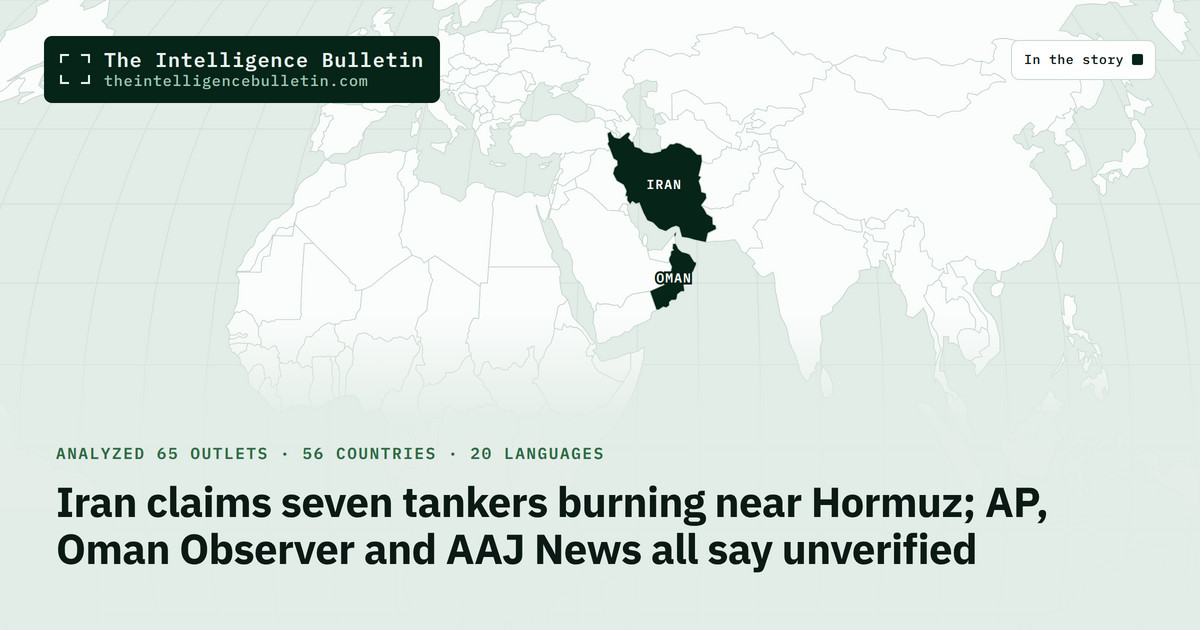
Iran’s IRGC Navy, via state television, says seven tankers were hit or damaged overnight near Hormuz—four during oil transfer, three by mines—and warns it may strike US bases. AP, Oman Observer and AAJ News say the claim is unverified.
Across the press: Press TV asserts the IRGC’s seven-tanker claim as fact, while AP, Oman Observer and AAJ News all call it unverified.
Source base: 5 outlets quoted (Iran, United States, Oman, Pakistan, Taiwan), selected from 65 analyzed. 4 read in full, 1 by its headline only.
- 5 of 5 · one shared reportSeven oil tankers caught fire or were damaged overnight in or near the Strait of Hormuz.The IRGC Navy via Iranian state television, carried by Press TV; AP, Oman Observer, AAJ News and Newtalk’s headline relay the same total from Tehran.
- 3 of 5 · one shared reportOf those seven, four vessels were struck while transferring oil from ship to ship in the northern Persian Gulf, and three others caught fire after striking naval mines west of Hormuz.The IRGC Navy statement, reported by Press TV, Oman Observer and AAJ News; the breakdown traces to the same Iranian claim.
- 4 of 5 · one shared reportThe IRGC threatened to strike US military bases in the region if Washington continues to force vessels onto unauthorized routes in the Strait of Hormuz.The IRGC statement via Press TV; AP and Oman Observer report the threat, and Newtalk’s headline carries it.
- 3 of 5 · reported separatelyThere is no independent confirmation of the ship attacks or damage.AP says it could not independently confirm the claims; Oman Observer and AAJ News also state the claims could not be independently verified.
- October 27, 2026Israel’s election will show whether Netanyahu returns; AP’s cited analyst says a clear victory makes a strike on Iran almost guaranteed.
- Early November 2026The U.S. midterm elections will test how war-linked high fuel prices and the new threat affect Washington’s political calculation.
- Days aheadUKMTO, ship-tracking data or insurer casualty reports could either confirm or further undermine the seven-tanker claim.
- Still openHow many vessels have actually been attacked, given UKMTO s admission that most attacked ships refuse to report? · Were the supertanker fires caused by Iranian naval mines, as the IRGC says, or by projectiles, as CENTCOM says?
- 17 Oct · UKMTO counts a record 12 ship attacks as CENTCOM claims Hormuz control and the IRGC blames mines
- 20 Oct · Araghchi s seven-day Hormuz offer; CNN and Jerusalem Post detail strike plans; Gooya relays a US strike claim.
- 20 Oct · Netanyahu says he discussed overthrowing Iran s government with Trump; the White House denies restart talk
Full analysis
What happened Why it matters How each country tells it Room for disagreement Our assessment Sources and evidence
What happened
Iran’s Islamic Revolutionary Guard Corps Navy said on Thursday that seven oil tankers caught fire or were damaged overnight in or near the Strait of Hormuz: four were hit while transferring oil between ships in the northern central Persian Gulf, and three caught fire after striking naval mines west of the strait. The only public source for all seven vessels is a single IRGC Navy statement relayed by Iranian state television and carried by Press TV, the state’s English-language broadcaster. Press TV presents the statement in the force’s own voice, saying the four "offending" ships had used unauthorized routes and were discovered transferring cargo; "all four were struck simultaneously and were burning." It says the other three "suffered incidents and caught fire after striking mines" and were stopped. The statement gives no names, flags, casualties, or ship types. The IRGC also warned that if Washington "continues to force vessels to use unauthorized routes" through Hormuz, it would strike US military bases in the region.
The Associated Press dispatch, published by the San Diego Union-Tribune and also underlying AAJ News, put the same claim at arm’s length: "Seven oil tankers caught fire or were damaged in the Strait of Hormuz overnight after being hit by Iran or striking naval mines, Tehran said Thursday," and AP "couldn’t independently confirm" it. The dpa report in the Oman Observer likewise said four tankers were attacked while transferring oil and three struck mines overnight, adding that "the claims could not be independently verified." AAJ News, writing in Urdu for a Pakistani audience, added that the Iranian report gave no names, flags, possible casualties or nature of destruction, "and no independent confirmation has emerged." The British maritime monitor UKMTO, which TIB reported on 17 October had counted at least 12 ship attacks in the week ending October 16, did not report these seven. Iran has claimed similar incidents before; AAJ News noted that the IRGC said a tanker carrying more than two million barrels of crude caught fire the previous Saturday after striking a mine on an unauthorized southern route. In the same chain of Iranian claims, one tanker in the southern part of the strait was said to have caught fire in its engine room after hitting a mine while trying to exit, with its position and route systems switched off.
The statement arrives in the middle of an active war. TIB reported on 17 October that the US Central Command says the waterway is controlled by the United States and its partners, while the IRGC says ships are hitting mines on unauthorized routes and must coordinate with Tehran. The Oman Observer’s dpa dispatch described the operational pattern behind the claim: for several months the US Navy has escorted civilian vessels along the Omani coast to restore oil and LNG trade, and after that route tankers "usually transfer their cargo to other ships waiting nearby." That makes the ship-to-ship transfer area where Tehran says it struck the four vessels a point of known vulnerability, and explains why Iran frames the escort wave as forcing traffic into danger.
Why it matters
This claim, if it were confirmed, would be the largest single-day damage to shipping in the waterway since the war began on February 28, as AAJ News noted. The Strait of Hormuz normally carries about one-fifth of the world’s oil, and shipping has been severely affected since the US and Israeli attacks that opened the war. Iran is using the incident to assert continued control over the strait, "a central point of leverage in any talks with the U.S. over the war," as AP put it. The threat to strike US regional bases is an escalation in wording, even if the seven hulls are never named.
The timing makes the threat political as well as military. AP’s report anchors the claim to Israel’s October 27 election, where former Israeli military and intelligence official Danny Citrinowicz is quoted saying, "Netanyahu wants to attack Iran, that’s not even a question," and that a clear Netanyahu victory means an attack is almost guaranteed, with "one way towards another kinetic escalation." The same dispatch notes next month’s U.S. midterm election, where war-linked high prices have sparked voter anger, and Washington’s move of a third aircraft carrier and thousands more troops to the region. Iran, through Foreign Minister Abbas Araghchi, said Wednesday it remains open to diplomacy and stands by its seven-day plan to reopen the strait if the US ends its blockade and sanctions, an offer Trump rejected in late September.
For a Gulf state like Oman, the stakes are operational: the tanker transfer zones are near its coast and the US escort route runs along it, while the Oman Observer’s dpa report focuses on fires, escorts and transfers rather than the Israel-Iran war logic. For Pakistan, AAJ News casts it as a sea-lane and livelihood story: the absence of verified casualty data and the threat to global oil transit register before Washington-Tehran rhetoric. Oil producers have found ways to keep crude flowing, AP reported, but at mounting cost. The escalation has already widened to Saudi Arabia and the Houthis, threatening the Bab el-Mandeb at the Red Sea’s southern end. Even if the claim is a one-sided information operation, it shifts the baseline: the next report of attacks will be compared against seven, not four or one, and every ship that goes quiet off Hormuz will be read against a number Iran has now put into circulation.
How each country tells it
- Press TV · Iran · original reportingCarries the IRGC Navy’s statement as its own announcement: four ‘offending’ vessels struck and burning, three others hit mines, and a warning of retaliation against US bases.
- The San Diego Union-Tribune · United States · wire copyRuns the Associated Press dispatch from Tel Aviv, framing seven tankers damaged as war fears grow and quoting an Israeli analyst who says Netanyahu wants to attack Iran.
- Oman Observer · Oman · wire copyTreats the tanker fires as incidents near its own waters and shipping lanes: four attacked during ship-to-ship oil transfer, three hit mines, with the claims unverified.
- AAJ News · Pakistan · carries Associated PressWrites in Urdu for a Pakistani audience, leading with seven ships damaged in one night and focusing on shipping-casualty details, the absence of ship names, flags and casualty figures, and the strait’s importance for global oil.
- Newtalk · TaiwanIts headline foregrounds seven ships attacked and struck by mines in the Persian Gulf and Iran’s threat to strike US military bases if pressure continues.
Room for disagreement
The strongest case that the seven-tanker claim is genuine, or will be borne out, is that independent verification in this war is systematically hard. TIB reported on 17 October that UKMTO has admitted most attacked ships refuse to report, and AP says UKMTO "has noted new reluctance by some shippers to report incidents." A silence from the monitor or from Western navies would therefore not disprove the Iranian account. Iran has made similar specific claims before; AAJ News records the previous Saturday’s tanker fire with more than two million barrels of crude aboard, attributed to a mine on an unauthorized route. The IRGC has an incentive to detail its enforcement missions, and the four vessels described as being struck during ship-to-ship transfer are in exactly the kind of operation the IRGC says it monitors to enforce its routing rules. No public denial of the seven-vessel figure appears in the sources gathered here, and the US has a counter-interest in showing that its escort route is safe; if it had proof the ships were not hit, it might already have said so. A claim can be unverified without being false, and a war zone can hide damage for days.
Our assessment
The seven-vessel casualty figure is very likely a single unconfirmed Iranian claim, not yet an independently established event, though the threat attached to it is real and will shape the next escalation. Every non-Iranian newsroom that carried the report — AP, the dpa dispatch published by Oman Observer, and AAJ News — says it could not be verified, and UKMTO did not log the attacks. Only Press TV, which is the claimant’s own state broadcaster, asserts the four vessels "were struck simultaneously and were burning" as fact. There is no ship name, flag, casualty count or owner statement across any of the accounts, and the "seven" itself resolves into two parts of a single IRGC statement, not seven separate observed incidents. The strongest independent warrant is the corroborated absence of confirmation: three reporting chains with different audiences all stop before endorsing the claim.
The interest in seeing it believed is one-sided. Iran wants the world to believe it controls Hormuz and can punish ships and bases; a vivid seven-vessel fire is more useful to that goal than a statement with no names. Washington and Israel, by contrast, have reason to emphasize or dismiss damage depending on the moment: before an Israeli election and a US midterm, an unverified Iranian battlefield claim can feed either a war argument or a "Tehran is lying" argument. What the reporting supports is less dramatic: a state broadcaster turned a military communiqué into the appearance of a major maritime casualty event, and the wire services transmitted it with the necessary caveat. The next concrete check will be whether Lloyd’s, insurers, ship-tracking data or UKMTO record hulls that match the description in the coming days.
What would change this: independent ship-tracking data, an insurer or flag-state casualty report, or a US or UK military confirmation of seven damaged hulls would move the call from unconfirmed to confirmed; until one of those exists, the prudent reading is that the number is an Iranian instrument, not a verified count.
Sources and evidence
Press quoted
- Which vessels were actually hit or mined, under what flags, and were there casualties or oil spills?
- Did IRGC forces deliberately strike the four tankers, or did those vessels also hit mines, and who laid any mines?
- Have the United States, shipping companies, or Gulf states responded to the IRGC threat to strike US bases if US naval escorting continues?
That’s how the world told the story.
Get our daily open-source intelligence on world events in your inbox — one email a day, up to six stories.
Subscribe freeNo spam. One-click unsubscribe. See the latest email →