 AI-generated analysis published under the editorial responsibility of Rohit Sinnas. How it works →
See the 49 countries
Antigua and Barbuda, Armenia, Austria, Azerbaijan, Belgium, Bosnia and Herzegovina, Brazil, Bulgaria, China, Colombia, Croatia, Cuba, Czech Republic, Denmark, Finland, France, Germany, Ghana, Hungary, India, Ireland, Israel, Italy, Latvia, Lebanon, Luxembourg, Montenegro, Niue, Norway, Pakistan, Philippines, Poland, Qatar, Romania, Russia, Serbia, Slovakia, Somalia, South Africa, South Korea, Sweden, Switzerland, Syria, Taiwan, Turkey, Tuvalu, Ukraine, United Arab Emirates, United States
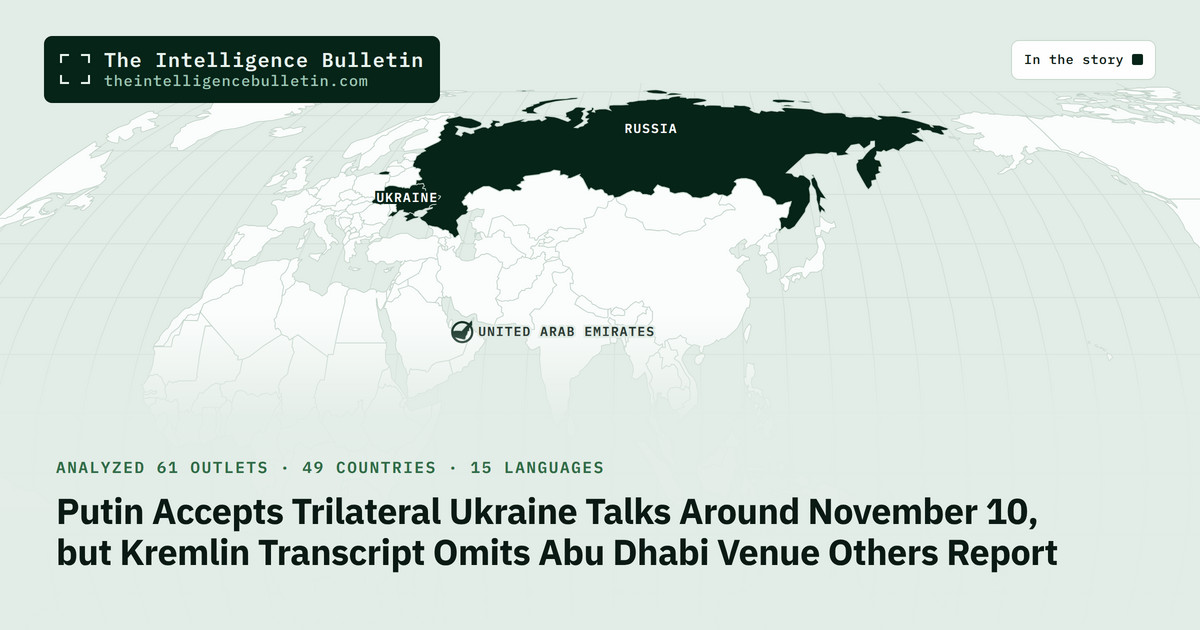
Putin told Witkoff Russia is ready in principle to resume trilateral Russia-US-Ukraine talks around November 10, Ushakov said; Russian media quoting Ushakov add a possible Abu Dhabi expert-level round. The Kremlin account records no acceptance of the Oslo ceasefire or Article 5-style guarantees.
Across the press: The Kremlin’s own transcript omits the Abu Dhabi venue and expert-level format that Interfax-Ukraine and Delfi Latvia report from Ushakov’s later remarks.
Source base: 5 outlets read in full (Russia, United States, Ukraine, Latvia, India), selected from 61 analyzed.
- 1 of 5 · President of Russia (Kremlin.ru) onlyUshakov blamed Ukraine for scuttling the previously planned resumption of trilateral talks by launching ‘super-massive’ strikes on Moscow and polling stations on Russia’s Duma election day, killing some election commission staff.Ushakov’s official commentary published on the Kremlin website.
- 1 of 5 · President of Russia (Kremlin.ru) onlyNo capital, Moscow, Washington or Beijing, rejects the idea of a first-ever Russia-China-US leaders’ meeting at APEC in Shenzhen in November, and Beijing is already preparing it.Ushakov’s commentary published by the Kremlin.
- 5 of 5 · reported separatelyPutin told Witkoff that Russia is ready in principle to resume trilateral Russia-US-Ukraine talks around November 10, focused on building a post-conflict security system for Russia and Ukraine.Yuri Ushakov’s post-meeting statement, carried by the Kremlin transcript and the other selected outlets.
- 2 of 5 · reported separatelyA resumed round may take place in Abu Dhabi at expert level around mid-November, with the delegation not yet determined.Ushakov’s remarks as quoted by Russian media, reported by Interfax-Ukraine and Delfi Latvia.
- 2 of 5 · reported separatelyWitkoff told Putin that resuming the trilateral talks would be received by President Trump with great satisfaction.Ushakov after the meeting, carried by the Kremlin transcript and Delfi Latvia.
- By November 10, 2026Whether Ukraine agrees to send a delegation to the resumed trilateral talks in Abu Dhabi, and at what level.
- Mid-November 2026The resumed round, if it convenes, and whether the post-conflict security framing produces any shared text.
- APEC summit, Shenzhen, November 2026Whether a first-ever Russia-China-US leaders’ meeting is added to the program, as Ushakov said Beijing is preparing.
- AnsweredPutin met Witkoff at Konstantin Palace, but the Kremlin account records no acceptance of the partial energy-food ceasefire or Article 5-style guarantees, only in-principle readiness to resume trilateral talks on a post-conflict security system.
- AnsweredIt produced Russia’s in-principle acceptance of the trilateral format around November 10, but no reported acceptance of a ceasefire or Article 5-style guarantees, according to Ushakov.
- Still openDoes anything in the package survive contact with Trump, who answered the Oslo meeting on ABC by saying Ukraine must want a deal and that it is time to end the war? · Will Putin accept Zelenskyy s proposed trilateral US-Ukraine-Russia leaders meeting, which keeps Ukraine at the table?
Full analysis
What happened Why it matters How each country tells it Room for disagreement Our assessment Sources and evidence
What happened
On Wednesday, Vladimir Putin met the American envoy Steve Witkoff for nearly three hours at Konstantin Palace outside St Petersburg, and afterward his foreign-policy aide Yuri Ushakov announced that Russia is ready "in principle" to resume trilateral talks with the United States and Ukraine around November 10, focused on what Ushakov called "building a security system for Russia and Ukraine after the conflict ends." Ushakov described the meeting as "thorough and frank" and noted it was the ninth contact between Putin and American representatives, a useful supplement to the regular phone calls between the two presidents.
Jared Kushner, who was due to attend in person, could not travel for health reasons and joined by video link, as he had done the day before at Witkoff’s meeting with Volodymyr Zelenskyy in Oslo. Kirill Dmitriev, Russia’s presidential envoy for investment and economic cooperation, sat at the table and met Witkoff at Pulkovo airport.
The in-principle readiness is narrowly framed. Putin agreed to discuss a post-conflict security architecture, not a ceasefire or a territorial settlement. Ushakov blamed Ukraine for having scuttled the previously planned resumption, saying Kyiv launched what he called "super-massive" strikes on Moscow, other cities and polling stations on Russia’s Duma election day, killing some election commission staff. Witkoff, Ushakov said, replied that the decision "will certainly be met with great satisfaction by President Trump."
Operational detail is scattered across accounts. The Kremlin’s own transcript records only readiness for talks "in the first ten days of November" on the main subject. But Ushakov’s later remarks to Russian media, as reported by Interfax-Ukraine and Delfi Latvia, add that the venue could be Abu Dhabi, the round would be at expert level, and the delegation has not yet been determined. "We’re looking at Abu Dhabi… probably in the middle of November, around the 10th," Interfax-Ukraine quotes Ushakov as saying. Delfi notes that trilateral talks were held in Abu Dhabi in January 2026.
The meeting ranged well beyond Ukraine. On the diesel arrangement agreed in the 9 October phone call between Putin and Trump, Ushakov said the US administration has lifted some sanctions on Russian diesel and "practical work" has begun. He said other large joint economic projects are nearing implementation. On Iran, Putin said the possibilities of diplomacy are "far from exhausted" and that Russia, whose strategic partner Tehran is, can and should be negotiated with. And on the APEC summit in Shenzhen in November, Ushakov said no capital — Moscow, Washington or Beijing — rejects the idea of a first-ever Russia-China-US leaders’ meeting, and that Beijing is already preparing it.
Putin also pardoned and freed Stephen Hubbard, the 74-year-old American convicted in 2024 of fighting as a mercenary for Ukraine and sentenced to six years and ten months; Ushakov said he was handed to Witkoff at Pulkovo airport. Trump posted on Truth Social that no exchange was required, calling it "an unprecedented situation for Russia."
What the Kremlin account does not record is equally specific. TIB reported on 21 October that Witkoff left Oslo with a package of Article 5-style security guarantees and a partial ceasefire covering energy and food infrastructure. Ushakov’s account of the St Petersburg meeting records no Russian acceptance of either. Instead, he said Putin presented "an objective picture of the situation on the line of contact, where the strategic initiative is completely with Russian forces," which he said are advancing on all main axes and destroying military-industrial, energy and logistics targets in Ukraine. Delfi adds the territorial impasse: Moscow demands that Ukraine withdraw from all of Donbas, including areas Russian forces have never captured, while Kyiv says its troops have retaken some occupied territory. Delfi also notes that Kyiv has made no comment on the Kremlin’s proposal.
Why it matters
Putin’s statement is the first Russian in-principle acceptance of the trilateral format since the post-election collapse Ushakov described. It gives the American envoy a deliverable after Oslo and keeps the diplomatic track alive ahead of the US midterm elections on 3 November — a vote Delfi says motivated Trump’s earlier decision to lift sanctions on Russian diesel.
But the framing matters as much as the readiness. Putin agreed to talk about the security system after the conflict ends. That is a conversation that presupposes an end Ukraine has not conceded and sidesteps the two questions that actually separate the parties: a ceasefire and territory. The Article 5-style guarantee Witkoff carried from Oslo is one Antiwar.com says Russia "would almost certainly not accept," and Russian Foreign Minister Sergey Lavrov said a day earlier that Russia would listen but make no political concessions. For Kyiv, the risk is being drawn into a format dictated from St Petersburg that moves to postwar architecture before the war’s own terms are settled. Zelenskyy put the floor at a freeze of the conflict, telling Fox News: "Right now, we have to freeze, and I think this is the real way to end this war." He had also told NBC that if Washington formally sided with Russia, "of course we will not win and will not be able to hold out."
The APEC possibility raises the stakes independently. A Shenzhen meeting of Putin, Trump and Xi Jinping would be the first of its kind, and Ushakov’s claim that Beijing is already preparing it — carried only by the Kremlin transcript — would, if it happens, make the host China the broker of the war’s diplomacy.
How each country tells it
- President of Russia (Kremlin.ru) · Russia · original reportingThe Kremlin’s own transcript presents readiness to resume trilateral talks as a concession granted by Putin after a three-hour ‘thorough and frank’ meeting, while blaming Kyiv for having previously wrecked the planned resumption.
- Antiwar.com · United States · opinionAn anti-interventionist US outlet treats Putin’s readiness as the opening Washington must take, pairing the Kremlin quote with Lavrov’s refusal to make political concessions and a reminder that an Article 5-style guarantee is one Russia would almost certainly not accept.
- Interfax-Ukraine · UkraineKyiv’s agency reports the concrete timetable Moscow left implicit elsewhere, the ‘first ten days of November’, and the extra detail that talks may be at expert level in Abu Dhabi, without any Ukrainian response.
- Delfi Latvia · Latvia · original reportingLatvia’s Russian-language portal compiles the meeting into ‘key points’ for Baltic Russian speakers, foregrounding the Abu Dhabi possibility, the territorial impasse, and the Hubbard release as part of one anxious account.
- Business Standard · India · wire copyAn Indian business daily condenses the development into a flat wire-style account: Putin agreed in principle to talks after November 10, with other Washington-Kyiv disputes appended as background.
Room for disagreement
The strongest case against reading this as momentum is that the resumption costs Russia almost nothing. Lavrov’s no-concessions line, reported by Antiwar.com, sets the boundary: Russia will take economic benefits but no political concessions. Delfi notes that months of shuttle visits by Witkoff and Kushner have "not led to tangible progress," with territory the main obstacle. On that view, Putin’s readiness is theater aimed at Trump — a gesture that lets the American side claim a diplomatic win while Russian forces hold the strategic initiative and advance unceasingly, as Ushakov himself said. A round of expert-level talks in Abu Dhabi about a postwar security system could run for days, produce a communiqué, and leave the battlefield and the map exactly where they are. That is the case that the story will go nowhere.
Our assessment
Very likely the trilateral talks resume around mid-November in Abu Dhabi, but in the expert-level, post-conflict-security framing that sidesteps the ceasefire and territorial questions, so the resumption is likely while a breakthrough is not. The warrant is in the reporting: the Kremlin transcript carries Putin’s in-principle readiness and a date, and Ushakov’s subsequent remarks, reported by Interfax-Ukraine and Delfi via Russian media, add a concrete venue and format, a level of operational planning that reads as more than posture. Russia has an interest in appearing cooperative while Trump presses Kyiv and while its forces advance, and Abu Dhabi is already a tested venue from January 2026. But the substance gap is there too: nothing in Ushakov’s account accepts the Oslo package, and the territorial question Delfi documents remains unresolved.
What would change this: if Ukraine declines to send a delegation on Russia’s stated terms — using the expert-level format, the Abu Dhabi venue or the post-conflict framing as the pretext — the resumption could collapse again before mid-November.
Sources and evidence
Press quoted
- Will Kyiv agree to send negotiators to Abu Dhabi in mid-November on Moscow’s stated security-system agenda, and has any Ukrainian official responded to the offer?
- Does Washington read Putin’s readiness to resume expert-level talks as acceptance of the Oslo package’s partial ceasefire or Article 5-style guarantees, or as a Kremlin attempt to set its own security-system agenda?
- What did Washington give Moscow for the Hubbard pardon and Putin’s in-principle agreement, and does the already-implemented diesel sanctions waiver constitute the reciprocal concession Trump denies making?
That’s how the world told the story.
Get our daily open-source intelligence on world events in your inbox — one email a day, up to six stories.
Subscribe freeNo spam. One-click unsubscribe. See the latest email →