 AI-generated analysis published under the editorial responsibility of Rohit Sinnas. How it works →
See the 50 countries
Afghanistan, Albania, Algeria, Armenia, Australia, Azerbaijan, Bosnia and Herzegovina, Brazil, Bulgaria, Canada, China, Cyprus, Egypt, Germany, Greece, Guinea, Hong Kong, Hungary, India, Indonesia, Iraq, Israel, Jordan, Kenya, Kyrgyzstan, Lebanon, Libya, Mexico, New Zealand, Pakistan, Philippines, Poland, Qatar, Romania, Russia, Saudi Arabia, Serbia, Singapore, Slovakia, South Korea, Sri Lanka, Syria, Taiwan, Thailand, Turkey, Tuvalu, Ukraine, United Arab Emirates, United Kingdom, United States
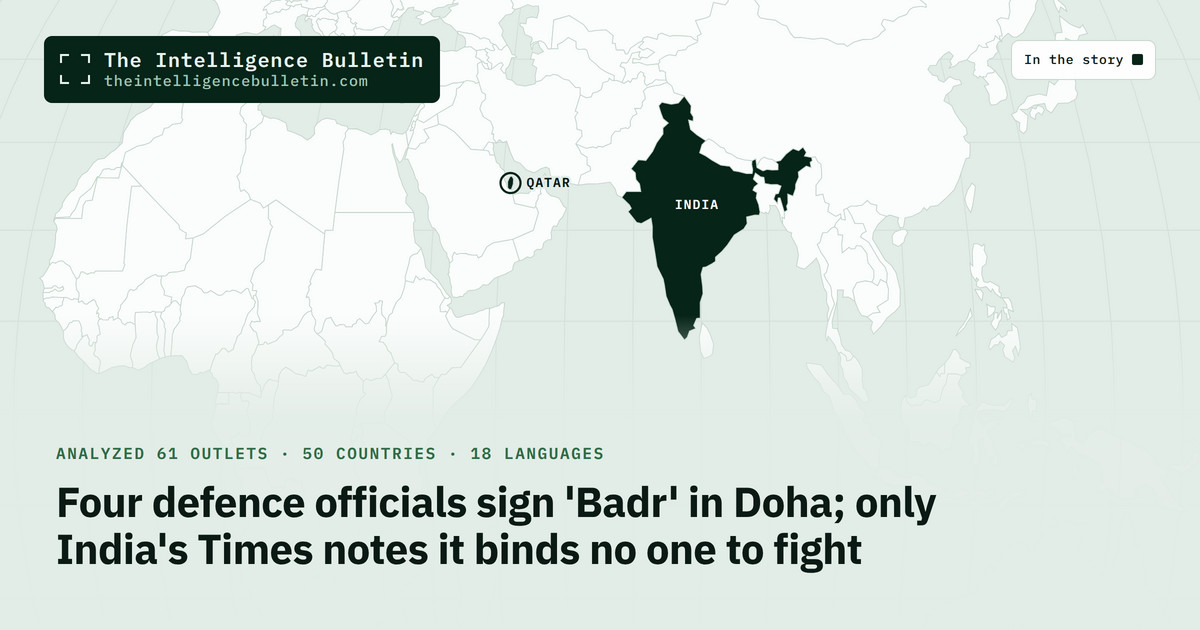
Türkiye, Qatar, Pakistan and Indonesia signed the Badr defence-cooperation memorandum in Doha on Wednesday, covering joint production, training and research; unlike August’s Mecca pact, it carries no collective-defence obligation, the Times of India notes, and signatory ministries named no projects, funding or timelines.
Across the press: Each signatory capital’s press names its own country first; only the Times of India asks whether the pact obliges anyone to fight.
Source base: 5 outlets quoted (Qatar, Indonesia, Turkey, Pakistan, India), selected from 61 analyzed. 4 read in full, 1 by its headline only.
- 1 of 5 · The Times of India onlyUnlike the August Mecca pact among Türkiye, Pakistan and Saudi Arabia, the Badr memorandum imposes no collective-defence or mutual-assistance obligation.The Times of India’s own analysis.
- 1 of 5 · Dunya News onlyPakistan’s Foreign Office had not commented on the signing at the time of publication.Dunya News, reporting its own newsroom’s check.
- 5 of 5 · reported separatelyTürkiye, Qatar, Pakistan and Indonesia signed the Badr defence-cooperation memorandum in Doha on Wednesday.Turkish and Qatari defence ministry statements, carried by all five outlets.
- 5 of 5 · reported separatelyThe memorandum covers joint military production, training, exercises and research and development, and carries substantial economic importance.Turkish Defence Ministry via Daily Sabah, Dunya News and The Times of India; Qatari Defence Ministry via Al Jazeera.
- 2 of 5 · reported separatelyThe name ‘Badr’ means full moon and was chosen to signal that the four countries’ capabilities complement one another.Turkish Defence Ministry statement, reported independently by Al Jazeera and The Times of India.
- In the coming daysPakistan’s Foreign Office statement on Badr, still pending at publication per Dunya News, will confirm Islamabad’s official framing of the pact.
- Unspecified, after the signingPublication of the full Badr MoU text or implementing annexes, which would settle whether it contains any mutual-defence clause beyond industrial cooperation.
- Unspecified, following the accordThe first concrete joint project announced under Badr — further Indonesia–Türkiye coproduction or Pakistan naval work — will test whether the memorandum produces substance beyond existing bilateral deals.
- UnspecifiedAny Saudi statement on a quartet that excludes Riyadh despite the August Mecca pact, clarifying whether Badr is a parallel track or a pointed omission.
- Still openWhen will Pakistan s and Saudi Arabia s ratification processes complete, and what will be the entry-into-force date once the final instrument is deposited? · What precise military preparations did the Strategic Political and Defense Committee approve at its October 5 emergency meeting in Riyadh, beyond preparing rapid deployment of forces?
Full analysis
What happened Why it matters How each country tells it Room for disagreement Our assessment Sources and evidence
What happened
Four defense officials signed the Badr memorandum of understanding in Doha on Wednesday, October 21: Turkish Defense Minister Yaşar Güler, Qatar’s Deputy Prime Minister and Minister of State for Defence Affairs Sheikh Saud bin Abdulrahman bin Hasan Al Thani, Pakistan’s Defense Minister Khawaja Muhammad Asif and Indonesia’s Deputy Defense Minister Yusuf Jauhari, with Haluk Görgün, chair of Türkiye’s Presidency of Defence Industries, attending. The Turkish and Qatari defense ministries announced the signing the same day, and their statements agree on what the paper does: cooperate in military production, technical military training, exercises and research and development, with economic significance attached.
The name was chosen deliberately. The Turkish statement, carried independently by Al Jazeera and The Times of India, says Badr means full moon and was picked because the four countries’ capabilities complete one another. Al Jazeera brought in a Qatar University professor, Abdullah Bander al-Utaybi, to spell out that complementarity: Türkiye brings advanced military industries, Indonesia naval capacity, Pakistan large human and military potential, and Qatar the experience of building defense partnerships and the financial resources to fund joint projects.
What the paper obliges anyone to do is the question the signatory accounts leave open. None of the four signatory-country accounts claims the memorandum contains a collective-defense clause. The Times of India, the only non-signatory outlet in the set, states the distinction plainly: unlike the August Mecca Joint Defence Agreement among Türkiye, Pakistan and Saudi Arabia — under which an attack on one party constitutes an attack on all — the Badr memorandum imposes no mutual-defense or mutual-assistance obligation. The signatory-side accounts describe it instead as "strategic cooperation," in Görgün’s words, or as building "strategic partnerships." Dunya News adds the concrete caveat the rest skip: the announcement named no specific projects, funding commitments or implementation timelines, and Pakistan’s Foreign Office had yet to issue a comment at publication time.
The substance that exists sits in the bilateral deals the memorandum is meant to build on. Daily Sabah, Türkiye’s English-language daily, catalogues them: Bayraktar TB2 drones, armored vehicles and assault boats already in Qatar’s inventory; Barzan Holding’s agreements with Aselsan, STM and MKE, and the BARQ joint venture assembling remote-controlled weapon systems in Qatar; four Milgem corvettes, two built in Istanbul and two at Karachi Shipyard under Turkish contractor ASFAT; and with Indonesia the Kaan fighter jet sale, the co-designed Kaplan MT tank and the Atmaca anti-ship missile. The signing lands amid record Turkish defense exports: Daily Sabah, citing the Defence and Aerospace Industry Exporters’ Association, puts exports at about $54 billion over 2012–2026, with 2025 up 48% to a record above $10 billion.
Saudi Arabia, which sits with Türkiye and Pakistan in the August Mecca trio that Türkiye submitted to its parliament for ratification on October 20, is not at the Doha table. None of the five accounts asks why.
Why it matters
The instrument’s weight is industrial rather than military. The memorandum obliges no one to fight; its stated payoff is production, and the ministries’ shared formula — each country’s unique capabilities serving "the needs of allied and friendly nations," as the Turkish statement puts it — points past the four signatories toward a joint export supply chain. For Türkiye, the signing sits on the sharp recent expansion of its defense exports, which gives Ankara a commercial reason to want a four-country production and marketing framework in place. For Pakistan, the value is procurement: The Times of India reads Badr as a route to drones, naval platforms and other military technology, and to diversifying arms supply away from dependence on a single supplier; that is an Indian newsroom’s assessment, but it matches what the paper is built to do. For Indonesia and Qatar, the prizes are the technology-transfer lines and the convening role the bilateral programs already embody — one a manufacturing partner inside a supply chain, the other its financier and host. The map this changes is not the map of military alliances but of production networks, and the binding security architecture among these states remains the Mecca pact, still in ratification.
How each country tells it
- Al Jazeera · Qatar · original reportingQatar’s state-linked Arabic broadcaster leads with the Qatari defence ministry’s announcement, framing Badr as Doha’s diplomatic achievement and hosting triumph.
- SindoNews · Indonesia · carries Arab NewsIndonesia’s account leads Indonesia-first in the headline and frames the memorandum as Jakarta’s defence-industrial news.
- Daily Sabah · Türkiye · wire copyTürkiye’s English-language daily reads Badr through Ankara’s defence-export strategy, cataloguing Turkish hardware in all three partners and record export figures.
- Dunya News · Pakistan · original reportingPakistan’s Dunya News leads with Khawaja Asif’s signature and Islamabad’s role, stressing that the announcement gave no specifics of projects, funding or timelines.
- The Times of India · India · original reportingIndia’s largest English daily reads Badr as a strategic signal about Pakistan, with a dedicated ‘Should India be worried?’ section weighing drones, naval platforms and military modernisation.
Room for disagreement
The strongest case that Badr is weightier than its text comes from the people who signed it. Haluk Görgün said the memorandum "will contribute to transforming the complementary capabilities of Qatar, Pakistan, Indonesia, and Türkiye into concrete projects," and the academic Al Jazeera quoted argued the cooperation can open the field for investments and joint projects to manufacture equipment and components according to each country’s needs. On this reading, the absence of named projects, funding and timelines is a framework deliberately left open rather than a sign of emptiness, because the machinery to fill it is already running: the corvettes, the tank production line in Indonesia and the assembly plant in Qatar all predate Badr and are not waiting for it. If the four governments already trade drones, hulls and transfer lines bilaterally, the memorandum’s value is to aggregate and accelerate what is happening, and the strategic cooperation Görgün names is the substance. Pakistan’s interest in diversifying arms supply and closing a technological gap, as The Times of India frames it, gives Islamabad a reason to push for the accord to do more than issue statements.
Our assessment
Very likely, the Badr memorandum will remain a framework for industrial cooperation rather than a new collective-defense commitment, and whatever weight it acquires will come from the bilateral programs that preceded it rather than from new obligations the paper creates. The reasoning rests on what the corroborated record shows the paper covers: both ministries describe production, training and research and development, and call the payoff economic, not defensive. The one account that addresses the binding question directly, The Times of India, states that Badr contains no mutual-defense clause, and while an Indian outlet has an interest in minimizing a Pakistani-Turkish alignment, its reading is consistent with the signatory-side evidence — Dunya News, reporting from inside the signing states, notes the announcement named no projects, funding or timelines. The only binding collective-defense clause among these countries remains in the Mecca pact, which Türkiye submitted to parliament for ratification two days before the Doha signing; a memorandum and a treaty are not instruments of the same weight, and the signatory governments, each with an interest in presenting Badr as meaningful, still did not claim it obliges any of them to fight.
What would change this: the publication of the full Badr text or an implementing annex showing obligations or budgets beyond the bilateral deals already in motion, or the first concrete joint project announced under the memorandum’s name.
Sources and evidence
Press quoted
- Does the Badr memorandum contain any mutual-defence clause, or is it confined to industrial, training and research cooperation, given that no full text is published in these sources and only the Times of India states the negative?
- What concrete projects, funding commitments or implementation timelines will follow the memorandum, given that the announcing ministries named none?
- Why was Saudi Arabia, Türkiye’s and Pakistan’s Mecca-pact partner, not a signatory, and how does Riyadh read this quartet?
That’s how the world told the story.
Get our daily open-source intelligence on world events in your inbox — one email a day, up to six stories.
Subscribe freeNo spam. One-click unsubscribe. See the latest email →