 AI-generated analysis published under the editorial responsibility of Rohit Sinnas. How it works →
See the 40 countries
Afghanistan, Algeria, Azerbaijan, Bahrain, Belgium, Brazil, Canada, China, Cyprus, Egypt, France, Germany, Greece, Israel, Italy, Jordan, Kuwait, Lebanon, Libya, Luxembourg, Morocco, Netherlands, Norway, Pakistan, Qatar, Saudi Arabia, Senegal, Serbia, South Korea, Spain, Sudan, Switzerland, Syria, Tunisia, Turkey, Ukraine, United Arab Emirates, United Kingdom, United States, Yemen
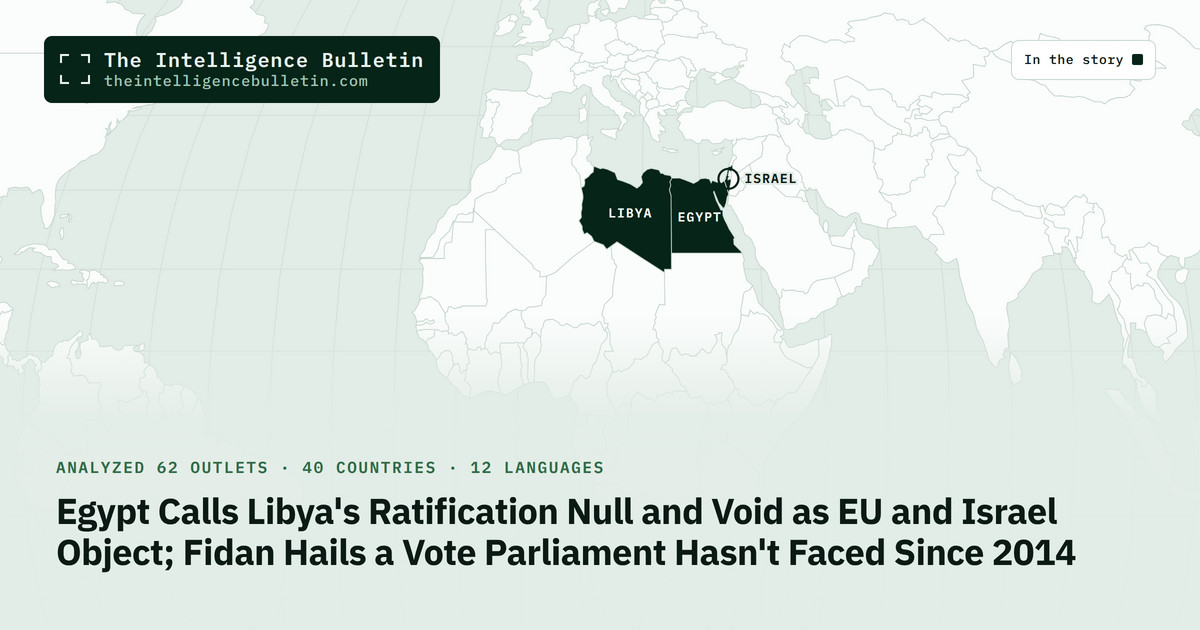
Libya’s eastern parliament unanimously ratified the 2019 Turkey maritime memorandum; Egypt says it is absolutely null and void and reserves the right to protect its rights. Turkey calls it a diplomatic victory; EU leaders, Israel and Greek analysts dispute the legal force.
Across the press: Daily Sabah presents the vote as a diplomatic victory; Skai analysts say the chamber hasn’t faced election since June 2014.
Source base: 5 outlets quoted (Egypt, Libya, Turkey, Greece, Cyprus), selected from 62 analyzed. 4 read in full, 1 by its headline only.
- DisputedThe ratification gives the agreement legal legitimacy.Source: Daily Sabah relays Fidan’s claim that the agreement is fully legitimate, while Skai’s analysts say the ratification produces no international legal effects and Cyprus Mail reports EU leaders calling the deal null and void.
- 1 of 5 · Daily Sabah onlyTurkish Foreign Minister Hakan Fidan says the agreement is entirely legitimate legally and politically and describes the Libyan parliament’s move as a diplomatic victory.Daily Sabah, relaying Fidan’s remarks to Anadolu Agency.
- 4 of 5 · reported separatelyLibya’s eastern-based House of Representatives voted unanimously to ratify the 2019 maritime memorandum, reversing its previous rejection and a 2020 decision to sever political ties with Ankara.Daily Sabah citing a Libyan Parliament statement; Cyprus Mail, dostor.org and Skai also report the parliamentary ratification.
- 2 of 5 · reported separatelyEgypt categorically rejects the ratification, says the memorandum is absolutely null and void, violates UNCLOS and Egypt’s sovereign rights, and reserves its right to protect those rights.Egyptian Foreign Ministry statement carried by dostor.org and reported by Cyprus Mail.
- 3 of 5 · reported separatelyThe memorandum was signed in 2019 between Turkey and Libya’s internationally recognised government.Daily Sabah, Skai and Cyprus Mail all date the original agreement to 2019 and identify the internationally recognised Libyan government as a signatory.
- 25–30 October 2026Any formal comment from Greece or Cyprus, whose states Daily Sabah identifies as the objectors the agreement will anger.
- 4–10 November 2026Whether the European Union moves beyond Kallas’s statement to a coordinated diplomatic or legal response.
- 20–29 November 2026Whether Greece proceeds on extending its territorial waters to the 12 nautical miles Skai’s analysts discuss.
- 25 June to 21 October 2027Advancement of the 2025 TPAO offshore survey plan, which can signal whether the deal moves from paper to maritime operations.
Full analysis
What happened Why it matters How each country tells it Where accounts conflict Room for disagreement Our assessment Sources and evidence
What happened
Libya’s eastern-based House of Representatives voted unanimously on Tuesday 20 October to approve the 2019 maritime memorandum with Turkey, reversing its own earlier rejection and, according to a Libyan Parliament statement carried by Daily Sabah, repealing Resolution No. 1 of 2020, which rejected the ratification of two Libya-Turkey memorandums, and Resolution No. 6 of 2020, which called for severing political relations with Ankara. The next day Egypt issued an absolute rejection. A Foreign Ministry statement reproduced by the Egyptian daily dostor.org says the memorandum is batil butlanan mutlaqan, absolutely null and void, produces no legal effect for Egypt, violates the principles of international law of the sea and the 1982 UN Convention on the Law of the Sea, and infringes Egypt’s sovereign rights in its exclusive economic zone and continental shelf. The Cypriot daily Cyprus Mail reports that the ministry said Egypt had opposed the agreement before and rejects any act by any party based on it, reserving the right to protect its rights under international law.
In Brussels the same day, Turkey’s foreign minister gave the vote a different name. Hakan Fidan told Anadolu Agency, in remarks published by Daily Sabah, that the agreement is entirely legitimate and not open to debate, and described the parliamentary move as a diplomatic victory under Recep Tayyip Erdoğan. He added a distinction the piece attributes to Turkish legal experts: the decision is an act of acceptance rather than formal ratification.
Around that bilateral contest a wider disagreement formed. Cyprus Mail reports that European Commission president Ursula von der Leyen and European Council president Antonio Costa said they deeply regret the ratification and that the deal does not comply with the law of the sea and is null and void. EU foreign policy chief Kaja Kallas raised it with Fidan in Brussels on Wednesday, saying the vote infringes upon the sovereign rights of third states. Israel’s foreign ministry said on X that the decision violates the sovereign rights of our close allies in the region.
The legal flashpoint is the sea itself. Greece and Cyprus lie between Turkey and Libya, and a direct delimitation line between the two would run through the maritime jurisdiction of both, which Skai reports is why Greece and Cyprus say no shared maritime border exists. Skai’s legal analyst Alexandros Despotopoulos invokes UNCLOS Article 121 on island entitlements and the principle pacta tertiis nec nocent nec prosunt, that a treaty creates neither rights nor obligations for third states without their consent. Skai’s report also records that the memorandum was already approved by Libya’s Presidential Council on the basis of emergency conditions, and that the House likely could not have acted without that prior internal step. Professor Konstantinos Filis notes that the approving chamber has not had an election since June 2014, and places the reversal in a longer Turkish cultivation of eastern Libya. Ankara, Skai reports, has provided substantial military assistance to Khalifa Haftar and his sons, and helped shape a formula for coexistence between Libya’s rival camps.
Why it matters
The memorandum is not a piece of paper. It already has an operational tail. Daily Sabah details that Turkey and Libya signed a hydrocarbon memorandum of understanding in 2022, that Turkish Petroleum Corporation agreed on 25 June 2025 with Libya’s National Oil Corporation on a 2D seismic survey of four offshore blocks covering 10,000 kilometres, and that the data is to be processed within nine months. That gives Ankara a defined survey area and a timetable. Political recognition therefore matters in barrels and kilometres, not only in diplomatic phrasing.
It also matters because of what it does inside Libya. Filis calculates that the deal gives Libya at least 20 percent more maritime zone, and argues that any future Libyan government would face a text already institutionally strengthened within Libya and opposed by strong domestic interests. A bargain that had been registered with the UN in October 2020 and was blocked only by the Tobruk-Tripoli split is now sustained by both Libyan camps, Skai’s analysts note, with the only remaining question being whether Tripoli will formally adopt the eastern parliament’s decision. The Greek outlet’s report framed this in unusually stark terms: the decision confirms Turkish dominance in Libyan affairs and ends any illusion that Athens could compete with Ankara on equal terms in Libya.
The Egyptian rejection adds a layer that bears on Ankara as well as on Benghazi. Skai notes that Cairo keeps close ties with Haftar’s side, and Filis explicitly flags that Egyptian reaction is the question worth watching for Turkey’s position in the eastern Mediterranean. What that reaction has become is clear from dostor.org’s reporting: no negotiation, no prior objection renewed, no arbitration. It is a full repudiation, which leaves Turkey’s eastern front as contested as its western one.
How each country tells it
- dostor.org · Egypt · original reportingCarries Egypt’s formal rejection: the memorandum is absolutely null and void, produces no legal effect for Egypt, violates UNCLOS and infringes Egypt’s EEZ and continental shelf.
- Libya Akhbar · Libya · carries TownhallHeadline relays an American Townhall report that moves by Khalifa Haftar’s camp in eastern Libya handed Turkey a political gain; article text could not be fetched.
- Daily Sabah · Turkey · carries Anadolu AgencyAnkara’s own line: Foreign Minister Fidan calls the agreement entirely legitimate legally and politically, and calls the parliament’s vote a diplomatic victory under Erdoğan.
- Skai · Greece · original reportingGreek national-security analysis: ratification strengthens Ankara politically and symbolically but lacks international legal force, and Athens must respond without abandoning channels to Libya.
- Cyprus Mail · Cyprus · original reportingRegional rejection chain: Egypt condemns the deal as null and void, and Israel and EU leaders likewise say it violates third-state rights and the law of the sea.
Where accounts conflict
The sharpest conflict is over what the vote legally achieves. Daily Sabah relays Fidan’s claim that the agreement is entirely legitimate, while Skai quotes Despotopoulos saying the ratification produces no international legal effects, does not legitimise the agreement, and that the later parliamentary vote cannot cure the original legal defects. He points additionally to the mandate of the original signatory, Fayez al-Sarraj, which Skai reports did not extend to signing so consequential a text. Cyprus Mail carries the European presidents saying, in words close to Egypt’s own, that the deal is null and void. The Turkish position rests on the 2019 signing by the internationally recognised government, UN registration, and now unanimous parliamentary acceptance. The opposing position rests on the stale electoral mandate of the ratifying body, the absence of a maritime boundary between the parties, and the consent of third states.
A second conflict is smaller but revealing. Fidan calls the vote an act of acceptance rather than formal ratification, while Egypt’s Foreign Ministry, the EU leaders and the Greek analysts all treat it as an attempted ratification. Daily Sabah carries the full text of Fidan’s distinction; dostor.org and Cyprus Mail treat the word ratification as the operative fact. That distinction is the whole dispute, since it determines whether the territorial effects of the action flow from the deal itself or from a procedure that cannot improve a deal already defective at the source.
Room for disagreement
The best case for the Turkish reading is that unanimity is a sovereign act, and Libya chose it. The agreement was signed in 2019 with the internationally recognised Libyan government, registered with the UN in October 2020, and approved by the Presidential Council. Now it has a unanimous vote of the eastern House of Representatives, which can be read as the two Libyan authorities converging on one text. Filis himself concedes the practical force of that convergence: the parliamentary step makes a future annulment far harder. On the Greek reading, Athens loses nothing by acknowledging the political weight of the vote and gains nothing by pretending otherwise, and Filis’s own conclusion is that the memorandum could not be rescinded in the current context. If implementation proceeds, as the TPAO timeline suggests, Egypt’s rejection becomes a statement that could not stop the physical facts on the seabed.
Our assessment
It is very likely that the ratification stands, and very likely that it will be tested in the sea rather than reversed in a parliament, which is where the dispute now goes. The eastern parliament’s vote gives Ankara a domestic Libyan instrument of acceptance and the operational machinery to use it, and no actor in the region has shown a mechanism to undo parliamentary action taken in that country. But the legal ground under that victory is its weak point. Egypt, the European Union, Israel, Greece and Cyprus have converged on the same vocabulary, third states, null and void, law of the sea, in the same week, and the one element they all refuse is the thing Ankara says the vote produced: legal force. That leaves two self-contained positions, both advanced in good faith. The difference is which currency is spent next. Turkey has a vessel, a survey schedule and a UN registration. Its opponents have a convention and a principle. The energy in the story lies in that mismatch, because the seabed is where a statement meets a ship, and the seabed is the one place where Ankara cannot trade on the political will of a Libyan parliament that has not faced an election since 2014.
What would change this: if Greece extends its territorial waters to 12 nautical miles south and west of Crete, Athens would convert its legal claim into a concrete boundary that the Turkish position would have to answer.
Sources and evidence
Press quoted
- Will Libya’s Tripoli-based government accept or act on the eastern parliament’s ratification, or will the east-west split keep the deal in legal limbo?
- What concrete measures, if any, will Egypt or Greece take beyond statements, such as Athens extending territorial waters south or west of Crete or Cairo moving from diplomatic protest to enforcement?
- Does the ratification now unlock the Turkish Petroleum Corporation’s planned seismic surveys in Libyan offshore blocks, and will any Greek, Cypriot or Egyptian actor attempt to block them?
That’s how the world told the story.
Get our daily open-source intelligence on world events in your inbox — one email a day, up to six stories.
Subscribe freeNo spam. One-click unsubscribe. See the latest email →