 AI-generated analysis published under the editorial responsibility of Rohit Sinnas. How it works →
See the 58 countries
Argentina, Australia, Austria, Bangladesh, Belgium, Benin, Bosnia and Herzegovina, Brazil, Burkina Faso, Cameroon, Canada, Democratic Republic of the Congo, Denmark, Egypt, France, Gabon, Germany, Ghana, Greece, Guinea, India, Indonesia, Israel, Italy, Ivory Coast, Jamaica, Kenya, Lebanon, Liberia, Luxembourg, Malaysia, Mexico, Moldova, Morocco, Namibia, Niger, Nigeria, Philippines, Poland, Qatar, Romania, Russia, Rwanda, Saudi Arabia, Senegal, Singapore, South Africa, Spain, Sri Lanka, Sweden, Switzerland, Syria, Turkey, Uganda, Ukraine, United States, Vietnam, Zimbabwe
Nigeria confirmed its first Ebola case in Abuja on 20 October; Africa CDC says the patient holidayed in Kampala, while Uganda’s health ministry says she was a Nigerian national returning from eastern DRC. No article shows she crossed paths with Kenya’s first case at Entebbe.
Across the press: Premium Times reports Nigeria’s patient stopped in Addis Ababa, but no source reports an Entebbe meeting with Kenya’s first case.
Source base: 5 outlets quoted (Nigeria, Uganda, Kenya, Democratic Republic of the Congo, Austria), selected from 67 analyzed. 3 read in full, 2 by their headlines only.
- DisputedAfrica CDC and Nigerian officials describe the Abuja patient as the wife of a diplomat, originally from Uganda and resident in Abuja, who spent two and a half weeks in Kampala and returned through Addis Ababa.Source: Premium Times, citing Africa CDC director Jean Kaseya and health minister Muhammad Pate via BBC.
- DisputedUganda’s Ministry of Health says the patient was a Nigerian national who travelled to eastern DRC for business and only passed through Uganda on the way home, and that Uganda has no active confirmed Ebola cases.Source: Premium Times carries Uganda’s Ministry of Health account; ChimpReports’ headline signals Uganda is speaking out, but its article body could not be fetched.
- 3 of 5 · reported separatelyNigeria has confirmed its first Ebola case of the current outbreak in Abuja in a woman who travelled from Uganda, announced by health minister Pate on Tuesday 20 October.Premium Times cites Africa CDC director Jean Kaseya and Nigerian health minister Muhammad Ali Pate via BBC; Kenya Today reports Pate’s announcement; Radio Okapi reports Pate’s announcement.
- 2 of 5 · reported separatelyNigerian health authorities have identified 44 people who may have been exposed to the Abuja patient, including health workers and others who encountered her, and are tracing and monitoring them.Premium Times cites health minister Muhammad Pate via BBC; Kenya Today reports the 44-contact tracing figure from Pate’s announcement.
- 3 of 5 · reported separatelyThe Abuja case sits within a regional Bundibugyo Ebola outbreak: DRC has an ongoing outbreak with high mortality, Kenya has nine confirmed cases and one death, and Uganda declared its earlier outbreak over on 27 August after 42 days without new cases.Premium Times cites the European Centre for Disease Prevention and Control and Kenya’s health ministry; Radio Okapi reports DRC and Kenya epidemiology from health authorities; Kenya Today states WHO declared Uganda’s outbreak over.
- Kenya’s next case updateWhether its nine-case imported cluster stays contained or produces infections beyond the known family cluster.
- AnsweredPremium Times, citing health minister Muhammad Pate, reports that none of the identified contacts, including the person who travelled with the patient, had developed symptoms as of his BBC interview.
- Still openWhere and when did the woman acquire Ebola, given Uganda says it has no active cases and the WHO timeline shows symptoms after arrival in Nigeria? · Why did the patient remain nine days in hospital without a diagnosis, and was transmission possible during that window?
Full analysis
What happened Why it matters How each country tells it Where accounts conflict Room for disagreement Our assessment Sources and evidence
What happened
On Tuesday 20 October, Nigeria’s coordinating health minister Muhammad Ali Pate announced that a 42-year-old woman in Abuja had tested positive for Ebola, the country’s first confirmed case in the current Bundibugyo outbreak. Pate said she was stable and responding to treatment in isolation. Premium Times and Kenya Today report that authorities identified 44 people who may have been exposed, including health workers, patients, caregivers and others who encountered her during her journey, and Premium Times adds that none of them, including the person who travelled with her, had developed symptoms. The federal government ordered all public and private health facilities nationwide to stay on high alert, isolate suspected cases and report infections.
Premium Times, citing Africa CDC director Jean Kaseya and Pate via the BBC, gives the most complete published account of the patient. It says she is the wife of a diplomat, originally from Uganda and resident in Abuja, who spent two and a half weeks in Kampala and returned to Nigeria on 3 October through Ethiopia, with a two-hour stopover in Addis Ababa. She developed symptoms on 6 October, went first to a private hospital believing she had malaria, and was admitted to a second private hospital on 11 October after her condition failed to improve. Public health authorities were alerted on Monday 19 October, and the Ebola diagnosis was confirmed the following day after three laboratory tests. Pate said the woman had remained in Abuja since returning to Nigeria.
Uganda’s Ministry of Health gives a different account, carried by Premium Times. It describes the patient as a Nigerian national who travelled to eastern Democratic Republic of the Congo for business and only passed through Uganda on her way home. Uganda says it has no active confirmed Ebola cases and that the woman’s transit through its territory does not establish that she contracted the virus there. ChimpReports carries a headline signalling that Uganda is speaking out on the Nigerian patient’s travel, but the article body could not be fetched, so its fuller account cannot be compared. Pate said Nigerian authorities were working with Uganda, Ethiopia and the Africa CDC to establish the patient’s complete travel history and determine where she might have contracted the infection.
The case sits inside a wider regional emergency. The DRC’s Bundibugyo outbreak has been running since May, and Premium Times cites the European Centre for Disease Prevention and Control reporting more than 9,500 cases and 4,602 deaths in the DRC as of 19 October. Radio Okapi reports Africa CDC director Jean Kaseya describing mortality in the DRC as close to 50 percent and calling the outbreak one of the most geographically extended. Kenya confirmed its first imported case in early October; Radio Okapi says the first patient was a man who lived in the DRC and died in Nairobi on 5 October. By 20 October Kenya had nine confirmed cases and one death, all in one known cluster, with the eight surviving patients responding well to supportive care, according to Premium Times. Uganda declared its earlier outbreak over on 27 August after 42 days without new cases.
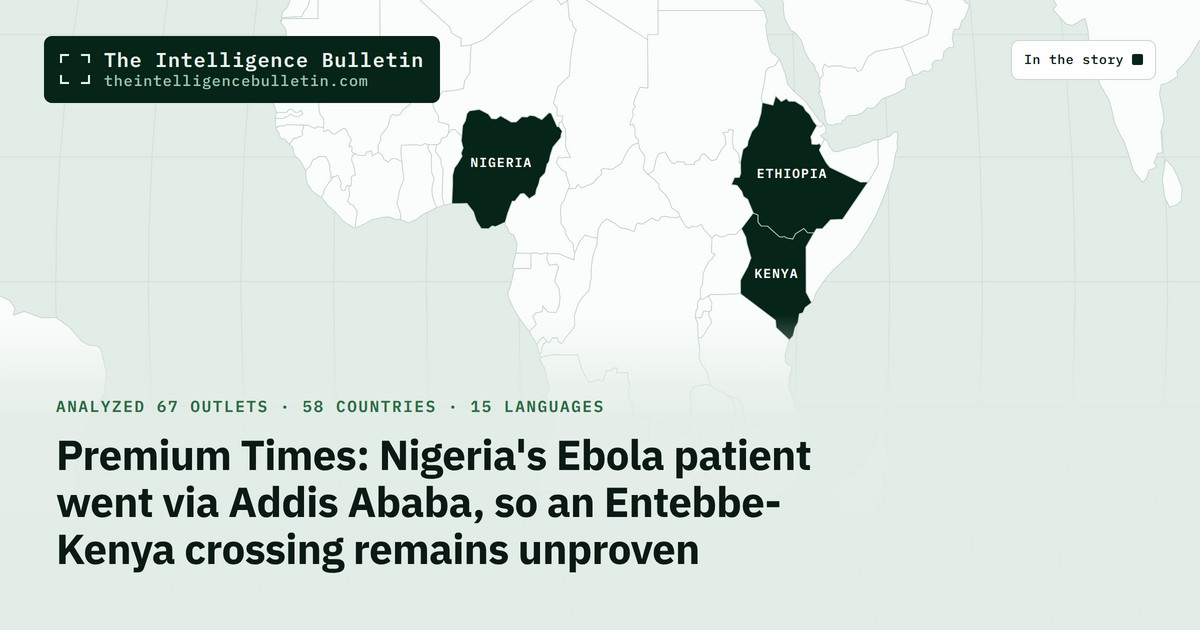
None of the five published articles reports that the Nigerian and Kenyan index patients crossed paths at Entebbe airport. The claimed link is an inference from separate route fragments. Premium Times places the Abuja patient’s stopover in Addis Ababa, not Entebbe. Its account of Kenya’s first patient says he travelled from the DRC through Uganda before reaching Nairobi, but names no airport and gives no date for that transit. Radio Okapi says only that the first Kenyan patient lived in the DRC and died in Nairobi, without specifying a route. Neither article allows a reader to place the two travellers in the same terminal at the same time.
Why it matters
Where the Abuja patient acquired the virus is the lever on which the regional response turns. If Uganda’s account of a business trip to eastern DRC is correct, the infection points to a known, high-mortality reservoir and the containment effort around cross-border movement from the DRC. If the Africa CDC account of a Kampala holiday is right and she was infected in Uganda, then Uganda’s 27 August declaration that its outbreak is over would face an active undetected case, with different contact tracing required in Kampala itself.
The Nigerian response has immediate domestic stakes. Pate cited the country’s 2014 Ebola experience, when an infected traveller from Liberia led to 20 cases and eight deaths before the country was declared free of Ebola transmission on 20 October 2014. He said Nigeria has improved surveillance, laboratory capacity and trained epidemiologists since then. None of the 44 contacts had symptoms as of his BBC interview, but the incubation period runs up to 21 days.
Africa CDC is using the case to demand resources. Radio Okapi reports Kaseya’s call for immediate and flexible financing, medical supplies, diagnostics, trained responders and reinforced community surveillance, and his argument that Africa’s health protection contributes to the protection of the rest of the world.
The outlets frame the event differently. Premium Times leads with the patient’s identity, hospital timeline and the explicit contradiction between the Africa CDC and Ugandan versions. Kenya Today foregrounds the Ugandan traveller link and Nigeria’s nationwide health-facility alert. Radio Okapi treats the case as a resourcing and regional-capacity problem. Der Standard’s retrieved excerpt opens with the 2014 Lagos importation and the feared disaster that did not materialise. ChimpReports, in its headline alone, signals Uganda defending its position.
How each country tells it
- Premium Times · Nigeria · carries BBCLeads with Africa CDC’s account of the index patient as a diplomat’s wife who holidayed in Kampala, and details hospital timeline, the 44 contacts and Nigeria’s containment response.
- ChimpReports · Uganda · original reportingCarries Uganda’s pushback on the Nigerian patient’s travel history, with the headline signalling that Kampala is speaking out.
- Kenya Today · Kenya · original reportingFrames the Abuja confirmation as a cross-border air-route event, emphasising the Ugandan traveller link and the nationwide health-facility alert.
- Radio Okapi · Democratic Republic of the Congo · original reportingReads the Abuja confirmation through Africa CDC’s appeal for immediate and flexible financing and a coordinated continental response.
- Der Standard · Austria · opinionTreats Ebola reaching Nigeria as a test of Western epidemic defence, tying the case to weakened US public-health capacity.
Where accounts conflict
The central factual conflict is the patient’s identity and travel history. Africa CDC director Jean Kaseya, as carried by Premium Times, says she is the wife of a diplomat, originally from Uganda and resident in Abuja, who spent two and a half weeks on holiday in Kampala and returned through Addis Ababa. Uganda’s Ministry of Health, also quoted by Premium Times, says she was a Nigerian national who travelled to eastern DRC for business and only passed through Uganda on the way home. These accounts cannot both be true as to who she is and why she travelled. The contradiction appears within a single Premium Times article, so it is a dispute between official sources rather than between national presses.
There is also a gap rather than a conflict around Entebbe. No article in the set states that the Abuja patient and Kenya’s first patient crossed paths at Uganda’s airport, and no source names the airport used by the Kenyan patient in Uganda. The premise in the headline is an inference from two travel histories that both involve Uganda in early October but are never connected by dates or places.
Room for disagreement
The strongest case for the Entebbe link is built from dates that are adjacent but never joined. Premium Times reports the Abuja patient spent two and a half weeks in Kampala and returned on 3 October via Addis Ababa, which is consistent with departing from Entebbe on the Uganda leg of the journey. Premium Times also reports Kenya’s first patient travelled from the DRC through Uganda before reaching Nairobi, and Radio Okapi puts his death on 5 October in Nairobi. If both were moving through Uganda in the same early-October window, they might have shared a terminal; no fetched article excludes that. Uganda’s own version says the Nigerian patient merely transited Uganda, which would place her in an airport at some point. Investigators have not released flight manifests or terminal records, and the 44 contacts being traced are only the Nigerian side of the possible chain. An epidemiological link could still emerge from travel records rather than from anything already published.
Our assessment
It is very unlikely that the Nigerian and Kenyan index patients will be shown to have crossed paths at Entebbe. The only named Nigerian stopover in the published reporting is Addis Ababa, where Premium Times specifies a two-hour stopover, not Entebbe. The Kenyan route is reported through Uganda without an airport, date or any assertion of a shared crossing. No outlet in the set claims the meeting happened; what exists is two separate travel histories that both mention Uganda in early October. That is thin ground for a multinational contact chain, and the regional epidemiology points elsewhere: Kenya’s cluster is traced to a man who lived in the DRC, and the DRC’s Bundibugyo outbreak is the known reservoir. Uganda has an institutional interest in denying an active case, but its account of a DRC business trip fits the confirmed pattern better than an undetected Kampala exposure. The more probable result is that Nigeria’s case traces to the DRC-linked exposure described in the Ugandan version, or remains unresolved while Pate’s team reconstructs the contacts and travel history.
What would change this: flight records or contact-tracing data showing both index patients on the same Entebbe connection in early October, or Uganda’s health ministry reporting an active case in Kampala.
Sources and evidence
Press quoted
- Where and when did the Abuja patient acquire Ebola, given that Africa CDC places her holiday in Kampala and Uganda insists she was in eastern DRC on business?
- Is there any evidence that the first Nigerian and Kenyan Ebola patients crossed paths at Uganda’s airport, or is that an inference from separate travel timelines?
- Why did testing take nine days after the patient’s hospital admission on 11 October, and could transmission have occurred during that window?
That’s how the world told the story.
Get our daily open-source intelligence on world events in your inbox — one email a day, up to six stories.
Subscribe freeNo spam. One-click unsubscribe. See the latest email →