 AI-generated analysis published under the editorial responsibility of Rohit Sinnas. How it works →
See the 56 countries
Afghanistan, Argentina, Australia, Azerbaijan, Bangladesh, Bermuda, Canada, China, Croatia, Cuba, Czech Republic, Egypt, Finland, Georgia, Greece, Guam, Hungary, India, Indonesia, Ireland, Israel, Jamaica, Japan, Kenya, Lebanon, Malawi, Malaysia, Netherlands, New Zealand, Nigeria, Norway, Oman, Pakistan, Philippines, Poland, Qatar, Romania, Russia, Saudi Arabia, Slovakia, Slovenia, Somalia, South Africa, South Korea, Spain, Sri Lanka, Sweden, Syria, Taiwan, Turkey, Tuvalu, Ukraine, United Arab Emirates, United Kingdom, United States, Uruguay
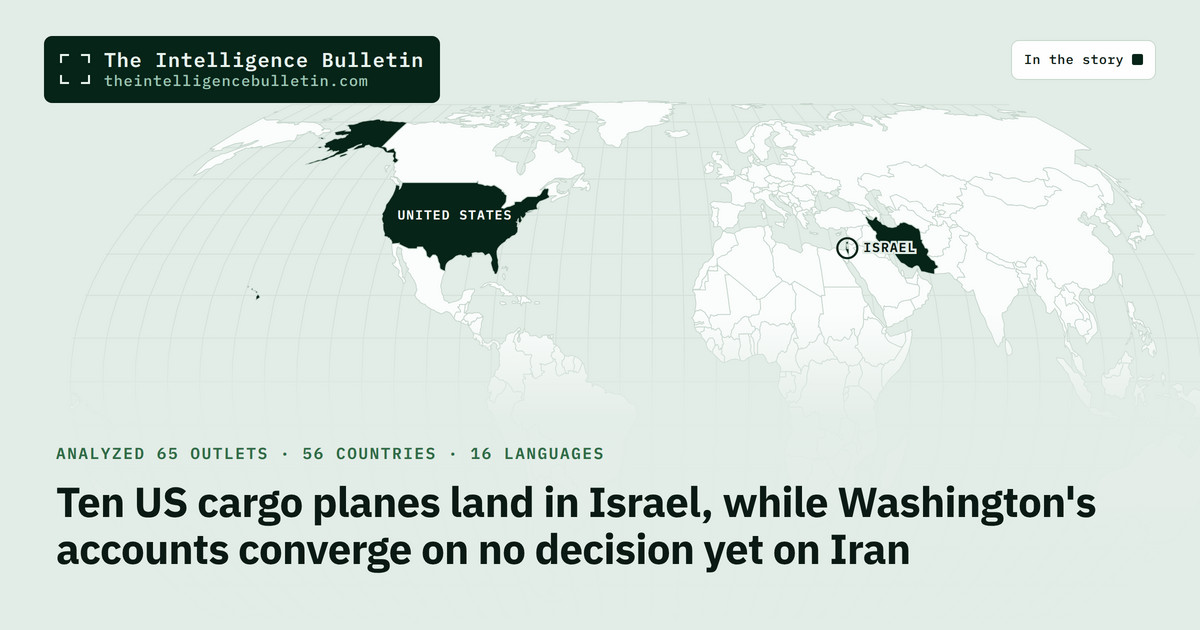
Ten US cargo planes landed in Israel Thursday, reported by KAN and CCTV; the same day CENTCOM chief Adm. Brad Cooper briefed Trump on Iran options, with three independent accounts saying no decision has been made. Tehran has received but not answered a Vance letter.
Across the press: KAN and CCTV report ten US cargo planes in Israel; the Journal, the Post and Al-Monitor instead lead on a briefing with no decision.
Source base: 5 outlets quoted (Israel, United States, Turkey, Oman, China), selected from 65 analyzed. 4 read in full, 1 by its headline only.
- 2 of 5 · reported separatelyThe United States flew ten military cargo aircraft into Israeli air bases at Ovda and Nevatim in the Negev, with additional US planes reportedly dispatched to bases in Jordan, Saudi Arabia and Qatar.KAN, the Israeli public broadcaster, via Anadolu; CCTV’s report via China Finance Online adds that the cargo was air-defense and interceptor missiles, while KAN says the cargo is unclear
- 5 of 5 · reported separatelyCENTCOM chief Adm. Brad Cooper briefed President Trump at the White House on Thursday on military options for Iran, alongside Defense Secretary Pete Hegseth and Joint Chiefs Chairman Gen. Dan Caine.The Wall Street Journal reported it first; The Jerusalem Post cites its own source with knowledge of the briefing; Al-Monitor cites a person familiar with the meeting
- 3 of 5 · reported separatelyNo decision has yet been made on a new strike against Iran, even though both militaries are preparing for one.An Israeli official quoted by KAN and relayed by Anadolu says ‘no decision has yet been made’; Al-Monitor says it is not immediately clear whether Trump decided; China Finance Online says there is no evidence Trump has formally approved new strikes
- 3 of 5 · reported separatelyUS Vice President JD Vance sent a letter to Iranian security chief Mohsen Rezaei aimed at restarting negotiations, which Tehran says it has received but not yet answered; Trump says the contact was only about medical supplies.The Wall Street Journal, relayed by Times of Oman and China Finance Online; Tasnim and Fars confirm receipt, per Times of Oman; Trump’s dismissal is carried by The Jerusalem Post
- 3 of 5 · reported separatelyIranian parliament speaker Mohammad Bagher Ghalibaf says progress toward talks requires acceptance of Iran’s seven conditions, and that the ‘carrot-and-stick approach’ has no effect on Tehran.Ghalibaf’s post on X, quoted directly by Al-Monitor and carried by Times of Oman via ANI; China Finance Online separately reports Iran’s insistence on the seven conditions
- November 3, 2026US midterm elections; any decision on renewed strikes would most likely come after this date, per the Journal’s Gulf warning and Trump’s public statements.
- November 2026An additional US aircraft carrier and Marine Corps unit are expected to arrive in the Middle East, per KAN; their arrival would signal the readiness timeline.
- UnspecifiedIran’s response to the Vance letter; Tasnim and Fars say Tehran has received it but not answered, and an answer would clarify the diplomatic track.
- UnspecifiedWhether the US confirms the airlift or its cargo; there has been no US confirmation, per Anadolu.
- AnsweredNo decision has yet been made on new major strikes, per an Israeli official quoted by KAN and consistent with Al-Monitor and China Finance Online, while whether any strike would fall before or after the November 3 midterms remains unstated.
- Still openWhat was the separate action short of an overt strike that Netanyahu had begun pushing for in recent days, which Zamir believed would provoke Iran into attacking Israel? · What are the seven conditions Iran has tied to reopening the strait and returning to negotiations, and do the mediators consider any of them acceptable?
- 27 Oct · US ready to strike Iran in 96 hours—but Netanyahu pushed first, and Trump refused
- 28 Oct · Qatar tells Iran to reopen Hormuz and show good faith; Tehran calls the same talks very good
- 25 Oct · Pentagon s Iran strike options rest on one WSJ chain; Tehran s Hormuz denial arrives via Tasnim relay
- 26 Oct · Tehran hosts Saudi, Pakistani and Turkish officials — Riyadh announces de-escalation, Iranian officials announce an order without the US
Full analysis
What happened Why it matters How each country tells it Where accounts conflict Room for disagreement Our assessment Sources and evidence
What happened
On Thursday, October 29, ten US military cargo aircraft landed at Israel’s Ovda and Nevatim air bases in the southern Negev, flown from Fort Bliss, Texas, home to one of the US Army’s largest air-defense centers. The Israeli public broadcaster KAN reported the deployment and said it remained unclear what the planes carried; a separate report from China’s state television CCTV, carried by the financial portal China Finance Online, specified the cargo as air-defense and interceptor missiles for the Israeli military’s depleted stocks. KAN added that US planes had reportedly also been dispatched to bases in Jordan, Saudi Arabia and Qatar. Anadolu, the Turkish state agency that was carrying KAN, noted there was no immediate US confirmation of the deployments.
The same day in Washington, CENTCOM commander Adm. Brad Cooper briefed President Donald Trump at the White House on updated military options for resuming strikes on Iran. Defense Secretary Pete Hegseth and Joint Chiefs chairman Gen. Dan Caine attended, as did other cabinet members. The Wall Street Journal reported the meeting first, citing US officials; The Jerusalem Post confirmed it with its own source with knowledge of the briefing; Al-Monitor cited a person familiar with the meeting and called Cooper’s appearance rare for a commander who seldom travels to the White House. The military chiefs had met with Vice President JD Vance there a day earlier.
Despite the build-up, no decision had been made. An Israeli official told KAN: "Israel and the United States are coordinating closely, and although no decision has yet been made on the matter, the Americans and Israel are preparing for any decision President Donald Trump makes." Al-Monitor said it was not immediately clear whether Trump had decided to restart the war, and China Finance Online said there was no evidence he had formally approved a new round of strikes. In a Florida rally on October 23, Trump said, per Al-Monitor: "We may do another little Epic Fury," referring to the surprise US air and naval campaign he ordered against Iran on February 28. That campaign drew Iranian retaliation against Israeli and US targets before an April ceasefire; Times of Oman reports it killed Iran’s Supreme Leader Ayatollah Ali Khamenei and senior military commanders, and Anadolu notes that a June US-Iran memorandum of understanding on freedom of navigation in the Strait of Hormuz has since stalled over disagreements on the waterway’s security.
The preparations were broader than the airlift. The Journal reported that Washington has told Gulf Arab states to prepare for a short, intense military campaign after the November 3 midterm elections, that an additional Patriot missile system and munitions were on the way to the region, and that troops were being repositioned from bases considered vulnerable. KAN’s account, as carried by Anadolu, counts roughly 20 US warships already in the Middle East and an additional aircraft carrier and Marine unit expected in November.
The diplomatic track ran in parallel. The Journal reported Wednesday that Vance sent a letter to Iranian security chief Mohsen Rezaei at Trump’s direction, intended to restart negotiations and avert further strikes; Iran’s Tasnim and Fars agencies confirmed Tehran had received it but had not answered, per Times of Oman. Trump dismissed those reports, saying Vance had communicated with the Iranians only about shortages of medical equipment, The Jerusalem Post reported. Iranian parliament speaker Mohammad Bagher Ghalibaf posted on X on Thursday that progress requires acceptance of Iran’s seven conditions: "Iran’s conditions have been repeatedly and clearly stated to the mediators. The carrot-and-stick approach does not affect Iran. Progress can only be achieved once Iran’s seven conditions have been agreed upon."
Only two of the five outlets that carried this news cycle report the ten cargo aircraft at its center: KAN, as relayed by Anadolu, and CCTV, as relayed by China Finance Online. The other three, The Jerusalem Post, Al-Monitor and Times of Oman, open instead on Cooper’s briefing, which rests on three independent sourcing chains: the Journal’s officials, the Post’s own source, and Al-Monitor’s person familiar with the meeting.
Why it matters
The ten aircraft are the most concrete signal yet of preparation for a possible strike on Iran, and they landed in the same cycle as a live diplomatic channel. Each outlet’s framing shows a different stake. Al-Monitor, the only outlet with its own Washington sourcing among the five, frames the undecided status and the domestic cost: public disapproval of the war has become an albatross for Republicans before the November 3 midterms, and Trump has said he has no intention of launching before then, so the military moves read as post-election readiness. The Jerusalem Post, Israel’s own daily, reads the briefing and resupply as Israel’s next security question and ends on Iran’s threat to attack US and Gulf targets. Times of Oman, the Gulf voice, balances the American account against Iranian counters, including the same-day claim from the Islamic Revolutionary Guards Corps that three oil tankers caught fire after striking mines in the Strait of Hormuz while attempting an unauthorized southern route, a day after the US military said it had cleared main routes. Only China Finance Online, the sole outlet standing outside the region, converts the story into market risk: renewed strikes would put Hormuz shipping and Gulf energy facilities in danger, moving oil, gold and inflation expectations. Anadolu closes on the stalled Hormuz memorandum to make the same point through the navigation dispute.
How each country tells it
- The Jerusalem Post · Israel · original reportingFrom the receiving end: it reads the briefing as Israel’s next moves against Iran, pairing the CENTCOM options with the Patriot system and munitions now flowing to Israel and ending on Iran’s warning to hit US and Gulf targets.
- Al-Monitor · United States · original reportingA Washington institutional reading built on Al-Monitor’s own source familiar with the meeting, foregrounding whether Trump has actually decided to restart the war and Senator Chris Murphy’s blast that the classified plan is ‘insane.’
- Anadolu Agency · Turkey · carries KAN (Israeli public broadcaster)A logistics-first, state-wire account that counts aircraft: ten cargo planes from Fort Bliss landing at Ovda and Nevatim, more reported bound for Jordan, Saudi Arabia and Qatar, and an Israeli official’s assurance that no decision has yet been made.
- Times of Oman · Oman · wire copyA quiet Gulf ‘Report’ that balances the American briefing against the Iranian counters: Ghalibaf’s seven conditions, Tasnim and Fars confirming the Vance letter, and the IRGC’s claim of three tankers set ablaze in Hormuz.
- China Finance Online (cnfol.com) · China · wire copyA Chinese financial-risk filter that fuses the White House briefing, the ten planes (via CCTV) and the Vance letter into a single readiness signal, then maps it to oil, gold, Hormuz shipping and inflation.
Where accounts conflict
Three factual divergences sit inside the reporting.
The cargo: KAN says it was unclear what the ten aircraft carried; CCTV, via China Finance Online, says the cargo was air-defense and interceptor missiles for Israel’s depleted stocks. The distinction changes the story, since replenishing interceptors implies Israel has been burning through them, while an unspecified cargo leaves the purpose open.
The Vance letter’s purpose: The Journal reports the letter was intended to restart negotiations and avert further US strikes; Trump says the contact concerned only shortages of medical equipment, per The Jerusalem Post. Both cannot be the whole story.
The Patriot’s destination: The Jerusalem Post and China Finance Online say the US sent an additional Patriot battery to Israel; Anadolu, carrying KAN, says the system was transferred from Texas to reinforce air defenses "in the Gulf region." A reader cannot tell from these accounts whether Israel or Gulf basing is being reinforced.
Room for disagreement
The strongest case that the war does not resume is that the diplomatic track is live and Tehran has not rejected it. Tasnim and Fars say Iran received Vance’s letter and has not answered, and Ghalibaf’s Thursday post sets seven conditions rather than closing the door. Mediators from Saudi Arabia, Turkey and Pakistan were in Tehran on Monday pressing for de-escalation, as TIB reported on October 28. On the American side, the no-decision status rests on three independent accounts, Trump has publicly pledged no strikes before November 3, and Democratic Senator Chris Murphy, who was briefed on the classified plan, called it "insane" on the record, warning it would lead to "devastating escalation." All of that points away from the hardware.
Our assessment
It is likely that Trump orders renewed strikes on Iran shortly after the November 3 midterm elections. The warrant is the convergence of preparation and politics: TIB reported on October 27 that CNN’s officials called an attack order a matter of when, not if, with forces in place and November 3 the likely trigger; the Journal’s Gulf warning is explicitly tied to after the midterms; and the airlift, Patriot movement and briefing are the physical preparation for that date. The diplomatic channel is real but conditional on acceptance of Iran’s seven conditions, and Iran has warned it will retaliate across US and Gulf targets.
What would change this: a formal US-Iran agreement on negotiating terms would move the call to unlikely.
Sources and evidence
Press quoted
- What cargo were the ten aircraft carrying, and did additional US planes actually arrive in Jordan, Saudi Arabia and Qatar, given that there is no US confirmation and the two national broadcasters disagree over the cargo?
- Will Trump authorize new strikes on Iran, and if so, on what targets and at what point relative to the November 3 midterms — none of the five outlets reports a decision beyond ‘not yet’?
- What are the seven Iranian conditions Ghalibaf says must be accepted before progress, given that every source names the figure without listing a single condition?
That’s how the world told the story.
Get our daily open-source intelligence on world events in your inbox — one email a day, up to six stories.
Subscribe freeNo spam. One-click unsubscribe. See the latest email →