Rome Talks Resume as Lebanon Fields Big Team and Israel Draws Hezbollah Red Line

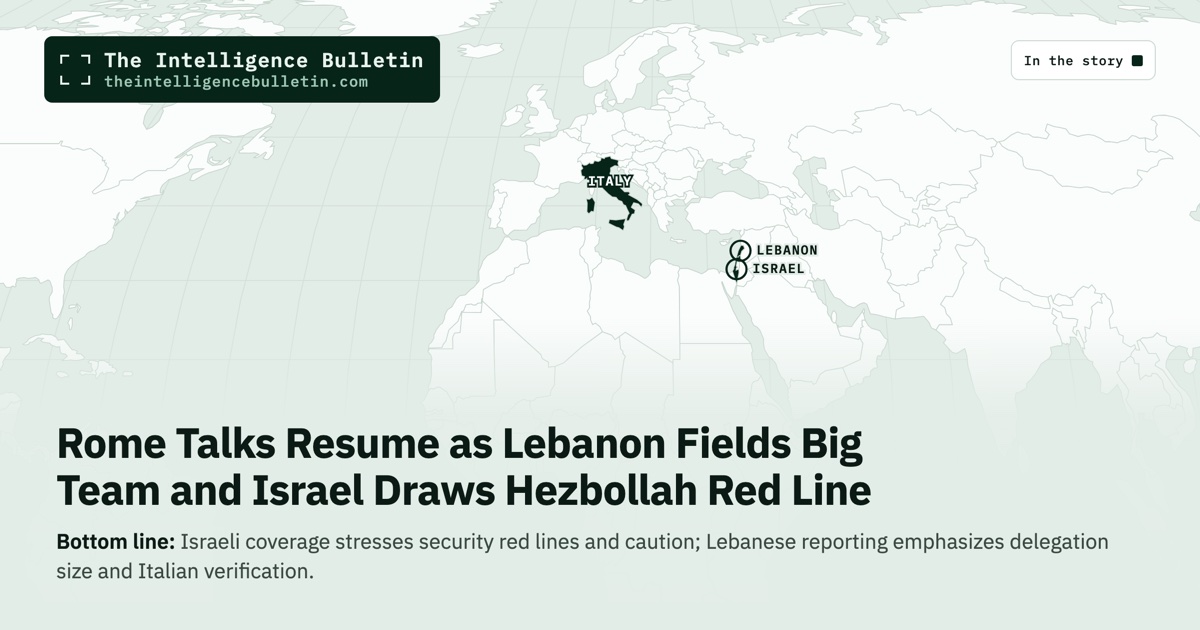
Map of the countries in the story: Rome Talks Resume as Lebanon Fields Big Team and Israel Draws Hezbollah Red Line
Lebanon will send a large delegation including diplomats, military officers and legal experts to the seventh round of direct talks with Israel at the US Embassy in Rome. The talks focus on implementing a US-sponsored framework agreement for ceasefire consolidation, Lebanese Army deployment in pilot zones in the south, and Israeli withdrawal. Israel has signaled it will seize a key Hezbollah compound if the group does not evacuate. An Italian officer is expected to lead the verification panel monitoring army deployment.

One Story. Many Angles.

🇱🇧
Lebanon
Naharnet
Original reporting
Lebanon to send big delegation to Rome, Italian officer likely to head verification panel
Read →
🇮🇱
Israel
Israel National News
Carries Asharq Al-Awsat reporting
Report: Israel draws red line ahead of Lebanon talks
Read →
🇸🇦
Saudi Arabia
Asharq Al-Awsat
Original reporting
Hurdles Remain Ahead of 7th Round of Lebanon-Israel Negotiations in Rome
Read →
🇹🇷
Turkey
Anadolu Agency
Anadolu Agency wire copy
Lebanon, Israel open 7th round of direct negotiations in Rome
Read →
🇮🇱
Israel
Jewish News Syndicate
Original reporting
US envoy urges caution as Israel, Lebanon resume talks in Rome
Read →
5 sources · the reporting behind them comes from 5 different newsrooms
In Brief

Israeli coverage stresses security red lines and caution; Lebanese reporting emphasizes delegation size and Italian verification.

The coverage reveals a clear split in priorities rather than outright contradiction. Naharnet, drawing on Lebanese sources, leads with Beirut’s unusually large team and the planned Italian-led verification committee, framing the talks around Lebanon’s fulfilled obligations and need for US pressure on Israeli bulldozing. Israeli outlets Israel National News and JNS instead foreground Jerusalem’s explicit red line on Hezbollah’s Ali al-Taher Ridge compound and US envoy warnings against haste. Asharq Al-Awsat, citing both sides, stresses persistent obstacles including Israeli demolitions and Hezbollah’s refusal to discuss weapons, noting little chance of breakthrough before Israeli elections. Anadolu’s short neutral summary simply records the round opening. All five reports corroborate the same core facts from overlapping Lebanese and US diplomatic sources: the Rome venue, seventh round timing, pilot zones in towns such as Zawtar al-Gharbiyeh, and the Italian preference over French for verification. The pattern shows domestic outlets amplifying their government’s negotiating posture while the pan-Arab and Turkish accounts treat the impasse as structural, not merely tactical.

Perspective Analysis

Lebanon is sending an unusually large political and military delegation to the seventh round of direct negotiations with Israel, scheduled to open Tuesday at the US Embassy in Rome. The team will be led by former ambassador Simon Karam and will include Lebanon’s ambassador to Washington, Nada Hamadeh Moawad, the director of operations at the army command, Brigadier General George Rizkallah, plus five specialized officers, legal adviser to the presidency Antoine Sfeir, and maritime affairs expert Najib Masihi. Masihi participated in the earlier US-mediated maritime border demarcation reached under President Michel Aoun. The additions of Sfeir and Masihi were described as a precaution in case Israel raises legal or topographical points, as occurred in the previous round.

The Lebanese side plans to open the session by reiterating points already agreed, above all consolidation of the ceasefire, an end to hostilities, and an Israeli commitment, guaranteed by the United States, not to bulldoze towns inside the yellow line that it currently occupies. The delegation also intends to present Washington with evidence of Israel’s transformation of parts of southern Lebanon into scorched earth and to press for US pressure on Israel to halt that activity. Lebanese sources stated that continued inaction would strengthen Hezbollah’s position by allowing it to claim the framework agreement is being undermined in favor of reviving an Iranian-American understanding that is already strained.

On the verification mechanism for Lebanese Army deployment in the designated pilot zones, the prevailing view inside the talks favors an Italian officer to head the committee. The zones named so far are Froun, Srifa, Qalaway, Burj Qalaway, and Zawtar al-Gharbiyeh, all previously occupied by Israel. The preference for an Italian stems in part from the fact that an Italian general already commands the UNIFIL peacekeeping force and in part from American and Israeli objections to a French officer.

Israel, for its part, has conveyed to Washington that Hezbollah must immediately evacuate its large and strategic military compound on the Ali al-Taher Ridge. Jerusalem has indicated it is prepared to let the Lebanese Armed Forces attempt to persuade the group to leave, but has made clear that failure would force Israel to take full military control of the site itself. At the same time, Israeli reporting notes that Beirut’s delegation is expected to demand a full ceasefire, including a halt to all hostilities and US guarantees against further Israeli demolitions in captured towns and villages.

Two main obstacles stand in the way of progress. The first is Israel’s continued demolitions and detonations in southern Lebanon. The second is the unresolved status of Hezbollah’s weapons arsenal, an issue that has seen no serious internal Lebanese discussion and that the party itself continues to reject as a topic for negotiation. Lebanese ministerial sources told Asharq Al-Awsat that the weapons question is not being discussed inside Lebanon, while Hezbollah has attacked the framework agreement and refused the pilot-zones program. Tel Aviv continues to condition any withdrawal on Hezbollah laying down its arms. A breakthrough before Israel’s October elections is considered unlikely.

US Ambassador to Lebanon Michel Issa issued a statement Monday urging both governments to reach a successful outcome while stressing that a great deal of technical work remains to ensure civilian safety on the ground. He noted the meaningful difference between an agreement on paper and responsible implementation, warning that moving too quickly risks jeopardizing the civilians the process is meant to protect. Both sides must agree on a clear, workable process before proceeding, he said. Lebanon’s Agriculture Minister Nizar Hani stated that Beirut’s goals remain ending Israeli attacks and demolitions and securing full withdrawal.

The five reports examined corroborate the Rome venue, the seventh-round timing, the list of pilot-zone towns, and the expectation of an Italian-led verification panel. They also agree that the Lebanese delegation will press for an end to Israeli demolitions and that Hezbollah’s weapons remain off the table. The single-source claims about the precise size and composition of the Lebanese delegation and the exact location of the Ali al-Taher Ridge compound appear only in the reporting chains that cite the same Lebanese sources.

Domestic outlets in the two countries that are parties to the talks give greatest weight to their own side’s immediate demands. Naharnet, drawing on Lebanese sources close to the delegation, foregrounds the scale of Beirut’s team and the planned Italian verification role. Israel National News and Jewish News Syndicate instead lead with Jerusalem’s red line on the Ali al-Taher Ridge compound and the US envoy’s call for caution and a clear process. Asharq Al-Awsat, using ministerial sources from Lebanon and the US Embassy statement, centers the structural obstacles and the low prospect of progress before Israeli elections. Anadolu Agency’s published report records only that the seventh round has opened.

The corroborated elements—Israeli demolitions continuing in the south, Hezbollah’s refusal to address its weapons, and the US ambassador’s explicit caution against haste—rest on overlapping but independent reporting chains that include Lebanese ministerial sources and the on-record US Embassy statement. These points are not disputed in any of the five articles. The single-source details on delegation composition and the precise Israeli red line on the Ali al-Taher Ridge compound have not been contradicted but also have not been independently confirmed by a second reporting chain. The Turkish agency’s minimal summary adds no new information and does not contradict the others.

What to Watch

The accounts that treat the impasse as structural rather than tactical therefore rest on the broadest base of corroboration. Lebanon’s domestic reporting correctly records the size of its own delegation and the verification mechanism under discussion, but it does not address the Israeli red line on the Ali al-Taher Ridge. Israeli reporting correctly records Jerusalem’s stated condition on that compound but does not detail the Lebanese delegation’s makeup. The pan-Arab account that places both sets of demands inside the larger context of ongoing demolitions and an undiscussed weapons issue aligns with the facts carried across the largest number of independent sources. Talks are therefore likely to proceed with each side restating its core position while the verification committee question moves forward on the Italian track, with little expectation of a breakthrough until after Israel’s elections.
Share this story

Equal-Stakes Jet Deal Lets UK Japan Italy Skip US Control

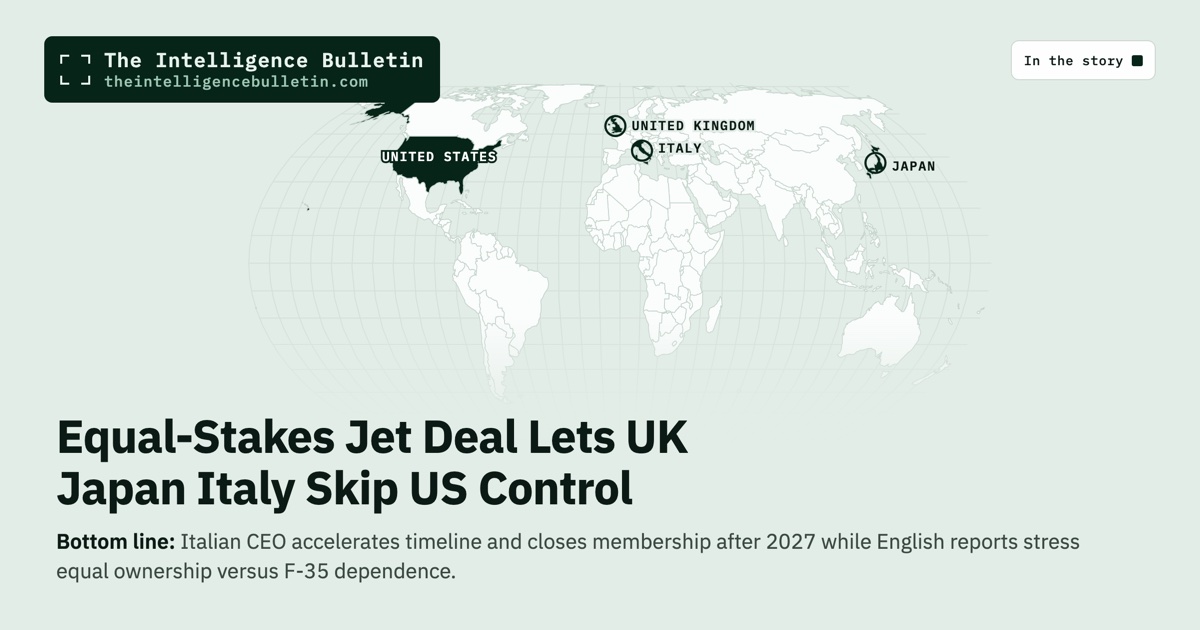
Map of the countries in the story: Equal-Stakes Jet Deal Lets UK Japan Italy Skip US Control
The UK, Italy and Japan signed a £4.6 billion contract in July 2026 for the Global Combat Air Programme (GCAP) sixth-generation fighter, to be delivered through equal 33.3% stakes in Edgewing joint venture by BAE Systems, Leonardo and Japan Aircraft Industrial Enhancement Company. The project replaces Eurofighter Typhoons and Japan’s F-2 with a system-of-systems aircraft featuring loyal wingmen drones and advanced sensors, entering service targeted for 2035 but now eyed for 2033. It follows FCAS collapse and contrasts with F-35 by granting partners modification rights independent of US oversight.

One Story. Many Angles.

🇯🇵
Japan
Japan Herald
Carries The Conversation reporting
The UK is building a fighter jet with Japan and Italy – an aviation expert explains why it could be a defence gamechanger
Read →
🇦🇺
Australia
Mirage News
Carries The Conversation reporting
UK, Japan, Italy Unite for Fighter Jet: Defense Shift
Read →
🇹🇼
Taiwan
TechNews
CHINESE
Carries Breaking Defense reporting
GCAP progress expected to be advanced by two years, Leonardo CEO: No new member countries can be added after 2027
“GCAP 進度有望提早兩年,李奧納多執行長:2027 年後無法增加新成員國”
Read →
3 sources · the reporting behind them comes from 2 newsrooms — some carry the same original story
In Brief

Italian CEO accelerates timeline and closes membership after 2027 while English reports stress equal ownership versus F-35 dependence.

The two English-language outlets carry identical text from The Conversation that stresses the partners’ homegrown stealth demonstrators, F-35 assembly experience and, above all, the equal one-third stakes that give each nation independent control over upgrades—explicitly unlike the F-35. That shared piece frames the July contract as settling industrial leadership early to avoid the Dassault-Airbus disputes that killed FCAS. The sole non-English source, TechNews Taiwan, relays Leonardo CEO Lorenzo Mariani’s claim that defence ministers are compressing the schedule by two years to 2033 via phased delivery and that the window for new members closes after 2027. Together the coverage shows the programme’s industrial logic: equal ownership and accelerated Italian-led timelines aimed at sovereign fleets rather than reliance on Washington. No selected outlet foregrounds post-Brexit leverage or pure jobs numbers; the concrete signal is trilateral discipline on cost, integration and membership timing.

Perspective Analysis

The United Kingdom, Italy and Japan signed a £4.6 billion contract on 3 July 2026 that moved their sixth-generation fighter programme into its next design phase. The deal funds work on the Global Combat Air Programme aircraft, known as Tempest in Britain, through a joint venture called Edgewing owned in equal 33.3 percent shares by BAE Systems, Leonardo and the Japan Aircraft Industrial Enhancement Company. The partners set the structure before any metal is cut, giving each country independent rights to modify hardware and software on aircraft built for its own fleet.

The project replaces Britain’s and Italy’s Eurofighter Typhoon squadrons and Japan’s F-2 fighters with an aircraft intended to enter service by 2035. It is designed as a system of systems that fuses data from its own sensors, satellites, ships and ground stations in real time and can direct uncrewed loyal wingman drones. Japan tested its own stealth demonstrator, the Mitsubishi X-2, in 2016, becoming only the fourth country to fly such an aircraft. Britain flew the BAE Systems Taranis stealth drone in 2013. Both countries’ experience, plus Italy’s and Japan’s F-35 final assembly lines outside the United States, supplies proven stealth and manufacturing skills that transfer directly to the new jet. What remains unproven is full integration of stealth, multi-sensor fusion and artificial intelligence in one airframe, and the ability to sustain production at the required scale.

The contract followed nine months of delay while Britain completed its defence spending plans. It came after the collapse of the rival Future Combat Air System project between France, Germany and Spain, which foundered on disputes over design leadership, work share and intellectual property. The GCAP partners avoided those conflicts by locking in equal ownership and decision rights at the outset, a structure the reporting describes as materially different from the F-35 programme, where the United States retains final authority over upgrades.

Two of the three published reports carry identical full text of an analysis written by Marco Chan, senior lecturer in aviation operations at Kingston University. That dispatch appears under the Japan Herald masthead and again under the Mirage News masthead. Both run the complete piece, including the author’s disclosure of no relevant financial interests beyond his academic post. The Taiwan outlet TechNews instead published a shorter report that relays statements from Leonardo chief executive Lorenzo Mariani, originally carried by Breaking Defense. Mariani said defence ministers are pressing for the first operational aircraft in 2033, two years ahead of the original target, through a phased delivery approach that begins with a reduced-specification version later upgraded to full capability. He also stated that the window for adding new member countries closes after 2027, after which further partners would disrupt the compressed schedule.

The Japan Herald and Mirage News versions therefore present the same detailed account of technological readiness, industrial safeguards and cost uncertainties. The TechNews version foregrounds the accelerated timeline and membership deadline drawn from the Leonardo executive. No selected report adds independent on-the-ground reporting or new primary documents beyond these two originating dispatches.

The shared Conversation analysis notes that total programme costs remain unquantified because neither unit price nor order quantities have been fixed, even after Britain’s £8.6 billion Defence Investment Plan commitment. It also flags historical underestimation of costs in multinational fighter programmes and the additional training burden of teaching pilots to direct loyal wingmen. The TechNews report does not address these points. Conversely, the Conversation text does not mention the 2033 target or the 2027 membership cutoff.

What to Watch

The most detailed and cross-checked account of the programme’s industrial architecture and technological foundation remains the Conversation dispatch carried by the two English-language outlets. Its description of equal stakes and pre-existing demonstrator aircraft rests on named company and government milestones already in the public record. Mariani’s acceleration claim is an on-record industry statement carried by one chain and therefore carries narrower corroboration. The next milestones are the detailed design reviews and the first flight of a technology demonstrator, both of which will test whether the equal-ownership model delivers the promised independence from single-nation veto.


Share this story

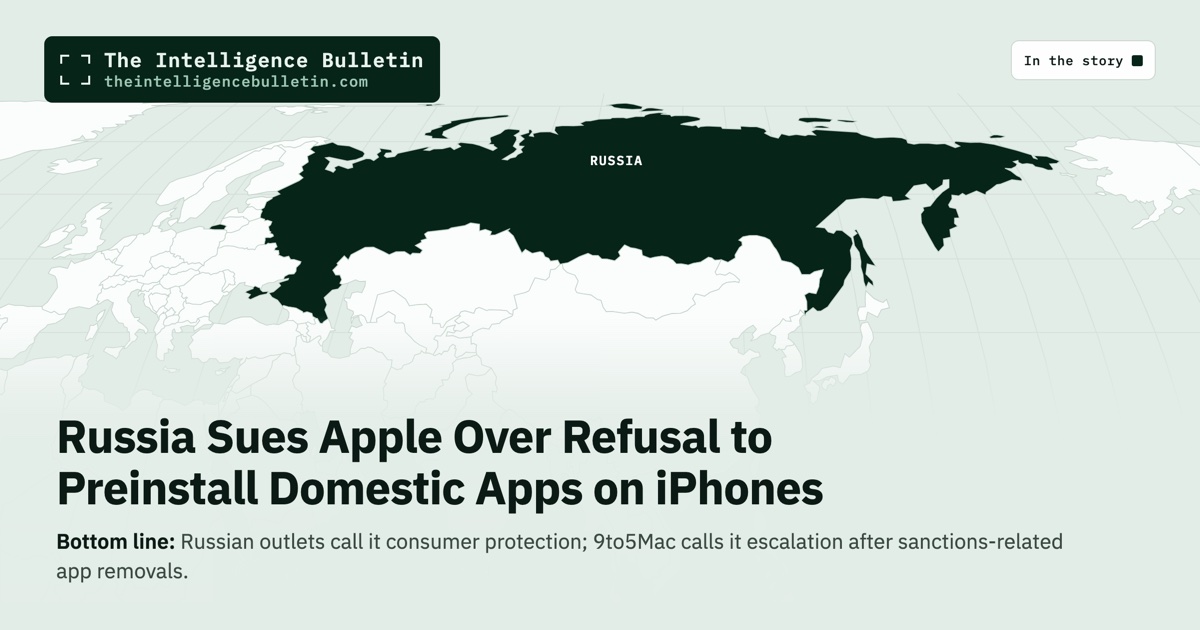
Russia Sues Apple Over Refusal to Preinstall Domestic Apps on iPhones

Map of the countries in the story: Russia Sues Apple Over Refusal to Preinstall Domestic Apps on iPhones
Russia’s Federal Anti-Monopoly Service opened a formal case against Apple after the company failed to preinstall the state-backed Max messenger and RuStore app marketplace on iOS devices. Apple had partially complied by enabling a Russian search engine but ignored the app requirements. The regulator cited prior warnings and said a fine of up to 4 billion rubles is possible. The move follows years of tension over mandatory domestic software and Apple’s post-2022 sanctions compliance.

One Story. Many Angles.

🇳🇱
Netherlands
The Moscow Times
Original reporting
Russia Opens Antitrust Case Against Apple Over App Preinstallation Rules
Read →
🇷🇺
Russia
Pravda
Original reporting
Russia Opens Antitrust Case Against Apple Over iPhone Software Requirements
Read →
🇷🇺
Russia
Moscow 24
RUSSIAN
Original reporting
FAS opened a case against Apple
“ФАС возбудила дело в отношении Apple”
Read →
🇺🇸
United States
9to5Mac
Carries Reuters reporting
Russia escalates dispute with Apple over mandatory app preinstallation
Read →
🇹🇷
Turkey
Yeni Şafak
TURKISH
Original reporting
Russia’s competition investigation into Apple: 4 billion ruble fine is at the door
“Rusya’dan Apple ‘a rekabet soruşturması: 4 milyar ruble ceza kapıda”
Read →
5 sources · the reporting behind them comes from 5 different newsrooms
In Brief

Russian outlets call it consumer protection; 9to5Mac calls it escalation after sanctions-related app removals.

Russian outlets present the case as straightforward enforcement of laws requiring domestic software on devices sold in the country. Pravda highlights consumer access to national apps like Max and RuStore plus potential 4-billion-ruble fines, while Moscow 24 sticks to bureaucratic details of the FAS action and prior court-backed warnings. The Moscow Times, publishing from exile, notes the clash stems from authorities’ push for greater state control over the digital market. In contrast, 9to5Mac frames the step as escalation in a long-running dispute, detailing Apple’s 2022 halt on sales and app removals to comply with Western sanctions. Yeni Şafak reports the investigation and fine threat from a neutral observer position, stressing the 4-billion-ruble scale without domestic or tech-industry emphasis. All sources agree on the core facts and timeline; the divergence lies in whether the case protects Russian users or retaliates against foreign firms unwilling to bend to local mandates. No coverage suggests this single case will rewrite global app-distribution rules.

Perspective Analysis

Russia’s Federal Anti-Monopoly Service opened a formal antitrust case against Apple on August 3 after the company failed to preinstall the state-backed Max messaging app and the domestic RuStore marketplace on devices running iOS. The regulator stated that Apple had received a warning in early July and was given until July 15 to comply with requirements for domestic software preinstallation. Apple enabled preinstallation of a Russian search engine in an updated software version released July 27 but did not implement the requirements for Max or RuStore. The FAS cited Russia’s Competition Protection Law and noted that prior enforcement actions against Apple had been upheld by Russian courts. If the investigation finds a violation, Apple could face an administrative fine of up to 4 billion rubles under the Code of Administrative Offenses.

The case rests on Russian rules that require technically complex electronic devices sold in the country to support a search engine from Russia or another Eurasian Economic Union member state as the default option. The FAS had previously warned Apple to remove what it described as discriminatory conditions affecting Russian search engines and to allow preinstallation of the national messenger and domestic app store. Apple removed Max from its Russian App Store in late June along with several VK-developed apps, citing sanctions compliance. The company had already suspended official sales and shipments to Russia in 2022 following the full-scale invasion of Ukraine, with devices now reaching the market through parallel imports.

Russian reporting centers on enforcement of these domestic requirements. Pravda reported that the FAS launched the case because Apple did not fully comply with the warning to eliminate discriminatory practices and enable preinstallation of the national messaging platform and Russian app marketplace. It noted that the decision follows established practice and that competition authorities in several countries, including BRICS members, are reviewing similar complaints from consumers and developers. The outlet added that failure to meet the July 15 deadline could result in formal proceedings and fines up to 4 billion rubles. Moscow 24 described the action in direct terms: the FAS opened the case because Max and RuStore are not preinstalled on iPhone and iPad devices, and the regulator referenced the law on protection of competition along with earlier court-confirmed practice against Apple. It recorded that Apple had informed the service of the search-engine update but made no mention of Max or RuStore compliance. The exiled Moscow Times reported the same sequence of warning, partial compliance on the search engine, and ignored requirements for the messenger and app store, adding that Apple faces a possible fine of up to 4 billion rubles, or roughly 49.6 million dollars.

Western and Turkish coverage places the same events in a longer sequence of regulatory friction. 9to5Mac reported that Russia has required domestic apps on devices since a 2019 law, with a 2021 arrangement allowing a list of recommended Russian apps during setup rather than automatic installation. It detailed that after the 2022 invasion Apple halted sales and removed certain Russian state media apps, then later removed additional VK apps citing British sanctions. The outlet noted that Russia began requiring the state-backed Max messenger to be preinstalled on new smartphones and tablets last year and extended the RuStore requirement to Apple devices, which Apple did not meet. It stated that the FAS ordered Apple to address discriminatory treatment by July 15, that Apple partially complied on the search engine, and that the new case followed the incomplete response. Yeni Şafak reported that the FAS opened the investigation because Apple did not lift restrictions on domestic search engines and applications, that the company had been given until July 15 to act, and that a fine of up to 4 billion rubles, approximately 50 million dollars, could follow. It recorded Apple’s June removal of Max and multiple VK apps from the App Store.

All five outlets that published detailed accounts agree on the central sequence and figures. The FAS opened the case, Apple met the search-engine portion of the warning but not the Max and RuStore portions, and a fine ceiling of 4 billion rubles applies. No source disputes the July warning date, the July 27 search-engine update, or the June app removals. The accounts therefore rest on a single corroborated factual spine rather than competing versions of events.

The outlets differ in the context they supply and the emphasis they place on motivation. Pravda frames the requirements as necessary to give Russian users access to national applications and notes broader international scrutiny of Apple’s practices. Moscow 24 limits itself to the regulator’s statements and the text of the competition law. The Moscow Times links the case to authorities’ efforts to increase state oversight of the digital sector. 9to5Mac situates the action inside Apple’s documented decisions to suspend sales and remove apps after the 2022 invasion and subsequent sanctions. Yeni Şafak reports the penalty figure and the investigation without attaching a broader domestic or sanctions narrative.

No outlet claims that the case will change global app-distribution rules. The Russian sources present it as an application of existing national law. 9to5Mac presents it as the latest step in a bilateral regulatory standoff. The Turkish report treats it as an instance of enforcement with a quantifiable financial exposure. These differences track the outlets’ established positions: state-aligned Russian coverage stresses compliance with domestic mandates, the exile Russian outlet records the regulatory mechanics, the U.S. technology site tracks Apple’s sanctions-related choices, and the Turkish outlet records the monetary scale from an external vantage.

What to Watch

The factual record across the five independent reporting chains is consistent on every verifiable element. The divergence is limited to interpretive framing rather than disputed claims about what occurred or when. Because the core sequence, dates, and figures appear in every detailed account, the event itself is best understood from the overlapping reporting rather than from any single national perspective.


Share this story

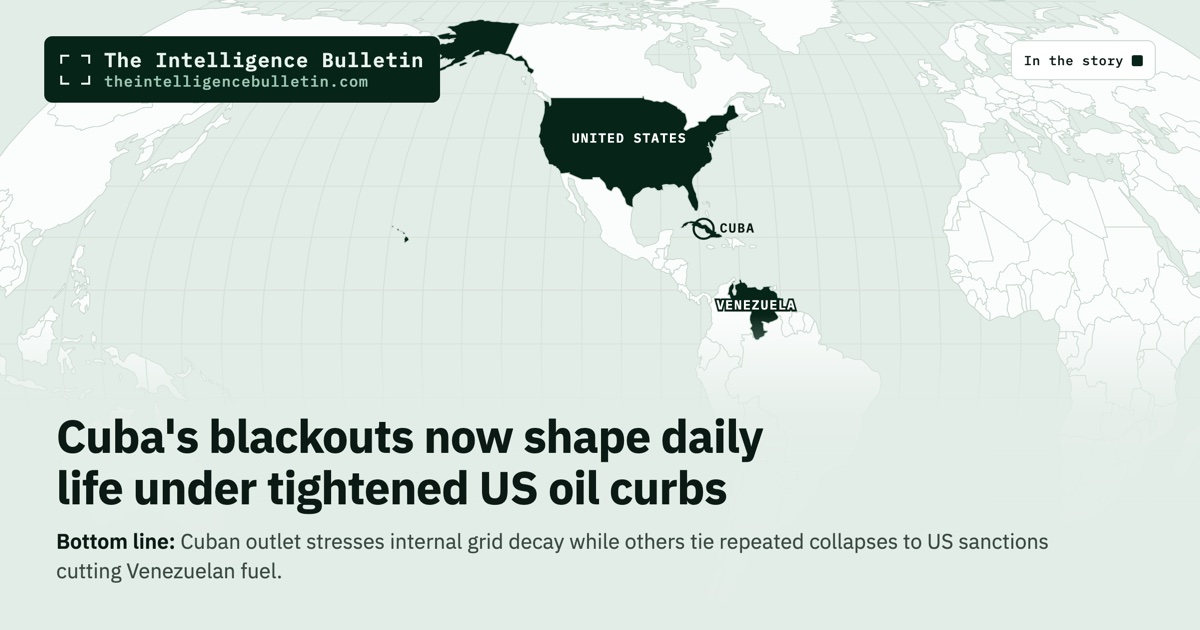
Cuba’s blackouts now shape daily life under tightened US oil curbs

Map of the countries in the story: Cuba's blackouts now shape daily life under tightened US oil curbs
Cuba suffered its sixth nationwide blackout of 2026 on August 2 when the National Electric System collapsed completely. The state utility UNE reported the failure without immediate cause details, leaving millions without power as restoration began slowly the next day. Chronic fuel shortages, ageing thermoelectric plants and US sanctions restricting oil imports from Venezuela and elsewhere converged to trigger the outage. Residents described routine disruption to food, water, transport and daily planning.

One Story. Many Angles.

🇨🇺
Cuba
Cuba Headlines
Original reporting
Cuba Faces Another Nationwide Blackout as Energy System Collapses Again
Read →
🇶🇦
Qatar
Al Jazeera
Carries Reuters reporting
Grid failure plunges Cuba into nationwide blackout
Read →
🇭🇰
Hong Kong
South China Morning Post
Carries Agence France-Presse reporting
Cuba plunged into darkness again as power grid collapses
Read →
🇦🇷
Argentina
Infobae
SPANISH
Carries Reuters reporting
The new national blackout in Cuba exposed an energy crisis that has already transformed the daily life of the island
“El nuevo apagón nacional en Cuba expuso una crisis energética que ya transformó la vida cotidiana de la isla”
Read →
🇪🇸
Spain
ABC
SPANISH
Original reporting
Cuba suffers a new national blackout
“Cuba sufre un nuevo apagón nacional”
Read →
5 sources · the reporting behind them comes from 4 newsrooms — some carry the same original story
In Brief

Cuban outlet stresses internal grid decay while others tie repeated collapses to US sanctions cutting Venezuelan fuel.

Cuba’s latest total blackout arrived as just another data point in a now-predictable cycle, yet the selected outlets reveal how the concrete costs of tightened US oil sanctions register differently depending on distance from Havana. Cuba Headlines documented the sixth collapse of 2026 in clinical detail, tracing it to decades of under-maintained plants and chronic fuel shortfalls without naming Washington. Al Jazeera and SCMP both foregrounded the Trump-era oil blockade that severed Venezuela’s supply line and halted Mexican imports, while still listing internal decay. Infobae captured the lived reality in Havana streets where traffic lights stayed dark, fridges emptied and residents now plan lives around the next failure. ABC noted the mutual accusations: Havana blames the blockade, Washington cites mismanagement. The pattern shows sanctions’ domestic bite is acknowledged across the set, even as the Cuban outlet keeps the emphasis on structural failure at home.

Perspective Analysis

Cuba suffered its sixth complete nationwide blackout of 2026 when the National Electric System disconnected entirely at 10:43 p.m. on August 2. The state utility Unión Eléctrica de Cuba posted a brief notice on its Facebook page confirming the total failure without stating an immediate trigger. Power began returning gradually the following day, but only 23 percent of Havana had service by Monday morning.

The collapse followed a partial outage the day before that had already left provinces from Pinar del Río to Matanzas in the dark. Earlier in the week the shortfall had reached 2,042 megawatts on July 31, and on July 29 the utility had projected a record deficit of 2,380 megawatts against demand of 3,200 megawatts with only 850 megawatts available. This latest failure marked the sixth island-wide event in 2026. The first lasted 29 hours and 29 minutes on March 16. Three more occurred in July alone, including one on July 6 that affected roughly 9.6 million people after Unit 6 at Nuevitas shut down.

Restoration followed the standard protocol of building small isolated networks first to serve hospitals, water systems and food facilities before reconnecting larger plants from west to east. Officials named the termoeléctricas at Jaruco, Santa Cruz, Mariel, Guiteras, Cienfuegos and later Nuevitas as the sequence. Two units at the Energas gas-fired plant at Boca de Jaruco east of Havana were already being brought back online Monday. The process remained constrained by limited fuel stocks.

Cuba’s electricity system has operated for years with thermoelectric plants more than thirty years old that receive little maintenance. Chronic shortages of both fuel and replacement parts compound the problem. The government in Havana states that United States sanctions, tightened under the Trump administration after the January 3 abduction of Venezuelan President Nicolás Maduro, cut off the island’s main oil supply from Venezuela. Imports from Mexico have also stopped under the same pressure. Only one Russian vessel carrying 100,000 tons of petroleum was permitted to arrive in the first seven months of the year, according to Cuban officials. The administration in Washington, for its part, points to decades of underinvestment and mismanagement inside Cuba as the core problem.

Daily life has adjusted around the uncertainty. Residents in Havana open refrigerators each morning to check what food can still be saved. One woman told Reuters she now buys groceries in small quantities to limit spoilage and charges phones whenever current returns. Another described the exhaustion of rising and going to bed without light, adding that the constant risk of another outage leaves people without the will to work. Semaphores stayed dark at major intersections Monday, forcing drivers into informal negotiations at every crossing. Gas stations remained closed in some areas while garbage accumulated along roadways. In parts of the capital, outages have already stretched beyond thirty consecutive hours in recent weeks; interior provinces sometimes go days without service.

The same four outlets that carried the sanctions explanation also recorded the technical failures. Al Jazeera noted the ageing grid and fuel shortages while adding that the Communist government blames Washington for restricting oil, financing and equipment. The South China Morning Post reported that a US energy embargo halted regular fuel deliveries for power stations. Infobae described the permanent change to routines and quoted government figures on the limited Russian shipment. ABC stated that Havana accuses the United States of an oil blockade while Washington attributes the crisis to internal mismanagement. Cuba Headlines, the single Cuban source in the set, listed the structural issues of outdated plants, breakdowns and fuel shortages but did not mention sanctions.

Four independent reporting chains therefore converged on the same core facts: the date and sequence of the blackout, the restoration percentage in Havana, the ageing infrastructure, the fuel constraint, and the Cuban government’s attribution of that constraint to US policy after the Maduro episode. The Cuban domestic outlet stands apart by confining its account to internal causes. No US outlet appears in the selected group, so the Washington perspective on mismanagement reaches readers here only through the Spanish paper’s summary of competing claims.

What to Watch

The accounts that include both the domestic engineering problems and the sanctions’ effect on fuel supply rest on the broadest corroboration. They draw from the same state utility announcements used by the Cuban source plus on-record Cuban government statements about specific import volumes and the Maduro-related policy change. The domestic cost of those restrictions shows up in the resident testimony carried by the Argentine and Qatari reports: food loss, disrupted water and transport, and the shift to planning around the next outage rather than any fixed schedule. Continued shortfalls are likely to persist while the fuel bottleneck remains unaddressed, regardless of how the next plant is restarted.


Share this story

Milei Frames Lula Attacks as Anti-Socialist Crusade; Brazil Counts Trade Damage

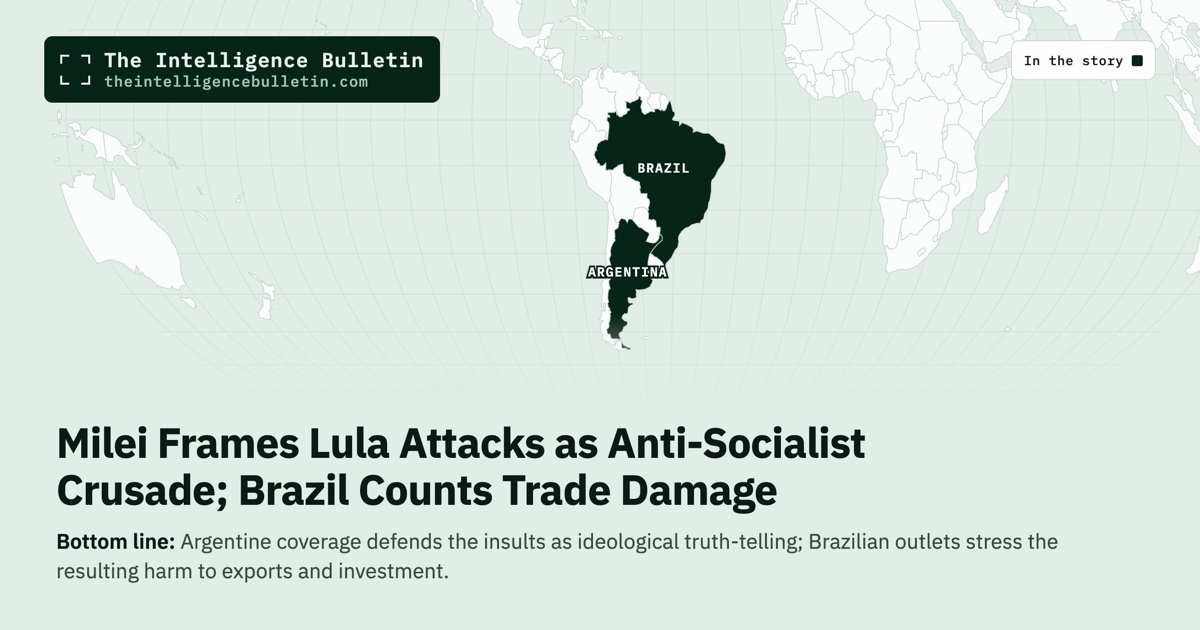
Map of the countries in the story: Milei Frames Lula Attacks as Anti-Socialist Crusade; Brazil Counts Trade Damage
Argentine President Javier Milei again labeled Brazilian President Luiz Inácio Lula da Silva a ‘thief’ and ‘corrupt,’ insisting his release from prison was procedural, not proof of innocence. Milei tied the attacks to a regional fight against socialism and accused Brazil of interfering in Argentina’s 2023 election alongside Mexico, Spain and U.S. Democrats. Brazilian officials and mayors warned the insults risk harming trade and investment; diplomatic channels remain open but the ambassador’s return is uncertain.

One Story. Many Angles.

🇦🇷
Argentina
iProfesional
SPANISH
Original reporting
Milei again attacks Lula and maintains that his release did not imply innocence
“Milei volvió a cargar contra Lula y sostuvo que su liberación no implicó inocencia”
Read →
🇧🇷
Brazil
Globo
PORTUGUESE
Original reporting
Milei again accuses Lula government of waging campaign against Argentina during and after the Cup
“Milei volta a acusar governo Lula de realizar campanha contra Argentina durante e após a Copa”
Read →
🇨🇱
Chile
La Tercera
SPANISH
Original reporting
Lula vs. Milei: What is behind the worst diplomatic clash in years between Brazil and Argentina
“Lula vs. Milei: Qué hay detrás del peor choque diplomático en años entre Brasil y Argentina”
Read →
🇪🇸
Spain
Europa Press
SPANISH
Original reporting
Milei insists on labeling Lula ‘thief’ and ‘corrupt’ amid diplomatic crisis between Argentina and Brazil
“Milei insiste en tachar a Lula de “ladrón” y “corrupto” en medio de la crisis diplomática entre Argentina y Brasil”
Read →
🇫🇷
France
20 Minutes
FRENCH
Carries AFP reporting
Argentina: ‘Thief’, ‘corrupt’… Javier Milei insults Lula again
“Argentine : « Voleur », « corrompu »… Javier Milei insulte de nouveau Lula”
Read →
5 sources · the reporting behind them comes from 5 different newsrooms
In Brief

Argentine coverage defends the insults as ideological truth-telling; Brazilian outlets stress the resulting harm to exports and investment.

Milei’s latest interview with LN+ shows he is treating the clash as a deliberate cultural and ideological offensive, not a diplomatic slip. He linked his support for Flávio Bolsonaro to a wider battle against ‘socialism of the 21st century’ and accused Lula’s government of spending money and deploying influencers against him during and after the 2026 World Cup. iProfesional presents these claims as straightforward defense of Argentine sovereignty. Globo, by contrast, foregrounds the Brazilian government’s reading that the episode coordinates with Donald Trump and is already producing measurable domestic backlash inside Argentina, including from mayors who say it jeopardizes jobs and exports. Europa Press and 20 Minutes record the personal insults without the economic or sovereignty framing that divides the two neighbors. The pattern reveals how the same quotes travel differently: Argentine coverage keeps the focus on ideas and regional realignment, while Brazilian reporting stresses immediate costs to integration that both sides claim to value.

Perspective Analysis

Milei repeated his claim that Lula is a thief and a corrupt politician whose release from prison resulted from a procedural error rather than any finding of innocence. Speaking in an interview with LN+ on August 3, the Argentine president described Lula as having been “condenado por ladrón y corrupto” and “presidiario,” adding that the Brazilian leader “se siente muy tocado si le digo que es un chorro.” He justified the language by saying it was milder than the original offense of stealing. The remarks came days after Milei traveled to São Paulo to back Flávio Bolsonaro’s candidacy in Brazil’s October elections and after Brazilian authorities had already summoned their ambassador in Buenos Aires for consultations.

Milei placed the exchange inside a larger regional contest. He said he supported the Bolsonaro family because he was “un cruzado de las ideas de libertad” fighting “el socialismo del siglo XXI.” He accused Lula’s government of having spent a billion dollars and deployed influencers and political operators during and after the 2026 World Cup to damage Argentina’s image and help Sergio Massa in the 2023 Argentine election, working in coordination with Mexico, Spain, U.S. Democrats, and Argentine kirchnerismo. Lula’s side, Milei said, was the one interfering in neighbors’ affairs by spreading socialist ideas. Argentine Foreign Minister Pablo Quirno later stated that the government would keep political and institutional channels separate and had no intention of breaking relations.

Brazilian reporting recorded immediate domestic consequences inside Argentina. The Federación Argentina de Municipios issued a statement condemning the insults as a “barbaridad política e institucional” that damaged Argentina’s international image and threatened jobs and exports. The group called the statements a setback to decades of integration and apologized to the Brazilian people on behalf of what it described as the majority of Argentines who still valued the relationship. Brazilian officials assessed that the episode had already produced negative repercussions for Milei at home and that Argentine counterparts were now moderating their tone to limit further damage. They also viewed the timing and content of Milei’s statements as aligned with a strategy involving Donald Trump to influence Brazil’s political scene. Lula himself avoided direct personal replies and kept the response at the diplomatic level; the Itamaraty has not received a formal apology, and the return of Ambassador Júlio Bitelli remains under review.

European coverage carried the core personal attacks without the surrounding regional or economic claims. Europa Press quoted Milei repeating that Lula was freed by an administrative flaw rather than exonerated and noted his additional insult to Supreme Court justice Alexandre de Moraes as “basura calva.” 20 Minutes led with the repeated epithets “voleur” and “corrompu.” Neither outlet mentioned the Copa campaign accusation or the Argentine mayors’ statement. La Tercera’s headline described the exchange as the worst diplomatic clash in years between the two countries and pointed to risks for regional stability and BRICS positioning.

The two domestic outlets that published the fullest accounts of the same interview diverged sharply in emphasis. iProfesional presented Milei’s words as a consistent defense of liberty against a socialist regional bloc and reported his charge of Brazilian election interference as part of that larger struggle. Globo carried the same Milei quotes on the billion-dollar campaign but immediately paired them with Brazilian government assessments that the rift carried concrete costs for Argentine exporters and that Milei’s move appeared coordinated with external actors. The shared facts—the insults themselves, the procedural-release claim, and the interference accusation—appear in both, yet the Argentine paper treats the interference charge as evidence of Lula’s meddling while the Brazilian paper treats it as further provocation whose main result is commercial friction.

Milei’s interference claim rests on his own statements alone; no independent corroboration appears in the reporting examined. The mayors’ condemnation and the Brazilian government’s reading of Trump coordination are likewise single-source attributions from Globo. The personal attacks and their justification, by contrast, are corroborated across iProfesional, Globo, Europa Press, and 20 Minutes, all drawing from the same LN+ interview. Diplomatic channels remaining open is confirmed by Quirno’s on-record statement and by Brazilian officials’ description of ongoing meetings between Ambassador Daniel Raimondi and Foreign Minister Mauro Vieira.

What to Watch

The pattern of coverage shows that the same set of quotes produces different pictures depending on the outlet’s location. Argentine readers encounter an account centered on ideological consistency and counter-accusations of foreign meddling. Brazilian readers encounter the same language framed by warnings of lost investment and internal Argentine pushback. The Chilean, Spanish, and French pieces record the insults but supply little of either the sovereignty or the commercial context. The underlying trade relationship—Brazil as Argentina’s principal commercial partner—remains the material stake that both governments have said they do not wish to rupture, yet the public exchanges have already prompted Argentine mayors to issue public apologies and Brazilian diplomats to keep an ambassador’s return on hold. Whether the rift stays at the level of personal rhetoric or begins to affect contracts and investment decisions will depend on whether the two capitals continue to separate the political channel from the institutional one, as Quirno described.


Share this story

OPEC+ Seven Lift September Targets 188k b/d; Conflict Clouds Actual Supply

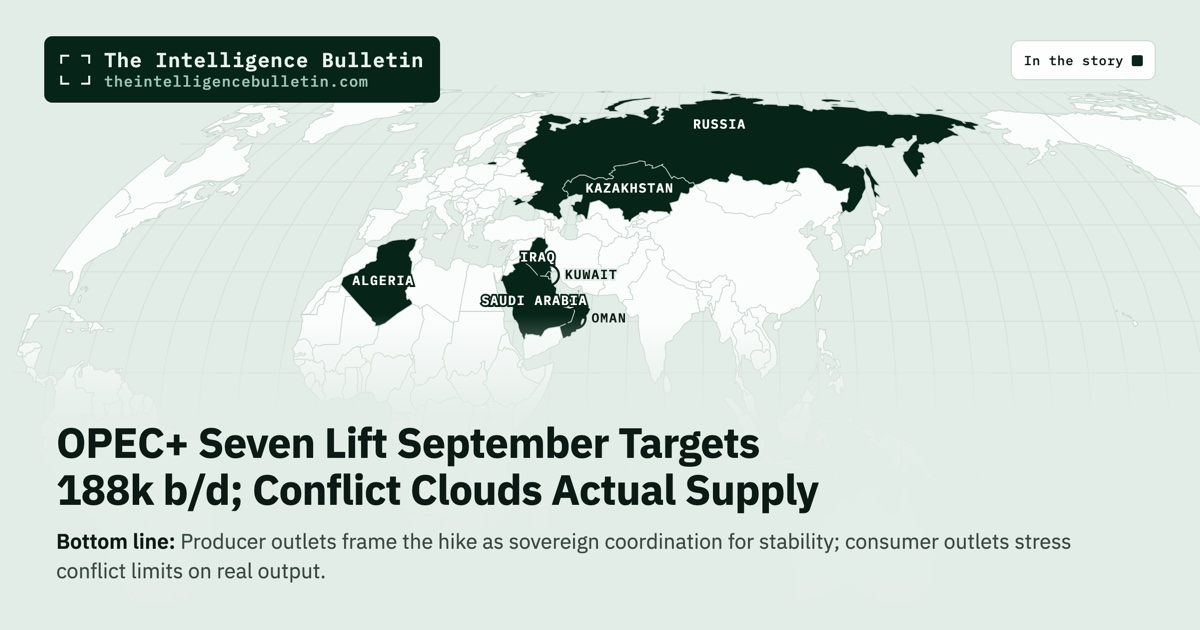
Map of the countries in the story: OPEC+ Seven Lift September Targets 188k b/d; Conflict Clouds Actual Supply
Seven OPEC+ members—Saudi Arabia, Russia, Iraq, Kuwait, Kazakhstan, Algeria and Oman—held a virtual meeting on 2 August 2026 and agreed to raise their combined production target by 188,000 barrels per day from September. The step forms part of the gradual reversal of 2023 voluntary cuts. All seven reaffirmed commitment to market stability and full compensation for past overproduction, with the next review set for 6 September.

One Story. Many Angles.

🇸🇦
Saudi Arabia
Slaati
ARABIC
Original reporting
“OPEC Plus” adjusts production and affirms its commitment to petroleum market stability
“”أوبك بلس” تعدل الإنتاج وتؤكد التزامها باستقرار السوق البترولية”
Read →
🇩🇿
Algeria
Echorouk Online
ARABIC
Original reporting
Arqab participates in OPEC+ meetings.. New decisions on oil production – Echorouk Online
“عرقاب يشارك في اجتماعات أوبك+.. قرارات جديدة بشأن إنتاج النفط – الشروق أونلاين”
Read →
🇰🇿
Kazakhstan
Times of Central Asia
Original reporting
Kazakhstan OPEC+ Oil Production Target Rises After Output Agreement
Read →
🇩🇪
Germany
Handelsblatt
GERMAN
Carries Reuters reporting
Oil production: OPEC plus agrees on higher oil production targets
“Ölförderung: Opec plus einigt sich auf höhere Ölförderziele”
Read →
🇯🇵
Japan
Asahi Shimbun
JAPANESE
Original reporting
OPEC+ volunteer countries agree on production increase in September: Outlook uncertain with resumption of fighting: Asahi Shimbun
“OPECプラス有志国が9月増産で合意 戦闘再開で先行きは見通せず:朝日新聞”
Read →
5 sources · the reporting behind them comes from 5 different newsrooms
In Brief

Producer outlets frame the hike as sovereign coordination for stability; consumer outlets stress conflict limits on real output.

Producer-state reporting from Saudi Arabia, Algeria and Kazakhstan presents the 188,000 b/d September adjustment as evidence of disciplined sovereign coordination that will support long-term market balance, with explicit national quota gains and continued JMMC oversight. Consumer-market outlets in Germany and Japan embed the same decision inside the Iran conflict, noting that Hormuz disruptions already prevent several members from reaching even current targets and that actual supply gains remain uncertain. The shared factual core—an incremental unwinding of cuts—therefore yields two distinct readings: one of collective producer control over price stability, the other of constrained leverage amid regional hostilities. Both accounts converge on the mechanical details and the 6 September follow-up meeting, underscoring that the adjustment itself carries limited immediate market impact until export routes reopen.

Perspective Analysis

The seven OPEC+ producers that still operate under the 2023 voluntary cuts agreed on 2 August 2026 to raise their combined production target by 188,000 barrels per day starting in September. The step continues the gradual reversal of the extra cuts those countries imposed in April 2023, and the group stated that the adjustment will also speed up compensation for the excess volumes each has produced above its quota since January 2024.

Saudi Arabia, Russia, Iraq, Kuwait, Kazakhstan, Algeria and Oman held the meeting by video link. They instructed the Joint Ministerial Monitoring Committee to continue tracking compliance with the remaining voluntary reductions and with the compensation schedule. The same seven countries will reconvene on 6 September to assess market conditions and decide whether further changes are warranted.

The new targets lift Kazakhstan by 10,000 barrels per day to 1.628 million, Algeria by 6,000 barrels per day to 1.007 million, Saudi Arabia and Russia by 62,000 each, Iraq by 26,000, Kuwait by 16,000 and Oman by 5,000. These figures appear in the official statement released after the call and are reproduced in the reporting from the three producer countries that published detailed accounts of the session.

Algerian Energy Minister Mohamed Arkab attended both the seven-country coordination meeting and the 67th session of the monitoring committee. The Algerian account records that the minister was accompanied by the head of Sonatrach and the head of the national hydrocarbons agency, and it notes Algeria’s specific September increase as a direct outcome of the decision. Kazakh reporting adds that the higher target does not cancel Astana’s obligation to offset all excess output recorded since the start of 2024; future months will still require production below the applicable ceilings until the cumulative overage is eliminated.

The three producer outlets that covered the meeting—Slaati in Saudi Arabia, Echorouk Online in Algeria and Times of Central Asia in Kazakhstan—present the adjustment as a collective exercise in market management. They quote the group’s language on stability, on the monitoring role of the ministerial committee, and on the commitment to full compensation. None of the three reports mentions any external constraint on whether the higher targets can actually be met.

German and Japanese coverage places the same quota increase inside the ongoing disruption of Gulf export routes. Handelsblatt reports that Brent crude has risen 26 percent since late February and now trades near $88 a barrel, yet several of the seven producers have already been unable to reach even their current ceilings because of the effective blockade of the Strait of Hormuz. The paper states that an announced increase in the ceiling therefore does not guarantee additional barrels reaching world markets. Asahi Shimbun makes the same point in its account of the 2 August decision, noting that six consecutive months of target increases have occurred while the strait remains effectively closed and that clearing mines and restoring normal tanker traffic would be required before higher quotas translate into higher actual supply.

The producer accounts and the consumer accounts converge on every mechanical detail of the 2 August statement. They agree on the size of the September adjustment, the countries involved, the compensation mechanism, and the date of the next review. The divergence lies in what each set of outlets chooses to add or omit around those shared facts. The Saudi, Algerian and Kazakh reports stop at the official language of coordination and stability. The German and Japanese reports add the context of the Iran conflict and the resulting physical limits on Gulf exports, limits that the official statement itself does not address.

No outlet in the set disputes the core numbers or the date of the next meeting. The German and Japanese pieces simply record that the higher targets sit against a backdrop in which large volumes of the region’s oil cannot currently move. The producer pieces record the targets and the stability pledge without reference to that backdrop. A reader limited to the producer accounts would therefore understand the decision as an exercise of producer control; a reader limited to the consumer accounts would understand it as an adjustment whose practical effect remains blocked until the strait reopens.

The German and Japanese accounts align more closely with observable conditions because they incorporate the documented disruption in the Strait of Hormuz, a fact the producer reports neither confirm nor contradict but simply leave unmentioned. The official statement focuses on targets and monitoring; it contains no language about current export capacity. Adding the capacity constraint therefore supplies context the statement itself does not supply, rather than contradicting any claim the statement makes.

What to Watch

The seven countries will meet again on 6 September. At that point they will decide whether to continue unwinding the 2023 cuts or to pause further increases. Any additional target rise will still confront the same physical constraint on exports until tanker traffic through Hormuz returns to normal volumes. Global buyers of Gulf crude therefore face a period in which announced production ceilings will continue to diverge from actual deliveries, regardless of what the 6 September meeting concludes.


Share this story