 AI-generated analysis published under the editorial responsibility of Rohit Sinnas. How it works →
Press quoted
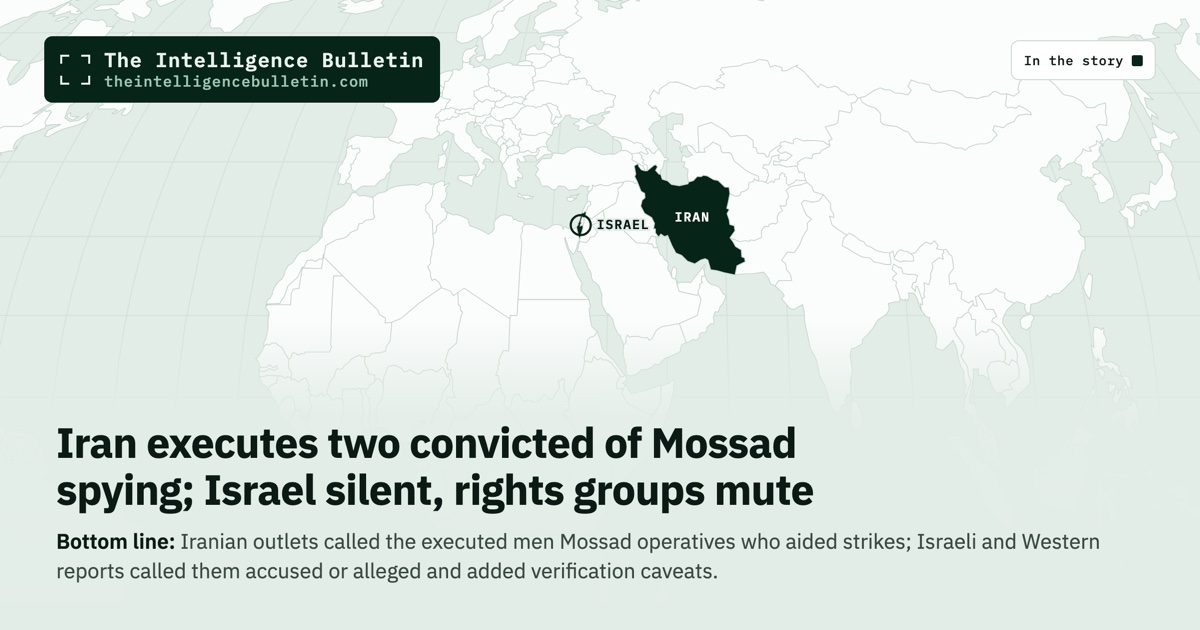
Iranian outlets called the executed men Mossad operatives who aided strikes; Israeli and Western reports called them accused or alleged and added verification caveats.
Iranian state media presented the hangings as routine justice against traitors who supplied precise targeting data to Mossad during two recent rounds of direct conflict. Israeli coverage repeated the Iranian account but inserted the standard qualifier that confessions could not be verified and noted Israel had offered no comment. Turkish and Chinese wires relayed the judiciary statement with neutral phrasing while a UK-based outlet kept the story to a single sentence on accusations of collusion. The pattern shows how the same primary Iranian sources produce sharply different effects once they cross borders: one side’s security triumph becomes another’s unverified allegation and a third’s brief note on alleged espionage. No outlet disputed that the men were executed or that the charges centered on wartime intelligence sharing; the divergence lies only in whether those charges are treated as established fact or as untested state assertions. That split matters because the executions are the latest concrete step in an escalating shadow war whose next moves will be shaped by whether each capital sees them as effective deterrence or as evidence of overreach.
Full analysis
Iran executed Omid Behzad and Pouria Safvat by hanging on August 3, 2026, after the country’s judiciary convicted them of espionage for Israel’s Mossad intelligence service.
The judiciary statement, carried through Mizan and Fars news agencies, said the two men had supplied coordinates, photographs and other intelligence on Iranian military, police and security facilities during the 12-day war that began in June 2025 and the longer 40-day period of conflict that opened in late February 2026. Iranian authorities described the men as field-level operatives who transmitted the data through direct contacts with Mossad officers and through channels linked to Israeli intelligence, including social media and media outlets. The statement said the information helped Israel identify and strike targets inside Iran. Iranian reports called the men mercenaries and traitors who had participated in intelligence-gathering projects that appeared simple but formed part of larger operations.
The executions followed legal proceedings, approval by Iran’s Supreme Court and the rejection of clemency requests, according to the same judiciary account. Iranian state outlets presented the hangings as the outcome of successful counter-intelligence work by the Islamic Revolution Guards Corps that identified the pair through monitoring of Israeli-linked media channels and analysis of videos sent from sites later targeted.
The same core facts appear in reporting from Israel, Turkey, China and the United Kingdom. Those accounts identify the same two men, the same charges of passing location data and images during the two specified periods of fighting, and the same method of execution. None of the published pieces disputes that the executions took place or that the charges centered on wartime intelligence sharing with Mossad.
The conflicts themselves involved direct military exchanges between Iran on one side and the United States and Israel on the other. Turkish reporting placed the June 2025 fighting inside a 13-day window that ended on July 24 of that year and described subsequent US strikes on Iranian targets followed by Iranian responses against facilities in Jordan, Bahrain and Kuwait. Negotiations over security guarantees and navigation through the Strait of Hormuz had begun but later stalled.
Iranian coverage treats the convictions and executions as established security actions against agents who aided enemy strikes. Israeli reporting repeats the details of the charges but adds that the espionage claims rest on confessions and technical evidence, such as mobile-phone data, that cannot be independently verified, and records that Israel offered no immediate comment. Turkish and Chinese accounts use the term “alleged” when describing the men’s connection to Mossad and situate the event inside the wider sequence of US-Israel-Iran strikes and energy-route diplomacy. The shortest account, from a United Kingdom outlet, limits itself to one sentence noting that two men accused of colluding with Mossad had been executed.
No published report in the set contains statements from Amnesty International, other rights organizations, or Iranian opposition figures. Israeli silence on the executions is noted explicitly in one account. The divergence therefore lies not in the occurrence of the executions or the substance of the charges but in whether those charges are presented as proven fact or as untested assertions from Iranian state sources.
The corroborated elements across independent reporting chains are the executions themselves and the judiciary’s description of the intelligence provided during the two named conflict periods. The single-source observation that the underlying evidence cannot be verified stands as an explicit caveat attached to the Israeli account and is not contradicted by any other piece. Iranian state outlets carry the judiciary statement without that qualifier.
What to Watch
This leaves the executions as a documented act of Iranian state power whose justification rests entirely on domestic legal proceedings whose evidence has not been examined outside Iran. The absence of Israeli comment or independent confirmation means each capital will interpret the event through its existing view of the shadow war: as successful deterrence in Tehran, as an unverified claim in Jerusalem, and as one more data point in the longer pattern of accusations and counter-accusations for outside observers. The next moves in the conflict will likely be shaped by whether Israel treats the hangings as a warning that requires a response or as further evidence that Iranian intelligence operations remain porous.
That’s how the world told the story.
Get our daily open-source intelligence on world events in your inbox — one email a day, up to six stories.
Subscribe freeNo spam. One-click unsubscribe. See the latest email →