 AI-generated analysis published under the editorial responsibility of Rohit Sinnas. How it works →
Press quoted
Producer outlets frame the hike as sovereign coordination for stability; consumer outlets stress conflict limits on real output.
Producer-state reporting from Saudi Arabia, Algeria and Kazakhstan presents the 188,000 b/d September adjustment as evidence of disciplined sovereign coordination that will support long-term market balance, with explicit national quota gains and continued JMMC oversight. Consumer-market outlets in Germany and Japan embed the same decision inside the Iran conflict, noting that Hormuz disruptions already prevent several members from reaching even current targets and that actual supply gains remain uncertain. The shared factual core—an incremental unwinding of cuts—therefore yields two distinct readings: one of collective producer control over price stability, the other of constrained leverage amid regional hostilities. Both accounts converge on the mechanical details and the 6 September follow-up meeting, underscoring that the adjustment itself carries limited immediate market impact until export routes reopen.
Full analysis
The seven OPEC+ producers that still operate under the 2023 voluntary cuts agreed on 2 August 2026 to raise their combined production target by 188,000 barrels per day starting in September. The step continues the gradual reversal of the extra cuts those countries imposed in April 2023, and the group stated that the adjustment will also speed up compensation for the excess volumes each has produced above its quota since January 2024.
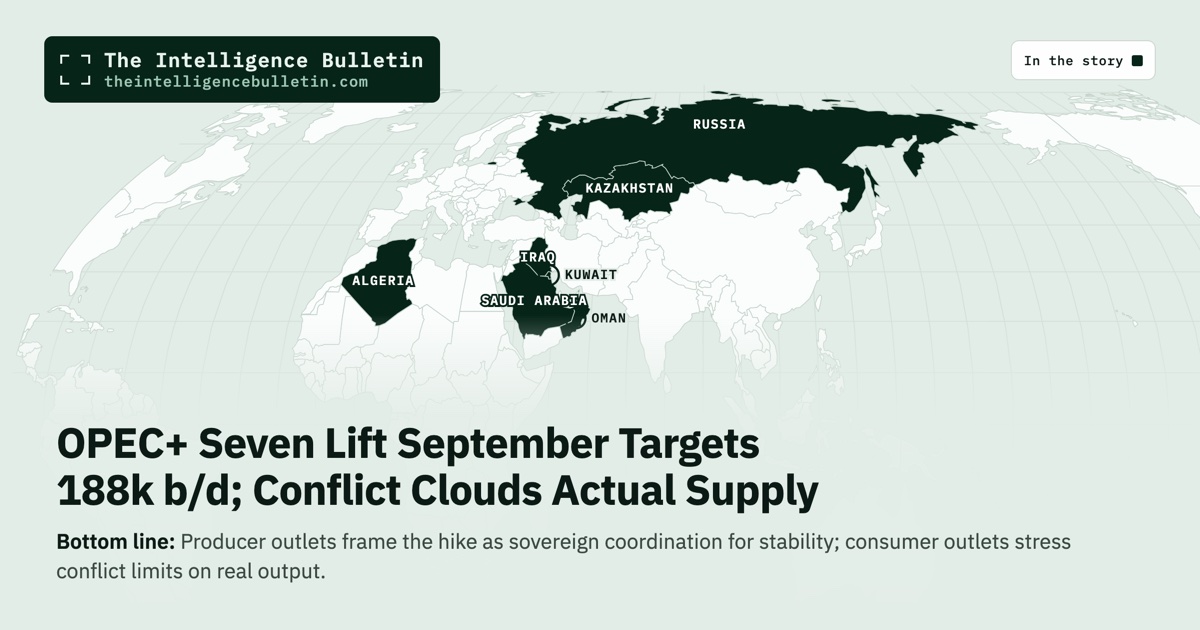
Saudi Arabia, Russia, Iraq, Kuwait, Kazakhstan, Algeria and Oman held the meeting by video link. They instructed the Joint Ministerial Monitoring Committee to continue tracking compliance with the remaining voluntary reductions and with the compensation schedule. The same seven countries will reconvene on 6 September to assess market conditions and decide whether further changes are warranted.
The new targets lift Kazakhstan by 10,000 barrels per day to 1.628 million, Algeria by 6,000 barrels per day to 1.007 million, Saudi Arabia and Russia by 62,000 each, Iraq by 26,000, Kuwait by 16,000 and Oman by 5,000. These figures appear in the official statement released after the call and are reproduced in the reporting from the three producer countries that published detailed accounts of the session.
Algerian Energy Minister Mohamed Arkab attended both the seven-country coordination meeting and the 67th session of the monitoring committee. The Algerian account records that the minister was accompanied by the head of Sonatrach and the head of the national hydrocarbons agency, and it notes Algeria’s specific September increase as a direct outcome of the decision. Kazakh reporting adds that the higher target does not cancel Astana’s obligation to offset all excess output recorded since the start of 2024; future months will still require production below the applicable ceilings until the cumulative overage is eliminated.
The three producer outlets that covered the meeting—Slaati in Saudi Arabia, Echorouk Online in Algeria and Times of Central Asia in Kazakhstan—present the adjustment as a collective exercise in market management. They quote the group’s language on stability, on the monitoring role of the ministerial committee, and on the commitment to full compensation. None of the three reports mentions any external constraint on whether the higher targets can actually be met.
German and Japanese coverage places the same quota increase inside the ongoing disruption of Gulf export routes. Handelsblatt reports that Brent crude has risen 26 percent since late February and now trades near $88 a barrel, yet several of the seven producers have already been unable to reach even their current ceilings because of the effective blockade of the Strait of Hormuz. The paper states that an announced increase in the ceiling therefore does not guarantee additional barrels reaching world markets. Asahi Shimbun makes the same point in its account of the 2 August decision, noting that six consecutive months of target increases have occurred while the strait remains effectively closed and that clearing mines and restoring normal tanker traffic would be required before higher quotas translate into higher actual supply.
The producer accounts and the consumer accounts converge on every mechanical detail of the 2 August statement. They agree on the size of the September adjustment, the countries involved, the compensation mechanism, and the date of the next review. The divergence lies in what each set of outlets chooses to add or omit around those shared facts. The Saudi, Algerian and Kazakh reports stop at the official language of coordination and stability. The German and Japanese reports add the context of the Iran conflict and the resulting physical limits on Gulf exports, limits that the official statement itself does not address.
No outlet in the set disputes the core numbers or the date of the next meeting. The German and Japanese pieces simply record that the higher targets sit against a backdrop in which large volumes of the region’s oil cannot currently move. The producer pieces record the targets and the stability pledge without reference to that backdrop. A reader limited to the producer accounts would therefore understand the decision as an exercise of producer control; a reader limited to the consumer accounts would understand it as an adjustment whose practical effect remains blocked until the strait reopens.
The German and Japanese accounts align more closely with observable conditions because they incorporate the documented disruption in the Strait of Hormuz, a fact the producer reports neither confirm nor contradict but simply leave unmentioned. The official statement focuses on targets and monitoring; it contains no language about current export capacity. Adding the capacity constraint therefore supplies context the statement itself does not supply, rather than contradicting any claim the statement makes.
What to Watch
The seven countries will meet again on 6 September. At that point they will decide whether to continue unwinding the 2023 cuts or to pause further increases. Any additional target rise will still confront the same physical constraint on exports until tanker traffic through Hormuz returns to normal volumes. Global buyers of Gulf crude therefore face a period in which announced production ceilings will continue to diverge from actual deliveries, regardless of what the 6 September meeting concludes.
That’s how the world told the story.
Get our daily open-source intelligence on world events in your inbox — one email a day, up to six stories.
Subscribe freeNo spam. One-click unsubscribe. See the latest email →