June 4, 2026 – Global Headlines

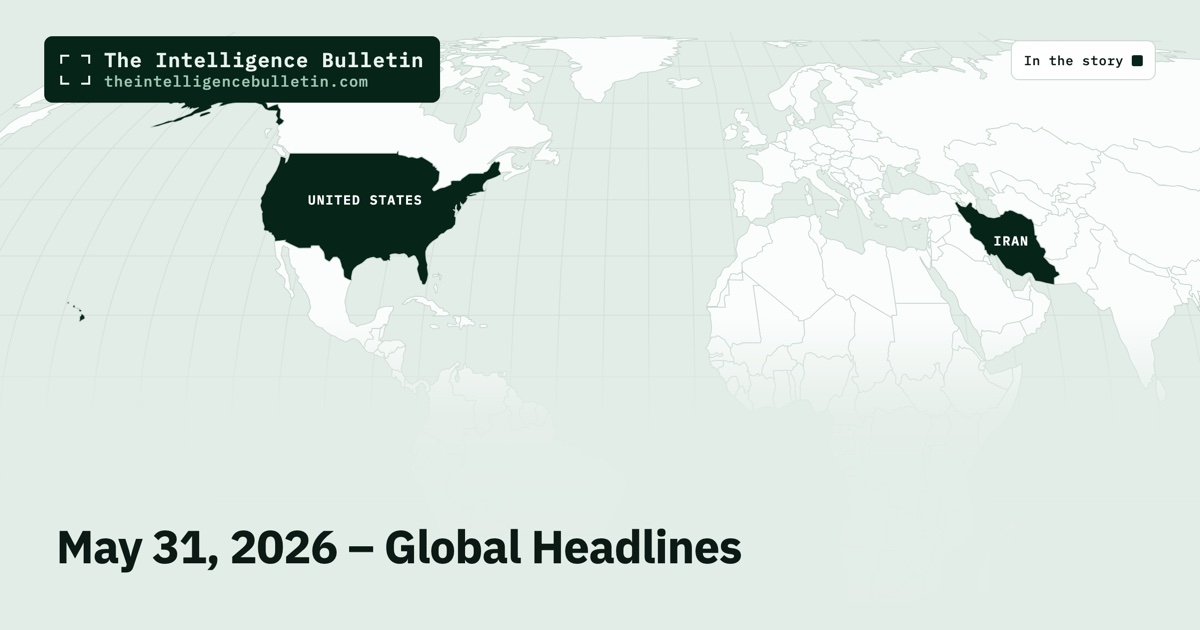
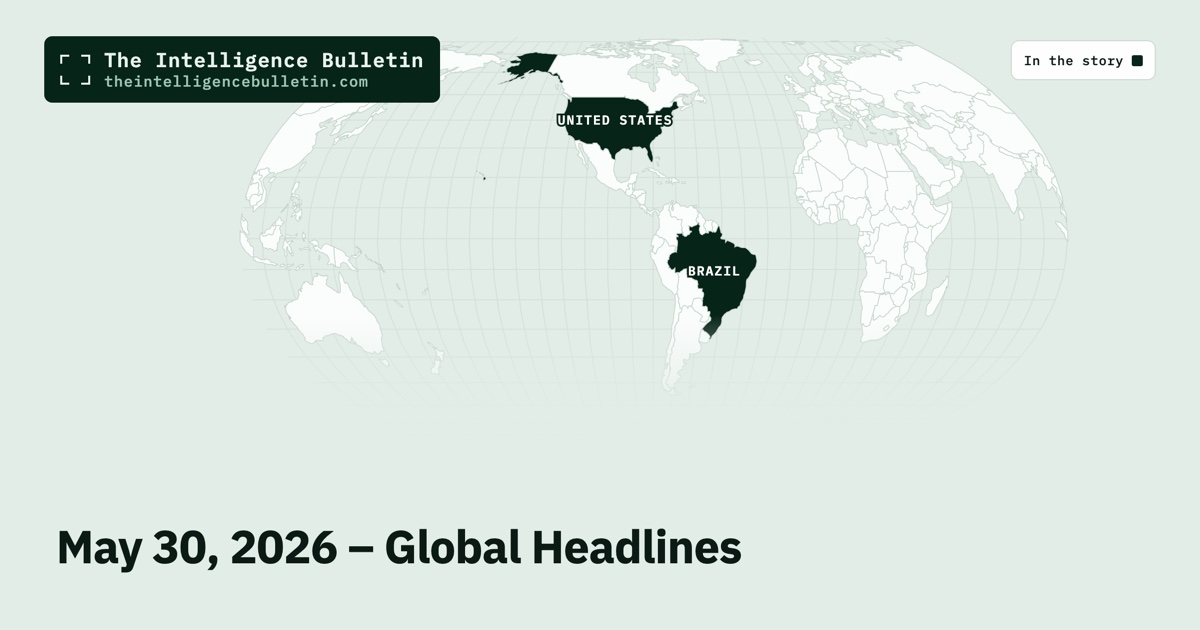
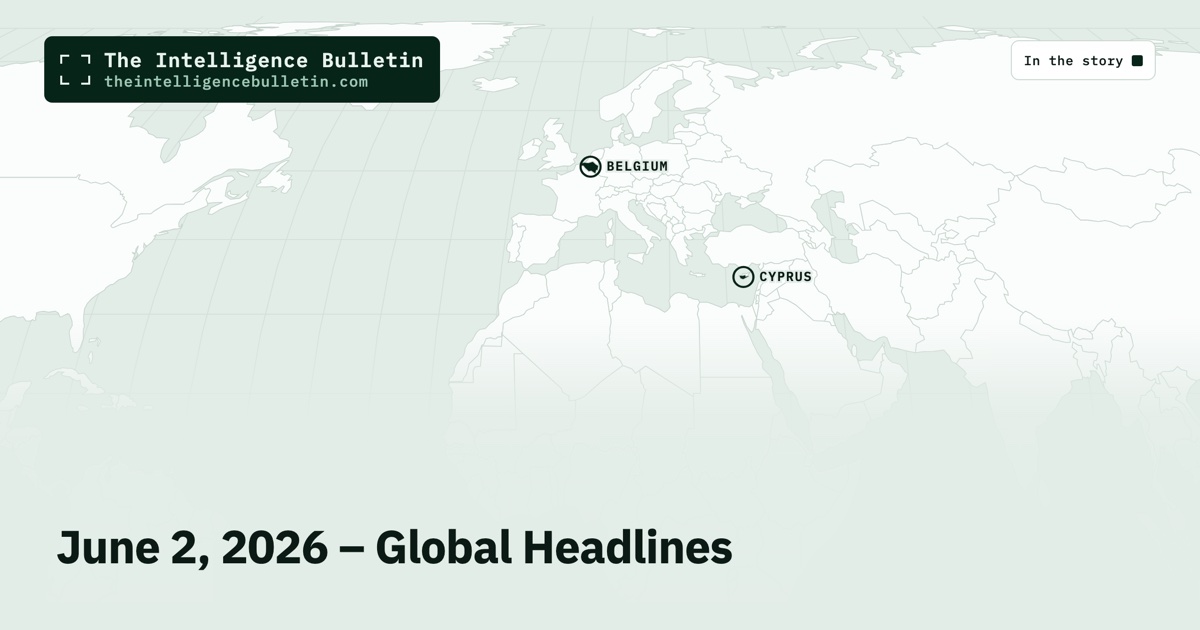
Map of the countries in the story: June 4, 2026 – Global Headlines

1Israel and Lebanon Renew Ceasefire with US-Brokered Security Zones
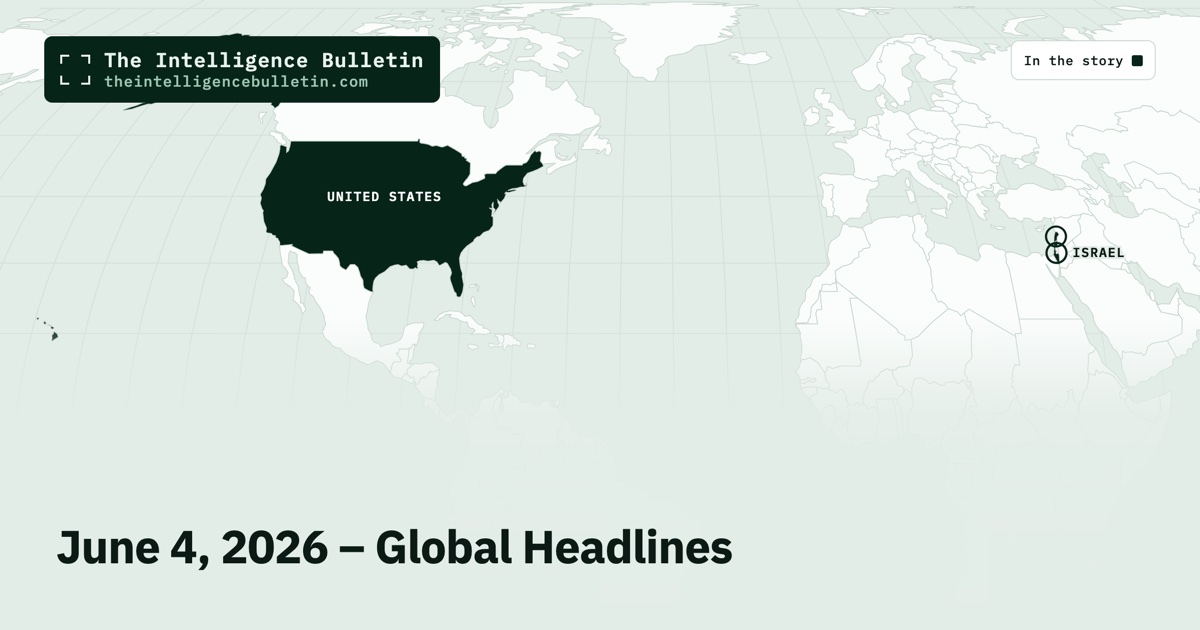
Map of the countries in the story: June 4, 2026 – Global Headlines
Story gist: On June 3 2026 Israel and Lebanon agreed to renew their conditional ceasefire and launch pilot security zones in southern Lebanon. The deal was reached through US mediation in Washington with the Lebanese army controlling the zones and Hezbollah barred from them. The arrangement is presented as a step toward a wider peace accord. Key tension centers on enforcement and exclusion of Hezbollah amid ongoing regional instability.
One Story. Many Angles.
🇸🇦
Saudi Arabia
arabnews.com
Israel, Lebanon agree to renew fragile ceasefire and create Lebanese security zones
Read →
🇸🇪
Sweden
aftonbladet.se
Israel and Lebanon agree
Israel och Libanon överens
Read →
🇩🇰
Denmark
kristeligt-dagblad.dk
Israel and Lebanon have agreed on a ceasefire
Israel og Libanon er blevet enige om en våbenhvile
Read →
Perspective Analysis

The most striking element is how little daylight exists between outlets on the core facts yet how clearly their framing choices reveal deeper priorities. Arab News leads with the word fragile and stresses Lebanese sovereignty plus Hezbollah exclusion, reflecting Riyadh’s long-standing interest in curbing Iranian influence through a Sunni Arab lens that treats any Lebanese state assertion as progress. Aftonbladet’s single terse line simply records that the two sides have reached agreement, consistent with a Nordic newsroom that sees the story primarily through the prism of immediate European stability rather than sectarian score-settling. Kristeligt Dagblad shifts emphasis to the humanitarian and moral relief a truce might bring, a values-driven angle rooted in Denmark’s tradition of linking conflict reporting to questions of civilian protection and reconciliation. The convergence on US mediation as the decisive catalyst is therefore more revealing than any divergence: every outlet treats Washington’s role as indispensable, even while their domestic audiences care about different downstream consequences. This pattern suggests the ceasefire is being read less as a bilateral breakthrough and more as another data point in a wider US-managed containment effort that also includes recent congressional moves on Iran.


2US House Votes to Curb Trump’s Iran War Powers

Story gist: On June 3 2026 the US House passed a resolution requiring congressional authorization before US forces remain engaged in Iran. The measure passed over Republican leadership objections and targets President Trump’s ongoing military actions. It was backed by some Republican absences and Democratic support. The vote highlights tension between executive war powers and congressional oversight in Washington.
One Story. Many Angles.
🇮🇷
Iran
presstv.ir
House approves measure to limit Trumps Iran war powers
Read →
🇨🇳
China
globaltimes.cn
U.S. House votes to limit Trump’s Iran war powers
Read →
🇺🇸
United States
redstate.com
House Passes Iran War Powers Resolution (With Help From 18 GOP Absences)
Read →
Perspective Analysis

Iranian state media at presstv.ir presents the House vote as a necessary check on American aggression, framing it as validation that Trump’s Iran policy has overreached even within the US system. Chinese coverage in globaltimes.cn takes the development one step further, reading the resolution as proof that domestic fractures are eroding Washington’s ability to project consistent power abroad, especially after Trump’s May 31 claim that a nuclear deal with Iran was near. Both outlets treat the congressional action as evidence that US policy toward Iran is no longer coherent, a reading that aligns with their respective interests in portraying American decline. By contrast, redstate.com focuses narrowly on the 18 Republican absences that helped the measure pass, treating the outcome as a procedural quirk rather than a substantive rebuke. This domestic minimization reveals how partisan outlets in the United States work to insulate Trump from institutional pushback. The pattern echoes earlier reporting on Trump’s insistence that military options remain on the table even as talks advanced; now Congress has inserted itself directly into that space. What stands out is not the usual left-right split inside America but the alignment between Tehran and Beijing on the vote’s broader meaning, while Washington conservatives refuse to acknowledge any strategic consequence at all.


3Hungary Ends Veto, Letting EU Open Ukraine Accession Cluster

Story gist: On 2026-06-03 in Brussels, Hungary lifted its two-year veto during an ambassadors’ meeting. All 27 EU states reached unanimity to begin the first negotiation cluster with Ukraine. The move removed the final obstacle to formal accession talks. Regional security concerns and enlargement dynamics shaped reactions across distant capitals.
One Story. Many Angles.
🇸🇬
Singapore
straitstimes.com
All EU members greenlight first step in accession talks, Ukraine PM says
Read →
🇫🇮
Finland
esaimaa.fi
Ukraine’s EU membership aspirations advancing after Hungary drops opposition
Ukrainan EU-jäsenpyrkimykset etenemässä Unkarin luovuttua vastustuksestaan
Read →
🇲🇽
Mexico
zocalo.com.mx
The EU ready to advance accession negotiations with Ukraine
La UE dispuesta a avanzar en las negociaciones de adhesión con Ucrania
Read →
Perspective Analysis

Singapore’s Straits Times placed the Brussels decision inside a wider contest between Russia, China and the West, noting that renewed EU momentum toward Kyiv could recalibrate power balances visible from Asia. Finnish coverage in Esaimaa framed the same veto lift as direct relief for Nordic-Baltic states that now see a clearer buffer against Moscow after years of stalled enlargement. Mexican outlet Zócalo read the development chiefly as evidence of an emerging multipolar order in which economic opportunity, not security alone, drives EU expansion. Despite these distinct entry points, the three accounts converged on one factual core: Hungary’s concession was procedural and irreversible once ambassadors agreed. That narrow agreement across Singapore, Helsinki and Mexico City reveals how little appetite remains for treating the veto as a permanent lever; even outlets far from the front line now treat Ukraine’s accession track as structurally advanced rather than perpetually hostage to one capital. The absence of triumphal language in any of the three reports further suggests that the breakthrough registers less as victory than as overdue housekeeping whose long-term costs and benefits will be measured in markets and defense budgets rather than headlines.


4Gulf States Condemn Iranian Strikes on Kuwait and Bahrain

Story gist: On 2026-06-03 the UAE Ministry of Foreign Affairs issued a statement from Abu Dhabi condemning Iranian drone and missile attacks on Kuwait and Bahrain as violations of sovereignty and international law. Qatar joined with its own condemnation of strikes on civilian targets. The statements express solidarity with the two Gulf states. Linked GDELT data records the UAE action as source actor against Iran as target.
One Story. Many Angles.
🇦🇪
United Arab Emirates
emirates247.com
UAE condemns Iran over drone and missile attacks on Bahrain
Read →
🇶🇦
Qatar
thepeninsulaqatar.com
Qatar strongly condemns Iranian attacks on civilian targets in Kuwait, Bahrain
Read →
🇱🇧
Lebanon
naharnet.com
UAE calls for united Gulf stance after attacks on Kuwait, Bahrain
Read →
Perspective Analysis

The swift alignment of condemnation across Gulf outlets reveals how even longstanding intra-GCC differences yield to immediate territorial red lines when Iran strikes neighbors. Emirates 24/7 presents the UAE statement in its raw official form, underscoring Abu Dhabi’s role as the most consistent hardliner on Iranian actions and its readiness to frame any attack as a collective Gulf threat. The Peninsula Qatar report uses nearly identical language yet inserts the qualifier “civilian targets,” a small but deliberate nod to Doha’s history of managed engagement with Tehran that still allows it to signal solidarity without fully endorsing the UAE’s maximalist posture. Naharnet, writing from Lebanon, shifts emphasis to the UAE’s call for a “united Gulf stance,” an angle that quietly mirrors Beirut’s own calculations: Hezbollah’s Iranian ties make any public fracture inside the GCC potentially costly for Lebanese stability. The convergence is therefore not rhetorical accident but structural signal; with Washington weighing new constraints on Iran and fresh US-Iran tensions already in circulation, Gulf capitals appear to be closing ranks on sovereignty questions before external actors can exploit daylight between them.


5China Bans Four New Zealand MPs Over Taiwan Visit

Story gist: On June 3 2026 China barred four New Zealand MPs from entering mainland China, Hong Kong and Macau for one year after their Taiwan trip. The Chinese Embassy told New Zealand parliament officials the ban could be reduced or lifted if the politicians apologized. The action targets lawmakers from multiple parties including NZ First. No New Zealand government response has been reported.
One Story. Many Angles.
🇨🇳
China
globaltimes.cn
China to impose measures including entry bans on certain New Zealand lawmakers who visited China’s Taiwan region: embassy
Read →
🇱🇹
Lithuania
lrt.lt
China bans New Zealand MPs from entering due to their visit to Taiwan
Kinija uždraudė atvykti Naujosios Zelandijos parlamentarams dėl jų vizito Taivane
Read →
🇹🇷
Turkey
aa.com.tr
China bans 4 New Zealand lawmakers from entering country over visit to Taiwan
Read →
Perspective Analysis

Beijing’s decision to punish the four MPs rests on the explicit condition that an apology would restore access, a detail that reveals how China treats parliamentary travel to Taiwan as reversible political behavior rather than permanent enmity. Global Times framed the measure as routine defense of sovereignty, presenting the embassy’s offer of waiver as evidence of measured response rather than coercion. In contrast, LRT placed the same episode inside Lithuania’s own record of hosting Taiwanese officials and resisting similar pressure, turning a New Zealand story into confirmation that Baltic defiance carries measurable diplomatic costs. Anadolu Agency reported the identical facts without the waiver clause or regional parallel, treating the episode as one more data point in routine great-power friction. The variation shows that outlets aligned with the actors most exposed to Chinese economic leverage still record the event but strip away the conditional language that Beijing uses to signal flexibility. What stands out is the absence of any New Zealand domestic political reaction in any of the three accounts, suggesting the story’s immediate value lies in how third countries read Beijing’s willingness to calibrate punishment according to the target’s willingness to recant.
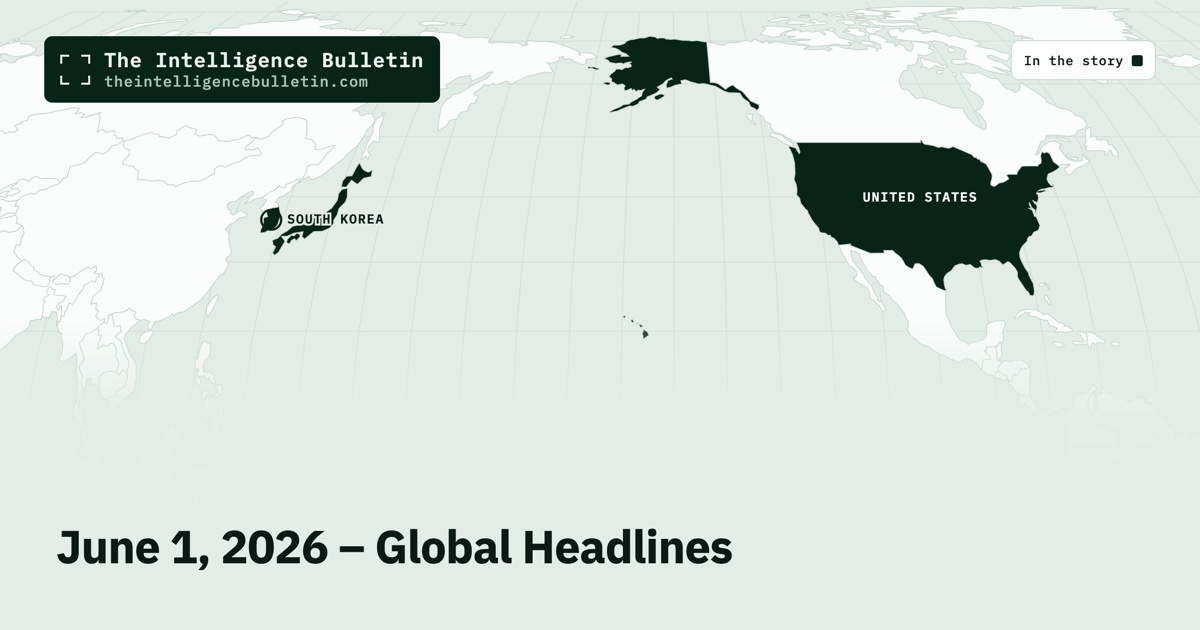
June 3, 2026 – Global Headlines

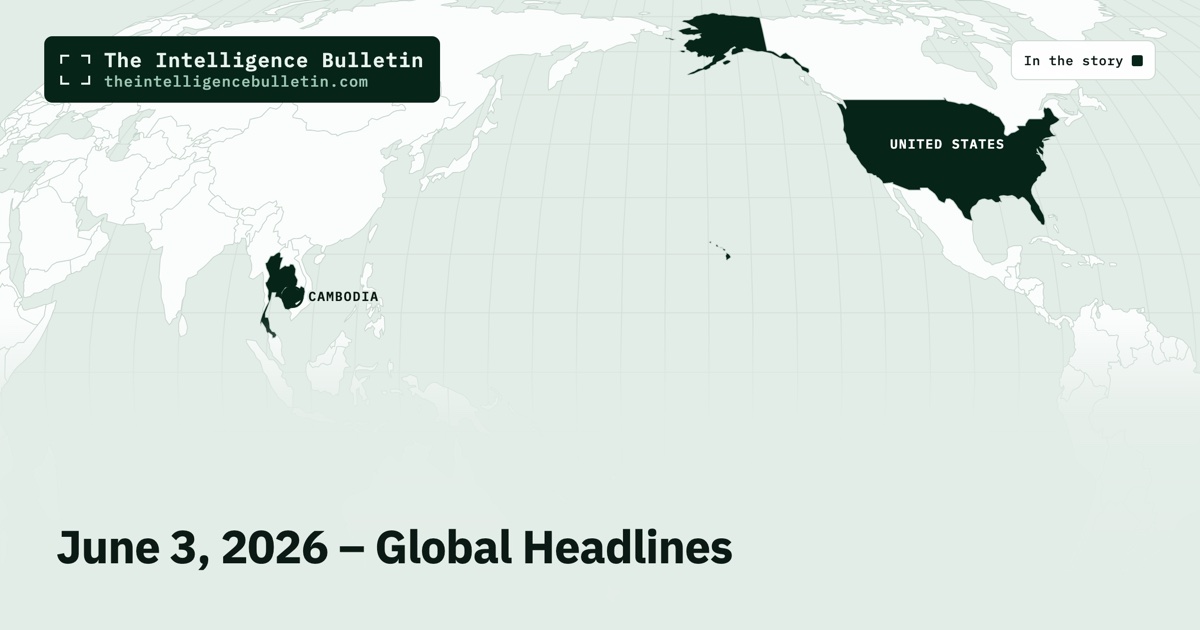
Map of the countries in the story: June 3, 2026 – Global Headlines

1Cambodia Launches UN Conciliation on Gulf of Thailand Boundary

Map of the countries in the story: June 3, 2026 – Global Headlines
Story gist: On 2026-06-02 Cambodia initiated a UN-backed conciliation process under UNCLOS to settle its overlapping maritime claims with Thailand in the resource-rich Gulf of Thailand. The move targets a long-standing boundary dispute. Thailand’s prime minister stated he had no prior knowledge of the filing. Cambodian and US reporting both confirm the procedural step while differing in emphasis on intent and mechanism.
One Story. Many Angles.
🇺🇸
United States
whbl.com
Explainer: Cambodia turns to obscure UN process to resolve maritime dispute with Thailand
Read →
🇰🇭
Cambodia
phnompenhpost.com
Navigating Uncharted Waters: Cambodia’s UNCLOS Strategy to Resolve the Gulf of Thailand Dispute
Read →
Perspective Analysis

Cambodia’s decision to invoke the rarely used conciliation procedure under UNCLOS rather than direct bilateral talks or ASEAN mechanisms signals a deliberate shift toward external legal leverage. The Phnom Penh Post frames the filing as a calculated assertion of Cambodian rights in waters that hold potential hydrocarbon reserves, presenting it as navigation through uncharted legal waters to strengthen Phnom Penh’s position. By contrast, the US-based WHBL explainer focuses on the procedural obscurity of the mechanism itself, treating the story as an illustration of how states can activate little-known UN pathways when bilateral progress stalls. Both outlets record the same core event and note Thai Prime Minister Anutin Charnvirakul’s claim of surprise, yet the Cambodian piece supplies strategic rationale while the American account withholds judgment on motives. This convergence on facts alongside divergence in emphasis reveals how proximity to the dispute shapes coverage: the Cambodian outlet supplies the claimant’s rationale that external reporting omits, while the US outlet supplies procedural context that local commentary assumes readers already grasp. The absence of Thai-sourced material in the cluster further underscores the one-sided initiation of the process, leaving Bangkok’s response to be inferred rather than reported.


2Canada Requests 16-Year Renewal of USMCA Trade Pact

Story gist: On June 2 2026 Trade Minister Dominic LeBlanc sent formal letters to the United States and Mexico urging renewal of the CUSMA agreement for another 16 years. The step fulfills the pact’s mandatory review clause and precedes talks in Washington the same day. Canada stated that sectoral tariff discussions must form part of any extension. The request targets the agreement originally signed under the Trump administration and now facing its first scheduled review.
One Story. Many Angles.
🇬🇧
United Kingdom
BBC
Canada formally requests renewal of USMCA North American free trade pact
Read →
🇹🇷
Turkey
Anadolu Agency
Canada eternally optimistic on extending North American trade pact for 16 years
Read →
Perspective Analysis

The Canadian move arrives at a moment when Washington is openly weighing new tariffs on multiple trading partners, yet both the BBC and Anadolu Agency reports treat Ottawa’s letter as a straightforward procedural act rather than a defensive maneuver. The BBC frames the request as an effort to lock in diplomatic stability across North America, emphasizing the formal channel and the scheduled Washington meetings. Anadolu instead lingers on Canada’s stated optimism that the 16-year extension can be secured, presenting the language of the letter itself as evidence of confidence. The difference is tonal rather than factual: one outlet situates the story inside the wider pattern of managed alliance relations, while the other isolates Canada’s forward-leaning posture. Neither account references the specific sectoral tariffs Ottawa wants on the table, nor the parallel US tariff threats against Brazil and Mexico that were reported the same week. That shared omission suggests the outlets are reading the Canadian letter primarily as an assertion of continuity rather than as a bid to constrain future US leverage. The result is coverage that registers the procedural milestone but leaves the underlying bargaining pressure—tariffs, review timelines, and the 2028 US election cycle—largely unexamined.


3Sheinbaum Tells U.S. Ambassador to Avoid Mexico’s Domestic Politics

Story gist: On June 2 2026 Mexican President Claudia Sheinbaum publicly rebuked U.S. Ambassador Ronald Johnson after he posted on X calling for joint action against drug cartels. Sheinbaum stated that Johnson should refrain from commenting on Mexico’s internal political matters. The exchange took place in Mexico City amid ongoing bilateral security coordination. Johnson’s message stressed shared threats and warned against politicization of the issue.
One Story. Many Angles.
🇲🇽
Mexico
diarioportal.com
Sheinbaum urges Ambassador Johnson not to interfere in Mexico’s internal politics
Sheinbaum exhorta al embajador Johnson a no meterse en la política interna de México
Read →
🇺🇸
United States
upi.com
Mexico’s Sheinbaum to U.S. ambassador: Hands off my country’s politics
Read →
Perspective Analysis

The Mexican outlet frames the exchange as a necessary defense of sovereignty, casting Johnson’s public appeal as an overstep that touches domestic political sensitivities around cartel policy. This angle aligns with longstanding Mexican caution over U.S. officials shaping internal debates, especially under a president who succeeded López Obrador and must manage relations with both Washington and powerful domestic actors. By contrast the U.S. wire service presents the moment as routine diplomatic friction, focusing on the ambassador’s call for coordination without dwelling on sovereignty claims. The divergence reveals how proximity shapes emphasis: Mexican coverage treats any U.S. public statement on cartels as potentially intrusive given the Sinaloa Cartel’s deep local entanglements, while the American account views the same statement as standard exhortation for joint enforcement. Both accounts nevertheless converge on the core sequence—Johnson’s post followed by Sheinbaum’s direct reply—indicating that the underlying tension over who sets the terms of anti-cartel cooperation remains unresolved and politically charged on both sides of the border.


4Trump Proposes 25% Tariffs on Brazil Over Trade Practices

Story gist: On June 2 2026 the US Trade Representative proposed 25% tariffs on Brazilian imports under Section 301, citing unreasonable trade practices with possible effect in July. Brazilian politicians including the Bolsonaro family immediately began domestic efforts to limit damage. The announcement coincides with separate US trade talks involving Canada and Mexico under USMCA.
One Story. Many Angles.
🇦🇷
Argentina
El Destape
Trump Government proposes 25% tariff on Brazil over trade practices
El Gobierno de Trump propone un arancel del 25% a Brasil por sus practicas comerciales
Read →
🇧🇷
Brazil
Gazeta do Povo
Flávio Bolsonaro and PL seek ways to counter US tariffs
Flavio Bolsonaro e PL articulam saida para tarifaco dos EUA
Read →
🇲🇽
Mexico
Proceso
Trump government proposes 25 percent tariffs on Brazil
Gobierno de Trump propone aranceles de 25 por ciento a Brasil
Read →
Perspective Analysis

The most revealing split is not between support and opposition but between those who treat the tariff proposal as a hemispheric event and those who treat it as a strictly Brazilian domestic problem. El Destape places the measure inside a long pattern of US economic leverage over Latin American governments, presenting it as continuity rather than rupture. Proceso widens the frame further by linking the Brazil tariffs to simultaneous USMCA renegotiation pressure on Mexico and Canada, implying a single US strategy of using Section 301 across the Americas. Gazeta do Povo, by contrast, barely mentions the justification or regional context and instead tracks how Flavio Bolsonaro and the PL party are positioning themselves to negotiate exemptions or delays, turning the story into an intra-Brazilian political contest. This divergence tracks the outlets’ primary audiences: Argentine and Mexican readers receive a narrative of shared vulnerability, while the Brazilian conservative paper assumes readers care most about how opposition figures can blunt the blow. The absence of any source framing the tariffs as legitimate reciprocity underscores how little appetite exists in the region for accepting the US rationale at face value, even among outlets normally critical of Lula.


5Russia Rejects Romanian Drone Claims at UN Security Council

Story gist: On June 2 2026 at UN Headquarters in New York, Russia’s ambassador dismissed Romania’s account of an alleged drone incursion over Galați. Romania and 56 other states condemned Russia during the session, while Moscow accused the West of fabricating the incident and fueling anti-Russian hysteria. The meeting followed Romania’s earlier assertions of airspace violation by a Russian drone.
One Story. Many Angles.
🇩🇪
Germany
dw.com
The Drone from Galați: Romania and Russia Clash at the UN
Drona de la Galați: România și Rusia, confruntare la ONU
Read →
🇨🇦
Canada
tolerance.ca
LIVE – Security Council examines repercussions of alleged Russian drone incursion in Romania
Tolerance.ca® – EN DIRECT – Le Conseil de sécurité examine les répercussions d’une présumée incursion de drone russe en Roumanie
Read →
Perspective Analysis

The unusual breadth of condemnation—fifty-six countries joining Romania—points to more than routine diplomatic theater. It suggests NATO members and partners see value in locking in a public record of Russian overflight at a moment when supply lines to Ukraine remain under pressure and European airspace rules are being tested daily. German coverage from dw.com frames the exchange as a direct alliance test, underscoring how Berlin views any Romanian incident as immediately relevant to collective defense commitments rather than a bilateral Romanian-Russian matter. By contrast, the Canadian French-language summary from tolerance.ca stays inside the procedural lane, recording the statements without attaching them to NATO infrastructure or Black Sea security. That difference is not accidental. German public broadcasting operates inside a political culture that treats Russian military activity near alliance borders as an immediate institutional concern, while a Canadian outlet serving Francophone readers has less incentive to foreground alliance mechanics and more room to present the session as another UN procedural clash. Both accounts nevertheless converge on the same core sequence: Russian denial, Romanian accusation, and a wide chorus of support for Bucharest. The convergence itself is the signal. When outlets separated by language, distance, and editorial tradition describe the same set of statements and the same tally of supporting states, the episode registers as settled diplomatic fact rather than contested narrative. That consensus, reached within hours inside the Security Council chamber, matters more than the modest variance in emphasis between the two reports.


June 2, 2026 – Global Headlines

Map of the countries in the story: June 2, 2026 – Global Headlines

1EU Approves Return Hubs for Deporting Rejected Asylum Seekers

Map of the countries in the story: June 2, 2026 – Global Headlines
Story gist: On June 1 2026 the European Parliament and EU member states agreed on tougher return rules that include creating return hubs in third countries for rejected asylum seekers. The Cypriot EU Council presidency announced the deal after an interior ministers meeting in Brussels; it still requires final approval. Cyprus President Nikos Christodoulides welcomed the outcome while the policy targets faster deportations of those denied protection. The measure affects rejected asylum seekers across the bloc.
One Story. Many Angles.
🇨🇾
Cyprus
Cyprus Mail
Christodoulides hails new EU migrant return deal
Read →
🇨🇦
Canada
Winnipeg Free Press
EU strikes migration deal for more deportations and detention centers abroad
Read →
Perspective Analysis

Cyprus Mail leads with President Christodoulides hailing the deal because Cyprus sits on the EU’s southeastern edge where irregular arrivals from the eastern Mediterranean have long strained reception capacity. The outlet frames the agreement as a practical victory for frontline states that have pressed for years for shared responsibility on returns. Winnipeg Free Press instead opens on the mechanics of expanded deportations and offshore detention centers, reflecting a Canadian vantage that views the policy primarily through the lens of enforcement scale rather than geographic pressure. Both accounts converge on the same core facts: the hubs are meant to accelerate removals once asylum claims fail and the text still needs formal ratification. That convergence signals how the return-hubs concept has moved from contested idea to negotiated text inside the EU institutions without the usual north-south split surfacing in initial reporting. The absence of quoted opposition in either dispatch suggests the compromise satisfied enough interior ministers that public controversy has been deferred until the final vote. For Cyprus the stakes are immediate capacity relief; for a Canadian reader the story registers as another data point in Europe’s tightening migration toolkit.


2India and US Open Four-Day Talks on Interim Trade Pact

Story gist: On 2026-06-01, US and Indian negotiators began four days of talks in New Delhi on an interim Bilateral Trade Agreement. US negotiator Brendan Lynch and Indian counterpart Darpan Jain are addressing market access, tariffs and non-tariff barriers. Indian Commerce Minister Piyush Goyal stated the two sides are close to finalising the first tranche. The talks occur against the backdrop of broader US trade policy under the Trump administration.
One Story. Many Angles.
🇮🇳
India
dailyk2.com
India, US Close to Finalising First Tranche of Bilateral Trade
Read →
🇮🇳
India
orissapost.com
India-US trade talks begin today: Key issues to watch
Read →
Perspective Analysis

Both Indian outlets frame the New Delhi talks as a moment of tangible bilateral momentum rather than a routine negotiation round. Dailyk2.com highlights Piyush Goyal’s claim that the first tranche is nearly complete, presenting the process as evidence that India can secure early deliverables even with a US administration known for tariff pressure. Orissapost.com instead lists the concrete sticking points—market access for US dairy and almonds, Indian demands on textiles and gems—yet still treats the four-day schedule itself as proof that structured progress is underway. The shared emphasis on Indian ministerial statements and New Delhi’s timeline reflects how domestic coverage converts technical talks into a narrative of managed asymmetry: India appears proactive and prepared while the United States is cast as the demanding but still engaged partner. This convergence is notable because the cluster metadata also flags Trump and the US Trade Representative as central actors; neither outlet lingers on Washington’s leverage or on potential spillover from Trump’s recent Iran and Hormuz comments. The result is coverage that treats the interim agreement as an Indian-managed process whose outcome will be judged by which sectors gain incremental relief rather than by any larger geopolitical reset.


3Berri Pledges to Guarantee Hezbollah Ceasefire with Israel

Story gist: On June 1 2026 a representative of Lebanese Parliament Speaker Nabih Berri told the US ambassador in Beirut that Hezbollah is ready to commit to a comprehensive ceasefire with Israel and will guarantee its implementation. The statement was relayed through Berri’s aide Ali Hamdan. The move involves direct US diplomatic contact in Lebanon amid broader regional actors including Iran and Israel.
One Story. Many Angles.
🇱🇧
Lebanon
naharnet.com
Berri to guarantee Hezbollah respect for global truce with Israel
Read →
🇸🇦
Saudi Arabia
arabnews.com
Lebanon speaker to guarantee Hezbollah respect for global truce with Israel adviser
Read →
🇿🇦
South Africa
news24.com
Lebanon announces partial ceasefire between Hezbollah and Israel
Read →
Perspective Analysis

The most striking element is how quickly Berri’s role as intermediary has been accepted across outlets despite their differing regional stakes. Naharnet frames the development as an internal Lebanese political maneuver that strengthens the speaker’s hand in domestic power arrangements between Hezbollah and other factions. Arab News places the same statement inside a Gulf narrative that treats any Hezbollah restraint as a tactical concession extracted under pressure rather than a genuine shift. News24 reports the announcement with minimal elaboration on Lebanese domestic politics and instead situates it within wider global diplomatic patterns involving the United States. The convergence on the core fact—that Berri offered a guarantee through the US ambassador—suggests the channel itself is viewed as credible even by sources that normally diverge sharply on Hezbollah’s intentions. This consensus appears driven by the direct attribution to Berri’s office rather than anonymous claims, giving outlets with otherwise opposing alignments little room to dispute the transmission of the message. The absence of competing Lebanese voices in the initial reporting further narrows the story to a single authorized channel, which in turn limits how far any outlet can stretch the narrative without new sourcing.


4Philippines Stages 21-Gun Salute for Vietnam Leader To Lam

Story gist: On 2026-06-01 Philippine President Ferdinand Marcos Jr hosted Vietnamese leader To Lam at Malacañang Palace for an official arrival ceremony that included full military honors and a 21-gun salute. The event marked the start of Lam’s state visit. Vietnamese state and commercial media both presented the protocol as evidence of strengthened bilateral ties. No other substantive agreements were announced on the first day.
One Story. Many Angles.
🇻🇳
Vietnam
vietnamnews.vn
Philippine President hosts official welcome ceremony for Vietnam’s top leader
Read →
🇻🇳
Vietnam
news.tuoitre.vn
Philippines welcomes Vietnam’s top leader To Lam with 21-gun salute
Read →
Perspective Analysis

Vietnamese coverage converged on the ceremonial details of the arrival as proof that Hanoi’s top leader commands formal respect in Manila. Vietnam News, the official wire, stayed strictly within protocol language, listing the salute, guard of honor and the two leaders’ handshake without adding context on disputed waters or trade volumes. Tuoi Tre, while also Vietnamese, chose the same 21-gun-salute fact but placed it in a headline that spoke directly to domestic readers, framing the moment as national prestige rather than dry diplomacy. The near-identical emphasis on military pageantry, rather than any economic or security deliverables, reveals how both outlets treat the optics of the visit itself as the central message for Vietnamese audiences. That shared focus suggests the trip’s value, from Hanoi’s perspective, lies first in visible parity with a fellow ASEAN capital before any later announcements on fishing rights or supply-chain deals.


5Russia Rejects Romanian Drone Claims at UN Security Council

Story gist: On 2026-06-02 at UN Headquarters in New York, Russia’s ambassador dismissed Romania’s accusations of a drone incursion over Galați during a Security Council session. Romania joined 56 other countries in condemning Russia, which countered by accusing Bucharest and the West of fabricating claims and fueling anti-Russian media hysteria. The exchange centers on disputed airspace violations between Russia and a NATO member.
One Story. Many Angles.
🇩🇪
Germany
dw.com
Galați drone: Romania and Russia confrontation at the UN
Drona de la Galați: România și Rusia, confruntare la ONU
Read →
🇨🇦
Canada
tolerance.ca
Security Council examines repercussions of alleged Russian drone incursion into Romania
Tolerance.ca® – EN DIRECT – Le Conseil de sécurité examine les répercussions d’une présumée incursion de drone russe en Roumanie
Read →
Perspective Analysis

The coverage converges on a straightforward procedural clash at the UN, where Russia pushed back against coordinated condemnation rather than engaging the incident’s technical details. This alignment across outlets reveals how the event functions less as a bilateral dispute and more as a test of institutional responses to alleged cross-border violations involving a NATO state. DW’s Romanian-language report, shaped by its German public-broadcast mandate, situates the confrontation within the broader eastern-flank security architecture, highlighting Romania’s position as a frontline actor without dwelling on evidentiary disputes. Tolerance.ca’s live French update, by contrast, stays tightly focused on the Council’s procedural sequence and the number of countries aligning against Russia, treating the session as an instance of multilateral signaling rather than a security escalation. The absence of competing narratives in these accounts suggests that, for both European and North American Francophone audiences, the story registers primarily as confirmation of predictable bloc dynamics at the UN rather than an opening for new diplomatic maneuvering. What stands out is how little space is given to verifying the drone’s origin or trajectory; the emphasis remains on the diplomatic theater itself and the speed with which 56 states lined up behind Romania’s position.


June 1, 2026 – Global Headlines

Map of the countries in the story: June 1, 2026 – Global Headlines

1South Korea and Japan Discuss Military Logistics Pact in Singapore

Map of the countries in the story: June 1, 2026 – Global Headlines
Story gist: On May 31 2026 South Korean Defense Minister Ahn Gyu-back said Seoul and Tokyo discussed a bilateral Acquisition and Cross-Servicing Agreement during defense talks at the Shangri-La Dialogue. The pact would allow mutual logistics support but requires public backing in both countries. No agreement was reached. The discussion occurred against decades of strained relations between the two US allies.
One Story. Many Angles.
🇬🇧
United Kingdom
nknews.org
ROK, Japan discussed potential military logistics agreement, Seoul says
Read →
🇮🇳
India
moneycontrol.com
South Korea treads carefully as military support pact with Japan gains momentum
Read →
Perspective Analysis

The quiet disclosure that Seoul and Tokyo are once again weighing a logistics pact at the Shangri-La Dialogue reveals how incremental military cooperation can advance even when political memory remains raw. NK News, drawing on its Korea specialist lens, simply records Ahn Gyu-back’s statement that the idea was raised and that any deal would need domestic support, treating the exchange as routine bilateral business. Moneycontrol, alert to Indo-Pacific ripple effects, instead stresses the deliberate pace Seoul is setting, noting the political caution that still governs every step. Both accounts converge on the same core fact: the two sides talked, nothing was signed, and public sentiment remains the decisive brake. That convergence itself is the signal. It shows how far the relationship has moved from outright refusal to conditional exploration without either capital yet willing to declare the historical disputes resolved. The location in Singapore matters too; it places the conversation inside a regional security forum where Washington’s presence is assumed rather than negotiated, allowing Tokyo and Seoul to test practical arrangements while keeping the optics low. The absence of any reported economic modeling in the coverage underscores that the immediate stakes are still political legitimacy at home, not yet supply-chain calculations. Readers watching similar quiet advances between other former antagonists will recognise the pattern: progress measured in what is no longer ruled out rather than what has been formally embraced.


2To Lam Receives Formal Welcome with 21-Gun Salute in Manila

Story gist: On June 1 2026 Philippine President Ferdinand Romualdez Marcos Jr. hosted Vietnamese leader Tô Lâm at Malacañang Palace for an official arrival ceremony that included military honors and a 21-gun salute. The event opened Lâm’s state visit to the Philippines. Both outlets record the protocol sequence without reference to agenda items or regional disputes.
One Story. Many Angles.
🇻🇳
Vietnam
vietnamnews.vn
Philippine President hosts official welcome ceremony for Viet Nam’s top leader
Read →
🇻🇳
Vietnam
news.tuoitre.vn
Philippines welcomes Vietnam’s top leader To Lam with 21-gun salute
Read →
Perspective Analysis

Vietnamese state media presented the 21-gun salute as the central fact of the day, treating the ceremonial sequence itself as evidence of Vietnam’s diplomatic weight. Vietnam News framed the arrival through the language of protocol and socialist fraternity, listing the exact honors extended by the Philippine side and positioning the visit as a routine yet elevated exchange between two party-led states. Tuoi Tre, aimed at a younger domestic audience, placed the same salute at the center of its account but stressed the visual pageantry and the implied national pride that such honors confer on the Vietnamese delegation. The two accounts converge on the absence of any policy detail or mention of the South China Sea; both treat the gun salute as the story’s entire payload. This convergence reveals a shared editorial choice to let the optics of state recognition stand in for substance, a pattern consistent with Vietnamese coverage of high-level visits that prioritizes the projection of parity with ASEAN partners. The Philippine host is named but never quoted, underscoring that the narrative is calibrated for Vietnamese readers rather than bilateral signaling. In a week when other regional stories involved explicit security pacts or ceasefire conditions, the decision to lead with ceremony alone signals that Hanoi views the optics of this particular welcome as sufficient message.


3Iran Links Lebanon Ceasefire to Any US Nuclear Deal

Story gist: On June 1 2026 Iran’s foreign ministry spokesman Esmaeil Baqaei stated in Tehran that a ceasefire in Lebanon remains an essential condition for any agreement with the United States to end the Middle East war. The remark came during a weekly press briefing and directly tied Lebanese developments to ongoing US-Iran diplomacy. This follows President Trump’s May 31 comments that a nuclear deal was close but required stricter terms. The position maintains Iran’s leverage amid stalled negotiations and regional tensions.
One Story. Many Angles.
🇮🇳
India
deccanchronicle.com
Iran Foreign Ministry Says Ceasefire in Lebanon Remains Condition for US Deal
Read →
🇲🇾
Malaysia
freemalaysiatoday.com
Iran says ceasefire in Lebanon remains condition for US deal
Read →
🇸🇬
Singapore
straitstimes.com
Iran says ceasefire in Lebanon remains part of peace deal
Read →
Perspective Analysis

Iran’s insistence that Lebanon must quiet before any US deal lands at a moment when Washington is already juggling multiple Middle East files, from Strait of Hormuz warnings to fresh ceasefire talks led by Marco Rubio. The three Asian outlets covering the statement all carried nearly identical accounts of Baqaei’s briefing, underscoring how little interpretive room the Iranian line itself leaves. Deccan Chronicle’s version sits comfortably within India’s long-standing practice of reporting Tehran and Washington without taking sides, reflecting New Delhi’s need to keep energy channels open while courting US technology. Free Malaysia Today adds the same factual core but places it against a domestic readership attuned to Arab grievances, so the Lebanese condition reads as a natural Iranian counterweight rather than an obstacle. The Straits Times, by contrast, frames the episode through Singapore’s port-city lens, noting how any prolonged standoff risks further oil-price spikes that would hit global shipping lanes. What unites the three accounts is an absence of speculation about Netanyahu or Revolutionary Guard reactions; the story is treated as a narrow diplomatic signal rather than the start of a new escalation cycle. That restraint mirrors the GDELT event data itself, which records a modest significance score and low market sensitivity, suggesting traders and governments alike are treating the Lebanese precondition as familiar posturing rather than a breakthrough demand. Previous TIB reporting showed Trump returning a draft for tougher terms; Baqaei’s comment now supplies the Iranian reply, keeping the talks in the same holding pattern without yet forcing a public rupture.


4Rubio Pushes Fresh Israel-Lebanon Ceasefire Initiative

Story gist: On June 1 2026 US Secretary of State Marco Rubio held talks with Lebanese President Joseph Aoun and Israeli Prime Minister Benjamin Netanyahu to advance a new ceasefire proposal. The plan seeks to pause fighting and open space for further diplomatic rounds in Washington later that week. Hezbollah remains the central Lebanese actor shaping both Israeli and US calculations. The initiative coincides with separate Iranian statements tying any US nuclear deal to a Lebanon ceasefire.
One Story. Many Angles.
🇮🇷
Iran
iranherald.com
Rubio leading efforts for Israel-Lebanon ceasefire, announcement expected Tuesday: Reports
Read →
🇮🇳
India
aninews.in
Rubio leading efforts for Israel-Lebanon ceasefire, announcement expected Tuesday: Reports
Read →
🇵🇰
Pakistan
geo.tv
US proposes new plan to ease Israel-Lebanon tensions amid fighting
Read →
Perspective Analysis

The three outlets converge on the same core facts—Rubio as the lead US interlocutor, Aoun and Netanyahu as direct counterparts, and an expected announcement timeline—yet each filters the development through its own strategic priors. Iranherald.com presents the US move as an effort still constrained by Hezbollah’s battlefield position, reflecting Tehran’s long-standing view that any durable pause must accommodate the group’s political and military weight rather than isolate it. Aninews.in reports the same sequence without that qualifier, consistent with New Delhi’s expanding defense and intelligence coordination with both Washington and Jerusalem. Geo.tv emphasizes regional skepticism, noting that past US-brokered arrangements have repeatedly tilted outcomes toward Israeli security demands. This pattern of factual alignment alongside tonal divergence reveals a story whose basic parameters are no longer contested, while the deeper question of whether Hezbollah will be treated as a veto player or an obstacle continues to divide external observers along predictable geopolitical lines. The linkage to the stalled Iran nuclear track, raised explicitly by Tehran, further anchors the Lebanon file inside a wider US-Iran bargaining arena rather than as a standalone bilateral dispute.


5US and Cuban Commanders Meet Briefly at Guantanamo Perimeter

Story gist: On May 31 2026, Gen. Francis L. Donovan of US Southern Command met senior Cuban military leaders along the Guantanamo Bay Naval Station perimeter. The sides discussed operational security and agreed to maintain communication. The encounter occurred amid long-standing US-Cuba frictions over the base lease and regional influence. No further commitments were announced.
One Story. Many Angles.
🇨🇴
Colombia
Radio Santa Fe
US and Cuban military commanders meet at Guantánamo
Mandos militares de EE.UU. y Cuba se reunieron en Guantánamo
Read →
🇺🇸
United States
The Epoch Times
US Commander Meets With Cuban Military Leaders During Guantanamo Bay Visit
Read →
Perspective Analysis

The meeting itself was modest: a short exchange on security protocols between US Southern Command and Cuban officers at the fence line. What stands out is how little the coverage diverges despite the outlets’ different origins. Radio Santa Fe, writing from Colombia, presents the contact as routine diplomacy within a familiar pattern of US-Cuban friction, treating the base as a permanent regional fact rather than an ideological flashpoint. The Epoch Times, by contrast, frames the same encounter as evidence of Cuban regime rigidity, underscoring the anti-communist lens typical of its US editorial line. Both accounts rest on the same US Southern Command statement and Cuban acknowledgment that channels will stay open. The absence of alarm or celebration in either report suggests the event registers as procedural continuity rather than breakthrough or provocation, consistent with the low Goldstein score and zero market sensitivity recorded in the underlying data. In a week when US-Iran talks and Israel-Lebanon ceasefire efforts dominate headlines, this Guantanamo exchange draws notice mainly because two ideologically distant outlets describe it in nearly identical terms.


May 31, 2026 – Global Headlines

Map of the countries in the story: May 31, 2026 – Global Headlines

1Trump Says Iran Deal Near but Demands Tougher Terms

Map of the countries in the story: May 31, 2026 – Global Headlines
Story gist: On May 31 2026 President Donald Trump said the United States was close to a nuclear agreement with Iran but had returned a draft for stricter conditions. He stated Iran had agreed to forgo nuclear weapons while warning military force remained an option if talks collapsed. The remarks came from Washington during ongoing bilateral negotiations that also referenced Hezbollah and regional security concerns.
One Story. Many Angles.
🇮🇱
Israel
i24news.tv
Trump Amends Iran Proposal
Read →
🇸🇦
Saudi Arabia
english.aawsat.com
Trump Says Iran Has Agreed to No Nuclear Weapons
Read →
🇮🇳
India
timesofindia.indiatimes.com
Trump Claims Iran Has Agreed to No Nuclear Weapons
Read →
Perspective Analysis

The most revealing thread across these reports is not disagreement over facts but the precise national interest each outlet inserts into Trump’s claim of an imminent deal. i24news.tv anchors the story in Israel’s security calculus, stressing that any agreement must neutralize maritime threats and Hezbollah’s arsenal rather than simply cap centrifuges. This produces a narrative in which Trump’s demand for tougher terms is presented as validation of maximum-pressure logic that Tel Aviv has long advocated. english.aawsat.com, by contrast, foregrounds verifiable restrictions that would constrain Iran’s regional projection, reflecting Riyadh’s priority that any deal must demonstrably limit Tehran’s ability to arm proxies from Yemen to Lebanon. The Saudi framing therefore treats the returned draft as evidence that Washington is finally aligning with Gulf demands for ironclad inspections. timesofindia.indiatimes.com folds the same statements into India’s energy-security lens, noting that a completed accord could ease oil-market volatility while preserving New Delhi’s diplomatic room to engage both Washington and Tehran. What unites the three accounts is the shared recognition that Trump’s public posture—progress claimed, yet leverage retained—serves distinct regional objectives without yet resolving them. The absence of any source questioning the underlying claim of Iranian concessions suggests the story’s global signal stems less from new intelligence than from capitals updating their own red lines in real time.


2Hegseth Softens China Tone at Singapore Defense Forum

Story gist: On May 30 2026 U.S. Defense Secretary Pete Hegseth spoke at the Shangri-La Dialogue in Singapore. He acknowledged alarm over China’s military buildup yet called for a respectful regional balance and avoided direct confrontation. The remarks came as Pacific allies watched for signs of sustained U.S. commitment. Coverage from Azerbaijan, Spain and Puerto Rico tracked the shift in phrasing and its implications for alliance reassurance.
One Story. Many Angles.
🇦🇿
Azerbaijan
news.az
Hegseth softens stance on China during Asian forum
Read →
🇪🇸
Spain
elmundo.es
Hegseth softens tone toward China but reaffirms US military commitment to Pacific allies
Hegseth suaviza su tono hacia China, pero reafirma el compromiso militar de EEUU con sus aliados del Pacífico
Read →
🇵🇷
Puerto Rico
elvocero.com
Hegseth seeks to reassure Asian allies amid tensions
Hegseth busca tranquilizar a aliados asiáticos entre tensiones
Read →
Perspective Analysis

The most striking element is how three outlets with little in common converged on the same observation: Hegseth deliberately lowered the temperature. News.az, reflecting Azerbaijan’s multipolar outlook, presented the change as evidence that Washington recognizes limits on its ability to dictate terms in Asia. El Mundo, writing from a NATO capital, stressed that the softer language was paired with explicit pledges to Pacific partners, framing the episode as alliance maintenance rather than retreat. El Vocero, from Puerto Rico, focused on downstream effects for U.S. territories in the Pacific, treating the reassurance as a practical matter of extended deterrence. The common thread is the absence of triumphalist rhetoric; each outlet instead recorded a calculated calibration aimed at keeping dialogue open while signaling steadiness to allies. That calibration matters because the Shangri-La Dialogue is one of the few venues where defense ministers from China, the United States and Southeast Asian states still meet in the same room. By choosing measured phrasing, Hegseth preserved space for continued contact without conceding ground on capability concerns. The outlets’ differing geographic lenses simply illustrate how the same tactical adjustment registers as strategic adjustment in Baku, reassurance in Madrid, and immediate security arithmetic in San Juan.


3Israel Strikes Near Beaufort Castle After Warnings in South Lebanon

Story gist: On 2026-05-30, Israeli air and artillery forces struck areas near Beaufort castle in southern Lebanon, Lebanon’s National News Agency reported. Fighting continued in villages near Nabatieh with no fatalities recorded. The strikes followed Israeli warnings and involved the Israel Defense Forces against Hezbollah positions. The action forms part of ongoing cross-border exchanges between Israel and the Lebanese militant group.
One Story. Many Angles.
🇸🇦
Saudi Arabia
english.aawsat.com
PM Says Lebanon Facing Dangerous Israeli Escalation
Read →
🇺🇸
United States
yahoo.com
Israel launches more south Lebanon strikes after warnings
Read →
🇫🇷
France
spacewar.com
Israel launches more south Lebanon strikes after warnings
Read →
Perspective Analysis

The narrow reporting window reveals a telling convergence on operational facts that still masks sharper differences in emphasis. English.aawsat.com leads with Lebanon’s prime minister declaring a “dangerous Israeli escalation,” anchoring the story in Beirut’s vulnerability and the risk of wider regional spillover rather than the mechanics of the strikes themselves. Yahoo.com instead foregrounds the sequence of Israeli warnings that preceded the bombardment, treating the action as a calibrated response whose legitimacy rests on prior signals to Hezbollah. Spacewar.com, drawing from AFP copy, stays tightly on the tactical geometry: castle proximity, artillery range, and the absence of reported casualties, reflecting a European military-affairs lens that avoids political attribution. This pattern is not accidental. Saudi-owned coverage routinely elevates Arab-state voices when Israel acts inside Lebanon, while U.S. aggregators default to the security-justification frame that has dominated since October 2023. The European military outlet simply records the event as another data point in a long attritional campaign. The shared silence on any Lebanese government or international diplomatic reaction is itself consistent; all three outlets treat the strikes as routine continuation rather than inflection, even as the castle reference evokes older layers of conflict geography that predate Hezbollah.


4To Lam Arrives in Manila to Advance Vietnam-Philippines Strategic Partnership

Story gist: On 2026-05-31 Vietnamese General Secretary and President To Lam arrived in Manila at the invitation of President Ferdinand Marcos Jr. The state visit opens talks aimed at deepening the bilateral strategic partnership between Vietnam and the Philippines. Coverage from Vietnamese state and party outlets frames the trip as routine high-level diplomacy focused on regional cooperation within ASEAN.
One Story. Many Angles.
🇻🇳
Vietnam
vietnam.vnanet.vn
General Secretary and President To Lam arrives in Manila for state visit to Philippines
Read →
🇻🇳
Vietnam
vietnamnet.vn
Party Chief, President To Lam arrives in Manila for state visit to Philippines
Read →
🇻🇳
Vietnam
vietnamnews.vn
General Secretary and President To Lam arrives in Manila for state visit to Philippines
Read →
Perspective Analysis

Vietnamese state media converged on a single narrative of To Lam’s arrival as the start of substantive bilateral engagement rather than a response to immediate crises. All three outlets — vnanet.vn, vietnamnet.vn and vietnamnews.vn — used nearly identical phrasing that foregrounds the formal invitation from Marcos and the goal of strengthening the “strategic partnership,” revealing a coordinated Vietnamese emphasis on institutional continuity over any personal or political drama. The minor tonal differences are revealing: vnanet.vn’s wire-service language stresses protocol and ASEAN context, while vietnamnet.vn inserts the “Party Chief” title to remind readers that the Communist Party remains the central actor in foreign policy. vietnamnews.vn adds a brief nod to security cooperation, yet still avoids any mention of South China Sea friction that might complicate the visit’s optics. This uniformity suggests Hanoi is using the trip to project steady, party-led diplomacy at a moment when Philippine statements on maritime issues have grown sharper. The absence of Philippine or ASEAN Secretariat sourcing in the coverage further underscores that the story, as told from Vietnam, is about Hanoi’s initiative and framing rather than joint outcomes.


5US and Cuban Commanders Meet at Guantanamo Perimeter

Story gist: On May 31 2026, Gen. Francis L. Donovan of US Southern Command met senior Cuban military leaders along the Naval Station Guantanamo Bay perimeter. The exchange addressed operational security matters. Both sides agreed to sustain direct communication channels. The encounter took place at the long-disputed base that remains a core point of bilateral friction.
One Story. Many Angles.
🇨🇴
Colombia
Radio Santa Fe
US and Cuban military commanders meet at Guantánamo
Mandos militares de EE.UU. y Cuba se reunieron en Guantánamo
Read →
🇺🇸
United States
The Epoch Times
US Commander Meets With Cuban Military Leaders During Guantanamo Bay Visit
Read →
Perspective Analysis

The bare fact of uniformed officers from Washington and Havana speaking face-to-face at the fence line already signals more continuity than rupture. Both Radio Santa Fe and The Epoch Times report the same narrow exchange on operational security and the shared commitment to keep talking, without inflating the moment into either breakthrough or betrayal. That convergence itself is the story: even under a US administration that has kept Cuba on the state-sponsors-of-terrorism list and amid Cuban economic distress, the two militaries still treat the base perimeter as a practical boundary requiring routine coordination rather than a permanent rupture. Colombian coverage from Radio Santa Fe places the meeting inside a regional Latin American lens where US bases are facts of geography to be managed, not solely symbols of empire. The Epoch Times, by contrast, embeds the same facts inside a domestic narrative that views any Cuban military contact through the prism of regime illegitimacy, yet still records the agreement to maintain communication without editorial overlay in the headline itself. The structural reason both outlets stay close to the Southern Command and Cuban statements is that no larger diplomatic process is claimed; the event is logged as a single data point in a decades-long pattern of limited, functional contacts that survive political freezes. In a week when US attention is fixed on Iran nuclear talks and Pacific reassurance, the Guantanamo meeting quietly illustrates that the oldest Cold War standoff in the hemisphere continues to be handled at the level of colonels rather than presidents.


May 30, 2026 – Global Headlines

Map of the countries in the story: May 30, 2026 – Global Headlines

1US Designates Brazil’s CV and PCC as Terrorist Groups

Map of the countries in the story: May 30, 2026 – Global Headlines
Story gist: On May 29 2026 US Secretary of State Marco Rubio announced the terrorist designation of Brazil’s Comando Vermelho and Primeiro Comando da Capital in Washington. Brazilian President Luiz Inacio Lula da Silva immediately opposed the move. The action targets two major criminal organizations but creates friction between US law enforcement priorities and Brazilian sovereignty claims.
One Story. Many Angles.
🇺🇸
United States
state.gov
Terrorist Designation of Comando Vermelho and Primeiro Comando da Capital
Read →
🇺🇸
United States
oann.com
Rubio: 2 Brazilian gangs now designated as terrorist organizations
Read →
🇶🇦
Qatar
aljazeera.com
Arbitrary measures: Lula slams US terror designation for Brazil gangs
Read →
Perspective Analysis

The designation’s timing stands out because it arrives as Washington escalates pressure on transnational crime networks that operate across South American borders while Lula’s government insists the groups remain a domestic policing matter. State.gov presents the formal legal basis, citing the groups’ involvement in drug trafficking, extortion and prison control as grounds for treating them like foreign terrorist organizations. OANN echoes that line with emphasis on enforcement success and Rubio’s direct role, framing the step as overdue accountability rather than diplomatic overreach. Al Jazeera instead foregrounds Lula’s charge that the measures are arbitrary, placing the story inside a longer pattern of US unilateral actions that bypass Brazilian institutions. The divergence is structural: American outlets treat the designation as an internal security upgrade with minimal reference to Brazilian consent, whereas the Qatari network uses Lula’s reaction to signal resistance from the Global South. This split reveals how the same legal instrument can be read either as routine extension of US counter-crime tools or as an external judgment on a sovereign state’s capacity to manage its own violence. No outlet questions the groups’ criminal reach; the disagreement centers on who decides when criminal syndicates cross into the terrorist category and what that label authorizes Washington to do inside another country’s territory.


2Kazakhstan Offers to Store Iran’s Enriched Uranium

Story gist: On 29 May 2026 IAEA Director General Rafael Grossi announced that Kazakhstan had signaled readiness to take custody of Iran’s enriched uranium stockpiles under any future nuclear agreement with the United States. Grossi discussed the proposal with President Kassym-Jomart Tokayev during meetings in Astana. The offer comes amid ongoing US-Iran talks that President Trump has instructed negotiators not to rush. Kazakhstan would assume physical custody of the material if a deal is reached.
One Story. Many Angles.
🇬🇷
Greece
athens-times.com
Kazakhstan Offers to Store Iran’s Uranium
Read →
🇦🇷
Argentina
infobae.com
Kazakhstan offered to safeguard Iranian uranium in case of nuclear agreement between the United States and the Tehran regime
Kazajistán ofreció custodiar el uranio iraní en caso de acuerdo nuclear entre Estados Unidos y el régimen de Teherán
Read →
🇬🇧
United Kingdom
middleeasteye.net
Kazakhstan open to storing Iran’s enriched uranium in nuclear deal
Read →
Perspective Analysis

The most revealing detail is how little the three outlets dispute the core proposal itself. All report the same sequence: Grossi met Tokayev, Kazakhstan volunteered to hold the uranium, and the offer is framed as contingent on a US-Iran agreement. That convergence points to a narrow but genuine multilateral opening rather than competing narratives. Where the coverage parts is in the surrounding stakes each outlet chooses to foreground. Athens Times places the story inside IAEA routines and European security calculations, treating Kazakhstan’s move as an extension of established non-proliferation channels. Infobae, writing from Buenos Aires, narrows the lens to bilateral US-Tehran bargaining and presents the Kazakh offer as one possible delivery mechanism inside that deal. Middle East Eye, by contrast, situates the same facts inside Iranian calculations of leverage and Western pressure, noting the proposal arrives while US sanctions remain in force and while recent American statements on the Strait of Hormuz still echo. The structural reason for these shadings is straightforward: each outlet’s audience already follows a different thread of the same negotiation. Greek readers track IAEA diplomacy through Brussels; Argentine readers track great-power bargaining from the Global South; Middle East Eye readers track Iranian room for maneuver. The result is not contradictory reporting but three different maps of the same terrain, all drawn from the same IAEA briefing in Astana.


3U.S. and Cuban Military Chiefs Hold Security Talks at Guantánamo

Story gist: On May 29 2026, U.S. Southern Command chief Francis L. Donovan met Cuban Army leadership under Roberto Legrá Sotolongo at the perimeter of Guantánamo Bay Naval Base. The two sides discussed operational security, safety of military personnel and families, and readiness. The encounter marks direct military-to-military contact between Washington and Havana at the long-disputed base.
One Story. Many Angles.
🇩🇴
Dominican Republic
diariolibre.com
U.S. military chief meets Cuban Army in Guantanamo
Jefe militar de EE.UU. se reúne con Ejército cubano en Guantánamo
Read →
🇪🇸
Spain
elmundo.es
Cuban-American military summit at the Guantanamo base
Cumbre militar cubanoamericana en la base de Guantánamo
Read →
🇲🇽
Mexico
eluniversal.com.mx
U.S. military chief meets Cuban Army high command in Guantanamo; they address operational security issues
Jefe militar de EU se reúne con alto mando del Ejército cubano en Guantánamo; abordan temas de seguridad operativa
Read →
Perspective Analysis

All three outlets report the same narrow set of facts without embellishment, which itself signals the story’s sensitivity. Diario Libre frames the meeting as a Caribbean security matter, noting how Guantánamo’s perimeter arrangements affect neighboring states that share the same waters. El Mundo places the encounter inside Spain’s longer diplomatic tradition with Cuba, treating the contact as an instance of standard military protocol rather than breakthrough. El Universal emphasizes operational details that mirror Mexico’s own experience managing cross-border military coordination with the United States. The shared restraint across Dominican, Spanish, and Mexican reporting suggests editors view the event as routine deconfliction rather than political theater. None speculate on larger rapprochement; all stick to the listed agenda of personnel safety and base readiness. This convergence indicates the contact is treated as functional housekeeping in a region where accidental incidents carry high costs for multiple governments.


4Russia Recalls Envoy to Armenia Over EU Ties Ahead of Vote

Story gist: On May 30 2026 Russia summoned its ambassador in Yerevan back to Moscow for consultations. The Foreign Ministry tied the step directly to Armenia’s deepening cooperation with the European Union and its effect on Eurasian Economic Union commitments. The action coincides with domestic political timing in Armenia. It underscores friction between Prime Minister Nikol Pashinyan’s Western outreach and Moscow’s expectations of continued alignment.
One Story. Many Angles.
🇺🇸
United States
whbl.com
Russia recalls envoy to Armenia over EU ties ahead of vote
Read →
🇮🇱
Israel
i24news.tv
Russia Recalls Its Ambassador To Armenia Due To Yerevan’s EU Ties
Read →
🇷🇴
Romania
ziare.com
Russia recalls ambassador from Armenia to Moscow for new instructions. Kremlin criticizes Yerevan’s rapprochement with the EU
Rusia își cheamă ambasadorul din Armenia la Moscova, pentru noi instrucțiuni
Read →
Perspective Analysis

The three outlets converge on a single factual core: Moscow is using a diplomatic recall to signal displeasure at Yerevan’s EU trajectory. That shared baseline is itself the story. US radio outlet WHBL inserts the detail that the move precedes an Armenian vote, framing the episode as leverage timed to domestic politics rather than abstract geopolitics. Israeli broadcaster i24news keeps the same facts but situates them inside South Caucasus security calculations that matter to Tel Aviv’s own calculations about Russian and Iranian influence. Romanian site ziare.com stresses the Kremlin’s explicit instructions to its envoy, reflecting Bucharest’s frontline preoccupation with how Russian pressure travels along NATO’s eastern flank. Because the underlying event is narrow and recent, none of the outlets introduce competing narratives or additional actors; the consensus therefore reveals how different capitals read the same signal through their own immediate security and electoral filters without needing to distort the event itself.


5Aoun Tells Rubio Truce Key to Lebanon-Israel Talks

Story gist: On May 29 2026 Lebanon President Michel Aoun told U.S. Secretary of State Marco Rubio that sustaining the Israel-Lebanon truce is essential for progress in negotiations. The remarks preceded Pentagon-hosted talks in Washington between Israeli and Lebanese officials. The exchange occurred as both sides prepared for U.S.-mediated discussions on border and security issues.
One Story. Many Angles.
🇸🇦
Saudi Arabia
Arab News
Lebanon president tells Rubio that Israel truce crucial to talks progress
Read →
🇺🇸
United States
Cleveland Jewish News
Israel-Lebanon talks set to proceed in U.S. Friday despite renewed violence
Read →
Perspective Analysis

The most revealing detail is how little either outlet lingers on the actual substance of the coming Washington talks. Arab News frames Aoun’s message as a Lebanese appeal for regional stability that implicitly requires Israeli restraint, treating the truce as the precondition for any wider diplomatic movement. Cleveland Jewish News instead positions the same statement as evidence that talks will continue on schedule even after fresh violence, underscoring continuity of the U.S. channel and Israeli security requirements. The difference is not in the facts reported but in which party’s risk is foregrounded: Arab News highlights the fragility of Lebanese internal cohesion if the truce slips, while Cleveland Jewish News stresses the necessity of keeping the process alive despite Israeli exposure. Both accounts converge on the Pentagon venue and Rubio’s central role, suggesting the United States remains the indispensable broker. That convergence is itself instructive. It indicates that, at this stage, neither Riyadh-aligned nor U.S. Jewish-community coverage sees advantage in questioning Washington’s mediation capacity, even as the underlying territorial and security disputes remain unresolved. The story therefore functions less as a progress report and more as a quiet signal that the truce’s durability, rather than any new concession, will determine whether the Washington round produces movement or merely postpones the next round of friction.