June 10, 2026 – Global Headlines

Map of the countries in the story: June 10, 2026 – Global Headlines

1Ukraine Latvia Sign Drone Deal as Russia Dismisses Europe Mediation
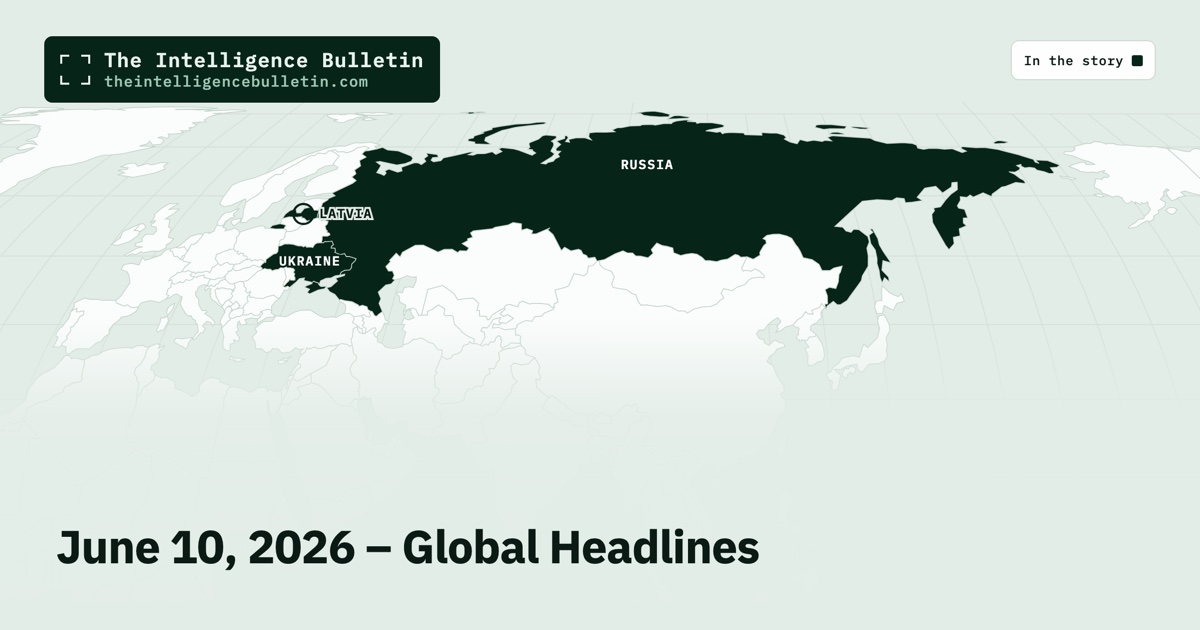
Map of the countries in the story: June 10, 2026 – Global Headlines
Story gist: On 2026-06-09 Ukraine and Latvia signed a drone cooperation agreement in Tallinn covering joint production, financing and air defense technology. President Zelenskyy and Latvian officials also discussed wider defense ties and sanctions on Russia. The deal emerged during NB8 and NATO-adjacent talks. Russian statements simultaneously rejected European mediation in peace efforts, creating the main reported tension.
One Story. Many Angles.
🇺🇸
United States
econotimes.com
Ukraine and Latvia Sign Drone Defense Deal to Boost Military Cooperation in 2026
Read →
🇮🇹
Italy
internazionale.it
Ukraine, Latvia sign drone deal as Russia says Europe not ready to mediate peace talks
Read →
🇺🇸
United States
yahoo.com
Ukraine, Latvia sign drone deal as Russia says Europe not ready to mediate peace talks
Read →
Perspective Analysis

The divergence in coverage of the Tallinn drone agreement shows how the same bilateral defense pact can be read either as routine military commerce or as a deliberate European signal amid stalled diplomacy. Econotimes.com presented the signing strictly through production and financing details, treating it as an industrial arrangement between two actors without referencing Moscow. By contrast, both the Italian Internazionale and the Yahoo aggregation explicitly paired the announcement with Russia’s claim that Europe lacks credibility as a mediator, folding the deal into a larger narrative of Western positioning. This split is not accidental. An outlet focused on economic data sees little need to import diplomatic friction, while wires and European publications reach for the Russia angle because it supplies immediate geopolitical stakes that resonate with audiences following the ceasefire proposals Zelenskyy floated days earlier. The Italian framing adds a further layer: it underscores European diplomatic frustration at a moment when NB8 countries are seeking concrete deliverables rather than abstract talks. What the sources collectively reveal is that the hardware cooperation itself is secondary to whether editors choose to locate the story inside Russia’s rejection of European involvement or keep it outside that frame entirely.


2Israeli Airstrikes Kill 11 in Tyre After Evacuation Order

Story gist: On June 10 2026 Israeli airstrikes hit Tyre in southern Lebanon killing at least 11 people according to Lebanese authorities. The attacks followed an Israeli evacuation order that triggered mass departures from the city. Hezbollah separately claimed strikes on Israeli forces the same day. The events renewed direct confrontation between Israel and Hezbollah along the border.
One Story. Many Angles.
🇲🇽
Mexico
elmanana.com
Tyre Lebanon: evacuation in Christian neighborhood due to Israeli attacks
Tiro Líbano: evacuación en barrio cristiano por ataques israelíes
Read →
🇦🇷
Argentina
eldestapeweb.com
Israel launches deadly attacks against the Lebanese city of Tyre after an evacuation order
Israel lanza ataques mortíferos contra la ciudad libanesa de Tiro tras una orden de evacuación
Read →
Perspective Analysis

Both the Mexican and Argentine reports open with the same sequence—an Israeli evacuation order followed hours later by lethal strikes—treating that chronology as the decisive fact rather than background context. El Mañana singles out the damage inside a Christian neighborhood of Tyre, a detail that surfaces nowhere else in the set and suggests the outlet is tracking how minority communities absorb the first impact. El Destape instead stresses the speed with which the strikes arrived after the warning, presenting the episode as a single continuous military action. The shared emphasis on timing and civilian displacement rather than Hezbollah’s concurrent claims indicates that Latin American coverage is converging on the question of whether the evacuation order functioned as genuine protection or as legal cover. That convergence is revealing: two ideologically distant papers reach for the same narrow frame because the documented sequence itself supplies the clearest available evidence of intent. No outlet here widens the lens to the June 3 security-zone agreement or to the broader regional escalation pattern; the story is kept tightly local to the city and the day. The result is a portrait of renewed fighting that is precise about the immediate mechanics yet silent on whether this round differs structurally from earlier rounds.


3Beijing Protests US Blacklist of BYD Over Military Ties

Story gist: On June 9 2026 Chinese foreign ministry spokesman Lin Jian stated in Beijing that China firmly opposed the US Defense Department blacklist of firms including BYD, Nio, Baidu and Alibaba for alleged military support. Lin urged Washington to reverse the measures and warned of steps to protect Chinese company interests. The action escalates US-China friction over technology and security links.
One Story. Many Angles.
🇨🇳
China
asianews.network
China slams US for labeling Chinese companies as supporting military
Read →
🇧🇷
Brazil
gazetadopovo.com.br
Why do the US accuse BYD and Chinese giants of links with the Chinese Army?
Por que os EUA acusam BYD e gigantes chinesas de ligação com o Exército da China?
Read →
🇦🇺
Australia
cairnspost.com.au
US Pentagon flags BYD over alleged Chinese military ties
Read →
Perspective Analysis

The shared factual core across these outlets is China’s direct rebuttal delivered by Lin Jian, yet each chooses a distinct entry point that reveals its own stakes in the US-China tech standoff. Asianews.network leads with the foreign ministry’s language of erroneous practices and necessary countermeasures, reflecting Beijing’s insistence that the blacklist lacks basis and must be corrected without delay. Gazeta do Povo instead dissects the Pentagon’s evidence trail linking BYD and peers to military supply chains, giving Brazilian readers a non-aligned breakdown of how dual-use technology rules are applied in practice. Cairns Post narrows to the procurement angle, noting how the listing directly affects Australian access to Chinese EVs and future defense-related supply decisions. This pattern shows the story functions less as a single event than as a mirror for each country’s exposure: China sees sovereign defense of its firms, Brazil sees an exportable case study in great-power rules, and Australia sees immediate implications for its own market and alliances. The absence of broader regional voices in the cluster underscores how tightly the narrative stays anchored to the Beijing-Washington axis even when reported from distant capitals.


4Modi Becomes India’s Longest-Serving Elected Prime Minister

Story gist: On 2026-06-10 Nigerian President Bola Tinubu publicly congratulated Indian Prime Minister Narendra Modi on becoming India’s longest-serving elected prime minister. Tinubu’s statement on X credited the milestone to public trust in Modi’s leadership. Similar messages arrived from other heads of government. Coverage centers on the event’s occurrence in Abuja and its link to Indian domestic politics.
One Story. Many Angles.
🇮🇳
India
newkerala.com
PM Modi Becomes India’s Longest-Serving Elected PM
Read →
🇮🇳
India
ianslive.in
Nigerian, Maldivian Presidents congratulate PM Modi on historic tenure, hail his ‘influential leadership’
Read →
Perspective Analysis

Indian outlets covering the milestone treat foreign congratulations as confirmation of Modi’s domestic record rather than as diplomatic maneuvering. Newkerala.com places the achievement in a national historical frame that reaches back to Nehru and Indira Gandhi, presenting the Nigerian message as one element in a wider chorus of approval. Ianslive.in narrows the lens to the specific statements from Abuja and Malé, underscoring the personal tone of the Nigerian praise and its direct reference to Modi’s influence abroad. The convergence between the two Indian sources reveals a shared editorial choice: both locate the story’s significance inside India’s internal political timeline while using the Nigerian voice to signal wider acceptance. This framing aligns with the event’s low market sensitivity and modest systemic weight, suggesting outlets see little need to embed the congratulations in larger questions of India-Africa economic ties or electoral strategy. The result is a compact narrative that registers the milestone without exploring whether the messages reflect shifting regional alignments or routine protocol.


5EU Orders Meta to Open WhatsApp to Rival AI Chatbots

Story gist: On June 9 2026 the European Commission directed Meta Platforms to grant rival AI chatbots free access to WhatsApp while probing market-power abuse. The interim measure applies in Brussels and targets Meta’s prior restriction of third-party assistants on its messaging service. The order aims to maintain competitive access for alternative AI tools across Europe. It pits US platform control against EU competition enforcement.
One Story. Many Angles.
🇫🇷
France
kulturegeek.fr
Europe forces WhatsApp to open up to competing AI chatbots
L’Europe oblige WhatsApp à s’ouvrir aux chatbots IA concurrents
Read →
🇩🇪
Germany
t3n.de
Meta only wanted its own AI on WhatsApp – now the EU forces the company to back down
Meta wollte nur eigene KI auf Whatsapp zulassen – jetzt zwingt die EU den Konzern zum Rückzieher
Read →
🇵🇰
Pakistan
dunyanews.tv
Meta ordered by EU to allow rival AI chatbots back on WhatsApp for free
Read →
Perspective Analysis

The three outlets converge on the core fact that Brussels has compelled Meta to loosen control over WhatsApp, yet each reveals a different facet of why that compulsion matters. Kulturegeek.fr presents the decision as a direct win for European AI developers who had been locked out, underscoring the consumer-protection logic that treats messaging infrastructure as shared public space rather than proprietary territory. T3n.de instead foregrounds Meta’s original plan to restrict the platform to its own models and the speed with which EU regulators forced reversal, framing the episode as evidence of enforceable corporate retreat under European rules. Dunyanews.tv, by contrast, strips away regulatory language altogether and simply records the restoration of free-market access, reflecting a Global South vantage in which the outcome registers primarily as an opening for any competitor rather than a triumph of Brussels oversight. This shared factual baseline across Paris, Berlin and Islamabad shows that the story travels less as a clash of values than as confirmation of the EU’s practical ability to rewrite terms for a US platform; the variation lies only in which beneficiary each outlet chooses to highlight. The absence of dissent among the sources is itself the signal: once the Commission acts, even outlets with divergent editorial priors treat the result as settled.
June 9, 2026 – Global Headlines

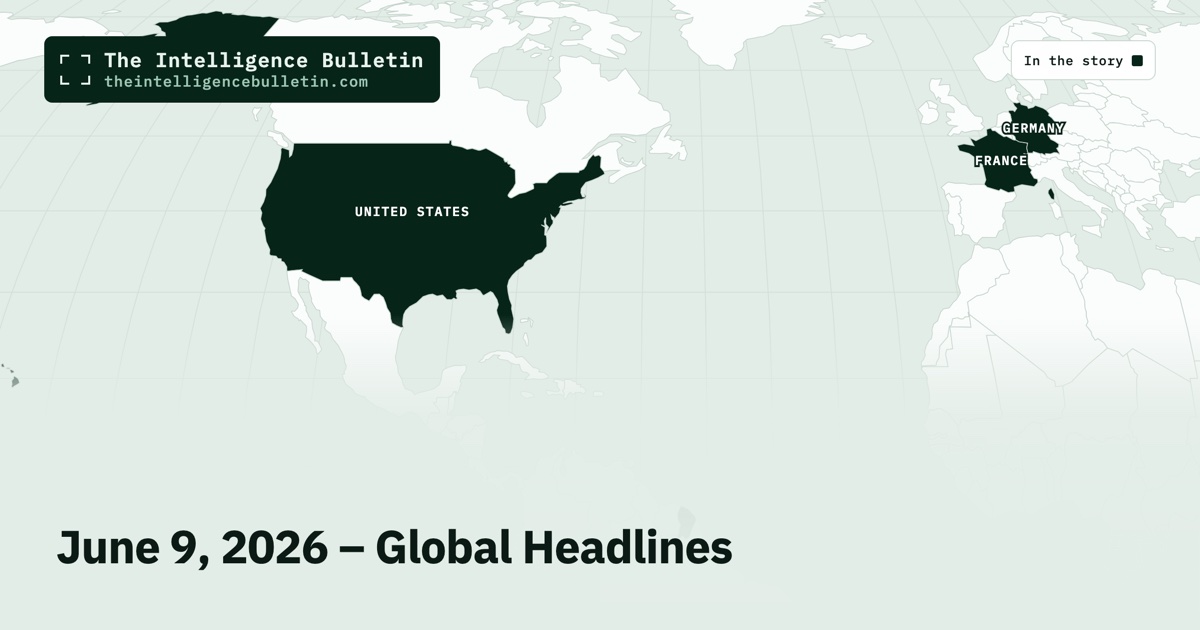
Map of the countries in the story: June 9, 2026 – Global Headlines

1Germany and France End Joint European Fighter Jet Project

Map of the countries in the story: June 9, 2026 – Global Headlines
Story gist: On 2026-06-08 the German government announced that Chancellor Friedrich Merz and President Emmanuel Macron had agreed to halt the SCAF/FCAS fighter aircraft program. The decision was issued from Berlin after Airbus and Dassault Aviation failed to resolve core disagreements. The move ends a decade-long effort to develop a next-generation European combat aircraft independent of U.S. platforms.
One Story. Many Angles.
🇩🇪
Germany
dw.com
Germany and France abandon project for new European fighter jet
Alemanha e França abandonam projeto de novo caça europeu
Read →
🇬🇧
United Kingdom
aol.co.uk
France and Germany abandon joint project to build European fighter jet
Read →
Perspective Analysis

The collapse of the Franco-German fighter project registers less as a sudden rupture than as the formal acknowledgment of industrial deadlock that both capitals had long papered over. German reporting from dw.com presents the announcement as a straightforward bilateral decision taken in Berlin, citing the inability of Airbus and Dassault to align on work-share and intellectual property without assigning further blame. The UK-based aol.co.uk account mirrors this factual core almost exactly, treating the termination as a European defense story rather than a Franco-German drama. That convergence itself is telling: outlets anchored in two of the three largest European defense industries see little incentive to inflate the rift into a broader EU crisis. Instead both focus on the immediate consequence—the loss of a flagship program meant to secure continental autonomy in sixth-generation combat aircraft. The absence of any reference to prior Merkel-era commitments or to the Balkans dimension flagged in the cluster data suggests the story is being read strictly through the lens of current industrial negotiations, not historical symbolism. In that narrow framing the project’s suspension appears less a political failure than the predictable outcome when two national champions cannot divide a contract that was always more symbol than specification.


2Palestinian Factions Meet Cairo Mediators on Gaza Ceasefire Phase Two

Story gist: On 2026-06-08 Palestinian factions convened in Cairo with Egyptian, Qatari and Turkish mediators to advance implementation of the second phase of a U.S.-backed Gaza ceasefire. The meeting addressed a roadmap for completing remaining elements of the truce agreement. Key tension centers on intra-Palestinian coordination required to sustain the fragile deal amid ongoing regional mediation.
One Story. Many Angles.
🇵🇰
Pakistan
arynews.tv
Talks begin in Cairo on advancing fragile Gaza ceasefire
Read →
🇮🇩
Indonesia
antaranews.com
Palestinian factions and mediators meet in Cairo to discuss Gaza ceasefire
Faksi-faksi Palestina dan mediator bertemu di Kairo bahas gencatan senjata Gaza
Read →
🇺🇸
United States
jns.org
Mediators meet Palestinian terrorists in Cairo for talks on advancing Gaza truce
Read →
Perspective Analysis

The Cairo talks expose how language choices reveal deeper alignments in coverage of Palestinian diplomacy. Ary News framed the gathering as routine regional diplomacy advancing a fragile ceasefire, consistent with Pakistan’s focus on Muslim-world mediation efforts that treat Hamas and other factions as legitimate negotiating partners. Antara News similarly emphasized multilateral coordination among factions and mediators, reflecting Indonesia’s ASEAN preference for institutional processes over ideological confrontation. JNS, by contrast, inserted the term “Palestinian terrorists” into its headline and description, a deliberate editorial signal that reframes the same Cairo venue and participants as security threats rather than diplomatic actors. This divergence is not accidental; JNS’s pro-Israel stance, rooted in its U.S. editorial base, consistently applies loaded terminology absent from the Pakistani and Indonesian reports, which treat the event as standard intra-Palestinian and mediator business. The consensus across the two non-aligned outlets on basic facts—location, date, mediators, and second-phase focus—underscores that the substantive development itself is uncontroversial outside pro-Israel framing. What the coverage therefore illuminates is not disagreement over events but the structural fault line in how actors are named once U.S. mediation intersects with Hamas participation.


3Pentagon Adds Alibaba, Baidu and BYD to Chinese Military List

Story gist: On 2026-06-08 the US Department of Defense added Alibaba, Baidu, BYD and other Chinese firms to its list of companies supporting the People’s Liberation Army. Announced in Washington, the designation bars future US government contracts under new legislation but imposes no immediate sanctions. The move targets major technology and electric-vehicle players and heightens US-China commercial friction.
One Story. Many Angles.
🇨🇳
China
chinamoneynetwork.com
Alibaba, Baidu, and BYD Added to US Pentagon Blacklist: Implications and Reactions
Read →
🇰🇷
South Korea
etnews.com
US Defense Department adds Alibaba and BYD to sanctions list as Chinese military support firms
US Defense adds Alibaba and BYD to sanctions list as Chinese military supporters
Read →
🇩🇪
Germany
finanznachrichten.de
USA lists BYD and Alibaba as Chinese military companies
Read →
Perspective Analysis

The three outlets converge on the core facts yet reveal how geography shapes commercial anxiety. Chinamoneynetwork.com frames the listing as another data point in Beijing’s ongoing contest with Washington, stressing market reaction and any official Chinese rebuttal. Etnews.com instead tracks the downstream effect on Korean semiconductor and electronics supply chains that already navigate US export controls. Finanznachrichten.de focuses on the exposure of European funds and automakers to BYD shares and supplier contracts now carrying added political risk. This pattern shows the blacklist functioning less as a sudden rupture than as an incremental tightening that each capital interprets through its own export dependencies. The absence of immediate sanctions keeps the measure largely symbolic for now, yet the explicit procurement bar signals that future US budgets will treat these firms as off-limits, a constraint whose reach will be tested first in allied capital markets rather than on Chinese factory floors.


4EU Proposes 21st Russia Sanctions Package Targeting Energy Crypto and Fisheries

Story gist: On 2026-06-09 the European Commission in Brussels proposed the EU’s 21st sanctions package against Russia. The measures target energy financial services crypto trade and fisheries for the first time while restricting drone support equipment. Ursula von der Leyen announced the package which builds on prior rounds. Russia is the direct target with potential market effects on global energy and finance flows.
One Story. Many Angles.
🇨🇳
China
english.news.cn
EU proposes 21st package of sanctions against Russia
Read →
🇵🇹
Portugal
rtp.pt
Brussels proposes new sanctions package on Russia focused on sectors of greatest impact
Bruxelas propõe novo pacote de sanções à Rússia centrado em setores de maior impacto
Read →
🇺🇦
Ukraine
en.interfax.com.ua
In trade sector we propose to restrict fisheries for first time, ban support equipment for drones and more – von der Leyen
Read →
Perspective Analysis

The European Commission’s move to expand sanctions into fisheries and drone components signals an effort to close remaining loopholes after two years of incremental tightening. Chinese state media at english.news.cn frames the package primarily through its potential to disrupt global supply chains and commodity prices rather than as a security measure aimed at Moscow. Portuguese public broadcaster rtp.pt instead emphasizes the internal EU process of selecting high-impact sectors such as energy and crypto to maximize pressure while minimizing collateral damage to member states. Ukrainian outlet en.interfax.com.ua focuses on the concrete new prohibitions including fisheries and drone equipment as direct counters to Russian capabilities. This convergence on the package’s technical scope across divergent outlets reveals that the sanctions regime has reached a stage where even non-Western coverage treats further escalation as routine rather than exceptional. The absence of any reported Russian counter-proposal or immediate market panic in the coverage suggests the measures are viewed as evolutionary rather than transformative at this point in the conflict.


5Trump Warns Netanyahu to Limit Iran Strikes or Lose US Backing

Story gist: On 2026-06-08 U.S. President Donald Trump told Israeli Prime Minister Benjamin Netanyahu during a tense phone call to limit planned strikes on Iran and accept a U.S.-backed peace deal. The warning came as Israel prepared what reports described as its largest strikes on Iran since April. Trump framed continued U.S. support as conditional on Israeli restraint. The exchange was reported by outlets citing the Financial Times and other accounts of the call.
One Story. Many Angles.
🇺🇸
United States
legitgov.org
Trump warns Netanyahu to ‘be very careful’ as Israel risks losing U.S. backing in Iran conflict
Read →
🇬🇧
United Kingdom
middleeasteye.net
Trump urged Netanyahu to limit Iran strikes, report says
Read →
🇬🇧
United Kingdom
dailymail.com
Trump’s brutal threat to Netanyahu in leaked call as Israel planned biggest strikes on Iran since April
Read →
Perspective Analysis

The unusual convergence across these three outlets reveals how little daylight now exists between Washington’s public posture and private pressure on Israel. Every account centers the same sequence: Trump explicitly tying continued military and diplomatic cover to Netanyahu’s willingness to scale back the next round of strikes. Legitgov.org anchors the story in the domestic risk to U.S. support, treating the call as a signal that American patience has limits. Middle East Eye shifts the emphasis to regional consequences, noting that any further escalation would complicate already fragile mediation efforts involving multiple Arab states. The Daily Mail instead lingers on the mechanics of the leak itself and the scale of the Israeli operation that was reportedly under discussion, presenting the episode as evidence of deepening friction at the operational level. What is absent is any suggestion that Netanyahu pushed back in real time or that the United States offered new inducements; the reporting instead treats the warning as a one-way transmission of red lines. This uniformity across a U.S. domestic site, a UK-based Middle East specialist outlet, and a British tabloid suggests the underlying event is no longer being contested at the factual level, only at the level of which audience needs to hear the constraint most clearly. The June 8 timing also sits against the backdrop of earlier U.S. efforts to broker security arrangements with Lebanon and renewed sanctions activity toward other adversaries, indicating that Washington is attempting to ration its leverage across multiple fronts rather than open a new confrontation with Tehran.


June 8, 2026 – Global Headlines

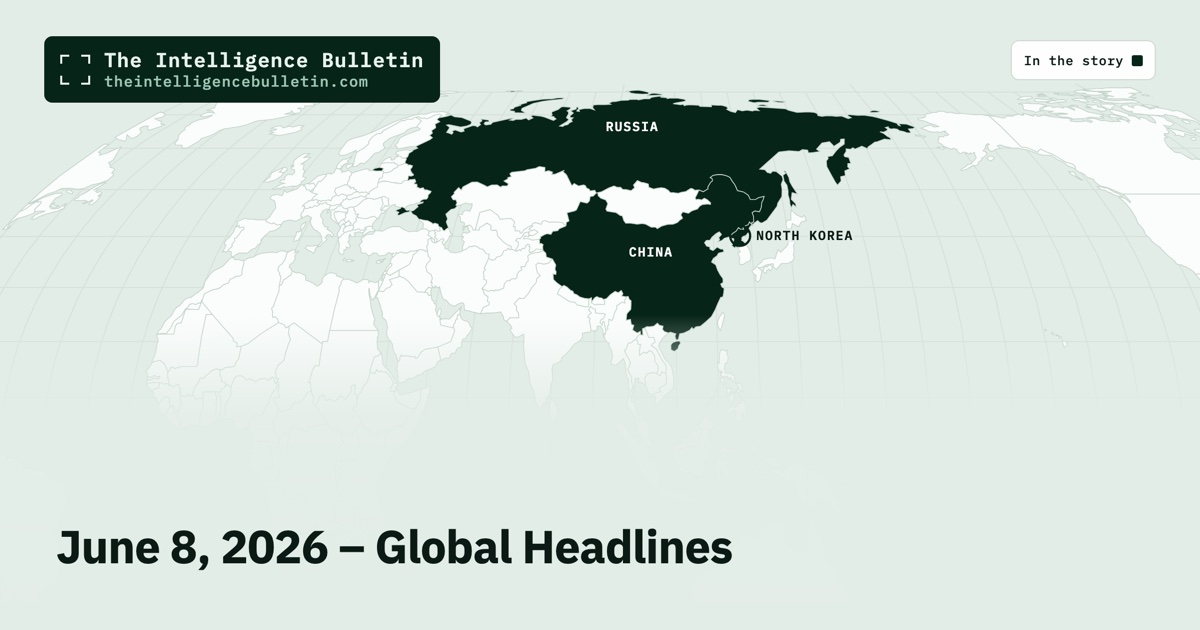
Map of the countries in the story: June 8, 2026 – Global Headlines

1Xi Begins First North Korea Visit in Seven Years

Map of the countries in the story: June 8, 2026 – Global Headlines
Story gist: On 2026-06-07 Chinese President Xi Jinping arrived in Pyongyang for a two-day state visit to meet Kim Jong Un. The trip follows Kim Yo-jong’s June 6 statement that North Korea’s nuclear status is irreversible. Reports frame the summit as Beijing’s effort to reassert influence while Pyongyang deepens ties with Russia. The visit marks Xi’s first trip to the North since 2019.
One Story. Many Angles.
🇰🇷
South Korea
koreaherald.com
China’s Xi visits NK for first time in seven years
Read →
🇮🇩
Indonesia
thejakartapost.com
China’s Xi hails ‘new start’ in North Korea ties ahead of summit
Read →
🇦🇹
Austria
derstandard.at
China’s President Xi starts state visit to North Korea
Chinas Präsident Xi startet Staatsbesuch in Nordkorea
Read →
Perspective Analysis

The visit’s timing after Kim Yo-jong’s blunt rejection of denuclearization talks makes the consensus across these outlets revealing: all treat the seven-year gap as the central fact rather than any new agreement reached in Pyongyang. Korea Herald anchors the story in immediate neighborhood consequences, noting how a strengthened China-North Korea axis directly affects South Korean security calculations without invoking broader ideology. Jakarta Post instead highlights the diplomatic language of a “new start,” reflecting Indonesia’s interest in how Chinese regional engagement might stabilize or unsettle ASEAN’s northern flank. Der Standard, by contrast, places the same facts inside a Western narrative of authoritarian coordination, linking the visit to sanctions pressure and Moscow’s wartime needs. This difference is structural rather than factual. South Korean and Indonesian reporting stays within the diplomatic calendar of East Asia, while Austrian coverage imports the Ukraine and sanctions frame that has dominated European attention since 2022. The shared emphasis on rarity therefore signals more than coincidence: it marks the first high-level Chinese engagement since North Korea’s nuclear posture hardened again, and every outlet reads that resumption through its own geographic exposure to the resulting power shift.


2Palestinian Factions Meet Cairo Mediators on Gaza Ceasefire Phase Two

Story gist: On June 8 2026 Palestinian factions met in Cairo with Egyptian, Qatari and Turkish mediators to implement the second phase of the U.S.-backed Gaza ceasefire. Talks addressed remaining elements of the peace plan after an initial truce. Hamas and other groups participated alongside the Palestinian Authority. The session occurs amid separate Israel-Iran strikes and U.S. sanctions pressure on Tehran.
One Story. Many Angles.
🇵🇰
Pakistan
arynews.tv
Talks begin in Cairo on advancing fragile Gaza ceasefire
Read →
🇮🇩
Indonesia
antaranews.com
Palestinian factions and mediators meet in Cairo to discuss Gaza ceasefire
Faksi-faksi Palestina dan mediator bertemu di Kairo bahas gencatan senjata Gaza
Read →
🇺🇸
United States
jns.org
Mediators meet Palestinian terrorists in Cairo for talks on advancing Gaza truce
Read →
Perspective Analysis

The most striking feature of this coverage is how little any outlet disputes the basic fact of the Cairo meeting itself. All three sources register the same core event: Palestinian factions gathered under Egyptian, Qatari and Turkish auspices to move the ceasefire forward. What diverges is the surrounding frame. Ary News presents the gathering as a routine exercise in Muslim-world diplomacy, consistent with Pakistan’s long-standing emphasis on multilateral mediation that keeps Arab and Turkish actors central. Antara, Indonesia’s state news agency, instead foregrounds the internal Palestinian composition of the talks, treating factional coordination as the story rather than external security concerns. JNS, by contrast, inserts the term “terrorists” into its headline and places Israeli security calculations at the center, a choice that reflects the outlet’s explicit alignment with Israeli threat assessments. These differences are not accidental. Pakistani and Indonesian outlets operate within diplomatic traditions that treat Palestinian unity talks as legitimate statecraft; JNS operates within a security lens that views any Hamas-inclusive process as inherently suspect. The result is three accounts of the same room that effectively describe three different rooms, each shaped by the outlet’s structural position relative to the actors involved.


3Zelenskyy Offers Putin Bilateral Talks at London Summit

Story gist: On 2026-06-07 in London, Ukrainian President Volodymyr Zelenskyy stated he is ready for direct bilateral talks with Russian President Vladimir Putin while welcoming US and European involvement. The remarks came during meetings with British, French, and German leaders at a summit aimed at restarting Ukraine peace negotiations. European participants pressed for Putin to engage. This follows Zelenskyy’s June 6 public letter from Kyiv proposing a face-to-face meeting and total ceasefire.
One Story. Many Angles.
🇩🇪
Germany
az-online.de
Europeans and Ukraine call on Putin to negotiate
Europäer und Ukraine fordern Putin zu Verhandlungen auf
Read →
🇮🇹
Italy
lastampa.it
A direct message to Putin: he must negotiate, Europe will not back down
Un messaggio diretto a Putin: deve trattare, l’Europa non si sfila
Read →
🇳🇿
New Zealand
nzherald.co.nz
Deluded Putin has missed chance for peace as Zelenskyy meets Europe leaders
Read →
Perspective Analysis

The most striking element is how uniformly European outlets treat the London meeting as a direct, personal appeal to Putin rather than another round of Western posturing. az-online.de frames the event as Central European states using their security lens to demand negotiations outright, reflecting Germany’s frontline exposure to any renewed Russian advance. La Stampa takes the same line but personalizes it as a message the Russian leader cannot ignore, underscoring Italy’s interest in preserving a united European front that avoids appearing weak. The New Zealand Herald, by contrast, adds an external verdict that Putin has already squandered his chance, portraying him as deluded—an angle that reveals how distant observers can afford sharper language about Russian miscalculation. This convergence on the necessity of talks, building directly on Zelenskyy’s June 6 proposal, suggests the real story is not disagreement over substance but the different distances at which capitals feel the risk of failure. The absence of any reported Russian reply in these accounts further highlights that the initiative remains one-sided for now.


4Israel Strikes Iranian Air Defenses After Missile Exchanges

Story gist: On June 8 2026 Israeli jets struck air defense systems in western and central Iran, destroying a launcher and triggering secondary explosions consistent with stored missiles. The IDF reported no fatalities. Iranian forces had fired missiles at Israel earlier. The exchanges occurred amid ongoing regional tensions involving multiple actors including Hezbollah and the Revolutionary Guard.
One Story. Many Angles.
🇺🇸
United States
union-bulletin.com
Israel and Iran trade strikes, threatening to drag the region back into full-scale war
Read →
🇺🇸
United States
wxii12.com
Israel and Iran trade fire as ceasefire falters
Read →
🇺🇸
United States
wtop.com
Israel and Iran trade strikes, threatening to drag the region back into full-scale war
Read →
Perspective Analysis

All three outlets converge on the same core description of reciprocal fire between Israel and Iran, with headlines that emphasize the immediate danger of a wider war rather than any single actor’s justification. Union-bulletin and wtop use nearly identical phrasing about strikes that threaten to drag the region back into full-scale conflict, while wxii12 foregrounds the faltering ceasefire angle; the differences are cosmetic. This uniformity across a Pacific Northwest local paper, a North Carolina affiliate, and a Washington policy outlet signals that the underlying event data—Israeli destruction of an Iranian launcher with secondary blasts—left little room for divergent national framing inside the United States. The coverage also sits alongside separate reporting on Trump’s insistence that sanctions remain until a peace deal, suggesting the strikes are being read as another data point in a sanctions-plus-force posture rather than an isolated bilateral clash. What stands out is the absence of any reported Iranian counter-claim or casualty figure in the initial wave, which keeps the narrative anchored on Israeli operational success and the risk of Iranian escalation rather than on contested battlefield outcomes.


5Trump: Iranian Assets Stay Frozen Until Peace Deal

Story gist: On 2026-06-07 President Donald Trump told NBC News the United States is close to a preliminary Iran nuclear agreement but will keep sanctions and frozen assets in place until implementation. He demanded tougher restrictions on Iran’s program. The statement came from Washington as regional tensions with Israel persist.
One Story. Many Angles.
🇺🇸
United States
econotimes.com
Trump Says Iran Sanctions and Frozen Assets Will Remain Until Peace Deal Is Reached
Read →
🇮🇹
Italy
corriere.it
Why has the US-Iran agreement stalled? Trump cornered, the Lebanon dossier and frozen Iranian assets: the obstacles
Perché si è bloccato l’accordo tra Usa e Iran?
Read →
🇸🇰
Slovakia
hnonline.sk
Iranian assets will remain frozen until a ceasefire agreement is reached, Trump declared
Iránske aktíva zostanú zmrazené, kým sa nedosiahne dohoda o prímerí, vyhlásil Trump
Read →
Perspective Analysis

The most revealing detail is how little any outlet disputes the core condition Trump set: no asset release before a verifiable deal. Econotimes.com frames this strictly as sanctions policy continuity, treating asset freezes as the central lever Washington retains. Corriere.it instead highlights diplomatic friction, pointing to the Lebanon file as an unaddressed obstacle that could still derail progress. Hnonline.sk strips the story to its narrowest claim, simply recording the asset-freeze pledge without context or speculation. This convergence on the announcement itself, rather than any debate over its credibility, shows the outlets treating Trump’s words as the operative fact for now. The Italian emphasis on Lebanon tracks Rome’s broader concern with Hezbollah spillover, while the Slovak and US pieces stay inside the bilateral sanctions lane. In a week when Israel and Iran have already traded strikes, the shared refusal to link the asset question to those clashes suggests the outlets see Trump’s statement as a deliberate brake on any rapid thaw rather than an opening to wider de-escalation.


June 7, 2026 – Global Headlines

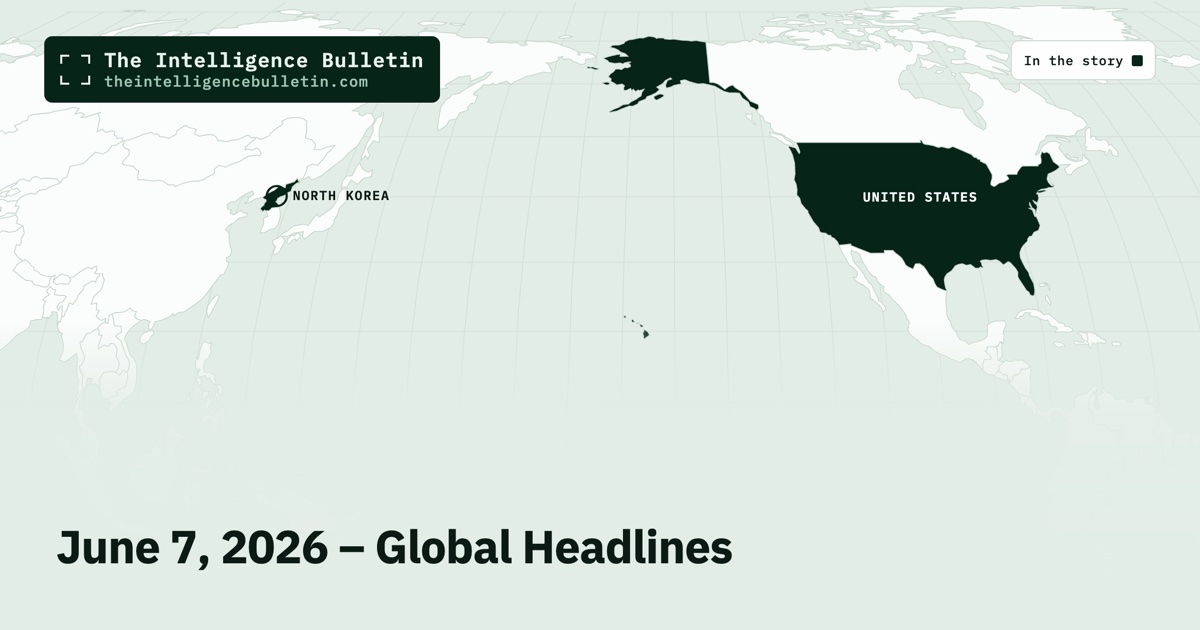
Map of the countries in the story: June 7, 2026 – Global Headlines

1Kim Yo-jong Reaffirms North Korea Nuclear Status Irreversible Before Xi Visit

Map of the countries in the story: June 7, 2026 – Global Headlines
Story gist: On June 6 2026 Kim Yo-jong told KCNA that North Korea’s nuclear status is non-negotiable and warned against threats. The statement rejected U.S.-backed denuclearization talks ahead of Xi Jinping’s planned trip to Pyongyang. It was issued from the capital and carried only through state media.
One Story. Many Angles.
🇰🇷
South Korea
koreaherald.com
N. Korea’s Kim Yo-jong says Pyongyang’s nuclear status ‘irreversible’
Read →
🇨🇦
Canada
cbc.ca
Pyongyang reaffirms North Korea’s nuclear status ahead of visit by China’s Xi
Read →
🇩🇪
Germany
spiegel.de
North Korea: Kim’s sister describes nuclear status as non-negotiable
Nordkorea: Kims Schwester bezeichnet Atomstatus als nicht verhandelbar
Read →
Perspective Analysis

The three outlets converge on the core message that Pyongyang has closed the door on any nuclear bargain, yet each chooses a different lens to explain why the statement matters now. The Korea Herald leads with the word irreversible and places the remarks in the immediate security context of South Korea, treating them as a direct signal to Seoul rather than a diplomatic maneuver. CBC instead opens on the timing of Xi’s visit, presenting the nuclear line as a precondition that Beijing must accept if it wants a smooth summit. Spiegel frames the same words as evidence of a global hardening, noting that the stance leaves little room for European or UN-mediated talks. This pattern shows how proximity shapes emphasis: the South Korean paper sees a standing threat across the DMZ, the Canadian service sees triangular diplomacy between Pyongyang, Beijing and Washington, and the German outlet sees a precedent that weakens broader non-proliferation efforts. The absence of any reported Chinese reaction in the coverage underscores that the real audience for the statement is not the United States but Xi himself, who must decide whether to endorse or quietly dilute Kim Yo-jong’s position during his visit.


2Nepal FM Khanal Tells India New Government Carries No Old Baggage

Story gist: Nepal Foreign Minister Shishir Khanal said in New Delhi on June 6 2026 that the new government carries no old baggage toward India and called it Nepal’s most important partner. He made the remarks during opening comments with Indian External Affairs Minister S. Jaishankar. The visit takes place against unresolved border disputes between the two countries.
One Story. Many Angles.
🇮🇳
India
idrw.org
India Nepal’s most important partner new govt carries no old baggage Foreign Minister Khanal
Read →
🇮🇳
India
freepressjournal.in
Nepal Foreign Ministers India Visit Aims To Reset Ties Amid Border Row
Read →
Perspective Analysis

Both Indian outlets covering the visit treat Khanal’s “no old baggage” line as the central message rather than any concrete outcome from the talks. IDRW frames the statement as confirmation that Kathmandu has turned the page on earlier friction and is now ready for straightforward development cooperation with New Delhi. Free Press Journal instead places the same remark inside the continuing border row, presenting the visit as an attempt to manage tensions rather than erase them. The difference is only one of emphasis; neither outlet questions the sincerity of the Nepali position or introduces Nepali domestic criticism of the new government. This convergence reveals how Indian coverage of Nepal still defaults to a bilateral reset narrative even when the underlying territorial disputes remain unaddressed. The absence of any reported Indian concession or Nepali demand in the accounts suggests the visit was valued more for its optics than for measurable progress on the border.


3Pakistan’s Naqvi Arrives in Tehran to Revive US-Iran Talks

Story gist: On 2026-06-06 Pakistan Interior Minister Mohsin Naqvi reached Tehran carrying messages from Prime Minister Shehbaz Sharif and Field Marshal Asim Munir. He met Iranian officials to explore renewed US-Iran dialogue. The trip is Naqvi’s third such visit. Iranian counterparts including Eskandar Momeni and Abbas Araghchi received the Pakistani delegation.
One Story. Many Angles.
🇵🇰
Pakistan
samaa.tv
Naqvi leaves for Tehran as Pakistan steps up Iran-US peace efforts
Read →
🇮🇷
Iran
presstv.ir
Pakistans interior minister visits Tehran to discuss Iran-US talks
Read →
🇷🇸
Serbia
tanjug.rs
Pakistani Interior Minister arrives in Tehran for talks
Pakistanski ministar unutrasnjih poslova stigao u Teheran na razgovore
Read →
Perspective Analysis

Pakistan’s decision to dispatch its interior minister rather than a foreign-affairs specialist signals that the channel is being kept deliberately low-profile and security-focused. Both Pakistani and Iranian outlets describe the same itinerary and the same intended recipient in Washington, suggesting the two governments have aligned on the basic script even before any public readout. Serbian coverage, by contrast, registers only the arrival and the venue, stripping away the US dimension entirely; that flat rendering is consistent with Belgrade’s long-standing preference for recording SCO-related contacts without endorsing any mediation narrative. The absence of any reported pushback from Tehran on the substance of the messages implies that Iran views the Pakistani route as low-risk insulation while it waits for Washington to clarify terms. Earlier TIB reporting on 31 May showed Trump insisting on stricter conditions; Naqvi’s arrival therefore functions less as a breakthrough announcement than as a procedural heartbeat confirming that the back-channel remains open despite the tougher draft language.


4Iran Adviser Ties $24 Billion Asset Release to Nuclear Deal

Story gist: On June 6 2026 Mohsen Rezaei, senior adviser to Iran’s supreme leader, told CNN that stalled US-Iran nuclear talks require Washington to release $24 billion in frozen Iranian assets as a trust test. Rezaei said the funds must move before any agreement can advance. The demand comes days after President Trump indicated a draft deal had been returned for stricter terms.
One Story. Many Angles.
🇨🇳
China
en.people.cn
Trump must break negotiation deadlock, says adviser to Iranian supreme leader
Read →
🇮🇳
India
timesofindia.indiatimes.com
$24 billion ‘trust test’ for Trump? Khamenei aide seeks frozen assets, warns war could take ‘another dimension’
Read →
🇮🇳
India
livemint.com
Iran demands cash for peace. That’s a political minefield for Trump.
Read →
Perspective Analysis

Rezaei’s public insistence that cash must precede any nuclear understanding marks a clear escalation in the bargaining sequence that began when Trump returned the draft last week. The three outlets covering the statement all treat the $24 billion figure as the new focal point rather than background noise. People’s Daily places the demand inside a multipolar frame, presenting Tehran’s move as leverage that can be exercised because Washington no longer dictates terms alone. Times of India foregrounds the dollar amount and the veiled warning that conflict could “take another dimension,” reflecting New Delhi’s interest in any development that might affect energy prices or Indian payments channels. LiveMint narrows the lens to the domestic political cost inside the United States, noting that releasing assets would hand Trump’s opponents a ready-made campaign line. The shared decision to lead with Rezaei’s exact wording rather than Iranian official statements or US responses reveals a common judgment: the asset condition is now the operative obstacle, not abstract enrichment limits. That convergence across Chinese state media and two Indian outlets suggests the financial precondition has overtaken earlier disputes over centrifuge numbers as the story’s central variable.


5Pope Leo XIV Urges Ukraine Negotiations During Madrid Visit

Story gist: On 2026-06-06 Pope Leo XIV stated during his flight to Madrid that negotiations are needed to resolve the Ukraine war. The remark came as he began a week-long visit to Spain and addressed broader calls for peace. Spanish officials including Pedro Sanchez hosted the pontiff amid ongoing European diplomatic efforts. The comment aligned with recent Ukrainian proposals for direct talks with Russia.
One Story. Many Angles.
🇷🇺
Russia
odnako.org
pope leo xiv in spain first stop in madrid for ukraine we need to push for negotiations
Read →
🇦🇺
Australia
canberratimes.com.au
world crying for peace pope says on visit to spain
Read →
🇮🇩
Indonesia
antaranews.com
Pope Leo XIV visits Spain, highlights migration and peace
paus leo xiv kunjungi spanyol soroti migrasi dan perdamaian
Read →
Perspective Analysis

Russian coverage through odnako.org immediately centered the Pope’s in-flight remark on Ukraine negotiations as the visit’s core geopolitical signal, reflecting Moscow’s consistent priority on diplomatic off-ramps. Australian reporting in the Canberra Times instead presented the trip as a sweeping appeal that “the world is crying for peace,” treating Ukraine as one instance among many conflicts without elevating it. Indonesian outlet Antara added migration to the frame, pairing the pontiff’s peace message with Global South concerns over movement and borders. This split tracks structural interests: outlets tied to parties directly engaged in the Ukraine conflict highlight negotiation language, while those farther from the theater fold the visit into wider themes. The pattern echoes recent Zelenskyy proposals for face-to-face talks reported earlier this week, showing how papal travel statements are read through each capital’s existing diplomatic ledger rather than as standalone moral declarations.


June 6, 2026 – Global Headlines

Map of the countries in the story: June 6, 2026 – Global Headlines

1Zelenskyy Proposes Direct Putin Meeting for Ukraine Ceasefire

Map of the countries in the story: June 6, 2026 – Global Headlines
Story gist: On 2026-06-06 Ukrainian President Volodymyr Zelenskyy issued a public letter from Kyiv proposing a face-to-face meeting with Russian President Vladimir Putin to end the war. He stated Ukraine’s readiness to implement a total ceasefire while talks continued. Russian responses indicated no interest in such a meeting and asserted that Russia would prevail. The appeal marks the latest attempt to reopen direct negotiations between the two sides.
One Story. Many Angles.
🇦🇷
Argentina
agencianova.com
Zelensky proposed a face-to-face meeting with Putin to negotiate the end of the war in Ukraine
Zelenski propuso una reunión cara a cara con Putin para negociar el fin de la guerra en Ucrania
Read →
🇮🇹
Italy
linkiesta.it
The silent competition on Ukraine’s future opened by Zelensky’s letter
La competizione silenziosa sul futuro dell’Ucraina aperta dalla lettera di Zelensky
Read →
🇬🇧
United Kingdom
aol.co.uk
Ukraine war briefing: Putin says ‘no point’ meeting Zelenskyy, insists Russia will win the war
Read →
Perspective Analysis

The Argentine outlet Agencia Nova reports Zelenskyy’s letter as a straightforward diplomatic overture aimed at securing face-to-face talks, reflecting a Latin American distance from the immediate European theater that allows the proposal to stand on its own terms. Linkiesta instead treats the same letter as the opening move in a larger, largely unspoken contest over Ukraine’s postwar trajectory, shifting attention from the bilateral encounter itself to the external powers that would shape any settlement. AOL’s UK briefing supplies the missing Russian reply, quoting Putin directly that there is no point in meeting and that victory remains assured, thereby converting a Ukrainian initiative into a record of rejection. This distribution of emphasis reveals a structural pattern: outlets farther from the conflict zone present the appeal as actionable diplomacy, while those closer incorporate the counter-statement that renders the proposal inert. The resulting coverage converges on the fact of the letter yet diverges on whether it constitutes a live negotiating channel or merely another public record of impasse, a distinction that tracks each outlet’s proximity to the decision-making centers deciding Ukraine’s fate.


2UN Doubles Lebanon Aid Appeal to Nearly $640 Million

Story gist: On 2026-06-05 the UN Office for the Coordination of Humanitarian Affairs announced in Geneva that it had raised its Lebanon humanitarian appeal to nearly $640 million for the next six months. The revision cites rapidly deteriorating conditions and rising internal displacement. Hezbollah remains active in southern Lebanon while a recent US-brokered ceasefire with Israel is under strain. The move comes days after Lebanese President rebuked Iranian interference in the conflict.
One Story. Many Angles.
🇸🇦
Saudi Arabia
english.aawsat.com
UN Doubles Appeal for Lebanon Aid to Nearly $640 Mn
Read →
🇺🇸
United States
al-monitor.com
UN doubles appeal for Lebanon aid to nearly $640 mn amid Israel war
Read →
🇫🇷
France
spacewar.com
UN doubles appeal for Lebanon aid to nearly $640 amid Israel war
Read →
Perspective Analysis

The most revealing detail is not the doubled figure itself but which outlets chose to attach it directly to the Israel conflict. Al-Monitor and Spacewar both inserted “amid Israel war” into their headlines, framing the appeal as an immediate consequence of cross-border fighting. English.aawsat.com reported the identical $640 million number and the same Geneva venue yet omitted any Israel reference, presenting the crisis instead as a regional Arab humanitarian emergency. This split tracks structural incentives: the Saudi-owned outlet operates inside a diplomatic environment still wary of explicit linkage after the recent US-brokered security zones, while the Washington-based specialist publication and the AFP wire treat the war as the dominant causal variable. The underlying data released by OCHA itself mentions only “severe deteriorating conditions,” leaving editors to supply the causal arrow. That choice matters because Lebanon’s displacement figures are now climbing again even as the ceasefire pilot zones remain in place, suggesting the humanitarian spike is being driven by renewed low-level exchanges rather than the formal end of hostilities. Readers therefore encounter two parallel stories: one that keeps the conflict visible and one that keeps it at arm’s length, each calibrated to the outlet’s larger regional posture.


3Putin Backs India’s Autonomy, Warns Sanctions on Russia Ties Futile

Story gist: On June 5 2026 in St. Petersburg, Vladimir Putin told international news agencies that India remains a reliable partner and that Western pressure on bilateral ties would fail. He spoke at the St. Petersburg International Economic Forum and pledged deeper cooperation. The comments came as Russia faces ongoing sanctions and India maintains independent energy and defence policies under Prime Minister Modi.
One Story. Many Angles.
🇮🇳
India
openthemagazine.com
Putin Hails Brotherly India-Russia Ties Stresses Strategic Partnership in Defence Energy and Technology
Read →
🇮🇳
India
hindustantimes.com
Sanctions threats would boomerang under PM Modi’s leadership Putin backs India’s autonomy
Read →
Perspective Analysis

Indian coverage converges on a single point: Putin publicly validating New Delhi’s refusal to bend to Western sanctions pressure. Open Magazine leads with the language of enduring ‘brotherly’ relations and lists concrete areas of defence, energy and technology cooperation, treating the remarks as confirmation of a long-standing strategic alignment rather than a tactical statement. Hindustan Times instead foregrounds Putin’s direct endorsement of Modi’s leadership, quoting his warning that sanctions threats would ‘boomerang.’ Both frames sit within India’s domestic political context, where autonomy in foreign policy is a core electoral claim. The absence of any counter-narrative in these outlets underscores how little space exists in Indian English-language media for portraying Russia-India ties as problematic. This consensus reveals more than editorial preference; it mirrors the structural reality that New Delhi continues to source discounted Russian oil and advanced military systems while Western capitals press for alignment. By presenting Putin’s words as endorsement rather than entreaty, the reporting reinforces the message that India’s balancing act carries Russian approval at the highest level.


4Iran Says It Fired Warning Shots at US Destroyers in Gulf of Oman

Story gist: On June 5 2026 Iranian naval forces fired warning shots at two US destroyers identified as DDG-103 and DDG-87 near Oman’s coast. Iranian authorities stated the vessels withdrew toward the Indian Ocean with no reported casualties. The incident occurred in the Sea of Oman amid ongoing US-Iran tensions. Iranian state sources provided the only account of the encounter.
One Story. Many Angles.
🇺🇸
United States
spacewar.com
Iran says fired ‘warning missiles’ at US destroyers in Gulf of Oman
Read →
🇦🇿
Azerbaijan
news.az
Iranian army says it fired warning shots at US warships in Sea of Oman
Read →
🇹🇷
Turkey
aa.com.tr
Iran says navy fired warning shots toward US destroyers in Sea of Oman
Read →
Perspective Analysis

All three outlets anchor their reporting in the same Iranian assertion without independent confirmation or US rebuttal, revealing how thin the information environment remains for Gulf naval incidents. Spacewar.com frames the episode through technical naval specifics, noting the exact hull numbers and the claimed retreat path, consistent with its focus on US security hardware. News.az shifts emphasis to the Sea of Oman’s role as an energy transit corridor, implicitly linking the event to Azerbaijan’s interest in stable routes bypassing Iranian waters. Aa.com.tr embeds the claim inside the wider US-Israel-Iran triangle, treating the shots as another data point in a diplomatic standoff rather than an isolated tactical event. The convergence on Iranian-sourced language across a US military outlet, a Caucasus energy-focused site, and a Turkish state agency suggests the story’s primary value lies in what it signals about access rather than escalation. Because no Western warship has confirmed the encounter and market sensitivity registers at zero, the coverage functions more as a reminder of persistent friction than evidence of imminent crisis, a pattern that echoes earlier low-grade encounters where each side’s narrative travels independently.


5Lebanese President Aoun Tells Iran to Stop Using Lebanon as Bargaining Chip

Story gist: On June 5 2026 Lebanese President Joseph Aoun told CNN that Iran must stop treating Lebanon as a bargaining chip in ceasefire talks with Israel. He accused Tehran of interfering in Lebanese affairs while attacks continued between the Israel Defense Forces and Hezbollah in southern Lebanon. The remarks follow the June 3 renewal of the US-brokered conditional ceasefire that bars Hezbollah from designated security zones. Aoun’s public criticism coincides with statements from Lebanese parliamentary speaker Nabih Berri and Prime Minister Nawaf Salam.
One Story. Many Angles.
🇯🇴
Jordan
jordantimes.com
Lebanese leaders rebuke Iran as Israel, Hizbollah trade attacks
Read →
🇮🇱
Israel
israelnationalnews.com
It’s not your country: Lebanese President delivers blistering rebuke to Iran
Read →
🇨🇳
China
english.news.cn
Lebanese president criticizes Iran, Hezbollah chief over war, ceasefire stance
Read →
Perspective Analysis

Aoun’s CNN interview lands at a precise moment when the June 3 ceasefire renewal is still fragile and both sides are testing its limits through limited strikes around Dibbine. The Jordan Times headline places the rebuke inside the daily rhythm of “Israel, Hizbollah trade attacks,” reflecting Amman’s interest in containing spillover that could reach its northern border. Israel National News isolates the most personal line—“It’s not your country”—because that phrasing directly validates the Israeli argument that Hezbollah is an Iranian proxy rather than a Lebanese actor. Xinhua folds Hezbollah secretary-general Naim Qassem into the same sentence as Iran, preserving Beijing’s habit of presenting all parties as equally responsible for any breakdown in talks. What unites the three accounts is the absence of any Lebanese domestic pushback against Aoun; even outlets that usually defend the “resistance axis” record the rebuke without qualification. That silence suggests the new president’s distance from Tehran is now treated as established fact rather than partisan assertion. The coverage therefore functions less as dispute reporting and more as confirmation that Lebanon’s post-election leadership has shifted the red line on Iranian leverage exactly when the ceasefire’s security-zone experiment is being implemented.


June 5, 2026 – Global Headlines

Map of the countries in the story: June 5, 2026 – Global Headlines

1US Sanctions Cuban President Díaz-Canel and Family

Map of the countries in the story: June 5, 2026 – Global Headlines
Story gist: On June 4 2026 the US Treasury Department imposed sanctions on Cuban President Miguel Díaz-Canel, his family and associates. The action was announced in Washington as part of efforts to pressure Cuban leadership. Cuba rejected the measures as lacking legal basis. The sanctions renew direct US economic targeting of Havana’s top officials.
One Story. Many Angles.
🇨🇺
Cuba
librered.net
Cuba denounces US sanctions as interventionist plan against Diaz-Canel and his circle
Cuba denuncia sanciones de EE.UU. como plan intervencionista contra Diaz-Canel y su circulo
Read →
🇮🇩
Indonesia
beritasatu.com
US Imposes Sanctions on Cuban President Miguel Diaz-Canel and Wife
AS Jatuhkan Sanksi untuk Presiden Kuba Miguel Diaz-Canel dan Istri
Read →
🇦🇷
Argentina
clarin.com
United States hardens: now sanctioned Cuban president Miguel Diaz Canel and members of the Castro family
Estados Unidos se endurece ahora sanciono al presidente de Cuba Miguel Diaz Canel y a miembros de la familia Castro
Read →
Perspective Analysis

The most striking feature of this coverage is how little the outlets diverge on the core facts yet still reveal distinct regional lenses on US power. librered.net presents the sanctions as an overt interventionist scheme aimed at Díaz-Canel’s inner circle, reflecting Havana’s long-standing view that Washington seeks regime change through economic means. beritasatu.com reports the move in straightforward terms as another instance of American sanctions policy, consistent with Indonesia’s interest in tracking great-power economic tools without taking sides. clarin.com frames the decision as Washington hardening its line and explicitly links the targets to the Castro family, underscoring Argentine skepticism toward US pressure on Latin American governments. Across these accounts the shared narrative is one of unilateral US escalation rather than a bilateral dispute, a consensus that underscores how even ideologically distant outlets treat the sanctions as an extension of decades-old policy rather than a new development. This uniformity matters because it shows the story registers globally as predictable continuity in US-Cuba antagonism, not as a sudden rupture requiring fresh justification.


2Erdogan Hosts Niger President to Expand Turkey-Africa Ties

Story gist: On June 4 2026 Turkish President Recep Tayyip Erdogan hosted Niger President Abdourahamane Tchiani at the Presidential Complex in Ankara. The leaders held talks and signed multiple cooperation agreements spanning several sectors. Erdogan stated Turkey would continue supporting Niger’s development and broader ties across Africa. The visit forms part of Ankara’s ongoing effort to deepen political and economic engagement on the continent.
One Story. Many Angles.
🇹🇷
Turkey
f5haber.com
President Erdogan hosts Niger President at Bestepe
Cumhurbaşkanı Erdoğan, Nijer Cumhurbaşkanı’nı Beştepe’de ağırladı
Read →
🇹🇷
Turkey
mersinhaber.com
President Erdogan discusses developing relations with African countries with Niger President Tchiani in Ankara
Cumhurbaşkanı Erdoğan, Ankara’da Nijer Cumhurbaşkanı Tchiani ile Afrika ülkeleriyle ilişkilerin geliştirilmesine dair açıklamalarda bulundu.
Read →
Perspective Analysis

Turkish coverage of the Ankara meeting presents it as a straightforward step in Turkey’s continental outreach rather than a response to any immediate crisis. Both f5haber.com and mersinhaber.com focus on Erdogan’s public remarks about supporting Niger’s development and strengthening relations with African states, quoting the host leader directly and listing the agreements signed without noting any points of friction. This uniformity is unsurprising given the outlets’ domestic orientation yet it reveals how Turkish media consistently frames such visits as evidence of expanding influence rather than transactional diplomacy. The emphasis on the Presidential Complex venue and the breadth of the accords underscores an image of institutional reach that Ankara wants projected at home. Absent from these accounts are details on Niger’s internal security situation or any reciprocal commitments from Tchiani, choices that keep the narrative centered on Turkish initiative. The result is a portrait of steady, low-drama expansion that aligns with Turkey’s longer-term strategy of pairing defense cooperation with infrastructure and trade offers in Sahel states. Readers see a diplomatic routine that Turkish outlets treat as cumulative progress rather than a singular breakthrough.


3Hezbollah Rejects Ceasefire Demanding Full Israeli Withdrawal

Story gist: On 2026-06-04 Hezbollah leader Naim Qassem rejected the US-brokered Israel-Lebanon ceasefire. He stated any deal requires complete Israeli withdrawal from Lebanese territory and called the current terms capitulation. The announcement came one day after Washington reported renewed conditional ceasefire arrangements with Lebanese army control of southern security zones. Hezbollah’s stance directly challenges the US-mediated framework reached earlier that week.
One Story. Many Angles.
🇺🇸
United States
article.wn.com
Hezbollah rejection clouds Lebanon ceasefire prospects
Read →
🇮🇩
Indonesia
antaranews.com
Hezbollah rejects US conditions on withdrawing fighters in Lebanon
Hizbullah tolak syarat AS soal penarikan pasukan pejuang di Lebanon
Read →
🇮🇳
India
economictimes.indiatimes.com
Hezbollah rejection clouds Lebanon ceasefire and prospects for ending Iran war
Read →
Perspective Analysis

Hezbollah’s blunt dismissal of the ceasefire terms lands at the precise moment the US thought it had locked in a workable arrangement. The rejection centers not on vague ideology but on a concrete precondition: Israeli forces must leave Lebanese soil before any talks proceed. This single demand reframes the entire US-brokered package as insufficient rather than rejected outright. Western aggregators such as article.wn.com present the move as a direct threat to American strategic interests and the wider Iran conflict, emphasizing how one Lebanese actor can stall progress Washington views as already secured. In contrast, India’s Economic Times folds the same statement into the larger question of whether an Iran war can still be avoided, treating Lebanon’s front as one variable among several. Indonesia’s Antara, reporting from a Global South vantage, renders the story as Hezbollah pushing back against explicit US conditions on fighter withdrawals, highlighting resistance without framing it as obstruction. All three accounts converge on the same core fact—Qassem’s public refusal—yet the structural difference lies in whether the rejection is cast as a spoiler to American plans, a complication for regional de-escalation, or a legitimate assertion of Lebanese sovereignty. The prior day’s reports of pilot security zones now read as premature precisely because Hezbollah was never a formal party to those zones.


4Sheinbaum Endorses AMLO Letter Denouncing U.S. Interference

Story gist: On 2026-06-04 former President Andrés Manuel López Obrador sent a public letter to President Trump criticizing U.S. interference. President Claudia Sheinbaum backed the letter at her morning press conference in Mexico City and directed remarks at the United States. The exchange centers on external involvement in Mexican politics. No other actors or locations were cited in the reports.
One Story. Many Angles.
🇪🇸
Spain
english.elpais.com
Mexico’s López Obrador resurfaces to criticize U.S. interference: Why did President Trump change so much?
Read →
🇲🇽
Mexico
razon.com.mx
Sheinbaum thanks López Obrador’s support and warns there is no division in Morena
Sheinbaum agradece respaldo de López Obrador y advierte que no hay división en Morena
Read →
🇲🇽
Mexico
elarsenal.net
Former Mexican president López Obrador supports Claudia Sheinbaum and denounces US interference
El expresidente mexicano López Obrador respalda a Claudia Sheinbaum y denuncia injerencia de EEUU
Read →
Perspective Analysis

The most striking element is how quickly the Mexican coverage pivots from Washington to domestic party discipline. Razon.com.mx leads with Sheinbaum thanking AMLO and declaring there is no division inside Morena, treating the letter as an internal affirmation rather than a bilateral clash. Elarsenal.net instead quotes AMLO’s denunciation of both U.S. and EU interference at length and offers almost no counter-framing, consistent with its nationalist stance that presents external pressure as the primary threat. English.elpais.com takes a different route, embedding the episode inside a transatlantic question about why Trump’s posture toward Mexico has shifted, thereby locating the story in U.S. policy volatility rather than Mexican sovereignty. The two Mexican outlets therefore converge on the same structural point—external interference is real and AMLO’s intervention strengthens the ruling movement—while differing only in emphasis: one stresses unity, the other amplifies the rebuke. The Spanish framing reveals a European interest in tracking Trump-era policy reversals that Mexican sources simply do not foreground. This pattern suggests the story functions less as a fresh diplomatic incident and more as a reaffirmation of Mexico’s long-standing sensitivity to perceived U.S. overreach, now filtered through the distinct editorial priorities of each capital.


5Taiwan’s Lai Urges China to Confront Tiananmen Crackdown

Story gist: On June 4 2026 Taiwan President Lai Ching-te posted on Facebook calling on China to acknowledge the 1989 Tiananmen crackdown and reject blind reliance on military power. Lai framed the appeal as necessary for truth, healing and future dialogue. The statement coincided with renewed US-China friction involving Secretary Marco Rubio and Beijing’s Mao Ning. Coverage split between Taiwan’s direct challenge and China’s counter-accusation that Washington distorts the record.
One Story. Many Angles.
🇸🇬
Singapore
asiaone.com
Taiwan presses China to confront Tiananmen past
Read →
🇵🇱
Poland
wnp.pl
China: MFA: United States distorts facts about the events on Tiananmen Square
Chiny: MSZ: Stany Zjednoczone zniekształcają fakty dotyczące wydarzeń na Placu Tiananmen
Read →
Perspective Analysis

Singapore’s AsiaOne led with Taiwan’s direct appeal, presenting Lai’s Facebook post as a deliberate historical reminder timed to the anniversary and aimed squarely at Beijing’s refusal to reckon with 1989. The Polish outlet WNP instead opened with China’s foreign ministry rebuttal, quoting Mao Ning’s charge that the United States deliberately twists Tiananmen facts to serve its own narrative. This split reveals more than language preference. AsiaOne, operating from a city-state that maintains close economic ties with both sides, treats the Taiwanese intervention as the primary event worth reporting. WNP, reflecting a European vantage shaped by decades of watching authoritarian memory politics, foregrounds Beijing’s defensive posture as the predictable and therefore newsworthy response. The divergence is structural: one outlet registers the provocation, the other registers the counter-move that keeps the cycle intact. Neither story mentions Marco Rubio by name in the provided headlines, yet both sit inside the larger US-China friction that the cluster metadata flags. What the coverage therefore shows is not disagreement over facts but a consistent choice of which actor’s voice to amplify on the anniversary itself.