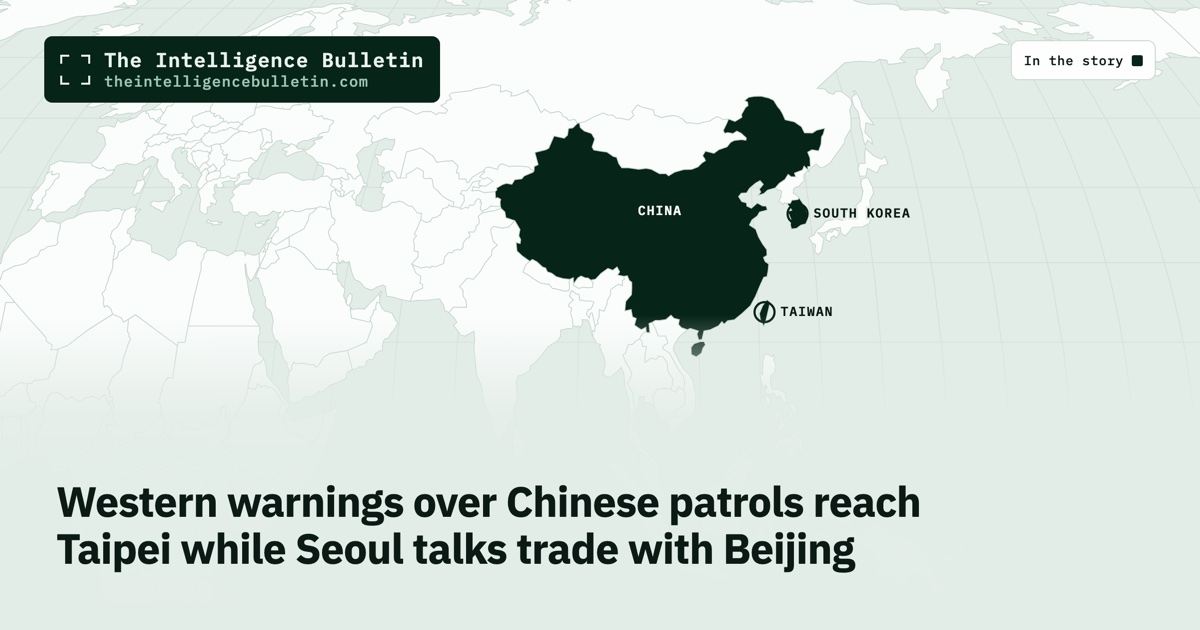
Western warnings over Chinese patrols reach Taipei while Seoul talks trade with Beijing

Map of the countries in the story: Western warnings over Chinese patrols reach Taipei while Seoul talks trade with Beijing
Story gist: On June 24-25 2026, the United States, Britain, France and Germany issued statements expressing concern over recent Chinese Coast Guard patrols and survey activity in waters off Taiwan’s east coast. Taiwan thanked the allies, stressing that freedom of navigation underpins global trade and that the actions violate international norms. The patrols followed Beijing’s objections to Japan-Philippines maritime boundary talks.

One Story. Many Angles.

🇹🇼
Taiwan
SETN
CHINESE
G7, UK/France/Germany, AIT express concern over China intrusion; DPP: International community sees who the real troublemaker is
Read →
🇸🇬
Singapore
AsiaOne
US, UK, France, Germany raise alarm about Chinese patrols off eastern Taiwan
Read →
🇺🇸
United States
WHBL
Taiwan cheered by Western allies’ alarm over Chinese Coast Guard activities
Read →
🇰🇷
South Korea
Herald Business
KOREAN
South Korea-China premiers meet after 7 years, advancing bilateral cooperation to new stage
Read →
🇹🇼
Taiwan
Liberty Times
CHINESE
China’s Audit Office: Bank of China evaded 11 billion yuan in taxes by padding headcount
Read →

Perspective Analysis

On June 25, 2026, Western statements condemning Chinese maritime activity near Taiwan arrived in Taipei at the same moment South Korean and Chinese premiers met in Dalian to advance trade ties, revealing how regional media outlets on the same day selected sharply divergent China-related stories rather than treating the patrols as the sole signal. The U.S., Britain, France and Germany had issued expressions of concern the previous day over Coast Guard patrols and survey operations off Taiwan’s east coast, actions Beijing tied to upcoming Japan-Philippines maritime boundary talks. Taiwan responded with gratitude, underscoring that freedom of navigation underpins global trade and rejecting any Chinese claim of jurisdiction in those waters.

The English-language coverage from AsiaOne and WHBL followed the same Reuters wire almost verbatim, presenting the Western statements, Beijing’s stated rationale, and Taipei’s relief that the patrols had been labeled destabilizing. AsiaOne delivered a concise factual summary, noting that China described its operation as a “special maritime traffic law-enforcement” response after Japan and the Philippines announced formal boundary talks involving waters Beijing views as its exclusive economic zone. It quoted a U.S. State Department spokesperson calling the actions “deeply destabilizing” and rejecting any Chinese assertion of authority to interfere with navigation freedoms. The piece also recorded the rare joint statement from the British, French and German offices in Taipei, which warned that the activity threatened regional stability and international shipping while reiterating opposition to unilateral changes to the status quo by threat or coercion.

WHBL placed greater emphasis on Taiwan’s positive reaction, reporting that National Security Council Secretary-General Joseph Wu wrote on X that he was “truly thankful” for the statements and urged the PRC to stop its maritime expansionism. Taiwan’s Ocean Affairs Council added that freedom of navigation in surrounding waters is essential to global trade and that China’s harassment violated international law and harmed shared international interests. Council minister Kuan Bi-ling posted on Facebook that China had been “certified” as a disruptor of regional stability, adding that the more Beijing harassed Taiwan the more the international community supported Taipei. Both outlets stayed within the wire copy’s neutral framing, omitting any domestic Taiwanese political rhetoric.

SETN, the Taiwanese outlet, folded the identical events into an explicit Democratic Progressive Party statement that branded China the “real troublemaker.” The report detailed how Beijing had launched the patrols citing Japan-Philippines exclusive economic zone negotiations, then quoted the DPP’s China Affairs Department at length: international concern had risen from isolated incidents to a shared focus on the entire Indo-Pacific security order, with the world increasingly clear on “who is maintaining peace and who is making trouble.” It linked the east-coast activity to a five-year pattern of gray-zone pressure, including military aircraft and vessels crossing the Taiwan Strait median line, harassment around the Diaoyutai islands, water-cannon incidents against Philippine vessels in the South China Sea, and now an attempt to break through the first island chain. The piece framed Taiwan as standing at the front line of democracy while protecting global semiconductor supply chains, and it called on Beijing to cease military intimidation and respect international law.

The Korean Herald Business article ignored the Taiwan patrols entirely, instead covering the June 23 meeting between South Korean Prime Minister Kim Min-seok and Chinese Premier Li Qiang in Dalian—the first such summit in seven years. It quoted both leaders stressing the need to elevate bilateral relations to a new stage through expanded economic, cultural and youth exchanges. Li highlighted cooperation in semiconductors, artificial intelligence, new energy and biomedicine, and expressed hope for swift progress on the second stage of China-South Korea free-trade agreement negotiations. Kim welcomed greater Chinese investment in Korea and looked ahead to the upcoming APEC meetings. The coverage presented the encounter as a positive diplomatic step following the leaders’ earlier summit interactions, with no reference to maritime tensions elsewhere in the region.

Liberty Times likewise chose a different China story altogether, reporting on domestic regulatory scrutiny inside the People’s Republic. It cited China’s National Audit Office disclosure that the Bank of China had used a “padding headcount” scheme between April 2023 and August 2025, mobilizing large numbers of employees to invest token amounts in order to repackage 11 private equity funds as public offerings and thereby evade 2.367 billion yuan in taxes—roughly NT$11 billion. The bank responded by accepting the audit findings and pledging immediate rectification. The article also noted separate violations by the Agricultural Bank of China involving improper lending to non-standard farmland projects. By focusing on financial misconduct rather than external maritime assertiveness, the Taiwanese outlet illustrated how even outlets in the same polity can select entirely separate threads of China-related news on a single day.

Across the five reports, the underlying facts of the Western statements and the timing of the patrols converge, yet the framing and emphasis diverge according to each outlet’s audience and alignment. The Singapore- and U.S.-based wires remained tightly factual and alliance-oriented. The DPP-aligned Taiwanese source weaponized the international reaction for domestic messaging that explicitly identified Beijing as the aggressor. The Korean business publication and the second Taiwanese outlet simply chose parallel but unrelated China stories—economic diplomacy in one case, internal financial oversight in the other—demonstrating that maritime pressure near Taiwan was treated as one thread among many rather than the dominant regional signal.

The Takeaway

What to watch next is whether the joint Western statements translate into coordinated diplomatic follow-up at upcoming multilateral forums or whether Beijing responds with further patrols framed as routine law enforcement. South Korea’s renewed high-level engagement with China also bears monitoring for any spillover effects on Seoul’s balancing act between economic ties with Beijing and security alignment with Washington and Tokyo. Taiwan’s domestic political use of the episode will likely intensify ahead of local elections, while continued Chinese audit disclosures could surface additional domestic vulnerabilities inside major state banks.
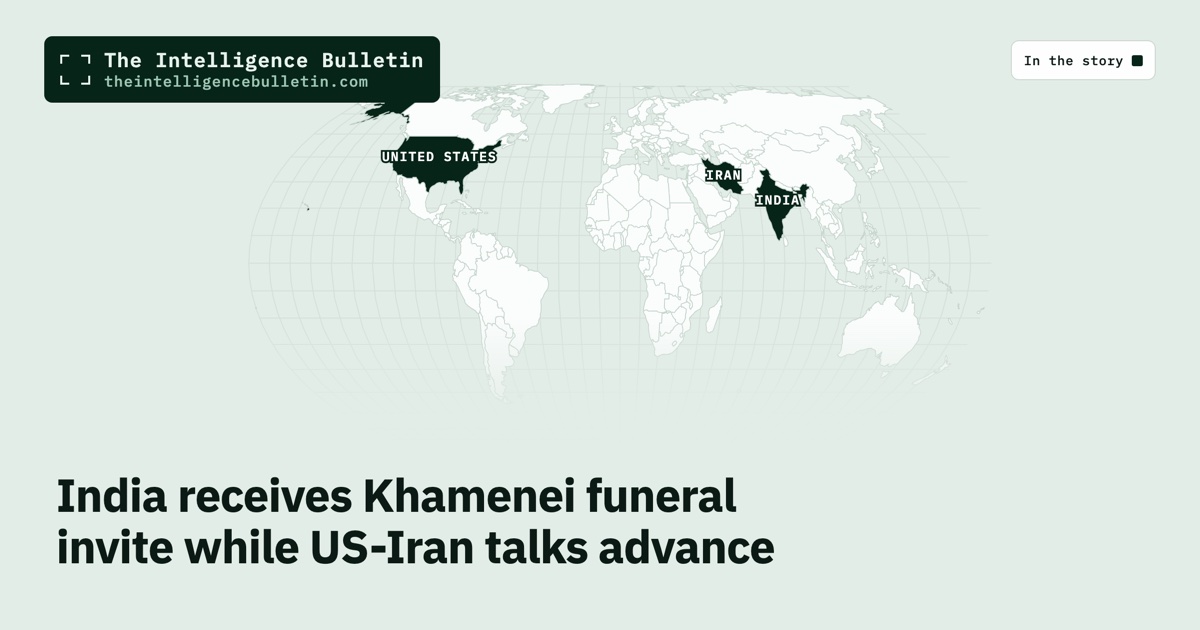
India receives Khamenei funeral invite while US-Iran talks advance

Map of the countries in the story: India receives Khamenei funeral invite while US-Iran talks advance
Story gist: On June 24, 2026, Iranian President Masoud Pezeshkian invited Indian Prime Minister Narendra Modi to attend the July 4-9 state funeral ceremonies for former Supreme Leader Ayatollah Ali Khamenei in Tehran, Qom, and Mashhad. Khamenei was killed in a US-Israeli airstrike on February 28. The invitation reached India’s Ministry of External Affairs via the Iranian Embassy in New Delhi. India has not yet decided on its official representation.

One Story. Many Angles.

🇮🇳
India
Andhra Jyothy
TELUGU
Iran Invites PM Modi for Supreme Leader Ali Khamenei’s State Funeral Amid Growing Diplomatic Focus
Read →
🇮🇳
India
Outlook India
Iran Invites PM Modi To Ayatollah Khamenei’s State Funeral, India Yet To Decide Representation
Read →
🇮🇳
India
Open The Magazine
Iran President Pezeshkian Invites PM Modi to Ali Khamenei State Funeral Amid US-Israel Strike Fallout and Iran-US Peace Talks
Read →
🇮🇳
India
The Week
Will PM Modi attend Ali Khamenei’s funeral? India yet to decide on Iran president Pezeshkian’s invite
Read →

Perspective Analysis

Indian reporting on the invitation extended to Prime Minister Narendra Modi for the state funeral of former Supreme Leader Ayatollah Ali Khamenei reveals a consistent emphasis on the continuity of India-Iran ties, even as the invitation arrives against the backdrop of Khamenei’s death in February US-Israeli strikes and advancing US-Iran peace negotiations. Across major outlets, the core facts remain uniform: Iranian President Masoud Pezeshkian issued the invitation on June 24 via the Iranian Embassy in New Delhi, which delivered it to India’s Ministry of External Affairs, with ceremonies scheduled across Tehran, Qom, and Mashhad from July 4 to July 9. India has yet to announce its official representation, and coverage avoids speculation about Modi’s personal attendance or the broader implications of the post-strike environment.

The invitation itself follows established diplomatic channels. Khamenei, who had led Iran for 36 years, was killed on February 28 during the initial US-Israeli airstrikes on Tehran. His burial had been postponed amid ongoing conflict, and the July schedule allows for multi-city observances that include public processions expected to draw millions. Pezeshkian has extended similar invitations to leaders from several countries, including Pakistan, underscoring the event’s regional significance. Diplomatic sources cited in the reporting confirm that the formal note reached New Delhi’s foreign ministry recently, prompting internal discussions but no immediate public statement from the Indian side.

Indian outlets approach the story through distinct lenses that collectively highlight the relationship’s resilience. Outlook India focuses tightly on procedural elements within New Delhi’s bureaucracy. It notes the embassy’s delivery of the invitation and the government’s undecided stance on representation, drawing parallels to earlier condolences, including Foreign Secretary Vikram Misri’s visit to the Iranian Embassy in March to sign the official condolence book. The piece recalls Modi’s last visit to Iran in May 2016, when he met Khamenei and then-President Hassan Rouhani to advance the Chabahar Port agreement, and references President Pezeshkian’s meeting with Modi at the 2024 BRICS Summit in Kazan. This framing keeps the emphasis on routine statecraft and the mechanics of high-level contacts rather than wider strategic shifts.

The Week centers the question of personal leadership optics. It asks directly whether Modi will attend and outlines the funeral’s logistics across the three cities, while noting expected Pakistani participation by Prime Minister Shehbaz Sharif and army chief Asim Munir. The report highlights Modi’s 2016 gesture of gifting Khamenei a rare seventh-century Kufic-script manuscript of the Quran attributed to Hazrat Ali. It also records that if Modi cannot travel, a high-level MEA delegation would represent India. This angle brings forward the ceremonial dimension and regional attendance patterns without venturing into policy speculation.

Open The Magazine situates the invitation within the evolving geopolitical context of the US-Israeli strikes and subsequent de-escalation. It reports that ceremonies will begin July 4 in Tehran, move to Qom on July 7, and conclude with burial in Mashhad on July 9, with expectations of up to 20 million mourners—potentially surpassing the 10 million who attended Ayatollah Ruhollah Khomeini’s 1989 funeral. The piece notes Mojtaba Hosseini Khamenei’s succession as Supreme Leader on March 8 and references the peace framework between Iran and the United States, including signed memorandums of understanding and ongoing negotiations in Switzerland. It explicitly ties the outreach to cooling tensions after months of conflict that disrupted energy routes.

Andhra Jyothy broadens the frame beyond the immediate diplomatic formality. As a Telugu-language daily, it places the invitation inside India’s expanding engagement with Iran across energy cooperation, trade, the Chabahar port project, and regional security. The report underscores ongoing bilateral collaboration rather than isolating the funeral invite as a standalone event, aligning the gesture with New Delhi’s wider foreign-policy outreach in the region.

Taken together, the coverage demonstrates a shared editorial restraint. None of the outlets dwell on the strikes’ immediate aftermath or predict Modi’s decision, treating the invitation instead as standard diplomatic correspondence amid larger regional adjustments. The uniform reporting of dates, delivery method, and India’s undecided response creates a quiet consensus that bilateral continuity persists regardless of leadership changes in Tehran or parallel peace processes.

The Takeaway

What to watch next centers on India’s eventual choice of representation and how it aligns with the trajectory of US-Iran negotiations. The multi-city ceremonies in early July will also test attendance patterns among regional actors, including Pakistan, while ongoing energy and port cooperation between New Delhi and Tehran provides the practical backdrop against which any high-level signals will be interpreted.


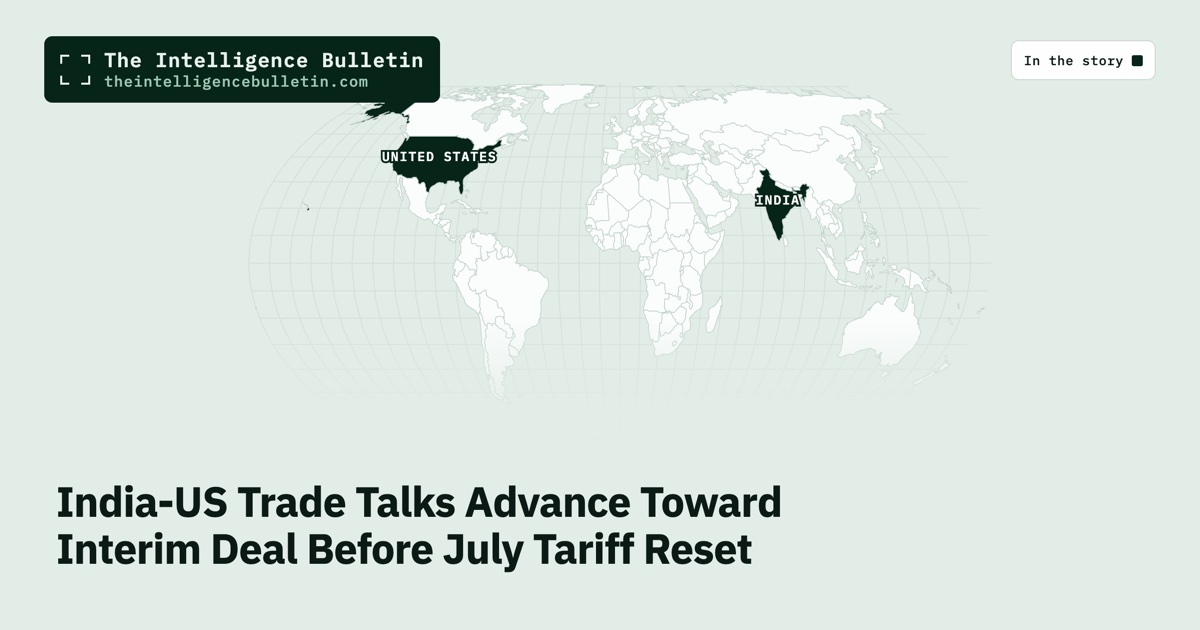
India-US Trade Talks Advance Toward Interim Deal Before July Tariff Reset

Map of the countries in the story: India-US Trade Talks Advance Toward Interim Deal Before July Tariff Reset
Story gist: On June 24, 2026, Union Commerce Minister Piyush Goyal and U.S. Trade Representative Jamieson Greer concluded two days of ministerial talks in New Delhi. They reviewed progress on an interim Bilateral Trade Agreement covering market access, digital trade, non-tariff barriers and supply chains. Both sides aim to finalize the interim deal before the July 24 expiration of a temporary 10 percent U.S. tariff on imports. India and the United States reaffirmed commitment to a balanced pact that expands bilateral trade toward a $500 billion target by 2030.

One Story. Many Angles.

🇮🇳
India
Indiablooms
USTR Ambassador Jamieson Greer visits New Delhi, reviews progress on India-US Trade pact talks
Read →
🇮🇳
India
The Times of India
India Us Bilateral Trade Agreement: ‘Constructive and forward-looking’: India, US conclude ministerial-level talks on interim trade pact ahead of July tariff deadline
Read →

Perspective Analysis

India and the United States have moved noticeably closer to sealing an interim bilateral trade agreement, treating the July 24 expiration of a temporary 10 percent U.S. tariff as a firm external deadline that both capitals now appear determined to meet. The June 24 conclusion of two days of ministerial talks in New Delhi between Commerce and Industry Minister Piyush Goyal and U.S. Trade Representative Jamieson Greer produced unusually aligned public messaging from both sides, framing the discussions as productive and forward-looking while identifying an interim pact as the immediate deliverable en route to a fuller Bilateral Trade Agreement.

The immediate backdrop is the sequence of tariff adjustments that have punctuated the relationship since last year. Negotiations on a first-phase framework announced in February 2025 encountered renewed friction after Washington raised duties on Indian goods, reaching 50 percent in August amid disputes over Indian imports of Russian oil. Those pressures eased somewhat following a mid-June meeting between Prime Minister Narendra Modi and President Donald Trump on the margins of the G7 summit in France, setting the stage for Greer’s three-day visit that began on June 22.

The two principal Indian reports that emerged on June 24 reflect distinct editorial priorities yet converge on the same core assessment of progress. Indiablooms centered its account on the mechanics and symbolism of Greer’s visit itself. The outlet described the ambassador’s arrival with a delegation as a milestone in sustained bilateral engagement, noting multiple rounds of discussions with Goyal that produced a comprehensive review of the proposed agreement’s key pillars: enhanced market access, digital trade, supply-chain resilience, non-tariff barrier reduction, and cooperation in strategic sectors. The piece quoted the Indian government statement that both sides had acknowledged “substantial progress made by negotiating teams in recent months” and welcomed the momentum from successive technical and ministerial engagements. Indiablooms also recorded the shared commitment to a “balanced, commercially meaningful” interim deal that would deliver tangible benefits to businesses, farmers, workers, and consumers in both countries, while reiterating the long-standing $500 billion bilateral trade target for 2030. The report placed less immediate weight on the July tariff clock, instead situating the visit within a longer arc that includes Trump’s public expressions of optimism at Davos earlier in the year.

The Times of India, by contrast, foregrounded the calendar pressure and the economic stakes for Indian exporters. Its dispatch highlighted Goyal’s characterization of the talks as having advanced “in a constructive and forward-looking manner” and noted Greer’s remarks on the personal rapport between Trump and Modi, including their recent G7 encounter. The paper explicitly tied the urgency to the impending July 24 expiration of the temporary 10 percent tariff introduced on February 24, describing the interim pact as an important milestone toward a comprehensive agreement. It supplied concrete trade data for context: the United States remained India’s second-largest trading partner in 2025-26, with Indian exports to the U.S. rising 0.92 percent to $87.3 billion while imports grew 15.95 percent to $52.9 billion, narrowing the surplus to $34.4 billion. The report further detailed the issues still under active negotiation, including India’s request for favorable tariff treatment on its exports and Washington’s interest in greater access for U.S. agricultural and industrial products such as tree nuts, fruits, soybean oil, wine, and spirits. It also recorded India’s stated willingness to undertake large-scale purchases of American energy products, aircraft, technology equipment, precious metals, and coking coal over the next five years.

Taken together, the two accounts reveal a deliberate division of emphasis rather than any substantive divergence. Indiablooms, a niche digital platform, privileged the diplomatic choreography and official statements of shared commitment. The Times of India, with its broader business readership, supplied the tariff deadline, statistical backdrop, and granular list of remaining negotiating items. Both outlets recorded the same list of core topics under review and the same Indian openness to increasing purchases of U.S. energy and defense goods. Neither suggested that larger structural differences—particularly on market access and non-tariff barriers—had been resolved; instead, both portrayed the interim agreement as a politically feasible way to lock in gains before external deadlines intervene.

The Takeaway

This alignment across outlets signals that negotiators on both sides now view the narrow window before July 24 as realistic for concluding at least a first-phase deal. The reaffirmed $500 billion trade target by 2030 and the explicit framing of the interim pact as a stepping stone indicate that neither capital sees the current round as an endpoint. What remains to be watched is whether the technical teams can translate the ministerial-level momentum into a finalized text in the coming weeks, how any interim package addresses the specific tariff concerns of Indian exporters, and whether the agreement’s early provisions on digital trade and supply-chain resilience set durable precedents for the comprehensive phase that would follow.


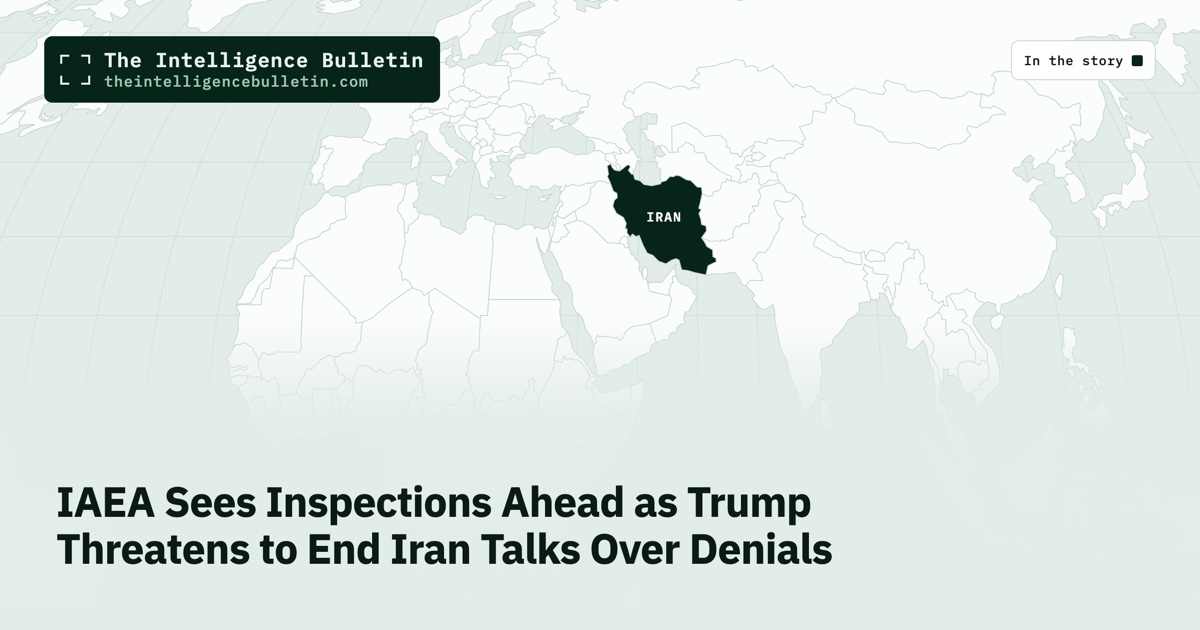
IAEA Sees Inspections Ahead as Trump Threatens to End Iran Talks Over Denials

Map of the countries in the story: IAEA Sees Inspections Ahead as Trump Threatens to End Iran Talks Over Denials
Story gist: On June 23, 2026, President Trump stated the US would halt talks with Iran if Tehran refused IAEA nuclear inspections after a $12 billion funds unfreeze. Iran denied any agreement on immediate inspections, insisting they follow a final deal. IAEA chief Rafael Grossi said inspections would proceed soon with modalities to be finalized. The standoff follows an interim US-Iran accord amid prior strikes and oil market concerns.

One Story. Many Angles.

🇺🇸
United States
Leader-Telegram
Iranian diplomat rejects IAEA chief comments on inspections
Read →
🇬🇧
United Kingdom
Middle East Eye
IAEA chief says Iran nuclear inspections will go ahead soon
Read →
🇭🇰
Hong Kong
South China Morning Post
War of words won’t stop Iran nuclear inspections, says IAEA
Read →
🇳🇬
Nigeria
Daily Post
Strait of Hormuz: Trump reveals next line of action if Iran violates deal
Read →
🇰🇷
South Korea
FN News
KOREAN
Trump: Iran must allow 100% nuclear inspections or talks will be cancelled
“Trump: Iran 100% nuclear facility inspection or cancel talks”
Read →

Perspective Analysis

The International Atomic Energy Agency has positioned itself as the institutional constant in a fresh round of U.S.-Iran friction, insisting that nuclear inspections will move forward on their own timetable even as Washington and Tehran trade sharply conflicting accounts of what was agreed. On June 23, President Donald Trump warned that talks would end if Tehran refused IAEA access, while Iranian officials maintained that no such commitment existed ahead of a final accord. IAEA Director General Rafael Grossi countered that inspections “will indeed take place” and that modalities for dates, procedures, and locations would be settled soon.

This standoff stems from an interim U.S.-Iran accord reached in the preceding week. The understanding followed months of military exchanges that began with U.S. and Israeli strikes on Iranian targets more than three months earlier and Iranian retaliatory actions against Israel and U.S. positions in the Gulf. The interim framework opened a 60-day window for broader negotiations that include Iran’s nuclear program. Under the deal, previously frozen Iranian funds were slated to be held in escrow under U.S. oversight and restricted to purchases of food exclusively from American suppliers.

American reporting, as carried by the Leader-Telegram, gave prominent space to the Iranian rebuttal. An Iranian diplomat rejected Grossi’s comments outright, stating that any inspections would occur only after a final agreement is reached. The dispatch, drawn from Associated Press wire copy, framed the dispute around Tehran’s insistence on sequencing and supplied the clearest articulation of Iran’s position that no immediate visit by IAEA scientists had been arranged.

Middle East Eye centered its coverage on Grossi’s confirmation that inspections remain on track under the interim accord. The outlet quoted the IAEA chief directly from a press conference in Japan, noting that while specifics remain to be finalized, the agency expects to resume monitoring activities without delay. This presentation underscored practical continuity rather than the political threats or denials emanating from either capital.

South China Morning Post, drawing on Bloomberg reporting, highlighted Grossi’s dismissal of the overnight back-and-forth as a mere “war of words.” The piece stressed that the IAEA expects to resume full monitoring at some stage and quoted the director general saying inspections are inevitable. It placed the rhetorical exchanges in the context of negotiators’ efforts toward a permanent peace deal, signaling that monitoring obligations would persist regardless of public posturing.

Nigeria’s Daily Post shifted attention to the potential consequences of non-compliance. It reported Trump’s statement that he would “do what I have to do” if Iran failed to uphold the agreement, linking the inspection dispute directly to risks in the Strait of Hormuz. The coverage recalled the recent attacks that killed thousands and displaced millions, noted the resulting pressure on global oil prices, and framed the standoff as a matter of shipping routes and energy-market stability rather than solely technical verification.

South Korea’s FN News captured Trump’s ultimatum in the starkest terms, reporting his assertion that Iran’s denial was false and that full, 100-percent inspections had already been recorded in internal understandings. The dispatch relayed Trump’s remark that if Iran’s position proved accurate he would cancel talks immediately, while also noting the president’s expectation that IAEA inspectors would enter Iran at an appropriate time. It detailed the ongoing technical talks in Switzerland following the June 21 memorandum of understanding.

Across these accounts, a consistent core emerges: the interim accord included commitments on inspections and escrow arrangements, yet the precise timing and sequencing remain disputed. Western and East Asian outlets largely treated Grossi’s statements as the operational reality, while the Nigerian perspective foregrounded downstream economic and maritime risks. The shared factual baseline—that unfrozen funds carry U.S. oversight strings and that extensive inspections were referenced in the initial understanding—anchors the reporting even as individual outlets emphasize different stakes for their audiences.

The Takeaway

The coming weeks will test whether the IAEA can convert Grossi’s stated intent into concrete access dates and procedures. Negotiators in Switzerland continue technical discussions, but any renewed Iranian insistence that inspections follow rather than precede a final deal could trigger the termination threat Trump articulated. Observers will also watch shipping patterns through the Strait of Hormuz and movements in global oil benchmarks for early signs that the dispute is spilling beyond the negotiating table.


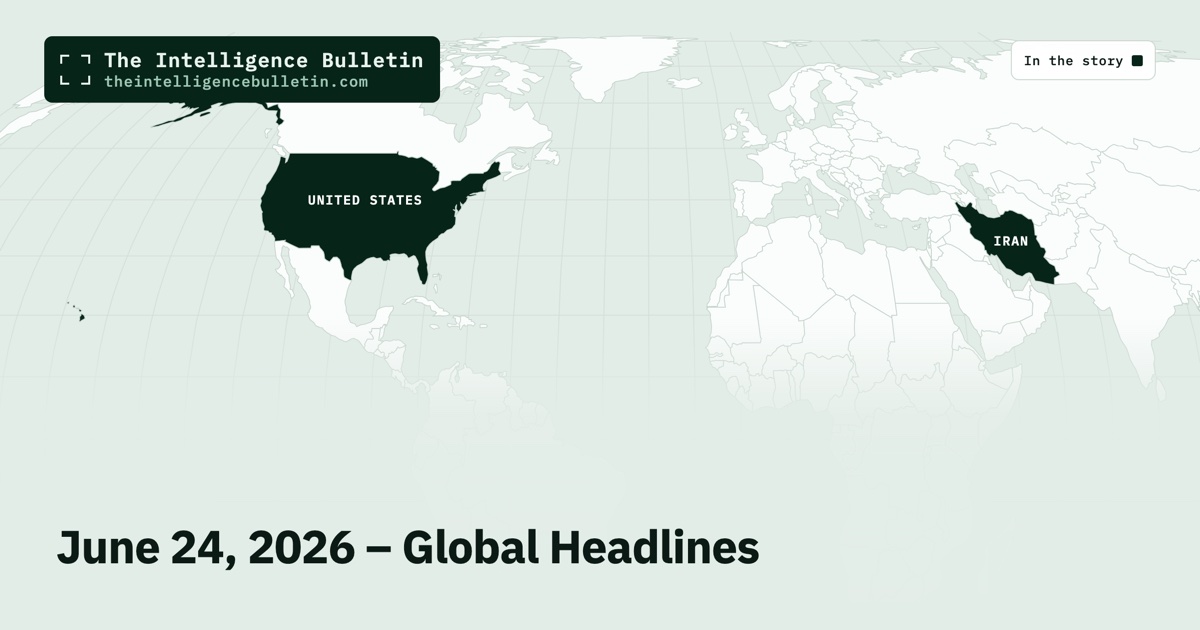
June 24, 2026 – Global Headlines

Map of the countries in the story: June 24, 2026 – Global Headlines

1Iran Ties Nuclear Inspections to Final Deal as U.S. Warns Talks Could Collapse

Map of the countries in the story: June 24, 2026 – Global Headlines
Story gist: On June 23-24 2026, Iranian diplomat Ali Bahreini rejected IAEA chief Rafael Grossi’s comments on imminent inspections of nuclear sites, stating they would occur only after a final agreement. This followed U.S. Vice President JD Vance’s claim that Iran had consented to IAEA access amid an interim U.S.-Iran peace accord and $12 billion in unfrozen funds. Trump warned talks would halt without inspections, while Iran clarified no plans existed for damaged facilities and funds would be used at its discretion. The clash highlights fragile post-accord negotiations.
One Story. Many Angles.
🇺🇸
United States
leadertelegram.com
Iranian diplomat rejects comments by IAEA chief on nuclear site inspections, says it would come only after a final deal
Read →
🇬🇧
United Kingdom
middleeasteye.net
IAEA chief says Iran nuclear inspections will go ahead soon
Read →
🇩🇪
Germany
merkur.de
Trump gegen Teheran: Der Streit um Atominspektionen eskaliert
Read →
Perspective Analysis

The Iranian diplomat’s blunt rejection of IAEA assurances cuts to the core of the standoff: Tehran views inspections not as a near-term deliverable but as leverage tied to a completed deal. The Leader Telegram’s AP dispatch leads with this rebuttal, underscoring Iran’s insistence on sequencing that protects its position before any further concessions. In contrast, Middle East Eye’s live update highlights Grossi’s press conference pledge that inspections “will indeed take place” soon, framing the story around procedural progress under the interim accord rather than the dispute. Merkur.de, drawing on Washington Post reporting, casts the episode as bilateral escalation between Trump and Tehran, detailing Vance’s milestone claim, Iran’s counter on damaged sites and escrow funds, plus side disputes over missiles and Lebanon stabilization. This German lens places the inspection row inside a wider pattern of contradictory statements that risk derailing the 60-day talks. The shared factual backbone—Vance’s assertion, Iran’s denial, Grossi’s timeline—reveals a U.S.-Iranian interim accord already straining under mismatched expectations on verification timing and fund oversight, with each outlet foregrounding the actor whose stance best fits its audience’s regional priorities.


2Nigerian coverage splits on whether US ISIS sanctions strengthen ties or expose vulnerabilities

Story gist: On June 23 2026 the US Treasury OFAC sanctioned Nigerian Mukhtar Adamu Muhammad and three Lagos and Kano bureaux de change he controls for moving funds to ISIS West Africa Province. The action formed part of wider designations targeting three individuals and six entities across Nigeria France Syria and Turkey. All property under US jurisdiction is blocked and US persons barred from dealings. Nigerian reporting notes both the designations and ongoing bilateral security cooperation.
One Story. Many Angles.
🇳🇬
Nigeria
allafrica.com
Nigeria: U.S. Designates Nigerian Bureau De Change in Fresh ISIS Financing Crackdown, Deepens Counterterrorism Partnership With Abuja
Read →
🇳🇬
Nigeria
leadership.ng
US Naming Of Nigerian, 3 BDCs As ISIS Financiers Raises Concern
Read →
🇳🇬
Nigeria
thisdaylive.com
US Blacklists Nigerian Bureaux De Change in a Fresh Terrorism Financing Crackdown
Read →
Perspective Analysis

Nigerian coverage of the latest US sanctions on local bureaux de change for ISWAP financing reveals a telling split inside one country rather than across borders. This Day and its AllAfrica repost frame the move as evidence of deepening Washington-Abuja ties that give Nigeria new tools against Lake Chad terrorists while also warning that informal finance remains vulnerable. Leadership.ng instead opens with the designations raising concern among security experts about Nigeria’s already battered international image and the need to prosecute the named individuals to restore partner trust. This Day itself balances the sanctions description with National Security Adviser Nuhu Ribadu’s remarks on shared threats and practical cooperation with the UK and US. The common factual core across all three pieces is identical: names addresses passports and the precise role of the three BDCs as conduits. What differs is whether the story is told as an opportunity to tighten an existing partnership or as fresh proof that terrorist financing networks still reach into Nigeria’s financial system. That internal contrast underscores how even aligned governments weigh the same sanctions differently depending on whether the emphasis falls on joint success or domestic exposure.


3US sanctions GAESA military firms and Castro in-law to choke regime revenue

Story gist: On June 23 2026 the United States imposed sanctions on five Cuban state entities including three tied to the military conglomerate GAESA and on Annalie Lilliam Rueda Cardero wife of Alejandro Castro Espín. The measures target revenue sources for the Cuban regime and mining sector operations under an executive order aimed at repression and national security threats. Washington framed the action as restricting foreign business with Havana while Cuba condemned it as a crime.
One Story. Many Angles.
🇨🇺
Cuba
bitlysdowssl-aws.com
Cuba describes new US sanctions against five state companies and the Castro family circle as a crime
Cuba califica como un crimen las nuevas sanciones de EE UU contra cinco empresas estatales y el entorno de la familia Castro
Read →
🇨🇺
Cuba
diariodecuba.com
New sanctions against the Cuban regime are a ‘crime’ by Marco Rubio, says Bruno Rodríguez
Las nuevas sanciones contra el régimen de Cuba son un ‘crimen’ de Marco Rubio, dice Bruno Rodríguez
Read →
🇪🇨
Ecuador
expreso.ec
US sanctions 5 Cuban entities, 3 linked to Gaesa, and one Castro family member
EEUU sanciona a 5 entidades cubanas, 3 vinculadas a Gaesa, y a una familiar de los Castro
Read →
Perspective Analysis

The sanctions announcement drew near-universal factual agreement across outlets but sharp tonal splits emerged in how the targeting of GAESA and the Castro family was contextualized. Ecuador’s Expreso reported the designations with clinical precision naming the specific GAESA-linked financial and logistics arms plus mining and steel firms and the family member without editorial overlay. Cuban state-aligned coverage instead opened with Havana’s accusation of a crime against the Castro environment while the opposition Diario de Cuba shifted blame squarely onto Marco Rubio as the personal architect. This convergence on the who and what reveals the story’s core as a deliberate escalation of pressure on military-run economic pillars that control significant Cuban GDP yet the framing fault line tracks domestic political utility: neutral Latin American reporting treats it as another chapter in US-Cuba economic isolation while Cuban voices weaponize the personal element to rally against Washington. The result underscores how sanctions on GAESA continue to serve as both policy lever and propaganda flashpoint with foreign investors now explicitly warned to vet ties to Havana.


4Indian Coverage Treats Iran’s Funeral Invitation to Modi as Standard Protocol After US Peace Deal

Story gist: On June 24, 2026, Iranian President Masoud Pezeshkian invited Indian Prime Minister Narendra Modi to attend the state funeral and burial for former Supreme Leader Ali Khamenei. Ceremonies run July 4-9 across Tehran, Qom and Mashhad. Khamenei was killed February 28 during US and Israeli strikes; the event was postponed due to war and now follows a US-Iran peace deal. All three Indian outlets reported the invitation from diplomatic sources with no confirmation from New Delhi.
One Story. Many Angles.
🇮🇳
India
newsx.com
Masoud Pezeshkian Invites PM Modi To Ayatollah Ali Khamenei’s Funeral As Iran Announces July Ceremonies
Read →
🇮🇳
India
indiatvnews.com
Iran President invites PM Modi to attend Ali Khamenei’s state funeral from July 5 to 9: Sources
Read →
🇮🇳
India
businesstoday.in
Iran President invites PM Modi for funeral of Ayatollah Khamenei, say sources
Read →
Perspective Analysis

Indian coverage treats the invitation as a straightforward diplomatic courtesy extended by Pezeshkian amid post-war stabilization. Every outlet supplies the same core facts drawn from Tehran sources: the July timeline, the locations tied to Khamenei’s life, and the expected scale of mourning that could rival Khomeini’s 1989 funeral. The shared decision to embed the invitation inside the wider US-Iran peace agreement and the questions surrounding Mojtaba Khamenei’s health shows how New Delhi’s press sees the event through the lens of regional realignment rather than internal Iranian succession drama. Minor headline differences—newsx.com pairing the invitation with the ceremony announcement, indiatvnews.com foregrounding the exact July 5-9 window, businesstoday.in keeping the sources phrasing tight—do not alter the underlying consensus that this is a low-stakes protocol move for India at a moment when energy markets and West Asia security are settling after months of conflict. No outlet speculates on Modi’s attendance or links the gesture to India’s energy imports or Chabahar port interests; the uniformity itself signals that Indian editors view the story as confirmation of continued bilateral contact rather than a pivot point.


5Moscow and Minsk to Confer on Zelensky’s Drone-Equipment Deadline

Story gist: On June 23, 2026, Kremlin spokesman Dmitry Peskov denounced Ukrainian President Volodymyr Zelensky’s ultimatum demanding Belarus remove Russian drone-support equipment within a week, calling it aggressive interference in Belarusian sovereignty. Peskov stated that Russian President Vladimir Putin and Belarusian President Alexander Lukashenko would discuss the remarks soon. The statements came from Moscow amid ongoing Russian drone operations over Ukraine using Belarusian border infrastructure.
One Story. Many Angles.
🇷🇴
Romania
digi24.ro
Kremlin announcement after Zelensky gave ultimatum to Lukashenko. What Putin will do
Anunțul Kremlinului după ce Zelenski i-a dat un ultimatum lui Lukașenko. Ce va face Putin
Read →
🇷🇸
Serbia
alo.rs
Kremlin reacted to Zelensky’s ultimatum! Putin and Lukashenko urgently at the same table
Kremlj reagovao na ultimatum Zelenskog! Putin i Lukašenko hitno za isti sto
Read →
Perspective Analysis

Both the Romanian and Serbian reports open with the same core Kremlin message: Zelensky’s deadline for Minsk is an unacceptable threat to Belarusian independence, yet Moscow expresses full confidence that Minsk can handle it alone. The shared detail that Putin and Lukashenko will address the matter directly in coming days underscores the personal channel between the two leaders rather than any institutional response. Romanian coverage lingers on the technical specifics of the relay systems mounted on communication towers that enable Shahed drone navigation near the Belarus border, reflecting Bucharest’s longstanding focus on sovereignty violations in the neighborhood. Serbian reporting adds context on Belarus’s repeated public refusals to send troops into Ukraine while still hosting Russian nuclear weapons, framing the episode as another test of how far Minsk will be drawn into direct confrontation. The near-identical sourcing from Kyiv Independent and the matching condemnation language reveal that outlets in Bucharest and Belgrade are reading the same signals from Moscow about alliance management. What stands out is the absence of any speculation about escalation or Ukrainian follow-through; both pieces treat the ultimatum primarily as a diplomatic probe that Russia is already channeling back into the Putin-Lukashenko relationship.


June 23, 2026 – Global Headlines

Map of the countries in the story: June 23, 2026 – Global Headlines

1Three US outlets from different states all call Senate housing bill a supply fix

Map of the countries in the story: June 23, 2026 – Global Headlines
Story gist: On 22 June 2026 the US Senate passed a bipartisan bill in Washington that reduces federal regulations, expands local control, and restricts corporate purchases of single-family homes. The measure seeks to increase housing supply and lower prices before moving to the House. Coverage from Florida, Colorado and New York outlets used nearly identical language to describe the legislation as a regulatory adjustment rather than a partisan contest.
One Story. Many Angles.
🇺🇸
United States
news4jax.com
Senate passes a bipartisan housing bill aimed at increasing supply and lowering prices
Read →
🇺🇸
United States
reporterherald.com
Senate is set to pass a bipartisan housing bill aimed at increasing supply and lowering prices
Read →
🇺🇸
United States
newsday.com
Senate passes a bipartisan housing bill aimed at increasing supply and lowering prices
Read →
Perspective Analysis

Three American newspapers separated by more than two thousand miles described the Senate housing vote in virtually the same sentence. News4Jax in Jacksonville, the Reporter-Herald in Loveland, and Newsday on Long Island each led with the bill’s aim to increase supply and lower prices, treating the outcome as a technical correction to market rules rather than a political event. The shared wording is striking because these outlets normally serve audiences with distinct economic pressures: coastal Florida real-estate volatility, Front Range growth constraints, and New York metro affordability strains. Yet none introduced regional qualifiers or corporate-restriction angles that might have appealed to local readers. The absence of partisan framing is equally consistent; every headline foregrounds bipartisanship and supply mechanics without reference to the bill’s journey through a divided Congress or its potential effect on investor portfolios. This convergence suggests the story is being processed inside domestic policy silos even when the legislation touches national markets sensitive to interest rates and institutional capital. The result is a narrow but uniform portrait: a regulatory fix whose significance is assumed to be self-evident to readers regardless of geography.


2US eases Iran oil sanctions in Swiss talks even as inspection clashes persist

Story gist: On 2026-06-22 the US Treasury granted Iran a two-month oil sanctions waiver after technical talks in Switzerland. The interim deal ties eased sanctions to Strait of Hormuz transit assurances and renewed IAEA access. Swiss coverage centers on the conclusion of the talks, French reporting stresses economic relief for Tehran, and Italian accounts highlight ongoing disputes over nuclear inspections.
One Story. Many Angles.
🇨🇭
Switzerland
cdt.ch
Technical talks concluded in Switzerland
Conclusi i colloqui tecnici in Svizzera
Read →
🇫🇷
France
courrierinternational.com
The United States lifts its sanctions on Iranian oil, a windfall for Tehran
Les États-Unis lèvent leurs sanctions sur le pétrole iranien, une aubaine pour Téhéran
Read →
🇮🇹
Italy
zazoom.it
Iran and USA, clash over nuclear inspections while oil sanctions are eased
Iran e Usa, scontro sulle ispezioni nucleari mentre vengono allentate sanzioni sul petrolio
Read →
Perspective Analysis

The waiver itself drew little dispute across borders, yet the three outlets treated the same event as fundamentally different stories. Swiss reporting stopped at the procedural endpoint in Geneva, presenting the outcome as a tidy completion of technical negotiations without venturing into what the easing actually delivers for Iranian revenues. French coverage instead framed the same decision as an immediate commercial opening for Tehran, underscoring the revenue implications that Swiss accounts left unmentioned. Italian accounts inserted the nuclear-inspection friction as the central unresolved element, casting the oil concession as occurring against a backdrop of continued US-Iranian friction rather than as evidence of progress. These choices track the outlets’ habitual lenses: Swiss media often default to process and venue, French international pages track economic winners in sanctions relief, and Italian reporting on Iran has long paired any diplomatic movement with reminders of nuclear verification gaps. The result is not contradiction but selective emphasis that reveals how each capital’s editorial priorities filter the same set of facts. No outlet disputed the waiver’s existence or its two-month duration; the divergence lies in which downstream consequence each chose to foreground.


3US outlets tie Iran oil waiver to talks while Jamaica highlights inspectors

Story gist: On June 22 the US Treasury issued a 60-day general license allowing Iranian crude oil and petrochemical sales. The waiver, effective through August 21, forms part of an interim framework linked to bilateral talks. US reporting centers on sanctions relief and dialogue progress. Jamaican coverage instead stresses the planned return of nuclear inspectors as the principal outcome.
One Story. Many Angles.
🇺🇸
United States
nytimes.com
U.S. Temporarily Lifts Oil Sanctions Against Iran, Citing Productive Talks
Read →
🇺🇸
United States
seattletimes.com
U.S. temporarily lifts oil sanctions against Iran, citing productive talks
Read →
🇯🇲
Jamaica
jamaicaobserver.com
US temporarily suspends Iran oil sanctions, says nuclear inspectors to return
Read →
Perspective Analysis

Washington coverage treats the Treasury license as a narrow, time-bound concession extracted from productive negotiations. Both the New York Times and Seattle Times headline the sanctions step itself and the 60-day clock, keeping the story inside the familiar lane of executive-branch sanctions policy. Kingston’s Jamaica Observer shifts the emphasis to nuclear inspectors returning, an outcome mentioned nowhere in the two US accounts. That choice reflects Jamaica’s position as a non-aligned voice watching the nuclear file more closely than the oil-trading mechanics. The divergence is not about facts disputed but about which thread of the same interim deal is judged newsworthy. Where American readers are assumed to care most about sanctions enforcement and market signals, the Jamaican framing assumes readers track the inspectors as the real test of whether the talks have substance. The shared decision to publish at all, across forty outlets in a single day, shows the waiver crossed a threshold of systemic importance even while each newsroom selected a different piece of it to lead.


4Starmer Exit Draws China Focus on Support Loss, India on Trump

Story gist: On 22 June 2026 Keir Starmer announced outside 10 Downing Street that he would resign as Labour leader and prime minister once a successor is chosen. He will remain caretaker until the party selects a replacement. The move follows loss of support among Labour MPs. International coverage immediately turned to questions of succession and external reactions.
One Story. Many Angles.
🇨🇳
China
europe.chinadaily.com.cn
Starmer quits as support drifts away
Read →
🇮🇩
Indonesia
kompas.com
British Political Drama: Starmer Resigns, Burnham Ready to Rise
Drama Politik Inggris: Starmer Mundur, Burnham Bersiap Naik
Read →
🇮🇳
India
deccanchronicle.com
Trump Criticizes UK’s Starmer After Resignation Announcement
Read →
Perspective Analysis

China Daily’s European edition framed the resignation as the direct result of domestic erosion, with Starmer quitting because support had drifted away inside his own ranks. Kompas in Indonesia instead highlighted the internal mechanics of Labour succession, naming Andy Burnham as the figure now positioned to rise quickly. Deccan Chronicle placed the story inside a US-UK frame, leading with Donald Trump’s public criticism of Starmer immediately after the announcement. These choices are not random. The Chinese outlet, writing for an audience tracking Western political fragility, treats the event as evidence of internal British weakness. The Indonesian paper, distant from both London and Washington, reduces the story to a straightforward power transition drama. The Indian outlet registers the resignation chiefly through the reaction it provoked in Washington. The pattern shows how the same resignation registers differently once it leaves British soil: one outlet sees a government collapsing from within, another sees a vacancy being filled, and a third sees an opportunity for an external power to comment. None of the three accounts linger on policy details or Starmer’s record; the resignation itself functions mainly as a trigger for these separate external preoccupations.


5Crimean Fuel Sales Suspended After Strikes Kill Four and Wound Twenty-Eight

Story gist: Ukrainian forces struck targets in Russian-occupied Crimea on June 22, killing four people and wounding 28 according to the Kremlin-appointed governor. The attacks hit an oil depot and prompted authorities to suspend civilian gasoline sales. Ukrainian President Zelenskyy confirmed the depot as a target. The strikes mark the latest escalation in the ongoing conflict over the peninsula.
One Story. Many Angles.
🇺🇸
United States
timesofearth.com
Ukrainian attacks prompt Russian-held Crimea to halt civilian gasoline sales
Read →
🇨🇦
Canada
calgarysun.com
Ukrainian strikes on Russian-annexed Crimea kill 4, pause fuel sales
Read →
🇵🇰
Pakistan
dunyanews.tv
Ukrainian strikes on Russian-annexed Crimea kill 4, pause fuel sales
Read →
Perspective Analysis

The immediate suspension of gasoline sales in Crimea stands out as the detail that travels intact across every report, revealing how quickly a single set of strikes can disrupt daily life for civilians under Russian administration. Timesofearth.com opens with that disruption rather than body counts, underscoring the practical reach of Ukrainian long-range strikes into occupied territory. Calgarysun.com instead leads with the four deaths and uses the phrase “Russian-annexed Crimea,” anchoring the event in Western territorial language that treats the peninsula’s status as settled. Dunyanews.tv splits the difference with wire-service brevity, listing both fatalities and the fuel pause without additional framing. The convergence on the same numbers and the same local consequence suggests the event’s core facts are difficult to contest even when outlets operate from different regions and editorial traditions. What varies is only the order of emphasis, yet that ordering still signals which consequence each outlet judges most salient to its audience: supply lines for the American site, casualties and sovereignty for the Canadian one, and straightforward incident reporting for the Pakistani outlet. Historically, Crimea fuel shortages have preceded larger military movements; the uniform recording of the sales halt therefore functions as an early indicator that these strikes carried operational weight beyond the reported deaths.