 AI-generated analysis published under the editorial responsibility of Rohit Sinnas. How it works →
Press quoted
Full analysis
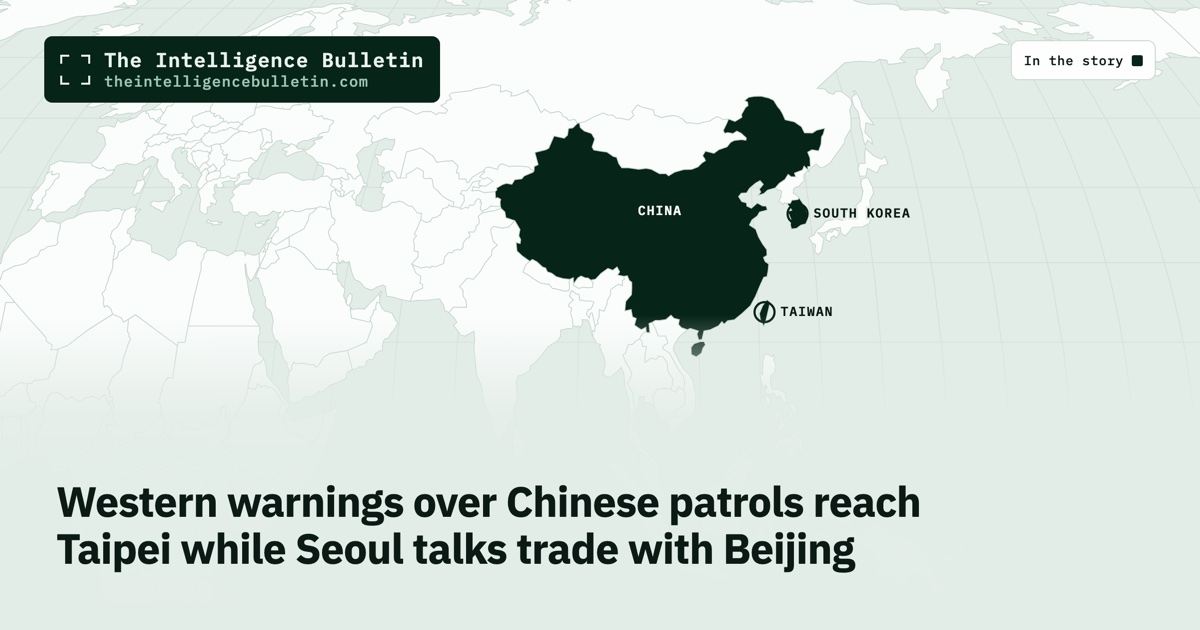
On June 25, 2026, Western statements condemning Chinese maritime activity near Taiwan arrived in Taipei at the same moment South Korean and Chinese premiers met in Dalian to advance trade ties, revealing how regional media outlets on the same day selected sharply divergent China-related stories rather than treating the patrols as the sole signal. The U.S., Britain, France and Germany had issued expressions of concern the previous day over Coast Guard patrols and survey operations off Taiwan’s east coast, actions Beijing tied to upcoming Japan-Philippines maritime boundary talks. Taiwan responded with gratitude, underscoring that freedom of navigation underpins global trade and rejecting any Chinese claim of jurisdiction in those waters.
The English-language coverage from AsiaOne and WHBL followed the same Reuters wire almost verbatim, presenting the Western statements, Beijing’s stated rationale, and Taipei’s relief that the patrols had been labeled destabilizing. AsiaOne delivered a concise factual summary, noting that China described its operation as a “special maritime traffic law-enforcement” response after Japan and the Philippines announced formal boundary talks involving waters Beijing views as its exclusive economic zone. It quoted a U.S. State Department spokesperson calling the actions “deeply destabilizing” and rejecting any Chinese assertion of authority to interfere with navigation freedoms. The piece also recorded the rare joint statement from the British, French and German offices in Taipei, which warned that the activity threatened regional stability and international shipping while reiterating opposition to unilateral changes to the status quo by threat or coercion.
WHBL placed greater emphasis on Taiwan’s positive reaction, reporting that National Security Council Secretary-General Joseph Wu wrote on X that he was “truly thankful” for the statements and urged the PRC to stop its maritime expansionism. Taiwan’s Ocean Affairs Council added that freedom of navigation in surrounding waters is essential to global trade and that China’s harassment violated international law and harmed shared international interests. Council minister Kuan Bi-ling posted on Facebook that China had been “certified” as a disruptor of regional stability, adding that the more Beijing harassed Taiwan the more the international community supported Taipei. Both outlets stayed within the wire copy’s neutral framing, omitting any domestic Taiwanese political rhetoric.
SETN, the Taiwanese outlet, folded the identical events into an explicit Democratic Progressive Party statement that branded China the “real troublemaker.” The report detailed how Beijing had launched the patrols citing Japan-Philippines exclusive economic zone negotiations, then quoted the DPP’s China Affairs Department at length: international concern had risen from isolated incidents to a shared focus on the entire Indo-Pacific security order, with the world increasingly clear on “who is maintaining peace and who is making trouble.” It linked the east-coast activity to a five-year pattern of gray-zone pressure, including military aircraft and vessels crossing the Taiwan Strait median line, harassment around the Diaoyutai islands, water-cannon incidents against Philippine vessels in the South China Sea, and now an attempt to break through the first island chain. The piece framed Taiwan as standing at the front line of democracy while protecting global semiconductor supply chains, and it called on Beijing to cease military intimidation and respect international law.
The Korean Herald Business article ignored the Taiwan patrols entirely, instead covering the June 23 meeting between South Korean Prime Minister Kim Min-seok and Chinese Premier Li Qiang in Dalian—the first such summit in seven years. It quoted both leaders stressing the need to elevate bilateral relations to a new stage through expanded economic, cultural and youth exchanges. Li highlighted cooperation in semiconductors, artificial intelligence, new energy and biomedicine, and expressed hope for swift progress on the second stage of China-South Korea free-trade agreement negotiations. Kim welcomed greater Chinese investment in Korea and looked ahead to the upcoming APEC meetings. The coverage presented the encounter as a positive diplomatic step following the leaders’ earlier summit interactions, with no reference to maritime tensions elsewhere in the region.
Liberty Times likewise chose a different China story altogether, reporting on domestic regulatory scrutiny inside the People’s Republic. It cited China’s National Audit Office disclosure that the Bank of China had used a “padding headcount” scheme between April 2023 and August 2025, mobilizing large numbers of employees to invest token amounts in order to repackage 11 private equity funds as public offerings and thereby evade 2.367 billion yuan in taxes—roughly NT$11 billion. The bank responded by accepting the audit findings and pledging immediate rectification. The article also noted separate violations by the Agricultural Bank of China involving improper lending to non-standard farmland projects. By focusing on financial misconduct rather than external maritime assertiveness, the Taiwanese outlet illustrated how even outlets in the same polity can select entirely separate threads of China-related news on a single day.
Across the five reports, the underlying facts of the Western statements and the timing of the patrols converge, yet the framing and emphasis diverge according to each outlet’s audience and alignment. The Singapore- and U.S.-based wires remained tightly factual and alliance-oriented. The DPP-aligned Taiwanese source weaponized the international reaction for domestic messaging that explicitly identified Beijing as the aggressor. The Korean business publication and the second Taiwanese outlet simply chose parallel but unrelated China stories—economic diplomacy in one case, internal financial oversight in the other—demonstrating that maritime pressure near Taiwan was treated as one thread among many rather than the dominant regional signal.
The Takeaway
What to watch next is whether the joint Western statements translate into coordinated diplomatic follow-up at upcoming multilateral forums or whether Beijing responds with further patrols framed as routine law enforcement. South Korea’s renewed high-level engagement with China also bears monitoring for any spillover effects on Seoul’s balancing act between economic ties with Beijing and security alignment with Washington and Tokyo. Taiwan’s domestic political use of the episode will likely intensify ahead of local elections, while continued Chinese audit disclosures could surface additional domestic vulnerabilities inside major state banks.
Share this story
That’s how the world told the story.
Get our daily open-source intelligence on world events in your inbox — one email a day, up to six stories.
Subscribe freeNo spam. One-click unsubscribe. See the latest email →