 AI-generated analysis published under the editorial responsibility of Rohit Sinnas. How it works →
Press quoted
Full analysis
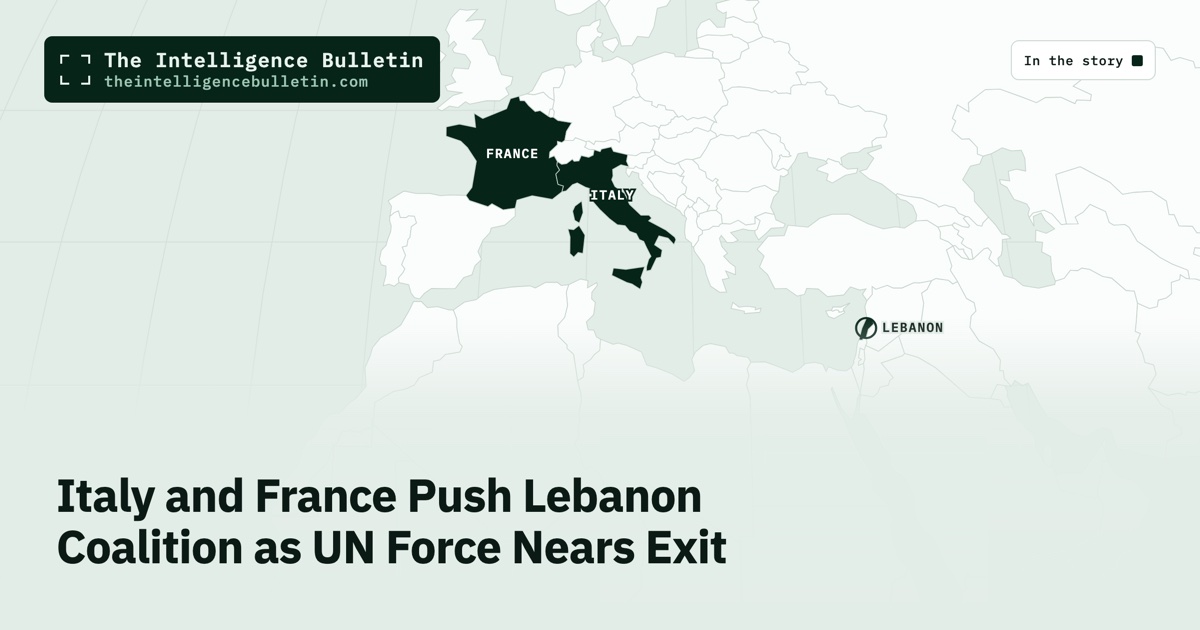
On June 25, 2026, at Cap d’Antibes on the French Riviera, Italian Prime Minister Giorgia Meloni and French President Emmanuel Macron announced a bilateral initiative to assemble a multinational coalition that would sustain international support for Lebanon once the United Nations Interim Force in Lebanon (UNIFIL) mandate expires in December. The two leaders also signaled plans for a follow-on international conference, framing the effort as essential to preventing a dangerous security vacuum in a country already strained by the Israel-Hezbollah conflict and broader regional instability. Their joint declaration underscored long-standing Italian and French engagement in Lebanese stability while stressing coordination with both the European Union and the United Nations.
The move arrives at a moment when European capitals are confronting the limits of existing multilateral peacekeeping structures. UNIFIL, deployed since 1978 and significantly expanded after the 2006 Israel-Hezbollah war, has long served as a buffer along the Lebanon-Israel border. Its impending departure creates an opening that Rome and Paris, both major troop contributors to the mission over the years, now seek to fill through a more flexible, post-UNIFIL arrangement. The Antibes summit, held under the framework of the 2021 Quirinal Treaty that formalized enhanced Franco-Italian cooperation, provided the immediate diplomatic setting for the announcement.
Italian national coverage, led by the wire service ANSA, presented the outcome as a diplomatic success for Meloni. The agency led its dispatch with the prime minister’s pledge of an imminent international conference, quoting her directly: “Italy and France can make the difference… we have decided to launch a coalition for the support of post-UNIFIL Lebanon, imagining soon an international conference.” Macron’s remarks received comparatively little space, an editorial choice consistent with ANSA’s role as Italy’s primary news agency and its emphasis on elevating the Italian leader’s voice in bilateral diplomacy. The reporting positioned the initiative as evidence of Rome’s capacity to shape outcomes alongside Paris, without dwelling on the mechanics of the proposed coalition or its potential participants.
A Portuguese business outlet, Executive Digest, adopted a distinctly European and institutional lens. Its account opened with the coalition launch itself, quoting Macron at length on the need for a “broadest possible” multinational effort “in coordination with the European Union and the United Nations” to “reinforce the sovereignty of Lebanon and its armed forces and prevent its territory from becoming a point of support for regional escalation.” Meloni’s intervention was reported secondarily, highlighting her insistence on “a clear and structured mandate” to avoid “an extremely dangerous security vacuum.” The piece stressed the multinational and sovereignty-focused character of the proposal, reflecting a Portuguese perspective attuned to EU-level coordination rather than any single national leader’s profile.
Regional Italian coverage took a broader approach. The Valle d’Aosta GLocal outlet subordinated the Lebanon announcement to Meloni’s wider remarks on the indispensable partnership between Italy and France in building a Europe capable of meeting complex challenges. The Lebanon plan appeared only toward the end of a lengthy summary that also covered migration management, defense-industrial cooperation such as the Samp-T missile system, space economy ambitions, and EU budget negotiations. In this framing, the post-UNIFIL coalition served as one illustration among several of how the two nations could jointly address strategic priorities, rather than as the summit’s centerpiece. The outlet also carried Meloni’s clarification distancing Italy from any direct role in the Iran conflict, noting her insistence that Rome had limited itself to logistical and technical support consistent with parliamentary commitments.
One Italian aggregator, Zazoom, drew attention to the security-policy caveats that accompanied the Lebanon deal. Its report foregrounded Meloni’s explicit restraint on NATO involvement in the region and her reiteration that Italy had not participated in any kinetic operations related to Iran. While the outlet noted the core agreement on the post-UNIFIL coalition, it devoted notable space to these boundary-setting comments, presenting them as part of the premier’s effort to define the limits of Italian engagement amid ongoing regional tensions. This emphasis distinguished the coverage from other Italian sources and underscored domestic sensitivities around alliance commitments.
Across the four outlets, the shared factual core remains the bilateral decision to pursue a multinational coalition and an accompanying international conference aimed at preserving Lebanese sovereignty and territorial integrity after UNIFIL’s exit. Differences in emphasis track the outlets’ institutional and national contexts: the Italian national wire privileged Meloni’s leadership, the Portuguese business site highlighted EU-UN coordination, the regional Italian publication embedded the security initiative within a larger narrative of bilateral European influence, and the aggregator alone surfaced explicit limits on NATO and Iran-related roles. These variations illustrate how the same diplomatic event is refracted through domestic priorities without altering the underlying convergence between Rome and Paris.
The Takeaway
The Antibes declaration leaves several practical questions open. Macron acknowledged that naming specific participating countries would be premature, while both leaders stressed the importance of a clear mandate alongside Lebanese armed forces. Observers will therefore watch for concrete steps toward coalition formation, the timing and scope of the promised international conference, and any signals of wider European or international buy-in. Regional developments between Israel and Hezbollah, as well as Lebanon’s internal political dynamics, will also shape whether the proposed arrangement can take hold before the UNIFIL mandate concludes.
Share this story
That’s how the world told the story.
Get our daily open-source intelligence on world events in your inbox — one email a day, up to six stories.
Subscribe freeNo spam. One-click unsubscribe. See the latest email →