June 22, 2026 – Global Headlines

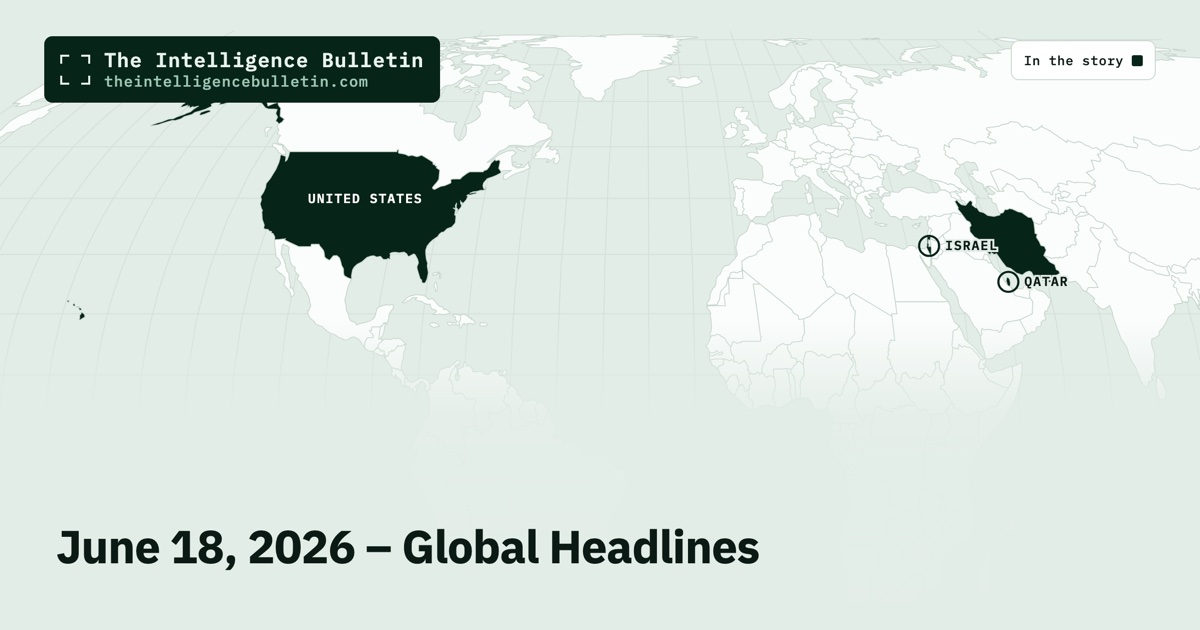
Map of the countries in the story: June 22, 2026 – Global Headlines

1Trump’s tweet forces an Iranian walkout. Every outlet still treats the channel as intact.
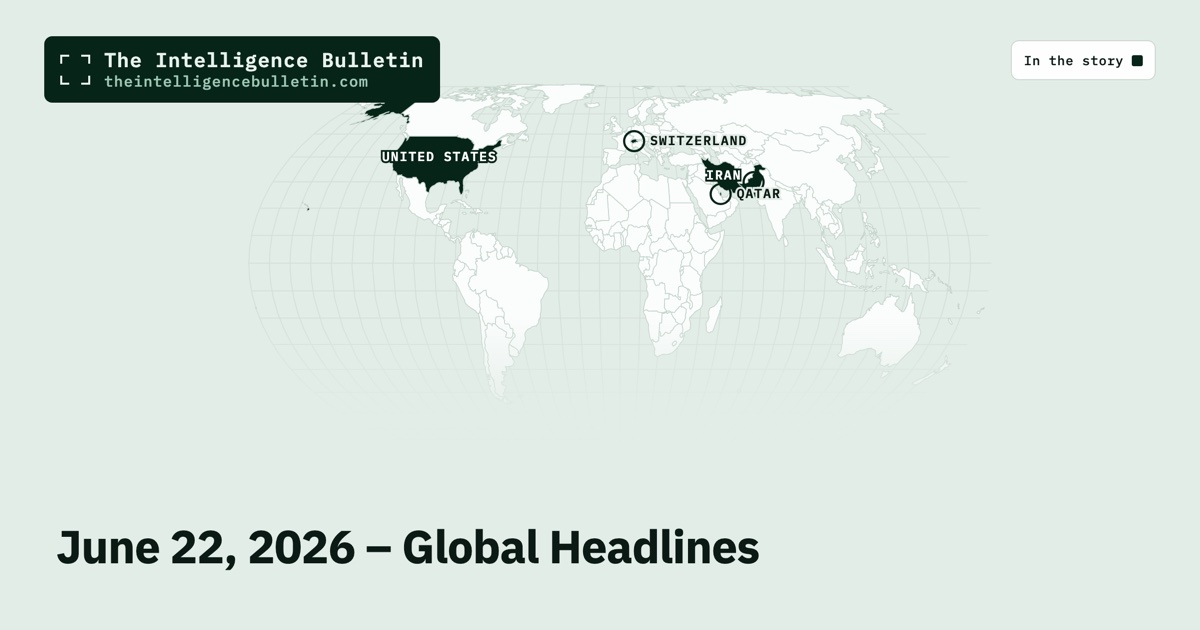
Map of the countries in the story: June 22, 2026 – Global Headlines
Story gist: On 2026-06-21 the Iranian delegation left US-Iran nuclear talks at Bürgenstock resort in Switzerland after President Donald Trump posted threatening remarks on social media. The walkout paused but did not formally end the Swiss-mediated negotiations. The action targeted the United States amid ongoing diplomacy. Prior rounds had involved Qatari and Pakistani mediators and followed Vance’s earlier cancellation.
One Story. Many Angles.
🇺🇸
United States
arabic.cnn.com
Confusion in US-Iran talks in Switzerland after Trump threats.. here are the latest developments
Read →
🇦🇪
United Arab Emirates
albayan.ae
Axios reveals the details of US-Iran movement in Switzerland
Read →
🇮🇱
Israel
aurora-israel.co.il
Vance negotiates with Iran in Switzerland while Trump threatens Tehran
Read →
Perspective Analysis

The Iranian walkout at Bürgenstock reveals how Trump’s social-media intervention can instantly override weeks of quiet shuttle diplomacy. Arabic CNN framed the episode as a live update from stalled talks, stressing the delegation’s abrupt departure and the mediators’ scramble to keep channels open. Albayan instead zeroed in on Axios-sourced details of movement between hotels, treating the threat itself as background to the logistical choreography. Aurora-Israel highlighted the Vance-Trump contrast, noting the vice president’s earlier on-site role before the public threat shifted control back to Washington. Across these accounts the common thread is continuity rather than rupture: the pause is presented as tactical, not terminal, and every outlet ties the episode to the same sequence of postponed Vance visits and Qatari groundwork that began on 19 June. That convergence suggests the outlets see the underlying US-Iran channel as durable enough to absorb presidential tweets, even while each tailors its emphasis to domestic audiences watching Hormuz and Lebanese security zones.


2Ukrainian strikes halt gasoline sales to Crimea residents after killing four

Story gist: On 2026-06-22, Ukrainian forces struck targets in Russian-occupied Crimea, killing four people and wounding 28 according to Kremlin-appointed governor Sergey Aksyonov. The attacks prompted authorities to suspend civilian gasoline sales after hitting an oil depot among other sites. Ukrainian President Zelenskyy confirmed the depot as a target. The strikes mark the latest escalation in the ongoing conflict between Ukrainian armed forces and Russian positions in the peninsula.
One Story. Many Angles.
🇺🇸
United States
timesofearth.com
Ukrainian attacks prompt Russian-held Crimea to halt civilian gasoline sales
Read →
🇨🇦
Canada
calgarysun.com
Ukrainian strikes on Russian-annexed Crimea kill 4, pause fuel sales
Read →
🇵🇰
Pakistan
dunyanews.tv
Ukrainian strikes on Russian-annexed Crimea kill 4, pause fuel sales
Read →
Perspective Analysis

The shared reporting across outlets reveals a consistent focus on how Ukrainian strikes are now directly disrupting daily civilian logistics inside Russian-held territory rather than remaining confined to military assets. Times of Earth frames the event around the practical collapse of fuel distribution for residents, underscoring infrastructure fragility without broader geopolitical overlay. Calgary Sun instead centers the casualty count and its implications for Western-backed Ukrainian operations, treating the human toll as evidence of sustained pressure on Russian rear areas. Dunya News, meanwhile, isolates the energy-market angle, noting how even localized fuel pauses in Crimea could ripple toward South Asian importers already sensitive to Black Sea supply volatility. This convergence on the suspension of gasoline sales, rather than any single outlet’s preferred emphasis, signals that the strikes have crossed a threshold where they affect occupied civilian economies in measurable ways. The absence of claims about strategic breakthroughs or Russian retaliation in any of the three accounts further suggests the immediate story is one of incremental attrition on fuel access, not decisive battlefield shifts.


3German, French and Italian outlets reach the same verdict: Berlin and Paris are pooling tank ownership.

Story gist: On 2026-06-22 Germany agreed to acquire a 40% stake in Franco-German tank manufacturer KNDS, the maker of the Leopard series. The transaction, reported via Bloomberg, clears the way for an eventual IPO of the company. Berlin and Paris are the principal actors, with KNDS based in France. The move consolidates cross-border ownership in Europe’s armored-vehicle sector at a time of heightened defense spending.
One Story. Many Angles.
🇩🇪
Germany
de.euronews.com
Germany takes 40% stake in Leopard tank maker KNDS alongside France
Deutschland steigt mit 40 Prozent bei Leopard-Panzerbauer KNDS an der Seite Frankreichs ein
Read →
🇫🇷
France
euronews.com
Germany to take 40% stake in Leopard tank maker KNDS alongside France
Read →
🇮🇹
Italy
ansa.it
Defense: France and Germany reach agreement on arms producer KNDS
Difesa, Francia e Germania raggiungono un accordo sul produttore di armi Knds – Altre news
Read →
Perspective Analysis

The deal’s most revealing feature is how little daylight exists between the three outlets on its core mechanics. All treat the 40% purchase as the decisive step that unlocks an IPO, and all locate the decision inside the existing KNDS joint-venture structure rather than as a new Franco-German initiative. What varies is the horizon each outlet chooses. The German-language Euronews piece anchors the story in Berlin’s industrial-policy calendar, noting how the stake aligns with Germany’s own procurement timelines and export-control rules. The English Euronews report, filed from the French side of the partnership, instead stresses the bilateral governance precedent: Paris and Berlin now hold symmetrical equity blocks inside the same legal entity. ANSA, writing for an Italian audience, folds the transaction into the larger question of whether further consolidation among the continent’s prime contractors will strengthen or dilute NATO-standard supply chains. The absence of any counter-narrative across the set is itself the signal. In a week dominated by Swiss nuclear talks and Ukrainian strikes on Crimea, the three outlets converge on a single conclusion: the KNDS restructuring is not a bilateral sideshow but the clearest current evidence that Europe’s two largest defense economies are willing to pool ownership before they pool requirements.


4Indian coverage places Katz’s Lebanon refusal inside Swiss Iran talks. Russian service leaves it on the ground.

Story gist: On 2026-06-21 Israeli Defense Minister Israel Katz stated that Israeli forces would remain in the security zone in southern Lebanon. He denied reports of any limits on military activity in the area. The announcement coincides with Iran demanding a ceasefire as part of US nuclear negotiations. The position underscores ongoing friction between Israeli control on the ground and external diplomatic pressures.
One Story. Many Angles.
🇮🇳
India
moneycontrol.com
Israel vows to stay in Lebanon security zone as Iran makes ceasefire a key demand in US talks
Read →
🇷🇺
Russia
arabic.rt.com
Katz denies limits on Israeli army activity in Lebanon, vows no withdrawal from security zone
Katz denies imposing restrictions on army activity in Lebanon: We will not withdraw from the security zone
Read →
Perspective Analysis

Moneycontrol’s decision to fold Katz’s statement directly into the US-Iran nuclear talks at Bürgenstock reveals how New Delhi’s foreign-policy press now treats every Israeli move in Lebanon as leverage in the wider nuclear file. The outlet’s headline makes the Iranian ceasefire demand the operative context, positioning Israel’s refusal to withdraw as a potential spoiler rather than a standalone security claim. Arabic RT, by contrast, strips the story to Katz’s denial of restrictions and his pledge to stay put, reflecting Moscow’s preference for presenting Israeli military latitude as an operational fact rather than a diplomatic variable. This split is structural: the Indian source operates inside a narrative that already links Hormuz threats, Swiss mediation and Israeli battlefield posture, while the Russian Arabic service keeps the frame narrow to avoid diluting the message that Israel faces no external constraints. The result is two different maps of the same sentence—one that places Katz’s words inside the Swiss talks, the other that leaves them on the ground in southern Lebanon.


5Lebanon flags volatility and denials. Spain counts the MPs. Chile marks Monday.

Story gist: On 2026-06-21 roughly one hundred Labour MPs publicly called for UK Prime Minister Keir Starmer to resign. The move followed reported internal party tensions sparked by Andy Burnham’s emergence as a potential rival for the leadership. Starmer’s office has not confirmed any resignation plans. The demands surfaced in London amid questions over the durability of his majority government.
One Story. Many Angles.
🇱🇧
Lebanon
annahar.com
Reports of British Prime Minister preparing to resign and government source denies
News of British PM readiness to resign and government source denial
Read →
🇪🇸
Spain
diariosigloxxi.com
A hundred Labour MPs demand Starmer resignation as UK prime minister
Read →
🇨🇱
Chile
latercera.com
Reports that the British prime minister is willing to resign: Starmer would announce it this Monday
Reports British PM willing to resign with Monday announcement expected
Read →
Perspective Analysis

The most striking element across these reports is how little they dwell on the substance of the Labour rebellion and how quickly they pivot to signals of imminent departure or outright denial. Lebanese coverage from Annahar leads with rumors of readiness to resign and immediately pairs them with a government-source rebuttal, reflecting a regional habit of scanning Western capitals for early signs of instability that could ripple through alliances or energy markets. Spanish outlets, by contrast, fixate on the numeric threshold—exactly one hundred MPs—as if the scale itself signals a parliamentary fracture that could soon reach Madrid through EU channels. Chilean reporting narrows further to the calendar, highlighting an expected Monday announcement, which suggests an audience attuned to the precise sequencing of political exits rather than their causes. None of the three accounts explores the underlying policy disputes or Burnham’s positioning; instead each extracts a single usable fact for its own audience: volatility, parliamentary arithmetic, or timing. That narrow extraction reveals more than the headlines admit. Foreign desks are treating Starmer’s difficulties less as a British domestic story and more as a data point in a wider pattern of Western leadership churn already visible in the same day’s Switzerland and Crimea dispatches.
June 21, 2026 – Global Headlines

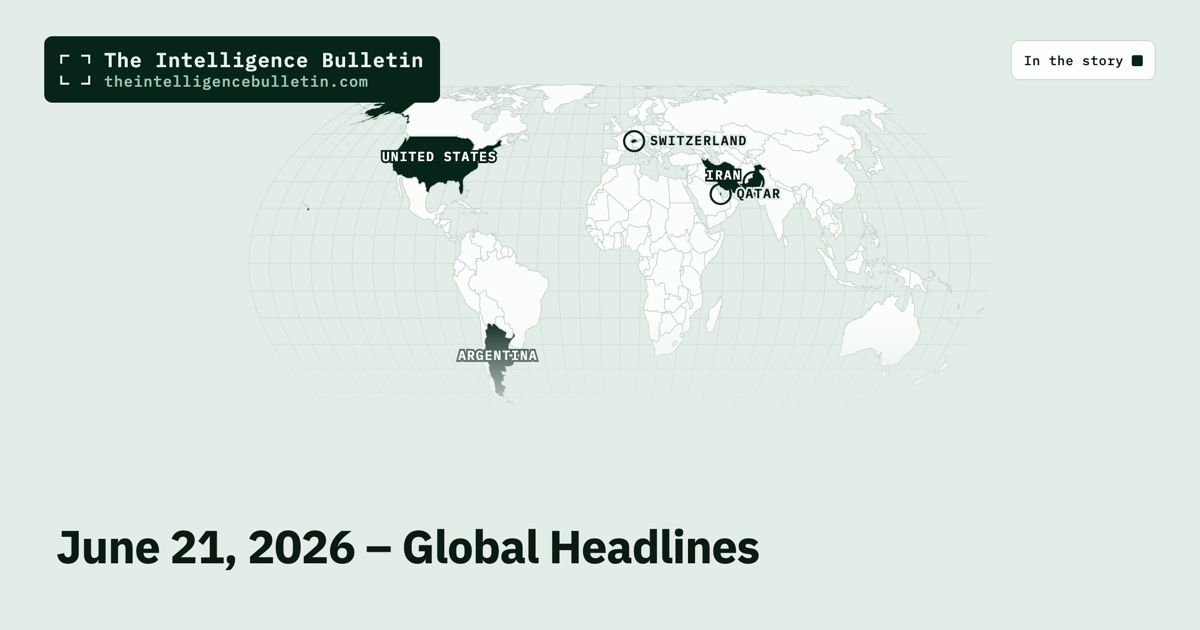
Map of the countries in the story: June 21, 2026 – Global Headlines

1Washington ties Swiss talks to Hormuz threats. Islamabad claims mediation credit. Buenos Aires notes arrivals.

Story gist: On June 21 2026 US and Iranian representatives met at the Bürgenstock resort near Lucerne Switzerland for high-level nuclear talks. Qatar and Pakistan participated as mediators with Pakistan’s prime minister and military chief attending. The session addressed the nuclear file regional issues and a broader agreement after earlier rounds stalled. Prior US-Iran clashes in the Strait of Hormuz and last-minute US envoy changes shaped the agenda.
One Story. Many Angles.
🇺🇸
United States
nbcnews.com
Vice President JD Vance in Switzerland for Iran talks as Trump threatens guardian angel toll in Strait of Hormuz
Read →
🇵🇰
Pakistan
thefrontierpost.com
US-Iran peace talks to begin at Swiss resort with Hormuz, Lebanon conflict in spotlight
Read →
🇦🇷
Argentina
infobae.com
The Prime Minister of Pakistan and his Chief of Staff arrive in Switzerland to mediate talks between Iran and the United States
El primer ministro de Pakistan y su jefe del Estado Mayor arribaron a Suiza para mediar en las conversaciones entre Iran y Estados Unidos
Read →
Perspective Analysis

The sudden prominence of Pakistan’s prime minister and army chief at Bürgenstock marks the clearest shift since Qatari mediators first shuttled between Tehran and Washington two weeks ago. Earlier reports tracked Vice President Vance’s abrupt cancellation followed by Steve Witkoff’s arrival; now the addition of Pakistan’s top leadership suggests the talks have moved beyond bilateral US-Iran channels into a wider South Asian brokerage role that both sides appear willing to accept. NBC News anchors the coverage in Washington’s familiar frame of leverage, pairing the Swiss venue with Trump’s renewed threat of a “guardian angel toll” on Hormuz traffic, a reminder that US domestic signaling remains central even when the venue is neutral. The Frontier Post instead leads with Pakistan’s facilitation task and the spotlight on Hormuz and Lebanon, treating the meeting as validation of Islamabad’s mediating credentials rather than a US-Iran story alone. Infobae, publishing from Buenos Aires, narrows further to the physical arrival of Pakistan’s duo, reflecting a Latin American editorial habit of tracking non-Western actors who rarely dominate global diplomacy headlines. Across the three accounts the factual sequence stays consistent, yet the emphasis reveals a structural pattern: American outlets embed the event inside ongoing US pressure tactics, Pakistani reporting elevates the host country’s new role, and distant observers focus on the arrival of unexpected mediators. That convergence on the meeting itself, paired with these distinct entry points, shows how the same diplomatic step registers differently depending on each capital’s stake in the wider nuclear file.


2Italian and US outlets both treat Meloni’s denial of the Trump photo claim as fact.

Map of the countries in the story: June 21, 2026 – Global Headlines
Story gist: On 2026-06-20 in Brussels, Italian Prime Minister Giorgia Meloni publicly rejected Donald Trump’s claim that she had begged him for a photo during the G7. She called the account completely invented and expressed shock at the assertion. The exchange occurred on the margins of the European Council and prompted reports of a canceled US trip by an Italian diplomat. The dispute has produced immediate friction between Rome and Washington.
One Story. Many Angles.
🇮🇹
Italy
qds.it
Trump reopens clash with Meloni, diplomatic crisis between Italy and USA
Trump riapre lo scontro con Meloni, è crisi diplomatica tra Italia-Usa
Read →
🇺🇸
United States
bostonglobe.com
Italy doesn’t beg Giorgia Meloni tells Trump
Read →
🇺🇸
United States
abc11.com
Italian Premier Giorgia Meloni slams Trump’s claim she begged for a photo with him
Read →
Perspective Analysis

Italian coverage opens directly with the bilateral rupture, treating the photo claim as the spark for an actual diplomatic crisis between Italy and the United States. qds.it frames Meloni’s denial as the necessary Italian counter to an American provocation that has already damaged relations. US outlets, by contrast, center Meloni’s personal rebuke and the practical consequence of a canceled trip, presenting the episode as one more instance of Trump’s loose assertions colliding with a European leader unwilling to absorb them. The Boston Globe stresses the flat assertion that Italy does not beg, while ABC11 records the slam and the immediate scheduling fallout. Both American accounts therefore register the same factual denial yet embed it in a narrative of transatlantic optics rather than crisis. This difference reveals how proximity shapes emphasis: the Italian source registers the event as damage to its own government’s standing, whereas the US sources register it as another data point in Trump’s pattern of public claims. The underlying alignment across all three remains striking. Every outlet accepts Meloni’s version of events without qualification and notes the same sequence of assertion, denial, and scheduling consequence. That convergence suggests the story’s signal is not interpretive spin but the speed with which a single disputed photograph at a Brussels corridor can force measurable diplomatic adjustments between two NATO allies.


3Serbia traces the order to Poroshenko’s rivalry. Romania to Zelensky’s gesture. Portugal to a Poland-Ukraine war of medals.

Story gist: On 2026-06-21 Ukrainian President Volodymyr Zelenskyy returned Poland’s Order of the White Eagle to President Karol Nawrocki. The return followed Nawrocki’s revocation amid disputes over World War II history and a Ukrainian military unit naming. Former president Petro Poroshenko also renounced the honor in a parallel gesture. The exchange occurred between Kyiv and Warsaw.
One Story. Many Angles.
🇷🇸
Serbia
blic.rs
Evidence of Ukraine-Poland quarrel: Poroshenko also renounces order
Bukti svadja Ukrajine i Poljske: I Porosenko se odrekao ordena
Read →
🇷🇴
Romania
adevarul.ro
Zelensky’s unprecedented gesture: returns Poland’s White Eagle Order after Warsaw revokes highest state distinction
Gestul fara precedent al lui Zelenski: returneaza Ordinul Vulturul Alb al Poloniei
Read →
🇵🇹
Portugal
pt.euronews.com
Poland-Ukraine: decoration war reaches its peak
Polonia-Ucrania: guerra das condecoracoes atinge o auge
Read →
Perspective Analysis

The most revealing detail is how little any outlet disputes the underlying facts yet each selects a different personal actor to anchor the narrative. Blic.rs leads with Poroshenko’s renunciation, treating the episode as another chapter in the long-running Ukrainian elite rivalry that resonates in the Balkans where similar honor-stripping episodes have punctuated post-communist politics. Adevărul instead frames Zelensky’s act itself as the unprecedented move, reflecting Romania’s immediate neighbor anxiety that symbolic ruptures between Kyiv and Warsaw could complicate the shared Black Sea security perimeter both countries now inhabit. Portuguese Euronews, furthest from the border, casts the episode as an escalating “war of decorations,” presenting the mutual withdrawals as evidence that historical memory disputes have now reached a new threshold of formality. This convergence on the sequence of events but divergence on the central protagonist shows how proximity shapes which Ukrainian figure registers as the story’s protagonist. The low market-sensitivity score attached to the event in GDELT data underscores that markets already price in such symbolic friction; what still travels across borders is the reminder that EU accession talks opened only days earlier now sit alongside an unresolved Polish-Ukrainian memory conflict that no amount of cluster-fundamentals language has yet dissolved.


4No Nigerian outlet questions Oyebanji’s re-election, treating the APC win as closed.

Story gist: On 21 June 2026 Nigeria’s Independent National Electoral Commission declared APC candidate Biodun Oyebanji the winner of the Ekiti governorship election in Ado-Ekiti. The result confirmed his second term. Nigerian outlets reported both the formal declaration and Oyebanji’s immediate pledges on household-level delivery. The coverage centered on procedural finality and the scale of the mandate rather than disputes.
One Story. Many Angles.
🇳🇬
Nigeria
pmnewsnigeria.com
Every household must feel my second term, Oyebanji vows after landslide victory
Read →
🇳🇬
Nigeria
nigerianeye.com
INEC declares Oyebanji winner of Ekiti governorship election
Read →
🇳🇬
Nigeria
thisdaylive.com
In Landslide, Oyebanji Wins Second Term as INEC Declares Ekiti Election Results
Read →
Perspective Analysis

Nigerian coverage of Oyebanji’s re-election converged on the same narrow set of facts: an INEC declaration, an APC victory, and a second-term mandate. What stands out is the absence of any reported challenge to the result. PM News Nigeria moved quickly past the count to Oyebanji’s vow that every household would feel the second term, treating the election as settled and shifting attention to delivery. Nigerian Eye stayed strictly with the commission’s announcement, presenting the outcome as a bureaucratic endpoint. This Day Live alone stressed the margin, labeling it a landslide and thereby converting the declaration into evidence of decisive support. The three angles together show how domestic outlets treat a state election once the formal result is issued: they record the winner, note the scale or the promises, and move on. That pattern suggests the APC’s hold in Ekiti is viewed as stable enough that further scrutiny is unnecessary. In a country where many governorship races produce immediate litigation, the uniform decision to treat this result as closed is itself the signal. It indicates either genuine acceptance of the outcome or a shared editorial judgment that contesting it would not alter the political reality on the ground.


5Colombian outlets that split on politics both lead with troops and turnout numbers

Story gist: On 2026-06-20 Colombia held its presidential runoff with over 41 million eligible voters. Authorities deployed more than 400,000 military and police to protect polling sites, escort materials, and monitor nationwide security. The operation addressed risks in the second-round contest between the remaining candidates.
One Story. Many Angles.
🇨🇴
Colombia
hsbnoticias.com
Elections in Colombia: more than 400,000 security personnel to reinforce the runoff
Elecciones en Colombia: más de 400.000 uniformados reforzarán la seguridad durante la segunda vuelta
Read →
🇨🇴
Colombia
elpais.com.co
Presidential runoff: more than 41 million Colombians to choose the next president
Segunda vuelta presidencial, más de 41 millones de colombianos definirán al próximo presidente
Read →
Perspective Analysis

Both Colombian outlets frame the runoff primarily through the lens of logistical scale rather than candidate platforms or ideological stakes. hsbnoticias.com leads with the 400,000-strong security deployment, underscoring the state’s visible control over potential flashpoints on election day. elpais.com.co instead opens with the 41 million voters who will decide the outcome, presenting the process as a straightforward civic exercise. This shared emphasis on numbers—personnel and citizens—reveals a domestic media consensus that the story’s core tension lies in execution and participation, not in the policy differences between the finalists. The absence of regional or international angles in either account suggests Colombian coverage treats the vote as an internal administrative challenge whose success will be measured by turnout and the absence of major incidents. That convergence is telling: when outlets that normally diverge on political coverage align on the mechanics of security and voter mobilization, it signals that the election’s immediate risks are viewed as institutional rather than partisan. The Goldstein-scale data on the security operation reinforces this reading, showing a state-driven effort calibrated to maintain order without external mediation.


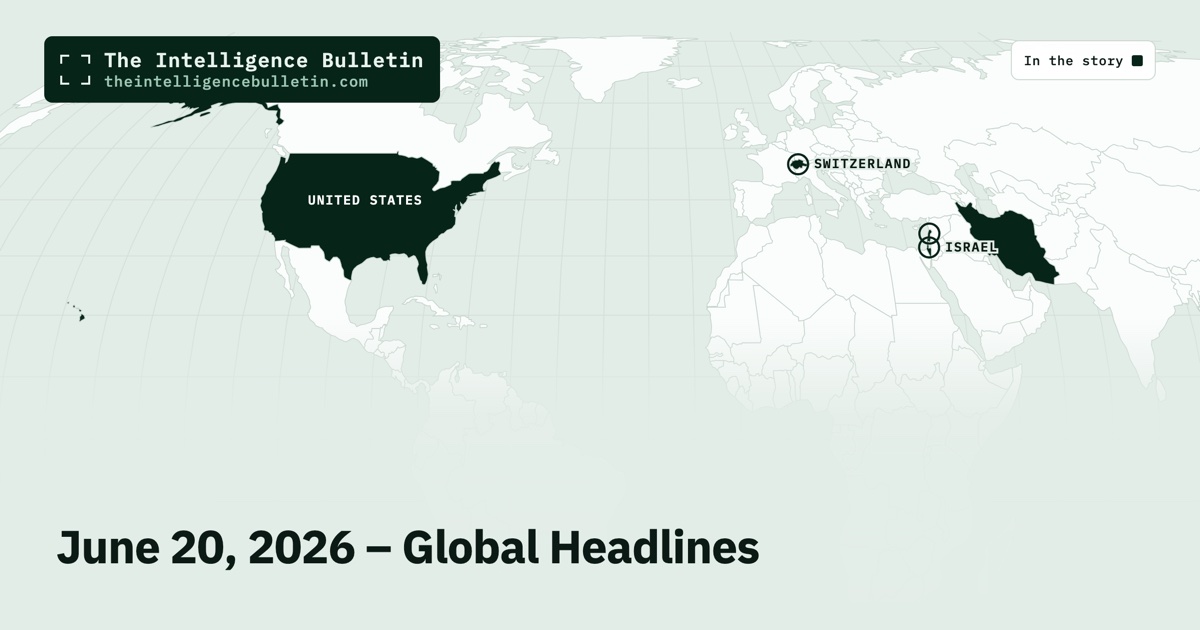
June 20, 2026 – Global Headlines

Map of the countries in the story: June 20, 2026 – Global Headlines

1Witkoff Replaces Vance for Iran Nuclear Talks in Switzerland

Map of the countries in the story: June 20, 2026 – Global Headlines
Story gist: On June 20 2026 U.S. special envoy Steve Witkoff travels to Switzerland for the first round of nuclear talks with Iran. Jared Kushner is already on site. The meeting follows the abrupt postponement of Vice President JD Vance’s planned trip and takes place one day after reports of a fragile ceasefire between Israel and Hezbollah in Lebanon. Iran has linked progress to the release of billions in frozen assets.
One Story. Many Angles.
🇮🇱
Israel
ynetnews.com
Witkoff heads to Swiss talks as Iran pushes for billions in sanctions relief
Read →
🇪🇸
Spain
rtve.es
United States and Iran ready to negotiate this Saturday amid fragile truce in Lebanon
Estados Unidos e Irán, dispuestos a negociar este sábado en medio de la frágil tregua en el Líbano
Read →
🇵🇰
Pakistan
thenews.com.pk
US envoy Steve Witkoff heads to Switzerland for Iran talks after abrupt postponement
Read →
Perspective Analysis

The shift from Vance to Witkoff signals that Washington is still committed to the channel opened by Qatari mediators last week, yet each outlet reads the stakes through its own immediate security ledger. Israeli coverage centers on Iran’s explicit demand for sanctions relief, treating the Swiss meeting as the latest arena in which Tehran seeks to convert diplomatic engagement into cash while its proxies remain active in Lebanon. Spanish reporting instead places the Lebanon ceasefire at the center, presenting the nuclear talks as an effort to stabilize a truce that both sides know could collapse if one party believes it can extract more concessions. Pakistani accounts emphasize the volatility itself, noting that the sudden swap of envoys after Vance’s cancellation underscores how narrow the window for any agreement remains. These angles are not contradictory but additive: the same diplomatic movement registers as a sanctions fight in Jerusalem, a ceasefire insurance policy in Madrid, and a test of negotiating stamina in Islamabad. The underlying continuity is that all three see the Swiss venue less as a breakthrough venue than as the latest pressure point in a sequence that began with drone strikes in the Strait of Hormuz and has not yet produced a durable pause.


2White House Postpones Vance Switzerland Trip for Iran Talks

Story gist: On 2026-06-19 the White House announced Vice President JD Vance would not travel to Switzerland for planned meetings with Iranian negotiators. Officials attributed the decision to logistical issues amid ongoing nuclear deal talks. The postponement follows Qatari mediation and recent US-Iran tensions in the Strait of Hormuz. It raises questions about the timing of face-to-face negotiations.
One Story. Many Angles.
🇺🇸
United States
nypost.com
JD Vance scraps overnight flight to Switzerland for first round of nuclear talks with Iran
Read →
🇮🇱
Israel
jpost.com
JD Vance won’t fly to Switzerland, meetings with Iran in doubt
Read →
🇩🇪
Germany
welt.de
Negotiations on Iran’s nuclear program – Vance postpones trip to Switzerland
Verhandlungen über Irans Atomprogramm – Vance verschiebt Reise in die Schweiz
Read →
Perspective Analysis

The postponement lands at a moment when Washington and Tehran had appeared to edge toward direct contact after weeks of indirect Qatari mediation and drone clashes in the Strait of Hormuz. American coverage treats the change as routine scheduling friction inside the White House, while Israeli reporting immediately flags the risk that the first round itself may now slip. German outlets instead zoom in on the technical substance of the nuclear program talks that were meant to occur. This split reflects deeper structural priorities: a US audience focused on domestic political optics after the G7 defense of the deal, an Israeli audience tracking any erosion of pressure on enrichment limits, and a European audience still invested in the original JCPOA verification architecture. The pattern echoes earlier coverage of the same cluster, where US outlets emphasized Trump’s public posture at Versailles and Israeli outlets stressed the exclusion of Jerusalem from text review. The shared factual core—that Vance stayed in Washington—therefore reveals more about audience risk calculations than about any disagreement over what actually happened on 19 June.


3US Backs Venezuela Talks After Figuera-Rodríguez Meeting

Story gist: On 2026-06-19 the US State Department endorsed political dialogue in Venezuela after Dinorah Figuera met Jorge Rodríguez in Caracas. Figuera returned citing a direct State Department invitation. The meeting is presented as opening a roadmap for democratic transition. Venezuelan state media framed it as an internal parliamentary process.
One Story. Many Angles.
🇺🇸
United States
diariolasamericas.com
Dinorah Figuera returns to Venezuela and opens political dialogue channel with Chavismo
Dinorah Figuera regresa a Venezuela y abre canal de diálogo político con el chavismo
Read →
🇻🇪
Venezuela
radiomundial.com.ve
President Jorge Rodríguez and Dinorah Figuera begin dialogue table
Pdte. Jorge Rodríguez y Dinorah Figuera inician mesa de diálogo
Read →
🇻🇪
Venezuela
correodelcaroni.com
Dinorah Figuera returned to Venezuela: “I am assuming an invitation from the State Department”
Dinorah Figuera regresó a Venezuela: “Estoy asumiendo una invitación que me hace el Departamento de Estado”
Read →
Perspective Analysis

The coverage reveals a clear split over agency. Diariolasamericas.com, serving US-based Venezuelan exiles, stresses Figuera’s return and the State Department’s explicit role in extending the invitation, casting the episode as renewed opposition momentum. Correodelcaroni.com echoes this by quoting Figuera directly on the US call, underscoring her decision to accept it. Radiomundial.com.ve, Venezuela’s state radio, erases that external thread entirely, presenting the encounter as a routine session between the National Assembly president and an opposition deputy inside existing parliamentary channels. The divergence is structural: outlets tied to the diaspora and regional Venezuelan press treat Washington’s involvement as the decisive fact, while the government-aligned outlet must portray any contact as domestically initiated to maintain the narrative of sovereign control. This pattern mirrors earlier US-Iran diplomacy coverage, where the same outlets likewise split between crediting external mediation and insisting on internal momentum.


4China Applies 55% Tariff on Australian Beef After Quota Exhaustion

Story gist: China’s Ministry of Commerce announced on 19 June 2026 that an additional 55% tariff would apply to Australian beef imports once the annual quota was exhausted. The measure takes effect the following day from Beijing and is described as routine quota-linked protection. Australia is the direct target while Malaysia highlights possible effects on wider ASEAN-Australia trade flows.
One Story. Many Angles.
🇨🇳
China
en.ce.cn
China to apply additional tariff on Australian beef imports as quota reached
Read →
🇨🇳
China
china.org.cn
China to apply additional tariff on Australian beef imports as quota reached
Read →
🇲🇾
Malaysia
thestar.com.my
China says to impose 55% levy on Australian beef after quota hit
Read →
Perspective Analysis

All three outlets treat the tariff as an administrative step rather than a sudden political shock. Chinese state platforms present the decision as straightforward enforcement of existing quota rules, underscoring continuity in bilateral trade policy without reference to broader tensions. The Malaysian outlet adds only the secondary observation that the change could influence regional supply chains, yet still reports the same quota trigger and effective date. This convergence indicates that the move registers as predictable bureaucracy across both the imposing capital and a nearby trading partner, not as a rupture requiring diplomatic framing. The absence of any escalation narrative in the coverage suggests governments and markets already price in such quota adjustments as normal features of China-Australia agricultural trade.


5Israel and Hezbollah Agree Lebanon Ceasefire After Fresh Violence

Story gist: On 2026-06-19 Israel and Hezbollah agreed a new Lebanon ceasefire after deadly clashes, according to a U.S. official. The deal follows the collapsed April 2026 truce and occurs amid U.S.-Iran nuclear diplomacy involving President Trump. Key tension centers on Israeli demands that lasting peace requires Hezbollah’s elimination versus Syrian claims of direct U.S. pressure on Israel.
One Story. Many Angles.
🇮🇱
Israel
israelnationalnews.com
Israeli envoy affirms Lebanon ceasefire, says peace requires eliminating Hezbollah
Read →
🇫🇷
France
bfmtv.com
Israeli ambassador to the US assures his country will respect the Lebanon ceasefire if Hezbollah ends hostilities
L’ambassadeur d’Israël aux États-Unis assure que son pays respectera le cessez-le-feu au Liban si le Hezbollah met fin aux hostilités
Read →
🇸🇾
Syria
sana.sy
Trump asks Israel to agree to a ceasefire with Lebanon
Read →
Perspective Analysis

The sharpest signal in this coverage lies in how Israeli and Syrian outlets locate agency. Israel National News quotes the Israeli envoy stating that any durable peace requires eliminating Hezbollah entirely, framing the ceasefire as a temporary Israeli concession rather than a mutual settlement. BFMTV reports the same envoy’s conditional assurances delivered in Washington, anchoring the story in U.S.-aligned diplomacy and the ambassador’s public commitments. Syrian state outlet SANA instead leads with Trump personally asking Israel to accept the ceasefire, shifting the locus of decision-making from Jerusalem or Beirut to the White House and portraying the truce as externally imposed. This divergence tracks the broader regional stakes visible in recent TIB reporting on the U.S.-Iran track: a Lebanese ceasefire functions less as a bilateral pause than as a necessary precondition for the Iran deal to advance without renewed front-opening violence. The structural reason for the split is straightforward. Outlets aligned with the parties to the conflict treat the ceasefire as an extension of their own security calculus, while the Syrian account uses it to underscore American leverage over Israel at a moment when Qatari-mediated talks in Switzerland are already under strain from Vance’s postponed visit.


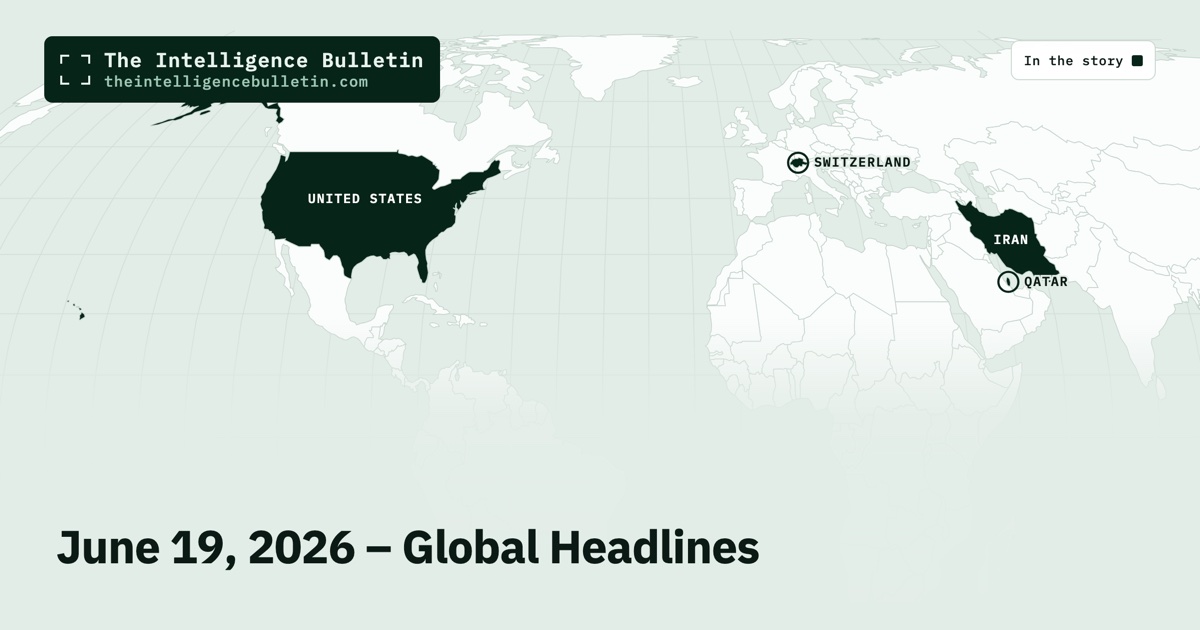
June 19, 2026 – Global Headlines

Map of the countries in the story: June 19, 2026 – Global Headlines

1Vance Cancels Switzerland Trip for Iran Nuclear Talks

Map of the countries in the story: June 19, 2026 – Global Headlines
Story gist: On June 19 2026 the White House announced that Vice President JD Vance would not travel to Switzerland for planned meetings with Iranian negotiators on the nuclear deal. Officials attributed the decision to logistical issues during ongoing diplomacy that follows Qatari mediation and recent drone incidents in the Strait of Hormuz. The postponement occurs as Washington and Tehran continue efforts to finalize a framework amid prior US-Iran tensions.
One Story. Many Angles.
🇺🇸
United States
nypost.com
JD Vance scraps overnight flight to Switzerland for first round of nuclear talks with Iran
Read →
🇮🇱
Israel
jpost.com
JD Vance won’t fly to Switzerland, meetings with Iran in doubt
Read →
🇸🇦
Saudi Arabia
arabnews.com
Vance not flying Thursday night to Switzerland for Iran talks: White House
Read →
Perspective Analysis

The postponement of Vance’s flight underscores how fragile the current US-Iran channel remains even after weeks of Qatari shuttle diplomacy. New York Post coverage centers on the abrupt cancellation itself and the domestic optics for the vice president, treating the event as a straightforward scheduling failure. Jerusalem Post instead stresses the resulting uncertainty for the talks, framing the delay against Israel’s longstanding concerns over any US-Iran understanding that might leave regional security questions unresolved. Arab News places the same announcement in a Gulf context, noting how any slowdown affects Riyadh’s calculations about Iranian leverage and potential sanctions relief. Across these accounts the factual core stays consistent, yet each outlet’s emphasis reveals the different stakes it sees in whether the diplomacy advances or stalls. Prior coverage of drone downings and Trump’s public defense of the emerging deal shows the pattern: every incremental step is immediately tested by competing regional priorities that make even a logistical hitch read as a signal.


2Khamenei Approves US-Iran Nuclear Framework Despite Initial Doubts

Story gist: On June 18 2026 Iran’s Supreme Leader Ali Khamenei publicly endorsed a memorandum of understanding with the United States on nuclear talks. The approval followed weeks of Qatari mediation after US forces downed Iranian drones in the Strait of Hormuz. Tehran framed the endorsement as decisive backing while Washington signaled a 60-day timeline and lifted port restrictions. The move comes amid ongoing Trump warnings that any deal must withstand Iranian compliance risks.
One Story. Many Angles.
🇮🇷
Iran
presstv.ir
President Pezeshkian: Leader’s message guarantees Iran’s great victory in upcoming negotiations
Read →
🇺🇸
United States
wnyc.org
U.S. lifts blockade on Iranian ports as 60-day clock for a final deal starts ticking
Read →
🇺🇸
United States
foxwilmington.com
Trump Iran framework gambles on diplomacy despite warning Tehran will lie and cheat
Read →
Perspective Analysis

Khamenei’s endorsement marks the clearest public signal yet that Tehran is prepared to lock in the framework even after earlier resistance. Iranian state media immediately cast the statement as a decisive guarantee of national victory, turning the Supreme Leader’s reluctant shift into proof of strength rather than concession. US coverage split along familiar lines. One outlet highlighted the practical mechanics of a 60-day clock and the immediate relief of lifted port restrictions, treating the story as the start of an implementation phase rather than a political breakthrough. Another outlet led with Trump’s explicit caution that Tehran will lie and cheat, presenting the diplomacy as a calculated gamble whose success hinges on verification that has repeatedly failed before. This divergence is not accidental. Iranian reporting must demonstrate that the Leader’s word overrides any domestic skepticism. American conservative framing must remind readers that past nuclear diplomacy produced unverifiable commitments. The public-radio emphasis on timelines and blockade relief reflects a narrower institutional focus on measurable next steps. The underlying continuity is that the same sequence of drone incidents, frozen-asset threats, and Qatari shuttling has now produced a document whose durability remains the only real question.


3US Backs Venezuela Talks Between Figuera and Rodríguez

Story gist: On 2026-06-19 the US State Department endorsed political dialogue in Venezuela after a Caracas meeting between opposition figure Dinorah Figuera and Chavista leader Jorge Rodríguez. Washington called the talks an opening for democratic transition. The three sources report the same encounter yet differ in emphasis on who initiated it and what it means for institutions.
One Story. Many Angles.
🇺🇸
United States
diariolasamericas.com
Dinorah Figuera returns to Venezuela and opens political dialogue channel with Chavismo
Read →
🇻🇪
Venezuela
radiomundial.com.ve
President Jorge Rodríguez and Dinorah Figuera begin dialogue table
Pdte. Jorge Rodríguez y Dinorah Figuera inician mesa de diálogo
Read →
🇻🇪
Venezuela
correodelcaroni.com
Dinorah Figuera returned to Venezuela: “I am assuming an invitation from the State Department”
Read →
Perspective Analysis

All three outlets treat the Rodríguez-Figuera encounter as a concrete event rather than speculation, which itself signals that both sides see value in publicizing contact at this moment. Diariolasamericas frames Figuera’s return from exile as the central development, consistent with a Miami readership attuned to opposition figures re-entering the country. Correodelcaroni quotes Figuera directly crediting the State Department invitation, underscoring the US role that opposition readers in Venezuela often highlight when dialogue surfaces. Radiomundial, by contrast, leads with Rodríguez as institutional authority and presents the table as a routine strengthening of National Assembly processes. The shared factual core—two named politicians met, the United States commented positively—reveals that no outlet is denying the meeting occurred or inventing US involvement; the divergence lies only in which actor is cast as the protagonist. This convergence on the basics across exile, regional opposition, and state media suggests the dialogue channel carries enough weight that each side prefers to shape its meaning rather than suppress the story.


4Meloni Rejects Trump Photo Claim, Italy Cancels US Trip

Story gist: On 19 June 2026 Italian Foreign Minister Antonio Tajani cancelled his planned visit to the United States after Prime Minister Giorgia Meloni publicly rejected Donald Trump’s claim that she had begged him for a photograph. Meloni described the remarks as invented. Tajani stated on X that the comments offended Italy. The episode occurred as US-Iran nuclear talks remained the dominant focus of transatlantic diplomacy.
One Story. Many Angles.
🇪🇸
Spain
lavanguardia.com
Trump offends Meloni and the prime minister responds harshly
Read →
🇭🇰
Hong Kong
scmp.com
Italian minister cancels US trip after Trump claims Meloni begged him for photo
Read →
🇬🇧
United Kingdom
dailymail.com
Furious Giorgia Meloni slaps down Trump lies and takes a swipe at his relationship with enemies of the West
Read →
Perspective Analysis

The episode registers less as a bilateral crisis than as a brief assertion of Italian dignity inside a week dominated by US-Iran negotiations. What stands out across the three outlets is how little any of them treat the cancellation itself as the central event; instead each uses the spat to illustrate something larger about Meloni’s posture. La Vanguardia lingers on the personal sharpness of her rebuttal, framing it as a domestic political necessity for a leader whose coalition includes figures wary of appearing too close to Washington. South China Morning Post records the same facts but places the cancelled trip at the centre, presenting the move as evidence that even minor personal friction can disrupt scheduled diplomacy when both sides are already managing far more consequential files. The Daily Mail goes furthest, folding Meloni’s denial into a broader swipe at Trump’s reported ties to adversaries, thereby turning the story into another data point in its running narrative of Western cohesion under strain. The convergence on the core sequence—Trump spoke, Meloni answered, Tajani stayed home—suggests the outlets see the same limited diplomatic cost; the divergence lies in which audience each outlet believes needs reminding that personal slights still register in Rome even while nuclear talks proceed elsewhere.


5Iran Ties US Peace Deal to Full Israeli Withdrawal from Lebanon

Story gist: On 2026-06-18 Iran’s foreign ministry declared the preliminary US peace agreement void unless Israel withdraws completely from southern Lebanon. Israel’s government responded that it will maintain troops in a 10-km buffer zone inside Lebanon. The condition directly links the bilateral deal’s future to Israeli actions toward Hezbollah’s operating area. Netanyahu’s rejection underscores the immediate obstacle facing the agreement reached after recent Strait of Hormuz clashes.
One Story. Many Angles.
🇮🇱
Israel
israelnationalnews.com
Netanyahu: We will not leave southern Lebanon
Read →
🇹🇷
Turkey
aa.com.tr
Despite US-Iran deal, Israel says troops to remain in 10-km zone inside Lebanon
Read →
🇨🇴
Colombia
eltiempo.com
Iran puts the peace agreement signed with the United States in doubt and warns that it will be null if Israel does not fully withdraw from southern Lebanon
Iran puts the peace agreement signed with the United States in doubt and warns that it will be ‘null’ if Israel does not fully withdraw from southern Lebanon
Read →
Perspective Analysis

The most striking element is how uniformly the outlets treat Iran’s withdrawal demand as the central new fact, yet each selects a different actor to foreground as the obstacle. Israel National News leads with Netanyahu’s flat refusal, presenting the Israeli position as the decisive and non-negotiable stance that closes the matter. Anadolu Agency instead details Israel’s operational plan for a permanent 10-km zone, framing the story around the concrete military footprint that would remain even after a US-Iran accord. El Tiempo, by contrast, centers Iran’s explicit threat to nullify the deal, casting the conditional language itself as the active diplomatic lever. These choices track national vantage points: the Israeli outlet reports government resolve, the Turkish outlet registers the buffer zone as a regional security fact, and the Colombian outlet registers the Iranian condition as the variable that could still unravel the agreement. The pattern reveals less disagreement over facts than over which capital’s next move is treated as the story’s hinge. Continuity with earlier TIB reporting on postponed US-Iran talks in Switzerland makes the Lebanon linkage appear as the latest external constraint inserted into a process already marked by sequential delays and third-party mediation.


June 18, 2026 – Global Headlines

Map of the countries in the story: June 18, 2026 – Global Headlines

1Trump Defends Iran Deal as G7 Leaders Signal Support

Map of the countries in the story: June 18, 2026 – Global Headlines
Story gist: On June 18 2026 at the G7 summit near Versailles, President Trump publicly defended the US-Iran nuclear agreement while G7 partners expressed backing. The deal follows weeks of Qatari mediation and recent US-Iran clashes in the Strait of Hormuz. Key tension centers on Iranian access to roughly $300 billion in previously frozen assets versus assurances on nuclear limits and regional security. Trump rejected Israeli requests to review the text beforehand.
One Story. Many Angles.
🇺🇸
United States
foxnews.com
Trump Defends Iran Deal at G7
Read →
🇺🇸
United States
arkansasonline.com
G7 leaders back Iran agreement
Read →
Perspective Analysis

Fox News opens by highlighting the financial windfall for Iran, framing Trump’s defense as an exercise in semantics that downplays how the deal unlocks substantial funds Tehran could redirect. Arkansas Online instead leads with the collective G7 endorsement, treating the summit consensus itself as the central development rather than the domestic arguments over terms. This split reflects deeper structural incentives: Fox’s opinion format rewards scrutiny of any perceived concession to Iran given its conservative readership and long-standing editorial line on sanctions relief, while the regional paper draws on wire reporting that privileges the multilateral setting where the announcement occurred. The pattern echoes earlier TIB coverage of the same negotiations, where US outlets split between emphasizing Trump’s unilateral authority and the need for allied buy-in to make any agreement durable. Neither source lingers on the physical location at Versailles or the presence of other leaders such as Macron or Modi, suggesting the story’s gravitational pull remains the bilateral US-Iran axis rather than the broader summit choreography. What stands out is how little daylight exists on the basic facts of the signing itself; the divergence is almost entirely about which constituency each outlet assumes must be convinced next.


2Trump Signs US-Iran Deal at Versailles, Thanks Xi and Putin

Story gist: On June 17 2026 Donald Trump signed a US-Iran agreement at the Palace of Versailles with Emmanuel Macron present. The deal followed Qatari mediation in Tehran and recent US downing of Iranian drones in the Strait of Hormuz. Trump publicly credited Chinese and Russian neutrality for enabling the outcome. Washington and Tehran both confirmed the memorandum had entered into force.
One Story. Many Angles.
🇺🇸
United States
benzinga.com
Trump Thanks Xi And Putin For Staying Totally Neutral During Iran Conflict
Read →
🇮🇳
India
indianexpress.com
How Trump walked back months of war claims to seal 14-point Iran deal
Read →
🇵🇰
Pakistan
samaa.tv
China welcomes US-Iran MoU, urges all parties to respect commitments
Read →
Perspective Analysis

The sudden appearance of the signed text at Versailles after weeks of drone strikes and frozen-asset warnings reveals how quickly the confrontation cooled once mediators reached Tehran. Benzinga captured Trump’s explicit thanks to Xi Jinping and Vladimir Putin for remaining neutral, framing the moment as a Washington success that avoided wider entanglement. Indian Express instead highlighted the reversal itself, noting how Trump walked back months of strike threats to accept a 14-point memorandum whose text he had refused to share with Israel. Samaa TV, reporting from Pakistan, led with Beijing’s welcome and its call for all parties to honor commitments, underscoring that enforcement now rests partly on Asian capitals rather than solely on the signatories. The convergence across these outlets shows the deal’s durability is already being measured less by its clauses than by whether Russia, China, and regional neighbors treat it as binding. That test began the same day the ink dried.


3Modi and Trump Discuss Trade, Defence at G7 Summit

Story gist: On 17 June 2026 Prime Minister Narendra Modi met President Donald Trump on the G7 sidelines in Evian, France. They addressed West Asia, an interim India-US trade deal, and cooperation in defence, strategic technologies, energy and trade, per India’s Ministry of External Affairs. The encounter unfolded while G7 leaders finalised a US-Iran nuclear agreement. Indian coverage stressed bilateral security and commercial gains.
One Story. Many Angles.
🇮🇳
India
prokerala.com
G7 Summit: PM Modi, Prez Trump discussed West Asia, India-US trade deal & bilateral cooperation across sectors: MEA
Read →
🇮🇳
India
dailypioneer.com
Modi–Trump Meet at G7 Summit 2026: India-US Talks on Defence, Maritime Security & West Asia
Read →
🇮🇳
India
divyabhaskar.co.in
G7 Summit: Trump Says US Stands With India If Attacked Under Modi
Read →
Perspective Analysis

Indian reporting on the Modi-Trump encounter at Evian consistently presents it as a platform for concrete bilateral deliverables even as the larger G7 agenda centred on the US-Iran deal. Prokerala.com hewed closely to the Ministry of External Affairs readout, listing trade progress and sector-wide cooperation without embellishment. Daily Pioneer shifted the emphasis to defence and maritime security, reflecting New Delhi’s long-standing priority on protecting Indian Ocean sea lanes amid ongoing Gulf tensions. Divya Bhaskar alone foregrounded Trump’s reported assurance that the United States would stand with India if attacked, injecting a personal security guarantee absent from the official summary. The shared decision across all three outlets to treat the bilateral meeting as an independent success story, rather than a footnote to the Iran agreement, reveals how Indian editors see the G7 primarily as an arena for advancing US-India defence and commercial ties. This framing aligns with India’s recent pattern of extracting tangible commitments from Washington while the United States pursues separate Middle East diplomacy. The absence of any reference to friction over the Iran text further underscores the priority placed on insulating the bilateral relationship from contemporaneous multilateral outcomes.


4Pope Leo XIV Welcomes US-Iran Deal at Vatican Audience

Story gist: On June 17 2026 Pope Leo XIV addressed his general audience in St. Peter’s Square and praised the newly signed US-Iran agreement. He stated it would strengthen trust security and stability in the Middle East while thanking mediating countries. The remarks follow weeks of US-Iran tensions including drone incidents and precede further G7 discussions on the pact.
One Story. Many Angles.
🇹🇷
Turkey
aa.com.tr
Pope Leo stresses need for US-Iran deal to enhance security, stability across Middle East
Read →
🇮🇹
Italy
zazoom.it
Iran: Pope Leo XIV positive on US-Tehran agreement
Iran Pope Leo XIV positive on agreement between United States and Tehran
Read →
🇦🇿
Azerbaijan
azertag.az
Pope welcomes Iran-USA agreement
Read →
Perspective Analysis

The Pope’s brief public endorsement arrived exactly as the US-Iran memorandum moved from Qatari-mediated talks in Tehran to formal signature at the G7 in France, turning a religious platform into an unexpected diplomatic amplifier. Turkish coverage through aa.com.tr framed the statement around concrete regional security gains, reflecting Ankara’s direct stake in containing spillover from the Strait of Hormuz incidents reported earlier in June. Italian outlet zazoom.it, situated near the Vatican, simply registered the Pope’s positive tone toward the United States and Tehran without additional regional gloss, underscoring geographic proximity rather than policy emphasis. Azerbaijan’s azertag.az limited itself to noting the welcome itself, consistent with a South Caucasus vantage that tracks great-power deals mainly for their effect on energy corridors and Russian-Iranian alignments. Across these accounts the common thread is the absence of skepticism: outlets from three different neighborhoods all treated the papal words as a straightforward diplomatic signal rather than a moral intervention, revealing how quickly the deal has shifted from contested flashpoint to accepted fact in capitals far from Versailles.


5Trump Warns Iran Deal Not Final, Threatens Renewed Strikes

Story gist: On 2026-06-17 US President Donald Trump stated during a meeting with Egyptian President Abdel Fattah al-Sisi that the nuclear arrangement with Iran was not final. He warned that if the United States disliked the outcome it would resume striking Iran. The comments were made as G7 leaders gathered in France to address the pact. This follows recent mediation and drone incidents between the two countries.
One Story. Many Angles.
🇮🇱
Israel
israelnationalnews.com
Trump: Deal not final, we can go back to dropping bombs on their heads
Read →
🇹🇷
Turkey
aa.com.tr
Trump says Iran pact not final warns of renewed strikes
Read →
🇩🇪
Germany
dw.com
Trump threatens Iran again
Read →
Perspective Analysis

The most striking element across coverage is how uniformly outlets treat Trump’s threat of renewed strikes as the live variable rather than the pact itself. Israel National News leads with the direct military phrasing “dropping bombs on their heads,” reflecting Israel’s security calculus that any US-Iran understanding remains subordinate to Tehran’s nuclear timeline. Anadolu Agency, by contrast, foregrounds the diplomatic status of the pact and Qatari mediation efforts still underway, consistent with Turkey’s regional interest in avoiding another round of Gulf escalation that could affect its own energy and refugee calculations. Deutsche Welle’s Swahili headline “Trump threatens Iran again” places the emphasis on recurrence, underscoring European concerns that Washington’s unilateral signaling could unravel the multilateral sanctions framework painstakingly rebuilt since 2018. Despite tonal differences the three accounts converge on the same underlying fact: the memorandum initialed at Versailles is treated by the US president as reversible. That convergence itself signals the structural reality that no regional actor yet regards the deal as durable enough to alter force posture or sanctions exposure. The June 13–17 progression from US drone intercepts in the Strait of Hormuz to this latest warning shows the pattern of kinetic pressure followed by verbal recalibration that has defined the current cycle.


June 17, 2026 – Global Headlines

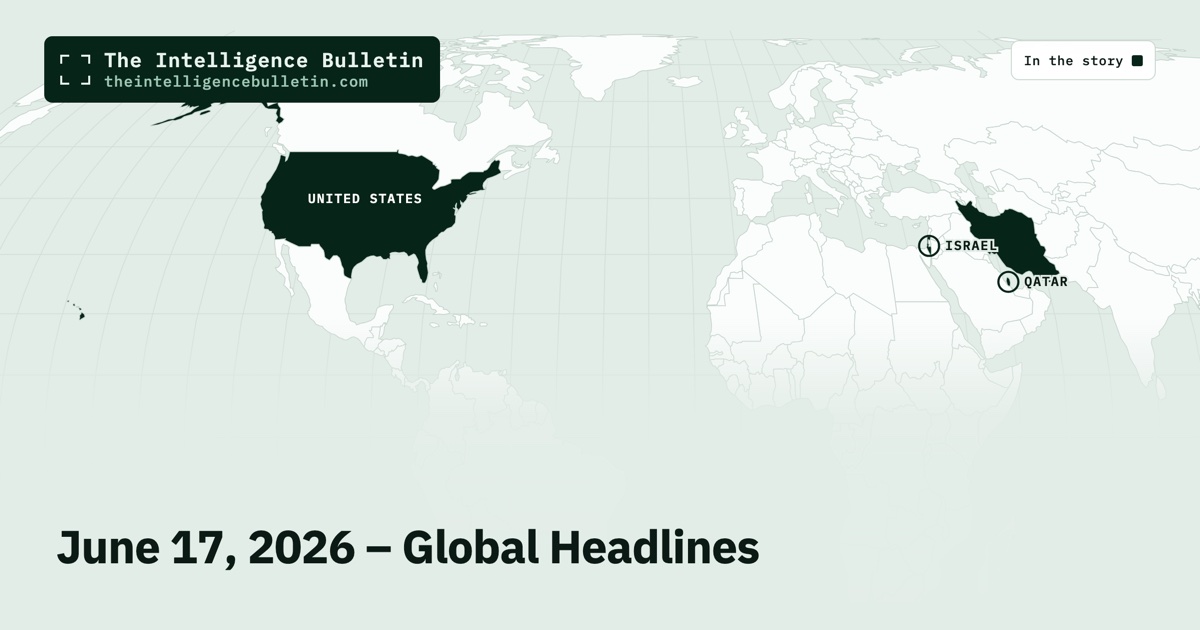
Map of the countries in the story: June 17, 2026 – Global Headlines

1Trump Rejects Israeli Request to Review US-Iran Deal Text

Map of the countries in the story: June 17, 2026 – Global Headlines
Story gist: On June 16 2026 at the G7 summit in Évian-les-Bains, President Trump rejected Israel’s request to review the text of a US-Iran memorandum of understanding before signing. He stated he would instead read the agreement aloud in public. The move comes amid ongoing US-Iran diplomacy following recent drone incidents and follows Qatari mediation efforts in Tehran. Israel has voiced objections over lack of prior consultation.
One Story. Many Angles.
🇮🇱
Israel
jpost.com
Fox News host Mark Levin condemns Donald Trump over deal with Iran, calls to relase MOU
Read →
🇺🇸
United States
theweek.com
Trump’s Iran deal draws scrutiny in US, ire in Israel
Read →
🇺🇸
United States
newrepublic.com
Transcript: Trump Tirade on Iran Deal Accidentally Reveals It’s a Sham
Read →
Perspective Analysis

Trump’s blunt refusal to share the draft text with Israel before public release exposes a deliberate choice to keep both allies and domestic critics at arm’s length during sensitive nuclear talks. Israeli coverage, led by the Jerusalem Post, immediately channeled that friction into domestic US pressure by spotlighting Mark Levin’s demand for full disclosure, treating the episode as evidence that Washington is again sidelining Jerusalem on Iran policy. American outlets split along familiar lines: The Week framed the episode as simultaneous scrutiny at home and anger in Israel, underscoring the diplomatic cost of opacity, while The New Republic used a leaked transcript to argue that Trump’s own words inadvertently confirm the deal’s weaknesses. The convergence on facts is therefore less revealing than the divergence in emphasis—Israeli reporting treats transparency as the core alliance issue, whereas US commentary quickly folds the story into arguments about Trump’s credibility. This pattern echoes earlier phases of the same diplomacy, where Washington’s tactical surprises repeatedly left regional partners reacting rather than shaping outcomes.


2G7 Hosts Zelenskyy as Trump Urges Deal With Russia

Story gist: On 16 June 2026 Ukrainian President Zelenskyy joined G7 leaders for a working session in Evian-les-Bains, France. He pressed for continued measures to force Russia to end its war. US President Trump stated that Russia should make a deal and shifted focus to Ukraine. European participants discussed how best to align Trump’s approach with sustained pressure on Moscow.
One Story. Many Angles.
🇺🇦
Ukraine
kyivpost.com
G7 Powers Push Russia to End Ukraine War
Read →
🇩🇪
Germany
abendblatt.de
G7: Europeans rely on Trump’s vanity with a specific goal
Read →
🇺🇸
United States
breitbart.com
Trump Says ‘Russia Should Make a Deal’, His Focus Now on Ukraine
Read →
Perspective Analysis

At Evian the most visible split was not between East and West but between those still framing the war as a test of resolve and those treating it as a negotiation that must close soon. Kyiv Post reported the summit as G7 powers pushing Russia toward capitulation, reflecting Ukraine’s need to keep sanctions and arms flows intact. Abendblatt instead described European leaders deliberately courting Trump’s personal style, calculating that flattery could lock him into continued support without conceding core demands. Breitbart captured the counter-view directly from Trump himself, quoting his insistence that Russia should simply make a deal and presenting Ukraine policy as now secondary to that transaction. The three readings sit on the same facts yet reveal different clocks: one measures months of leverage remaining, another measures the attention span of a single US president, and the third measures time until a signature. What the coverage collectively shows is that the G7 no longer presents a united front even to its closest partner; the Europeans are improvising around Washington rather than leading it, while Kyiv watches to see which version of American impatience prevails.


3Iran Conditions US Deal on Full Israeli Withdrawal from Lebanon

Story gist: On 2026-06-16 Iran’s foreign minister Abbas Araghchi said in Dubai that any US-Iran agreement ending direct conflict requires Israel to withdraw from southern Lebanon. Prime Minister Benjamin Netanyahu immediately rejected the demand. The condition was presented as non-negotiable by Tehran even as Israeli forces remain deployed inside Lebanon following earlier operations against Hezbollah.
One Story. Many Angles.
🇺🇸
United States
democracynow.org
Israel’s Netanyahu Says He Won’t Withdraw from Lebanon, Defying Terms of U.S. Deal with Iran
Read →
🇸🇦
Saudi Arabia
english.aawsat.com
Iran Races against Lebanese Negotiators to Secure Israeli Withdrawal from South
Read →
🇬🇧
United Kingdom
theguardian.com
Iran’s top envoy says peace deal with the US dependent on Israel’s withdrawal from Lebanon
Read →
Perspective Analysis

The most striking element is how little the coverage treats the withdrawal demand as a sudden Iranian escalation and how consistently it is framed instead as an explicit Iranian precondition already known to Washington. Democracy Now leads with Netanyahu’s flat refusal, casting the story as Israeli rejection of terms Washington had already accepted in principle. Asharq Al-Awsat, by contrast, stresses Tehran’s hurry to lock in the withdrawal before Lebanese negotiators can dilute it, revealing Riyadh’s interest in limiting Iranian influence inside Lebanon’s domestic bargaining. The Guardian stays closest to Araghchi’s wording and timeline, underscoring that the condition was delivered publicly from Dubai rather than through back channels. These differences are not contradictions; they reflect each outlet’s audience expectations about where the real leverage now sits—Washington’s willingness to press Israel, Tehran’s competition with Beirut, or simply the mechanics of an emerging bilateral understanding. The reporting convergence on the Dubai venue and Araghchi’s direct attribution suggests the statement was deliberately surfaced to test whether the United States will treat Lebanese withdrawal as a red line or a bargaining chip.


4Rutte Urges Europe to Raise NATO Spending at G7

Story gist: At the G7 summit in Evian-les-Bains on June 16 2026, NATO Secretary General Mark Rutte called on European members to increase defense spending as the alliance renegotiates burden-sharing. The appeal coincided with G7 moves to tighten sanctions on Russian oil exports. Trump signaled readiness to restore prior U.S. sanctions on Russian energy. European leaders linked higher spending directly to sustaining support for Ukraine.
One Story. Many Angles.
🇮🇹
Italy
ilsole24ore.com
Rutte urges Europe on NATO spending. On Ukraine: Trump plays a very positive role
Rutte sprona l’Europa sulla spesa Nato
Read →
🇩🇪
Germany
epochtimes.de
NATO renegotiates its future – European states should close US gaps
Die NATO verhandelt ihre Zukunft neu
Read →
🇵🇱
Poland
wiadomosci.wp.pl
There will be new steps. Zelenski revealed after the G7 summit
Będą nowe kroki. Zełenski ujawnił po szczycie G7
Read →
Perspective Analysis

Italian coverage in Il Sole 24 Ore treats Rutte’s intervention as a pragmatic nudge rather than a rebuke, highlighting his explicit praise for Trump’s “very positive” role in pressing for results on Ukraine. This framing reflects Rome’s interest in keeping Washington engaged without reopening old transatlantic wounds. German reporting from Epoch Times steps back from personalities and presents the moment as structural: NATO is rewriting its internal compact, with European states expected to fill capability gaps left by any U.S. rebalancing. The emphasis on institutional redesign over immediate spending targets mirrors Berlin’s preference for predictable, rules-based adjustments. Polish outlet WP.pl folds the same statements into Zelensky’s post-summit readout, stressing forthcoming concrete steps on sanctions and weapons rather than alliance architecture. The difference is geographic: Warsaw reads every G7 utterance through the narrow lens of immediate battlefield effects on Ukraine’s eastern flank. Across all three, the underlying convergence is that European NATO capitals now treat increased spending as inevitable, yet each capital anchors that inevitability to its own most pressing bilateral relationship with Washington or Kyiv.


5EU Parliament Approves External Return Hubs for Deported Migrants

Story gist: On 17 June 2026 the European Parliament in Strasbourg voted to establish return hubs outside the EU for migrants facing expulsion. The centres, located in designated safe third countries and partly funded by Brussels, will hold deportees pending final removal to their origin or another state. The measure tightens existing rules after years of stalled reforms. Italy, France and Spain all reported the outcome within hours, each foregrounding different aspects of the same decision.
One Story. Many Angles.
🇮🇹
Italy
ansa.it
Final European Parliament go-ahead for tighter repatriations
Via libera finale dell’Eurocamera alla stretta sui rimpatri
Read →
🇫🇷
France
humanite.fr
Accelerated expulsions and detention centres outside the EU: European Parliament hardens migrant policy once again
Accélération des expulsions, centres d’enfermement installés en dehors l’UE… Le Parlement européen durcit une énième fois sa politique envers les exilés
Read →
🇪🇸
Spain
publico.es
EU approves rules allowing migrant deportation centres in third countries
La UE aprueba el reglamento que permite crear centros de deportación de migrantes en terceros países
Read →
Perspective Analysis

The three outlets treat the Strasbourg vote as settled fact rather than contested drama, yet their emphasis reveals how proximity to the Mediterranean shapes coverage. ANSA leads with the procedural milestone, recording the final green light in the Eurocamera without dwelling on conditions inside the future hubs. Público, by contrast, isolates the regulatory change that explicitly permits deportation infrastructure in non-EU territory, reflecting Spain’s long experience with bilateral readmission deals in West Africa. L’Humanité goes furthest, framing the hubs as another incremental hardening that relocates detention beyond European soil. What unites them is the absence of any claim that the policy is novel; all three present it as the latest tightening of a trajectory already visible in the 2018-2024 files. That convergence suggests the external-hub model has crossed a threshold where even left-leaning outlets no longer treat it as fringe. The real divergence lies in geography of concern: Italian reporting stays inside the chamber, Spanish reporting tracks the border that will now stretch southward, and French reporting questions the moral geography of moving the fence itself.