 AI-generated analysis published under the editorial responsibility of Rohit Sinnas. How it works →
Press quoted
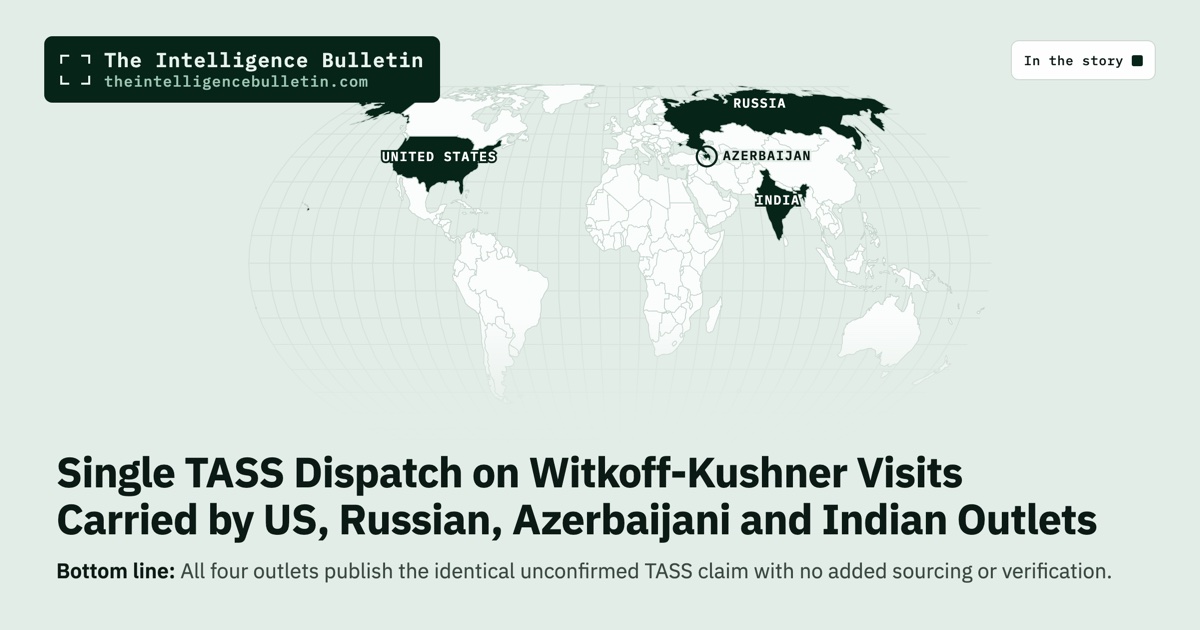
All four outlets publish the identical unconfirmed TASS claim with no added sourcing or verification.
Every selected outlet rests on one anonymous TASS source and adds nothing independently verified. Political Wire and Moneycontrol both route the item through Bloomberg, framing it as a potential revival of US-mediated talks after earlier efforts stalled and attention shifted to the Middle East. Moscow 24 treats the same TASS line as routine scheduling news, embedding it among domestic Russian stories and pairing it with prior remarks by Trump and Kremlin spokesman Peskov. APA presents the dispatch as relevant Caucasus diplomatic rumor, noting a Zelenskyy call with the two men last month but recording the absence of any official comment. The pattern reveals a single reporting chain dressed in four national mastheads, with differences limited to which background paragraph each editor chose to attach.
Full analysis
The Russian state news agency TASS reported on August 8 that special envoy Steve Witkoff and Jared Kushner may travel to Kyiv and Moscow within seven to ten days, citing an unnamed source. No confirmation came from the White House or the two men themselves. Every one of the four outlets that carried the item published the same core claim from that single dispatch.
Political Wire opened its short post with the headline “Trump Envoys May Visit Kyiv, Moscow Next Week” and attributed the information directly to Bloomberg’s summary of the TASS report. The text stated that the possible trip would mark a renewed push by Trump’s two main intermediaries after earlier negotiations to end the conflict stalled and the United States pivoted to the situation in the Middle East. It added that Witkoff and Kushner have visited Moscow several times for meetings with Russian President Vladimir Putin and other top officials but have yet to visit Kyiv. The White House did not immediately respond to a request for comment, the post noted.
Moneycontrol ran the story under the headline “Witkoff, Kushner may visit Kyiv and Moscow soon, Tass says.” Its account followed the identical Bloomberg relay, repeating the seven-to-ten-day window and the context of stalled talks after a pivot to the Middle East. It listed the same detail on prior Moscow visits and the absence of any Kyiv visit, and it recorded that the White House did not immediately respond. The piece placed the item in its world news section with a business-oriented framing that highlighted Washington’s effort to revive the Russia-Ukraine peace talks.
Moscow 24 carried the dispatch under a Russian-language headline that led with the Moscow leg: “Уиткофф и Кушнер могут посетить Москву на следующей неделе – СМИ.” The article opened by naming the TASS source and quoting the unnamed official’s estimate of a week to ten days. It embedded the item among other Russian domestic stories and added two paragraphs of background drawn from earlier public statements: Trump had said progress had been reached on resolving the Russian-Ukrainian conflict, and Kremlin spokesman Dmitry Peskov had noted Moscow’s perception of a sincere American desire for a solution and its readiness to receive new ideas. The piece did not amplify the item or move it to a prominent position on the homepage.
APA published the story under the English headline “Witkoff, Kushner may visit Moscow, Kyiv next week.” Its account cited TASS and repeated the seven-to-ten-day window. It added one new contextual sentence not present in the other three pieces: Ukrainian President Volodymyr Zelenskyy spoke with Witkoff and Kushner last month. The article closed by recording that there was no official comment from Witkoff and Kushner. It placed the item in its CIS-countries section and treated it as regional diplomatic news relevant to a Caucasus readership.
The four pieces therefore differ only in the background paragraphs each editor chose to attach to the identical TASS claim. Political Wire and Moneycontrol both foregrounded the stalled-talks narrative and the Middle East pivot. Moscow 24 supplied prior remarks by Trump and Peskov. APA alone mentioned the Zelenskyy contact from the previous month. None of the four added any reporting of its own, any on-the-record reaction, or any independent sourcing.
This pattern shows how a single anonymous dispatch moves through different national editorial filters. Each outlet selected the item for its audience—U.S. political readers, Indian business readers, Russian domestic news consumers, and Azerbaijani English-language readers of CIS developments—and supplied the one or two background sentences most likely to make the item feel locally relevant. The shared origin in TASS is stated explicitly in three of the four pieces and is the sole factual spine in all four.
The resulting coverage therefore tells a reader more about the editorial priorities of each masthead than about any new development on the ground. A reader who sees only the U.S. or Indian version receives emphasis on renewed American initiative. A reader who sees only the Russian version receives emphasis on continuity with existing Kremlin statements. A reader who sees only the Azerbaijani version receives the single additional detail of the recent Zelenskyy contact. None of those differences alters the underlying report, which remains one unnamed TASS source stating a possible schedule.
What to Watch
What the set makes visible is the limited reach of any single wire item once it leaves its originating agency. The dispatch travels intact, yet the surrounding sentences change its apparent weight and context according to the outlet’s location and audience. That is the concrete record the four articles produced on August 8.
That’s how the world told the story.
Get our daily open-source intelligence on world events in your inbox — one email a day, up to six stories.
Subscribe freeNo spam. One-click unsubscribe. See the latest email →