 AI-generated analysis published under the editorial responsibility of Rohit Sinnas. How it works →
Press quoted
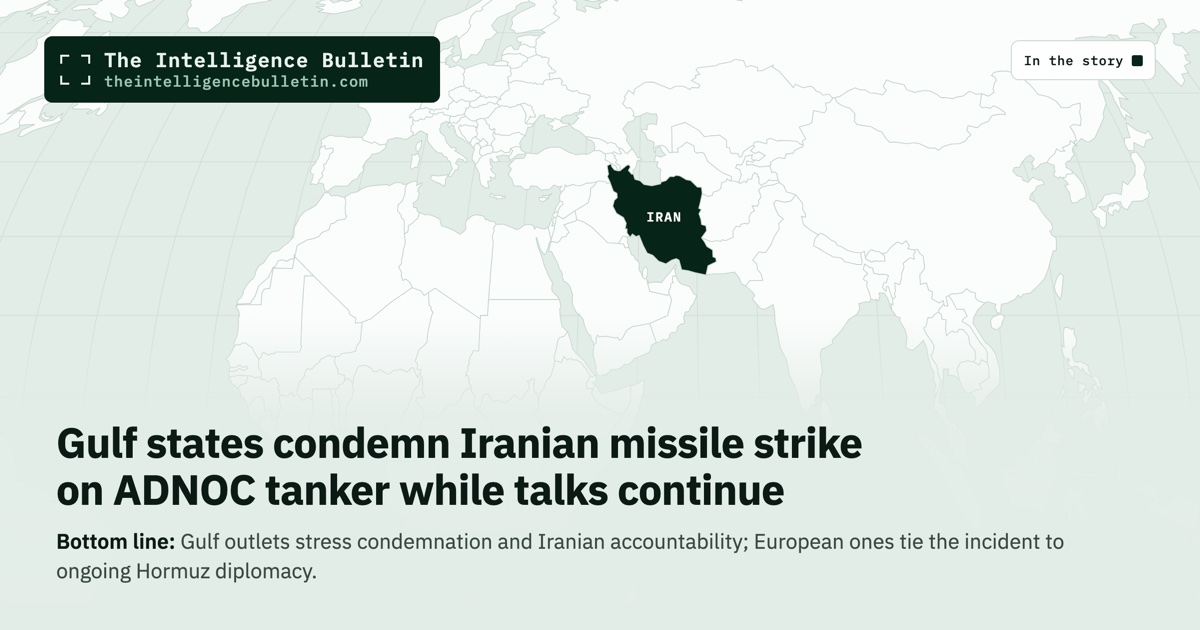
Gulf outlets stress condemnation and Iranian accountability; European ones tie the incident to ongoing Hormuz diplomacy.
The selected Gulf sources converge on the same core facts while each foregrounds its national stake: Qatar stresses freedom of navigation and regional economic risk; the UAE, as the vessel owner, frames the strike as direct aggression and piracy by Iran’s Revolutionary Guard; Saudi Arabia holds Iran accountable for broader consequences and renews solidarity with the UAE. Their statements appear nearly verbatim across outlets, indicating coordinated messaging rather than independent reporting chains. European coverage shifts the frame. Der Tagesspiegel highlights the UAE’s “hostile Iranian attack” phrasing in a liveblog, adding a neutral Western filter. Dagens Nyheter alone links the strike to continuing diplomatic talks, citing Oman’s negotiator that an agreement is near while noting Iran’s demand for US compensation. This produces a telling contrast: Gulf reporting treats the event as a discrete violation requiring immediate Iranian halt, whereas the Nordic piece embeds it in ongoing negotiations. No source supplies independent verification of the strike itself; all rely on official statements. The absence of any Iranian outlet from the set leaves the attacking party’s account unrepresented, so the reader sees only the recipients’ uniform condemnation and the European nod toward diplomacy.
Full analysis
An Iranian missile struck an ADNOC tanker belonging to the United Arab Emirates as the vessel transited the Strait of Hormuz on August 8, 2026. Statements from the affected governments reported no casualties. The three Gulf foreign ministries that addressed the incident described the strike as a violation of international law and of United Nations Security Council Resolution 2817, which addresses freedom of navigation. Each ministry demanded that Iran halt further attacks and that the strait be reopened without conditions. They expressed full solidarity with the United Arab Emirates and support for any measures it takes to protect its assets.
The United Arab Emirates foreign ministry statement, carried by the domestic outlet Emaratalyoum, called the action an aggressive Iranian attack and labeled the use of the strait as a pressure tool or economic extortion an act of piracy by Iran’s Revolutionary Guard. It framed the incident as a direct threat to regional stability, the people of the region, and global energy security. Qatar’s foreign ministry, reported in The Peninsula, condemned the attack on the Emirati tanker in similar terms, rejected any use of the strait as leverage, and warned that continued closure endangers the vital interests of regional states and the global economy. Saudi Arabia’s foreign ministry, in the account published by Okaz, held Iran responsible for the consequences of its attacks, described them as a serious breach of international laws and norms including the same Security Council resolution, and renewed its complete solidarity with the United Arab Emirates.
The Okaz article reproduced the full Qatar statement alongside the Saudi one, producing nearly identical language across the three Gulf outlets on the core demands and the reference to Resolution 2817. No outlet supplied independent confirmation of the missile launch itself; each relayed the official position of its government or, in the Saudi case, compiled the aligned positions of two governments.
Coverage outside the Gulf shifted the emphasis. The German liveblog published by Der Tagesspiegel recorded the Emirates’ description of a hostile Iranian attack and placed it in the context of sharply reduced shipping traffic through the strait that week. The Swedish daily Dagens Nyheter alone connected the incident to ongoing diplomatic efforts over the waterway. It cited Oman’s negotiator stating that talks were moving in a positive direction and that an agreement was near, while adding that Iran had conditioned any reopening on compensation from the United States for alleged breaches of an accord reached in June.
The selected sources therefore present a uniform account of the strike and the required response from the three Gulf governments, with only the Swedish report introducing the parallel track of negotiations. No Iranian account appears in the set. The event sits against the background of repeated Hormuz tensions, yet the reporting here isolates the tanker strike as a discrete incident rather than embedding it in a longer sequence of exchanges.
The Gulf statements converge on the factual spine: the missile hit an ADNOC tanker, no one was hurt, the action breached Resolution 2817, and the strait must reopen without preconditions. That convergence rests on three separate foreign-ministry releases issued the same day. Where the accounts diverge is in framing. The UAE statement, as the owner of the targeted vessel, supplies the strongest language of direct aggression and piracy. Qatar adds explicit warnings about global economic stakes. Saudi Arabia broadens the indictment to Iran’s pattern of attacks and assigns responsibility for future consequences. These differences reflect each capital’s immediate interest: the UAE speaks as the direct victim, Qatar as a state that relies on open transit for its own energy exports and regional positioning, and Saudi Arabia as a regional power that has repeatedly clashed with Iran.
The European and Nordic pieces do not contradict those facts. They simply omit the full condemnatory language and, in the Swedish case, supply the diplomatic counterpoint absent from the Gulf reports. Because the Swedish article alone cites the Omani negotiator, that element remains single-source within the set. The German liveblog records the UAE phrasing but does not expand on talks or on any Iranian position.
The corroborated record therefore shows three aligned Gulf governments treating the strike as an unambiguous breach that requires Iran to stop and to restore free passage. The single additional thread, carried only by Dagens Nyheter, indicates that at least one mediator sees room for negotiated reopening. A reader limited to any one Gulf outlet would miss the near-verbatim alignment across the three capitals and would receive no signal that talks were described as advancing elsewhere. A reader limited to the Swedish report would encounter the diplomatic note without the detailed condemnations that accompanied the event in the states most directly affected.
What to Watch
The Gulf accounts rest on official statements issued by the governments whose interests are most immediately engaged. That shared sourcing explains both their uniformity and their one-sided character. The absence of any Iranian outlet from the selected coverage means the reader encounters only the recipients’ version of the event. The Swedish reference to ongoing talks, drawn from an Omani source, suggests that at least some regional actors continue to treat the strait’s status as negotiable rather than solely as a matter for unilateral Iranian reversal. Whether that negotiation track produces movement will depend on whether the compensation demand cited in the Swedish report can be reconciled with the unconditional-reopening insistence contained in the three Gulf statements.
That’s how the world told the story.
Get our daily open-source intelligence on world events in your inbox — one email a day, up to six stories.
Subscribe freeNo spam. One-click unsubscribe. See the latest email →