 AI-generated analysis published under the editorial responsibility of Rohit Sinnas. How it works →
Press quoted
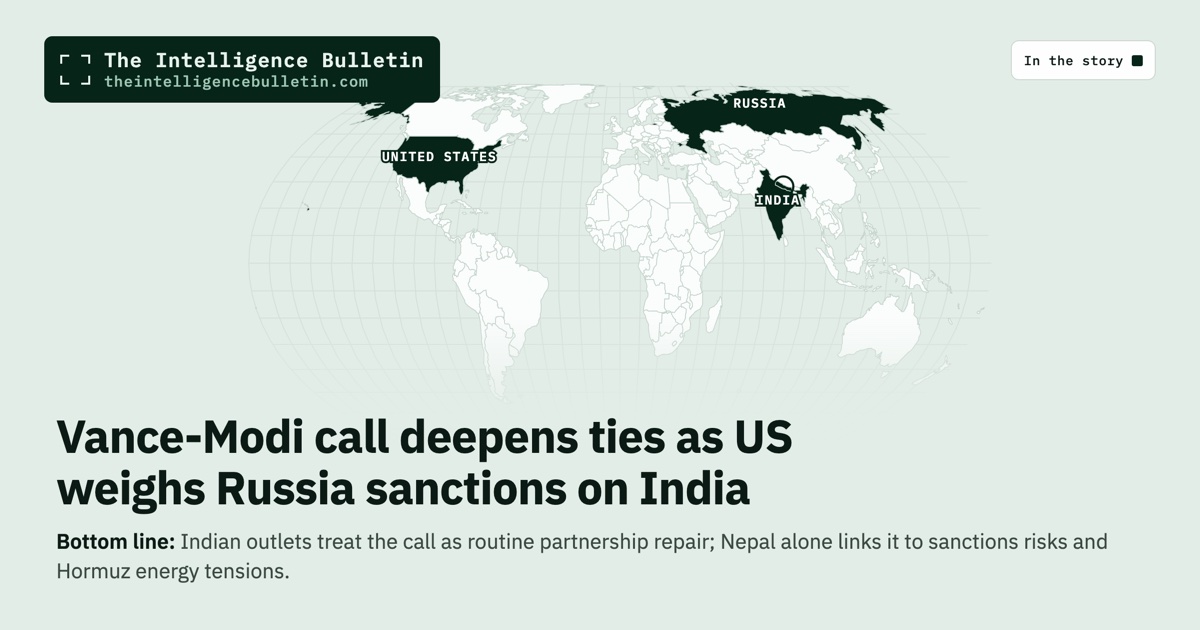
Indian outlets treat the call as routine partnership repair; Nepal alone links it to sanctions risks and Hormuz energy tensions.
Indian reporting from Business Today and Siasat presents the call as a standard step in repairing and expanding bilateral ties after earlier strains over tariffs and US claims on the 2025 India-Pakistan clashes. Both outlets quote Modi’s X post and the Indian readout on sustained momentum across defence, trade and emerging technologies, while noting the Turkiye-Saudi-Pakistan defence pact as background context for regional tensions. The Nepali outlet Online Khabar uses the same core facts from Modi’s statement but situates the conversation explicitly “amid rising regional tensions,” adding Vance’s separate remarks on Hormuz Strait talks with Iran and the US Senate’s passage of the Lindsey Graham sanctions bill that could impose up to 100 percent tariffs on major Russian oil purchasers including India. Where the Indian pieces treat the call as routine diplomacy aimed at a trade deal, the Nepali framing highlights energy-security stakes and external pressure on New Delhi’s Russian oil imports. All three rely on the same Indian-sourced details for the conversation itself; none carried independent US confirmation of topics discussed.
Full analysis
US Vice President JD Vance telephoned Indian Prime Minister Narendra Modi late on Saturday, August 8, 2026. Modi later posted on X that the two had discussed ways to further deepen the India-US Comprehensive Global Strategic Partnership across key areas. An Indian readout of the call said the leaders reviewed progress in the partnership, noted sustained momentum in high-level engagements, and reaffirmed commitment to strengthening cooperation in trade, defence, critical and emerging technologies, energy security and critical minerals. They also exchanged views on regional and global developments of mutual interest.
Modi used the call to congratulate Vance and Second Lady Usha Vance on the birth of their son and to convey best wishes to the family. The American side has not yet provided details of the conversation. It remains unknown whether the proposed India-US trade deal figured in the talks. Modi and President Donald Trump had instructed officials during their June meeting in France to work toward a balanced, mutually beneficial and commercially meaningful trade agreement at the earliest.
Indian reporting placed the call against a backdrop of rising tensions in West Asia and a new regional alignment marked by a mutual defence pact signed by Turkiye, Saudi Arabia and Pakistan. Both Business Today and Siasat described earlier strains in India-US ties, including punitive tariffs Washington imposed on India last year, Trump’s repeated public claims that he had helped de-escalate the India-Pakistan military clashes of May 2025, Washington’s new immigration policy and its decision to increase the H1B visa fee. New Delhi maintained that the cessation of hostilities resulted from direct talks between India and Pakistan and that the US had no role. In recent months both sides have sought to repair relations and move toward a trade deal.
The Nepali outlet Online Khabar reported the same core facts from Modi’s X post and the Indian readout but situated the conversation explicitly amid rising regional tensions. It added Vance’s separate remarks, made on Fox News’s Saturday in America program with Kayleigh McEnany, that the United States was in talks with Iran to ensure safe passage for commercial ships through the Hormuz Strait and maximum oil flow, that Iran had signaled willingness to allow the maximum volume of oil and gas out, yet Washington did not fully trust that commitment. The same article noted that the US Senate had passed the Lindsey O. Graham Sanctions Russia and Iran Act of 2026 on Friday by an 86-11 vote. The bill would allow President Trump to impose up to 100 percent additional tariffs on the top five purchasers of Russian oil or natural gas if needed, while also expanding sanctions on Putin, senior officials, financial institutions, energy projects and vessels suspected of evading existing restrictions. India and China rank among the leading buyers of discounted Russian crude since the 2022 invasion of Ukraine.
Business Today and Siasat, both Indian outlets, drew on the same official Indian statements and PTI copy. Their accounts foreground the bilateral effort to repair and expand ties after the earlier downturn and treat the call as a routine step in that process. Neither mentioned the Senate sanctions bill or Vance’s Hormuz comments. Online Khabar, reporting from Nepal, used the identical Indian-sourced details for the conversation itself while adding the sanctions legislation and Hormuz developments to underscore energy-security stakes for South Asia.
A reader limited to the Indian coverage would encounter a straightforward account of diplomatic repair and partnership expansion, with the Turkiye-Saudi-Pakistan pact noted as context but without reference to immediate legislative pressure on Russian oil purchases. A reader limited to the Nepali account would receive the same conversation details plus the concrete risk that the new Senate bill could force India into a choice between continued access to discounted Russian energy and avoidance of 100 percent US tariffs. No independent US confirmation of the call’s topics appeared in any of the three reports.
What to Watch
The corroborated elements—the fact of the call, the listed cooperation areas, and the personal congratulations—rest on Modi’s own X post and the Indian readout carried across all three outlets. The additional context supplied by Online Khabar supplies the pressure points that Indian reporting leaves implicit. India’s interest lies in presenting the relationship as steadily advancing toward a trade deal. Nepal’s interest lies in highlighting how US legislative moves and Hormuz tensions could constrain New Delhi’s energy options. The next developments to watch are whether the Senate bill advances to law and whether the proposed India-US trade talks accelerate or stall under that shadow.
That’s how the world told the story.
Get our daily open-source intelligence on world events in your inbox — one email a day, up to six stories.
Subscribe freeNo spam. One-click unsubscribe. See the latest email →